GENDER DIFFERENCES IN LEARNING OUTCOMES ON THE MOLE CONCEPT IN A DEVELOPING COUNTRY: KENYA
Nicholas Wanjala Twoli Janet B. Akala David W. Khatete
Kenyatta University Masinde Muliro University Kenyatta University
[email protected] [email protected] [email protected]
The gender gap that results from the differential treatment of boys and girls is still noticeable today in their achievement and participation in chemistry education in Kenya and perhaps in every other developing country. Due to its large concept map and sometimes theoretical nature, the Mole Concept has been recognized as one of the most difficult topics to teach and learn within the secondary school chemistry curriculum. The study compared male and female form four secondary school students’ learning outcomes in Mole Concept area of chemistry in Kakamega County, Kenya. The sample consisted of 384 students randomly selected from the three school types: mixed, boys and girls. Two instruments were used viz: Mole Concept Students Attitude Scale (MCSAS) and the Mole Concept Achievement Test (MCAT). Data collected were analysed using t-test. The findings of the research showed that there were significant differences between male and female students in overall chemistry achievement (t = 4.409, p < 0.05) and attitude to science (t = 0.387, p < 0.05). The absolute t-values for spatial and mathematical items 4.780 (p < 0.05) and 4.094 (p < 0.05) respectively were highly significant with boys performing better than girls. It is therefore recommended among others that teachers should use instructional strategies that will enhance gender equality in students’ learning outcomes in chemistry especially in major concepts like the Mole.
Keywords: Gender, Mole Concept, Learning Outcomes, Secondary School Introduction
Chemistry is one of the most important subjects in science. It enables learners to understand what happens around them. It is a subject filled with interesting phenomena, appealing experimental activities, and fruitful knowledge for understanding the natural and industrial worlds. As cited in Sheehan, (2010) chemistry is also a gateway to a wide range of fulfilling careers and a passport into one of the county’s most valuable and successful
industries. It is a launching point for a whole variety of other careers ranging from medicine through forensic science right the way through financial analysis. The study of Chemistry is therefore important in all aspects of life. As a vital tool for the understanding and application of science and technology, the discipline plays the vital role of a precursor and harbinger to the much needed chemi-technological and of course national development, which has become imperative in the developing nations of the world like Kenya. In the economic competitive environment of the developing countries each educational system is expected to ‘produce’ an optimum number of technologically qualified personnel who are needed by the labour market. This has implications for the planning of the educational system of each country. Not only are more science trained students expected to graduate from high school, but there is also a proportionately higher demand for female professionals as societies become more responsive to gender in science careers.
at creation of a globally competitive and prosperous country providing a high quality of life for all its citizens. It aspires to transform Kenya into a newly industrializing, middle-income country by 2030 (Republic of Kenya, 2007). The Economic, Social and Political pillars of the vision 2030 are equally anchored on all round adoption of Science, Technology and
Innovation as an implementation tool. Therefore, if Kenya is to develop economically and achieve her vision 2030 in the future, the number of people qualified in science and
technology need to increase. This will only occur if student’s performance in science and by extension to chemistry improves. In the past, many of the more prestigious and more highly rewarding jobs have gone to men who have been trained in science-based programs, such as medicine, engineering and technology. Since many girls have not studied science courses at school to the same extent, as have boys, such occupations have been filled by more men than women (Keeves & Kotte, 1991). Optimizing chemistry achievement and at the same time reducing differences in performance levels between boys and girls may eventually lead to greater economic efficiency within a system. In this process, gender differences can be reduced as increased opportunities become available to girls (Keeves & Kotte 1991).
Very worryingly, it has been noted that Kenyan students’ performance in chemistry has been poor over the years (SMASSE, 1998; Inyega, 2005; Akala, 2010; KNEC, 2000-2010). Performance levels in chemistry are low partly because it has some topics, which are perceived as difficult that students tend to shy away from (SMASSE, 1998, 2007). Among these topics is the Mole Concept. The ‘mole’ is the standard method in chemistry for
communicating how much of a substance is present in an entity. The importance of the topic is supported by the existence of abundant research into the problem of the teaching-learning of the mole concept in the last decades (Cervellati et al., 1982; Staver & Lumpe, 1995; Inyega, 2005; Sheehan 2010). At an ordinary practice, the mole concept is utilized in analysis of water, soil fertilizer and metals. The importance of the mole concept has been emphasized by leading scientists, for example Kolb, 1978: 54 when he stated:
There is probably no concept in the entire chemistry course more important for students to understand than the mole and one of the main reasons the mole concept is so essential in the study of chemistry is stoichiometry.
The origin of the modern definition of the mole, was established in 1971 as '.the amount of substance of a system which contains as many elementary entities as there are atoms in 0.012 kilogram of carbon 12; its symbol is "mol".' A key point, which has been stressed subsequently by IUPAC, is that the 'elementary entities' (e.g. atoms, molecules, ions) must be specified when the term 'mole' is used. The mole as the SI unit of the 'amount of substance' underpins much of chemistry, yet remains challenging to many students and teachers alike. Successful application of the concept depends on the ability to move seamlessly between macroscopic, microscopic and symbolic levels of representation, which is often problematic for students. The use of unclear and confusing terminology also presents a barrier to many students embarking on chemistry studies.
Statement of the Problem
For many years now, there seems to be a trend in the performance of girls and boys in secondary school chemistry where girls have not been performing as well as boys (KNEC, 2005-2010). This has led to a swing away from chemistry by most girls. The “mole concept” is an important topic in school chemistry and is applicable in all scientific work that promotes health and living standards of citizens. However, the mole concept appears to be seen by students at this level as one of the most difficult, even though it is very central to the understanding of many concepts, which involve calculations in chemistry as a whole. The topic is generally seen by some students as complicated and uninteresting to study. Teachers also appreciate that the Mole Concept is one of the most difficult topics to teach in the chemistry curriculum. The essence of this research was therefore to bring out detailed information to guide teachers and other stakeholders with regard to the gender related difficulties associated with the Mole Concept.
Theoretical Framework: Gender and Science Learning
Gender is an identifiable student characteristic that might determine or affect their achievement in science (Mwetulundila, 2001). Cheel (1987) argued that while a student's sex is not in itself a determinant of achievement, the differences in achievement between girls and boys, particularly in the physical sciences, is well researched and documented. Kotte (1992) contends that the differential expectations and socialization that boys and girls undergo are responsible for the gender differences in school subjects. Concern over the societal status of women has been in existence for a long time, although the concern over low participation and performance of women in science and mathematics has peaked in recent years (Plucker, 1996).
Gender differences have been noted in a number of national and cross-national research studies (Comber and Keeves, 1973; Kotte, 1992; Postlethwaite and Wiley, 1992). An initial explanation given for these findings, although not by those authors, was that girls were inherently unable to do well on the spatial problems that are present in the learning of chemistry and physics. Gray (1981), for instance, argued that girls' under-achievements in science were due to biological factors. Studies further show that the parts of the brain responsible for processing verbal information and permitting the exchange of information between hemispheres were more highly developed in girls (Kimura, 2005). Girls also
demonstrated earlier development in the brain regions responsible for impulse control, and, in general, matured earlier than boys (Viadero, 2006). However, the extent to which these biological differences manifested themselves in behavioural differences and their implications for learning was unknown. However, recent research has dismissed this as an inappropriate explanation, and researchers have focused on cultural or social factors such as attitudes towards science, type of schooling, and the socialization process, as well as structural and institutional factors as being responsible for gender differences in science education. Research Questions
The research questions examined in this study were:
1. What differences are there in achievement between boys and girls on the Mole Concept?
2. What differences are there in attitudes between boys and girls in chemistry? Methodology
Research Design
the study upon the target population from which only a representative sample was actually studied.
Target Population and Sample
The target population for the study comprised students in all the public secondary schools in Kakamega County, Kenya. Kakamega County is among the 47 counties in Kenya and is the second most populated county after Nairobi. Kakamega County on the contrary is the poorest of the 47 counties despite having an abundance of good rainfall and other resources. The county had a population of 1,660,651 according to the 2009 census figures. The Ministry of Devolution and Planning's report, ‘Socio-Economic Atlas of Kenya’- which is based on the 2009 Kenya Population and Housing Census data- says Kakamega contributes 4.8 per cent to national poverty. The county’s poverty incidence stands at 49.2 per cent with more than 809,500 of its people living below the poverty line. The county was chosen purposively given the contrasts in economics coupled with low performance in science national exams and proximity for efficient research management.
A stratified sample of thirty (30) public secondary schools was chosen from the three (3) school types in Kenya (boys, girls and mixed) and based on whether the schools were high or low performing from previous national examination results. Simple random sampling
technique was used to select the sample of three hundred and eighty four (384) form three students for the study.
Instrumentation
Two instruments were used to collect data for this study. They are: 1. Mole Concept Achievement Test (MCAT)
2. Mole Concept Students’ Attitude Scale (MCSAS)
Students were required to respond to a Mole Concept Achievement Test (MCAT). The items were constructed using the process that was adopted on the broad array of questionnaires of the Third International Mathematics and Science Survey (TIMSS) and in Kenya Certificate of Secondary Education (KCSE) past examination papers. The MCAT was used to assess the students’ understanding of the mole. It consisted of thirteen numerical problems based on the concept as stated in the chemistry syllabus in Kenya. The areas that were covered in the MCAT included understanding of what the mole is, the mole as a counting unit, relationship between reacting masses and stoichiometry, percent composition and Molar Volumes. The MCAT was also designed to measure three major areas; mathematical abilities, spatial ability and descriptive (chemical concepts). Copies of the questions and the table of specifications were given to the chemistry teachers of the sampled students and an expert in test
construction. They were requested to comment on (a) the clarity of the language used in writing the questions, (b) the questions’ construct and content validity, and(c) the accuracy of the specimen model answers to the question and weighting of the points scored in the marking scheme.
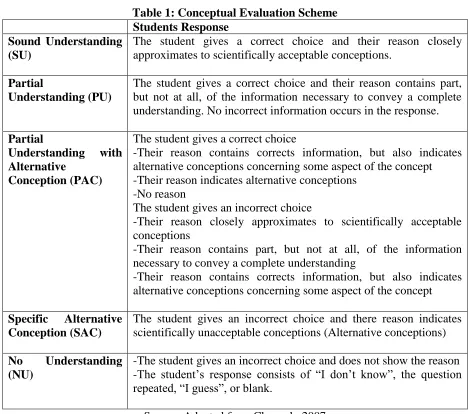
Students’ answers to the questions were categorized, according to the degree of understanding using the Conceptual Profile Inventory (CPI) approach, as Sound Understanding (SU), Partial Understanding (PU), Partial Understanding with Alternative Conceptions (PAC), Specific Alternative Conceptions (SAC) and No Understandings (NU) following the scheme used by Haidar & Abraham (1991) and Chanyah, (2007). The % instances of NU, AC, PU and SU were determined. From these five categories, % SU was used as the measure for students understanding of the topic. The higher the % SU of students, the more it was deemed that students had understood the topic.
chemistry, (d) beneficial aspects of chemistry, and (e) non-harmful aspects of chemistry. Five response categories were used: Strongly Agree (SA), Agree (A), Not Sure (NS), Disagree (D) and Strongly Disagree (SD). The scoring scheme involved the scoring of a favorable response to an item as ‘5’ and an unfavorable response as ‘1’. High values indicated a positive or favorable attitude and vice versa. The test retest reliability yielded .720 and .782 coefficients for MCAT and MCSAS respectively.
Method of Data Analysis
The data collected were analyzed using the Statistical Package for Social Sciences (SPSS) version 20.0. The MCAT was analyzed both qualitatively and quantitatively. In the qualitative analysis, the data were analyzed using the Conceptual Profile Inventory (CPI) approach. The student’s responses in each question were organized to capture each response in a conceptual evaluation scheme, which was adapted from Haidar and Abraham, (1991) and Chanyah, (2007). The conceptual evaluation scheme is shown in Table 1.
Table 1: Conceptual Evaluation Scheme Students Response
Sound Understanding (SU)
The student gives a correct choice and their reason closely approximates to scientifically acceptable conceptions.
Partial
Understanding (PU)
The student gives a correct choice and their reason contains part, but not at all, of the information necessary to convey a complete understanding. No incorrect information occurs in the response. Partial
Understanding with Alternative
Conception (PAC)
The student gives a correct choice
-Their reason contains corrects information, but also indicates alternative conceptions concerning some aspect of the concept -Their reason indicates alternative conceptions
-No reason
The student gives an incorrect choice
-Their reason closely approximates to scientifically acceptable conceptions
-Their reason contains part, but not at all, of the information necessary to convey a complete understanding
-Their reason contains corrects information, but also indicates alternative conceptions concerning some aspect of the concept Specific Alternative
Conception (SAC)
The student gives an incorrect choice and there reason indicates scientifically unacceptable conceptions (Alternative conceptions) No Understanding
(NU)
-The student gives an incorrect choice and does not show the reason -The student’s response consists of “I don’t know”, the question repeated, “I guess”, or blank.
Source: Adapted from Chanyah, 2007
Profile Inventory (CPI) developed as described above. Quantitative data from the MCSAS was analysed using SPSS. All the research questions were answered using t-test.
Results Research Question 1
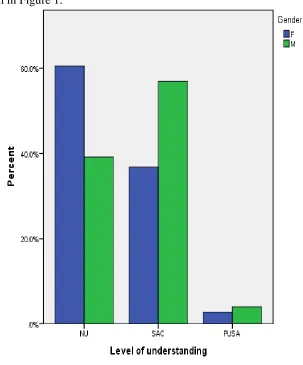
What differences are there in achievement between boys and girls on the Mole Concept? The overall students understanding on the Mole Concept Achievement Test with respect to gender are shown in Figure 1.
Figure 1: Bar Graph Showing Type of Understanding with Respect to Gender
Over half of the girls held no understanding (NU) of the Mole Concept as compared to 40% of the boys. This could be attributed to the girls having a low motivational orientation towards the topic as compared to the boys. Over half of the boys on the other hand held Specific Alternative Conceptions (SAC) with regard to the Mole. On the overall, both boys and girls had problems with conceptions of the Mole Concept.
Table 2: Differences between Boys and Girls in Mole Concept Achievement Variable Gender N Mean Std.
Dev
Std Error
df t Remarks
Mole Concept Achievement
Male Female
220 164
35.50 27.34
16.77 17.52
0.5172 0.3809
Table 2 indicates that boys obtained a higher mean score of 35.50 (n= 220) and a standard deviation of 16.77 as compared to the girls who scored a lower mean of 27.34 (n=162) with a standard deviation of 17.52. This shows that in overall, boys’ performed better than girls. There was a significant difference between boys and girls in Mole concept achievement (t = 4.409, p<0.05.
Differences between Boys and Girls in MCAT Performance in the Descriptive, Spatial, and Mathematical abilities
Some key areas which distinguish boys and girls performance are related to their cognitive abilities in mathematical, spatial and descriptive abilities. Differences were therefore computed with respect to gender on the different ability items in the MCAT, (Table 3).
Table 3: Differences between Boys and Girls in MCAT performance in the Descriptive, Spatial and Mathematical abilities
Variable Whole Sample Mean Whole Sample SD Male Mean Male SD Female Mean Female SD t-value (absolute value)
Descriptive 0.86 1.07 0.88 1.12 0.83 1.00 0.6670
Spatial 1.20 1.32 1.33 1.32 1.02 1.31 4.780*
Mathematical 0.75 1.19 0.84 1.24 0.62 1.10 4.094*
TOTAL 0.94 1.242 1.03 1.274 0.81 1.183 6.033*
NOTE: * denote significance at 0.05
From Table 3, it can be noted that boys obtained a higher mean score in both
mathematical and spatial ability. Boys had a mean score of 1.33 (SD = 1.32) and 0.84 (SD = 1.24) on the spatial and mathematical ability questions respectively. Girls on the other hand had a mean of 1.02 (SD = 1.306) and 0.62 (1.10) respectively for spatial and mathematical ability items. With regard to the descriptive ability items, boys still outperformed the girls with a mean of 0.88 as compared to the girls 0.66.
This contrasts the findings in the First International Science Study (FISS) that
documented girls performing better than boys on descriptive ability tasks because of their perceived innate language ability. This finding could be attributed to the girl’s negative attitude on the topic, lack of meaningful understanding of the topic and due to the fact that chemistry instruction takes place in the second language which is English. The difference however was not significant
Table 3 also indicates that the absolute t-values for the spatial and mathematical items 4.780 (p < 0.05) and 4.094 (p <0.05) respectively are highly significant at 0.05 with boys
performing significantly higher than girls did on the spatial and mathematical ability tests. Research Question 2
What differences are there in attitudes between boys and girls in chemistry? Table 4: Differences between Boys and Girls in Attitude Variable Gender N Mean Std.
Dev
Std Error
df t Remarks
Attitude Male Female 220 164 4.20 3.96 0.83 0.85 0.0646 0.0630
382 0.387 Significant
standard deviation of 0.85. This shows that in overall, boys’ performed better than girls. There was a significant difference between boys and girls in Mole concept achievement (t = 0.387, p < 0.05. It could be expected that the student’s primary socialization affected by the socio-economic status might well account for most of the gender differences exhibited with respect to attitudes towards chemistry. On average, boys had a stronger affinity towards chemistry.
Discussion
Consistent with past research, the results reveal that there was a significant difference between gender and students’ performance in chemistry. Gender therefore had a remarkably intense effect on Mole concept achievement with gender differences favouring the boys substantially as compared to the girls. This corroborates the findings by Twoli, 1986, Mwetulundila, 2001, Changeiywo, 2000. In addition, there was significant difference in performance with respect to gender among students in descriptive, mathematical and spatial ability areas. The findings of this study strongly agrees with that of Gabel and Sherwood (1984) who concluded that the problem students encounter in the mole concept was as a result of the lack of mathematics content skills involved in the study of this topic. The findings further show that there is a significant difference between male and female students’ attitude to science which corroborates Olasehinde and Olatoye (2014) that reported significant difference between male and female students in attitude to science.
Conclusion
The findings in this study show that gender differences do exist in learning outcomes on the mole concept area of chemistry. It is therefore recommended among others that teachers should use instructional strategies that will enhance gender equality in students’ learning outcomes in chemistry especially in major concepts like the Mole.
References
Barchok, H. (2013). Effect of collaborative concept mapping teaching strategy on students attitudes towards chemistry in selected schools in Kenya. Journal of Social Sciences and Humanities, 2, 530-540.
Cervellati, R., Montuschi, A., Perugini, D., Grimellini-Tomasini, N. & Balandi, B.P. (1982). Investigation of secondary school students’ understanding of the mole concept in Italy. Journal of Chemical Education, 59, 852-856.
Changeiywo, J.M. (2000). Students image of science in Kenya. A comparison by gender difference, level of schooling and regional disparities. Unpublished Ph.D. Thesis,Egerton University, Kenya.
Chanyah, D. (2007). Teaching and learning using conceptual change to promote grade 10 student understanding and numerical problem solving skills in stoichiometry. Unpublished phd thesis. University of Kasetsart. Cheel, K.S (1987). Curriculum and Achievement in Primary Science. Unpublished MA thesis. School of
Education, The Flinders University of South Australia, Adelaide.
Comber, L.C. and Keeves, J.P. (1973) Science Education in Nineteen Countries. International Studies in Evaluation 1. Almqvist and Wiksell, Stockholm.
First International Science Study. 1973.
Gabel, D. & Sherwood, R.D. (1984). Analyzing Difficulties with Mole Concept Task by Using Familiar Analog Tasks. Journal of Research in Science Teaching, 21, 843-851.
Haidar, A.H. & Abraham, M.R. (1991). A Comparison of Applied and Theoretical Knowledge of Concepts Based on the Particulate Nature of Matter. Journal of Research in Science Teaching, 28 (10), 919-938. Inyega, J. O. (2005). A Multi-Site analysis of secondary school chemistry teachers’ practices and experiences
following Professional development in Kenya. Georgia University, Athens Unpublished PhD thesis. Keeves, J. P. & Kotte, D. (1991) Sex Differences in Science Education: 1970 to 1984
Kimura, D. (2005). Sex Differences in the Brain. Scientific American, Battle of the Sexes. (Exclusive Online Issue 20).
Kolb, D. (1978). The Mole. Journal of Chemical Education, 55, 728-732.
Kotte, D. (1992) Gender Differences in Science Achievement in 10 countries, 1970/71 to 1983/84.
Olasehinde, K. & Olatoye, R. (2014). Comparison of Male and Female Senior Secondary School Students’ Learning Outcomes in Science in Katsina State, Nigeria. Mediterranean Journal of Social Sciences, 5, 517-523.
Plucker, J.A (1996). Secondary Science and Mathematics teachers and gender equity: Attitudes and attempted interventions. Journal of Research in Science Teaching, 33(7), 737-751
Postelthwaite, T.N. and Wiley, D.E. (1991) Science Achievement in Twenty- Three Countries, Pergamon Press, Oxford.
Republic of Kenya (2007). The Kenya Vision 2030. Nairobi: Government printers.
Sheehan, M. (2010). Identification of Difficult Topics in the Teaching and Learning of Chemistry in Irish Schools and the Development of an Intervention Programme to Target some of these Difficulties. UL. PhD thesis
Staver, J.R. & Lumpe, A.T. (1995). Two Investigations of Students’ Understanding of the mole concept and its use in problem solving. Journal of Research in Science Teaching, 32, 177-193.