Western University Western University
Scholarship@Western
Scholarship@Western
Electronic Thesis and Dissertation Repository
4-30-2018 10:15 AM
Efficient Traffic Management Algorithms for the Core Network
Efficient Traffic Management Algorithms for the Core Network
using Device-to-Device Communication and Edge Caching
using Device-to-Device Communication and Edge Caching
Hessam YousefiThe University of Western Ontario
Supervisor Wang, Xianbin
The University of Western Ontario Co-Supervisor Rahman, Quazi
The University of Western Ontario
Graduate Program in Electrical and Computer Engineering
A thesis submitted in partial fulfillment of the requirements for the degree in Master of Science © Hessam Yousefi 2018
Follow this and additional works at: https://ir.lib.uwo.ca/etd
Part of the Systems and Communications Commons
Recommended Citation Recommended Citation
Yousefi, Hessam, "Efficient Traffic Management Algorithms for the Core Network using Device-to-Device Communication and Edge Caching" (2018). Electronic Thesis and Dissertation Repository. 5374.
https://ir.lib.uwo.ca/etd/5374
This Dissertation/Thesis is brought to you for free and open access by Scholarship@Western. It has been accepted for inclusion in Electronic Thesis and Dissertation Repository by an authorized administrator of
ii
Abstract
Exponentially growing number of communicating devices and the need for faster, more
reliable and secure communication are becoming major challenges for current mobile
communication architecture. More number of connected devices means more bandwidth
and a need for higher Quality of Service (QoS) requirements, which bring new challenges
in terms of resource and traffic management. Traffic offload to the edge has been
introduced to tackle this demand-explosion that let the core network offload some of the
contents to the edge to reduce the traffic congestion. Device-to-Device (D2D)
communication and edge caching, has been proposed as promising solutions for
offloading data. D2D communication refers to the communication infrastructure where
the users in proximity communicate with each other directly. D2D communication
improves overall spectral efficiency, however, it introduces additional interference in the
system. To enable D2D communication, efficient resource allocation must be introduced
in order to minimize the interference in the system and this benefits the system in terms
of bandwidth efficiency. In the first part of this thesis, low complexity resource allocation
algorithm using stable matching is proposed to optimally assign appropriate uplink
resources to the devices in order to minimize interference among D2D and cellular users.
Edge caching has recently been introduced as a modification of the caching
scheme in the core network, which enables a cellular Base Station (BS) to keep copies of
the contents in order to better serve users and enhance Quality of Experience (QoE).
However, enabling BSs to cache data on the edge of the network brings new challenges
especially on deciding on which and how the contents should be cached. Since users in
the same cell may share similar content-needs, we can exploit this temporal-spatial
correlation in the favor of caching system which is referred to local content popularity.
Content popularity is the most important factor in the caching scheme which helps the
BSs to cache appropriate data in order to serve the users more efficiently. In the edge
caching scheme, the BS does not know the users request-pattern in advance. To
overcome this bottleneck, a content popularity prediction using Markov Decision Process
iii
be cached in each time-slot. By using the proposed scheme, core network access request
can be significantly reduced, and it works better than caching based on historical data in
both stable and unstable content popularity.
iv
Acknowledgments
I would like to express my appreciation and thanks to my supervisors Professor Dr.
Xianbin Wang and Dr.Quazi Rahman. You have been a tremendous asset to me. I would
like to thank you for guiding my research and career. Your advice on both research and
career have been invaluable. Besides my supervisors, I would like to thank the examiners
from my thesis committee: Dr. Samuel Asokanthan; Dr. Ilia Polushin and Dr. Hamada
Ghenniwa for coming for my thesis defense and helping me to improve my thesis quality.
I also would like to thank to all the fellow members for their help and support. Moreover,
I would like to thank my group, for their valuable support. They are not only my
colleagues but also my friends. A special thanks to my family for their kindness and help
v
Table of Contents
Abstract ... ii
Acknowledgments... iv
Table of Contents ... v
List of Tables ... ix
List of Figures ... x
List of Abbreviations ... xii
Chapter 1 ... 1
1 Introduction ... 1
1.1 Motivation ... 2
1.2 Research Objectives ... 3
1.3 Contributions... 4
1.4 Thesis Outline ... 5
Chapter 2 ... 6
2 Introduction to Device-To-Device Communication ... 6
2.1 Direct Communication in LTE Networks ... 6
2.2 Types of D2D Communication ... 6
2.3 D2D Connection Benefits for 5G Networks ... 8
2.4 D2D Design Aspects ... 9
2.4.1 Modulation ... 9
2.4.2 Frame Structure ... 9
2.4.3 Signaling ... 10
2.4.4 Synchronization ... 10
vi
2.4.6 Power Control ... 10
2.5 D2D Uses Cases and Applications ... 11
2.5.1 Vehicle to Vehicle Communication (V2V) ... 12
2.6 D2D Communication Background ... 12
2.7 Proposed System Model in 3GPP for D2D Connection ... 14
2.8 Interference Management Techniques for D2D Communication ... 15
2.8.1 Interference Channels ... 21
2.9 Chapter Summary ... 22
Chapter 3 ... 24
3 Delay-tolerant Resource Allocation for Device-to-Device Communication Using Matching Theory ... 24
3.1 Introduction ... 24
3.2 System Model ... 26
3.2.1 Problem Formulation ... 27
3.2.2 Data-Rate and Delay Threshold Model ... 29
3.3 Stable Matching ... 31
3.4 Modified Stable Matching Theory ... 31
3.5 Resource Allocation Procedure ... 32
3.5.1 Channel States Gathering ... 32
3.5.2 Time of the Request for D2D Communication ... 33
3.5.3 Stable Matching Procedure ... 34
3.6 Simulation Results ... 36
3.6.1 Effect of the Number of D2D Pairs on Weighted System Sum-Rate ... 36
3.6.2 Effect of Number of Available Resource Blocks on Weighted System Sum-Rate... 37
vii
3.7 Chapter summary ... 39
Chapter 4 ... 41
4 Introduction to the Edge Caching ... 41
4.1 Evolution of Caching in the Network ... 41
4.2 Caching Applications ... 43
4.2.1 Content Delivery Network ... 43
4.2.2 Information-Centric Networks ... 43
4.3 Mobile Edge Network ... 44
4.3.1 Edge Caching ... 44
4.3.2 Advantages of Edge Caching ... 45
4.4 Edge caching Challenges ... 46
4.4.1 Cache Placement ... 47
4.4.2 Content Popularity ... 48
4.4.3 Caching policy ... 49
4.5 Chapter summary ... 52
Chapter 5 ... 53
5 Robust Edge Caching Based on Unstable Popularity Distribution Learning Using MDP ... 53
5.1 Abstract ... 53
5.2 Introduction ... 53
5.3 System Model ... 55
5.3.1 Problem Formulation ... 56
5.3.2 Markov Decision Process ... 57
5.3.3 Formulation of Popularity Prediction in the MDP Framework ... 57
viii
5.5 Simulation Results ... 61
5.5.1 Expected Value of BS reward ... 62
5.5.2 Effect of Remember-Value on the Expected Value of Reward ... 63
5.5.3 Effect of Popularity Change ... 64
5.5.4 Effect of Step-Effect parameter on the Learning Rate... 65
5.5.5 Core Network Access Requests ... 67
5.6 Conclusion ... 67
Chapter 6 ... 68
6 Conclusion and Future Works ... 68
ix
List of Tables
Table 1: Comparison of Various Technologies ... 8
Table 2: Different Scenarios of Interference ... 22
Table 3: Simulation Results ... 36
Table 4: Caching Policy Taxonomy ... 49
x
List of Figures
Figure 1: Frame Structure ... 9
Figure 2: D2D Use Cases ... 12
Figure 3: Different Resource Allocation Methods ... 18
Figure 4: a Single Cell Scenario in Which D2D Pairs Share the Cellular Spectrum with Cellular Users... 21
Figure 5: Network Model with One Cellular User and D2D Pairs to Show Available Channels ... 26
Figure 6: Frame Structure for D2D ... 33
Figure 7: Algorithm 1 ... 35
Figure 8: Algorithm 2 ... 35
Figure 9: Effect of Number of D2D pairs on System Sum-rate ... 37
Figure 10: Effect of Number of Available Resources on the System Sum-rate ... 38
Figure 11: Comparison with Ex-search ... 39
Figure 12: Cloud Architecture ... 42
Figure 13: Architecture of Mobile Edge Networks ... 45
Figure 14: Connection Among Multiple Cells and Core Network via Fiber Optics ... 54
Figure 15: Transition Probability- in each time-slot (state), the probability of reaching the next time slot is 1 irrespective of what action is taken ... 59
Figure 16: Algorithm 3 ... 61
xi
Figure 18: Effects of Popularity Change During Learning Process ... 64
Figure 19: The Effect of Remember-Value on the Expected Value of Reward ... 65
Figure 20: Effects of Step-Effect Parameter on the Learning Rate ... 66
xii
List of Abbreviations
3GPP
Third Generation Partnership Project
4G
Fourth Generation of Mobile Communication
5G
Fifth Generation of Mobile Communication
BS
Base Station
CDF
Cumulative Distribution Function
CDN
Content Delivery Network
CQI
Channel Quality Information
CSI
Channel State Information
D2D
Device-to-Device Communication
FDD
Frequency Division Duplexing
HetNet
Heterogeneous Network
ICN
Information-Centric Network
LOS
Line of Sight
LTE
Long-term Evolution
LTE-A
LTE Advanced
MCC
Mobile Cloud Computing
xiii
MEC
Mobile Edge Computing
Non-LOS
non-Line of Sight
NFC
Near-Field Communication
OFDMA
Orthogonal Frequency Division Multiple Access
Probability Distribution Function
QoE
Quality of Experience
QoS
Quality of Service
RAN
Radio Access Network
Rx
Receiver
SC-FDMA
Single Carrier Frequency Division Multiple Access
SINR
Signal to Interference plus Noise Ratio
Tx
Transmitter
V2V
Vehicle-to-Vehicle Communication
1.1. Motivation 1
1
Chapter 1
1
Introduction
To cope with the proliferation of devices to support the future fifth generation of mobile
communication systems (5G), and the associated congestion in the core network due to
the exponential increase in the content-demand, many new wireless technologies have
been introduced. To provide better Quality of Experience (QoE) for users,
Device-to-Device (D2D) communication and edge caching are considered to be the key solutions to
offload huge data demand. By allowing D2D communication to be established, mobile
devices can connect to each other directly without going through the Base Station (BS)
by using licensed or unlicensed spectrum. Although using dedicated spectrum has no
additional interference, but it comes with a cost of inefficient spectrum usage.
Coexistence of D2D communication and conventional cellular communication in a
shared spectrum results in a higher spectral efficiency. However, it generates additional
interference which may degrade the performance of either connection. To ensure cellular
and D2D users received acceptable service threshold, advance resource allocation
algorithms should be considered to minimize the performance degradation. The first part
of this thesis is dedicated to designing an efficient and low-complexity resource
allocation method in order to minimize additional intra-cell interference while
maintaining service threshold.
As another promising solution to offload the traffic from the core network, edge
caching has been introduced. According to a forecast by Cisco [1], video contents will be
accounted for over 82% percent of the traffic by 2021. This exponential increase will
challenge current content delivery mechanism
On the caching side, edge caching will provide low-delay and fast access to the
available contents for users in the cell by keeping the copies of most popular contents at
the BS, however determining which data to cache has become challenging due to the
1.1. Motivation 2
2
second part of this thesis, we have provided a robust caching policy optimization using
content popularity distribution learning to cache most popular data on the edge.
1.1
Motivation
Unlike traditional cellular communication which users should communicate with each
other through an intermediate entity called the Base Station (BS), the introduction of
direct communication under the name of D2D communication provide an architecture
under which devices are allowed to communicate with each other directly. According to
Third Generation Partnership Project (3GPP), Device-to-Device communication has one
of the key roles in future mobile generations due to the fact that the number of connected
users is increasing exponentially. Increasing number of devices generates higher data
traffic which eventually dominates current mobile networks paradigm. Therefore, choice
of offloading some of the burdens on devices should be consideredas a solution. The
reasons D2D communication can be considered as one option are: first, providing higher
data rate due to the proximity of connected devices, second, increasing spectral efficiency
since the cellular spectrum will be reused within the cell rather than further cells like the
case in conventional communication, finally, there is a potential of increasing cell
coverage by implementing multi-hop communication through connected devices.
Direct communication is feasible either in licensed (in-band) or unlicensed
(out-band) spectrum. The in-band connection will be further divided into underlay and overlay
communication in terms of dedication of the spectrum. The D2D communication
underlying cellular network has attracted attention lately since it provides significant
advantages to the network in terms of spectral efficiency while generating additional
interference due to the fact that resources are not orthogonal. Advanced interference
management techniques need to be proposed in order to efficiently allocate resource to
the cellular users and D2D users.
D2D communication can facilitate local proximity services which are highly
1.2. Research Objectives 3
3
that is more relevant timely and spatially. However existing methods like Wi-Fi, ZigBee,
and Bluetooth which operates in the unlicensed band, cannot achieve desirable goals due
to the uncontrolled connection. Hence, the D2D connection under the supervision of BS
can provide a stable and reliable solution.
To further address offloading traffic from backhaul, caching systems has been
proposed. According to a study, video contents are responsible for over 82% of traffic
[1]. Even by considering advance content delivery architectures, high data traffic imposes
significant latency on the end users. This rapid increase in content-request with
increasing number of devices challenges current content distribution schemes.
Trying to address the issue, researchers have come up with content delivery networks
(CDN) as a short-term solution. However, the problem of CDN is that with increasing
traffic in the backhaul, the network architecture is not scalable. to solve the scalability
issue, information centric network (ICN) has been proposed in the literature where
contents have their own address irrespective of the location. The introduction of caching
not only benefits the content providers by decreasing traffic but also benefits users by
decreasing latency. By distributing replication of popular content intelligently around the
network, users can request contents from closer locations other than going all the way to
the core network. Although caching can benefit each party, it has many issues that need
to be addressed in term of cache placement, content popularity and caching policy. In the
second part of this thesis, we provide a comprehensive review of the challenges and
propose a solution.
1.2
Research Objectives
So far, we have introduced two different solutions to deal with increasing traffic demand.
Introducing D2D communication will provide significant interference problem that needs
to be addressed. On the other hand, keeping copies of the popular contents is not feasible
unless we know which contents should be cached. Therefore, the research objective is to
design a low-complexity resource allocation algorithm for D2D and cellular devices, as
well as design an efficient content popularity prediction technique at the edge of the
1.3. Contributions 4
4
Low Complexity Resource Allocation Algorithm: In order to reduce additional interference, D2D users should reuse the cellular spectrum of a cellular user which has
the maximum distance from the D2D pair. According to Shannon Capacity Law with
Rayleigh fading channel, the higher distance between transmitter and interference victim
results in better SINR, so we aim to match D2D pairs with cellular users while
maximizing the sum distance between them. In order to formulate Shannon Capacity, all
Channel State Information (CSI) is needed which induce significant overhead on the
communication side. To reduce overhead, we should avoid transmitting redundant
information by utilizing distributed allocation mechanism. By considering all the above
notes, we aim to maximize the cell sum-rate while minimizing the overall interference by
introducing distributed allocation technique.
Content Popularity Distribution Learning: increasing caching efficiency can be achieved by knowing which contents should be cached in the cell which directly relates
to user’s behavior and it is referred to local content popularity in the literature. Since
content popularity is unknown to the BS in advance and it is changing because of random
user activity. The objective is to learn local content popularity by observing past users
request and intelligently cache contents. The challenge that needs to be addressed is
although we assume a model for content popularity, users’ requests do not follow the
same model in each time slot, hence there may be noisy requests which degrade the
performance of caching algorithm. We aim to increase the cache hit by designing robust
content popularity learning algorithm.
1.3
Contributions
The main contribution of this thesis is summarized below:
• In chapter 2 and 3, we provide a comprehensive review of the device-to-device communication architecture and challenges. The focus is on the most important
challenge of D2D communication which is interference management. We have
proposed a low complexity interference management technique with distributed
channel state (CSI) reporting to reduce communication overhead resulting from
1.4. Thesis Outline 5
5
can be efficiently allocated to the users trying to communicate directly and system
sum-rate outperforms current methods.
• In chapter 4 and 5, edge caching is investigated with all benefits and challenges it brings to the network. We propose a learning mechanism for edge caching in
order to learn local content popularity in a cell to increase the cache hit. We
address fast-changing environment and random user activities which have not
been considered in most of the previous works. By utilizing similar content-needs
among users in the cell, the BS can serve users by caching popular contents. As a
result, proposed learning algorithm outperforms conventional edge caching
methods in terms of cache hit and core network access request.
1.4
Thesis Outline
The rest of the thesis is organized as follows: in chapter 2 we do an extensive literature
survey on theory and applications of D2D network and current challenges that need to be
addressed. In chapter 3, we provided our solution to the additional interference issue
which arises in D2D-enabled networks. Then in chapter 4, existing methods and
challenges of caching techniques are investigated and we showed that the main issue is
what content to cache (content popularity). In chapter 5, we provide a solution on how to
know what content should be cached by utilizing Markov Decision Process (MDP) and
modeling content requests with Zipf law. Finally, we conclude our work and discuss
2.1. Direct Communication in LTE Networks 6
6
Chapter 2
2
Introduction to Device-To-Device Communication
2.1
Direct Communication in LTE Networks
With increasing the number of devices, the need for faster communication push the limits
of the current generation of mobile communication. Enabling devices to connect directly
rather than going through BS has been introduced as a significant part of the evolution
toward Fifth Generation of cellular communication (5G) which provide very high-speed
communication among connected devices. There are several technologies trying to utilize
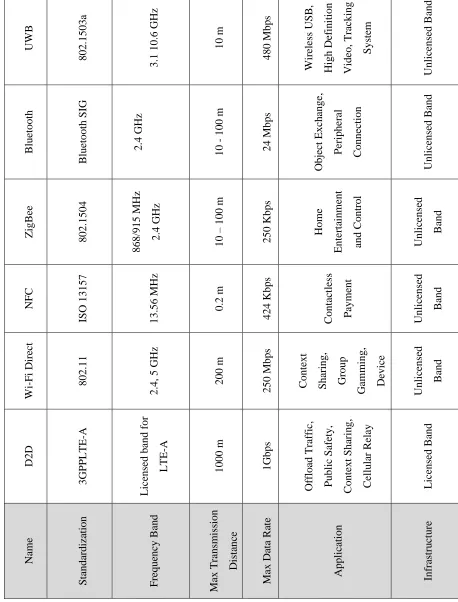
direct communication between devices such as Wi-Fi-Direct, ZigBee, Bluetooth, NFC
etc. detail comparison of current technologies in terms of standardization, frequency
band, transmission distance and the data rate is provided in Table 1.
2.2
Types of D2D Communication
Device-to-Device communication can be classified into two different categories: In-band
and out-band communication
In-band Communication: in this category, users are using the licensed spectrum for their direct connection. High control over interference and ability to manage
additional interference more efficiently in this kind of communication is counted as an
advantage of this category. There are two sub-categories for in-band communication,
namely, underlay and overlay communication. In underlay direct communication, D2D
users share cellular spectrum with mobile users which are better to deploy since cellular
spectrum is under full control of the BS. In contrast, D2D devices have their dedicated
spectrum in overlay communication which may result in inefficiency of using available
2.2. Types of D2D Communication 7 7 U WB 802.1503 a
3.1 10.6 G
H z 10 m 480 Mbp s Wi rel es s US B , H igh D ef in it ion V ideo, T rac k ing Syst em U nl ic ens ed B and B luet oot h B luet oot h SIG 2.4 G H z 10 - 100 m 24 Mbp s O bj ec t Exch ange , Per ip her al C onnec ti on U nl ic ens ed B and ZigBee 802.1504 868/ 91 5 MHz 2.4 G H z 10 – 100 m 250 K bps H om e Ente rt ai n m en t and Cont ro l U nl ic ens ed B and N FC ISO 13157 13.56 MHz 0.2 m 424 K bps C ont ac tl es s Paym ent U nl ic ens ed B and Wi -F i D ir ect 802.11
2.4, 5 G
H z 200 m 250 Mbp s C ont ex t Shar ing, G roup G am m ing , D evi ce C onnec ti on U nl ic ens ed B and D 2D 3G PP LT E -A Lic en se d b and for LTE -A
1000 m 1G
2.3. D2D Connection Benefits for 5G Networks 8
8
Table 1
The drawback of using in-band D2D communication is the possibility of wasting
the spectrum in overlay mode as well as complex interference management between
cellular and D2D users in underlay mode. Most power control and interference
management techniques will result in high complexity methods which induce a
significant amount of overhead. Additionally, in underlay mode users cannot have
simultaneous D2D and cellular communication. Researchers have been tending to
overcome challenges of using in-band D2D connection because they believe it will
provide higher spectral efficiency.
Out-band Communication: The direct communication under this category is established using unlicensed spectrum such as Wi-Fi Direct, Bluetooth or ZigBee. To
tackle with complex power and interference management techniques out-band has been
proposed to completely separate itself from cellular spectrum but new issues like
interference between Wi-Fi devices will arise. There are two subcategories for out-band
communication which are controlled and autonomous connection.
In the controlled mode, cellular network will control the establishing all
communication in cellular spectrum and unlicensed band whereas in autonomous mode,
D2D users initiate and establish their own communication under any standard like Wi-Fi,
Bluetooth, and Zigbee, so there is no interference with cellular domain and they can have
both D2D and cellular connection simultaneously.
2.3
D2D Connection Benefits for 5G Networks
Connecting directly to the other users to exchange content will benefit the overall system
in many ways which are:
1) The user can gain high data rates as well as low delay and low power consumption
2.4. D2D Design Aspects 9
9
2) Like what we get by reusing cellular spectrum several times in different cells, we can
benefit by reusing spectrum inside the cell more than one which means increasing the
reuse factor.
3) Unlike the case of cellular connection, in D2D communication there is no need to use
separate uplink and downlink resource.
2.4
D2D Design Aspects
2.4.1
Modulation
Under current LTE standard, users use single carrier FDMA (SC-FDMA) in uplink and
OFDMA in the downlink. The same modulation format can be used for the case of D2D
communication.
2.4.2
Frame Structure
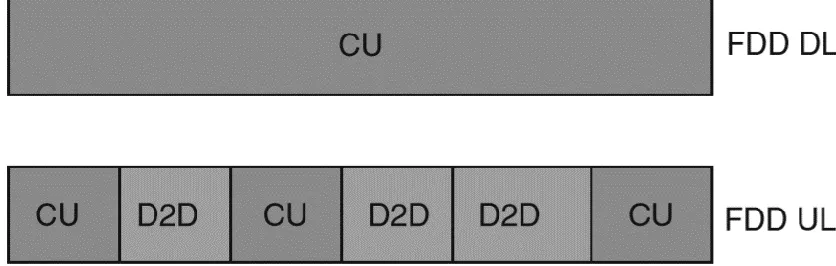
Figure 1 shows framing for D2D communication. Assuming frequency division
duplexing (FDD), the D2D connection will take place in FDD uplink because downlink
traffic load is heavier than uplink spectrum, so this makes it a suitable candidate for D2D
connection. The other reason is the amount of interference appears in downlink resource
in comparison to the uplink spectrum which is significantly higher. For establishing
communication in BS-controlled modes, there should be a signaling between BS and
D2D user which is considered as a cellular connection and takes place in the downlink
frame.
2.4. D2D Design Aspects 10
10
2.4.3
Signaling
To let BS informs D2D users which time slot and frequency they should use, a couple of
signaling between BS and D2D users should occur. There is no limitation on the
signaling between D2D transmitter and receiver, so they can communicate with each
other and initiate the connection whenever they want.
2.4.4
Synchronization
In the network-assisted D2D scenario, there is an important need for synchronization of
time-slots and frequency. To maintain the synchronization both in time and frequency,
D2D users use reference signals similar to what LTE does in the downlink.
2.4.5
Channel Measurement
One the important part of design aspect in D2D connection is how users can measure the
channel and take proper action based on the channel state. For instance, measurement of
received signal strength transmitted by users in downlink resource can be used to
estimate the amount of interference they cause. For the D2D communications, the BS can
obtain the channel status of D2D links between transmitter and receiver by taking
periodic or aperiodic Channel Quality Indication (CQI) reports from both of them.
2.4.6
Power Control
Researchers have been investigating power control as a solution to the interference
management problem between D2D users and cellular users. There are fixed SNR target
and fix power schemes which D2D communication can exploit. The drawback of using
fixed TX-power scheme is that although it is quite simple to use, it does not work well
due to the large dynamic range of D2D SINR. The overall dynamic range is relating
directly to the interference management scheme. In the worst case which is random
resource allocation, dynamic range is large whereas when D2D users are using their own
dedicated spectrum, they have lower dynamic range, so they can use fixed power scheme.
In fixed SNR target, we must choose appropriate TX power in order to reach desired
SINR target. The higher the SINR target is, the higher TX power needed which increase
2.5. D2D Uses Cases and Applications 11
11
2.5
D2D Uses Cases and Applications
There are three main use cases for D2D connection. D2D can serve simple exchanging
data between sender and receiver or act as a relay to forward data to or from the other
users.
• Local Data Services
There are a couple of local services which can benefit from the D2D connection
which are: information sharing, mobile multiplayer gaming, mobile advertising,
streaming services and social networking. By using D2D, one can facilitate the
connection between users, sensors, and devices in proximity. However, D2D
technologies offer benefits that exploit the physical proximity of the
communicating sides in terms of latency. Irrespective of the underlying
technology, we foresee the need for D2D communication technology containing
functions such as mobility control, user data routing, proximity detection, and
security management.
• Public Safety
Recently 3GPP defined the most important role of D2D connection which is
public safety services. From the deployment perspective, public safety services
can be categorized into within network coverage and outside coverage [4].
• Data Security
The other benefit comes with D2D service is data security which results from a
direct route between sender and receiver and avoids passing through cloud entity
2.6. D2D Communication Background 12
12
2.5.1
Vehicle to Vehicle Communication (V2V)
There has been a strict need for low-delay communication in the vehicular network in
order to send or receive traffic information. For example, for collision systems, it is
crucial to send signals on low latency protocols to coordinate braking system. Without
V2V connection, vehicles need to detect if any car in near distance is braking in order to
avoid a collision. Additionally, the Additionally, V2V connection can provide extensive
and reliable information about traffic stream to all the vehicles which could be useful to
maintain a safe distance.
2.6
D2D Communication Background
D2D communication refers to short-range communication between users without going
through the BS. Apart from the Bluetooth and Wi-Fi connection, in-band type of
communication does not utilize unlicensed spectrum and it takes place in cellular
spectrum and guarantees QoS. The first step in D2D communication is peer discovery
2.6. D2D Communication Background 13
13
which is manually operated by devices without any network intervention. Unlike the case
of cognitive radio in which there are two types of users (primary and secondary), in the
case of D2D connection cellular users known as primary users are allowed to establish
this type of connection as well so it is not just limited to secondary users. Since the role
of BS is eliminated, significant processing power can be saved, and shared usage of the
cellular spectrum may lead to spectrum efficiency.
In the literature D2D connection is categorized into two major class:
1. D2D in-band underlay which shares cellular spectrum between cellular and D2D
users
2. D2D in-band overlay in which D2D users are only allowed to use the cellular
spectrum when it is empty.
There is an extensive comparison of these two approaches in [5] with respect to
throughput. The most important problem which must be addressed in both approaches is
efficient interference management. To deal with this, [4] [6] [7] recommends the use of
uplink spectrum due to its underutilized feature. Moreover, in the case of using uplink
additional interference will be imposed on the BS which is equipped with
high-performance receivers and antenna. The other victim of this additional interference is a
D2D receiver. Considering the current advances in standardization toward ultra-dense
cells such as microcell and small cell, the amount of interference from devices in
proximity to the D2D receiver is not negligible and requires extensive investigation to
find efficient ways for controlling intercell interference.
Researchers have been approaching to the interference mitigation problem mainly in
the context of resource allocation and power control schemes provided in [8] [9] [10] [11]
by gathering required information from users and D2D devices, BS tries to allocate
appropriate spectrum and power level to devices to minimize intracell interference. to
reduce overhead, different techniques have been proposed in order to inform BS about
2.7. Proposed System Model in 3GPP for D2D Connection 14
14
reporting all the information to the BS requires network resources and even with accurate
information, the problem of resource allocation and power control is NP-Hard.
The other aspect of D2D communication which considered as a first step is peer
discovery. Peer discovery means finding out whether devices are close enough to initiate
reliable and high data rate connection. There are two major approaches to this problem:
centralized and decentralized approach. Researchers tend to use decentralized algorithms
since it requires less signaling and operates at the local level. However, finding devices in
proximity without the intervention of the BS may lead to unauthorized use of the licensed
band, hence centralized algorithms introduced to overcome this drawback. Recent efforts
in implementing D2D connection has been done by Qualcomm as FlashLinq which
includes: a) timing and frequency synchronization b) link management c) distributed
power allocation and scheduling [14].
The idea of mode selection which is a strong basis of many papers in the literature
first introduced in [15] [16] which shows D2D connection can be used for network
performance optimization while the problem of connection loss during switching between
cellular and the D2D connection should be addressed carefully.
2.7
Proposed System Model in 3GPP for D2D
Connection
In the system model, the BS is responsible for controlling D2D connection which means:
1. Resource allocation and power control
2. The peer discovery step.
All devices in the cell are equipped with D2D connection requirement. In this
scenario, D2D devices request resources from the base station, then the BS runs peer
discovery algorithm to find the best match from devices in proximity. When BS found a
candidate, the process of resource allocation and power control will be begun and inform
D2D transmitter and receiver their specific resource, power level and timing. In order to
2.8. Interference Management Techniques for D2D
Communication 15
15
address which requires the intervention of the core network since IP information is not
available at the local level. The new identity generated during the first access of the
devices to the network. Moreover, D2D transmitter knows the identity of its target device
so it can be reported to the BS. D2D connection procedure can be summarized as follow:
1. D2D devices identity generated during the first access at the BS.
2. D2D transmitter initiated connection and request spectrum in order to establish
direct communication. Target D2D receiver can be specified or detected by the
BS.
3. After receiving spectrum request, the BS runs peer discovery procedure if
applicable.
4. The BS informs D2D users of their allocated spectrum and power level which
minimize the intracell interference between the D2D system and cellular users.
5. The D2D transmitter tunes itself to the allocated spectrum and synchronized its
communication window, then start to transmit its data where the receiver is tuned
to the same communication window in order to receive data as well.
6. The D2D receiver acknowledges the reception of the data by sending
acknowledgment signal and they end the connection.
2.8
Interference Management Techniques for D2D
Communication
Because of coexistence of D2D and cellular communication, additional harmful
interference on the cellular users is generated which significantly decrease QoS. This
additional interference results in performance degradation of the cellular nodes [17] [18]
[19]. An efficient interference management technique should be introduced to address
2.8. Interference Management Techniques for D2D
Communication 16
16
management’s objectives are to protect cellular nodes performance. The impact of power
control is investigated in [16] [10] [20] [21] [22]. Doppler et al showed that controlling
the D2D transmit power could result in an increase in overall system throughput ref [16]
[22] while Yu et al guarantee SINR level for cellular users and showed there is an
acceptable level of SINR for D2D users as well. Moreover, Gu et al introduced dynamic
power allocation to decrease the amount of interference by the cellular users [21]. The
author in [23] considered a multi-cell scenario to minimize overall transmission power in
the cellular network. The problem of resource sharing, power allocation, and mode
selection are formulated as a linear programming problem which is NP-Hard. Trying to
reduce the complexity, they considered only single cell scenario. A heuristic approach to
the problem showed a significant gain in power efficiency over traditional cellular
communication. In [24] the problem of power allocation and mode selection has been
discussed. In their proposed algorithm, first power efficiency is calculated which is a
function of transmission rate and power consumption for the different users in different
modes (D2D and cellular). Therefore, each user uses the mode in which it gains the
maximum power efficiency. There is a comprehensive comparison of different power
control schemes in [20] which shows this approach is able to manage additional
interference.
The second approach is resource allocation to overcome harmful interference [5]
[25] [26]. Depends on whether the D2D connection is going to take place in underlay or
overlay mode, the BS shares part of the cellular spectrum or dedicates an empty part of
the cellular spectrum to the D2D user respectively [25]. In case of overlay connection,
additional interference can be eliminated while decreasing reuse factor and results in
spectrum inefficiency. Yu et al formulated resource allocation problem into power
constrained problem [5]. They have shown that, by jointly optimize resource allocation
and power allocation, the D2D connection can reach significant performance over
conventional cellular communication. Note that, by limiting transmit power or resources
of the D2D users, there is a possibility to get a quite unreliable connection and critical
2.8. Interference Management Techniques for D2D
Communication 17
17
of cellular and D2D connection [27] [8] [28] [29]. Janic et al proposed resource
allocation in order to maximize overall system performance where there are multiple
D2D and cellular users exist [8]. Furthermore, a power efficient scheme is proposed to
jointly optimize power level and resource allocation in [24]. Since optimizing resource
allocation for multiple cells is an NP-Hard problem, Feng et al adopted three-step
optimization technique to solve the problem [27]. Until now, the BS only utilized channel
state information in order to allocate power or resources. Wang et al show by considering
location information of users in the cell, there could be a significant performance gain,
but this information is not always available.
The most important category we must look at is In-band Underlay communication
since resources are shared in this category. In [30] uplink resources are shared between
D2D and cellular users. To tackle the additional interference imposed on cellular users,
D2D users monitor received signal strength (RSS) of the downlink control signal to
estimate the path loss effect on the signal coming from BS. This allows D2D users to
control the transmit power and maintain it below a specific threshold to decrease the
amount of interference on the cellular users. The mode selection in this algorithm allows
the D2D user to establish a direct connection if the transmit power required by the D2D
users is less than the threshold. Routing among D2D users using multi-hop connection
known as Dynamic Source Routing is proposed in [31] as well. Through simulation, the
author claimed that probability of establishing direct communication increases when path
loss effect is stronger. The reason for this is the stronger path loss, the weaker
interference at the BS causing by the D2D user. In [32], D2D users read control channel
to avoid using same resources as cellular users in proximity. The authors propose to
allocate a dedicated control channel for D2D users. Cellular users can listen to this
control channel and measure the SINR. If the SINR is higher than a threshold, cellular
users send a report to the BS. Based on these reports, BS reschedule cellular users and
avoid using resource blocks that are currently occupied by D2D users. In each time slot,
2.8. Interference Management Techniques for D2D
Communication 18
18
therefore, D2D users avoid using recourse blocks that cause interference on the cellular
users in proximity.
Mode selection which means determining the mode in which users should work is
discussed in [25]. In this work, users perform channel measurement and then achievable
channel transmission rate in each mode is calculated. Based on the achievable rate, each
user chooses the mode which results in higher transmission rate. Simulation results have
shown wisely choosing the mode for D2D communication can significantly increase
system throughput.
Downlink resource sharing among cellular users and D2D pairs is considered in
[33], [34], [35]. Sum-rate optimization using Game Theory is proposed in a work by Xu
et al [35]. They exploited Auction Theory to design combinatorial auction game trying to
manage available resources. In this game, the spectrum resources are considered as
bidders while D2D links are goods to be sold. The upside of their algorithm is less
complexity in comparison with traditional schemes since they have used the distributed
method. Simulations have been done under WINNER Ⅱ channel and showed 13% of
performance upgrade. Sequential second price auction algorithm is used in [33] to
iteratively match D2D pairs with available resource blocks, where the goal was to
minimize the interference between shared users. Islam et al In [34] proposed a
polynomial-time matching algorithm for the resource allocation problem to maximize the
sum-rate by assuming the location information of all the devices in the cell, which is not
always available at the BS. In [36], a two-phase auction-based algorithm is used to share
2.8. Interference Management Techniques for D2D
Communication 19
19
uplink spectrum. The authors assumed that all the channel information was calculated at
the BS and broadcasted to users in a timely manner.
Table 2: Taxonomy of Different Approaches to The Resource Allocation in D2D Communication
Reference Spectrum Metric
[18] UL/DL Sum Throughput
[37] UL/DL Energy Efficiency
[38] UL/DL QoS
[39] UL/DL SINR
[40] UL Cell Throughput
[41] UL/DL Sum-rate
[42] UL Cell throughput
Resource Allocation
Methods
Centealized
Heuristic Methods
Distributed
Game Theory
2.8. Interference Management Techniques for D2D
Communication 20
20
[43] UL Power efficiency
[42] UL SINR CDF
[14] UL Cellular rate
[44] UL/DL Rate Gain
[45] UL SINR
[46] UL Sum-rate
[47] UL/DL SINR CDF
[48] UL Mean System Capacity
2.8. Interference Management Techniques for D2D
Communication 21
21
2.8.1
Interference Channels
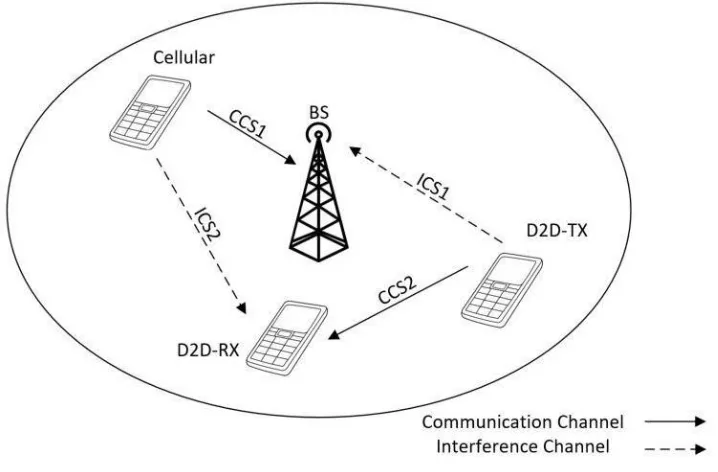
In order to compare the use of uplink and downlink spectrum for the D2D connection, we
consider a single cell scenario consists of single BS and single cellular user and single
D2D pair as depicted in Figure 4.
In this figure, we consider users are equipped with a single antenna, so they are able to
operate in one mode (cellular or D2D) at the same time.
In Figure 4, D2D pair A and B are in close proximity and therefore they have
initiated to connect directly. While increasing spectrum efficiency by reusing the cellular
spectrum, additional harmful interference will be imposed in the cellular network. Below
we elaborate more on how using uplink and downlink resource may impact on
connections.
Uplink: in this case, the coexistence of D2D and cellular connection generates two kinds of interference. The D2D transmitter generates interference to the BS during transmitting
data to the D2D receiver and cellular user imposes harmful interference on the D2D
receiver during its uplink period. Therefore, the overall system performance will be
degraded resulting this phenomenon.
2.9. Chapter Summary 22
22
Downlink: in downlink period, victims of additional interference are a D2D receiver and cellular users. In downlink period the BS stations impose interference on the D2D
receiver which will degrade its performance significantly due to the fact that the BS has
powerful SINR. The cellular users suffer from receiving signals from D2D transmitter
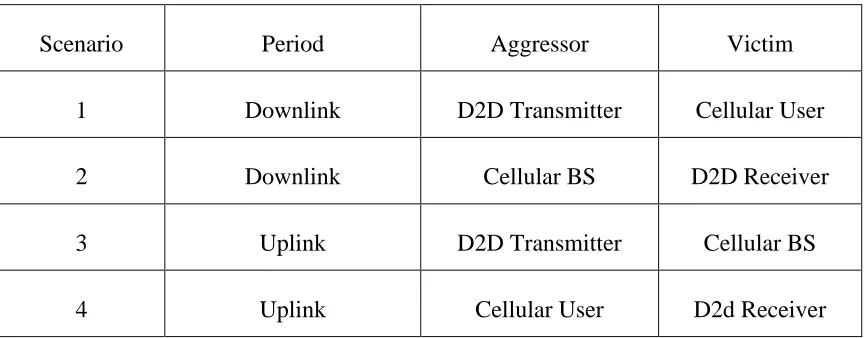
which makes it a victim in downlink scenario. In Table 2 we summarized victims and
aggressors for each scenario.
Table 2: Different Scenarios of Interference
Scenario Period Aggressor Victim
1 Downlink D2D Transmitter Cellular User
2 Downlink Cellular BS D2D Receiver
3 Uplink D2D Transmitter Cellular BS
4 Uplink Cellular User D2d Receiver
Since the cellular user has always a higher priority, it is always necessary to guarantee the
QoS of the cellular users, so in the case of 1 and 3, the interference from D2D
communication should be suppressed. This can be achieved by two means: controlling
transmit power or interference aware resource allocation. By pursuing either of them,
limited performance gain for the D2D connection could be achieved.
2.9
Chapter Summary
In this chapter, we provided a comprehensive literature review of D2D communication
from emergence and competitors to D2D communication use cases and the classification
of D2D connection as underlay and overlay. we have seen pros and cons of each category
and elaborated on why researchers tend to use underlay and that is because of the fact that
it gives better spectral efficiency. In-band and out-band connection have been discussed
and related works in each area have been provided. We have discussed several design
issues associating with a D2D connection such as synchronization modulation and
2.9. Chapter Summary 23
23
additional harmful interference due to shared resources. To address this issue, we have
provided a comprehensive comparison between two main methods namely power control
and resource allocation. In the end, we provided interference scenario considering a
single cell scenario with single cellular users and single D2D pair to illustrate
3.1. Introduction 24
24
Chapter 3
3
Delay-tolerant Resource Allocation for Device-to-Device
Communication Using Matching Theory
3.1
Introduction
To deal with the increasing demand for data communication with limited radio resources,
D2D communication has been proposed as a key aspect of Long Term Evolution (LTE)
networks. D2D communication allows users to communicate with each other directly
rather than going through the BS [50]. Establishing direct communication in the
underlying cellular networks increases system spectral efficiency and provides additional
service for new users while maintaining the minimum Quality of Service (QoS) for
cellular users [50]. Although D2D brings benefit to the network, it generates unwanted
interference on the existing cellular users, which needs to be addressed efficiently. Thus, efficient interference management techniques must be designed to make D2D
communication in the underlying cellular network feasible to implement [27].
In this chapter, we propose a resource allocation algorithm to share uplink resources
based on stable matching with distributed CSI. Stable Matching is a well-known
algorithm, which helps us match between any two finite sets of entities with low complexity. This algorithm has been defined in detail in [51]. Our proposed resource
allocation scheme has three significant parts, which address unresolved problems in the
previous works in terms of distributed CSI gathering, time of the request and delay-rate
trade-off. These three parts and the corresponding contributions are elaborated below.
Most previous works [9]– [34], [36] have assumed full CSI scenario and utilized a
centralized algorithm which is not practical due to an uncontrolled overhead [52]. They
are unable to address the challenge of the distributed CSI collection, and simply assume
that all the CSI is known at the BS. In order to deal with this challenge in a practical
manner, we propose a procedure to collect the required CSI information from the
distributed sources while minimizing the overhead. All types of needed CSI for an uplink
resource sharing for D2D communication is summarized in Table 3. The second problem,
3.1. Introduction 25
25
pairs find each other in the cell, which is known as peer discovery phase, they should
seek spectrum resources to exchange their data. Because of the continuity and
probabilistic nature of the request, it has virtually zero probability that a BS receives two
or more number of requests at the same time. Most of the existing works have proposed
an algorithm to allocate resources to the users without addressing how BS collects D2D
requests and process them. To address this problem, we propose a framed structure for
requesting D2D communication for the LTE networks. The last contribution of this work
in designing practical structure for allocating spectrum is to exploit the concept of
delay-tolerant networks in D2D infrastructures which means the D2D pair can wait for a
specific time-interval to get the spectrum, and this waiting time may vary based on the D2D’s application-level requirements. Because of the frequently changing channel
characteristics due to the relative motions of the devices, channel response may vary from
time to time during the D2D communications, and in this case, we can exploit this natural
phenomenon to serve the users without violating their delay limit. In this work, we find
the probability of meeting the minimum data-rate threshold for cellular users and relate it
to the time delay needed for the D2D pairs to get the service. The rest of this paper is
organized as follows: in Section 3.2 we provide system model and mathematical problem
formulation in obtaining the expected data-rate pdf. In Section 3.4, a brief explanation of
the Stable Matching algorithm, and its modified version are provided. The CSI gathering
procedure from the distributed resources, time of the request frame and the detailed
procedure to allocate resources are discussed in Section 3.5. Simulation results and
3.2. System Model 26
26
3.2
System Model
To analyze the proposed resource allocation algorithm, we have considered a single cell
scenario with multiple numbers of D2D pairs and conventional cellular users who want to
share the uplink spectrum. The main concern in this scenario is the interference between
the shared users who must be dealt efficiently in order to achieve maximum sum-rate. It
has been assumed that the cellular users and D2D pairs are distributed uniformly around
the cell. D2D pairs are composed of D2DTx and D2D-Rx, and the distance l between a
D2D pair should be less than a threshold lTh in order to establish a direct communication
between them. Direct communication is only allowed when the BS is under heavy load
and all of its resource blocks are occupied, otherwise, conventional communication via
BS would be established. The mathematical optimization problem is provided below
whose objective is to maximize the system weighted sum-rate.
3.2. System Model 27
27
3.2.1
Problem Formulation
Let us denote a set of D2D pairs by d ∈ D and a set of cellular users by c ∈ C. The
optimization problem to maximize the z as the system weighted sum-rate becomes:
C, D, max0,1 ,
C D C
c UL UL d d c c
c d c
UL UL c Th UL UL d Th c d
z R W R
R R
R R
c C d D
= +
Where RcUL and RdUL are cellular user and D2D user data-rate. The objective is to
maximize the system sum-rate while providing additional service for the D2D pairs. In
(3.2) and (3.3) it is shown that the final resource allocation should meet the minimum
threshold for data-rate RULc,Th and RULd,Th for each cellular user and D2D pairs, respectively. The parameter γc d is defined by the resource allocation method, which
shows whether cellular resource block c ∈ C is shared with D2D pair d ∈ D. We
emphasize on the importance of the cellular users and their sum-rate by adding a weight
of WC. In this problem, we consider sharing only one resource block between cellular and
a D2D pair which means each D2D pair can access only one resource block. After γcd is
determined by the Stable Matching algorithm, the consistency with optimization problem
constraints should be checked before announcing the assigned resources to the users.
Based on the information that will be gathered during the CSI gathering step (Section
3.5.1), achievable data-rate after resource allocation can be calculated using the following
expression:
(3.1)
(3.2)
(3.3)
3.2. System Model 28 28 ( ) ( ) , 2 , 0 d 2 , 0 10 10
R log 1 ,
R log 1 ,
128.1 37.6 log [ ]
148 40 log [ ] c BS
UL c
c D
c d BS d d d
UL d
d C
c c d d c c Tr c c Tr d d p H
W c C d D
N W p H
p H
W c C d D
N W p H
p p d km
p p d km
= + + = + + = − + = − +
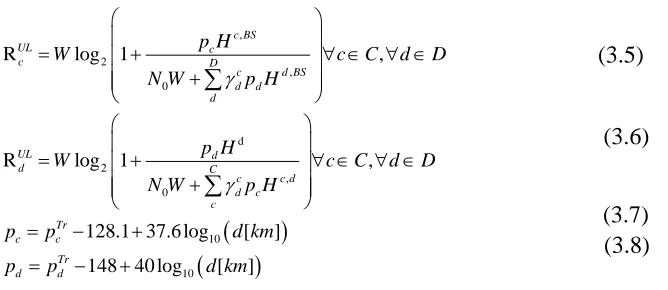
In the above equations, W is the bandwidth of each resource block and N0 is the Gaussian
noise power spectral density. pc and pd are the received powers in the BS and D2D-Rx,
respectively where pcTr and pdTr are cellular user and D2D-Tx transmit powers. These received powers have been calculated based on the path-loss model outlined in [53].
Since we have considered Rayleigh fading channel in our analysis, in equations (3.5) and
(3.6) Hi,j represents the magnitude of the complex Gaussian random variable CN(0,1) that
characterizes the fading effect on the channel between user i and user j, and hd represents
the channel between D2D-Tx and D2D-Rx.
Table 3: Types of Interference Channels
Type of Channel Abbreviation status
Communication channel state between BS
and cellular user CCS1 Known at the Base Station
Communication channel state between
D2D-Tx and D2D-Rx CCS2 Known at the D2D-Rx
Interference channel state between
D2D-Tx and BS ICS1 Unknown
Interference channel state between cellular
user and D2D-Rx ICS2 Unknown
(3.5)
(3.6)
3.2. System Model 29
29
3.2.2
Data-Rate and Delay Threshold Model
In this work, we exploit the concept of delay-tolerant networks in D2D communication,
which means each D2D pair can wait for a specific amount of time to get the spectrum
and start to communicate. This specific amount of time is determined by the required
application-level scenario of each D2D pair, and the service it needs. On the other hand,
cellular users rate is probabilistic due to the probabilistic nature of the channel, and
according to the optimization problem, cellular user data-rate is one of the constraints,
which should be met by the allocation algorithm. Therefore, finding the probability of
meeting the minimum data-rate threshold and relate it to the D2D pair’s delay threshold
helps us to find how many time slots are approximately needed to reach the threshold.
Now that Hi,j is a Rayleigh distributed random variable, we can calculate the pdf for RULc, and then we can find the probability of the minimum data-rate threshold that will be met after resource allocation. Let’s introduce new variables x and y as follows:
, , 0 1 , 1
c BS c
d d BS
x H d D
N B y H = = =
We can write:
0 c c D c d d d d
p x p x w
p y N B p y
=
+
Since we have two random variables x and y here, first we need to find their joint pdf and
then we need to evaluate the marginal pdf for w which is introduced in equation (3.10) as
a function of variables x and y. Here, we introduce a new variable z, and then construct
Jacobian matrix J as:
(3.8)
)
(3.9)
3.2. System Model 30 30
( )
( )
(
)
(
( ) ( )
)
1 2 1 1 2 2 2, , 1 2
, , , , , , | | c d c d d
z w x y
x z h x y
p z
y h x y
p w
h h
p p z
z w
J
h h p w
z w
f z w f h x y h x y J
= = = = = = − =
Due to the fact that Hc,BSandHd,BS are independent random variables, their joint pdf is
( )
( ) ( )
, ,
x y x y
f x y = f x f y
Then we can calculate marginal pdf of w from expression (3.12). Since z is always
positive according to expression (3.10), we can write:
( )
0( )
2c c d
w x y
d d
p z p p z
f w f z f dz
p w p w
+
=
where fw(w) is the pdf of Signal to Interference and Noise Ratio (SINR). Then expression
(15) can be written as:
( )
,
,
,
2 1
Pr[
]
Pr[
2
1]
UL c Th
UL Rc Th
B
R
UL UL B
c c Th
w
R
R
w
f
w dw
+
−
=
−
SinceHc,BSandHd,BSareRayleighdistributedrandomvariables,equation(3.15)canbe
evaluatednumerically.After we find this probability, we can relate it with the delay
threshold which is requested by a D2D pair and see whether it has any significant chance
to get the spectrum in the desired time or not. This new concept helps us to have an
3.3. Stable Matching 31
31
3.3
Stable Matching
The problem of matching arises when we have two finite population that want to be
matched. These two populations have relative preference over each other. The definition
of preference relation is as follows:
In set X, binary relation > satisfies the following properties:
• Every two members of X is comparable
• If x > y and y > z, the x > z which means the relation is transitive
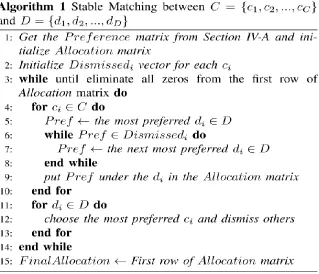
The simple form of the Stable Matching algorithm is when we have two finite sets with
an equal number of members. In order to match between two sets, one should follow
steps below to reach the stable matching. For simplicity, we use the example of two
groups of men and women who want to be matched based on their preference relation
with each other. The algorithm is as follows:
1- Every man stands in fronts of the woman he prefers most.
2- We ask every woman to choose the man she most prefers to stay and dismiss
others
3- Every dismissed man stands in front of the woman he most prefers who has never
dismissed him
4- Check if there is only one man in front of each woman and if not go to step 2
By following above algorithm, we reach a matching which is stable. Stable means there is
not any pair that both prefer each other but they are not already together.
3.4
Modified Stable Matching Theory
In a formal Stable Matching algorithm, there are two finite sets, which are equal in size.
Every individual member of each of these sets has preference over the members of the
3.5. Resource Allocation Procedure 32
32
Matching approach, which we employed in our work, sets are resource blocks and D2D
pairs, and the numbers of two sets are not equal, and yet we have those preference
relations for the members of each set by the other one. In order to solve this problem with
the assumption that the number of D2D pairs is less than the cellular users i.e. C > D, we
need (C − D) dummy D2D pairs to change the problem to the formal Stable Matching
definition. These dummy D2D pairs do not change anything in the final matching
scenario because they are least preferred pairs as seen by the cellular users. Formal Stable
Matching has two well-known approaches called women courtship and men courtship
[51]. The former one is better from the perspective of the women while the latter one is
the best for men. Here, we assume the cellular users and the D2D pairs play the roles of
men and women, respectively, and our matching approach is men courtship; therefore,
cellular users as men receive better matching based on their preference.
3.5
Resource Allocation Procedure
3.5.1
Channel States Gathering
CSI is one of the important parts of any resource allocation problem. In this work, we
assume distributed CSI to avoid reporting all the information to the BS. Based on the
consideration that the uplink resources are shared among the D2D pairs and the cellular
users, we have four types of channels that are summarized in Table 3. Essentially, we
need all this information in order to solve the maximizing sum-rate optimization problem
but gathering this information in one place requires overhead because it is distributed in
different locations. Unlike the centralized algorithm, we try to use distributed algorithm
to avoid gathering all the information at the BS. Each of these four types of channels will
be obtained as follows: CCS1 information is already known at the BS during
conventional communication between BS and the cellular user. During the activation
process, when D2D pairs are identifying each other, they can estimate the channel
between them. Therefore, CCS2 information is also known at the D2D pairs. In order to
estimate the ICS1, we know that during direct communication request, D2D-Tx should
3.5. Resource Allocation Procedure 33
33
this information for future use. The next step is to identify the ICS2. During each
scheduling interval, the BS broadcasts the information of C available resource blocks, so
after pairing process and before requesting direct communication, D2D-Rx starts
listening to the available channels and calculate the Received Signal Strength (RSS) from
each c ∈ C cellular users and then determines respective distances [11]. By using this
information, each D2D-Rx can make its own 1×C array representing its preference on
cellular users in descending order. By following the above procedure, all the required
information for calculating the system sum-rate is gathered. The frequency to update this
information is based on the mobility of devices.
3.5.2
Time of the Request for D2D Communication
One of the missing parts in previous works, discussed briefly in Section 3.1, is the time
of the D2D request. Each D2D pair requests data, based on the pdf. According to the
probability theory, two or more continuous events cannot happen at the same time;
therefore, only one request to be processed is received at any time by the BS. Processing
one request at a time decreases the efficiency of the resource allocation method because
of the probable decrease in the solution region of the optimization problem, which results
from the fact that it omits some possible solutions. To solve this problem, we consider a
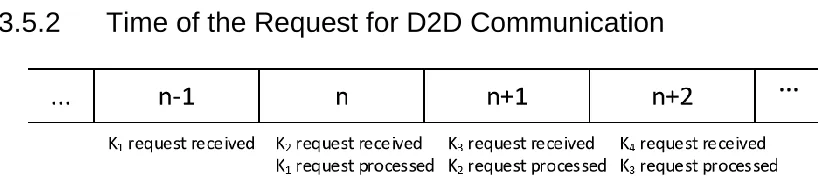
time-frame structure for requesting the D2D communication from the BS, so that every
D2D requests in the n-th frame is processed in the (n + 1)-th time slot. This frame
structure can be matched with the LTE frame structure, or it can be an independent frame
structure. Figure 6 shows the frame structure for collecting D2D communication request.