Available online:
http://edupediapublications.org/journals/index.php/IJR/
P a g e | 3286Electrodynamic Tether System for
Propellantless De-Orbiting
Sonia Chalia
1, Manish Kumar Bharti
21, 2
Department of Aerospace Engineering, Amity University Haryana
Abstract:
A key benefit of an electrodynamic tether system is the high peak power generation capability for a small impact in spacecraft mass and volume. By using electrodynamic drag to greatly increase the orbital decay rate, an electrodynamic tether system can remove spent or dysfunctional spacecraft from low Earth orbit rapidly and safely. Moreover, low mass requirements of such tether system make them highly advantageous compared to conventional rocket-based de-orbit systems. Electrodynamic tether
system offers the opportunity for in-space
“propellantless” propulsion around planets with a magnetic field and an ionosphere. To validate electrodynamic-tether thrusting, we must be able to demonstrate sustainable currents and effective methods of collecting and emitting electron current under varying ionosphere conditions. However, a tether system is much more vulnerable to space debris impacts than a typical spacecraft and its design must prove to be safe to a certain confidence level before being adopted for potential applications. The present study briefly reviews the concepts of various electrodynamic tether systems and benefits of using electrodynamic tether system as compared to conventional rocket propulsion systems. Risks imposed by electrodynamic tether system in space and on operating spacecraft/ international space stations has also been discussed.
Keywords
Propellantless propulsion, Orbit boosting, Debris removal, Power harvesting, Electromagnetic force
1. Introduction
The problems are compounded for exploration of outer planets such as Jupiter where distance from the sun makes photovoltaic power generation less effective and where every gram of fuel has to be transported hundreds of millions of kilometers. So scientists are taking a new look at an experimentally tested technology—the space tether—that exploits
some fundamental laws of physics to provide pointing, artificial gravity, electrical power, and thrust or drag while reducing or eliminating the need for chemical-energy sources.
Transporting a satellite from the lower elevation to its possible goal can run to a few thousand dollars for every kilogram of payload. The International Space Station, for example, will need an estimated 77 metric tons of booster propellant over its anticipated 10-year life span just to keep itself from gradually falling out of orbit. Even assuming a minimal price of $7,000 a pound to get fuel up to the station’s 360-kilometer altitude, that is $1.2 billion simply to maintain the orbital status quo. An electrodynamic tether is a distinctly different type of propulsion which provides cheap, lightweight, and reliable alternative to conventional rocket thrusters. It is a current-carrying wire that harnesses the force exerted by Earth's magnetic field. In essence, it is a clever way of getting an electric current to flow in a long conducting wire that is orbiting Earth, so that earth’s magnetic field will exert a force on and accelerate the wire and hence any payload attached to it. EDTs have been successfully demonstrated for propellantless propulsion, power generation onboard spacecraft orbiting the Earth (Harvesting), de-orbit and boost space craft or ISS, debris removal.
Harvesting of power and energy from the space environment offers the promise of reduction in fuel usage as well as extended mission lifetimes and/or enhanced system capability. Power levels on the order of 3.8 kW and a corresponding drag thrust of ~0.55 N were demonstrated on the TSS–1R. In addition, power generation and thrusting consume no expendables, which allows increased mission lifetime.
Available online:
http://edupediapublications.org/journals/index.php/IJR/
P a g e | 3287number of satellites has grown quickly, and as a result, the amount of orbital debris is growing rapidly. Because this debris is traveling at orbital speed (78 km/s), it poses a significant threat to the space shuttle, the International Space Station and the many satellites in Earth orbit. There are growing concerns that the accumulation of space debris is leading to environmental degradation in near-Earth space. In order to conserve the environment, it is very important to deorbit large artificial objects such as post-mission satellites and rocket upper-stages, since they pose a collision risk with other objects and with it the possible generation of countless smaller debris.
One method of removing a satellite from orbit would be to carry extra propellant so that the satellite can bring itself down out of orbit. However, this method requires a large mass of propellant and every kilo of propellant that must be carried up reduces the weight available for revenue-producing transponders. Moreover, this requires that the rocket and satellites guidance systems must be functional after sitting in orbit for ten years or more. Development in Electrodynamic Space-tethers may be as significant to future space development as rockets were to its beginnings. Tether propulsion is completely reusable and environmentally clean, provides all these features at low cost and requires no extra fuel.
There are risks and limitations associated using existing rocket fuels (Hydrogen peroxide, Kerosene, Nuclear energy), low thrust, cryogenic systems requirement, radiation by nuclear energy, emission from exhaust, spills or leaks or several hazardous problems, space needed for storage, few propellants give toxic vapors or fumes, prone to explosion and exhaust gases are usually toxic and time deterioration. An electrodynamic tether overcoming all such difficulties and risks with its unique features put forward is a better option. The goal of our study is to develop a better understanding of various concepts of EDT systems, benefits and risks associated with them.
2. Electrodynamic Tether Principle
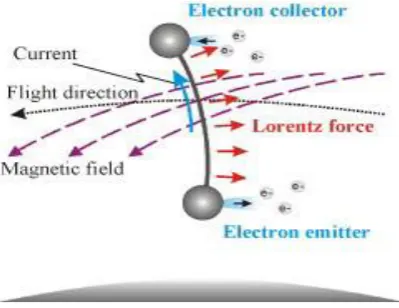
The basic principle to generate EMF across the electrodynamic tether is given by a Dutch physicist Hendrik Androon Lorentz that a moving electric charge experiences a force in a magnetic field and that force is known as Lorentz force. It exerts on a current carrying wire in a direction perpendicular to both the direction of current flow and the magnetic field vector as shown in figure 1.
This force is experienced by a current conductor in a magnetic field is due to the drifting of electrons
in it and following is the relation between Lorentz force, velocity of particle, charge of particle and magnetic field.
F = LvB sin θ
Where, F is the force acting on the particle, v is tether velocity relative to the geomagnetic field (m/s), L is the current length, B is magnetic field strength (webers/m2) and θ is the angle between V and B.
Figure 1: Generation on Lorentz force
Figure 2 shows Fleming’s left hand to figure out which way the force is acting. For a charged particle moving (velocity v) in a magnetic field (field B) the direction of the resultant force (force F) can be found by: middle finger of left hand in direction of current index finger of left hand in direction of field B, thumb now points in direction of the force or motion F. The force will always be perpendicular to the plane of vector v and B no matter what the angle between v and B is.
Figure 2: Fleming left hand rule
Available online:
http://edupediapublications.org/journals/index.php/IJR/
P a g e | 3288orbital velocity vector, thus slowing down the tether and effectively bringing it to a lower orbit
3. Electrodynamic tether concepts and
their working
Electrodynamic tethers (EDTs) are long conducting wires made from aluminum alloy and typically between 5 and 20 kilometers long. It extends downwards from an orbiting platform. Aluminum alloy is used since it is strong, lightweight, economical and effectively machined, work on electromagnetic principles, by changing over their dynamic vitality to electrical energy (as generators), and the other way around (as engines).
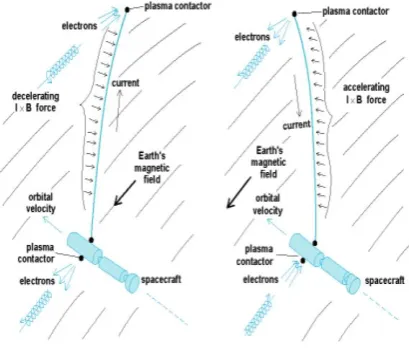
Electric potential is produced over a conductive tether by its movement through the Earth's attractive field. It can be utilized either to accelerate or decelerate an orbiting spacecraft as shown in figure 3. When direct current is pumped through the tether, it exerts a force against the magnetic field, and the tether accelerates the spacecraft.
Figure 3. Generation of electric potential across conductive tether
3.1 De-orbiting/ Debris removal
The tethers can be utilized to reduce the orbit of the spacecraft or to remove debris from space, if the system has methods for gathering electrons from the ionosphere plasma toward one side of the tether and ousting them back in to the plasma at the opposite end of the tether, the voltage can drive a current along the tether. This current, in turn, interacts with the Earth’s magnetic field to cause a Lorentz force, which will contradict the motion of the tether and its host craft. These electrodynamics drag power will decrease the orbit of the tether and its host craft. Basically, the tether changes over the orbital vitality
of the host shuttle in to electrical power, which is scattered as heating in the tether.
The region of low Earth orbit—from 200 to 2,000 kilometers above the surface has become littered with tens of thousands of objects, including defunct satellites, rocket motors, explosion debris and miscellaneous hardware. It takes decades to centuries for these objects to sink into the lower atmosphere, where they are incinerated by air friction. Deploying tethers on newly launched spacecraft would provide a simple and low-cost way to speed up that timetable. When Satellite reaches end of its design life and deploys tether and Tether produces drag, lowering the satellite’s altitude into denser layers of the atmosphere. Eventually drag induced by the tether lowers the satellite to an altitude sufficiently low that it rapidly falls into the lower atmosphere and burns up on reentry.
3.2 Orbit boosting
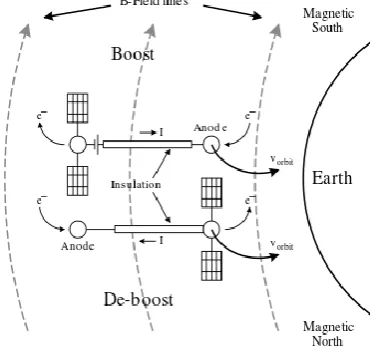
Figure 5 representing Boost and De-boost mechanism using an electrodynamic tether. The gravity slope field will tend to arrange the tether in a vertical position. On the off chance that the tether is orbiting around the Earth, it will cross the earth magnetic field at orbital speed (7-8 km/s) through the atmosphere ionosphere plasma and long aluminum wire extracts electrons from the plasma at the end farthest from the payload and carries them to the near end.
The movement of the conductor over the magnetic field prompts a voltage along the length of the tether. The voltage therefore made along its length can be up to a few hundred volts for every kilometer and used to drive current toward the path inverse to what it typically needs to stream; the tether can push against the Earth's magnetic field to raise the shuttle's orbit. The real preferred standpoint of this method contrasted with the other space impetus system is that it doesn't require any fuel. It utilizes Earth's magnetic field as its response mass. By wiping out the need to dispatch a lot of force in to orbiting, electrodynamic tethers can enormously lessen the cost of in-space drive.
3.3 Generation of onboard power
Available online:
http://edupediapublications.org/journals/index.php/IJR/
P a g e | 3289jumble of electrons and ions, called a plasma. The tether collects free electrons at one end (the anode, or positively charged electron attractor) and ejects them at the opposite end (the cathode, or negatively charged electron emitter). The electrically conductive ionosphere serves to complete the circuit, and the result is a steady current that can be tapped to use for onboard power.
Figure 5: Boost and De-boost mechanism
4. Benefits of electrodynamic tether
The major advantage of the tether technology compared to other propulsion systems is that it
Does not require any propellant.
a typical electrodynamic tether system, weighting about 30-50 kg, can achieve de-orbit of spacecraft requiring only a few percent (1-5%) of the carrier vehicle mass at launch whereas, chemical thrusters need a mass allocation that is a significant fraction (10-20%) of the total mass to be disposed of. Substantially reduce the weight of the spacecraft.
Eliminating the need to launch and store in orbit for many years a large amount of propellant, electrodynamic tethers can greatly reduce the cost and improve the reliability of in-space propulsion and operations.
Faster de-orbit of spacecraft or debris, a few weeks or months only from LEO, than the decay under the influence of the atmospheric drag alone and eliminates collision threat of debris to other operational spacecraft.
High efficiency and good adaptability to varying plasma conditions.
A cost effective method of re-boosting spacecraft
It is reusable
5. Risks of using electrodynamic tether
Tethers are usually very long and thin, providing increased opportunities for something to go wrong.
The accidental tether severing may be due to a number of causes including
Manufacturing defects, system malfunctions, material degradation, vibrations, and contact with other spacecraft elements.
EDTs have a tendency to build up vibrations from the variations in the Earth’s magnetic field. Unless these vibrations are damped, the tether will eventually fail from mechanical stress. One way to prevent excessive vibrations is to install radio or inertial sensors in the tether, and vary the current in it suitably to damp out the oscillations
Much greater risk than debris to operating satellites due to their considerably large collision cross-sectional area.
Because of their small diameter, tethers of normal design may have a high probability of being severed by impacts with relatively small meteoroids and orbital debris. The resulting tether fragments may pose additional risks to operating spacecraft.
The risk of impact with the largest space objects, typically spacecraft and upper stages, cannot be reduced by modifying the tether design or increasing the tether diameter. Tether-tether Collisions is of great concern
when many long tethers were put in space at the same time
Available online:
http://edupediapublications.org/journals/index.php/IJR/
P a g e | 3290and out-of-plane directions. Due to coupling between the in plane motion and longitudinal elastic oscillations, as well as coupling between in-plane and out-of-plane motions, an electrodynamic tether operated at a constant current will continually add energy to the liberation motions, causing the libration amplitudes to build until the tether begins rotating or oscillating wildly. In addition, orbital variations in the strength and magnitude of the electrodynamic force will drive transverse, higher-order oscillations in the tether which can lead to the unstable growth of "skip-rope" modes.
6. Conclusion
As electrodynamic tethers can provide long term propellant- less propulsion capability for orbital maneuvering and station keeping of small satellites in low earth orbit, these are preferable compared with the existing rocket propulsion system. Also EDTs may provide an economical means of electrical power in orbit. Hence electro dynamic tethers play a key role for satellite communication system.
Development of a propellant free, electrodynamic tether propulsion system would make it possible to put a long term probe in Jupiter's orbit - one that could leverage the planet's powerful magnetic field and magneto sphere to travel freely among the Jovian moons, providing more information and new insight about them as well. A concept developed by Tethers Unlimited wherein several rotating tethers in orbit around the earth and moon may provide a means of exchanging supplies between low Earth orbit facilities and Lunar bases without requiring the use of propellants.
Electrodynamic tether now becoming the most popular fuel carrier for space crafts. The use of space tethers is the answer to all the current problems as they don’t require propellants. ED tethers can provide long-term propellant less propulsion capability for orbital maneuvering and station keeping of small satellites in Low-Earth-orbit. ETDs are opening new doors in space explorations.
Tethers in space confronting problems like collision with space debris tether-tether collision and collision with operating spacecraft. Most of these causes can be prevented through design, quality check and active control of the tether dynamics and stability during the mission. Therefore, before electrodynamic tethers can be used to mitigate the problem of orbital debris, evaluate the impact of tethers on the space environment, i.e. to determine
the tether collision risk with operating spacecraft, the risk posed by the tether remnants after severing, the chance of collision among the tethers themselves, evaluate the risk for a tether of being cut during the mission by orbital debris and meteoroids.
References
[1] M.L. Cosmo, E.C. Lorenzini, Tethers in Space Handbook, 3rd ed., NASA, 1997.
[2] Lorenzini, E., Sanmartin, J. “Electrodynamic Tethers in Space.” Scientific American. Aug 2004.
[3] Beletskii, V.V., Levin, E.M., Dynamics of Space Tether Systems, Vol. 83 in Advances in the Astronautical Sciences, 1993.
[4] Forward, R.L., Hoyt, R.P., Uphoff, C., Application of the Terminator Tetherª Electrodynamic Drag Technology to the Deorbit of Constellation Spacecraft, AIAA Paper 98-3491, 34th Joint Propulsion Conference, July 1998.
[5] B.S. Yu, D.P. Jin, Deployment and retrieval of tethered satellite system under J2 perturbation and heating effect, Acta Astronautica, 67, (2010) 845-853.
[6] Hoyt, R.P., Forward, R.L., The Terminator Tetherª: Autonomous Deorbit of LEO Spacecraft for Space Debris Mitigation, 38th Aerospace Sciences Meeting & Exhibit, 10-13 January 2000, Reno, NV.
[7] A.K. Mishra, Dynamics and control of tethered satellite systems, Acta Astronautica, 63, (2008) 1169-1177
[8] Johnson, L, Herrmann, M., International Space Station Electrodynamic Tether Re-boost Study, NASA, Program Development Directorate, NASA/MSFC, July 1998
[9] Pelez, J, et al., A New Kind of Dynamic Instability in Electrodynamic Tethers, Paper AAS 00-190 in AAS/AIAA Space Flight Mechanics Meeting, 23-26 January 2000. [10]Tether Propulsion.” 20 Sept 2006.
<http://en.wikipedia.org/wiki/Space_tether [11]Larson, Wiley J., and James R. Wertz, eds.
Space Mission Analysis and Design. New York: Springer, 2006
Available online:
http://edupediapublications.org/journals/index.php/IJR/
P a g e | 3291[13]Z. H. Zhu and Rui Zhong, Deorbiting Dynamics of Electrodynamic Tether, International Journal of Aerospace and Lightweight Structures, 1, 47-66, 2011
[14]Nishid, S. I. et al. [2009] “Space Debris Removal System Using a Small Satellite,” Acta Astronautica 65(1–2), 95–102.
[15]Jablonski, A. M. and Scott R. [2009] “Deorbiting of microsatellites in Low Earth Orbit(LEO) — An Introduction,” Can. Aeronaut Space Journal 55(2), 55–67.
[16]Fujii H. [2010] “Tether technology for space solar power satellite and space elevator,” Proceedings of 61th International Astronautical Congress of the International Astronautics Federation, Prague, Czech Republic, IAC Paper 10–D4.3.3