© 2014, IJCSMC All Rights Reserved 102 Available Online atwww.ijcsmc.com
International Journal of Computer Science and Mobile Computing
A Monthly Journal of Computer Science and Information Technology
ISSN 2320–088X
IJCSMC, Vol. 3, Issue. 11, November 2014, pg.102 – 115
RESEARCH ARTICLE
Comparison of Classifiers in Data Mining
Gaurav Taneja
1, Ashwini Sethi
2Department of Computer Science, Guru Kashi University, Talwandi Sabo (Bathinda)
[email protected], [email protected]
Abstract: Hepatitis virus infection substantially increases the risk of chronic liver disease and hepatocellular carcinoma in humans and also affects majority of population in all age groups.
It is the major challenge for many hospitals and public health care services for diagnosing hepatitis. Accurate diagnosis and exact prediction of the disease on time can save many patients life and there health. Hepatitis viruses are the most common cause of hepatitis in the world but other infections, toxic substances (e.g. alcohol, certain drugs), and autoimmune diseases can also cause hepatitis. Using Data mining which is a effective tool to diagnose hepatitis and to predict result. This paper review the many data mining techniques which diagnosis hepatitis virus. I will compare three algorithms. All algorithms use different mechanism. I will analyze the result of all and will conclude the algorithm which gives the maximum accuracy for detection of hepatitis.
Keywords-Hepatitis, Data Mining, NB TREE, NAÏVE BAYES, SMO, Weka Tool
Introduction
1.
Naive Bayesian classification
© 2014, IJCSMC All Rights Reserved 103
A) Each data sample is represented by an n-dimensional feature vector, X = (x1, x2,…….. xn), depicting n measurements made on the sample from n attributes, respectively A1,A2,….An.
B) Suppose that there are m classes, C1, C2, ……Cm. Given an unknown data sample, X (i.e., having no class label), the classifier will predict that X belongs to the class having the highest posterior probability, conditioned on X. That is, the naive Bayesian classifier assigns an unknown sample X to the class Ci if and only if :
Thus we maximize P(CijX). The class Ci for which P(CijX) is maximized is called the maximum posteriori hypothesis. By Bayes theorem
c) As P(X) is constant for all classes, only P(X/Ci)P(Ci) need be maximized. If the class prior probabilities are not known, then it is commonly assumed that the classes are equally likely, i.e. P(C1) = P(C2) = ……..= P(Cm), and we would therefore maximize P(X/Ci). Otherwise, we maximize P(X/Ci)P(Ci). Note that the class prior probabilities may be estimated by P(Ci) = si/s , where si is the number of training samples of class Ci, and s is the total number of training samples.
© 2014, IJCSMC All Rights Reserved 104
The probabilities P(x1/Ci), P(x2/Ci)…….. P(xn/Ci) can be estimated from the training samples.
Bayesian belief classification:
The naive Bayesian classifier makes the assumption of class conditional independence, i.e., that given the class label of a sample, the values of the attributes are conditionally independent of one another. This assumption simplifies computation. When the assumption holds true, then the naive Bayesian classifier is the most accurate in comparison with all other classifiers. In practice, however, dependencies can exist between variables. Bayesian belief networks specify joint conditional probability distributions. They allow class conditional independencies to be defined between subsets of variables. They provide a graphical model of causal relationships, on which learning can be performed. These networks are also known as belief networks, Bayesian networks, and probabilistic networks.
2.
SMO (Sequential Minimal Optimization
)
© 2014, IJCSMC All Rights Reserved 105
into QP sub-problems, using Osuna’s theorem to ensure convergence. Unlike the previous methods, SMO chooses to solve the smallest possible optimization problem at every step. For the standard SVM QP problem, the smallest possible optimization problem involves two Lagrange multipliers, because the Lagrange multipliers must obey a linear equality constraint. At every step, SMO chooses two Lagrange multipliers to jointly optimize, finds the optimal values for these multipliers, and updates the SVM to reflect the new optimal values. The advantage of SMO lies in the fact that solving for two Lagrange multipliers can be done analytically. Thus, numerical QP optimization is avoided entirely. The inner loop of the algorithm can be expressed in a short amount of C code, rather than invoking an entire QP library routine. Even though more optimization sub-problems are solved in the course of the algorithm, each sub-problem is so fast that the overall QP problem is solved quickly.
In addition, SMO requires no extra matrix storage at all. Thus, very large SVM training problems can fit inside of the memory of an ordinary personal computer or workstation. Because no matrix algorithms are used in SMO, it is less susceptible to numerical precision problems. There are two components to SMO: an analytic method for solving for the two Lagrange multipliers, and a heuristic for choosing which multipliers to optimize.
3.
NBTree (The Hybrid Algorithm)
© 2014, IJCSMC All Rights Reserved 106
TERMINOLOGY
Imagine a study evaluating a new test that screens people for a disease. Each person taking the test either has or does not have the disease. The test outcome can be positive (predicting that the person has the disease) or negative (predicting that the person does not have the disease). The test results for each subject may or may not match the subject's actual status. In that setting:
True positive: Sick people correctly diagnosed as sick
False positive: Healthy people incorrectly identified as sick
True negative: Healthy people correctly identified as healthy
False negative: Sick people incorrectly identified as healthy
HEPATITIS DATASET
It contains 153 instances and 20 attributes, in which 9 instances are having missing values. It is a health care dataset. It has been taken from UCI Machine Repository(source). The fields (attributes) name are…..
AGE
SEX
STEROID
MALAISE
PROTIME
HISTOLOG
CLASS (LIVE/DEAD) etc.
And instances are like-(42,female,yes,no,yes,no,no,yes,yes,………..0.9,0.2,80,dead)
© 2014, IJCSMC All Rights Reserved 107
Name Type
1-)AGE 2-)SEX 3-)STEROID 4-)ANTIVIRALS 5-)FATIGUE 6-)MALAISE 7-)ANOREXIA 8-)LIVER_BIG 9-)LIVER_FIRM 10-)SPLEEN_PALPABLE 11-)SPIDERS 12-)ASCITES 13-)VARICES 14-)BILIRUBIN 15-)ALK_PHOSPHATE 16-)SGOT 17-)ALBUMIN 18-)PROTIME 19-)HISTOLOGY 20-)Class integer { 2, 1} { 1, 2} { 2, 1} { 2, 1} { 2, 1} { 2, 1} { 1, 2} { 2, 1} { 2, 1} { 2, 1} { 2, 1} { 2, 1} real integer integer real integer { 1, 2} { DIE, LIVE}
© 2014, IJCSMC All Rights Reserved 108
Data set used for example
RESULTS
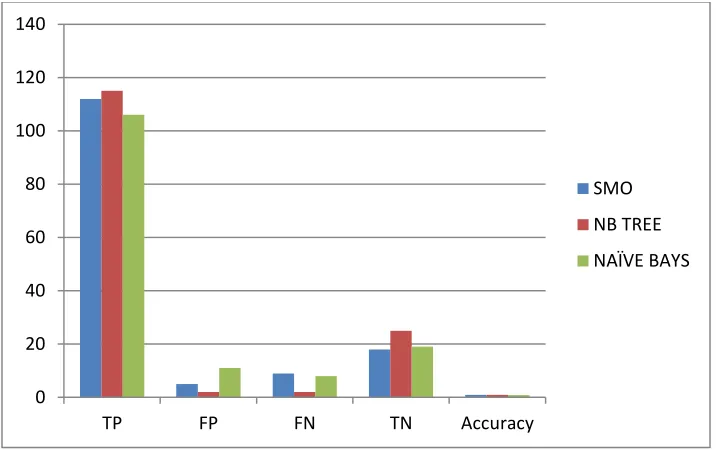
(A) Table: 1 ACCURACY OF BINARY CLASSIFIERS
Parameters SMO NB TREE NAÏVE BAYES
TP 112 115 106
FP 5 2 11
FN 9 2 8
TN 18 25 19
© 2014, IJCSMC All Rights Reserved 109
FIGURE 1: TP/FP/FN/TN/Accuracy of Classifiers
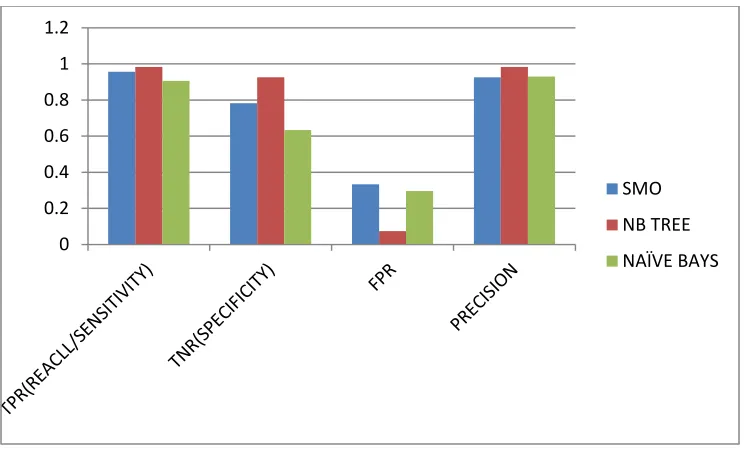
(B) Table 2: LIVE Class - Precision/TPR/TNR/FPR
Parameters SMO NB
TREE
NAÏVE BAYES
TPR(Recall/Sensitivity) 0.957 0.983 0.906 TNR(Specificity) 0.7826 0.9259 0.6333 FPR 0.333 0.074 0.296 PRECISION 0.926 0.983 0.93
Please note that all the values shown above in tables have been obtained by applying mentioned classification techniques in weka.
0 20 40 60 80 100 120 140
TP FP FN TN Accuracy
SMO
NB TREE
© 2014, IJCSMC All Rights Reserved 110
Figure 2: Bar chart showing parameters among classifiers
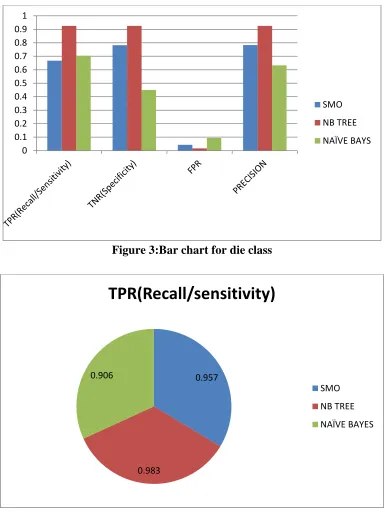
Table 3: DIE Class Precision/TNR/TPR/FPR
Parameters SMO NB TREE NAÏVE
BAYES
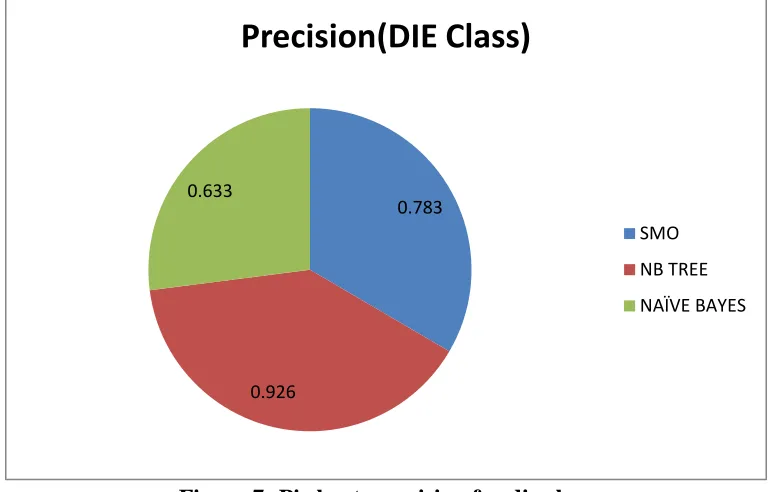
TPR(Recall/Sensitivity) 0.667 0.926 0.704 TNR(Specificity) 0.7826 0.9259 0.45 FPR 0.043 0.017 0.094 PRECISION 0.783 0.926 0.633
0 0.2 0.4 0.6 0.8 1 1.2
SMO
NB TREE
© 2014, IJCSMC All Rights Reserved 111
Figure 3:Bar chart for die class
Figure 4: Pi chart for Live Class Sensitivity(TPR)
0 0.1 0.2 0.3 0.4 0.5 0.6 0.7 0.8 0.9 1
SMO
NB TREE
NAÏVE BAYS
0.957
0.983 0.906
TPR(Recall/sensitivity)
SMO
NB TREE
© 2014, IJCSMC All Rights Reserved 112
.
Figure 5: Pi chart showing TPR(Recall/Sensitivity) for DIE Class
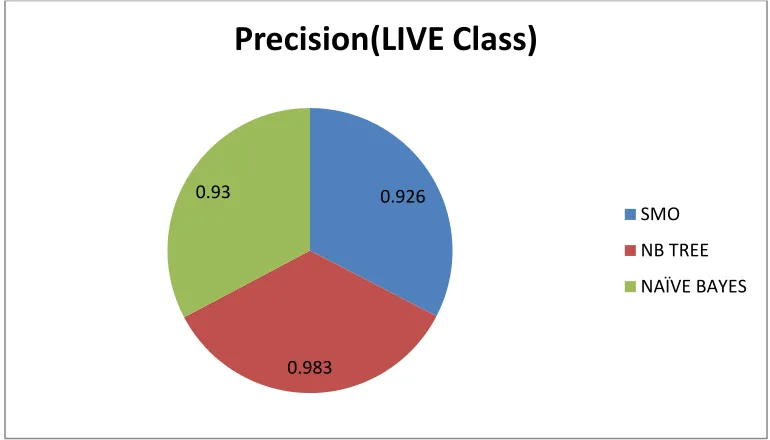
Figure 6: Pi chart showing precision for live class (Hepatitis)
0.667
0.926 0.704
TPR(Recall/Sensitivity)
SMO
NB TREE
NAÏVE BAYES
0.926
0.983 0.93
Precision(LIVE Class)
SMO
NB TREE
© 2014, IJCSMC All Rights Reserved 113
Figure 7: Pi chart precision for die class
OBSERVATION:
It has been observed (from Table :1 )that TP and TN values of NB Tree are high than other classifiers, which is a desirable point,
The accuracy of NB Tree (0.9722) is high in compare to SMO and NAÏVE BAYES Classification algorithms, which is a important point during classification of Hepatitis patients, we may easily guess that NB Tree is quite sufficient to judge Hepatitis symptoms.
It is giving very less false positive, it has shown only 2 out of 153 instances which is a desirable point.
TPR (Recall/Sensitivity) is high(0.983) than others i.e. there are very few chances of Disease undetection, means maximum cases have been detected(refer Table:2,3).
Since TNR(Specificity) of NB Tree is high(0.9259),means this algorithms has given maximum true result, means very few patients will be labled as sick(refer table:2,3).
0.783
0.926 0.633
Precision(DIE Class)
SMO
NB TREE
© 2014, IJCSMC All Rights Reserved 114
In ideal condition FPR should be zero,NB Tree has only 0.074 false positive rate which indicates that this algorithm does very minor mistake to judge Heaptitis, means most of the time it has given true result.
Precision answers that" how likely it is that patients have the disease, given that there test’s results were positive”?,from table2 and 3 we can say that precision of NB Tree is high which shows that results are positive out of all positive results however result is affected as number of Hepatitis patients increases time to time in world.
According to experiments and results in this work ,NB Tree gives a satisfying and promising results for the task of classification of class label (LIVE/DIE) in Hepatitis dataset in Healthcare industry. It gives better result in both cases(live class as well as die class).
CONCLUSION
According to above classification techniques result, we can find the best technique for our hepatitis dataset by comparing output of confusion matrix and summary statistic. So the following results are achieved,
Name of the algorithm Summary Confusion Matrix
SMO Correctly Classified Instances
130 90.2778 %
Incorrectly Classified Instances
14 9.7222 %
Ignored class unknown instance 2
a b
112 5 | a = DIE
9 18 | b = LIVE
NB TREE Correctly Classified Instances
140 90.2222%
Incorrectly Classified Instances
4 2.7772 %
Ignored class unknown instances 2
a b
115 2 | a = DIE
© 2014, IJCSMC All Rights Reserved 115
NAÏVE BAYES Correctly Classified Instances
125 86.8056 %
Incorrectly Classified Instances
19 13.1944 %
Ignored class unknown instances 2
a, b
106 11| a = DIE
8 19 | b = LIVE
From above conclusion we can say that NB Tree gives the more efficient result than others classifiers .But we may get also more promising result by applying other classifiers.
References
1. Data Mining concept and Techniques jiawei Han and Micheline Kamber :2000,Simon Fraser University
2. Dr. Varun Kumar, 2Luxmi Verma Department of Computer Science and Engineering, ITM University, Gurgaon, India.” Binary Classifiers for Health Care Databases: A Comparative
3. Study of Data Mining Classification Algorithms in the Diagnosis of Breast Cancer” IJCST Vol. 1, Issue 2, December 2010, I S S N : 2 2 2 9 - 4 3 3 3 ( P r i n t ) | I S S N : 0 9 7 6 - 8 4 9 1 (On l i n e ) 4. Sequential Minimal Optimization: A Fast Algorithm for Training Support Vector Machines
John C. Platt Microsoft Research [email protected] Technical Report MSR-TR-98-14 April 21, 1998 © 1998 John Platt
5. Wikipedia NAÏVE BAYES CLASSIFIER:www.wikipedia.org/en/classification.htm
6. An Introduction to the WEKA Data Mining System Zdravko Markov Central Connecticut State University [email protected] Ingrid Russell University of Hartford [email protected]
7. uci machine repository for dataset: http://www.ics.uci.edu/~mlearn/databases/hepatitis/hepatitis.names Web Documents: About Hepatitis domain database
8. Benchmark results of Naive Bayes implementations (http:/ / tunedit. org/ results?d=UCI/ & a=bayes) 9. http://wekadocs.com/node/6 Web Documents: WEKA Software