P a g e | 3991
Analysis of Entrepreneurial Traits: Evolution
and growth process of MSMEs
Supriyo Das & Dr. Amit Kundu
Department of Business Management, Calcutta University
Department: School of Management Studies, Techno India
Abstract:
The rising interest and awareness on entrepreneurship has become a regular topics discussed among academician and politician for its unique impact on society and economy. Nowadays many governments speak about the entrepreneurial ecosystem. The entrepreneurial ecosystem refers to all elements that help or hinder a person to become an entrepreneur or the possibility to achieve success. In light of the broader impact of reforming the entrepreneurial ecosystem, and the necessity of a greater impact of the SME sector, it seems relevant to study the role of entrepreneur’s ability to reform entrepreneurial ecosystem as the ecosystem is mainly controlled by the entrepreneur himself. The significance of entrepreneurial traits is becoming more visible in the present dynamic, complex and challenging global economic environment but there is no easy prescription to construct uniform entrepreneurial traits that would lead to enterprise success. Entrepreneurial environment and activity is also rapidly changing due to globalization and other external variables. Accordingly there is emergence to revisit the entrepreneurial traits. For this it is essential to know how these traits interact with external variable of environment and organization. Different scholars have attempted to find out significant traits of entrepreneur but the aim of the present study is to build up a conceptual model to realize the contentious interaction of traits with internal and external business environment. It is no longer possible to depend exclusively any one theory to predict growth and sustainability of firm .For this we must understand the complex and interdependent relationships between the entrepreneurs’ personality and business atmosphere in which the firm operates thus we can construct an entrepreneurial index. So
this paper is mainly focused on essential traits of entrepreneur at different stages and its role to combat with obstacles which keep us one step ahead to develop universal entrepreneurial index and reform entrepreneurial ecosystem
Keywords - Entrepreneur, Personal Traits, Dimensions, Sustainability, MSME Sector,
I.
INTRODUCTION
Currently Government of developed and developing countries taking interest to give emphasis on MSME sector because of its deep rooted impact on society. This vibrant and dynamic sector is the main instrument to reduce poverty mainly focusing on youth by giving them employment. MSME sector not only lay foundation of society but also indirectly reduce social unrest, reduce problem of digressed labour, increase standard of living in rural area, develop infrastructure etc. Different countries are giving focus on this sector because of some specific purpose like establishing enterprise culture is the centre purpose of Britain, assisting minorities and to develop alternatives to stagnant sector of economy is the main propose of Canada, some country like Malawi focused on MSME to develop their self dependency and reduce export, rural transformation is the primary objective of Sierra Leone to promote MSME. State like Nigeria promotes MSME to encourage independence and self employment. [52]
I.
Global scenario of
Micro-Small-Medium Enterprises (MSME)
Sector:
Available online:
https://edupediapublications.org/journals/index.php/IJR/
P a g e | 3992 problems. According to a report by InternationalFinance Corporation (IFC), 2012-13 that conducted a study of 132 countries, there are about 125 million MSMEs worth an estimated 85 million in emerging economies. MSMEs are the largest employment generators globally, with MSMEs in high-income economies employing at least 45 per cent of the workforce. A 2014 report from the Bank for International Settlements found that in the non-government sectors of advanced economies, MSMEs account for over 95 percent of the total number of enterprises, 60 percent of total employment and over 50 percent of value added. On average, 51 percent of the GDP in high-income countries is produced by formal MSMEs. In the United States, 99 percent of all enterprises are MSMEs, and they employ over 50 percent of private sector employees and generate 55 percent of net new private sector jobs. Similarly, in the United Kingdom 99.9 percent of enterprises are MSMEs, and they employ over 60 percent of all private sector employees.
The influence of MSMEs remains significant in low-income countries, although their impact is harder to measure because of higher levels of informal MSMEs. An estimated 16 percent of GDP in low-income countries is produced by formal MSMEs, and the informal MSME sector contributes about 40 percent of GPD. In specific countries, the impact of MSMEs on GDP is evident – in Morocco, for example, 93 percent of industrial firms are MSMEs, accounting for 38 percent of the production, 33 percent of investment and 30 percent of exports, and in South Africa an estimated 91 percent of the formal business entities that are MSMEs contribute 52-57 percent to GDP. In Ghana, MSMEs contribute about 70 percent to the country‟s GDP.22 Overall, an estimated 33 percent of employment in developing countries comes from formal MSMEs.
Though Small and Medium sized enterprises (SMEs) represents the backbone of an economy but very common problem of SMEs are the sensitivity related
to any kind of change in market. Changed competitive environment due to globalization put them in to the field of new level of challenges and also forced them to follow the trends of market with contentious searching for new markets, new product and adopt new process.
II.
BACKGROUND OF THE
STUDY
Most research in the entrepreneurship field has focused on the persons having enterprises finding out the answer that why certain individual fails while other successes very much in the similar condition. For in depth analysis of this condition many researcher focused on a basic question „what are the specific organization creation skill that entrepreneur need to know.
Different scholars have mentioned that there are more than one type of entrepreneur and those need different skills and process that require theoretical explanation. In deed hundred of studied shown that size is an important determinant of organization process and performance. We will concentrate on small business and find out relationship between entrepreneur trait and firm performance.
Reference [13] indicated the success factors of new venture as follows: a) three environmental variable (Dynamism, munificence and complexity) to create an environmental factor b) four strategic variable (strategic focus, low cost, innovation and quality deference) and c) ten personal characteristics to create trait skill motivation composite .In the past researches, different types of trait have been identified, grouped and also shown positive or negative impact on firm‟s performances. In case of some entrepreneur it is easy to understand business because of some external factors like education, family, culture, religion etc.
It is our contention that the complexity inherent to the entrepreneurial traits has been ignored previously by
Table 1: MSME Country Indicators
Country Name Year
GNI per Capita, Atlas Method
Size Breakdown
(% of all MSMEs) Number of MSMEs
MSME Participation in the Economy
Micro Small Medium Micro SMEs Total
MSMEs
MSMEs per 1,000
people
MSME employment
(% total)
Brazil 2007 6,060 89.4 9.3 1.3 3,492,347 415,473 3,907,820 20.6 25.3
Russia 2008 9,660 78.2 20.8 1.0 1,065,016 296,821 1,361,837 9.6 19.9
India 2007 950 95.1 4.7 0.2 1,475,681 76,811 1,552,492 1.4 2.2
China 2009 2,940 0.0 90.0 10.0 NA 10,231,000 10,231,000 7.7 80.0
South Africa 2004 3,630 90.7 7.7 1.6 1,632,890 167,110 1,800,000 38.8 60.0
P a g e | 3993 the policy makers in their rush to show better
entrepreneurial environment. The predicament is reinforced by the report published by International Finance Corporation (World Bank Group), 2010 on the MSME status of BRICS countries and it has been found that India was lagging far behind than BRICS nation (Ref Table 1). An attempt has been made by the present researchers to formulate a complete entrepreneurial index considering personality traits, which would be helpful for entrepreneur‟s mapping. Environmental and most importantly, organizational factors should also take into consideration for the construction of entrepreneurial index. Then, it would be possible to identify critical success factors (CSF) which are instrument to explain the variation of the efficiency of the enterprises in the context of MSME sector.
III. ORIGIN OF THE PROBLEM
A research gap exists in identifying the entrepreneurial traits which differentiate them from non entrepreneur and the level of impact of the identified traits on the success of the business. An exhaustive study of identifying entrepreneurial traits for global context specifically for the developing nation like India is outmost necessary to develop a conceptual framework which will lead to estimate the enterprising index and entrepreneur ecosystem in future research.
IV.
RESEARCH OBJECTIVE
An attempt has been made in this paper to identify all the possible personality traits of entrepreneur which differentiate them from non entrepreneur derived from literature and empirical research. An in depth study has also been made to identify the dominant variables out of all possible traits that have an influence on the performance of MSME. Ultimately, in this paper, we put forward an integrated model of entrepreneurial traits which incorporates the dominating variables and their linkages that have an impact on organization performance.
IV. ENTREPRENEURIAL TRAITS
Identification of Basic Traits
A.
Adding values and solving Problems
efficiently with innovative Ideas.
Entrepreneurs have characterized as creative thinkers [30] and people who show creativity in problem solving and overcome obstacle [46, 59] describes entrepreneurship as a driver of market based system. In other words an important function of enterprise
was to create something new which resulted in process that served as impulse for the motion of market economy. Entrepreneurship is defined as a process of creating something different with value by deploying the necessary time and effort assuming the various factors such as physical, financial and social risk for reward of monetary and personal satisfaction [38]. Reference [59, 29] argued that innovative behaviour is a core characteristic of entrepreneurs. Moreover, innovative strategies were described to be successful particularly for small enterprises because they are seen as useful attempts to maintain market share, to produce below price level or to maintain flexibility. So one trait associated with successful entrepreneurs is creativity [16] and entrepreneurial ventures are often characterized by innovation (both in the products of these firms and of those who produce them).So innovativeness play an important role for venture success. Innovativeness is one kind of behaviour that characterizes entrepreneurship and entrepreneurial orientation [31]. By definition entrepreneurs are always looking for new opportunities [76]. Reference [29] for example, claimed that innovation is the major tool of entrepreneurship. In his view, innovation is a systematic search for the changes as opportunities for new markets, products, or ideas [24, 66, and 72]. Like did many authors in the literature [66] argue that innovation is inherent in the role of entrepreneurship and it can separate “entrepreneurs” from “managers”. In the study by [69] innovativeness, also, has been taken as a major characteristic in defining the entrepreneurship profile. Reference [29] discusses the role of the entrepreneur in the process of economic development at length. The entrepreneur as a creative driven individual who finds new combinations of [factors] of production” to develop a new product, corner a new market, or design a new technology though small scale industry is suffering with the problem of financial crunch, so at this juncture Innovation activity is enhanced and dependent upon cooperation with other organization and collaboration between industry and academia should be enhanced to improve the innovation capacity [25]
B.
Recognize and analyze opportunity
and gain market power by social
networking
Available online:
https://edupediapublications.org/journals/index.php/IJR/
P a g e | 3994 definition of Entrepreneurship stated that it is animportant mechanism whereby the community converts the technical information into product and service; it shows a long process whereby economic efficiency is achieved in a specific time and place. According to [63] , an individual may have the ability to recognize that a given entrepreneurial opportunity exist but might lack of social connection to transform the opportunity into business start up and through access to a large social networks might help to overcome this problem. Past research studies indicated that some persons are more able to recognize and exploit opportunity than others because better access of information and knowledge [5, 62, and 7] and to access more information it is necessary to build up strong networks. Burt (1992) has shown how entrepreneurs‟ chances of success are determined by the structure of their networks. Individual entrepreneurs with deep structural holes in their networks that is, an absence of contact redundancy and substitution increase their chances of successfully identifying and optimizing entrepreneurial opportunities because they are central to and well positioned to manipulate a structure that is more likely to produce higher levels of information. Networking helps small entrepreneur to gain some market power. As market power is always enjoyed by big companies most of the time they impose their terms and conditions to SME‟s. Researchers have also defined entrepreneurship in sociological viewpoint. Reference [54] has identified four social contexts that relate to entrepreneurship opportunity. The first one is social network. Here the focus is on building social relationship and bond that promote trust and not opportunism.
C.
Planned move by managing human
resource
through
tenacity,
or
perseverance
The role of vision is central in entrepreneurship. Reference [36] defined entrepreneurial vision attributes which are brevity, clarity, abstractness, challenge, future orientation, stability, and desirability or ability to inspire and contents (growth imagery) are related to new venture growth [12].To fulfil the vision proper planning must be done and planning has been one of the fundamental components of the managerial process-planning, organizing, directing/leading, and controlling [41]).Making vision oriented plan considering all possible constrains and competition is not only reflection on ones expertise but also evidence of strong analytical ability. It is the first step to defeat competitor and for doing this entrepreneur must have clear vision and complete understanding about field of operation.
Clearly, entrepreneurs have a strong need for careful planning in addition to the avoidance of biases identified in the cognitive phase of entrepreneurship research [19]
Entrepreneurship is not only an individual act but it also covers the act of groups and institutions [64] which involve planned moves and aims to impact individual environment .Here researchers found that entrepreneurs must able to work within groups. Different management scientists have noted different reasons responsible for the success of entrepreneurial venture. While [27] gave importance to discussions and interpretations for development of opportunities .Many scholars‟ related Human Resource management and Performance in Manufacturing setting.
Tenacity, or perseverance, is a trait that involves sustaining goal-directed action and energy even when faced with obstacles. In addition to being associated with successful leadership [10, 39, 44], tenacity has been identified.
D.
Strong Risk taking attitude to combat
the competitors
Reference [38] definition of entrepreneurship: "Entrepreneurship is the process of creating something different with value by devoting the necessary time and effort, assuming the accompanying financial, psychic, and social risks, and receiving the resulting rewards of monetary and personal satisfaction". Entrepreneurs are generally characterized as having a greater propensity to take risks than other groups [24,68,69]. Risk and uncertainty are elements of the entrepreneurial behaviour since entrepreneurs‟ decisions result in actions that are innovative [24,68]. Most of the scholars agreed that risk taking propensity is the key to success. Some suggested that risk taking propensity is inherent in definition of entrepreneurship, since starting a new business is demonstrably risky [4].But some type of risk is unclear to a entrepreneur and this lack of clarity creates ambiguity, and [68] cite numerous research studies suggesting that entrepreneurs have a significantly greater capacity to tolerate ambiguity.
P a g e | 3995 Jr & Roth, P. L. (2004), the propensity to take risk
are higher among entrepreneurs than the managers. Though some other researchers are of completely different view and found managers to be less risk avoidant than entrepreneurs. Internal locus of control was also recognized to have a positive effect on the use of all sources of information. Reference [23] also found a positive relationship between need for achievement and success of small-scale enterprises. Reference [45] early work on need for achievement initiated many studies on characteristics of the entrepreneur. A high need for achievement leads to prefer challenging tasks of moderate difficulty rather than routine or very difficult tasks and also to look for new and better ways to improve one's performance. Consequently, a need was a force "in the brain region" [48] that organized perception, intellectual activity, and action.
E.
Smooth going with high Internal
Locus of Control
Individuals with an internal locus of control believe that, they can control their life by their own action such as hard work and this can be developed by proper education from childhood which can create systematic change in thinking and analyzing pattern of individual which ultimately increase internal locus of control. But sometime over optimism fuels the process coursing business founders to overestimate the return and under estimate the risk involve. Someone with an external locus of control believes that events are controlled by luck or other external phenomena [57]. An internal locus of control has been associated with entrepreneurial venturing and success [33] .Entrepreneur‟s personality was related to the use of specific sources of information. All type of source of information about product, process, market, manpower, updated technology, competitor‟s strategy can influence his self efficiency as well as self confidence which are main components of locus of control.
Identified Extended Traits
Reference [42] suggested that besides basic traits of entrepreneurship such as need for achievement [65], risk-taking propensity [18] and internal locus of control [61] etc, there emerges extended traits of entrepreneurs that were referenced repeatedly by contemporary leadership researchers and entrepreneurship theorists as significant for the success of the firm [39]
Among the extended traits, categorization has been made into two groups:
1. Perceived with Intention and 2. Perceived unintentionally
1. Perceived with Intention
Reference [44] in his qualitative analysis found passion for work to be the most critical virtue affecting leadership and entrepreneurial venture. Reference [65] also recognized “passion to be” perhaps the most observed phenomenon of the entrepreneurial process and entrepreneurial actions is passionate, full of emotional energy, drive, and strength of mind.
Leadership researchers [10, 39] have claimed that passion for work is a characteristic of successful business leaders, and passion is relevant in the entrepreneurship setting because it drives entrepreneurs to face extreme uncertainty and resource shortages [70]. Passion for work develops either seeing any role model, evaluate mental need with type of work or after possessing some technical expertise. The work by [47] on leading creative people suggested that technical expertise and creativity on the part of the entrepreneur is important to venture success. Educational system is the main facilitator in this respect. Another important attribute is ability to marshal resources because entrepreneurs not only see opportunities (understand the ways and means), but are able to marshal resources to carry out their vision using rational persuasion and inspirational appeals. Here also personal networking and knowledge about different scheme and awareness of personal right play a crucial role. Reference [49] indicated that efficient management of working capital and good credit management has been stressed as being pivotal to the health and performance of small firm so It is vital for entrepreneurs to be acquainted with these type of skills and many entrepreneurs often fail in this area due to poor record keeping and that can be mitigated by proper training. Beside this SME owners need know the art of prioritizing, as there is constant change in priorities [40]. Lastly marketing ability is vital attribute of entrepreneur to make the venture successful. [Marketing strategy which is well-suited for small firm considering the limitation of firm owner helps SMEs to develop not only customer base but also retain them by increasing awareness and creating strong stimuli in thinking process [67].
2. Perceived unintentionally
Available online:
https://edupediapublications.org/journals/index.php/IJR/
P a g e | 3996 and repeated sharing of information withstakeholders as influence tactics. Within a corporate environment, Howell and Higgins (1990) found that champions used greater influence than non-champions. These champions were defined as those with an entrepreneurial spirit and actively and enthusiastically promote the progress of an innovation, often risking their position and prestige to ensure the innovation‟s success [58]
Traits which developed unintentionally come from social pressure from family, friends or significant [2] to perform the entrepreneurial behaviour. In general, this type of norms tends to contribute more weakly on intention [8] for individuals with strong internal locus of control [3] than for those with a strong action orientation [9]. Ajzen‟s1985 model explains and predicts how the cultural and social environment affects human behaviour. It is based on the individual‟s intention, which is the result of three determinants [2] a) the attitude towards the behaviour (personal evaluation), b) the subjective norms (social pressures) and c) perceived behavioural control (ability to perform the behaviour). Some researchers pointed out that social values sometime determine the motive of an entrepreneur. Some understanding and process of action towards a specific situation is developed from beliefs and values and constant interaction with culture may positively or negatively influence their entrepreneur potential. Family member also play role model for the entrepreneur in many cases. Culture plays a significant role to influence entrepreneurial behaviour [77]. Since culture reinforces certain personal characteristics and penalizes others [69] a reinforced value which is associated with culture is unique to a particular group or society would make outline of his personality and characteristics that also help them to make capable for being entrepreneur found culture is the key aspect of entrepreneurial personality. When cultures meet with strong principle in freedom (i.e., internal locus of control) then higher rates of entrepreneurial activity found.
Educational system and family attitude towards business were also identified as significant contributing factors to be an entrepreneur. People are trained [56] to be better employees not entrepreneur and that schools and colleges‟ main focus is to develop the workforce for different companies. That is why so many parents say to their children to go to school or college so they can get good jobs , as truly said by Dr. Ola Adebayo, 2015 that” I have yet to see or hear any parent to say, go to school or college to become an entrepreneur” . So there is problem of image creation in our society for entrepreneurship which hinders individual potential to be an entrepreneur.
The researches on the area of identification of the entrepreneurial traits for business success in the Indian context are insignificant. The behavioural qualities of the great entrepreneurs in India are investigated by [50] as follows [ref Table 2]:
Table 2 Behavioural Quality of Indian Entrepreneurs
Initiative and drive Sound judgment
Innovative thinking Leadership qualities
High sense of achievement Taking full personal responsibilities
Sets example for himself High level of ambition
Hard work Organizer of resources
Capacity to take risk Target setting and fighting for achievements
High intelligence and deep knowledge of the project or new venture.
Sociable and flexible in his approach • Continuous learning by
Long range vision Future orientation
Motivation
P a g e | 3997 grow up. So SME entrepreneur attitude must be a
unique combination to combat with the situation.
It may be concluded that the study in the area of exploring the entrepreneurial traits considering personality traits are still unattended and the further investigation in this regard will not only contribute in the academic research but also has made significant contribution to the socio-economic development of the country.
V. DISCUSSION
An entrepreneur would certainly be defined from non entrepreneur in terms of some trait developed within him by some external influences but a successful entrepreneur need not have these entire traits together. An exhaustive discussion has been made in the previous section to have an understanding of the entrepreneurial traits which are responsible for the
possible success of the firms. But, still there is no evidence that an entrepreneur can‟t be successful without some of these characteristics but there are some dominant traits which are must to be a successful entrepreneur.
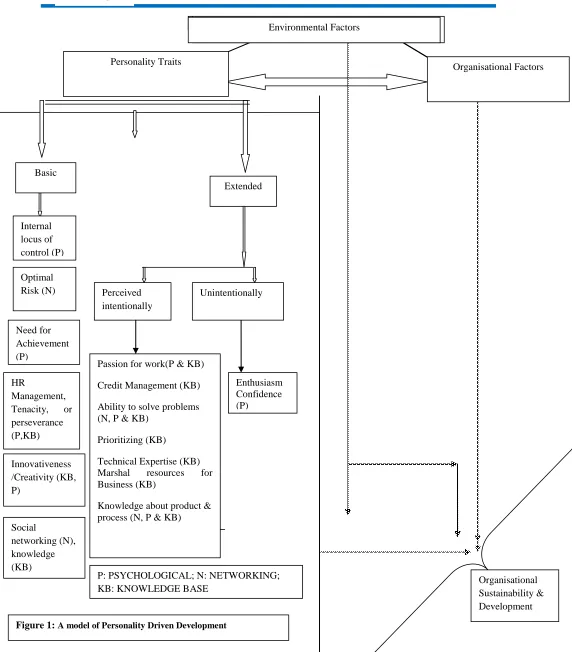
They are dominant because one dominant help entrepreneur to acquire automatically some important traits and also solve crucial problems of SME. These dominant traits are Social Networking and relationship (N), Psychological aspect (P) and Knowledge Base (KB).
Available online:
https://edupediapublications.org/journals/index.php/IJR/
P a g e | 3998 ExtendedP: PSYCHOLOGICAL; N: NETWORKING; KB: KNOWLEDGE BASE
Environmental Factors
Basic
Organisational Sustainability & Development Organisational Factors Environmental Factors
Internal locus of control (P)
Optimal Risk (N)
Need for Achievement (P)
Social networking (N), knowledge (KB)
Innovativeness /Creativity (KB, P)
HR
Management, Tenacity, or perseverance (P,KB)
Perceived intentionally
Unintentionally
Passion for work(P & KB)
Credit Management (KB)
Ability to solve problems (N, P & KB)
Prioritizing (KB)
Technical Expertise (KB) Marshal resources for Business (KB)
Knowledge about product & process (N, P & KB)
Knowledge about
product and process(KB)
Social Networking(N)
Enthusiasm Confidence (P)
Personality Traits
P a g e | 3999 Contribution of MSME on economic development
and its multidimensional effect towards society indicate the need of more research in the field of entrepreneurship]. The entrepreneurial success depends on the specific traits, no doubt, but it is also dependent on the environment. The environment is country specific and in specific country, it is also dependent on time and culture of the society.
In the context of the Indian business environment, entrepreneurs have faced some unique problems like cultural barriers, lack of resources, complex formalities for getting loan, different type of mediator in market and a question of trust worthiness, lack of favourable entrepreneurial environment etc. The question is: the identified dominant factors, namely, Networking and relationship (N), Psychological aspect (P) and Knowledge Base (KB) can resolve the complex issues pertaining to Indian context or not and also leading the firm towards the path of sustenance.
Because personal characteristics do make differences to the ability of entrepreneur to raise fund and also very interesting that firms in the nascent stage are largely dependent on the resources of firm owner, friend family and near and dear ones and in later stage small firms rely on short term debt financing while financial institution restricts the flow of because some risk issue in this sector [74] .In India existence of financial crunch in SME, forced entrepreneur to borrow money from money lenders with high rate of interest. But entrepreneur who have good social network can arrange money from their own personal relation at the point of time when they need money [11,71] and very few of them who know proper financial management can arrange money from their own.
Not only that in market common problem is late payment from client, big houses and also from government department and due to lack of funds they can‟t employ credit collection machinery and large firm forced them to offer long credit period and even pay advance to timely supply of materials. To solve out the slow payment, debt default different governments encouraging trade credit agreement overall to minimise the risk of SME owners or otherwise it is up to entrepreneurs attitude to mitigate risk using his person network [55].
It has been found that successful entrepreneurs have developed social networks and as a result, their organizations can utilize the huge pool of information developed through networking [53]. Social capital built on significant constructive reputation and directs personal contact frequently assist entrepreneur in gaining access to business enterprise capitalist and
possible customers. Reference [51] empirically established, that networking may promote new business activity through membership in many organizations, because this membership bring them into the position to access and utilize useful information. It has been also pointed out from different literature that network ties acts as a secret agent providing valuable resources in timely manner that can help improving strategic decision making. More generally external network can gain advantage on knowledge spill over or best practice, market intelligence on customer need or competitor moves. So there is a relation between social networking and knowledge .from network chain individual can gain some important informal knowledge that can use to resolve problem at some extend but besides this type of informative knowledge, technical knowledge and some special knowledge specifically in the field of financial management, operations management, human resource management and marketing management are also needed for start ups. Reference [34] argued that to achieve personal goal one‟s network relationships and access to external knowledge can be the key factor.
Knowledge is also related with psychological dimension because knowledge increase self efficiency and self-efficacy pertains to the belief that one has the necessary knowledge to successfully perform a particular task [35].And individuals may be more positive to choose a entrepreneurship as his profession if he has that level of confidence to win his fate, and that confidence comes from knowledge and skills, and on their exposure to others who can provide them with useful knowledge [17,21,43]
Knowledge is very important in the time of start-up the business, a positive relationship between individuals‟ existing knowledge base and the likelihood to start up a venture. Given that the anticipated success of new venture creation increases when one believes oneself to hold knowledge relevant to entrepreneurship [ 28] Knowledge is crucial for a firm‟s success as it is the starting point for decision making for deployment of resources and capabilities, develop or discard when the environment changes. Literature has provided evidence that innovation has positive impact on entrepreneur performance and innovative idea can be generated from external knowledge of various levels. [37; 2232; 20]
Available online:
https://edupediapublications.org/journals/index.php/IJR/
P a g e | 4000 experienced one can better understanding of businessrequirement [73].
VI. FUTURE SCOPE OF THE STUDY
In order to develop this work further we propose a strategic framework for entrepreneurial, that extends Networking and relationship (N), Psychological aspect (P) and Knowledge Base (KB) domains and interrelation among all the domains. Our model introduces specific spheres of study for each domain that will provide a more informed insight into the entrepreneurial traits issues. The model that we have put forward represents a conceptual framework to be used by the present researchers to develop an entrepreneurial index in the continuing research process.
We recognize that there is no easy prescription to construct uniform entrepreneurial traits that would lead to enterprise success. Nevertheless, the model can aid practitioners and implementers of this area to consider all of the issues and provide guidance on how to carry out a more balanced analysis. We believe it can be beneficial to the researchers undertaking the relevant research issues.
We are in the process of extending and building upon this work and this has led us to estimate entrepreneurial index in more detail. Two further papers are underway. The first will explore the contribution of literature in the fields of environmental and organizational factors on the success of the enterprises. The second one will explore the factors that would indicate the efficiency of the individual firm under our research consideration.
REFERENCES
[1] Ajzen, I. (1985). From intentions to actions: A theory of planned behavior. In J. Kuhl & J. Beckmann (Eds.), Action-control: From cognition to behavior Heidelberg, Germany: Springer
[2] Ajzen, I. (1991). The theory of planned behavior. Organizational Behavior and Human Decision Processes, 50(2) . [3] Ajzen, I. (2002) “Perceived behavioural
control, self-efficacy, locus of control and the theory of planned behaviour”. Journal of applied Psychology, 32 (4)
[4] Aldrich, H.E. & Martinez, M. (2001). Many are called, but few are chosen: An evolutionary perspective for the study of entrepreneurship. Entrepreneurship: Theory and Practice
[5] Aldrich, H.E. (1999).Organisations Evolving. Sage Publications
[6] Austrian Economics Newsletter (1978), “An interview with Ludwig Lachmann”, The Austrian Economics Newsletter, Fall 1978, volume 1, Number 3. [7] Anderson, A., &Miller, C. (2003),
“Class matters: human and social capital in the entrepreneurial process”, The Journal of Socio-Economics, 32 [8] Armitage, C. J., & Conner, M. (2001).
Efficacy of the theory of planned behavior: A meta-analytic review. British Journal of Social Psychology, 40(4)
[9] Bagozzi, R., Baumgartner, H., Yi, Y. 1992 State versus action orientation and the theory of reasoned action: an application to coupon usage, Journal of Consumer Research, 18
[10]Bass, B. M., & Stogdill, R. M. (1990). Bass & Stogdill's handbook of leadership theory, research, and managerial applications (3rd ed.). New York: Free Press
[11]Bates, T. (1997) Financing small business creation: The case of Chinese and Korean immigrant entrepreneurs, Journal of Business Venturing, Vol.12, Issue 2,
[12]Baum, J. R. (1998). A longitudinal study of the relation of vision and vision communication to venture growth in entrepreneurial firms. Journal of Applied Psychology, 83(1) .
[13]Baum, R., Locke, E., Smith, K., 2001. A multi-dimensional model of venture growth. Academy of Management Journal 44
P a g e | 4001 [15].Burt, Ronald S (2000) Network
Structure of social capital,Research in Organizing Behaviour,Volume 24. [16]Bolin, L. A. (1997). Entrepreneurial
leadership: New paradigm research discovering the common characteristics and traits of entrepreneurs who have served successfully in leadership positions. Unpublished Dissertation, Walden University
[17]Boyd, N. G., & Vozikis, G. S. (1994). The influences of self-efficacy on the development of entrepreneurial intentions and actions. Entrepreneurial Theory and Practice
[18]Brockhaus, R.H. (1980). ”Risk-Taking Propensity of Entrepreneurs”. Academy of Management
Journal, 23 (3)
[19]Busenitz, L. W. (1997). Differences between entrepreneurs and managers in large organizations:Biases and heuristics in strategic decision making. Journal of Business Venturing, 12(1) . [20]Cassiman, B., R. Veugelers and P. Zungia (2007), Science Linkages and Innovation Performance: An Analysis on Cis-3 Firms in Belgium, IESE Business School - University of Navarra No., Barcelona
[21]Chen, C. C. (1998). Does Entrepreneurial Self-efficacy Distinguish Entrepreneurs from Managers? Journal of Business Venturing 13(4) .
[22]Cockburn, I.M. and R.M. Henderson (1998), Absorptive Capacity, Coauthoring Behavior, and the Organization of Research in Drug Discovery, Journal of Industrial Economics 46 (2)
[23]Cooper, A. C.-G. (1992). Entrepreneurs, process of founding,and new-firm performance. In D. L. Sexton & J. D. Kasarda (Eds.). The state of the art of entrepreneurship, .
[24]Cromie, S. (2000), “Assessing Entrepreneurial Inclination: Some Approaches and Empirical Evidence”, European Journal of Work and
Organizational Psychology, Volume 9, No. 1
[25]Davindar Singh, Jaimal Singh Kharab,Tarun Nanda(2014),”Factors contributing towards technology development in small firm”, International Science Index
[26]Dean, J. W. (1987). Building the future: The justification process for new technology. In J. M. Pennings & A. Buitendam (Eds.), New Technology as Organizational Innovation Cambridge, MA7 Ballinger.
[27]Dimov, D (2007). Beyond the single-person, single-insight attribution in understanding entrepreneurial opportunities. Entrepreneurship, Theory, and Practice, 31(5),
[28]Dirk De Clercq and Pia Arenius, The Role of Knowledge in Business Start-up Activity, International Small Business Journal, APRIL 2006
[29]Drucker, P. F. (1985). Innovation and entrepreneurship. New York: Harper. [30]Engle, D.E., Mah, J.J. & Sadri, G.
(1997). An empirical comparison of entrepreneurs and employees: Implications for innovation. Creativity Research Journal, 10
[31]Entrialgo, M., Fernandez, E. & Vazquez, C.J. (2000). Characteristics of Managers as Determinants of Entrepreneurial Orientation: Some Spanish Evidence. Enterprise & Innovation Management Studies, Vol. 1 [32]Gambardella, A. (1995), Science and
Innovation: The Us Pharmaceutical Industry During the 1980s, Cambridge, MA
[33]Gatewood, E.J., Shaver, K.G. and Gartner, W.B. (1995), “A longitudinal study of cognitive factors influencing start-up behaviors and success at venture creation”, Journal of Business Venturing, Vol. 10
Available online:
https://edupediapublications.org/journals/index.php/IJR/
P a g e | 4002 [35]Grant, R. M. (1996). Toward aKnowledge-based Theory of the Firm. Strategic Management Journal 17(Winter) .
[36]Gupta, V., I.C. MacMillan, and G. Surie. 2004. "Entrepreneurial Leadership: Developing and Measuring a Cross-cultural Construct." Journal of Business Venturing
[37] Henderson, R. and I. Cockburn (1994), Measuring Competence? Exploring Firm Effects in Pharmaceutical Research, Strategic Management Journal 15 (8).
[38]Hisrich, R. D & Brush. (1985). The Women Entrepreneur: Characteristics and Perceptions for Success, Lexington Books, Lexington, MA .
[39]House, R. J., & Shamir, B. (1993). Toward the integration of transformational, charismatic and visionary theories of leadership. In M. Chemers & R. Ayman (Eds.), Leadership theory and research: Perspectives and directions San Diego, CA: Academic Press
[40]King, K. & McGrath S. (2007) Globalisation, Enterprise and Knowledge: Educational Training and Development, International Review of Education, Vol. 45(1)
[41]Kotter, J. P. (1982). What effective general managers really do. Harvard Business Review,
[42]Krueger, N.F. & Carsrud, A.L. (1993). Entrepreneurial intentions: Applying the theory of planned behaviour. Entrepreneurship and Regional Development
[43]Krueger, N.F., Jr. & Brazeal, D.V. (1994). Entrepreneurial potential and potential entrepreneurs. Entrepreneurship Theory & Practice, 18(3)
[44]Locke, E. A. (2000). The prime movers. New York: Amacom.
[45]McClelland, D. C. (1965). Toward a theory of motive acquisition. American Psychologist, 20
[46]Morris, M.H., Avila, R.A. & Allen, J. (1993). Individualism and the modern corporation: Implications for innovation and entrepreneurship. Journal of Management, 19
[47]Mumford, M. D., Schultz, R. A., & Osburn, H. K. (2002a). Planning in organizations: Performance as a multi-level phenomenon. In F. J. Yammarino & F. Dansereau (Eds.), The many faces of multi-level issues (pp. 3–65). Oxford, UK7 Elsevier. Mumford, M. D., Scott, G. M., Gaddis, B., & Strange, J. M. (2002b). Leading creative people: Orchestrating expertise and relationships. The Leadership
[48]Murray, H. A. (1938). Explorations in personality. New York: Oxford. [49]Peel, M.J. Wilson, N. 1996. “Working
capital and financial management practices in the small firm
sector”, International Small Business Journal 14(2)
[50]Pooja Saxena (2013) , A Study of Entrepreneurial Traits Through Organizational Leaders , IJMBS Vol. 3, Issue 2,
[51]Putnam, R. (1993). Making democracy work: civic tradition in modern Italy. Princeton: Princeton University Press [52]Rao, T.V., Wright, C. and Mukherje, H
(1990) Designing Entrepreneurship Development Programme Resource book for Technical and Vocational Institutions, London: Commonwealth Secretariat .
[53]Rauch, A., & Frese, M. (2001). The
psychology of
entrepreneurship., International
Encyclopedia of the Social & Behavioral Sciences. Amsterdam: Elsevier
[54]Reynolds, P.D. (1991), “Sociology and entrepreneurship: concepts and contributions”, Entrepreneurship: Theory & Practice, 16(2)
[55]Rike R, Chang N & Cehadick L (1998) ,
Managing Trade Credit for competitive
P a g e | 4003 Companies , London , The Chatered
Institute of Management Accountants.
[56]Robert, T. K. & Sharon, L. L. (2005): 10 Real-Life lessons every entrepreneur should know about building multimillion dollar business “Rich Dad Poor Dad” introduction
[57]Rotter, J. B. (1966). Generalized expectancies for internal versus external control of reinforcement. Psychological Monographs
[58]Schon, Donald A. (1963), Champions for Radical New Inventions, Harvard Business Review 41
[59]Schumpeter, J.A. (1934).The Theory of Economic Development. Cambridge, MA: Harvard University Press [60]Schumpeter, J. (1935). Theories der
wirtschaftlichen Entwicklung (Theory of economic development). 4Th Ed. Munich, Leipzig: Von Duncker & Humbold
[61]Sexton, D. and Bowman, N. (1983) „Comparative entrepreneurship characteristics of students: preliminary results‟, in J.A. Timmons and K.H. Vesper (Eds.) Frontiers of Entrepreneurship Research, Babson Center for Entrepreneurial Studies, Wellesley, Massachusetts
[62]Shane, S.A & Venkataraman, S. (2000), “The promise of entrepreneurship as a field of research”, Shane, S (2000), “Prior Knowledge and the discovery of entrepreneurial opportunities”, Organisation Science, 11, 448-469Academy of Management Review [63]Shane, S. (2003). A general theory of entrepreneurship. The individual-opportunity nexus. Cheltenham:Edward Elgar .
(Eds), Encyclopedia of entrepreneurship. Englewood Cliffs, NJ: Prentice Hall. 79 [64]Shaparo,A (1975).The displaced
,uncomfortable entrepreneur, Psychology Today, 9(November) 80 [65]Smilor, R. W.( 1997). Entrepreneurship:
Reflections on a subversive activity. Journal of Business Venturing
[66]Stewart, W. H., Jr., & Roth, P. L. (2004). Data quality affects meta-analytic conclusions: A response to Miner and Raju (2004) concerning entrepreneurial risk propensity. Journal of Applied Psychology, 89(1). [67]Tamara Jovanov Marjanova, M.Sc
(2011) Mitre Stojanovski, MARKETING KNOWLEDGE AND STRATEGY FOR SMEs: CAN THEY LIVE WITHOUT IT? Conference proceedings, economic development and entrepreneurship in transition economies: A Review of Current Policy Approaches
[68]Teoh, H.Y. and Foo, S.L. (1997), “Moderating Effects of Tolerance For Ambiguity and RiskTaking Propensity on The Role Conflict- Perceived Performance Relationship: Evidence from Singaporean Entrepreneurs”, Journal of Business Venturing, Vol. 12, No. 1
[69]Thomas, A. S., & Muller, S. L. (2000). A case for comparative entrepreneurship: Assessing the relevance of culture. Journal of International Business Studies, 31(2) [70]Timmons, J. A. (2000). New venture
creation: Entrepreneurship 2000 (5th ed.). Homewood, IL: Irwi
[71]Tseng, Y. (1995) Beyond Little Taipei: The development of Taiwanese immigrant businesses in Los Angeles, International Migration Review, Vol. 29, No.1
[72]Utsch ,A and Rauch, A. (2000), :”Innovativeness and initiative as mediators between achievement orientation and venture performance “ , European Journal of Work and Organizational Psychology vol. 9 No 1 [73]Vesper, K. H. (1980). New venture
strategies. Englewood Cliffs, NJ: Prentice Hall.
[74]Walker, E. & Petty, J. (1978). Financial differences between large and small firms. Financial Management, 7 (Winter, 1978)
Available online:
https://edupediapublications.org/journals/index.php/IJR/
P a g e | 4004 manufacturing strategy, and firmperformance. Academy of Management Journal
[76]Zacharakis, A. (1997). Entrepreneurial entry in to foreign markets. . Entrepreneurship: Theory and practice [77]Zahra, S. A., Jennings, D. F., & Kuratko, D. F. (1999). The antecedents and consequences of firm-level entrepreneurship: The state of the field. Entrepreneurship Theory and Practice [78]Zhao, H., & Seibert, S. E. (2006). The
Big Five personality dimensions and entrepreneurial status: A meta-analytical review. Journal of Applied Psychology
International Finance Corporation, World Bank Group. (2012). Micro, Small and Medium Enterprise Finance in India - A Research Study on Need, Gaps and Way Forward. International Finance Corporation (World Bank Group).Retrieved11.5,2013,from
http://www.ifc.org/wps/wcm/connect/4760ee004 ec65f44a165bd45b400a808/MSME+Report-03-01-2013.pdf?MOD=AJPERES
ACKNOWLEDGEMENT
The author is grateful to Prof. Arabinda Bhattacharyya, Department of Business Management, University of Calcutta for his valuable guidance.
BIOGRAPHY
Supriyo Das, Marketing officer, Allahabad Bank and Research scholar at Calcutta University, Obtained his B.Tech from Calcutta University, Kolkata, and MBA from Department of Business Management, Calcutta University, UGC Net qualified , now pursuing Ph.D from University of Calcutta.