Available online: https://edupediapublications.org/journals/index.php/IJR/ P a g e | 4910
Upgraded Agricultural Inputs – A Comparative Analysis of Different Production
Method
Dr. Pardeep Kumar Duhan Assistant Professor of Economics
Govt. College for Women Mokhra, Rohtak
Abstract
Increasing price of food items marks as the main problem for policy makers in recent years.Cost ofagriculture production remained the first step toward accessing the overall price of produce followed by production and demand of that produce. An attempt has been made in the present paper to examine the difference of agriculture input cost of usual equipment & technique and advanced equipment & technique for the production of wheat in NCR region. The studyis based on primary data collected from different size of farmers. Statistical tools like percentage, average and chi-square has been used to represent the data. Study concluded that small farmers’ bear more cost as compare to medium and large farmers. Land preparation cost was higher for small category farmers where seeds cost in case of medium and large farmers. In case of different method of production, the study concludes that that there are almost half difference of cost between usual and advanced method. In both the method, small size farmers pay maximum for land preparations.
Available online: https://edupediapublications.org/journals/index.php/IJR/ P a g e | 4911
Introduction
India adopted significant policy reforms that aimed self-sufficiency under a controlled inflation system. It began with a decision to adopt high yielding, improved technology for agriculture and availed subsidies time to time. That resulted into a paradigm shift of Indian agriculture from traditional to commercialized agriculture. The transformation of agriculture was not separated from many problems. Increasing production and inflation in food items were remained main challenges in this direction.
Inflation in food items remains one of the main problems for policy makers in recent times. Where cost of agriculture produce is mainly affected by input or production cost of agriculture produce. Agricultural production cost remained the first step toward accessing the overall price of produce followed by production and demand of that produce. The significance of production cost fetches the attention of policy makers. That results in many innovations and introduced low cost inputs and machines. The present research paper is an attempt in this direction and examined the difference of agriculture input cost of usual equipment and technique and advanced equipment and technique for the production of wheat in NCR region.
Conceptual difference between usual method and advanced method-
During the primary survey, it was found that there were two types of methods have been used by farmers for their production. There methods are here as-
Available online: https://edupediapublications.org/journals/index.php/IJR/ P a g e | 4912
thin layer of water is spread in all field. Some time in case of paddy, thin layer is converted into astand quantity of water up to 3 to 6 inches as per requirement of the field. As we are restricted to wheat crop only, so the method of wheat crop irrigation is only considered.
Advanced Method- Some farmers were using the improved inputs for land preparing and other modern method for production operation is categorized as advanced method. To cover up the operation of field preparation was doing in a single sift by land rotavator where this function was done in three or four shifts in usual methods. For spread the pesticides and fertilizers in field they used pressure spread machine that worked with the help of tractor. Even seeds also sowing by machine in the field. In case of irrigation the preparation of field was managed as it consumed
minimum quantity of water.
Review of some literatures-
P. Venkatesh and M. Nithyashree (2013) in their paper examined the major institutional changes in agriculture input markets and use of these inputs by farmers in India. Study based on secondary data of NSSO. Study concludes that almost 40 percent farmers have access to information on modern technology. Moreover credit is essential for inclusion of marginal and medium farmers. Asif A. Ali (2015) examined the role of seeds and its technological innovation in Indian agriculture sector. The study is based on published reports and secondary data. The study concludes that agriculture production largely depend upon the hybrid seeds or improved seeds since 30 years. Seeds industry was developed in full swing. There are scopes of future development in this regard.
The present research work is an attempt in this direction to examine the difference between usual and advance method of farming among different size group of farmers.
Objective-
I. To examine the cost difference between usual method and advanced method of farming. II. To examine the difference between different size group of farmers for different method
Available online: https://edupediapublications.org/journals/index.php/IJR/ P a g e | 4913
Research methodology-
The study is based on primary data collected from different size group of farmers. The farmers were divided into three categories on their land holding basis i.e
Categories of farmers Land holding(in acre)
Small 0-3
Medium 3-6
Large 6 and more
The categorizations of farmers were purely based on personal observation and convince method. A group of 75 farmers (25 from each group) has been selected for survey. Selected farmers were interviewed with the help of pretested scheduled questionnaire. Statistical tools i.e. percentage and chi- square has been used to explain the data.
Usual and Advance inputs cost difference among different size group-
Tab le- 1.1
Average Input cost in wheat production by usual methods
(In Rs/Per Acre)
Items Small M ed iu m Larg e
1.Land Preparation 2500 900 700
2. Seeds 1600 1550 1500
3. fertilizers 1000 500 500
4.pestisides 1200 500 500
5. spread cost 1000 500 300
6. irrigation 1500 1000 500
Available online: https://edupediapublications.org/journals/index.php/IJR/ P a g e | 4914
8. total Cost 8900 5350 4600
Source- primary survey
Table 1.1 shows the average Input cost in wheat production by usual methods. Total costs were high in case of small farmers followed by medium and large. Where in case of different costs the table indicates that land preparation cost shared high among all costs in case of small farmers, seeds cost in case of medium and large farmers. Seeds costs remained almost same among different size groups of farmers. Huge differences were appeared in case of land preparations cost, spread cost and irrigation cost. Other costs were the only variable that small farmers reported less as compare to medium and large farmers. It can be concluded that small farmers bearthe more cost as compare to medium and large farmers. Land preparation cost was higher in small category farmers where seeds cost in case of medium and large farmers.
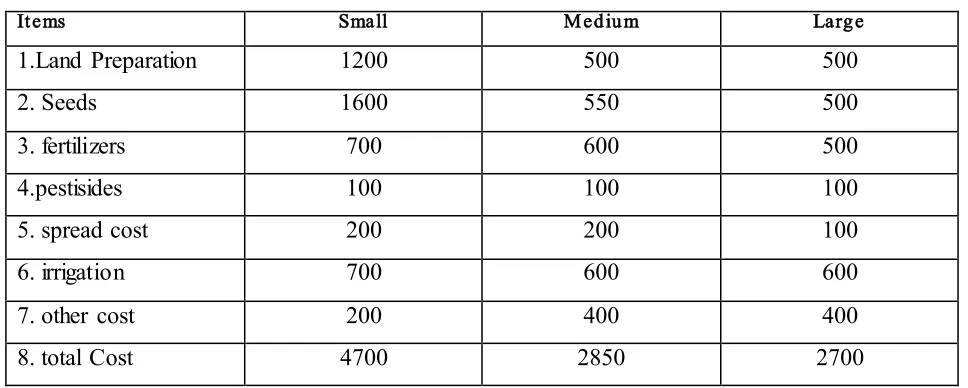
Table- 1.2
Average Input cost in wheat production by advanced methods
(In Rs/Per Acre)
Items Small M ed iu m Larg e
1.Land Preparation 1200 500 500
2. Seeds 1600 550 500
3. fertilizers 700 600 500
4.pestisides 100 100 100
5. spread cost 200 200 100
6. irrigation 700 600 600
7. other cost 200 400 400
8. total Cost 4700 2850 2700
Source- primary survey
Available online: https://edupediapublications.org/journals/index.php/IJR/ P a g e | 4915
It may be concluded from the above results that there were almost half difference of cost between usual and advanced method. In both the methods small size farmers pay maximum for land preparations. In usual method, all costs were high as compare to advanced method. The maximum gapes were reported in Land preparations cost.
Chi-Square Tests result- Usual method
Chi-Square Tests
Value Df Asymp. Sig. (2-sided)
Pearson Chi-Square 26.000a 24 .353
Likelihood Ratio 31.232 24 .147
Linear-by-Linear Association
3.832 1 .050
N of Valid Cases 21
a. 39 cells (100.0%) have expected count less than 5. The minimum expected count is .33.
Advanced method
Chi-Square Tests
Value Df Asymp. Sig. (2-sided)
Pearson Chi-Square 17.500a 20 .620
Likelihood Ratio 20.822 20 .408
Linear-by-Linear Association
.226 1 .634
N of Valid Cases 21
Available online: https://edupediapublications.org/journals/index.php/IJR/ P a g e | 4916
The results of chi-square test revealed that there is no significant difference in various type of cost among different types of farmers. In case of usual method there is enough statistical evidence to accept that various inputs do not differ significantly according to the size of farmers. it is evident with the help of Pearson chi-square methods.
Similarly in advanced method, the same statistic is found i.e. input costs here also stand indifferent according to farmer size. Hence it may be said that in both methods size of farmers has not been found significantly in making difference among increasing the various type of input costs. More specifically I can be placed that small medium and large farmers are more or less equal in incurring the various input costs in the eyes of statistical analysis.
Concluding Remarks-
It can be concluded from above results that small farmers bears more cost as compare to medium and large farmers. Land preparation cost was higher in small category farmers where seeds cost in case of medium and large farmers. In case of different method of production result may be concluded that there were almost half differences of cost between usual and advanced method. In both the methods small size farmers pay maximum for land preparations. In usual method all cost was high as compare to advanced method. The maximum gapes were reported in Land preparations cost. Chi-square results concluded that there is no significant difference in various type of cost among different types of farmers. Moreover, input costs here also stand indifferent according to farmer size. Hence it may be said that in both methods size of farmers has not been found significantly in making difference among increasing the various type of input costs.
References-
Agriculture Hand Book -2015
Agriculture Situation in India _2014_report www.agri.sti.nic.in
Available online: https://edupediapublications.org/journals/index.php/IJR/ P a g e | 4917
Chattopadhyay S.K., Sarkar K, Chattopadhyay R, Baur G, Trivedi S, Roy S.(2008).“A Study on Socio-Economic, Health and Hygiene Status of Women Engaged in Sericulture Industry in Sujapur of Malda District, West Bengal”J Environ &Sociobiology; 5(1):77-81. 13.
Dillon T.L., John I, HardakarJB(1989.)“Farm Management Research for Small Farmer Development”FAO Bulletin 1989; 41:21-49.
P.V. Venkatesh and M.L. Nithyashree(2014)“Major Institutional Changes in Agriculture Input Market” Agriculture Economics Research Review, Vol. 27 (2014) pp 85-92