INTRODUCING EXPERT SYSTEMS FOR
ENHANCING THE QUALITY OF SERVICES IN
CLOUD COMPUTING
Aadarsh Malviya
1, Vatan Mishra
2, Dr Vivek Kumar
31
Computer Science & Engineering, Jagannath University, Jaipur, (India)
2
JECRC Foundation, Jaipur
3
DCTM, Palwal.
ABSTRACT
The technology so called latest becomes outdated just the next day it is released. Cloud computing is not new to
this world. It is considered as one of the most emerging arenas of computer science in recent times. It is
providing the excellent facilities to business entrepreneurs by flexible infrastructure. Although cloud computing
is facilitating the information technology industry the research and development in this arena is yet to be
satisfactory. Our contribution in this section is advanced survey focusing on cloud computing services by
implementing expert techniques. We would be providing a better quality of services by cloud computing by
implementing Expert Techniques
Keywords
:
Cloud Computing, Data Globalization, Flexible Technology, Dynamic Server, Risk Reduction
I
INTRODUCTION
Cloud Computing [2] is a technology that has accelerated the use of resources, internet, storage, server, services
and their accessing mechanisms. It has provided globalization of these resources which can be accessed without
personally acquiring them. It has presented a flexible technology which reduces the cost, time and provided
scopes for future technologies. It is a superset of all the technologies that encircles the application and makes it
available for other users. It acts as the underlying architecture which is accessed by the users. Cloud Computing
is an abstraction of technology, resources and their location. The key issues in Cloud Computing is networking,
Large storage space , Uninterrupted Connections , hardware to implement the applications and software which
can act as an interface between the user and the application. Users are not aware these underlying technologies
used to provide the services only that resources they wish to purchase available on Internet.
Cloud computing changes the way we think about technology [2]. It is a computing model providing web based
software middle ware and computing resources on Demand [3].Cloud Computing has three main pillars: System
Application, Large Storage Space and Connections. All these three technologies are independent terms and they
stand all alone. We combine all three technical terms under the roof - Cloud Computing. A cloud is formed by
encapsulating system application, Storage space and Connection. System application covers the system
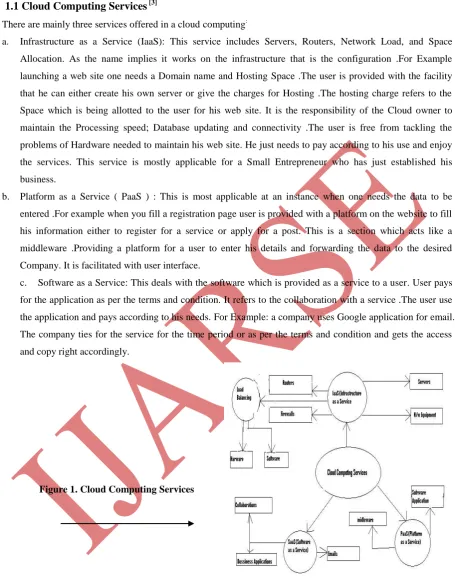
There are mainly three services offered in a cloud computing:
a. Infrastructure as a Service (IaaS): This service includes Servers, Routers, Network Load, and Space
Allocation. As the name implies it works on the infrastructure that is the configuration .For Example
launching a web site one needs a Domain name and Hosting Space .The user is provided with the facility
that he can either create his own server or give the charges for Hosting .The hosting charge refers to the
Space which is being allotted to the user for his web site. It is the responsibility of the Cloud owner to
maintain the Processing speed; Database updating and connectivity .The user is free from tackling the
problems of Hardware needed to maintain his web site. He just needs to pay according to his use and enjoy
the services. This service is mostly applicable for a Small Entrepreneur who has just established his
business.
b. Platform as a Service ( PaaS ) : This is most applicable at an instance when one needs the data to be
entered .For example when you fill a registration page user is provided with a platform on the website to fill
his information either to register for a service or apply for a post. This is a section which acts like a
middleware .Providing a platform for a user to enter his details and forwarding the data to the desired
Company. It is facilitated with user interface.
c. Software as a Service: This deals with the software which is provided as a service to a user. User pays
for the application as per the terms and condition. It refers to the collaboration with a service .The user use
the application and pays according to his needs. For Example: a company uses Google application for email.
The company ties for the service for the time period or as per the terms and condition and gets the access
and copy right accordingly.
Figure 1. Cloud Computing Services
II RESEARCH OBJECTIVE
Our Research started keeping in the mind the problem which is being faced by the users.We had an aim to
improve the Quality of the services offered by Cloud Computing. The general topic in concern was Speed with
security .When we make something global and common for every user there is a chance of data being misplaced
or stolen. Moving forward we first decided to mark all the negative point of the current technology. Our
a. Data Security and Speed.
b. Collaboration Issues
c. Switching Cost.
2.1 Data Security and Speed
When a user imports his data on any Cloud he makes it Global that is he makes it available for the user who is in
the network. A thing that is global needs more security than the thing that is private. User takes risks with his
data with an aim to keep secured from the HACKERS.
As Discussed Cloud Computing is not a technology, it is technique to make resources available for the user in a
view to make it Global. The thing that is global and easily available for every one invites more and more user to
use the service. This creates a problem of Overloading and hence decreases the accessing speed.
2.2 Collaboration Issues
Using the services of Cloud Computing User has to bind himself with the services. This creates a Problem with
the user. Even if the user is not satisfied with the service he has follow the terms and condition of the
technology. Some time continuing with the service creates a Problem and increases the Cost.
2.3 Switching Cost
.
If a user using a particular service is not satisfied with the service he chooses to switch from one service to
other. This creates a Problem as well as increases the cost as he has already invested for one service and now
moving to the other service increases cost as well as time.
III RESEARCH METHODOLOGY:
[9] [10] [11] [14]We would introduce four Expert techniques for improving the quality of services in Cloud Computing.
1. Fuzzy Computing.
2. Evolutionary computing
3. Neural Computing
4. Probalistic computing.
3.1 Fuzzy Computing
[14]In the real world there exists much fuzzy knowledge , i.e., that is knowledge
which is vague , imprecise, uncertain , ambiguous , inexact or probalistic in nature .Human can use such
information because the human thinking and reasoning frequently involve fuzzy information, possible
originating from inherently inexact human concepts and matching of similar rather than identical experiences
.We need a technology which not only answers like humans but also describe their reality levels. These levels
needs to be calculated using imprecision and the uncertainty of facts and rules that were applied.
3.2 Evolutionary Computing
[15]Evolutionary Computing refers to a group of problem solving techniqueswhich are based on biological evolution such as natural section and genetic inheritance. These techniques are
randomly applied to a variety of problems, ranging from practical applications in the industry and commerce to
leading edge scientific research.
3.3 Neural Computing
[16] aims to design and artificial brain which can manipulate the problems as a humanbrain do. It is a term which is used to investigate how biological nervous systems accomplish the goals of
capturing some of their performance.
3.4 Probabilistic Computing
[17] is Based on or adapted to a theory of probability. It refers to a model wherethere are multiple possible outcomes, each having varying degrees or certainty or uncertainty of it’s occurrence.
It is directly associated with randomness.
IV PROPOSED METHODOLOGY
We have divided the complete proposed methodology in four modules.
4.1 Module 1
Implementation on IaaS (Infrastructure as a Service ) : Services provided by under this tag line in Cloud
computing encapsulates servers , network equipments , routers, firewalls, hardware and software based load
balancing on servers and routers .
Figure 5.1 IaaS Infrastructure
4.1.1 Implementation: Tier 1
1. To enhance the services at routers and servers. Neuro Fuzzy technology will be implemented in cloud
computing environment to enhance the quality of services in cloud computing environment.
2. Performance of Network equipment and its quality of services will be improved with using multi objective
functional programming like genetic algorithm.
3. Hardware is highly complex and has unpredictable behaviour. This can be anticipated with the help of
neural network.
Figure2: Tier 1 Implementation at IaaS
IaaS(Infrastructre as a Service)
4.2 Module 2
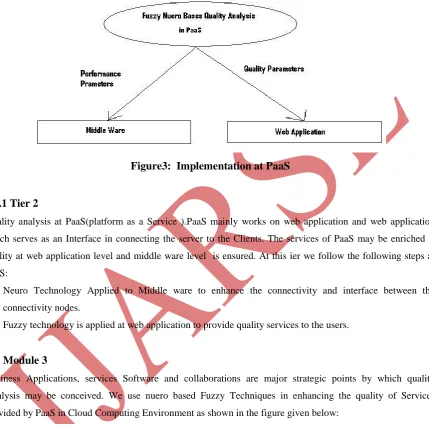
Implementation on PaaS(Platform as a Service): Platform in Cloud Computing serves as a middle ware and web
application. Fuzy Nuero Technology is being implemented in to increase the Quality of Services in PaaS as
shown in the figure given below:
Figure3: Implementation at PaaS
4.2.1 Tier 2
Quality analysis at PaaS(platform as a Service ).PaaS mainly works on web application and web application
which serves as an Interface in connecting the server to the Clients. The services of PaaS may be enriched if
quality at web application level and middle ware level is ensured. At this ier we follow the following steps at
PaaS:
1. Neuro Technology Applied to Middle ware to enhance the connectivity and interface between the
connectivity nodes.
2. Fuzzy technology is applied at web application to provide quality services to the users.
4.3
Module 3
Business Applications, services Software and collaborations are major strategic points by which quality
Analysis may be conceived. We use nuero based Fuzzy Techniques in enhancing the quality of Services
provided by PaaS in Cloud Computing Environment as shown in the figure given below:
At this tier we take SaaS as consideration which works on collaborations, emails and business application .We
apply the following steps at this tier:
1. Fuzzy technology is applied on the collaborations based structure to give the clear and exact details of the
bond the company is working on
2. Fuzzy Neuro Technology is being employed on business applications to provide the quality services to the
users.
3. Fuzzy Neuro Technology is being employed on business applications to provide the quality services to the
users.
4. We apply quality parameters of neuro technology on Service software to yield the quality of services.
4.4
Module 4
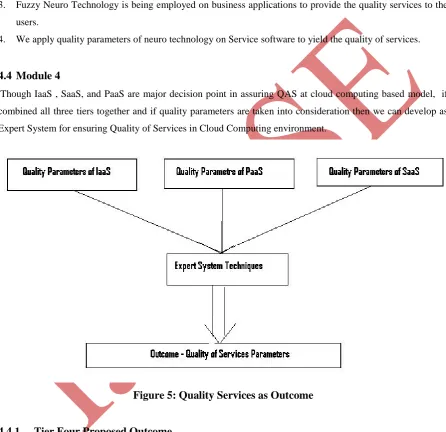
Though IaaS , SaaS, and PaaS are major decision point in assuring QAS at cloud computing based model, if
combined all three tiers together and if quality parameters are taken into consideration then we can develop as
Expert System for ensuring Quality of Services in Cloud Computing environment.
Figure 5: Quality Services as Outcome
4.4.1
Tier Four Proposed Outcome
We apply the quality parameters on IaaS, PaaS, and SaaS and we get the output as the quality of services in
Cloud Computing. We employ the expert systems which work on the services to give the desired output. The
quality parameters of IaaS, PaaS and SaaS are combined and expert techniques are implemented to have the
V CONCLUSION
The implementation of expert techniques can result in highly sensitive and progressive response by the clouds.
The cloud is meant to fulfill the requirement of an entrepreneur as well as the customers. Our aim is to develop
an intelligent Cloud which can work and can chose the services at its own without wasting time and extra cost.
Often we have seen the user is not satisfied with the service and tries to switch from one server to the other and
in every server he faces one or the other problems. There is no overall solution to the problem and user has to
face the problem. This results in the loss of an Entrepreneur. We would work in sorting out this types of
problems where are user need not to switch from one server to the other and can be given a proper choice .The
other step which will be involved in this will be that there will be interconnections between the clouds so that
the user of one server can access the application of other servers and would just pay for the thing that he used.
We have limitless application running currently .The current demand is to develop a computing or intelligent
cloud which is as equal as a human being. Implementation of soft computing in a cloud computing seems to be
an easier task to think on but has a vast problems to work on. This opens new arms for research and provides a
better outcome to the users.
REFERENCES
[1]An Advanced survey on Cloud Computing and State – of-the-art Research Issues, IJCSE - International
Journal of Computer Science Issues, Vol 0 Issue 1 , No 1 January 2012, www.IJCSE.org
[2] "Intercloud is a global cloud of clouds". Samj.net. 2009-06-22. Retrieved 2010-08-22.
[3] http://www.wikinvest.com/concept/Cloud_Computing
[4] http://searchcloudcomputing.techtarget.com/definition/Infrastructure-as-a-Service-IaaS
[5] http://en.wikipedia.org/wiki/Infrastructure_as_a_service#Service_Models
[6]A Survey on Cloud Computing Security, Challenges and Threats- IJCSE - International Journal of Computer
Science Issues, 2012,Vol 3., No 3 March 2012
[7]Davis S. Linthicum,Cloud Computing and SOA Convergence in your Expertise, Pearson, 2012.
[8]http://www.infoworld.com/d/cloud-computing/what-cloud-computing-really-means-031
[9] Chou, Timothy. Introduction to Cloud Computing: Business & Technology
[10] Mehrdad Mahdavi Boroujerdi,Soheil Nazem,Clou Computing :Changing Cogitation about Computing ,
World Academy of Science, Engineering and Technology 58,2009.
[11]http://www.accenture.com/us-en/outlook/Pages/outlook-online-2011-challenges-cloud-computing.aspx
[12]R.Buyya,C.S.Yeo, and S.Venugopa,”Marketoriented Cloud Computing : Vission hype and reality for
delivering it services as computing utilities “ in proceedings of the 10th IEEE international conference on High
performance computing and communications (HPCC-08,IEEE CS Press,Los Alamitos,Ca,USA)2008
[13]Top threats to Cloud Computing v1.0, Cloud security alliance ,March 2012.
[14] Armburst , M.Fox,A., Griffith ,R. Et . al. Abouve the Clouds: A Berkeley View of Cloud
Computing.UCB/EECS-2009-28,EECS Department, university of California, Berkeley,2009
[15]Brodkin,Jon.(2008,07): Seven Cloud Computing security Risks,available
Golle,Markus Jakobsson,Ryusuke Masuoka, Jesus Molina Elaine Shi,Jessica StaddonPrac,CCSW’09,
November13,2009,Chicago,Illinois,USA.
[17]Ko, Ryan K. L.; Jagadpramana, Peter; Lee, Bu Sung (2011). "Flogger: A File-centric Logger for
Monitoring File Access and Transfers within Cloud Computing Environments". Proceedings of the 10th IEEE
International Conference on Trust, Security and Privacy of Computing and Communications (TrustCom-11).
[18] King, Rachael (2008-08-04). "Cloud Computing: Small Companies Take Flight". Businessweek. Retrieved
2010-08-22.
[19] D Kyriazis, A Menychtas, G Kousiouris, K Oberle, T Voith, M Boniface, E Oliveros, T Cucinotta, S
Berger, “A Real-time Service Oriented Infrastructure”, International Conference on Real-Time and Embedded
Systems (RTES 2010), Singapore, November 2010
[20] B Rochwerger, J Caceres, RS Montero, D Breitgand, E Elmroth, A Galis, E Levy, IM Llorente, K Nagin, Y
Wolfsthal, E Elmroth, J Caceres, M Ben-Yehuda, W Emmerich, F Galan. "The RESERVOIR Model and
Architecture for Open Federated Cloud Computing", IBM Journal of Research and Development, Vol. 53, No.
4. (2009)