ISSN 2286-4822 www.euacademic.org
Impact Factor: 3.1 (UIF) DRJI Value: 5.9 (B+)
Design Issues during Wireless Sensor Networks
Deployment
SYED ABDUL WALI Directorate of Education Bureau of Curriculum & Extension Centre Quetta, Pakistan
Abstract:
Wireless Sensor Network is used to detect and report a certain event on a certain area, for example battlefield sensor network that reports the movements of troops. The idea behind these networks is that they are deployed by scattering in a certain area .e.g. by dropping them out of an airplane, the sensors automatically activate and auto configure as a it is in mesh topology shape and they determine how to send data packets to the data collector. One feature of this network is the movement of data collected to the data collector and the network can be modeled as a directed graph and every two nodes can be identified as upstream and downstream. A primary challenge of such a network is that all sensors operate on a finite supply of energy, in the form of a battery. These batteries are rechargeable e.g. by embedded solar panels but still the sensors have finite power store. Any sensor which drops the power level or its level reaches to its minimum level drops out of communication and may end up the network portioning. The maximum useful lifetime of the network at the worst case is the minimum lifetime of any sensor.
There are certain design parameters and by applying them, the lifetime of the network can be maximized. The issues and solutions recommended can extend the life the network up to 30%.
Introduction
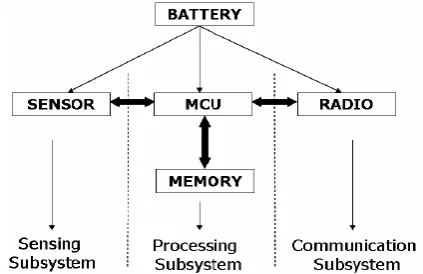
Wireless Sensor network is composed of many low power sensor nodes. Wireless Sensor Networks have many applications in our daily lives as well as lot of commercial and other kinds of applications such structural health, noise pollution control, battlefield, biological detection etc. The nodes of wireless sensor networks are deployed in the area to be monitored. Wireless Sensor Networks concept is based on a simple equation, i.e. Sensing + CPU + Radio = A large number of applications. Data collection from the observed environment is carried out through sensor nodes and sending this information to the adjacent nodes within a single hop distance. The data collected is forwarded to the sink node and as a result the report message is delivered to the base station [1, 4]. WSN has one or more microcontrollers, CPUs and memory. Every node contains a radio RF transceiver and battery. The nodes are composed of sensors. These nodes have wireless communication after they have been installed [2]. Wireless Sensor networks are not like traditional networks where the replacement of exhausted battery is favorable, in WSNs battery has limitations and replacement and recharge problems. In WSNs, communication consumes more power than the computational process. Network life will become longer if unnecessary communication avoided [3, 5].
Area Monitoring:
Area Monitoring is the most common application of Wireless Sensor Network. For the area monitoring, the WSNs are deployed over the area where there is the program to detect something under observation. One example of WSNs is its application in military to find the location of enemy intrusion. Another example is the area where to find gas in the oil industry. When sensors observe the phenomenon, the gathered data is sent to base station, which is used for appropriate action to handle the situation. WSNs are also used in to track vehicles of all types.
Landslide Detection:
The use of wireless sensor networks is also valuable for detection of landslide detection to detect the slight movement of soil and other changes before or after the land sliding. From the collection of data, the occurrence of landslide can be determined before it happens.
Literature review
Geographic Adaptive Fidelity protocol (GAF):
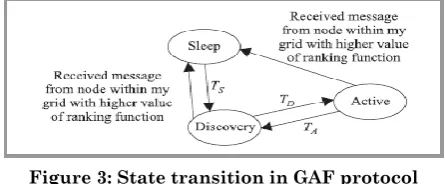
each Grid Square. This kind of node is designated as active node. If several nodes are there within a Grid Square, the function of an active node is turned around among entire nodes in Grid Square. Every node sets up assignment in the discovery mode. The node uses an unchanging measure of time TD in finding condition; whenever time goes over; node changes to active condition. Later than expending an unchanging measure of time TA to active condition, the node changes to discovery condition. When a node transforms to active or discovery condition, it instigates a transmit message having the node ID, Grid ID and value of the ranking function. But if a node in active or discovery state entertains the message from a node in the same grid as well as a high value of ranking function, it's permissible to change its condition to sleep state, turning off its radio transceiver for TS. The ranking function and timers TD, TA, TS can be used to synchronize algorithm. Normally, the ranking function chooses nodes having the highest predicted life span as the active nodes [6].
Figure 2: Network grid construction for GAF protocol
Figure 3: State transition in GAF protocol
Probing Environment and Adaptive Sleeping (PEAS)
means of big quantities of cost-effective, short-survived nodes. It broadens the working time length with the help of just a required number of sensors performing the task and setting the remaining nodes in the sleeping nodes. Resting nodes wake up from time to time, inquiring the neighboring environment and substitute fail nodes. Periods for sleeping are being managed dynamically just to keep the sensor's wake up rate constant, as a consequence adjusting to high node densities. PEAS design aims at a much adverse working situation. The Node breakdown must be considered standard rather than exception. Nodes have limited memory and resources for affording multifaceted protocols. PEAS attains fine vigorous maneuvers to randomize the sleeping periods of inactive periods of inactive Nodes for discovering with the replacing of unsuccessful nodes dynamically. It removes per neighbor conditions and ends the complexity of tracking each neighbor in a crowded deployment [7].
Recommendations and Suggestions:
1. Transfer Level:
It is the amount of energy in sending a packet; if the value is fixed very high, the sensors will soon become depleted after sending a few packets. Many more packets will be transferred or shifted if value is fixed as small.
2. Sensor Cost:
It is the amount of energy in detecting a vector and then generating a packet, this value setting very high can cause faster battery depletion.
3. Number of Nodes:
network is intended, this sets the transmission radius very low.
4. Cost for Packet Receiving:
It is the amount of energy in receiving the intended packet. If it is set high, energy waste will be higher and cause faster battery drop rate.
5. Sensor Period:
It is the waiting period for the detection of sensor events and sending report to the base station. If it is being set to a low value, the sensor will fire rapidly and much power is consuming in such a manner, while if it is set high then it will wait after finding the first event till finding another event. In this way power saving is possible.
6. Transmitter Period:
It is the time taken to send a packet. If it is set very high then the data reaching at the destination will be stale and the sensor nodes will be in active state for a long time causing more battery consumption, while setting this value low may be the fast result of data delivery and the sensor will activate and other network resources will be for a short period of time. This causes power saving.
Conclusion:
up to 30%. The aim of this research finding is the maximization of battery life to achieve useful results for long time.
BIBLIOGRAPHY:
Bharathidasn, Archana and Ponduru, Vijay Anand Sai. “Sensor Networks: an overview." 2003. Potentials, IEEE
Proceedings 22(2): 20-23, May 2003,
Doi:10.1109/MP.2003.1197877 [1]
Demirkol, Ilker, Cem Ersoy and Fatih Alagoz. 2006. “MAC Protocols for wireless sensor networks: a survey." IEEE
Communications Magazine 44(4): 115-121. [3]
Maheswar, R. P. Jayaraijan, F.Nathirullah Sherriff. 2013. “A survey on duty cycling schemes for wireless sensor networks." IRACST: International Journal of computer networks and wireless communication. 5(1). [5]
Niewiadomska-Szynkiewioz, Ewa, Piotr Kwasniewski, and Izabela Windyga. 2009. "Comparative study of wireless sensor networks energy-efficient topologies and power save protocols." Journal of telecommunication and information technology 3. [6]
Palwinder, Kaur and Anand Nayyar. 2013. “Conceptual representation and survey of dynamic power management in wireless sensor networks." International journal of advanced research in computer
science and engineering 3(3). [4]
Stankovie, John A. 2006. “Wireless Sensor Networks." Department of Computer Science, University of Virginia, June 19, 2006. [2]