Available online: https://edupediapublications.org/journals/index.php/IJR/ P a g e | 1251
A survey on Anomaly detection techniques for IoT based Healthcare
systems in Smart Cities: Techniques, Issues, and opportunities.
V.Daya Sagar Ketaraju1, Research Scholar, Dept.of Computer Science & Engineering, Shri Venkateswara University,
Gajraula Uttar Pradesh, India
DBK Kamesh2, Professor, Shri Venkateswara University, Gajraula Uttar Pradesh, India
Abstract: The Internet of Things (IoT) innovation has more spotlight on to give the possibility to diminish the strain on healthcare systems brought about by every day exceptionally expanded population in the cities, and a raises in endless disease. Institutionalization is a vast issue restricting advancement around there, and hence this paper we address accessible models and traps of each model. This paper, we discuss present the cutting edge inquire about identified with models and Challenges that health care IoT faces anomalies in IoT devices produced information, security, protection, wearability issues.
.
KeyWords: Health care sensors, IoT, machine learning, anomaly, security, Cloud, wearable sensors.
1. Introduction
Nowadays Healthcare is an essential part of human life. Unfortunately, the quick development of the population in cities the chronic illness is placing the most presser on modern healthcare systems [1], and more demand for resources from hospital beds to doctors and nurses is very high [2]. A concrete solution is required to reduce the pressure on healthcare systems while continuing to provide high-quality services for the patients.
IoT technology is one of the sources identified by many of the peoples to reduce the strain on the healthcare sector [3] [7]. A lot of this exploration takes a gander at observing patients with specific conditions, for example, diabetes [5] or Parkinson's ailment [6]. Further research hopes to fill particular needs, for example, helping recovery through steady observing of a patient's advancement [7].
This paper, hence, makes a one of a kind commitment in that it recognizes every single primary segment of a start to finish Internet of the Things human services framework, and proposes a conventional model that could be connected to all IoT based social insurance frameworks. This is crucial as there is still no known start to finish frameworks for remote observing of wellbeing in writing. This paper further provides a comprehensive survey of the machine learning techniques to detect anomalies in IoT devices generated data[10].
Available online: https://edupediapublications.org/journals/index.php/IJR/ P a g e | 1252
Based IoT Healthcare Systems, section 8 mainly focus on concusion and future directions of the research.
2. IoT Things for the Health Care Systems
The healthcare industry is in a state of great despair. Healthcare services are costlier than ever, the global population is aging, and the number of chronic diseases is on the rise.
What we are approaching is a world where primary healthcare would become out of reach to most people, a large section of society would go unproductive owing to old age, and people would be more prone to chronic disease. A new paradigm, known as the Internet of Things (IoT), has wide applicability in numerous areas, including healthcare. The full application of this paradigm in the healthcare area is a mutual hope because it allows medical centers to function more competently and patients to obtain better treatment.
2.1. The Internet of Things(IoT)
The Internet of things is the extension of Internet connectivity into physical devices and everyday objects. Embedded with electronics, Internet connectivity, and other forms of hardware, these devices can communicate and interact with others over the Internet, and they can be remotely monitored and controlled [7], [11], [12]. Web of Things innovation has effectively discovered business use in zones, for example, intelligent stopping [14], accuracy agribusiness [15], and water use the board [16]. Extensive research has likewise been directed into the utilization of IoT for creating astute frameworks in zones including traf c clog minimization [17], fundamental wellbeing observing [18], crash-staying away from autos [19], and intelligent networks [20]. Existing frameworks in different fields have demonstrated that remote observing of items, with information gathering and announcing, are feasible. This can, in this manner, be extended and adjusted for checking the strength of individuals and detailing it to pertinent conventions, for example, guardians, specialists, crisis administrations, and medicinal services focus.
2.2.The Internet of Things in Health Care
Research in related fields The Internet of Things (IoT) has opened up a world of possibilities in medicine: when connected to the internet, ordinary medical devices can collect valuable additional data, give further insight into symptoms and trends, enable remote care, and generally give patients more control over their lives and treatment.
The IoT system practically proven in a Continuous Glucose Monitor (CGM) is a device that helps people with diabetes to continuously monitor their blood glucose levels for several days at a time, by taking readings at regular intervals [5]. Medical smart contact lenses are an ambitious application of the Internet of Things in a healthcare context. While the concept has a great deal of potential, so far, science hasn’t always managed to live up to expectations[12]. SPHERE [4] Wearable technology doesn’t always have to be designed with medical use in
mind to have healthcare benefits
.
The ADAMM is a wearable savvy asthma screen that implies to identify the manifestations of an asthma assault before its beginning, enabling the wearer to oversee it before the attack deteriorates.
Available online: https://edupediapublications.org/journals/index.php/IJR/ P a g e | 1253
In the wake of surveying this broad scope of existing IoT based social insurance framework, a few prerequisites for the structure of such frames become clear. Every one of these papers accentuates the utilization of sensors for checking understanding wellbeing. All respect wearable sensors, to be specific remote and remotely wearable sensors, as fundamental to their frameworks. A few works [4], [6] additionally propose the utilization of environmental or vision-based sensors around the home. Be that as it may, this limits the handiness of the framework to one physical area. It is desirable over actualize every single fundamental sensor as little, compact, and remotely wearable hubs. It would furnish patients with a non-meddling and simple arrangement that is fit for checking their wellbeing wherever they go. It would make patients more responsive to utilizing wellbeing observing innovation than they would be if implantable sensors or cameras were required. Furthermore, fixing or supplanting remotely wearable hubs would be basic when contrasted with embedded sensors or vision-based sensors introduced in the home.
3.Wearable Sensor and Central Nodes
Wearable sensor hubs are those that measure physiological conditions. Prescribed sensors are those that measure the first signs beat, respiratory rate, and body temperature as these are the vital signs for assurance of fundamental wellbeing. Further sensors that could be actualised are pulse and blood oxygen sensors, as these parameters are regularly taken nearby the three vital signs. Extraordinary reason sensors, for example, blood glucose, fall discovery, and standard point sensors could likewise be actualized for frameworks focusing on a particular condition.
The focal hub gets information from the sensor hubs. It forms this data, may execute some essential leadership, and after that advances the knowledge to an outside area.
Available online: https://edupediapublications.org/journals/index.php/IJR/ P a g e | 1254
4. Detecting Anomalies In IoT Data Using Machine Learning Techniques
Abnormality discovery in the time arrangement information produced by the Internet of Things (IoT). We called attention to the scientific difficulties presented by certain irregular circumstances which require AI systems for examination. Time Series is characterized as a lot of perceptions taken at a specific period. [9].
In order to analyze the time series data, there is a need to understand the underlying pattern of data ordered at a particular time. This pattern is composed of different components which collectively yield the set of observations of time series. The Components of a time series data stream could be as follows: 1) Trend: Is a long pattern present in the time series.2) Cyclical: Is a pattern that exhibits up and down movements around a specified trend. 3) Seasonal: Is a pattern that reflects normal fluctuations. It always consists of a fixed and known period. 4) Irregular: It is an unpredictable component of the time series. These are short term fluctuations that are not systematic and have unclear patterns. There are two conventional approaches used for analyzing time series data: (a) Statistical approach and (b) Machine Learning based approach.
5.Machine learning based IoT Cloud Storage
Restorative data got from patients must be put away safely for proceeded with use. Specialists bene t from knowing a patient's medicinal history and AI isn't compelling except if substantial databases of data are accessible to it. In light of the writing, distributed storage is the most feasible strategy for putting away information. Be that as it may, giving openness to social insurance experts without trading off security is a significant concern [25], [26] that ought to be tended to by specialists creating therapeutic services IoT frameworks.
Also, AI has over and over been in-ti ed in writing as a method for improving social insurance frameworks [4], [6], [7]. However, it has not been generally investigated. AI offers the possibility to distinguish drifts in therapeutic information that was already obscure, give treatment plans and diagnostics, and provide suggestions to medicinal services experts that are explicit c to singular patients. In that capacity, distributed storage models ought to be intended to help the usage of AI on huge informational indexes.
Once a source of anomaly enters into the system, it causes to disrupt the system data widely, until the period preventive actions come to play. The origins of imbalanced data come from different attacks to individual IoT devices or a set of IoT devices in sensor networks. The sources of attacks can be any of the following:
5.1.Intrusion detection: As IoT devices get connected to the internet and remain vulnerable to security-related attacks. Such attacks involve denial-of-service (DoS) attacks and
distributed denial-of-service (DDoS) attacks which incur heavy damage to IoT services and smart environment applications.
Available online: https://edupediapublications.org/journals/index.php/IJR/ P a g e | 1255
5.3.Data Leakage: Sensitive information from databases, file servers, and other information sources can leak to any external entity. Such leakage not only results in loss of information but also creates a threat where the attacker can destroy confidential information from the system. Use of proper encryption mechanisms can prevent such leaks.
Anomalies in the IoT system can be detected based on its type like Point-wise, Contextual or Collective.
5.4. Point-wise anomalies from individual devices are detected by stochastic descriptors and used when the evolution of the series is not predictable.
5.6. Collective anomalies can be detected by typical time series patterns such as shapes, recurring patterns or residuals from multiple IoT devices.
5.7. Contextual anomalies are detected when the previous type of information or context is taken into account such as day of the week.
6.Proposed Method
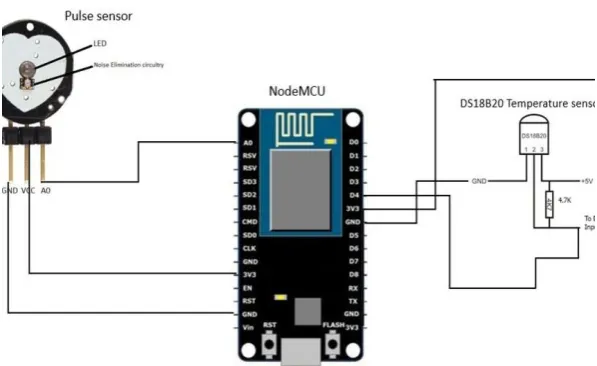
A microcontroller-based device with appropriate bio-medical sensors will be attached to the patient to provide constant cloud-based monitoring. The vital signs, i.e., temperature and pulse rate of the human body which are significant clues to detect any health problem will be sensed by respective sensors supported by NodeMCU in a Wi-Fi environment, and the data will be sent to ThingSpeak cloud where the data will be analyzed to look for any irregularity. In case of any inconsistency, a notification will be sent to doctors and nurses.
By this system, patients can be kept under proper constant monitoring without being dependent on any human’s responsibility at a meager cost. This will also reduce any possible errors and help the doctor to respond to the situation quickly.
Figure 2 Implemented IoT based Healthcare monitoring system
Available online: https://edupediapublications.org/journals/index.php/IJR/ P a g e | 1256
Cloud technologies have been widely researched due to their usefulness in big data management, processing, and analytics. Several related works have surveyed the literature on using cloud technologies for IoT purposes such as smart grid [115] and mobile cloud computing for smart-phones [116], [117], where complex computations are offloaded from low-resource mobile devices to the high-power environment of the cloud, before the result is returned to the mobile device. These works consider data storage and data processing as critical advantages of cloud technologies.
7.1.Cloud Computing For Health Care Monitoring System
Much research has conducted in recent years regarding the benefits of the cloud for healthcare applications. These benefits from the three primary services that can be provided by cloud technologies in healthcare environments:
Platform as a service(PaaS), Infrastructure as a Service(IaaS), Software as a service(SaaS) and Big data as a service(BaaS) are required for IoT based health care systems from cloud computing.
7.2. IoT data privacy and security in Cloud
Security is the main key issue in cloud-based systems. In a healthcare environment, it is essential that a patient's health information is readily accessible to authorized parties including doctors, nurses, specialists, and emergency services. It is also necessary that the patient's sensitive health data is kept private. If malicious attacks revealed the patient's health data, it could have many negative rami cations for the patient, including exposing them to identity theft or making it difficult for them to obtain insurance. Worse still, if the malicious attacker altered a patient's health record, it could have detrimental effects on the patient's health.
Access control policies and data encryption are two means of securing cloud-centric healthcare systems. An access control policy specifies who is authorized access to the patient's health data, and how much access they are allowed. It would also implement an authentication mechanism (e.g., password, facial recognition, etc.) that verifies the identity of the party attempting to access the data. Meanwhile, data encryption provides security for the data whilst in data storage. Secure data encryption would prevent an attacker from reading sensitive health information, even if they did gain access to the database.
8. Conclusion
Available online: https://edupediapublications.org/journals/index.php/IJR/ P a g e | 1257
REFERENCES
1. STEPHANIE B. BAKER1, WEI XIANG2, (Senior Member, IEEE), AND IAN ATKINSON3,
Internet of Things for Smart Healthcare: Technologies, Challenges, and opportunities”, IEEE. Translations VOLUME 5,2169-3536, 2017
2. Australian Institute of Health and Welfare. (2014). Australia'sHealth. [Online]. Available: http://www.aihw.gov.au/WorkArea/DownloadAsset.aspx-?id=60129548150
3. E. Perrier, Positive Disruption: Healthcare, Ageing and Participation in
The Age of Technology. Sydney, NSW, Australia: The McKell Institute,2015.
4. N. Zhu et al., ``Bridging e-health and the Internet of Things: The SPHERE project,'' IEEE Intell. Syst., vol. 30, no. 4, pp. 39 46, Jul./Aug. 2015.
5. Y. J. Fan, Y. H. Yin, L. D. Xu, Y. Zeng, and F. Wu, ``IoT-based smart rehabilitation system,'' IEEE Trans. Ind. Informat., vol. 10, no. 2,1568 1577, May 2014.
6. S. M. R. Islam, D. Kwak, H. Kabir, M. Hossain, and K.-S. Kwak, ``The Internet of Things for health care: A comprehensive survey,'' IEEEAccess, vol. 3, pp. 678 708, 2015.
7. C. C. Y. Poon, B. P. L. Lo, M. R. Yuce, A. Alomainy, and Y. Hao, ``Body sensor networks: In the era of big data and beyond,'' IEEE Rev. Biomed.Eng., vol. 8, pp. 4 16, 2015.
8. K. M. Alam, M. Saini, and A. E. Saddik, ``Toward the social Internet of vehicles: Concept, architecture, and applications,'' IEEE Access, vol. 3,343 357, Mar. 2015.
9. R. C. A. Alves, L. B. Gabriel, B. T. D. Oliveira, C. B. Margi, and F. C. L. D. Santos, ``Assisting physical (hydro)therapy with wireless sensors networks,'' IEEE Internet Things J., vol. 2, no. 2, pp. 113 120, Apr. 2015.
10.Cretikos, R. Bellomo, K. Hillman, J. Chen, S. Finfer, and A. Flabouris, ``Respiratory rate: The neglected vital sign,'' Med. J.Austral., vol. 188, no. 11, pp. 657 659, 2008.
11.B. Xu, L. D. Xu, H. Cai, C. Xie, J. Hu, and F. Bu, ``Ubiquitous data accessing method in IoT-based information system for emergency medical services,'' IEEE Trans Ind. Informat., vol. 10, no. 2, pp. 1578 1586, May 2014.
12.S. D. Min, Y. Yun, and H. Shin, ``Simple ed structural textile respiration sensor based on capacitive pressure sensing method,'' IEEE Sensors J., vol. 14, no. 9, pp. 3245 3251, Sep. 2014.
13.Eshkeiti et al., ``A novel self-supported printed flexible strain sensor for monitoring body movement and temperature,'' in Proc. IEEE SENSORS, Nov. 2014, pp. 1615 1618.
14.H. Lin, W. Xu, N. Guan, D. Ji, Y. Wei, and W. Yi, ``Noninvasive and continuous blood pressure monitoring using wearable body sensor networks,'' IEEE Intell. Syst., vol. 30, no. 6, pp. 38 48, Nov./Dec. 2015.
15.Y.-L. Zheng, B. P. Yan, Y.-T. Zhang, and C. C. Y. Poon, ``An arm-band wearable device for overnight and cuff-less blood pressure measurement,'' IEEE Trans. Biomed. Eng., vol. 61, no. 7, pp. 2179 2186, Jul. 2014.
16.J. Wannenburg and R. Malekian, ``Body sensor network for mobile health monitoring, diagnosis and anticipating system,'' IEEE SensorsJ., vol. 15, no. 12, pp. 6839 6852, Dec. 2015.
Available online: https://edupediapublications.org/journals/index.php/IJR/ P a g e | 1258
18.G. Li, B.-L. Lee, and W.-Y. Chung, ``Smartwatch-based wearable EEG system for driver drowsiness detection,'' IEEE Sensors J., vol. 15, no. 12, pp. 7169 7180, Dec. 2015.
19.U. Ha et al., ``A wearable EEG-HEG-HRV multimodal system with simultaneous monitoring of times for mental health management,'' IEEE Trans. Biomed. Circuits Syst., vol. 9, no. 6, pp. 758 766, Dec. 2015.
20.G. Cola, M. Avvenuti, A. Vecchio, G.-Z. Yang, and B. Lo, ``An on-node processing approach for anomaly detection in gait,'' IEEE Sensors J., vol. 15, no. 11, pp. 6640 6649, Nov. 2015.
21.K.-H. Chang, ``Bluetooth: A viable solution for IoT? [Industry Perspec-tives],'' IEEE Wireless Commun., vol. 21, no. 6, pp. 6 7, Dec. 2014.
22. https://www.xenonstack.com/blog/data-science/anomaly-detection-time-series-deep-learning/le