Fault Detection in Three Phase Transformer
Using Decision Tree
Ravi Shankar Chauhan1, Dr.AmritaSinha2
PG Student [Power System], Dept. of EIED, Thapar University, Patiala, Punjab, India1
Assistant Professor, Dept. of EIED, Thapar University, Patiala, Punjab, India2
ABSTRACT:In this paper the study of ABC (artificial bee colony algorithm) and decision tree machine learning has
been explored for internal fault detection in three phase transformer using differential protection scheme. The half cycle window of differential current has been sampled at 1 kHz sampling frequency for classification of five operating conditions i.e. normal, magnetizing inrush, over-excitation, internal and external fault condition. 420 samples have been generated by modeling the differential protection scheme of Y-Y transformer and simulating under different operating conditions in simpowersys of MATLAB/SIMULINK. The k-fold cross- validation is used for measuring accuracy and sensitivity of decision tree classification model. The result shows that decision tree method as compared with linear model is best in classification of fault prediction with sensitivity of 0.88 and accuracy of 0.91 on testing data set.
KEYWORDS:Machine learning, fault simulation, decision tree, three-phase transformer.
I.INTRODUCTION
Transformer is one of the most important equipment in electrical system.it plays a very important role in electricity transmission. Thus, it should be protected by fast and accurate relays to prevent subsequent damage due to different faults Differential protection is found to be effective in fault identification while the main challenge in differential protection is to differentiate internal fault with other operating condition. Digital differential relay has been improved significantly since its inception [1] andhas been introduced in year 1988 for industrial application [2]. In case of magnetizing inrush, the second harmonic in transformer is used for blocking differential relay to prevent maloperation. [3]. Differential relay show the vector difference as differential quantity, while keeping the vector sum as restrain quantity [4]. The local transient saturation caused by decaying dc component in the case of magnetizing inrush is main cause of the maloperation in transformer differential protection [5].
Differential protection has been done using artificial neural network as pattern classifier [6] which differentiates among the different operating condition of transformer.ANN-based algorithms were implemented successfully as investigated by researchers [7-13], in many pattern recognition problems.GA trained ANN (artificial neural network) provides faster, accurate, more secured results as compared with the back propagation trained ANN [14].
A method based on the application of Clark’s transform allow fuzzy logic to analyze operating condition of transformer such as energization, inrush and over excitation [15].An advanced technique SVM (support vector machine) has been provides effective discrimination between different operating condition of transformer .The performance of algorithm has been tested over a simulation data set of 5422cases and overall fault discrimination accuracy of more than99% is achieved [16].
The Artificial Bee Colony (ABC) algorithm [18] is a recently developed bio inspired algorithm. ABC is inspired by honey bee’s food searching behavior. ABC search process required three control parameters i.e. number of food sources SN, it is also equal to number of onlooker bees or employed bees, number of iterations and limit (number of trials after which a food source is considered to be abandoned) [18].
predicting the faults, artificial bee colony (ABC) is used to determine the feature importance. The K-fold cross validation is used to measure the accuracy and sensitivity of the decision tree.
II.ARTIFICIAL BEE COLONY AND DEISCION TREE METHOD
The Artificial Bee Colony (ABC) algorithm bio inspired algorithm ABC is inspired by honey bee’s food searching behavior. Here, food source of honey bees is known as solution of the problem. The quality of food source is considered as fitness value. There are three types of honey bees i.e. scout bees, onlooker bees and employed bees. There are equal number of onlooker bees and employed bees. Employed bee’s searches for the best fitness value (i.e. Food source) and get the information about its quality. The searching of onlooker bees are depend upon the information collected by employed bees. Onlooker bees are stay in the hive only. Scout bees randomly search for the new food sources.
Decision tree method uses a decision tree as a predictive tree as a predictive model which maps observations about an item to conclusion about the item’s target value. It is one of the predictive modeling approaches used in statistics, data mining and machine learning. Tree models where the target variable can take a finite set of values are called classification trees. In these tree structure ,leaves represent class labels and branches represent conjunction of features that lead to those class labels .decision tress where the target where the target variable can take continue values (typically real numbers) are called regression. In data mining a decision tree describes data but not decision rather the resulting classification tree can be an input for decision making.
III.MODELING AND SIMULATION OF TRANSFORMER
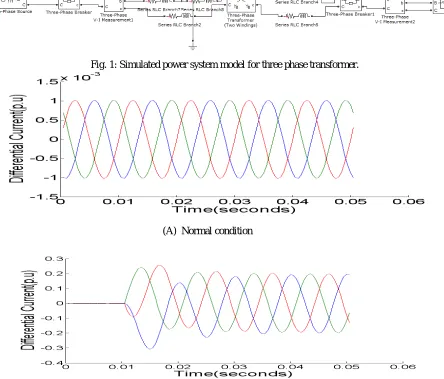
Three-phase 220/6.3 KV, 24MVA (star-star connected) transformer as shown in Fig. 1, has been used to produce the
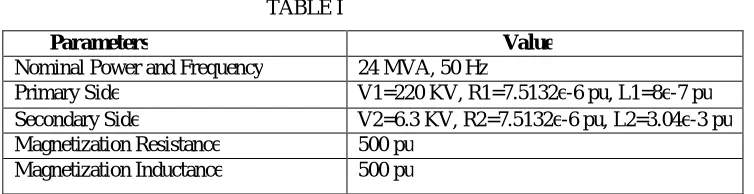
required test and training patterns. The simulation was done by means of Sim power systems (MATLAB) software. Table I represents the associated data with this power system. The combination of condition of system is shown in Table II.They involve inrush current and over excitation condition with different voltage angles and with different loads. The inputs to the network are samples taken from the waveforms generated by creating different operating conditions, they themselves define. There are total 420 simulations are generated for currents using sim power simulation (implemented in MATLAB) under different faults conditions. Table I represents the associated parameters with the sim power simulatio Table III describes description of features.
TABLE I
TABLE II: Dataset for classification of fault
Parameters Value
Nominal Power and Frequency 24 MVA, 50 Hz
Primary Side V1=220 KV, R1=7.5132e-6 pu, L1=8e-7 pu
Secondary Side V2=6.3 KV, R2=7.5132e-6 pu, L2=3.04e-3 pu
Magnetization Resistance 500 pu
Magnetization Inductance 500 pu
Fault Class Fault Type F1 F2 F3 ….. F30
1. Normal condition 0.001 0.001 0.001 ……0.000 2. Magnetizing
inrush
0.158 0.120 0.070……-0.108
3. Over -excitation 0.135 0.083 0.024…….-0.001 4. Internal -0.001 -0.001 -0.002…….-0.002
TABLE III: description of features
Fig. 1: Simulated power system model for three phase transformer.
(A) Normal condition
Feature Information
F1 - F10 Current in A Phase.
F11 - F20 Current in B Phase
(C) over –excitation
(D) Internal fault (LLG)
(E) External fault
IV.METHODOLOGY
The methodology is described in Fig. 3. In the first step, collection of currents using sim power simulation under different operating conditions of transformer. Data cleansing is performed in step two that includes removal of duplicates entries and removal of missing value from the dataset. In the third step, the ABC algorithm [17] is used to measure the importance of each feature. Feature selection makes the prediction of model efficient and accurate. In the fourth step, the random forest and support vector machine (refer, Table V) were trained and tested on the data set with their default parameters. Fig. 4 describes the prediction model. Finally, the evolution of the model is done on accuracy and sensitivity and K-fold cross validation is used to measure robustness of the best predictive model.
Fig3: Methodology used
Fig. 4: Prediction model.
V.MACHINE LEARNING METHODS
In this work, we used decision tree and linear model machine (refer, TableIV) for prediction of fault in three phase transformer. Both the models are available in R open source software. R is licensed under GNU GPL. A brief of the models is presented below:
1. Decision Trees: This model is an extension of C5.0 classification algorithms described by Quinlan [19]. 2. Linear Models: It uses linear models to carry outregression, single stratum analysis of variance and analysis of
TABLE IV: Machine learning classification model used
Model Package Tuning Parameter(s) Ref.
Decision Trees C50 window,model, trials [19] LM Stats None [20]
Table 5 represents the parameter setting of each machine learning models
TABLE V: Parameter setting for machine learning models
Model Parameter Setting
Decision Trees Min Split = 20, Max Depth = 30, Min Bucket = 7
LM Multinomial
VI.TESTRESULTS
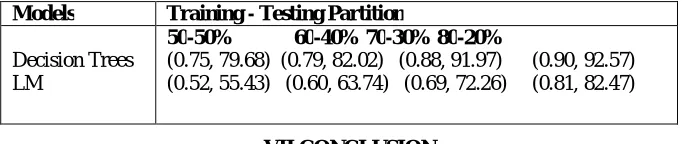
In this section, we analyse the prediction result of decision tree and linear model on the testing dataset. Both the methods are run on their default parameters as shown in Table VI. The accuracy and sensitivity shown in Table VII for all the models on 50-50, 60-40, 70-30 and 80-20 training-testing partitions. It is evident that the decision tree have the highest sensitivity and accuracy pair of (0.75, 79.68),(0.79, 82.02) , (0.88, 91.97) ,(0.90, 92.57) Further,10-fold cross validation is used to measure robustness of the random forest. Figure 7(a) and Figure 7(b) shows the sensitivity and accuracy respectively for the 10 folds. Cross validation results show a uniform performance in accuracy using random forest. The results validates that decision tree outperforms the machine learning models in the classification.
TABLE VII: Performance comparison of decision tree and linear model on different training-testing partitions in sensitivity and accuracy pair.
Models Training - Testing Partition
Decision Trees LM
50-50% 60-40% 70-30% 80-20%
(0.75, 79.68) (0.79, 82.02) (0.88, 91.97) (0.90, 92.57) (0.52, 55.43) (0.60, 63.74) (0.69, 72.26) (0.81, 82.47)
VII.CONCLUSION
Here, we explore the Decision Trees and linear model with 30 current samples to predict the internal fault in three phase transformer and also discriminate it with magnetizing inrush and over-excitation. The results indicate that Decision Trees outperforms as compared with linear model .The work can be extended for more samples, full cycle data window and other computational methods to enhance the performance of machine learning methods.
REFERENCES
[1] G.O.rockerfeller, fault protection with digital computer, IEEE transactions on power apparatus and systems,vol.PAS-88,no,4,pp 438-461,1969. [2] J.C Maun,Hardware and software design of a digital protection relay for power transformers, conference on computer relaying –future directions and impacts pp,1-19,1988
[3] Hao Zhang a,*, Pei Liu a, O.P. Malik, A new scheme for inrush identification in transformer protection, Electric Power Systems Research 63 (2002).
[4] B A1-Fakhri, I.Elagtal,A Unique Current Differential Based Algorithm for Protection of Three -Winding Transformers and Busbars.IEEE 2001.[5] T. Zheng, J. Gu, S. F. Huang,F. Guo and V. Terzija,A New Algorithm to Avoid Maloperation of Transformer Differential Protection in Substations With an Inner Bridge Connection.IEEE TRANSACTIONS ON POWER DELIVERY, VOL. 27, NO. 3, JULY 2012.
[7] Sachdev MS, Nagpal M. A recursive least error squares algorithm for powersystem relaying and measurement applications. IEEE Trans Power Delivery1991.
[8] Pihler J, Grcar B, Dolinar D. Improved operation of power transformerprotection using artificial neural network. IEEE Trans Power Delivery 1997.
[9] Zaman MR, Rahman MA. Experimental testing of the artificial neural networkbased protection of power transformers. IEEE Trans Power Delivery1998.
[10] Khorashadi-Zadeh H. Power transformer differential protection scheme basedon symmetrical component and artificial neural network. In: 7th Seminar onneural network applications in electrical engineering. vol. C.p.261.IEEE; 2004.
[11] Moravej Z. Harmonic restraint differential protection of power transformerbased MRBFN. In: Universities power engineering conference. vol. 2; 2004.
[12] Segatto EC, Coury DV. A differential relay for power transformers usingintelligent tools. IEEE Trans Power System 2006.
[13]Balaga H, Vishwakarma DN, Sinha A. Numerical differential protection of power transformer using ANN as a pattern classifier. In: IEEE internationalconference on power, control and embedded systems. Allahabad: IEEE; 2010
[14] Harish Balaga , Neha Gupta 1, DevendraNathVishwakarma, GA trained parallel hidden layered ANN based differential protection of three phase power transformer, Electrical Power and Energy Systems 67 (2015) 286–297.
[15] PrasenjitDey, Prof. Priyanath Das, Dr.Ajoy Kumar Chakrabothy, Implementation of Power Transformer Differential Protection Based on Clarke’s Transform and Fuzzy Systems, International Journal of Engineering Research & Technology (IJERT) Vol. 1 Issue 7, September – 2012 ISSN: 2278-0181.
[16] AM Shah and Bhavesh R Bhalja. Discrimination between internal faults and other disturbances in transformer using the support vector machine based protection scheme. IEEE Transactions on Power Delivery, 28(3):1508–1515, 2013.
[17] AK Qin, VL Huang, and PN Suganthan. Differential evolution algorithm with strategy adaptation for global numerical optimization. IEEE Transactions on Evolutionary Computation, 13(2):398–417, 2009.
[18]D. Karaboga and B. Akay. A comparative study of artificial bee colony algorithm. Applied Mathematics and Computation, 214(1):108–132, 2009.
[19] J.R. Quinlan. Induction of decision trees. Machine learning,1(1):81–106, 1986.