Image Processing of Eye to Identify the Iris
using Edge Detection
Jayakumar. K, S.Rajesh
Dept. of Electronics and Tele-Communication Engineering, Bharath University, Chennai, Tamil Nadu, India
Assistant Professor, Dept. of Electronics and Tele-Communication Engineering, Bharath University, Chennai, Tamil
Nadu, India
ABSTRACT: Iris is one the important Biometric Identification technique and also Iris is one of unique identifier of Human then it is stable throughout a life of the person’s. In this work a new method to recognition of the eye have been proposed. Edge detection is one of the important modules of any image processing technique. In this work we have proposed the edge detection technique based on Region of Interest (ROI) and also Edge Length (EL) to recognize the Human eye. The performance of the proposed system has been verified and validated with existing problem. This technique is a novel technique to identify the Iris and also the proposed technique shows significant results and compared with the other conventional technique. Using this technique we can able to predict the Cholesterol inside the eye through image processing.
KEYWORDS:Iris, Edge detection, ROI, Edge Length, Eye image and Cholesterol.
I. INTRODUCTION
II. EDGE DETECTION ALGORITHM
Segmentation is the process of partitioning a biomedical or digital image into its constituent objects or regions. These types of objects are having some common Characters like colour, density, texture, intensity and size, etc. In the segmentation first step is to predict the edge of the image and parts of the image. Once the edge will be detected from the using edge detection technique then the segmentation will take place. There will be a lot of segmentation techniques will be available. [2-3]
Fig. 1 Edge Map Detection of Cholesterol Level
The Block diagram of the proposed system of Iris Edge Detection and ROI prediction is shown in Figure 1. The different process sequence is involved in this process is also given in below. The Original image is obtained from the image centre and then it will be incorporated by using edge detection algorithm. Both the results have been compared and analyzed and also proved this technique also helpful for the Iris prediction. Eye description is shown in Figure 1 and then Right eye original image is shown in Figure 2, Left eye original image is shown in Figure 3 and similarly red eye original image is shown in Figure 4. The proposed method flow diagram is shown in Figure 5 in a sequence manner. Segmentation is the process of partitioning a biomedical or digital image into its constituent objects or regions.
II.SYSTEMDESCRIPTOR
These types of objects are having some common Characters like colour, density, texture, intensity and size, etc. In the segmentation first step is to predict the edge of the image and parts of the image. Once the edge will be detected from the using edge detection technique then the segmentation will take place. There will be a lot of segmentation techniques will be available.[7-9] That is Canny edge detection techniques, Genetic Algorithm approach, Random walker method approach, Sobel operator approach, Prewitt operator approach and Roberts operator approach, etc. In this work we have applied only Prewitt operator, Sobel operator and Prewitt operator approach. These techniques will follow the edge based technique. [6]
Fig.3. Image Pre-processing i.e., Cropping to a Standard Size
Sobel operator:
This technique performs 2D spatial gradient measurement on an image and also it emphasizes regions of high spatial frequency that correspond to edges. Typically it is used to find the approximate absolute gradient magnitude at each point in an input grayscale image. In theory at least, the operator consists of a pair of 3x3 convolution masks as shown in figure. One mask is simply the other rotated by 90.
IV.CONCLUSION
In this work performance comparison of three techniques have been investigated. Edge detection is one of the important modules of any image processing technique. In this work we have proposed the edge detection technique based on Region of Interest (ROI) and also Edge Length (EL) to recognize the Human eye.
The performance of the proposed system has been verified and validated with existing problem. This technique is a novel technique to identify the Iris and also the proposed technique shows significant results and compared with the other conventional techniques and also using this technique we have predicted the cholesterol inside the eye as one of the future extraction. [10-12]
Fig.5. Effect of Cholesterol resembling in the Iris Region
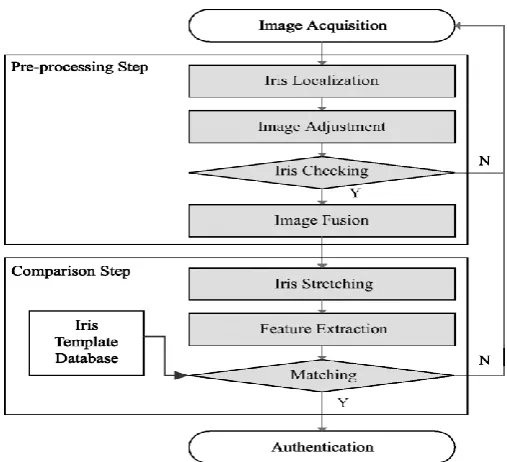
For the purpose of biometric person identification, iris recognition uses the unique characteristics of the patterns of the iris; that is, the eye region between the pupil and the sclera. When obtaining an iris image, the iris’s image is frequently rotated because of the user’s head roll toward the left or right shoulder. As the rotation of the iris image leads to circular shifting of the iris features, the accuracy of iris recognition is degraded. To solve this problem, conventional iris recognition methods use shifting of the iris feature codes to perform the matching. However, this increases the computational complexity and level of false acceptance error. To solve these problems, we propose a novel iris recognition method based on multi-unit iris images. Our method is novel in the following five ways compared with previous methods. First, to detect both eyes, we use Adaboost and a rapid eye detector (RED) based on the iris shape feature and integral imaging. Both eyes are detected using RED in the approximate candidate region that consists of the binocular region, which is determined by the Adaboost detector. Second, we classify the detected eyes into the left and right eyes, because the iris patterns in the left and right eyes in the same person are different, and they are therefore considered as different classes. We can improve the accuracy of iris recognition using this pre-classification of the left and right eyes. Third, by measuring the angle of head roll using the two center positions of the left and right pupils, detected by two circular edge detectors, we obtain the information of the iris rotation angle. Fourth, in order to reduce the error and processing time of iris recognition, adaptive bit-shifting based on the measured iris rotation angle is used in feature matching. Fifth, the recognition accuracy is enhanced by the score fusion of the left and right irises. To overcome these problems, we propose a new iris feature-matching method that uses multi-unit iris images, based on the iris rotation angle. In order to detect both eyes, we use Adaboost and a rapid eye detector (RED) based on iris shape feature and integral imaging. Both the user’s eyes are detected using RED in the approximate candidate region, consisting of the binocular region, which is determined by the Adaboost detector. Then we classify the detected eyes into the left and right eyes, because the iris patterns of the left and right eyes in the same person differ, and they are therefore considered as different classes. Thus we can improve the accuracy of iris recognition by pre-classification of the left and right eyes. By measuring the angle of head roll using the two center positions of the left and right pupils detected by two circular edge detectors (CEDs), we obtain the information about the iris rotation angle. In order to reduce the error and processing time of iris recognition, adaptive bit-shifting based on the measured iris rotation angle is used in feature matching. Further, the recognition accuracy is enhanced by the score fusion of left and right irises.
REFERENCES
[2] Udayakumar R., Khanaa V., Saravanan T., "Analysis of polarization mode dispersion in fibers and its mitigation using an optical compensation technique", Indian Journal of Science and Technology, ISSN : 0974-6846, 6(S6) (2013) pp. 4767-4771.
[3] Andreas Bulling, Jamie A. Ward, Hans Gellersen and Gerhard Troster, “Eye movement Analysis for Activity Recognition Using Electrooculography”, IEEE Transactions on Pattern Analysis and Machine Intelligence, 2011, Vol. 33 No.4, pp. 741-753.
[4] Udayakumar R., Khanaa V., Saravanan T., "Chromatic dispersion compensation in optical fiber communication system and its simulation", Indian Journal of Science and Technology, ISSN : 0974-6846, 6(S6) (2013) pp. 4762-4766.
[5] Bycoung-su Kim, Hyun Lee and Whoi-Yul Kim, “Rapid Eye Detection Method for Non-Glasses Type 3D Display on Portable Devices”, IEEE Transactions on consumer Electronics, 2010, Vol.56, No.5, pp.2498-2505.
[6] Udayakumar, R., Khanaa, V., Saravanan, T., "Synthesis and structural characterization of thin films of sno2 prepared by spray pyrolysis technique", Indian Journal of Science and Technology, ISSN : 0974-6846, 6(S6) (2013) pp.4754-4757.
[7] C.C. Chibelushi, J.S. Mason, and F. Deravi, "Integration of acoustic and visual speech for speaker recognition," EUROSPEECH'93, 1993, pp.345-348.
[8] Uma Mageswaran, S., Guna Sekhar, N.O., "Reactive power contribution of multiple STATCOM using particle swarm optimization", International Journal of Engineering and Technology, ISSN : 1793-8236, 5(1) (2013) pp. 122-126.
[9] Deborah Rankin, Bryan Scotney, Philip Morrow, Rod McDowell and Barbara Pierscionek, “Comparing and Improving Algorithms for Iris Recognition”, 13th International Machine Vision and Image Processing Conference, 2009, pp. 99-104.
[10] Udayakumar R., Khanaa V., Kaliyamurthie K.P., "Performance analysis of resilient ftth architecture with protection mechanism", Indian Journal of Science and Technology, ISSN : 0974-6846, 6(S6) (2013) pp. 4737-4741
[11] K. Bae, S.-I. Noh, and J. Kim, “Iris feature extraction using independent component analysis,” in Proc. Conf. Audio and Video Based Biometric Person Authentication Guildford, U.K., Jun. 2003, pp.838–844.
[12] Natalia A.Schmid, Manasi V,Ketkar, Harshinder Singh and Bojan Cukic, “Performance Analysis of Iris-Based Identification System at the Matching Score Level”, IEEE Transactions on Information Forensics and Security, 2006, Vol.1, No.2, pp. 154-168.
[13] B Karthik, TVUK Kumar, EMI Developed Test Methodologies for Short Duration Noises, Indian Journal of Science and Technology 6 (5S), PP 4615-4619, 2013.
[14] S.Rajeswari, Blurred Image Recognition by Legendre Moment Invariants, International Journal of Advanced Research in Electrical, Electronics and Instrumentation Engineering, ISSN 2278 – 8875,pp 83-86, Vol. 1, Issue 2, August 2012
[15] G.Tamizharasi, S.Kathiresan, K.S.Sreenivasan, Energy Forecasting using Artificial Neural Networks , International Journal of Advanced Research in Electrical, Electronics and Instrumentation Engineering,ISSN: 2249-2615,pp 7-13, Volume2 issue-6 No1 Nov 2012
[16] K. Subbulakshmi,An Embedded Based Web Server Using
ARM 9 with SMS Alert System,International Journal of Advanced Research in Electrical, Electronics and Instrumentation Engineering, ISSN (Print) : 2320 – 3765, pp 6485-6490,Vol. 2, Issue 12, December 2013.
[17] K. Subbulakshmi,VLSI Implementation of Evolvable PID
Controller,International Journal of Advanced Research in Electrical, Electronics and Instrumentation Engineering,ISSN (Print) : 2320 – 3765 , pp 6572-6579,Vol. 3, Issue 1, January 2014.