ISSN (Print) : 2320 – 3765 ISSN (Online): 2278 – 8875
I
nternational
J
ournal of
A
dvanced
R
esearch in
E
lectrical,
E
lectronics and
I
nstrumentation
E
ngineering
(An ISO 3297: 2007 Certified Organization)
Vol. 5, Issue 6, June 2016
Power Stability of Multi Machine System
Gulvender, Priyajit Dash
M.Tech Student, Department of EEE, BRCM College of Engineering, Behal, Bhiwani Haryana, India
Asst. Professor, Department of EEE, BRCM College of Engineering, Behal, Bhiwani Haryana, India
ABSTRACT: The stability of an interconnected power system is its ability to return to normal or stable operation after having been subjected to some form of disturbance. With interconnected systems continually growing in size and extending over vast geographical regions, it is becoming increasingly more difficult to maintain synchronism between various parts of the power system. In this paper we will study the various types of stability for multi machine system - steady state stability, transient state stability and the swing equation and its solution using numerical methods using MATLAB. Modern power systems have many interconnected generating stations, each with several generators and many loads. So we have presented multi-machine system and its stability has been analyzed using illustration and various fault and provided solution to the fault too.
KEYWORDS: multi- machine, swing equation, fault clearance, numerical method.
I. INTRODUCTION
The stability of power systems has been and continues to be of major concern in system operation. Modern electrical power systems have grown to a large complexity due to increasing interconnections, installation of large generating units and extra-high voltage tie-lines etc. Transient stability is the ability of the power system to maintain synchronism when subjected to a severe transient disturbance, such as a fault on transmission facilities, sudden loss of generation, or loss of a large load. The system response to such disturbances involves large excursions of generator rotor angles, power flows, bus voltages, and other system variables. It is important that, while steady-state stability is a function only of operating conditions, transient stability is a function of both the operating conditions and the disturbance( s).[1] This complicates the analysis of transient stability considerably. Repeated analysis is required for different disturbances that are to be considered. In the transient stability studies, frequently considered disturbances are the short circuits of different types. Out of these, normally the three-phase short circuit at the generator bus is the most severe type, as it causes maximum acceleration of the connected machine.[2]
Historically, simulation of transient phenomena related to power systems has been carried on using the electromagnetic transients program (EMTP)[3] or one of its variants, such as the alternative transient program (ATP) or electromagnetic transients for d.c. (EMTDC), which are all based on the trapezoidal integration rule and the nodal approach. SPICE is a general-purpose circuit simulation program, which was developed at the University of California, Berkeley.[4] It contains models for basic circuit elements (R, L, C, independent and controlled sources, transformer, transmission line), switches and most common semiconductor devices: diodes, bipolar junction transistors (BJTs), junction field effect transistors (JFETs), MESFETs and MOSFETs.
II. MULTIMACHINE SYSTEMS
Multi-machine system can be written similar to one-machine system by the following assumptions:
Each synchronous machine is represented by a constant voltage E behind Xd (neglect saliency and flux change)
Input power remain constant
using pre fault bus voltages, all loads are in equivalent admittances to ground
damping and asynchronous effects are ignored
ISSN (Print) : 2320 – 3765 ISSN (Online): 2278 – 8875
I
nternational
J
ournal of
A
dvanced
R
esearch in
E
lectrical,
E
lectronics and
I
nstrumentation
E
ngineering
(An ISO 3297: 2007 Certified Organization)
Vol. 5, Issue 6, June 2016
machines belong to the same station swing together and are said to be coherent, coherent machines can equivalent to one machine
Solution to multi-machine system:
solve initial power flow and determine initial bus voltage magnitude and phase angle
= ∗
∗=
−
∗ , ′= + ′
calculating load equivalent admittance
= −
| |
nodal equations of the system
0
= ′ ′
electrical and mechanical power output of machine at steady state prior to disturbances
Classical transient stability study is based on the application of the three-phase fault
= = { ∗, } = ′ ′ cos( − + )
Swing equation of multi-machine system
= − ′ ′ cos( − + ) = −
are the elements of the faulted reduced bus admittance matrix
state variable model of swing equation
=∆ = 1, ,
∆
= ( − )
III. MULTI MACHINE STABILITY ANALYSES
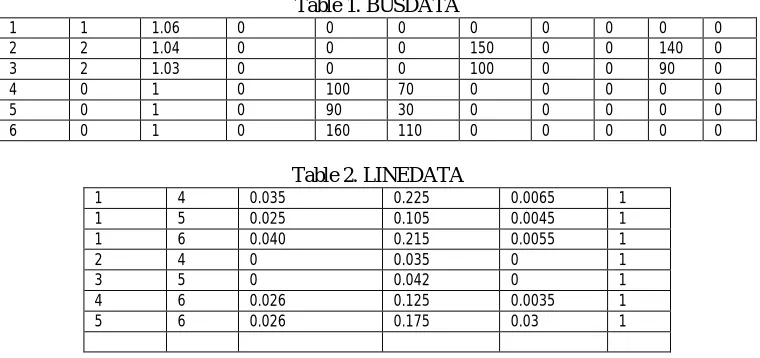
The power system network of an electrical company is shown in Fig-5.10. The load data, voltage magnitude, generation schedule and the reactive power limits for the regulated buses are tabulated. Bus 1, whose voltage is specified as V1=1.04∟00,is taken as slack bus.
Table 1. BUSDATA
1 1 1.06 0 0 0 0 0 0 0 0
2 2 1.04 0 0 0 150 0 0 140 0
3 2 1.03 0 0 0 100 0 0 90 0
4 0 1 0 100 70 0 0 0 0 0
5 0 1 0 90 30 0 0 0 0 0
ISSN (Print) : 2320 – 3765 ISSN (Online): 2278 – 8875
I
nternational
J
ournal of
A
dvanced
R
esearch in
E
lectrical,
E
lectronics and
I
nstrumentation
E
ngineering
(An ISO 3297: 2007 Certified Organization)
Vol. 5, Issue 6, June 2016
Table 3. GENDATA
1 0 0.20 20
2 0 0.15 4
3 0 0.25 5
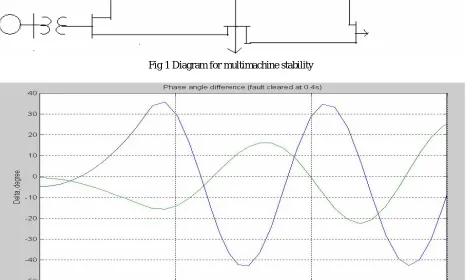
Fig 1 Diagram for multimachine stability
ISSN (Print) : 2320 – 3765 ISSN (Online): 2278 – 8875
I
nternational
J
ournal of
A
dvanced
R
esearch in
E
lectrical,
E
lectronics and
I
nstrumentation
E
ngineering
(An ISO 3297: 2007 Certified Organization)
Vol. 5, Issue 6, June 2016
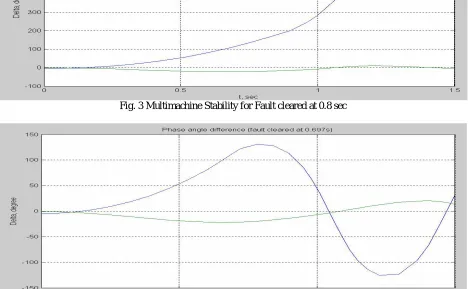
Fig. 3 Multimachine Stability for Fault cleared at 0.8 sec
Fig. 4 Multimachune Stability for Fault cleared at 0.697 sec
Figure shows that the phase angle differences, after reaching a maximum of δ21=123.90and δ31=62.950 will decrease,
and the machines swing together. Hence, the system is found to be stable when fault is cleared in 0.4 second.
ISSN (Print) : 2320 – 3765 ISSN (Online): 2278 – 8875
I
nternational
J
ournal of
A
dvanced
R
esearch in
E
lectrical,
E
lectronics and
I
nstrumentation
E
ngineering
(An ISO 3297: 2007 Certified Organization)
Vol. 5, Issue 6, June 2016
It can be seen that transient stability is greatly affected by the type and location of a fault so that a power system analyst must at the very outset of a stability study decide on these two factors. For the case of one-machine system connected to infinite bus it can be seen that an increase in the inertia constant M of the machine reduces the angle through which it swings in a given time interval offering a method of improving stability. But this cannot be employed in practice because of economic reasons and for the reason of slowing down of the response of the speed-governor loop apart from an excessive rotor weight.
For a given clearing angle, as the maximum power limit of the various power angles is raised, it adds to the transient stability limit of the system. The maximum steady power of a system can be increased by raising the voltage profile of a system and by reducing the transfer reactance. Thus we see that by considering the effect of rotor circuit dynamics we study the model in greater details. We have developed the expressions for the elements of the state matrix as explicit functions of system parameters. In addition to the state-space representation, we also use the block diagram representation to analyse the system stability characteristics. While this approach is not suited for a detailed study of large systems, it is useful in gaining a physical insight into the effects of field circuit dynamics and in establishing the basis for methods of enhancing stability through excitation control. We have explored a more detailed model for transient stability analysis taking into account the effect of damping which is clearly visible from the dynamic response of the system. We have included a damping factor in the original swing equation which accounts for the damping taking place at various points within the system.
Our aim should be to improvise methods to increase transient stability. A stage has been reached in technology whereby the methods of improving stability have been pushed to their limits. With the trend to reduce machine inertias there is a constant need to determine availability, feasibility and applicability of new methods for maintaining and improving stability.
REFERENCES
[1] Nagrath, I.J., and Kothari, D.P., Power System Engineering, New Delhi, Tata McGraw-Hill Publishing Company Limited, 1995. [2] Saadat, Hadi, Power System Analysis, New Delhi, Tata McGraw-Hill Publishing Company Limited, 2002.
[3] Wadhwa, C.L., Electrical Power Systems, New Delhi, New Age International publishers, 2005. [4] Yo, Yao-nan, Electrical Power Systems Dynamics, Academic Press, New York, 1983. [5] Anderson P.M., Analysis of Faulted Power Systems, IEEE Press, New York,1973. [6] ] Kundur Prabha, Power System Stability and Control, Tata McGraw-Hill, 2007. [7] W.D. Stevenson, Elements of Power System Analysis, 3rd Edition, McGrawHill,1975 [8] R.T. Byerly and E.W.Kimbark, Stability of Large Electric Power Systems, IEEE Press,1974
[9] E.R. Laithwaite and L.L.Freris, Electric Energy: Its Generation, Transmission and Use, McGraw-Hill (UK), 1980 [10] B.Stott, “Power System Dynamic Response Calculations”, Proc. IEEE, Vol.67, pp.210-241, February 1979
[11] N.Kakimoto, Y.Ohsawa, and M. Hayashi, “Transient Stability Analysis of Electric Power System Via Lure, Type Lyapunov Functions, Parts I and II,” Trans. IEE of Japan, Vol.98, No.516, May/June 1978