ANALYSIS OF CO-CHANNEL INTERFERENCE AT WAVEGUIDE JOINTS USING MULTIPLE CAVITY MODELING TECHNIQUE
D. K. Panda and A. Chakraborty
Department of Electronics and Electrical Communication Engineering Indian Institute Of Technology
Kharagpur, West Bengal, 721302, India
S. R. Choudhury
Department of Electronics Communication Engineering and Electronics Instrumentation Engineering
College of Engineering and Management Kolaghat Mecheda, Midnapur (E), WB, 721171, India
Abstract—A method of moment based analysis of the co-channel interference at waveguide joints has been presented using Multi Cavity Modeling Technique (MCMT). The proposed analysis has good agreement with the theoretical; CST microwave studio and HFSS simulated data.
1. INTRODUCTION
Low cost, low profile two dimensional scanning phased array antennas have wide application in Low Earth Orbit (LEO), Middle Earth Orbit (MEO) and Geostationary Earth Orbit (GEO) satellite communication. Multi-port Power divider has already found wide applications in phased array techniques. At the input of the two dimensional array mainly longitudinal power dividers are in use. Due to faulty workman-ship there may be a gap at the flange joints which causes the power coupling to the neighbor ports. However the problems of theoretical analysis of this power coupling remains unsolved. Effort has been made to model this interference using a regular structure with adding a uniform gap at the joints.
92 Panda, Chakraborty, and Choudhury
Technique (MCMT) [1]. The technique involves in replacing all the apertures and discontinuities of the waveguide structures, with equivalent magnetic current densities so that the given structure can be analyzed using only Magnetic Field Integral Equation (MFIE). Since only the magnetic currents present in the apertures are considered the methodology involves only solving simple magnetic integral equation rather than the complex integral equation involving both the electric and magnetic current densities.
2. FORMULATION OF THEORY
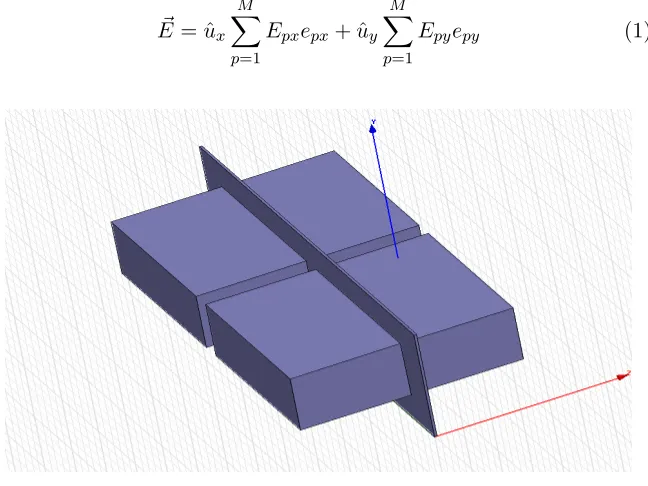
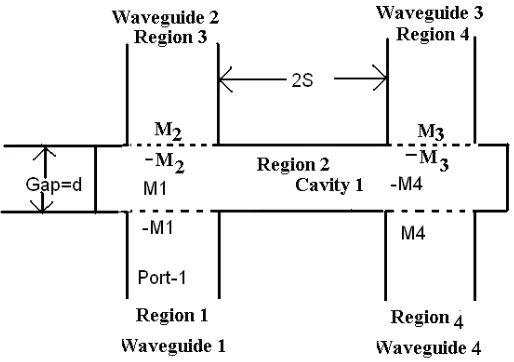
The diagram of a basic flange with two waveguide sections connected with another one with finite gap is shown in Fig. 1and its cavity modeling and details of region is shown in Fig. 2 which shows that the structures have 4 waveguide regions and 1cavity region. For the cavity modeling purposes a uniform gap is assumed and also the boundaries are covered with electric conductors. The interfacing apertures between different regions are replaced by equivalent magnetic current densities. The electric field at the aperture is assumed to be
E = ˆux
M
p=1
Epxepx+ ˆuy M
p=1
Epyepy (1)
Figure 2. Cavity modeling and details of regions of a two channel waveguide joint.
where the basis function ep (p= 1,2,3. . . M) are defined by
ei,yp =
sin pπ
2L(x−xw+L)
for xw−L≤x≤xw+L
yw−W ≤y ≤yw+W
0 elsewhere
(2a)
ei,xp =
sin pπ
2W (y−yw+W)
for xyw−L≤x≤xw+L w−W ≤y≤yw+W
0 elsewhere
(2b)
In the above expressions:
• L = a, W = b, xw = 0 and yw = 0 for aperture 1, aperture 2, aperture 3 and aperture 4 with respect to waveguide co-ordinate.
• L=a, W =b, xw =a+sandyw = 0 for aperture 1with respect to cavity axis.
• L=a, W =b, xw =a+sandyw = 0 for aperture 2 with respect to cavity axis.
• L = a, W = b, xw = −s−a and yw = 0 for aperture 3 with respect to cavity axis.
94 Panda, Chakraborty, and Choudhury
where a = 22.86 mm, b = 1 0.16 mm, S = 1.27 mm and 2S is the distance between waveguide-2 and waveguide-3.
The X-component of incident magnetic field at the aperture for the transmitting mode is a dominantT E10 mode and is given by
Hxinc=−Y0cos
πx
2a
e−jβz
3. EVALUATION OF THE INTERNALLY SCATTERED FIELD
The internally scattered field is obtained by using the modal expansion approach presented in [6]. The internally scattered electric field is given in [3]. Once the electric field is obtained, the corresponding magnetic fields can be derived. The modal voltages are given by (considering only ei,tnpq part of the aperture electric field):
Vmne = √2ab[Epx−Epy] (3)
Vmnm = 0 (4)
The x-component of internally scattered magnetic field can be obtained as,
HxwvgEpi,y = HxwvgMpi,x
=
−∞
m=1
Yme0sin mπ
2a (x+a)
forp=m and n= 0
0 Otherwise
(5)
HxwvgEpi,x = −HxwvgMpi,y= 0 (6)
HywvgEpi,y = HywvgMpi,x= 0 (7)
HywvgEpi,x = −HywvgMpi,y
=
∞
n=0
Y0ensin nπ
2b (y+b)
forp=nand m= 0
0 Otherwise
(8)
4. EVALUATION OF THE CAVITY SCATTERED FIELD
and Wcj is the height of jth the cavity. Li and Wi are the half length and half width ofith aperture.
Hxcavj(Mix) =−jωε
k2 ∞ m=1 ∞ n=0
εmεnLiWi 2LcjWcj
k2−
mπ
2Lc 2
sin
mπ
2Lcj
(x+Lcj)
×cos
nπ
2Wcj
(y+Wcj)
cos
nπ
2Wcj
(yw+Wcj)
sinc
nπ
2Wcj
Wi
Fx(p)
× (−1)
Γmnsin{2Γmntc}
cos{Γmn(z−tc)}cos{Γmn(z0+tc)} z > z0
cos{Γmn(z0−tc)}cos{Γmn(z+tc)} z < z0 (9)
Hxcavj(Miy) =jωε k2 ∞ m=1 ∞ n=0
εmεnLiWi 2LcjWcj
mπ
2Lcj
nπ
2Wcj sin
mπ
2Lcj
(x+Lcj)
×cos
nπ
2Wcj
(y+Wcj)
cos
mπ
2Lcj
(xw+Lcj)
sinc
mπ
2Lcj
Li
Fy(p)
× (−1)
Γmnsin{2Γmntc}
cos{Γmn(z−tc)}cos{Γmn(z0+tc)} z > z0
cos{Γmn(z0−tc)}cos{Γmn(z+tc)} z < z0(10)
Hycavj(Mix) =jωε k2 ∞ m=1 ∞ n=0
εmεnLiWi 2LcjWcj
mπ
2Lcj
nπ
2Wcj cos
mπ
2Lcj
(x+Lcj)
×sin
nπ
2Wcj
(y+Wcj)
cos
nπ
2Wcj
(yw+Wcj)
sinc
nπ
2Wcj
Wi
Fx(p)
× (−1)
Γmnsin{2Γmntc}
cos{Γmn(z−tc)}cos{Γmn(z0+tc)} z > z0
cos{Γmn(z0−tc)}cos{Γmn(z+tc)} z < z0(11)
Hycavj(Miy) =−jωε
k2 ∞ m=1 ∞ n=0
εmεnLiWi 2LcjWcj
k2−
nπ
2Wcj 2
cos
mπ
2Lcj
(x+Lcj)
×sin
nπ
2Wcj
(y+Wcj)
cos
mπ
2Lcj
(xw+Lcj)
sinc
mπ
2Lcj
Li
Fy(p)
× (−1)
Γmnsin{2Γmntc}
cos{Γmn(z−tc)}cos{Γmn(z0+tc)}z > z0
96 Panda, Chakraborty, and Choudhury
At the region of the window, the tangential component of the magnetic field in the aperture should be identical and applying the proper boundary conditions at the aperture the electric fields can be evaluated [5].
5. SOLVING FOR THE ELECTRIC FIELD
To determine the electric field distribution at the window aperture, it is necessary to determine the basis function coefficients Ei,x/yp at both the apertures. Since the each component of the field is described by M basis functions, 8M unknowns are to be determined from the boundary conditions. The Galerkin’s specialization of the method of moments is used to obtain 8M-different equations from the boundary condition to enable determination ofEpi,x/y[6]. The weighting function
wi,x/yq (x, y, z) is selected to be of the same form as the basis function
ei,x/yp . The weighting function are defined as follows:
wqi,y =
sin qπ
2L(x−xw+L)
for xyw−L≤x≤xw+L w−W ≤y≤yw+W
0 elsewhere
(13a)
wi,xq =
sin qπ
2W (y−yw+W)
for yxw−L≤x≤xw+L w−W ≤y≤yw+W
0 elsewhere
(13b)
6. REFLECTION COEFFICIENT AND TRANSMISSION COEFFICIENT
The procedure for derivation of reflection and transmission coefficients is given in [7]. Following the same procedure the expressions for Γ and
T is given by:
Γ = E
1
y +Ey2
Einc y
=−1−E11,y (14)
T21/31 = E
transmitted y
Einc y
=−E12/3,y (15)
7. NUMERICAL RESULTS AND DISCUSSION
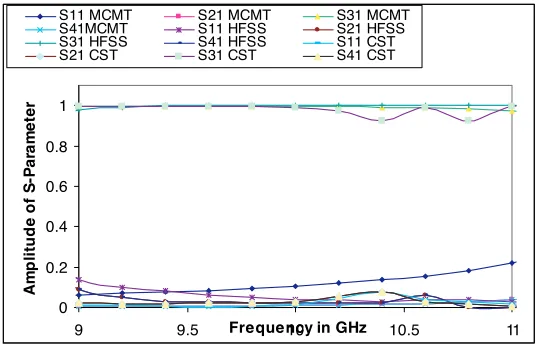
been compared with CST Microwave Studio simulated data and HFSS simulation data in Fig. 3.
0 0.2 0.4 0.6 0.8 1
9 9.5 Frequency in GHz10 10.5 11
A
m
p
litu
d
e
o
f
S
-P
ar
a
m
et
er
S11 MCMT S21 MCMT S31 MCMT S41MCMT S11 HFSS S21 HFSS S31 HFSS S41 HFSS S11 CST S21 CST S31 CST S41 CST
Figure 3. Comparison of theoretical, CST Microwave Studio And HFSS simulated data for an H-plane WR-90 waveguide two channel joints with a gap of 0.3 mm.
MATLAB codes have been written for analyzing the structure and numerical data have been obtained after running the codes. The structure was also simulated using CST microwave studio and HFSS. The theory has been validated by the excellent agreement between the theoretical, CST Microwave Studio simulated data and HFSS data. The scattering parameters for the circuit, when excited through port-2, port-3 and port-4 have not been presented in this section because these are also provide same pattern of data as for port-1.
ACKNOWLEDGMENT
The support provided by Kalpana Chawla Space Technology Cell, IIT Kharagpur is gratefully acknowledged.
REFERENCES
1. Das, S. and A. Chakraborty, “A novel modeling technique to solve a class of rectangular waveguide based circuits and radiators,”
98 Panda, Chakraborty, and Choudhury
2. Panda, D. K. and A. Chakraborty, “Multiple cavity modeling of a feed network for two dimensional phased array application,”
Progress In Electromagnetics Research Letters, Vol. 2, 135–140, 2008.
3. Panda, D. K. and A. Chakraborty, “Analysis of a 2:1rectangular waveguide power combiner using multiple cavity modeling technique,”NCCT-08, Proceedings, 87–90, India, 2008.
4. Harrington, R. F., Time-Harmonic Electromagnetic Fields, McGraw-Hill Book Company, New York, 1961.
5. Collins, R. E., Field Theory of Guided Waves, IEEE Press, 1991. 6. Harrington, R. F.,Field Computation by Moment Methods, Roger
E. Krieger Publishing Company, USA, 1982.