SPATIAL-SPECTRAL FORMULATION OF METHOD OF MOMENT FOR RIGOROUS ANALYSIS OF
MICROSTRIP STRUCTURES
C. Essid, M. B. Ben Salah, K. Kochlef, and A. Samet
UR-CSE, Research Unit Ecole Polytechnique de Tunisie B.743, La Marsa 2070, Tunisia
A. kouki
LACIME, ´Ecole de Technologie Sup´erieure 1100, rue Notre-Dame Ouest
Montr´eal, Qu´ebec, H3C 1K3, Canada
Abstract—In this paper, we present an efficient hybrid spatial-spectral formulation of the method of moment (MoM) in conjunction with the Mixed-Potential Integral Equation (MPIE) for planar circuit analysis. This method is based on the decomposition of the Green’s functions in two parts: quasi-static in the near field region and the dynamic contribution in the far field region. Using this decomposition of Green’s functions, the method of moment matrix entries can be reduced to a sum of two integrals. The first one is expressed in the spatial field and corresponds to the quasi-static contribution. It is analytically evaluated after a development in Taylor series of the exponential terms in the function to be integrated. The integrals expressed in the spectral field and corresponding to the dynamic part have the advantage of being calculated on a finite range and this is independent of the choice of the basis and test functions. The integrals expressed in the spectral field are performed by using numerical integration. It is also demonstrated that this hybrid method has accelerated the matrix fill in time by using a Fast Fourier Transform (FFT) algorithm. In order to validate the proposed method, numerical results are presented.
1. INTRODUCTION
Several numerical approaches have been developed to determine the characteristics of the planar structures. Among the well known methods, the MoM is the most robust approach used for planar circuit analysis and it can be applied both in spectral and spatial domains [1]. In the spectral domain, the MoM presents several limitations. Firstly, a good asymptotic behaviour of the spectral Green’s function is necessary. In addition, the quality of the convergence of the integrals computation depends on the choice of the basis and test functions [2]. The application of the MoM in the spatial domain suffers also from some limitations, specially when the frequency becomes higher and the quasi-Transversal Electromagnetic Mode (quasi-TEM) is not guaranteed. In the literature, the main limitations of spatial-domain MoM formulation are the accuracy of the closed-form Green’s functions for large distances, not extracting the quasi-static terms, the surface wave poles, and introducing wrong branch point in the process of approximation [3, 4].
To avoid the limitation of MoM in spatial and spectral domains, a hybrid spectral-spatial method is used. This technique has been implemented recently in the literature [5, 6]. In [6], the authors have presented a hybrid formulation for the electric field and they used it to evaluate the array Green’s function (AGF).
However, in this paper, we apply the hybrid method formulation to resolve the mixed potential integral equation (MPIE) in an efficient and a fast approach which is based on a simultaneous formulation in both spatial and spectral domains. The entries of the MoM matrix are then given by the sum of two integrals. The first one is expressed in the spatial domain. This part is analytically evaluated after a development in Taylor series of the exponential terms in the function to integrate. The integrals expressed in the spectral domain have a finite range, and they are calculated using numerical integration. Then the convergence problem is avoided in this approach. In order to validate our method, numerical results are presented.
2. METHOD OF MOMENTS
2.1. Spatial-Domain Method of Moments
geometry can be expressed as follows:
Zmns =< Jxm, GAxx∗Jxn>+
1
w2 < Jxm,
∂ ∂x
Gq∗
∂Jxn ∂x
> (1) Where (GxxA, Gq) are Green’s functions for the vector potential and
scalar. Jxm and Jxn are the surface current density and they are decomposed in rooftops basis functions in x and y directions, respectively. The spatial-domain Green’s functions employed in (1) are obtained in closed-form using the DCIMtwo-level approximation described in [11], and Sommerfeld identity and they are given by
G=
M
i=1
ai e−jk0ri
ri
(2)
where ri =
(x−x0)2+ (y−y0)2−b2i is the complex distances.
(G stands for either GA
xx, orGq), ai, bi, and M are respectively the
complex coefficients, and number of complex images obtained from the application of GPOF technique.
Using this approximation (2), the integrals correspond to matrix entries of method of moment can be written as follows:
Zmns =
i
k
l
e−jk0ri
ri
xkyldxdy (3)
The double integrals in (3) can be evaluated analytically as proposed in [7, 8]. Therefore, the computational efficiency of the spatial-domain MoM in the solution of the MPIE has been improved in the literature. However, this formulation suffers from some limitations in terms of accuracy of Green’s functions when the frequency becomes higher, of introduction of surfaces wave poles, branch points and branch cuts [4]. When we use the sub-domain basis functions, the number of basis functions that are required to model the current on a structure increases very rapidly with increasing the size of the structure. This implies that the interaction matrix can become quite large and the CPU time becomes higher.
2.2. Spectral-Domain Method of Moments
The tangential electric field on the plane of conductors can be expressed in spectral domain as follows:
˜
Ex(kx, ky) ˜
Ey(kx, ky)
=
˜
Axx(kx, ky) Axy˜ (kx, ky) ˜
Ayx(kx, ky) A˜yy(kx, ky)
˜
Jx(kx, ky) ˜
Jy(kx, ky)
˜
Axx(kx, ky) =−jωG˜Axx(kx, ky)− k 2
x
jωGq˜ (kx, ky) (5)
Where ˜Axx are the electric field Green’s functions in the spectral domain and ˜J is the current distribution obtained through the Fourier transform of a basis functions.
After substituting the expanded current expression and the Fourier transform of ˜J into (4). Galerkin’s procedure leads to the matrix equations:
˜
Zmn.Imn= ˜Vmn (6)
Where ˜Zmn is the mutual impedance coefficient between testing and
basis functions. The matrix entries of MoM can be expressed as: ˜
Zmn= +∞
−∞
+∞
−∞ J
∗
xmJxnG(kx, ky)dkxdky (7)
The expression of Green’s functions in spectral-domain is given in [10]. The MoM matrix entries in spectral domain are expressed in two dimensional integrals; they are oscillatory, complex and slow converging functions depending on the distance between the basis and testing functions.
Numerical methods can be used to evaluate these types of infinite integrals. It is possible to use asymptotic extraction techniques [14, 15]. Another approach is to transform the spectral variables to a polar coordinate system. The FFT can also be used to speed up numerical integration. In this paper, a hybrid spatial-spectral formulation is presented to accelerate the MoM matrix entries.
3. HYBRID SPATIAL/SPECTRAL FORMULATION
The mixed Spatial-Spectral Method of Moments is based on the decomposition of the spectral Green’s functions in quasi-static and dynamic parts. Each inner product in MoM matrix elements is then divided into two parts. The first one is still expressed in the spatial domain, while the other integral is computed in the spectral domain.
In hybrid method, the Green’s function can be written as follows: ˜
G(kρ) = ˜Gs(kρ) + ˜Gd(kρ) (8) where ˜Gs = lim
k0→0 ˜
G(kρ) the quasi-static part, and ˜Gd(kρ) = ˜G(kρ)−
˜
Employing this decomposition of Green’s function, Equation (7) can be written as:
˜
Zmn = ˜Zmns + ˜Zmnd
=
+∞
−∞
+∞
−∞ J
∗
xmJxnGs(kx, ky)dkxdky
+
+∞
−∞
+∞
−∞ J
∗
xmJxn(G−Gs)(kx, ky)dkxdky (9)
The first double integral in (9) is evaluated in the spatial domain, and the second one is treated in the spectral domain.
3.1. Evaluation of Quasi-Static Part in MoM Matrix Entries
The first integral ˜Zmns in (9) expressed in the spatial domain can be written as (3). In [7], the analytical evaluation of these integrals expressed are computed, using the fifth-order Taylor series expansion of the exponential term e−jK0ri around r
0 =
x20+y20−b2i.
In our work, we apply the AS-MoM technique [8, 9] recognized more efficient than [7]. This technique is based on the combination of two Taylor series expansions. The first one is for smaller r0; we use the same technique in [7]. The second one is for the largerr0; we use a Taylor series expansion of the exponential term e−jkr0ri
i where the integrals are given by:
xkyldxdy (10)
when the term e−jkr0ri
i is approximated as follows:
e−jkri
ri
= e
−jkr0
r0
k+l≤5
βklxkyl (11)
whereβkl are the Taylor series coefficients.
3.2. Evaluation of Dynamic Part in MoM Matrix Entries
expression of integrals are given as follows: ˜
Zmnd =
+∞
−∞
+∞
−∞ J
∗
xmJxn
GAdxx − k
2
x K2 0
Gdq
dkxdky (12)
Throughout this study, roof-top functions are chosen as the basis and test functions for current density, with each cell having the dimension of wxandwy which takes the form of [14]. The Fourier transforms of
testing and basis functions:
˜
J∗xm(kx, ky) ˜Jxn(kx, ky) =e−j(xm−xn)kx·
sinkxωx 2
kxωx 2
4
·
sinkyωy 2
kyωy 2
2 (13)
The evaluation of (13) is carried out by using numerical integration (Gaussian quadrature). Furthermore it is also demonstrated that this hybrid method has accelerated the matrix fill in time as compared to others approach using a Fast Fourier Transform (FFT) algorithm given in [13]. The function to be transformed is:
f(kx, ky) = ˜Jxm∗ J˜xn
GAdxx −k
2
x k2 0
Gdq
(14)
where GAdxx and Gdq are the remaing part of Green’s function. The matrix entries corresponding to dynamic part can be rewritten as:
I(d, d) =
k
−k k
−k
e−jkxde−jkydf(k
x, ky)dkxdky (15)
where d = xm−xn and d = ym−yn are the distance between the
basis and testing functions.
With a transformation of variable, this integral can be written as:
I(d, d) =ejkd 2k
0
2k
0
e−jkxde−jkydf(k
x−k, ky−k)dkxdky
=ejkdejkd R r=1 R r1=1
F(kxr−k, ky
r−k)e
−jkxrde−jkyrd∆∆(16)
where: kxr = (r−1)∆, ∆ = 2Rk and ky
r
= (r−1)∆, ∆ = 2k
R.
4. NUMERICAL RESULTS
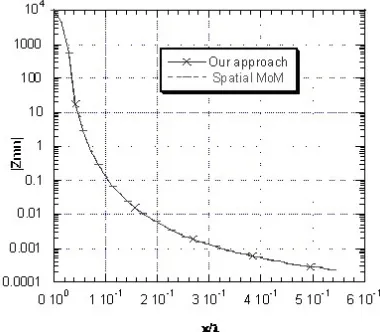
In order to verify our approach, the double integrals which is defined in (9) are evaluated by our method and are compared with spatial MoM. A good agreement is observed in Figure 1.
Figure 1. Comparison between different numerical techniques of evaluation of the infinite 2-d integral for single layer microstrip line structure (h= 0.7874 mm, εr =2.33, Wy = 0.03 mm).
Table 1. CPU Time for different method of Computation on a P-IV (RAM1GB) PC for the analysis of microstrip line (Wy = 0.03 mm, h= 0.7874 mm, L= 12 cm, εr =2.33).
Number of Spectral Our Speed unknown MoM (a) method (b) Improvement ab
40 66.83 (seconds) 0.32 (seconds) 208.34 200 325 (seconds) 1.01 (seconds) 321.78
In this paper, our hybrid method is based on the combination of spatial and spectral formulation. The double integral in (9) is divided into two parts; the first one is evaluated analytically in spatial domain; the remaining integrals are performed using the quadrature integration and also to speed up this part, a FFT algorithm is used.
Figure 2. Geometry of Coupled microstrip line filter.
Figure 3. Magnitude of S11 of the coupled microstrip line filter.
To show the speed of the computation time, the CPU time between the proposed method and the spectral MoM is given in Table 1 for two different numbers of unknowns. For 200 unknowns, the CPU time of our method is 1.01 second and for the spectral MoM is 325 second; the speed improvement is 321.78. We note that our method is faster than the spectral MoM.
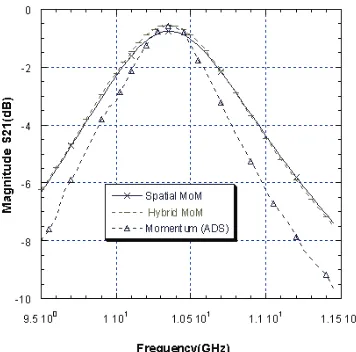
In this paper, the hybrid MoM formulation is applied to a coupled microstrip line filter, where the dielectric constant of the substrate εr
Figure 4. Magnitude S21 of the coupled microstrip line filter.
5. CONCLUSION
In this paper, we have presented a hybrid formulation of the method of moments for analysis of microstrip structures. The main idea is to evaluate the impedance matrix elements by two double integrals. One is treated in spatial domain using analytical method; the other is computed in spectral domain and accelerated by FFT. The results obtained from our proposed approach show the improved computational efficiency. Numerical results for single layer microstrip structures are presented and compared leading to good agreements. Our approach can be easily extended to multilayer microstrip structures.
REFERENCES
1. Jin, J. M. and W. C. Chew, “Computational electromagnetics: The method of moments,” Electrical Engineering Handbook, Academic Press, New York, 1999.
2. Uwaro, T. and T. Itoh, “Spectral domain approach,” Numerical Techniques for Microwave Millimeter-Wave Passive Structures, 334–380, John Wiley & Sons, Inc., 1989.
4. Aksun, M. I. and G. Dural, “Clarification of issues on the closed form Green’s functions in stratified media,” IEEE Antennas and Propagation Magazine, Vol. 53, 3644–3652, 2005.
5. Davidson, D. B. and J. T. Aberle, “An introduction to spectral domain method-of-moments formulations,” IEEE Antennas and Propagation Magazine, Vol. 46, No. 3, 251–259, June 2004 6. Mariottini, F., A. Cucini, and S. Maci, “A hybrid spectral/spatial
method to evaluate the active Green’s function of large planar rectangular arrays: A combined asymptotic/numerical algorithm,” IEEE Transactions on Antennas and propagation., Vol. 54, 878–887, Issue 3, March 2006.
7. Alatan, L., M. I. Aksun, K. Mahadevan, and M. T. Birand, “Analytical evaluation of the MoM matrix elements,”IEEE Trans. Microwave Theory Tech., Vol. 44, No. 9, April 1996.
8. Samet, A. and A. Bouallegue, “Fast and rigourous calculation method for MoM matrix elements in planar microstrip structures,”
Electronics letters., Vol. 36, No. 9, April 2000.
9. Essid, C., M. B. Ben Salah, A. Samet, and A. Kouki, “An efficient space domain formulation of the MoM method for planar circuits,”
PIERS Proceedings, 722–724, Cambridge, USA, July 2–6, 2008. 10. Chow, Y. L., Y. G. Yang, D. G. Fang, and G. E. Howard,
“A closed-form spatial Green’s function for the thick microstrip substrate,”IEEE Trans. Microwave Theory Tech., Vol. 39, No. 3, 588–592, 1991.
11. Aksun, M. I., “A robust approach for the derivation of closed-form Green’s functions,” IEEE Trans. Microwave Theory Tech., Vol. 44, No. 5, 651–658, 1996.
12. Kipp, R. and C. H. Chan, “Complex image method for sources in bounded regions of multilayer structures,” IEEE Trans. Microwave Theory Tech., Vol. 42, No. 5, 860–865, 1994.
13. Aksun, M. I., F. Caliskan, and L. Gurel, “An efficient method for electromagnetic characterization of 2-D geometries in stratified media,” IEEE Trans. Microwave Theory Tech., Vol. 50, No. 2, 1264–1274, May 2002.
14. Park, S. O., C. A. Balanis, and C. R. Birtcher, “Analytical evaluation of the asymptotic impedance matrix of a grounded dielectric slab with roof-top functions,” IEEE Trans. Microwave Theory Tech., Vol. 46, No. 2, 251–259, February 1998.
15. Chae, C. B., J. P. Lee, and S. O. Park, “Analytical asymptotic Extraction technique for the analysis of bend discontinuity,”