Scholarship@Western
Scholarship@Western
Electronic Thesis and Dissertation Repository
8-12-2014 12:00 AM
The Development and Validation of a Multidimensional Measure
The Development and Validation of a Multidimensional Measure
of Moral Orientation
of Moral Orientation
Erica A. Giammarco
The University of Western Ontario Supervisor
Dr. Philip A Vernon
The University of Western Ontario
Graduate Program in Psychology
A thesis submitted in partial fulfillment of the requirements for the degree in Master of Science © Erica A. Giammarco 2014
Follow this and additional works at: https://ir.lib.uwo.ca/etd Part of the Personality and Social Contexts Commons
Recommended Citation Recommended Citation
Giammarco, Erica A., "The Development and Validation of a Multidimensional Measure of Moral Orientation" (2014). Electronic Thesis and Dissertation Repository. 2255.
https://ir.lib.uwo.ca/etd/2255
This Dissertation/Thesis is brought to you for free and open access by Scholarship@Western. It has been accepted for inclusion in Electronic Thesis and Dissertation Repository by an authorized administrator of
THE DEVELOPMENT AND VALIDATION OF A MULTIDIMENSIONAL MEASURE OF MORAL ORIENTATION
Erica A. Giammarco
Supervised by Dr. Philip A. Vernon
Graduate Program in Psychology
A thesis submitted in partial fulfillment of the requirements for the degree of
Master of Science
The School of Graduate and Postdoctoral Studies The University of Western Ontario
London, Ontario, Canada
ABSTRACT
Researchers have found that when individuals are faced with moral dilemmas, they tend to
approach the situations with the same general perspective. This general perspective is referred to
as their moral orientation. Studies have shown that moral orientations tend to be either justice or
care focused. A justice orientation refers to a focus on rights, rules, and objective decision
making. In contrast, individuals using a care orientation are more likely to consider relationships,
contextual factors, and minimizing harm to others. Although numerous studies have reported
individual differences in these orientations, the literature has failed to consider how individuals
with ―abnormal‖ moral development approach these dilemmas. As such, the goal of present
study was to develop a measure of moral orientation that was able to capture adequately the
orientations of those individuals with more maladaptive tendencies. This was achieved by
assessing a novel moral orientation, termed self-promotion. After developing and administering
this scale to two independent samples, a series of item analyses were conducted and items that
failed to meet acceptable levels of psychometric criteria were deleted. The reduced scaled was
factor analyzed and the results indicated three distinct care, justice, and self-promotion factors
emerged for some scenarios, but not others, suggesting that further scale revisions are necessary.
Despite some potentially problematic items, preliminary validity evidence was found, with
significant correlations in the expected direction observed between each of the moral orientation
dimensions and various Dark Triad and HEXACO personality traits.
ACKNOWLEDGMENTS
First and foremost, I would like to thank Dr. Tony Vernon for his continued guidance over the
past few years. I am incredibly grateful for the many amazing opportunities he has afforded me,
and appreciate the detailed feedback I received while working on this paper. I would also like to
thank Dr. Sampo Paunonen, Dr. Richard Goffin, and Dr. Don Saklofske for their comments and
suggestions throughout the development of this thesis. Also, thank you to Livia Veselka for her
generous support throughout the writing process. Finally, thank you to my parents, family, and
TABLE OF CONTENTS
ABSTRACT……….. ii
ACKNOWLEDGMENTS……… iii
CHAPTER 1: INTRODUCTION AND LITERATURE REVIEW………. 1
1.1Introduction………. 1
1.2Kohlberg‘s Model of Moral Development………. 3
1.3Gilligan and the Importance of Care……….. 8
1.4The Assessment of Moral Orientation……… 10
1.4.1 Dilemma Content………... 11
1.4.2 Age……… 13
1.4.3 Personality……… 14
1.5The Five Factor Model of Personality and Beyond……… 15
1.6The Present Study………... 16
CHAPTER 2: SCALE DEVELOPMENT AND STUDY 1………. 20
2.1 Method……… 20
2.1.1 Participants………. 20
2.1.2 Materials and Procedures……… 20
2.1.3 Procedure………. 23
2.2 Results………. 24
2.2.1 Careless Responders……… 24
2.2.2 Item Level Analyses……….. 24
2.2.3 Exploratory Factor Analyses (EFA)……… 26
2.3 Discussion………... 39
CHAPTER 3: STUDY 2 – ITEM REFINEMENT AND CONSTRUCT VALIDITY ……... 41
3.1 Method……… 41
3.1.1 Participants……….. 41
3.1.2 Materials and Procedures……… 42
3.1.3 Procedure……… 43
3.2 Results………. 44
3.2.1 Careless Responders……… 44
3.2.2 Item Level Analyses………. 44
3.2.3 Exploratory Factor Analyses………... 46
3.2.4 Sex Differences………. 54
3.2.5 Convergent and Construct Validity………. 54
3.3 Discussion………... 57
CHAPTER 4: GENERAL DISCUSSION AND CONCLUSIONS………. 58
4.1 General Discussion………. 58
4.2 Limitations……….. 65
4.3 Future Directions……… 67
4.3.1 Scale Development………... 67
4.3.2 Computer Adaptive Testing………. 68
4.3.3 Moral Orientation in the Workplace……… 69
4.4 Conclusion……….. 70
TABLE 1: Study 1 Zero-Order Correlations between the AMO and MMO-2 Care and
Justice Subscales………... 27
TABLE 2: EFA Factor Loadings for MMO-2 by Scenario………. 30
TABLE 3: EFA Factor Loadings for AMO Impersonal Version Scenario 1………... 33
TABLE 4: EFA Factor Loadings for AMO Impersonal Version Scenario 2………... 34
TABLE 5: EFA Factor Loadings for AMO Impersonal Version Scenario 3………... 35
TABLE 6: EFA Factor Loadings for AMO Impersonal Version Scenario 4………... 36
TABLE 7: EFA Factor Loadings for AMO Impersonal Version Scenario 5………... 37
TABLE 8: EFA Factor Loadings for AMO Impersonal Version Scenario 6……….. 38
TABLE 9: Study 2 Descriptive Statistics……….. 45
TABLE 10: Study 2 EFA Factor Loadings for Scenario 1……… 47
TABLE 11: Study 2 EFA Factor Loadings for Scenario 2………. 48
TABLE 12: Study 2 EFA Factor Loadings for Scenario 3……….. 50
TABLE 13: Study 2 EFA Factor Loadings for Scenario 4……….. 51
TABLE 14: Study 2 EFA Factor Loadings for Scenario 5……….. 52
TABLE 15: Study 2 EFA Factor Loadings for Scenario 6……….. 53
TABLE 16: Study 2 Zero-Order Correlations………. 55
APPENDIX A: Personal and Impersonal Versions of the AMO (Study 1)………. 84
APPENDIX B: NMREB Ethics Approval……… 96
APPENDIX C: Reduced Version of the AMO (Study 2)………. 97
CHAPTER ONE: INTRODUCTION AND LITERATURE REVIEW
1.1 Introduction
Moral orientation refers to the general perspective an individual takes when approaching
a moral dilemma. Researchers have found significant differences in the factors people consider
when attempting to decide how they would behave in a dilemma (Haviv & Leman, 2002;
Weinberg, Yacker, Orenstein, & DeSarbo, 1993). In particular, some individuals tend to focus on
contextual factors, such as recent hardships experienced by others. This is referred to as a care
orientation and is characterized by a high regard for relationships and minimizing harm to others.
In contrast, some individuals display a justice orientation, which is demonstrated by objectivity
and rational thinking in decision making. These individuals are able to separate themselves from
a situation and are more likely to focus on the rights, rules, and reciprocity in a scenario (Liddell,
Halpin, & Halpin, 1992).
A number of scales have been created to assess each of these orientations, including the
Measure of Moral Orientation-2 (MMO-2; Liddell, 2006), the Moral Orientation Scale (MOS;
Yacker & Weinberg, 1990), and the Moral Justification Scale (MJS; Gump, Baker, & Roll,
2000). However, these scales all suffer from the same limitation—normal moral development is
an underlying assumption. In assuming normal moral development, these scales have failed to
explain the moral orientations of those individuals with antisocial tendencies.
Personality research has experienced a shift in recent decades, which conceptualizes
individual difference traits as existing on a continuum from normal to pathological, rather than
being classified categorically (Haslam, 2011). In particular, research on maladaptive personality
traits has focused on the so-called ―Dark Triad‖. First proposed by Paulhus and Williams (2002),
psychopathy. Individuals high in Machiavellianism tend to be manipulative and deceitful
(Christie & Geis, 1970), while those high in psychopathy display impulsive behaviour and have
little empathy for others (Hare, 1985). Lastly, narcissistic individuals think extremely highly of
themselves, report grandiose self-views, and have strong feelings of entitlement (Raskin & Hall,
1981).
Evidence that existing measures of morality do not capture adequately the behaviours of
those with maladaptive tendencies was found by Bartles and Pizarro (2011). The researchers
administered self-report measures of Machiavellianism and psychopathy, as well as the Defining
Issues Test (DIT; Rest, Cooper, Coder, Masanz, & Anderson, 1974). The DIT is a measure of
moral reasoning, which presents participants with a number of hypothetical ethical dilemmas.
Participants are asked how they would respond in the situation, and then they must rank the
factors they consider to be most important in arriving at their decision.
Bartles and Pizarro found that individuals who reported psychopathic and Machiavellian
traits tended to report a greater number of ―optimal moral judgments‖: solutions that had the best
outcome for the most number of people. This finding is clearly problematic for the construct
validity of the DIT because individuals with psychopathic and manipulative tendencies, by
definition, should not display optimal morality. In fact, Bartels and Pizarro concluded that such
utilitarian responses had less to do with morality and more to do with a belief that life is
meaningless. This may explain why non-empathetic individuals—as suggested by high
psychopathy scores—provided such answers.
Evidently, current conceptualizations of morality are problematic for populations with
subclinical maladaptive tendencies. Although some researchers have shown that
reasoning, as would be expected, (Campbell et al., 2009) it is still unknown how these Dark
Triad traits relate to moral orientation. It might be expected that those who score high on the
Dark Triad would not display a care orientation, given that a lack of empathy is characteristic of
these individuals. However, these individuals might not display a justice orientation either,
because they tend to care less about reciprocity and equality, and more about self-gains.
As such, the purpose of the present study is to develop a measure of moral orientation
that is able to capture adequately the orientation of those individuals with maladaptive
tendencies. To assess moral orientation more comprehensively, a novel orientation will be
developed in addition to existing orientations—one that is characterized by the tendency to focus
on factors that directly impact oneself, regardless of the consequences to others. This new
orientation has been termed self-promotion.
1.2 Kohlberg’s Model of Moral Development
The study of morality has interested researchers for decades, yet a unified definition of
the construct still does not exist. Some argue that morality refers to a universal code of ethics
which applies to everyone and which all rational individuals abide by, whereas others suggest
that morality is individualistic and describes a code of conduct accepted by an individual (Gert,
2011). Indeed it is possible to conceptualize how both definitions of morality could be true. For
example, widespread taboos such as incest seem to suggest that there are certain behaviours that
humans universally agree are morally wrong. However, the extensive controversy surrounding a
number of issues including abortion and physician-assisted suicide points to individual
differences in people‘s sense of what is and what is not moral.
One of the first researchers to empirically study moral development was Lawrence
how normal morality develops across the lifespan. Kohlberg argued that all individuals progress
through one or more of a series of six stages of moral development. Although not all individuals
progress through all six stages, according to the theory, once a certain stage of development is
reached, an individual cannot revert back to an earlier stage (Thoma, 1989).
As described by Crain (1985) Kohlberg proposed that moral development begins in
childhood. The first and second stages are collectively referred to as the pre-conventional level.
Both stages are characterized by making moral decisions based on the rules of one‘s society, and
judging certain behaviours as right or wrong based on their physical consequences. More
specifically, stage one is typically displayed in infancy and is solely focused on the physical
consequences of behaviours and avoiding punishment. In contrast, in stage two the individual
begins to understand that there are multiple sides to any issue and, as such, they choose to
behave in ways that are personally beneficial. This stage is most commonly observed among
pre-school children.
Stages three and four make up the conventional level, and reflect the moral development
of school-aged children. At this point in development, family expectations and national values
begin to factor into decision-making as the individual reaches adolescence. Kohlberg suggested
that the individual begins to accept social norms not simply to conform to society, but because of
a sense of loyalty and support. In particular, individuals at stage three consider behaviour to be
good or bad based on how others perceive it. As such, Kohlberg argues that individuals will try
to conform to ―good boy-nice girl‖ stereotypes. Progression to stage four is dominated by a law
and order orientation. Doing the ―right thing‖ is considered doing what is required to maintain
social order. Respect for authority and performing one‘s ―duty‖ are essential components of this
Lastly, stages five and six are labelled the post-conventional, autonomous, or principled
levels. Here, individuals develop and define moral values that should be applied even when
authority is not present. Stage five emphasizes individual rights and the democratic process,
which gives everyone a voice in social order. Kohlberg argued that this stage is most common
among teenagers. The final stage of moral development is not reached until adulthood, and
focuses on universal human rights of equality and respect for everyone.
Kohlberg‘s seminal model was first tested in his dissertation study in 1958, which was
not published until 1994. Kohlberg conducted a series of semi-structured interviews with young
boys 10 to 16 years of age, employing what he referred to as the ―Moral Judgments Scale‖
(MJS). During these interviews, participants were presented with a series of hypothetical moral
dilemmas and asked how they would react in each situation. Once a child indicated their
decision, the interviewer used a series of probes to investigate the child‘s justification for their
responses. All responses were then coded against Kohlberg‘s six stages, and it was found that
younger children received lower stage ratings than older children.
Unfortunately, attempts to replicate Kohlberg‘s findings were unsuccessful
(Niemczynski, Czyzowska, Pourkos, & Mirski, 1988). Due to the unstandardized nature of the
MJS, researchers found little evidence of inter-rater reliability, construct validity, or stability in
administration and question probes (Kurtines & Grief, 1974; Turiel, 1966). The lack of basic
psychometric properties severely limited the empirical investigation of Kohlberg‘s
developmental model. Rest et al. (1974) attempted to address this concern by developing a
standardized measure of Kohlberg‘s model of moral development: the Defining Issues Test
The DIT is a self-report measure of moral development that presents participants with a
series of hypothetical moral dilemmas. Following each dilemma, the participant reads a number
of statements that address relevant issues in the dilemma. The importance that individuals ascribe
to each statement in their decision making process is rated on a five-point Likert scale. Each
statement is written to reflect one of Kohlberg‘s stages. As such, if a participant rates an item as
being highly important, the participant is assumed to be at the developmental stage exemplified
by that item. An individual‘s moral development score is calculated by aggregating their
endorsement of items across all dilemmas.
Preliminary validation studies of the DIT compared ratings of junior high school, senior
high school, college, and graduate students (Rest et al., 1974). It was found that statements
exemplifying higher stages of moral development were endorsed by more advanced students. In
addition, participants‘ stage-ratings were consistent across situations.
Despite best attempts to produce a standardized measure of Kohlberg‘s stages, Rest et
al.‘s (1974) DIT suffers from a key design flaw. Initial validation studies found that children in
grade nine and under experienced difficulty understanding the instructions of the DIT (Kay,
1982). As such, Rest, Davison, and Robbins (1978) admitted that the use of the DIT with
children in elementary school would be inappropriate. As described by Kay (1982) in his
comprehensive review of the literature on the DIT and Kohlberg‘s model, this is a major
problem. That is, if a test designed to assess developmental stages is inappropriate for use on
individuals at the earliest and most rapid-changing stages, this seriously compromises the utility
of the measure.
In addition to this fundamental design flaw, Kay (1982) points to a series of
important, cross-sectional validation studies of the DIT compared junior high, senior high,
college, and graduate students‘ scores, concluding that higher stage scores among older
participants was support for Kohlberg‘s developmental model. However, each of these studies
failed to control for covariance between groups attributable to education, socio-economic status,
and IQ. Failing to account for each of these additional variables confounds the conclusion that
morality scores increase as a function of age. In fact, when DIT scores were compared against
age and education, researchers found a positive association between moral judgements and
education level, but a negative association with chronological age (Coder, 1975; Dortzbach,
1975, both as cited in Kay, 1982). These findings not only threaten the validity of the DIT, but
they also challenge the developmental nature of Kohlberg‘s model.
Whereas Kohlberg‘s model of moral development was revolutionary and highly regarded
at the time, it was clearly not without its critics. As previously mentioned, numerous early
validation studies failed to control for variance in moral development scores that could be
attributed to education and IQ (Martin, Shaftro, & Van Deinse, 1977). Since these studies,
researchers have found a significant association between moral development scores and IQ
(Dawson, 2002; Taylor, 1978). In addition, not only do DIT scores increase as the number of
years of education increase, but Coder (1975) found that scores increase more with special moral
education programs than with non-moral education. Perhaps the most intriguing study looking at
the association between DIT and education was conducted by Rest et al. (1978) who reported
that when an individual discontinued formal education their moral development scores stabilized.
Taken together, the results of these studies threaten the conclusion that higher DIT scores reflect
a higher level of moral development. Rather, it may be that higher DIT scores are achieved
In addition to confounding cognitive abilities and education with moral development,
researchers have criticized measures of Kohlberg‘s developmental model on the grounds that
participants are rarely found to endorse stage five or six judgments (Kurtines & Grief, 1974).
When Kohlberg (1958) initially proposed his six-stage model, he speculated that the highest
level of moral development would most typically be reached in late adolescence or early
adulthood. However, researchers have found that not only is it is rare for young adults to display
stage six judgements, but even those participants with advanced moral and theological training
rarely report judgments indicative of this supposedly higher level of reasoning (Kurtines & Grief,
1974). The relative rarity of post-conventional judgments, along with evidence that moral
judgement measures are not suitable for use on young children severely challenges the existence,
or at least the measurable existence, of six distinct stages of moral development.
Despite all these challenges, arguably the biggest criticism of Kohlberg‘s work came
from his own student, Gilligan (1982). According to Gilligan, the fact that Kohlberg‘s (1958)
sample consisted entirely of boys severely limited the generalizability of the model to girls. In
fact, Gilligan proposed that the moral judgments made by girls were quite different from those of
boys and as such, any measure of Kohlberg‘s stage model was inappropriate for use with female
participants.
1.3 Gilligan and the Importance of Care
As mentioned by Gilligan (1982), psychology studies conducted prior to the 1970s
predominately used male samples. In large part, this was due to the fact that there were more
men than women at the institutions where this research took place. Consequently, as female
enrolment in post-secondary schools increased, so did their inclusion in empirical studies.
this shift and as such, were based on predominately male samples. Kohlberg‘s (1958) stages of
moral development was one such model.
When researchers administered Kohlberg-type moral dilemmas to females they found
that young girls scored a full stage lower than their male counterparts, matched on IQ,
socio-economic status, and academic achievement (Holstein, 1972 as cited in Kurtines & Grief, 1974).
Examining participants‘ rational for their moral judgments, it became evident that females scored
lower on these measures because they showed less sense of justice and greater concern for
interpersonal relationships. As such, it appeared as though women‘s focus on relationships was
impeding their moral development. Rather than concluding that women were less morally
developed than men, Gilligan (1982) suggested that women‘s focus on relationships and
non-violent conflict resolution was not inferior to men‘s systematic and logical approach to moral
dilemmas. Rather, the two approaches should be considered complementary, not sequential.
Empirical investigations of sex differences on Kohlberg-type moral dilemmas, however,
failed to provide consistent evidence of the male-bias that Gilligan (1982) proposed. Although
some researchers did find that males scored higher on moral development measures than did
females (Walker, 1984), numerous researchers failed to find any significant sex differences
(Colby & Damon, 1983; Lifton, 1985; Rest, 1979; Thoma, 1986). Complicating the issue further,
some studies found that women actually scored higher than men on the DIT (Bruess & Pearson,
2002). However, as mentioned by Jaffee and Hyde (2000), these studies did not test directly the
assumption that males were more likely than females to use a justice orientation, as Gilligan
proposed. In fact, because the Kohlberg-based scoring methods do not code typical ‗care‘
responses, it is not possible to investigate properly the proposed hypothesis with these
1.4 The Assessment of Moral Orientation
Gilligan‘s (1982) proposition that different forms of thought led to two distinct modes of
moral judgment sparked a great deal of research on moral orientation. That is, rather than
focusing on how morality develops, researchers became interested in studying the different ways
people approached moral dilemmas, and in particular, if men and women display different
orientations, on average.
A number of self-report measures of moral orientation were developed including the
Measure of Moral Orientation (MMO; Liddell et al., 1992), MOS (Yacker & Weinberg, 1990),
and the MJS (Gump et al., 2000). Each of these scales contains a series of vignettes depicting
different moral dilemmas. Following each vignette, participants are presented with a series of
statements regarding different factors present in the dilemma, and are asked to rate their level of
agreement with each statement using a Likert-scale rating system. Each statement is written to
reflect either a care or a justice orientation. Liddell et al. (1992) defined a care orientation as
displaying a focus on relationships and the feelings of others. Those individuals who use a care
orientation make attempts to minimize harm done to others. In contrast, justice responses were
operationalized as being rational and objective. Individuals endorsing these responses approach a
given scenario as a third-party observer, and focus on the personal rights and legal ramifications
of a dilemma.
Although the previous assessments of moral orientation all use a similar format, each
offers a slightly unique way to assess moral orientation. The MMO (Liddell et al., 1992) was
created for use with a university sample and its vignettes reflect dilemmas that a typical
post-secondary student might encounter (e.g., a roommate plagiarizing their article for the student
childhood dilemmas (e.g., should you invite the unpopular child in your class to your birthday
party). Lastly, the MJS (Gump et al., 2000) contains very long, detailed scenarios, and rather
than having care and justice items for the same scenario, each scenario only contains either care
or justice items.
With an assortment of tests available to assess care and justice responses, researchers
once again investigated whether or not the gender differences suggested by Gilligan (1982)
would be borne out in empirical studies using objective measures. Again, the results were mixed.
A number of researchers did, in fact, find that women scored higher on care orientations, while
men scored higher on justice (Donenberg & Hoffman, 1988; Johnston, 1988; Liddell & Davis,
1996; Yacker & Weinberg, 1990). However, a number of studies found no significant sex
differences in moral orientation (Beal, Garrod, Ruben, Stewart, & Dekle, 1997; Friedman,
Robinson, & Friedman, 1987; Maqsud, 1998). These results led to a general agreement among
most researchers that there are different types of moral orientations (namely, care and justice);
however, it is greatly debated as to whether or not these differences are due to sex. As such, a
number of alternative explanations have been proposed (Jaffee & Hyde, 2000).
1.4.1 Dilemma content. With the increased attention being paid to moral orientation, a
series of researchers argued that the content of the moral dilemmas presented to participants
could have a large impact on the moral orientations used by these participants when solving the
dilemmas (Rothbart, Hanley, & Albert, 1986). Initially, it was suggested that perhaps the sex of
the protagonist in the scenario could account for some variance in responses (Holstein, 1976).
However, this was not found to have a significant impact on moral orientation (Garwood,
Next, concerns were raised as to whether or not people would respond consistently with
the same orientation across scenarios. Bush, Krebs, and Carpendale (1993) found that
participants responded very consistently across philosophical, Kohlberg-type dilemmas.
However, additional studies suggested that participants were less consistent across real-life
dilemmas (Bartek, Krebs, and Taylor, 1993). An example of a Kohlberg-type dilemma is
whether you should push a large man onto a set of train tracks to stop an oncoming train from
killing a group of children. In contrast, real-life dilemmas were generated by participants when
they were asked to describe a recent moral dilemma from their personal lives. A study by Wark
and Krebs (1997) reported that participants were consistent in their endorsement of either a care
or justice moral orientation approximately 90% of the time in Kohlberg-type moral dilemmas,
but only 68-75% consistent in real-life dilemmas.
Of course if the goal of an assessment tool is to be as psychometrically sound as possible,
participants should be responding consistently across items. This would suggest that scales of
moral orientation should rely exclusively on Kohlberg-type scenarios. However, the utility of
such an assessment would be severely limited if it did not reflect how individuals actually
thought about moral dilemmas in real life. As such, it may be that such scenario-based
assessments need to sacrifice some psychometric properties in order to enhance their external
validity.
Further evidence that dilemma content can impact moral orientation responses was
reported in a series of studies by Wark and Krebs (1997; 2000). Participants responded to
prosocial and antisocial dilemmas. Prosocial dilemmas were defined as those that required
participants to decide whether they should help someone or decide how to respond when two
labelled as those that involved behaving dishonestly and/or breaking the law/rules. It was found
that prosocial dilemmas evoked more care responses, although this effect was weak. Also,
antisocial dilemmas tended to evoke more justice responses. Additional researchers have found
similar results (Crandall, Tsang, Goldman, & Pennington, 1999; Haviv & Leman, 2002).
From these studies, it is clear that the content of the dilemma is important to consider
when assessing moral orientation. It could be argued that dilemmas written as either prosocial or
antisocial, as described by Wark and Krebs (1997), would lend themselves to certain orientations
because the dilemmas contain more opportunities for one type of response versus another (i.e.,
laws and consequences are salient in antisocial dilemmas but not in prosocial, causing people to
tend to use a justice orientation). As such, it seems that the ideal scenario would contain elements
of both prosocial and antisocial content, so as not to influence responses too strongly. As a
caveat, it should also be noted that, although it was found that certain dilemmas favoured one
orientation more than another, both orientations were found across both dilemmas. This indicates
that although the dilemma has an effect, there is additional variance in moral orientation scores
that can be accounted for by other variables.
1.4.2 Age. Early researchers suspected that age may have an impact on moral orientation
given that sex differences were found to exist in adult samples, but not among children (Walker,
de Vries, & Trevethan, 1987). Pratt, Golding, Hunter, and Sampson (1988) found significant sex
differences in an adult sample, but only for those individuals in middle adulthood (as compared
to younger and older adults). More recent studies suggest there is no correlation between moral
orientation and age (Glover, 2001). The limited number of studies on this topic and the lack of
consistent findings suggest that further research is needed to determine the extent of any relations
care orientations increased for children 6 to 8 years of age, at the same time that the use of justice
orientations decreased for both boys and girls (Muthukrishna & Govender, 2011). These results
confirm the notion that research conducted with adult samples should not be assumed to
extrapolate to children. In addition, the seemingly unstable nature of moral orientations suggests
that assessments used on adults may not be suitable for children.
1.4.3 Personality. A number of researchers have investigated associations between
personality and moral reasoning (Glenn, Koleva, Iyer, Graham, & Ditto, 2010; Koenigs,
Kruepke, Zeier, & Newman, 2012). These investigations have predominately focused on the role
of psychopathy in moral decision making. Using both student (Gao & Teng, 2013) and
incarcerated (Koenigs et al., 2012) samples it was found that utilitarian judgments were more
common among individuals who scored high on self-reported measures of psychopathy. These
findings support the results of Bartels and Pizzaro (2011) discussed above.
Unfortunately, surprisingly little research has examined the association between
personality and moral orientation, specifically. A study conducted by Glover (2001) examined
relations between the MOS and the Myers-Briggs Type Indicator (MBTI, Myers & McCaulley,
1985). It was found that care and justice orientations were less related to gender roles and more
strongly associated with personality types. In particular, a justice orientation was positively
correlated with judging and intuition personality traits, whereas a care orientation was associated
with perceiving and sensing traits. In addition, justice was found to be correlated with
extraversion, and care with introversion. These results were later replicated in an independent
study (Anwar, Bhutto, Maitlo, & Khawaja, 2012).
It should be noted that a number of researchers have criticized the use of the MBTI for
2002). In particular, McCrae and Costa (1989) argue that the MBTI does not adequately measure
distinct personality types, but instead could be conceptualized as measuring four of the five
relatively independent personality dimensions outlined by the Five Factor Model (FFM; Costa &
McCrae, 1992. Re-interpreting the MBTI in this way would make it an inappropriate assessment
of Jungian-theory, as was initially intended.
1.5 The Five Factor Model of Personality and Beyond
For decades the FFM has dominated individual differences research, with an
overwhelming body of literature supporting its existence (McCrae & Costa, 1997; Ones &
Viswesvaran, 1996; Saucier & Goldberg, 1998). The FFM proposes that there are five distinct
dimensions of personality which can account for all individual differences in personality. These
dimensions are Agreeableness (helpful, good-natured, cooperative, friendly), Conscientiousness
(self-disciplined, dutiful, organized, preference for planning), Extraversion (outgoing, energetic,
assertive, sociable), Neuroticism (tendency to experience negative emotions such as anxiety,
anger, depression), and Openness to Experience (appreciation for beauty, creativity, adventure,
curiosity).
In addition to the FFM, the six-factor HEXACO (Lee & Ashton, 2004) model has gained
considerable research attention (Gaughan, Miller, & Lynam, 2012; Jonason & McCain, 2012;
Lee & Ashton, 2014). Five of the six personality traits described by the HEXACO model
(Agreeableness, Conscientiousness, Extraversion, Openness, and Emotionality) are similar to the
FFM dimensions described previously. The major difference between HEXACO and the FFM is
the inclusion of the Honesty-Humility factor. Individuals who score high on Honesty-Humility
entitlement. As such, it could be argued that HEXACO assesses a broader range of personality
traits, and therefore is more desirable for individual differences research.
Although the HEXACO and FFM have greatly advanced our understanding of normative
personality traits, they have also been the subject of much criticism in recent years (Paunonen &
Jackson, 2000). In particular, researchers have argued that the FFM is not able to capture
adequately the full range of personality traits, especially those that reflect socially malevolent
behaviours (Veselka, Schermer, & Vernon, 2012). For this reason, alternative models, such as
the Dark Triad, have been proposed.
The inclusion of maladaptive personality traits when investigating morality is of
particular importance if we wish to study the full range of morality. Although various measures
of moral orientation currently exist (Gump et al., 2000; Liddell, 2006; Yacker & Weinberg,
1990) each scale suffers from the same limitation – normal moral development is an underlying
assumption. There is currently no known self-report assessment of moral orientation that
specifically assesses how individuals with presumable deficits in morality would respond to
ethical dilemmas. As such, it seems as if the existing conceptualization of moral orientation may
contain one of the same limitations as the FFM – it only capture the responses of those that fall
within the domain of ―normal‖ personality.
1.6 The Present Study
Current conceptualizations of morality have largely overlooked those populations with
subclinical maladaptive tendencies. Those few studies that have examined morality within these
samples have produced results that are problematic for the construct validity of current
assess adequately the moral judgments of those with antisocial tendencies, or if alternative
assessments would be better suited for use with these populations.
As such, the purpose of the present study is to develop a measure of moral orientation
that is able to capture adequately the orientations of those individuals with maladaptive
tendencies. This goal will hopefully be achieved by assessing a novel moral orientation,
characterized by the tendency to focus on factors that directly impact oneself, regardless of the
consequences to others. Such an orientation would diverge from a care orientation because
consequences to others are not considered, and it would also differ from a justice orientation in
that the focus is on the consequences to oneself, not on what is just or fair. This new orientation
will be referred to as self-promotion. Given the extensive literature linking the Dark Triad traits
to empathy deficits, inflated self-views, and a disregard for other‘s well-being (Paulhus &
Williams, 2002), it is reasonable to expect that individuals with these tendencies would be likely
to attend to factors that impact themselves, rather than others, in moral dilemmas.
This thesis consists of two studies. In Study 1, the novel moral orientation measure,
termed the Assessment of Moral Orientation (AMO) was developed and administered to a
sample of undergraduate university students, along with an existing measure of moral orientation
and a social desirability inventory. The purpose of this study will be to examine the effect of
scenario content on moral orientation. Participants in Study 1 will all receive the same moral
dilemmas, but they will be randomly selected to receive the scenarios in either a personal or an
impersonal context. It is expected that participants will respond more objectively in impersonal
situations (reflecting a justice orientation), but that care orientations will be more prevalent
among personal scenarios. Preliminary item analyses will also be conducted and any items that
Based on the results of Study 1, the AMO will be modified and administered to a large
community sample in Study 2. Participants in this second study will also complete an existing
moral orientation measure as a validity criterion, the MMO-2, as well as measures of the Dark
Triad and HEXACO personality traits. The MMO-2 was selected over other moral orientation
measures because it seemed to be the best fit for the adult sample. After completing a series of
item analyses on the proposed scale, those items which fail to meet certain psychometric criteria
will be removed from future analyses. The remaining items will be factor analyzed, with three
factors reflecting care, justice, and self-promotion expected.
Associations between the proposed scale and an existing measure of moral orientation
will be examined for evidence of convergent validity for the care and justice scales. Study 2 will
also attempt to provide validation evidence for the proposed scale by examining its association
with the Dark Triad and HEXACO. In particular, care orientations scores are expected to be
negatively correlated with each of the Dark Triad traits. Given that previous research has found
psychopathy to be the ―darkest‖ of the Dark Triad traits (Jonason & Krause, 2013), it is expected
that psychopathy will demonstrate the strongest negative association with care. Also,
self-promotion scores are expected to be significantly positively correlated with Machiavellianism,
narcissism, and psychopathy.
With respect to HEXACO, Honesty-Humility and Conscientiousness are both expected to
be negatively associated with a self-promotion moral orientation. These associations are
expected due to the research indicating low scores on Honesty-Humility reflect a tendency to be
manipulative for personal gain, and low scores on Conscientiousness are associated with
impulsivity and a lack of concern for ones surroundings (Lee & Ashton, 2014). For these
with justice. Care is expected to be positively correlated with Agreeableness give that both
constructs reflect a concern for maintaining relationships and care is also expected to be
positively correlated with Emotionality because those who score high on Emotionality tend to
CHAPTER TWO: SCALE DEVELOPMENT AND STUDY 1
As discussed in Chapter 1, previous researchers have found that dilemma content can
have an impact on self-reported moral orientation ratings (Wark & Krebs, 2000). As such, it was
expected that an individual‘s approach to moral dilemmas may differ depending on how personal
the situation is deemed to be. In particular, it could be reasonably argued that individuals would
be more likely to make objective and rational decisions (justice orientation) when the situation
involves other people (impersonal), but they may consider relationships and contextual factors
more (care) when they are actually in the situation themselves (personal). As such, Study 1 was
conducted to determine if varying questionnaire instructions and scenario wording would
influence moral orientation ratings.
2.1 Method
2.1.1 Participants
The sample consisted of 200 undergraduate students (69 male, 131 female) recruited
from an introductory psychology course at a large Ontario university. Participants ranged in age
from 17 to 25 years (M = 18.79, SD = 1.431years) and received partial credit in exchange for
their participation. The study was administered online via FluidSurvey and took approximately
30 minutes to complete.
2.1.2 Materials and Procedures
Assessment of Moral Orientation (AMO). The AMO was developed for the present
study to assess moral orientation in individuals with a range of antisocial tendencies (from
normal to subclinical). The scale was constructed to measure three facets, each reflecting a
unique orientation: care (―I would not want to hurt my partner.‖), justice (―I would feel
boost my average for graduation.‖). Orientations were first operationally defined based on
previous assessments of the constructs (see Chapter 1; Liddell et al., 1992). Next, hypothetical
scenarios reflecting real-life moral dilemmas were generated. North American online opinion
polls were screened and issues that were not overtly religiously or politically charged were
selected for scenario content (Moral Issues, 2013).
Six scenarios were written and administered to a group of graduate students who rated
each scenario according to Moral Foundations Theory (MFT; Graham et al., in press). This
theory states that there are five moral themes that are present across cultures: care/harm,
fairness/cheating, loyalty/betrayal, authority/subversion, and sanctity/degradation. Scenarios for
the AMO were rated by psychology graduate students on each of these five themes to ensure a
broad range of moral dilemmas were covered. Analysis of the ratings showed that all raters
agreed that each of the moral foundations was present in at least one of the scenarios, with the
exception of sanctity/degradation. This moral foundation was reported present in one scenario by
three of the five raters. Given that the definition of this foundation contained an example that
was actually the theme of this scenario (physician assisted suicide) this was taken as an
acceptable level of agreement.
Thirty-one preliminary response items were written and presented to a focus group of
four psychology graduate students. Each item was written to reflect a care, justice, or
self-promotion factor specific to one scenario. Discussion pertaining to the items revealed concerns
that the item content for the self-promotion factor was too extreme in nature and would lead to
socially desirable responding and low variability in responses. These concerns were taken into
consideration and a second item pool was generated. This second item pool contained six
scenarios written in the impersonal context (i.e., Joe Smith is in the situation). There were a total
of 113 response items across all 12 scenarios (57 items for the personal scenarios, 56 for the
impersonal). This second draft was examined by two experts in personality and measurement.
Concerns about item homogeneity and scenario length were expressed.
Following these comments, the scenarios were revised to lower the overall reading level
to grade seven, with a total of 74 items per condition (i.e., personal versus impersonal). The
instruction set was also revised to include three conditions: personal (i.e., what would you do),
somewhat personal (i.e., if you were Joe, what would you do), and impersonal (i.e., what do you
think Joe would do). In addition, one item for each scenario was added to check for careless
responding. These items make up the reading check scale. This scale does not have an impact on
participants‘ scores on the care, justice, or self promotion scales. Rather, the items were designed
to test if participants have read the scenario carefully. All items were measured on a 5-point
Likert scale, with higher scores reflecting a greater endorsement of the orientation (1 = extremely
unlikely, 5 = extremely likely; see Appendix A for personal and impersonal versions of the
AMO).
Measure of Moral Orientation-2 (MMO-2). Developed by Liddell (2006) the MMO-2
is a self-report measure that assesses the extent to which individuals approach moral situations
using a care or a justice orientation. The MMO-2 contains seven dilemmas and 52 response
items, each of which exemplifies either a justice (―Regardless of the consequences to my
roommate, the article was mine and I have a right to have it published.‖) or care (―I would not do
anything to harm my friendship with my roommate.‖) orientation. Responses are measured on a
4-point Likert scale (1 = Strongly Disagree, 4 = Strongly Agree). Liddell (2006) reported a
Balanced Inventory of Desirable Responding (BIDR-6).The BIDR-6 (Paulhus, 1991)
is a self-report measure of social desirability which asks participants to indicate the veracity of a
series of statements to assess whether or not individuals are responding truthfully. It consists of
40-items, rated on a 7-point Likert scale (1 = not true, 7 = very true). The BIDR-6 measures two
subscales, Self-Deceptive Enhancement (SDE; ―I am a completely rational person.‖) and
Impression Management (IM; ―Once in a while I laugh at a dirty joke.‖). Cronbach‘s reliability
alphas of .67 to .77 have been reported for the Self-Deceptive Enhancement subscale, and .77 to
.85 for the Impression Management subscale (Paulhus, 1991).
2.1.3 Procedure
This study was approved by the University of Western Ontario Research Ethics Board for
Non-Medical Research Involving Human Subjects (see Appendix B). Participants indicated their
interest in the present study by signing up through the university‘s online research pool. After
indicating interest in the study, participants received a link, which randomly directed them to one
of three study URLs. Each URL first presented participants with the letter of information, which
stated that their completion of the questionnaires was indication of their consent to participate.
Next, participants completed the AMO, MMO-2, and BIDR-6. After completing all
questionnaires, participants were debriefed.
Each URL contained unique instructions for the completion of the AMO. Those
participants exposed to condition A received the instructions: ―For each factor, please rate how
likely it is to impact your final decision‖. Participants in condition B were told: ―For each factor,
please rate how likely you think it is to impact Kelly‘s final decision‖, while those in condition C
were told: ―For each factor, please rate how likely it is to impact your final decision, if you were
B contained impersonal scenarios with impersonal instructions, and condition C contained
impersonal scenarios with semi-personal instructions.
2.2 Results
2.2.1 Careless Responders
A number of statistical procedures were performed to test for careless responders. First,
participants who responded ―agree‖ or ―strongly agree‖ to any reading check items (e.g., ―My
grandmother‘s current treatment could cure her cancer‖ for the Assisted Suicide scenario) were
removed from the sample, as endorsement of these reading check items was taken as an
indication of inattentive responding.
Following the recommendations of Meade and Craig (2012) and Johnson (2005), a series
of long string scores were computed for each participant. A long string score is computed by
finding the number of consecutive items to which a participant consistently responds with the
same answer (e.g., ―4 strongly agree‖). A long string score was computed for each response
option for each participant. The mean long string score was then calculated, and any participants
with a long string score one-half a standard deviation higher than this mean were removed from
further analyses.
Next, the Mahalanobis distance among participants‘ response profiles was computed to
test for outliers. This is a multivariate approach similar to Euclidian distance, but which also
takes into account the covariance of data. Following these tests the sample was reduced from 227
to 200 participants.
2.2.2 Item Level Analyses
Preliminary analysis of the data assessed the means and standard deviations of the AMO
deletion given that low variability may suggest an item reflects an attitude that is either very
uncommon, or likely to be endorsed by everyone (Jackson, 1970). However, items on the reading
check scale were not flagged, because it is expected that all participants will score low on these
items. In total, 17 items from condition A, 20 items from condition B, and 26 items from
condition C were flagged for potential deletion due to low variability.
Next, item-total correlations were computed between each item and its hypothesized
scale. Because correlating an item with a scale score that includes the item can inflate item-total
correlations, scale scores were computed after removing the item of interest (Henrysson, 1963).
Any item with a corrected item-total correlation smaller than .20 was considered for deletion
(Dozois, Dobson, & Ahnberg, 1998). A total of 23 items from condition A, 27 from condition B,
and 20 from condition C failed to reach acceptable levels for corrected item-total correlations.
To test for internal consistency reliability, Cronbach‘s alphas were computed for the
proposed care, justice, and self-promotion scales prior to any item deletion. For the care
subscales the alpha values were .59, .67, and .63 for conditions A, B, and C respectively. For
justice, internal consistency coefficients of .74, .67, and .77 were calculated for conditions A, B,
and C respectively. Lastly, for self-promotion, the alpha values were .73, .60, and .78
respectively. Although some of these internal consistency estimates met the criteria for
acceptable levels (Kline, 2000), they were likely inflated due to the large number of items in
each scale. Because of this inflation, a stricter criterion for internal consistency is preferable.
Consequently, the poor reliability is likely due to a number of low item-total correlations and
suggests several items should be revised or removed from the scale.
In an attempt to control for social desirability, response items that correlated highly (r >
correlated highly with IM, 9 with SDE, and 2 items with both BIDR-6 subscales. In condition B,
2 items correlated highly with IM, 2 with SDE, and 3 with both. Finally, in condition C, 9 items
correlated with IM, 7 with SDE, and 2 with both.
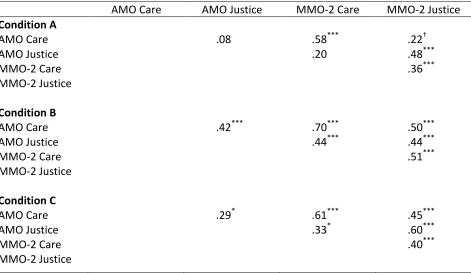
Correlations between the AMO and MMO-2 care and justice scales were also computed
to test for preliminary evidence of convergent validity. These results are reported in Table 1. For
conditions A, B, and C, AMO care was significantly positively correlated with MMO-2 care.
Similarly, AMO and MMO-2 justice scores were significantly correlated across all three
conditions. Consistent with previous research (Liddell, 2006), the care and justice subscales of
the MMO-2 were also significantly correlated with each other across all three conditions.
However, care and justice scores on the AMO were not significantly correlated with each other
in condition A, although they were in conditions B and C.
2.2.3 Exploratory Factor Analyses (EFA)
A series of EFAs were conducted to examine the structure of the 68 item AMO,
separately for each condition. Because the six reading check items were added to assess for
careless responding, they were not included in the factor analyses. Given that conditions B and C
(N = 69, and N = 58, respectively) contained the exact same scenarios and item wording, these
samples were combined to allow for a large enough sample size to conduct the EFA. However,
the sample size for condition A (N = 73) was somewhat smaller than recommended by most
researchers (Kline, 1979).
The EFAs were conducted using principal axis factoring (PAF), as recommended by
Fabrigar, Wegener, MacCallum, and Strahan (1999). Because the subscales were expected to
correlate with one another, an oblique rotation was selected. Fabrigar et al. (1999) advise against
Table 1
Study 1 Zero-Order Correlations between the AMO and MMO-2 Care and Justice Subscales
AMO Care AMO Justice MMO-2 Care MMO-2 Justice
Condition A
AMO Care .08 .58*** .22†
AMO Justice .20 .48***
MMO-2 Care .36***
MMO-2 Justice
Condition B
AMO Care .42*** .70*** .50***
AMO Justice .44*** .44***
MMO-2 Care .51***
MMO-2 Justice
Condition C
AMO Care .29* .61*** .45***
AMO Justice .33* .60***
MMO-2 Care .40***
MMO-2 Justice
Note. AMO refers to the Assessment of Moral Orientation and MMO-2 to the Measure of Moral Orientation
*indicates significance at p < .05 **indicates significance at p < .001
recommend alternative tests. One such test recommended by O‘Connor (2000) is the parallel
analysis test. Parallel analysis compares the eigenvalues from the observed data to eigenvalues
from simulated random data. The number of observed eigenvalues that are larger than the
randomly generated eigenvalues reflects the number of factors that should be extracted.
Following the recommendations of Fabrigar et al. (1999) and O‘Connor (2000), the parallel
analysis test was conducted to determine the number of factors that should be extracted for all
EFA‘s performed in this study.
Unfortunately, an EFA could not be conducted for condition A because the limited
sample size resulted in an error message when attempting to run both the parallel analysis test
and the EFA. For the combined samples of conditions B and C parallel analysis suggested that
seven factors be extracted. An EFA using PAF was conducted with an oblique rotation and seven
factors extracted. The seven factors were found to account for 42.70% of the total variance in the
model. Analysis of the factor loadings revealed that items from the same scenario tended to load
onto the same factor.1
Because the scenario format of the AMO was modelled after the existing MMO-2
(Liddell, 2006) an EFA was performed on the MMO-2 items to determine if a similar structure
pattern emerged. Parallel analysis suggested that nine factors be extracted from the MMO-2
items. Performing an EFA using PAF and an oblique rotation revealed that the nine factors
accounted for 52.99% of the total variance, and examining the factor loadings showed that for
the most part, items from the same scenario tended to cluster together.
It is evident from the results of these EFAs that variance due to the scenarios obscures the
ability to examine the underlying moral orientation structure of these items. As such, a series of
1 Factor loadings have not been reported because this analysis contained problematic items that would ordinarily be
EFAs were conducted on each scenario of the MMO-2 to determine if the care and justice
orientations emerged in each scenario. A test of parallel analysis was conducted for the items of
each scenario separately to determine the number of factors that should be extracted within each
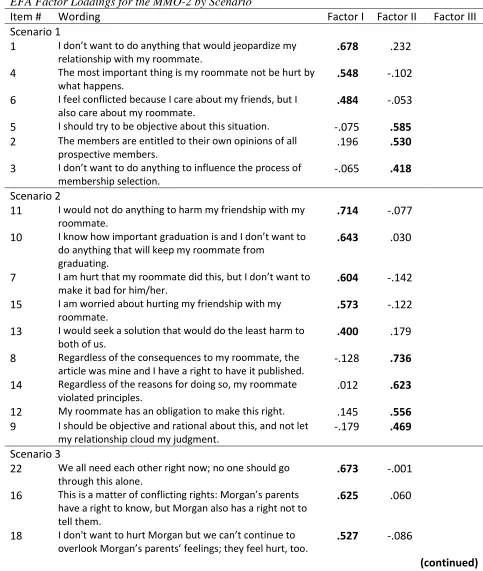
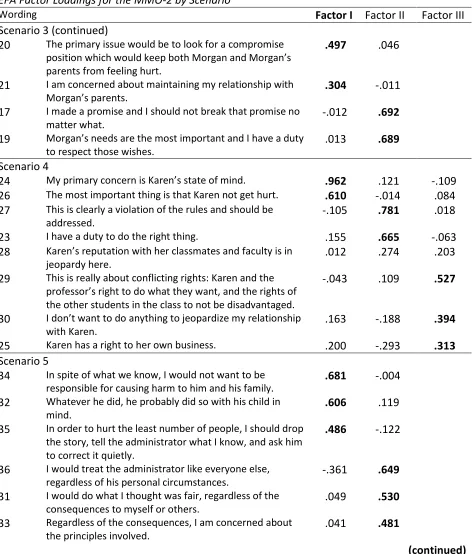
scenario. For five of the seven scenarios, two distinct factors emerged, with care items loading
onto the first factor and justice items on the second. For the remaining two scenarios a three
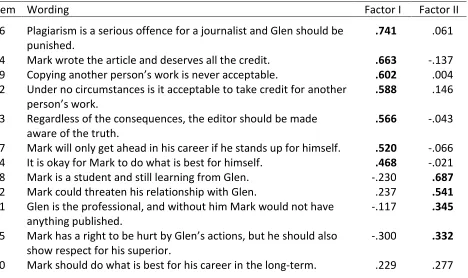
factor solution emerged in each case, with care and justice items loading onto each factor (see
Table 2). These results seem to suggest that it is more beneficial to examine moral orientation
structure at the scenario level, and to conceptualize the scenarios as parallel forms.
Consequently, this was the factoring approach that was used for the AMO.
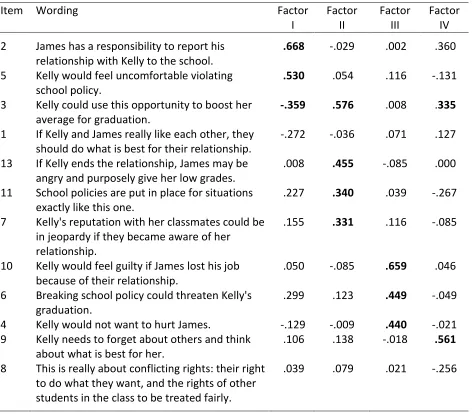
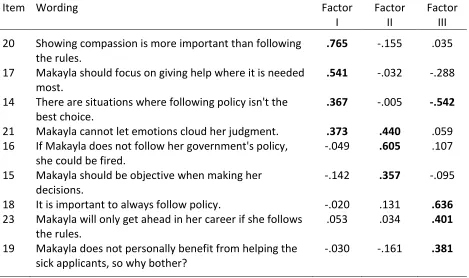
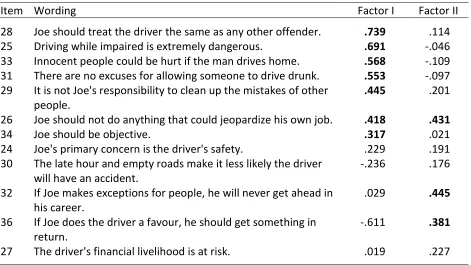
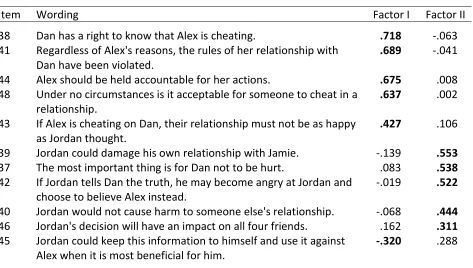
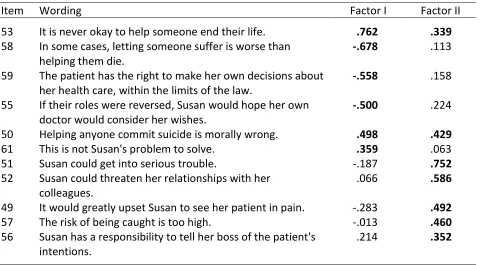
The results of the EFAs performed for each scenario of the AMO are reported in Tables 3
to 8. For each scenario, two to four factors emerge and in each case the extracted factors account
for 38.98 to 55.82% of the total variance. The rotated factor loadings show that, in many
instances, the items do load onto care, justice, and self-promotion factors, as hypothesized.
However, there are instances of items with high cross-loadings and items with higher negative
loadings on a factor other than its intended factor. Taken together with the previous item
analyses, these results will be used to identify problematic items and inform future scale
modifications.
2.2.4 Analysis of Variance (ANOVA) on Instruction Set
A series of single-factor ANOVAs were conducted using the General Linear Model
approach to determine if mean scores on the proposed care, justice, and self-promotion scales
differed significantly across instruction sets. Participants were randomly assigned to receive an
Table 2
EFA Factor Loadings for the MMO-2 by Scenario
Item # Wording Factor I Factor II Factor III
Scenario 1
1 I don’t want to do anything that would jeopardize my relationship with my roommate.
.678 .232
4 The most important thing is my roommate not be hurt by what happens.
.548 -.102
6 I feel conflicted because I care about my friends, but I also care about my roommate.
.484 -.053
5 I should try to be objective about this situation. -.075 .585 2 The members are entitled to their own opinions of all
prospective members.
.196 .530
3 I don’t want to do anything to influence the process of membership selection.
-.065 .418
Scenario 2
11 I would not do anything to harm my friendship with my roommate.
.714 -.077
10 I know how important graduation is and I don’t want to do anything that will keep my roommate from
graduating.
.643 .030
7 I am hurt that my roommate did this, but I don’t want to make it bad for him/her.
.604 -.142
15 I am worried about hurting my friendship with my roommate.
.573 -.122
13 I would seek a solution that would do the least harm to both of us.
.400 .179
8 Regardless of the consequences to my roommate, the article was mine and I have a right to have it published.
-.128 .736
14 Regardless of the reasons for doing so, my roommate violated principles.
.012 .623
12 My roommate has an obligation to make this right. .145 .556 9 I should be objective and rational about this, and not let
my relationship cloud my judgment.
-.179 .469
Scenario 3
22 We all need each other right now; no one should go through this alone.
.673 -.001
16 This is a matter of conflicting rights: Morgan’s parents have a right to know, but Morgan also has a right not to tell them.
.625 .060
18 I don't want to hurt Morgan but we can’t continue to overlook Morgan’s parents’ feelings; they feel hurt, too.
.527 -.086
Table 2 (continued)
EFA Factor Loadings for the MMO-2 by Scenario
Wording Factor I Factor II Factor III
Scenario 3 (continued)
20 The primary issue would be to look for a compromise position which would keep both Morgan and Morgan’s parents from feeling hurt.
.497 .046
21 I am concerned about maintaining my relationship with Morgan’s parents.
.304 -.011
17 I made a promise and I should not break that promise no matter what.
-.012 .692
19 Morgan’s needs are the most important and I have a duty to respect those wishes.
.013 .689
Scenario 4
24 My primary concern is Karen’s state of mind. .962 .121 -.109 26 The most important thing is that Karen not get hurt. .610 -.014 .084 27 This is clearly a violation of the rules and should be
addressed.
-.105 .781 .018
23 I have a duty to do the right thing. .155 .665 -.063 28 Karen’s reputation with her classmates and faculty is in
jeopardy here.
.012 .274 .203
29 This is really about conflicting rights: Karen and the professor’s right to do what they want, and the rights of the other students in the class to not be disadvantaged.
-.043 .109 .527
30 I don’t want to do anything to jeopardize my relationship with Karen.
.163 -.188 .394
25 Karen has a right to her own business. .200 -.293 .313 Scenario 5
34 In spite of what we know, I would not want to be responsible for causing harm to him and his family.
.681 -.004
32 Whatever he did, he probably did so with his child in mind.
.606 .119
35 In order to hurt the least number of people, I should drop the story, tell the administrator what I know, and ask him to correct it quietly.
.486 -.122
36 I would treat the administrator like everyone else, regardless of his personal circumstances.
-.361 .649
31 I would do what I thought was fair, regardless of the consequences to myself or others.
.049 .530
33 Regardless of the consequences, I am concerned about the principles involved.
.041 .481
Table 2 (continued)
EFA Factor Loadings for the MMO-2 by Scenario
Item # Wording Factor I Factor II Factor III
Scenario 6
42 I don’t want to be the one to hurt Richard with the news. .801 -.139 38 I do not want to be the one to cause harm to Richard’s
relationship with Amy.
.640 -.053
40 My reaction would depend upon how Richard really feels about Amy.
.424 -.137
37 The most important thing to me is that my brother Richard not get hurt.
.334 .371
41 Amy violated the rules of their relationship and Richard should know.
-.060 .887
44 Richard has a right to know that Amy is cheating. -.091 .753 39 I would tell Richard because if I were in his situation I
would want him to tell me.
-.142 .733
43 I would do what I thought was fair, regardless of the consequences.
-.116 .533
Scenario 7
47 What I wish more than anything is to make everyone happy and not hurt them.
.818 -.034 -.043
48 I don’t want anything to come between my parents and me.
.803 -.127 .194
52 I will do the objective thing – split my time between both of them.
.563 .212 -.095
46 I have an obligation to both my parents right now. .494 .236 -.287 45 I have the right to spend time with whomever I want. .451 .047 .222 50 Everyone has the right to happiness, even if the
consequences are sometimes hurtful to others.
-.061 .604 .051
51 In spite of what my mother did, I would not to anything to hurt her.
.214 .579 .092
49 What I did would depend on how I thought each parent needed me.
Table 3
EFA Factor Loadings for the AMO Impersonal Version Scenario 1 (Student/Teacher Relationships)
Item Wording Factor
I Factor II Factor III Factor IV
2 James has a responsibility to report his relationship with Kelly to the school.
.668 -.029 .002 .360
5 Kelly would feel uncomfortable violating school policy.
.530 .054 .116 -.131
3 Kelly could use this opportunity to boost her average for graduation.
-.359 .576 .008 .335
1 If Kelly and James really like each other, they should do what is best for their relationship.
-.272 -.036 .071 .127
13 If Kelly ends the relationship, James may be angry and purposely give her low grades.
.008 .455 -.085 .000
11 School policies are put in place for situations exactly like this one.
.227 .340 .039 -.267
7 Kelly's reputation with her classmates could be in jeopardy if they became aware of her
relationship.
.155 .331 .116 -.085
10 Kelly would feel guilty if James lost his job because of their relationship.
.050 -.085 .659 .046
6 Breaking school policy could threaten Kelly's graduation.
.299 .123 .449 -.049
4 Kelly would not want to hurt James. -.129 -.009 .440 -.021
9 Kelly needs to forget about others and think about what is best for her.
.106 .138 -.018 .561
8 This is really about conflicting rights: their right to do what they want, and the rights of other students in the class to be treated fairly.
Table 4
EFA Factor Loadings for AMO Impersonal Version Scenario 2 (Refugees)
Item Wording Factor
I
Factor II
Factor III
20 Showing compassion is more important than following the rules.
.765 -.155 .035
17 Makayla should focus on giving help where it is needed most.
.541 -.032 -.288
14 There are situations where following policy isn't the best choice.
.367 -.005 -.542
21 Makayla cannot let emotions cloud her judgment. .373 .440 .059
16 If Makayla does not follow her government's policy, she could be fired.
-.049 .605 .107
15 Makayla should be objective when making her decisions.
-.142 .357 -.095
18 It is important to always follow policy. -.020 .131 .636
23 Makayla will only get ahead in her career if she follows the rules.
.053 .034 .401
19 Makayla does not personally benefit from helping the sick applicants, so why bother?