Available online: http://internationaljournalofresearch.org/ P a g e | 1262
Study of Eggshell Membrane as a Potent
Adsorbent of Chromium
Nandini.V1, Shruthi.P.T1, Seema Tharannum1, V. Krishna Murthy1 1-Department of Biotechnology, PES Institute of Technology, Bangalore, India
Corresponding author: [email protected] Abstract
Chromium a highly toxic heavy metal and a major pollutant present in industrial effluent. Chromium (VI) is mobile and toxic to organisms. There are many methods of removal of chromium like ion exchange, ultra filtration, and reverse osmosis. The said methods are expensive and need trained personnel. Biosorption, a bioremediation process being cost effective and simple is a robust alternative for conventional techniques. In the present study, egg shell membrane considered to be a waste was used as adsorbent for the bioremediation of chromium. Chromium estimation was carried by spectrocolorimetry. The efficiency of chromium adsorption by egg shell membrane was studied. Adsorbent in its smaller particle size (250 microns) showed high degree of biosorption as it reduced 80% of 100mg/L concentration of chromium by 24 h in batch studies and 100% of the same in 18 h in column studies. These experiments showed that size and contact time are critical factors affecting the uptake capacity of the biosorbent. Percentage of adsorption was found to be directly proportional to the contact time and inversely proportional to size of the adsorbent. Scanning electron microscope analysis and Energy dispersive spectroscopy observations supported the results. Thus, egg shell membrane could be an efficient biosorbent for the remediation of toxic heavy metal chromium.
Keywords: Toxic heavy metal; chromium, biosorption; low cost adsorbent; eggshell membrane.
Introduction
Environmental pollution caused by
urbanization as a consequence of
industrialization has been a serious issue in recent times. Industrial effluents comprising heavy metals have become a major focus. Chromium, a heavy metal released from industries such as electroplating, leather tanning,wood processing, dyes and pigments cause severe health issues (Chiemezie et al., 2011; Guixia et al., 2011). Occupational exposure to chromium is primarily by
inhalation whereas, non-occupational
exposure is by ingestion of chromium contaminated food or water.
Chromium (Cr) being a d-block element exists in six oxidation states, while Chromium (III) and Chromium (VI) are most common in environment. Chromium (III) being insoluble in water causes less damage to the environment. Chromium (VI) has the ability to pass through the cells exerting toxicity (Seema et al., 2012). Anthropogenic activities majorly account to the Chromium (VI) in the environment. Lung, red blood cells, kidney and spleen are the major target for chromium to localize in humans. Chromium exposure leads to nasal
ulcers and hypersensitivity reactions
(Holmes et al., 2008).
Recommended maximum allowable
Available online: http://internationaljournalofresearch.org/ P a g e | 1263 according to World health organization as
well as Indian Standard Institution is 0.05mg/L (Sud et al., 2008) and 2.0-5.0mg/L is the permissible amount of Cr (VI) in effluents according to Central pollution control board.
Removal of chromium from the
contaminated site is done by various conventional techniques that include: ion-exchange, electro dialysis, reverse osmosis, ultra filtration, phytoremediation, chemical precipitation and so on (Ahalya et al., 2003). Each of these techniques has its own merits and demerits. The demerits shared by all the techniques are unanimously consumption of time and need of expertise.
Bioremediation in one of most exploited processes for the removal of heavy metals. Biosorption is one of the most simple bioremediation techniques. Biosorption can be summarized as a physicochemical process by which contaminants binds to cellular surface of biomass and passively concentrate (Jianlong and Can, 2008). Preparation of good biosorbent is essential for successful biosorption. Selection of a productive biomass, pre-treatment and immobilization are the steps followed in the preparation of biosorption in order to increase the efficiency. The adsorbed metal is removed by desorption process and the biosorbent can be reused for further treatments (Hima et al., 2007) (Ahmed et al., 2003).
A huge variety of biomass existing in nature is found to have the ability of biosorption such as: Algae (Holan and Volesky, 1994; Aksu and Acikel , 2000),Bacteria (Alok Prasad Das and Susmita Mishra, 2010; Ansari and Mallik , 2007;Asha Latha Singh, 2007) and Fungi (Bai and Abraham, 2001;Chikkara and Dhankhar , 2008; Gudd, 1990). Need for expertise and high cost has
raised the need for a cost efficient and user friendly biosorption techniques for the removal of heavy metals (Senthilkumar et al., 2000). Apart from the microbial biomass industry waste like those arising from dairy and food industries (Emine Malkov and Yasar Nuhoglu, 2007) and agricultural waste like husk, hull peels of few natural products(Teixeria et al.,2004; Dakiky et al., 2002), green coconut shell (Seema et al., 2015) has been proved to possess the ability of adsorbing heavy metals.
In the present study, biomass considered to be waste is used as adsorbent because of its high availability and low-cost. Low cost adsorbent used was Egg shell membrane. Egg Shell Membrane is considered as waste and disposed to the environment without any further usage. The membrane being an intricate lattice network of water insoluble and stable fibres provides high surface area for adsorption. Egg shell membrane has found to adsorb metals like Au, Pt and Pd (Kyozo et al., 1994).
Materials and Methods
Chemicals and reagents
All the chemicals used were of analytical research grade.
Glassware used were of MS Borosil Luria Bertani broth Himedia
Sampling
Available online: http://internationaljournalofresearch.org/ P a g e | 1264 sieved to get a particle size of 719 and 250
microns.
Estimation of Chromium (VI)
Chromium analysis was carried out by
spectrocolorimetric method using
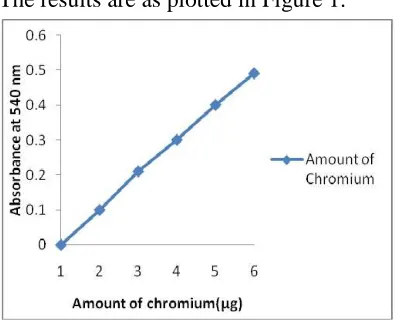
Diphenylcarbazide (DPC) method (APHA 2005). Chromium (VI) was determined by reaction with diphenylcarbazide in acid solution. A pink colour complex was formed, absorbance was read at 540nm. Chromium standard was prepared using potassium di chromate with a concentration of 100mg/L. Different aliquot of standard chromium were assayed to obtain a standard graph at optical density(OD) 540nm. Graph of OD versus Concentration of chromium (µg) was plotted.
Batch Studies
The batch studies were carried in 250ml conical flasks at room temperature by intermittent shaking. 0.5g of biosorbent was mixed with 100ml of standard chromium solution in 250ml conical flask. After a desired contact period of (24,48,72,96 etc ) hours(h) 0.5ml of solution is collected from conical flask and centrifuged at 6000rpm for 5 minutes at 4°c. The supernatant is collected and pellet is discarded. Chromium in the supernatant was estimated by DPC method (APHA, 2005). Adsorption studies were conducted in triplicates. The same was repeated for both the particle sizes of the adsorbent (719µ and 250µ).
Column Studies
A borosilicate column (21cm X 2.2cm) was
filled with Egg shell membrane
corresponding to 3cm bed heights. The adsorbent was initially heated with distilled water to 80°C to remove the lipids. The bed
was then percolated with 10ml of chromium solution (100mg/L). 1.5ml of sample was collected at the exit of column at an interval of 6 h for a period of total 48 h. The amount of chromium before and after adsorption was determined. All the experiments were performed in triplicates.
Scanning Electron Microscopy (SEM) and Energy dispersive Spectroscopy (EDS)
A small piece of sample was cleaned by
ultrasonication and alcohol washing
followed by drying in front of an air heater. After drying the sample was stuck to the SEM setup using two sided conductive sticker. After being coated with gold, the entire setup was placed in a pre-vacuum chamber. With the suitable magnification and position, the sample was viewed and corresponding images were captured.
EDS, involving the generation of X-ay spectrum from the entire scan area of the SEM allows the identification of particular elements and their relative proportions. Y-axis of EDS represents the number of X-rays received and processed by the detector while X-axis shows the energy level of those counts. SEM and EDS was obtained of egg shell membrane before and after 6h adsorption of chromium.
Results and Discussion Sampling
The sample (E) was collected processed and stored at room temperature for analysis. Estimation of Chromium (VI)
The hexavalent chromium was determined
colorimetrically by reaction with
diphenylcarbazide in acid solution.
Available online: http://internationaljournalofresearch.org/ P a g e | 1265 as the chromium concentration increases.
The results are as plotted in Figure 1.
Figure 1. Standard Chromium curve obtained by
DPC method.
Batch Studies
The amount of chromium was found to decrease from 24 h to 192 h. Sample of particle size 719 microns was found to adsorb 99mg of chromium from the solution, whereas, that of particle size 250 microns was found to remove chromium
100% from the solution on168h.
Comparisons of amount of chromium in the solution with both the particle sizes and the percentage of adsorption are as depicted in Fig 2a and 2b.
Figure 2. Effect of Particle size on Adsorption
in Batch studies 2a: Chromium removal capacity of Egg shell membrane. 2b: Percentage adsorption of Egg shell membrane.
Pine of Alep was found to adsorb chromium (VI) moderately after the thermal treatment (Messaoud and Fatima, 2007). Suleman and co-workers in 2007 stated Ficus religiosa leaves powder as a good adsorbent of chromium with the sorption capacity of 5.66± 0.43 mg/g (Suleman et al., 2007). Column Studies
Available online: http://internationaljournalofresearch.org/ P a g e | 1266
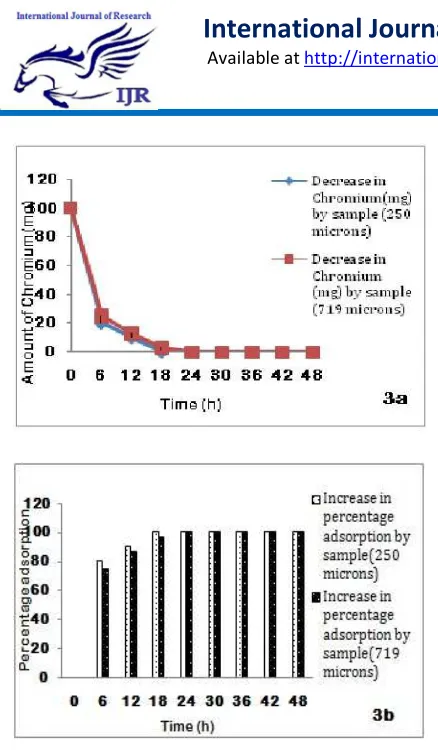
Figure 3. Effect of Particle size on Adsorption
in Column Studies 2a: Chromium removal capacity of Egg shell membrane. 2b: Percentage adsorption of Egg shell membrane.
SEM Analysis
SEM evaluated the morphological
characteristics of Egg shell membrane. The scanning electron micrographs of Egg shell
membrane powder before and after
chromium uptake are presented in Fig 4a
and 4b respectively. SEM analysis was
carried out at Material Science Department of Indian Institute of Science (IISC), Bangalore.
Figure 4. Scanning electron micrograph of Egg
shell membrane: 4a: Before Chromium(VI) uptake 4b: After Chromium(VI) uptake.
Figure 4b shows a significant difference from figure 4a, with quite irregular and porous material. This surface characteristic would be substantiating the high adsorption observed for particles of larger size, through mass transport inside the sorbent.
EDS Analysis
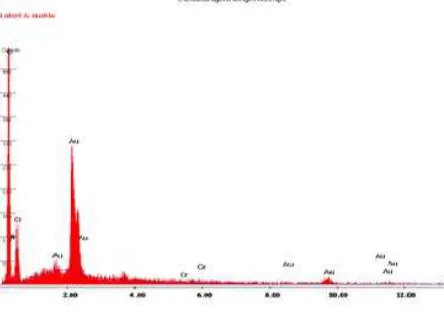
EDS analysis of egg shell membrane before and after the uptake of chromium is depicted in Fig 5 and 6 respectively.
4b
a 4a
Available online: http://internationaljournalofresearch.org/ P a g e | 1267
Figure 5. EDS diffractogram of micrographs of
egg shell membrane before Cr uptake.
Figure 6. EDS diffractogram of micrographs of
egg shell membrane after Cr biosorption.
The EDS analysis presented in Figure 5 shows the presence of N and O as natural species on the egg shell membrane.The EDS analysis in the particle loaded with chromium presented in Figure 6, shows the presence of chromium bands, retaining the presence of the rest three components found in the unadsorbed egg shell membrane. This could be indicative of adsorption of chromium to the egg shell membrane. The band of Au appears in the EDS, a time that the metalizing or coating of the samples was carried through with this element
Conclusion
In the present study, egg shell membrane was employed as a low cost biosorbent for the removal of chromium at a laboratory scale. Study when conducted in batch revealed the ability of egg shell membrane
to adsorb chromium(VI). Egg shell
membrane of particle size 250 microns could 100 % chromium in 192 h whereas, the same of particle size 719 microns could adsorb 99% chromium in192 h.
Column studies carried out with egg shell membrane reciprocated the results obtained by the batch studies except for reduction in time required for adsorption. Egg shell membrane of particle size 250 microns showed 100% adsorption in 18 h while, the same was shown by sample with 719 microns particle after 24 h contact time. The obtained results showed that incubation time affected the uptake capacity of
biosorbent. Percentage of adsorption
increased with time. Particle size (719 and 250 microns) was an influencing parameter used in the adsorption of chromium. Experimental results conclude that decrease in particle size, decrease the time required for adsorption of chromium.
SEM-EDS analysis results concluded
potential biosorption activity possessed by egg shell membrane by showing the presence of chromium on the membrane after adsorption. However, further research substantiating the efficacy of egg shell membrane in the removal of chromium in the industrial scale will provide a promising biosorption technique.
Acknowledgements
Available online: http://internationaljournalofresearch.org/ P a g e | 1268 providing research facility to carry out the
present work.
References
[1] Ahalya, N., Ramachandra, T.V.,
Kanamadi, R.D. (2003). Biosorption of heavy metals: Review. Research journal of chemistry and environment, 7(4), 71-79.
[2] Ahmed, G., Ranya, A., Hany, H.,
Hassan, M., Soraya S. (2003). Heavy metal resistant pattern in moderately halophilic bacteria. Arab Journal of biotech,2, 267-278.
[3] Aksu, Z., Acikel, U. (2000). Modelling
of a single-staged bioseparation process for simultaneous removal of iron (III) and Chromium(VI) by using Chlorella
vulgaris. Biochemical Engineering
Journal, 4, 229-238.
[4] Alok, P.D., Susmita, M. (2010).
Biodegradation of the metallic
carcinogen hexavalent chromium (VI) by an indigenously isolated bacterial strain. Journal of carcinogenisis, 9, 1-7.
[5] Ansari, M.I., Mallik, A. (2007).
Biosorption of nickel and cadmium by metal resistant bacterial isolates from agricultural soil irrigated with industrial wastewater. Bioresource Technology, 56(6), 3149-3153.
[6] APHA,AWWA,WEF, 2005, Standard
methods for the examination of water
and wastewater. 21st ed., American
Public Health Association Piblication, Washington, D.C.
[7] Asha, L.S. (2007). Removal of
Chromium from waste water with the help of microbes. e- journal of science and technology,21, 361-370.
[8] Bai, R. S., Abraham, T. E. (2001).
Biosorption of Cr(VI) from aqueous
solution by Rhizopus nigrificans.
Bioresources Technology., 79, 73-81.
[9] Chhikara, S., Dhankhar, R. (2008).
Biosorption of Cr(VI) ions from
electroplating industrial effluent using
immobilized Aspergillus niger. Journal
of Environmental Biology, 29,773-778.
[10] Chimezie, A., Kenneth, N.,
Olufunsho, A., Chinwe, N., Mohsen, A., Herbert, C.(2011). Concentrations of heavy metals in some pharmaceutical effluents in Lagos, Nigeria. Journal of Environmental Chemistry and ecotoxicity, 3(2), 25-31.
[11] Dakiky M., Khamis M., Manassra
A., Mereb M. (2002). Selective
adsorption of chromium (VI) in
industrial wastewater using low-cost
abundantly available adsorbents.
Advances in Environmental research, 6, 533-540.
[12] Emine, M., Yasar, N. (2007).
Potential of tea factory waste for chromium(VI) removal from aqueous solutions:thermodynamic and kinetic studies. Journal of separation and purification technology, 54, 291-298.
[13] Gadd, G.M. (1990). Heavy metal
accumulation by bacteria and other microorganisms.Experentia Biochemical Engineering Journal, 46, 834-840.
[14] Guixia, Z., Xilin, W., Xiaoli, T.,
Xiangke, W. (2011). Sorption of Heavy metal ions from Aqueous Solutions: A Review. The Open Colloid Science Journal, 4, 19-31.
[15] Hima, K.A., Srinivasa, R.R., Vijaya,
S.S.,Jayakumar, S. (2007). Biosorption: an ecofriendly alternative for heavy metal removal. African jounal of biotechnology, 6(25), 2924-2931.
[16] Holan, Z., Volasky, B. (1994).
Available online: http://internationaljournalofresearch.org/ P a g e | 1269
[17] Holmes, A.L., Wise, S.S., Wise, J.P.
(2008).Carcinogenicity of hexavalent chromium. Indian journal of medical research, 128, 353-378.
[18] Jianlong, W., Can, C. (2008).
Biosorbents for heavy metals removal
and their future. Journal of
biotechnology advances, 22, 196-222.
[19] Kyozo, S., Yoshitaka, F., Yoshiyaki,
U.(1994).A new biomaterial, hen egg shell membrane, to eliminate heavy metal ion from their dilute waste solution. Applied Biochemistry and Biotechnology, 45(1), 871-879.
[20] Seema, T., Krishnamurthy, V.,
Nandini, V., Shruthi, P.T. (2015) Toxic heavy metal chromium remediation by processed low cost adsorbent-Green coconut shell. The online journal of Science and Technology, 5(1), 49-54.
[21] Seema, T.,Krishnamurthy,V., Riaz,
M. (2012). Analysis of electroplating industrial effluent with reference to chromium remediation. International Journal of Current Research and Review, 4(15), 66-73.
[22] Senthilkumar, S., Bharathi, S.,
Nithyanandhi,D., Subburam,V. (2000), Biosorption of toxic heavy metals from
aqueous solutions. Bioresource
Technology, 75, 163-165.
[23] Sud, D., Mahajan, G., Kaur, M. P.
(2008). Agricultural waste material as
potential adsorbent for sequestering heavy metal ions from aqueous solution- A review. Bioresource Technology, 99, 6017-6027.
[24] Teixeria, T., Cesar, R., Zezzi, A.,
Marco, A. (2004). Biosorption of heavy metals using rice milling by-products. Characterization and application for
removal of metals from aqueous
solutions. Chemosphere, 54, 905-915.
[25] Dania, A., Mukhtar, U.L., Hafiza,
N.K., Sara, K., Nadia, J., Hafza, B.F. (2009). Biosorption of Chromium (VI) a low cost milling agro waste black gram (CICER ARIENTENUM) by Flash column process. Journal of Scientific Research, 39(2), 1-8.
[26] Messoud, C., Fatima, H. (2007).
Adsorption of Cr(VI) and Cd(II) from Alep Pine: effects of simple chemical
and thermal post treatments.
International Journal of Applied Chemistry, 3(2),107-118.
[27] Suleman, Q., Anwar, R.S.,
Muhammud, M.A. (2007). Heavy metal uptake by agro based waste materials. Electronic Journal of Biotechnology, 10(3).
[28] Low, K.S, Lee, C.K., Ng, A.Y.