e-ISSN: 2278-487X, p-ISSN: 2319-7668. Volume 17, Issue 1.Ver. I (Jan. 2015), PP 60-72 www.iosrjournals.org
Business Training Evaluation: Application andEffects on Trainee
Competencies
Guyo S. Huka
1, Benard Njehia
2and Zachariah KariukiMbugua
31
Meru University of Science and Technology
2
Kenyatta University
3
Karatina University
Abstract:This study was designed to assess the effects of business training evaluations on the competencies of business trainees in Marsabit Central and South Districts of Marsabit County, Kenya.The researcher used descriptive survey research design alongside simple random,proportionate and census sampling techniques. The study had 345 business trainees and 81trainers respondents. The study used structured survey questionnaires to elicit responses from sampled respondents coupled with secondary data. A regression model was developed and used to compute the effects of training evaluation techniques on the competencies of the business trainees in the study areas. The study revealed that business trainers in the study areas moderately evaluated the reaction and the skills and knowledge levels of their trainees. However, they least evaluated behavioural and impact factors of the business training on the trainees. The business trainers also use mainly experimentation and observation evaluation techniques as opposed to popularly used four-factor and three-factor comparison methods. It was further established that at 95% level of confidence all the training evaluation techniques used by the business trainers in the study areas did not have significant effects on the competencies of the business trainees. Thus, other training evaluation techniques could be explored for use in the study areas. In addition, further research can be carried out to establish reasons why the training evaluation techniques did not have significant effects on the competencies of the business trainees in the study areas.
Keywords:Competencies, training evaluations, skills, knowledge, learning.
I. Introduction
Human resource development (HRD) practitioners have tried myriads of training and development interventions meant to enhance competencies of their subjects. Systematic Training Cycle (STC) approach is one such technique which has been applied by training providers world over. Application of this technique has proven to yield satisfactory result in terms of imparting skills, knowledge and modify attitude of the business trainees (Mankin, 2009). Even though STC provides general guidelines on fundamental components of each of the stages, different trainers have discretion to emphasize on the stages that would most significantly affect their subjects` competencies (Laird, 2003). Business trainers in Marsabit Central and South districts of Kenya have been applying different business training evaluation techniques to ascertain the net gains achieved by their trainees. There were mixed reactions on the effects of these techniques on the competencies of the trainees and eventual access to gainful business ventures by the trainees.
1.1.Background of the Study
Application of business training to enhance business competencies among micro enterprise start-ups have been witnessed around the globe. For example business training modules such as Start and Improve Your Business (SIYB) had 4.5 million trainees in 100 countries around the world (McKenzie, 2011). Grameen Foundation with over 9 million micro enterprise borrowers uses business training to arouse the trainees’ curiosity and stimulate their interests in business. The practice of business training targeting organized groups has been quite popular particularly in developing countries. These training programmes were mainly offered through government agencies and Non-Governmental Organizations (Klinger & Matthias, 2011).
Experiences from Sub-Saharan Africa (SSA) regarding practice of business training to enhance the trainees` competencies have had mixture of approaches and methodologies. Most of the business training programmes targeted at helping the youth and women groups start their businesses were accompanied with some elements of business training evaluations at the end of the training programmes. The training input components mainly included project proposal writing, developing business plans, conducting business feasibility studies, counselling on business legal requirements and improving access to credit for business start-ups (World Bank, 2009 &Germano, 2004).
trainers actually applied appropriate training evaluation techniques. Hence there was need to establish the application and effects of business training evaluations on business competencies of the trainees in terms of transfer of skills, knowledge and modification of trainees` attitude towards business culture.
In the study areas, there were gross lacked of data on business training evaluations carried out by the trainers. The only verifiable indirect sources of information for business training evaluation in the study areas were annual reports and reaction evaluation forms from the business training providers (GoK, 2008). Therefore, it was not possible to attribute effects of business training on the competencies of the trainees to any particular evaluation technique.
1.2. Statement of the Problem
Business training evaluation basically tries to answer three critical questions; whether the training was successfully administered, whether it met the immediate objectives for which it was designed and whether any changes has resulted in terms of improved competencies and subsequent performance of the trainees. These expected improvements are significantly affected by challenges relating to training evaluation techniques applications.These challenges of evaluating business training programmes were evident in the study areas (GoK, 2013). In addition, the study areas lacked sufficient data to assess the effects of different training evaluations techniques on the competencies of the trainees. Thus, this study was designed to investigate the application and effects of various business training evaluation techniques on the competencies of the business trainees in Marsabit Central and South Districts of Marsabit County, Kenya.
1.3.Objective of the Study
To assess the effects of business training evaluations on the competencies of business trainees in Marsabit Central and South Districts of Marsabit County, Kenya.
1.4.TheoreticalLiterature Review
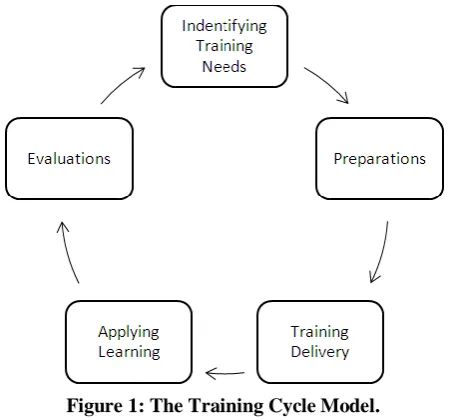
The study was founded on the Training Cycle Model. The Model has five (5) steps namely, training needs analysis (TNA), preparations for training, training delivery, application of learnt skills and knowledge and evaluation as shown in figure 1.
Figure 1: The Training Cycle Model.
Source: The Training Cycle,(2009).
techniques including pre-post evaluation tests, performance observations; training competence indicators, descriptive surveys, growth figures, focus groups among others (The Training Cycle,2009).
The Training Cycle Model has a number of lessons for the business training providers in the study areas. Appropriate application of TNA would increase chances of the trainers getting value from the training programmes (Bunch, 2007). Given the pastoralists background of the business trainees in the study areas, thorough preparations for the triaging was required in terms of training aids, environments, group dynamics as well as psychological preparations. Training delivery could take into account contents and presentation styles that would motivate the trainees towards appreciating the business culture as opposed to their pastoralists` backgrounds. Illustrations of learning inputs and language for communications needed to reflect the considerations for the diverse youths, women and self-help groups as well as socio-culture orientation of the pastoralists communities.
1.5.Evaluation of Business Training programmes
Business training is meant to improve trainee business competencies in terms of acquired skills, knowledge and attitude which in turn result into individual and organization performance improvements. In order to ascertain realization of these desired outcomes, organizations conduct business training evaluations. Outcomes of such evaluations have shown varied results from various researchers. McKenzie and Woodruff (2014) conducted a study of business training evaluation across different parts of the world including Africa (Tanzania, Ethiopia, Tunisia, Uganda), Asia (India, Pakistan, Vietnam, Sri Lanka), Latin America (Peru, Mexico, El Salvado) among others. The study revealed that business training had moderate effect on revenue generation but more on business expansions in terms of branches, products and increased services. It was also established that business trainees moderately implemented imparted competencies in their businesses after the trainings particularly among the microfinance sub-sectors of micro and small enterprises. There were evidences of application of managerial functions namely, planning, business organizing, staffing, leadership/management and controlling of business ventures. Marketing efforts were evident but rudimentary and non-technical in nature. These positive impacts of business training were not without challenges.
Karlan and Valdivia (2011) added that business training evaluation greatly vary in its scope and implementation by countries, locations and organizational philosophy. Trainees` financial environment after the training was also found to pose significant challenges given the differences in policies relating to credit access and cost of capital. Ease of female gender to access informal credit without the husbands` consent was also cited in some African cases (Nguta&Guyo, 2013).
Besides, individual trainee’s differences in terms of motivation and levels of education as well as competency levels of the trainers were found to be significant in affecting accuracy of the business training evaluation outputs. Equally important were ages of trainees, backgrounds of the trainees in terms of urban or rural settings and the sector of the venture (Chuthamas, Aminul, Thiyada, Dayang, 2011).
Besides, characteristics of training deliveries added to the challenges of training evaluation because firms use different means to deliver training to their employees such as hired professionals, own departmental instructors or non-professional local instructors. Training implementation environment may vary in input contents, length of training, cost of training and trainees` attendance rate. It has also been established that organizations choice and pick different areas of training inputs guided by their customer needs, resource availability and the age of the firm among others (Silberman&Auerbach, 2011).
II. Business Training Evaluation Stages
Training evaluations are carried out at different stages in the process of planning and implementing training programmes. The first stage is pre-training evaluation where the trainers generate data to aid in measuring expected learning outcomes from training. This data is important because it helps to establish levels of the skills and knowledge possessed and positions of the attitude of the trainees before the training. It further helps in assessing levels of training inputs required by the trainees, areas of emphasis as well as some useful information about trainees backgrounds (Agochiya, 2009).
There are various multi-level methods to evaluate net effect of any training from reaction to impacts with varying degrees of success. These methods include reaction to the learning general environments. Such environments may constitute hospitality issues, comfort and convenience of learning setting, interactions with the trainer and training aids among others. The second level of evaluation is skills uptake evaluation to determine ability of the trainees to describe, manipulate, apply and utilize learnt skills. Knowledge acquisition is also evaluated to test understanding of the principles, theories, concepts and internalization of the training input. In addition, Attitudinal changes evaluation tests level of appreciation and changes in the perceptions of the trainees towards new learning (William, 2009). Further, behavioural changes are analyzed to establish if there are any changes in the way trainees perform their work in relation to learnt knowledge and acquired skills. Finally, impact of trainings are assessed to evaluate positive improvement in the performance of the individuals, groups or organization with net benefit as a result of the training input (Saddler-Smith, 2006, Gravells, 2009 & Kirkpatrick, 1994)).
Business trainers in the study areas often conducted reaction to training evaluation as evidenced from training programmes. Given the diverse backgrounds of the business trainees in the study areas that is women, youths and self-help groups assessment of reaction to training was ideal. Baron and Armstrong (2007) opined that evaluation of reaction to training programmes help identify diversity among the trainees and hence enable the trainer to cater for the diverse interests.
Research has shown that trainers most often evaluate trainees` reaction than other levels of evaluation. Naughton and Rothwell (2004) asserts that learning and development managers spend much more time on measuring and evaluating training programme input than output and outcome. This study was further complemented by another study by Derek, Laura and Taylor (2008) in which they established that trainers tend to concentrate on evaluating lower level benefits of training than higher level benefits of training. In their research among American trainers, they found out that nine (9) out of ten(10) training programmers had some form of training evaluations after the training. Using Kirkpatrick four level training evaluation framework, they also established that 98% of the trainers evaluated level one (1) (reaction ), 73% evaluated level two (2)(learning), 62% evaluated level three (3)(behaviour), 36% evaluated level four (4)(impact) and only 18% evaluated level five (return on investment).
Despite of the emphasis attached by trainers to evaluate reaction, research have not shown any significant relationship between favourable reaction (extent to which learners found the programme to be enjoyable) and utility reaction (extent to which the programme might affect the capability of trainees to perform their job better) (Sadler-Smith 2006).
Scanty literature on training programme evaluation in the study areas further show that most programmes were evaluated through progress reports by the field officers and trainees as well as quarterly reports. The progress reports and quarterly reports reviewed were in a free format thus making skills and knowledge assessment fairly difficult. For example progress report by Merille Livestock Traders and Ersim Livestock Marketing group only showed programmes business activities but did not have milestones gained by the beneficiaries. However, the reports cited significant challenges including severe drought that had negatively affected livestock businesses including their prices. Funds available to the beneficiary groups were cited to be inadequate (FH-Kenya, 2011). Thus it was not clear whether the monitoring and evaluation of the programmes were affected by financial and environmental issues or sheer lack of the monitoring and evaluation practices.
One of the key components of learner competencies is attitude. Effective learning inputs help the learners change their attitude towards the benefits of learning. Robins (2008) adds that attitudes are learned, it define one’s predispositions toward given aspects of their environment and provide emotional basis of one’s interpersonal relations and identification with others. Given that attitudes are organized and are close to the core personality, trainers are often faced with the difficult task of changing attitudes because existing attitudes hinder anticipated changes. The hindrance may arise from many variables including trust in the sender of the message, the message itself and the circumstances under which message is delivered. Based on this characteristic nature of attitude, trainers need to design training programmes in such a way that these salient features of individual attitude are addressed (Goad, 2010).
Traditional practices among the pastoralist communities in the study areas show that there were social-cultural factors which have shown resistance to changes from pastoral livelihoods to business cultures. Major among these practices included keeping huge herd sizes and male dominance in matters of resources ownership. Management and nurturing of micro enterprises owned by women and youth were occasionally disrupted by demands from family and kindred. In this culture family heads have unlimited control over family resources making independent organization of the business start-ups difficult. However, there was no empirical literature to explain any conspicuous resistance to adopting commerce in place of pastoralism.
input, process, product) Model, IPO (input, process, output) Model and Philip`s Five-level Model. Some of the cross-cutting characteristics of these models are that they emphasize on assess changes in job performance as a result of training inputs, process, output and translation of leant skills and knowledge to performance by individuals and groups.
It is not empirically deducible how changes in performance of the trainees were assessed after the training amongst the business trainees in the study areas. However, there are records on pockets of development initiatives that could be inferred to from the business activities. For example Women’s Groups Grants Project run by Aids for Africa identified and supported numerous women groups through organized business enterprise in the study areas. The project gave seed grants and training to over 70 women groups in the study areas to help them grow their businesses (Aids for Africa, 2010). However, there were no data to verify that their businesses performed better after the training.
Similarly, Arid Lands Resource Management Programme (ALRMP) supported the Loiyangalani, El-Molo and Illeret fishing communities with fishing gears through credit provision and promoted marketing of the fish. This intervention was accompanied by prior training on utilization of credit facilities and basic entrepreneurial skills (GoK, 2008). ALRMP`s trainees were taught proposal writing and microfinance projects implementations, procurement procedures and basic financial management. At the end of the training, there were no records to show the trainees performed better in accessing the micro finances and expanded their fishing business.
In addition, International Livestock Research Institute (ILRI) supported a programme on Index Based livestock Insurance (IBLI) in the study area with a view of cushioning the herders against the harmful effect of frequent droughts that occasionally destock the herders and hence expose the pastoralists to the vagaries of acute food shortages. Herders were trained on insurance basics and diversification of livelihoods from pure pastoralism to commerce (ILRI, 2010).By the end of the programme there was no evidence that trainees performed better in this programme as a result of training they got on index based livestock insurance.
It was evident from available data that some of the business related programmes in the study areas ceased to function as soon as the project stopped. The reason for short life span of the business start-ups were remotely associated with social cultural practices in the study areas besides the technical business training inputs. There were seasonal labour migrations in search of subsistence by mainly the men and livestock migration caused by frequent harsh weather conditions. In addition, short lived funding patterns of NGO have also posed some practical challenges of unfinished process of training and development. Some development programmes were as short as 6 months with possibility of interference by seasonal changes such as drought or rainy seasons when the herders decentralize their camps which occasionally become potential opportunity cost for the business trainees.
BOMA Fund sponsored Rural Enterprise Access Project (REAP) helped the beneficiaries move from dependence on traditional subsistence living and relief food to becoming engaged in the cash economy. The Fund trained project beneficiaries and built their capacity to manage micro finances for entrepreneurial activities. They provided small cooperative groups with capital, small-business skills training and business mentoring for two years. The training enables them acquire basic business skills to start small businesses and sustain it. Between the years 2007 to 2010 SautiMoja Project carried out a performance evaluation of the project and established as follows. More than 1,000 people had taken part in the programme with 90 percent of them being women. After three years, the members of the groups enjoyed a 53 percent increase in food consumption, a 48 percent increase in the number of their children who attend school, and a 161 percent increase in the value of the animals they owned (BOMA Funds, 2010). However, there was absence of empirical data to show training evaluation techniques used and continued performance of the groups in their microfinance activities.
III. Research Methodology
descriptive statistic and regression model to establish effects of different training evaluation techniques on the competencies of business trainees in the study areas.
IV. Result And Discussion
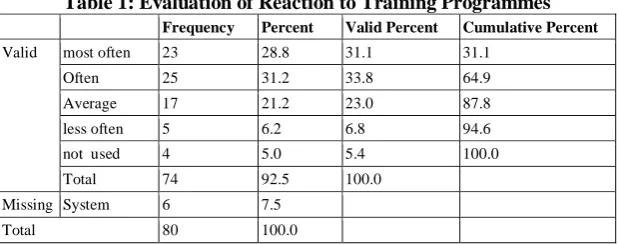
Training evaluation is an integrated process-based approach that begins with evaluation of needs assessment and ends with communication of programmes result to the trainees and other stakeholders. In this study the business trainers were asked to indicate how often they evaluated their trainees in terms of training evaluation levels. These levels are trainees` reaction to training programmes, levels of learnt skills and knowledge, levels of behavioural change and degrees of impact of the training on the learners. Frequencies of trainers’ responses for evaluating reaction to training programmes are illustrated in table 1.
Table 1: Evaluation of Reaction to Training Programmes Frequency Percent Valid Percent Cumulative Percent
Valid most often 23 28.8 31.1 31.1
Often 25 31.2 33.8 64.9
Average 17 21.2 23.0 87.8
less often 5 6.2 6.8 94.6
not used 4 5.0 5.4 100.0
Total 74 92.5 100.0
Missing System 6 7.5
Total 80 100.0
Frequencies of responses from Table 1 show that majority of business trainers in the study areas evaluated reaction to training programme. A significant 64.9% of the business trainers either most often or often evaluated reaction of the trainees to training programmes. Evaluation of trainees’ reaction to training programmes is important as it helps the trainers to understand various components of training that may have adverse effects on the transfer of knowledge and skills and modification of attitude. Key among these components is facilities, training method, training aids, communication, strengths and weakness of the trainer and physical environments among others. Research has shown that reaction to training programmes evaluation levels are most widely assessed by the trainers. It is a critical stage of learning because it sets pace for learners’ motivation to learn and re-learn as well as providing opportunity for future training improvements (Sandler-Smith, 2006). In line with these observations, the high frequencies of the reaction evaluation by the trainers in the study areas were a strong foundation for transfer of skills and knowledge in basic business management.
However reaction to learning as established through training evaluations do not have uniform outcomes. The way learners react to learning inputs is a function of many factors including age, levels of education, gender, stage of their business growth and degree of exposure to business experiences. Nevertheless, research findings converge to the conclusion that the effect of heterogeneity of the business trainees can be absorbed by mean reactions (McKenzie & Woodruff, 2014). The observations by McKenzie and Woodruff (2014) is quite relevant to the context of the trainers and trainees in the study areas in the sense that pastoralists background with limited exposure to business environment and low levels of formal education is a likely factor for the heterogeneity of training evaluation outcomes.
4.1.Evaluation Of Skills And Knowledge
The business trainers in the study areas were also required to indicate how often they evaluated skills and knowledge acquired from the training by the trainees. The degrees of acquisition of skills and knowledge are of great importance since it forms basis for attitudinal modification. It is also expected to improve performance of the trainees by applying the earned knowledge and skills in their small business managements. Table 2 shows frequencies of how business trainers evaluated their trainees’ skills and knowledge after the training.
Table 2: Evaluation of Skills and Knowledge
Frequency Percent Valid Percent Cumulative Percent
Valid most often 15 18.8 19.2 19.2
Often 16 20.0 20.5 39.7
Average 20 25.0 25.6 65.3
Less used Not used
6 21
7.5 26.3
7.6 26.9
72.9 100.0
Total 78 97.5 100.0
Frequency Percent Valid Percent Cumulative Percent
Valid most often 15 18.8 19.2 19.2
Often 16 20.0 20.5 39.7
Average 20 25.0 25.6 65.3
Less used Not used
6 21
7.5 26.3
7.6 26.9
72.9 100.0
Total 78 97.5 100.0
Missing System 2 2.5
Total 80 100.0
From Table 2, it is evident that business trainers in the study areas carry out less skills and knowledge evaluation for their trainees after the training. Less than one-half of the trainers carry out skills and knowledge evaluation with most often and often cumulative frequencies being 39.7%. About one-third of the trainers (33.5%) evaluated skills and knowledge either less frequently (less used) or not at all (not used). This finding indicates that levels of skills and knowledge transfer can hardly be ascertained empirically but can only be inferred. In addition, existing levels of trainees’ performances in their small businesses may not wholly be as a result of business trainings they received given the lack of these vital measurements. The researcher compared the low percentages of evaluation of skills and knowledge in the study areas with similar research work around the world and analyzed its implication.
Phillips (2004) conducted a research among professional trainers in human resources management and established that trainers carry out more of lower level training benefits evaluation than higher level benefits. From Kirkpatrick framework for training benefits evaluation, lower level includes evaluation of reaction and skills and knowledge. On the other hand, higher level benefits evaluation includes evaluation of behaviour, impact and return on investment. The study concluded that on the average, business trainers evaluated their training programmes as follow: reaction (90-100%), learning (skills & knowledge) (40-60%), behavioural changes (30%), impact (10-20%) and return on investment (5-10%). From this research findings there are progressive lowering of effort by the trainers to train higher level training benefits. In particular, trainers` evaluation of knowledge and skills show some average occurrence when comparing 40-60% of Phillips (2004) with the study areas findings of 53.8% (often & average frequencies).
One cardinal purpose of evaluating skills and knowledge transfer is to ascertain that these knowledge and skills go into building human capital which is a central theme in every training programme. Acquisition of these knowledge and skills result into development of a human capital which encompasses education, experience, access and utilization of factual knowledge and manipulative skills. This endowment increases owners' capabilities of discovering and exploiting business opportunities, acquire other utilitarian resources such as financial and physical capital. Empirical research has attested to existence of some relationship between human capital development and business performance(Fee, 2011).
Unger, Rauch, Frese, and Rosenbusch, (2011), established that there was some relationship between human capital and entrepreneurship success (σ=0.098), human capital and overall business success (σ= 0.204) and human capital investments (σ=0.140). The study further underscored that younger businesses had much higher correlation of success with enhanced human capital. Nevertheless, research suggests that there is need to investigate individual human capital (education, experience, knowledge, and skills) contribution to the processes of knowledge acquisition and the transfer of knowledge to entrepreneurial tasks and its ultimate success rate.
These analyzes therefore, suggests that entrepreneurial success or failure of business start-ups in the study areas can moderately be explained from the view point of knowledge and skills transfer. This further impliesthat contribution of the other training components such as needs analysis;training inputs, implementation, methodologiesand attitudes towards trainee’s competencies building cannot be fully explained using only transfer of skills and knowledge.
4.2.Evaluation Of Behavioural Changes
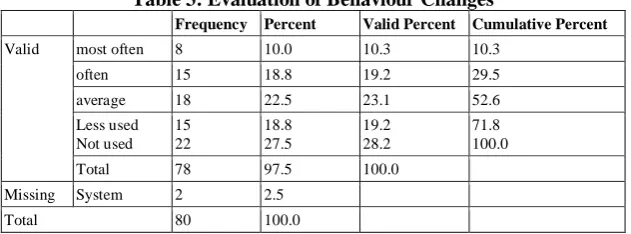
Evaluation of behaviour change is an example of post training assessment techniques in which the trainees are evaluated for improved changes in the way they do their businesses. A behavioural change in the context of this study implies improved performance of the trainees after the training. It further means that the learners have put to use the learning inputs and are able to perform business activities at higher levels than before the training. The evidence of improved behavioural changes may include more skillful manipulation of tasks, utilization of technical instruments; improve quantity of output, improved quality of output, reduced turnaround time among others (Hite & MacDonald, 2006). This higher level evaluation is important since it has direct impact on the efficiency and effectiveness of any training programmes. The trainers of business in the study areas were asked to indicate how often they evaluated their trainees on behavioural changes. Table 3 shows how often the business trainers evaluated the behavioural change of their trainees in the study areas.
Table 3: Evaluation of Behaviour Changes
Frequency Percent Valid Percent Cumulative Percent
Valid most often 8 10.0 10.3 10.3
often 15 18.8 19.2 29.5
average 18 22.5 23.1 52.6
Less used Not used
15 22
18.8 27.5
19.2 28.2
71.8 100.0
Total 78 97.5 100.0
Missing System 2 2.5
Total 80 100.0
From Table 3 it is deducible that most business trainers in the study areas did not evaluate their trainees on behavioural changes. A small percentage (10.3%) of the trainers most often carried out behavioural change training evaluation. Less than one-third (29.5%) of the trainers evaluate behavioural components of the trainees above average frequency. On the contrary, 28.2% of the trainers did not evaluate the behavioural aspects of the trainees. In addition, 47.4% of the trainers have either less often evaluated behavioural component or did not evaluate them at all. This implies that the business trainers have concentrated more on evaluating lower training benefit than higher level training benefits. The tendency by the trainers to evaluate less on behavioural and impact components as attested by Phillips (2004) is also reflected in this study. Unfortunately, this practice has negative implication as the key result areas of training benefits (higher level evaluation) is over shadowed by lower level(learning &skills/knowledge). Similar research work around the world has faulted this practice to the extent that it negatively affects the functional training benefits to the beneficiaries.
Saks and Burke (2012) carried out a research among 150 business training professionals in Canada to investigate training evaluation and transfer of learning. The findings established that training evaluation was positively related to training transfer. Using the Kirkpatrick four (4) levels of evaluations criteria, behavioural changes and result had higher rate of transfers compared to reaction and learning. This implies that the trainees with higher behavioural changes and result transfers benefited from enhanced ability to perform their duties more efficiently and that their individual and collective input improved their organizational performances.
The fact that there were less evaluation of behavioural changes in the study areas could be associated with some structural and resources issues. The programmes of NGOs who were the main training providers have fairly short time span depending on the donor support. Given that behavioural evaluations has to be done after the training and possibly more than once, period of time the sponsoring programme remain in existence is critical. This could an area for further research to establish whether the longevity of a programme has any impact on behavioural changes of the trainees.
4.3.Evaluation of Impact
Table4: Evaluation of Impact
Frequency Percent Valid Percent
Cumulative Percent
Valid most often 5 6.3 7.1 7.1
often 5 6.3 7.1 14.2
average 8 10.0 11.4 25.6
less often 22 27.5 31.4 57.0
not used
30 37.5 42.9 100.00
Total 70 87.5 100.00
Missing System 10 12.5
Total 80 100.0
The frequency Table 4 shows that only 7.1 % of the trainers most often evaluated the impact of the trainees after the training while another 7.1% often evaluated the impact. Close to three-quarter, that is (74.3%) of the trainers either less often evaluated the trainees` impact or did not evaluate them at all. Given the paramount importance of evaluating training impact among the trainees as means of validating the effectiveness of the training and establish return on investment, business trainers have no choice but evaluate impact of training programmes. However, the low impact evaluation evidence from the study areas may have been occasioned by both technical and logistical challenges which have been acknowledged by other researchers.
According to McKenzie and Woodruff (2014),many training evaluations suffer from low statistical power, measure impacts only within a year of training, experience problems with survey attrition and measurement of firm profits and revenues. The research further revealed that over the short time horizons, there were relatively modest impacts of training on survivorship of existing firms but stronger evidence suggested that training programs helped prospective owners launch new businesses more quickly. There were also evidences that firms tried to implement some of the practices taught in training, but the magnitudes of these improvements in practices are often relatively modest.This finding suggests that there could be firm or individual factors that are possibly making the practice of evaluating training programmes impacts less effective.
Corroborating literature in the study areas, showed that number of issues that have affected evaluation of impact of business training. These included temporary nature of the business groups that wound up within fairly short time before the trainers would carry out impact assessment. This particular factor has been cited as a major challenge facing sustainability of business enterprise among the youths, women and self-help groups in the study areas. In limited instances where the trainers have assessed the trainees’ impacts,lack of business records was found to be hindrance to effective impact analysis (BOMA Project, 2013).
In addition, influence of socio-cultural factors has been found to interfere with evaluation of training impact among communities with strong socio-cultural practices. These practices affected mainly gender relations and resource ownership. A research carried out among Tharaka County small women business enterprises in Kenya, showed that 64% of the women experienced barriers to entrepreneurial activities. This resulted into lack of ownership and control of the businesses which eventually significantly reduced the impact of the business training on the beneficiaries (Kawira, Ibuathu, Kubaison, &Guyo, 2014).
There were also technical and organization specific factors that may negatively affected effective evaluation of training impacts. Technical experience and expertise of the trainers and organization`s policies regarding duration allowed for learning curve for the trainees to internalize learnt skills and knowledge are important considerations. Indeed, learnt skills and knowledge have to be translated into behavioural changes which have to be institutionalized to give effect to the overall individual and organizational impacts.
In the study areas, this challenge can be attributed to lower levels of trainers expertise and experience in business training as earlier attested in this study by ―ten year rule‖ of Ericsson (1993). Besides, funding agencies that support capacity building through training and development included non-governmental organizations, community based organizations, government departments and faith based organizations. Most of these funding agencies provide training programmes as a short term interventions instead of a strategic approach to building sustainable human capital. Over and above this organizational factors and seasonal migrations practices among the pastoralist communities tend to take away the entrepreneurs attentions from developing their small businesses to taking up communal activities like herding and farming (GoK, 2013).
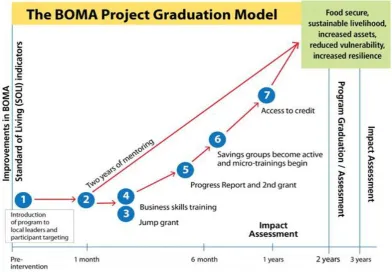
BOMA model was strongly supported by Grameen Progress out of Poverty Index (PPI). This index measures access to business supports and track project beneficiaries development and final exit with improved competencies from the programmes (Grameen Foundation, 2014). Figure 2 shows the BOMA Project Graduation Model.
Figure 2: BOMA Project Business Graduation Model Source: BOMA (2013)
One key factor behind this model is the pre-intervention of identifying potential beneficiaries using PPI against BOMA`s Standard of Living Index (SOLI). BOMA provides business mentors to help groups write business plans coupled with provision of seed-capital for business start-ups. The fund imparts business management skills training, micro-saving training and also help the groups to form and operate savings associations from amongst the beneficiaries. Group businesses and individuals make regular contributions to the savings pool, which serves as a source of credit for business expansion and individual interest-bearing loans. Programme impact assessment at the end of the year in 2012 showed that REAP beneficiaries were food secure, had more productive and household assets, had multiple viable sources of income and were able to successfully respond to shocks (BOMA Fund, 2013).
On the contrary, research has shown that organizations that do not assess impact of training on trainees after the training were found to have certain management and operational weaknesses. Phillips (2004) asserts that absence of training impact assessment may results into difficulties in validation of planned results, inability to diagnose structural failures arising from design, content, delivery, learner`s motivation and feedback communication of programme results to stakeholders. In addition, lack of training impacts evaluation has been linked to deficiencies in ascertaining return on investment (ROI) to the organization and its members. It has been established that inaccurate calculation of ROI leads to a number of false interpretation of training programmes benefits. These included unascertained net programme benefit to the trainees and the organization as well as undefined programme inaccurate cost-benefit analysis ratios. These documented evidences of disadvantages of not evaluating training programmes impacts is an important lesson for the trainers in the study areas where close to three-quarter of the trainers did not carry out training impact evaluations.
4.4.Training Evaluation Techniques
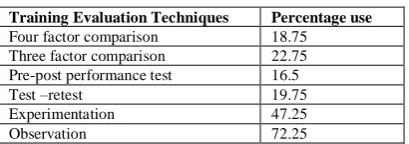
trainers on relative degrees of usage of different techniques with varying results. Aggregate usage of different training evaluation techniques in the study areas is given in table 5.
Table 5: Training Evaluation Techniques
From Table 5 is evident that trainers in the study areas predominantly used experimentation (47.25%) and observation (72.25%) training evaluation techniques for evaluating their trainees after the business training. This technique is fairly expensive given the limited resource endowments of the training providers as well as the trainees like the youths and women groups in the study areas. In experimentation, failure of two or more business training programmes may be source of reduced motivation to continue training thereafter. The controlled groups may also feel that they are been left out as beneficiaries of development projects in their areas and raises equity and fairness issues.
This view is attested to by resource dependent theory of human resource where organizations are expected to succeed if they gain and retain control over resources for posterity (Kohli& Deb, 2008). Further, experimentation assumes that the trainers have technical capabilities to compare and contrast cost-benefit analysis of the experimented groups and the control groups. The earlier analysis of the levels of education and experience of the trainers in the study areas may not mitigate against capability issues. Transition into fairly new mode of livelihoods of commerce from Pastoralism may not also avail the trainees and their trainers a wider scope of business venture experimentation opportunities in the study areas. Finally, the technique is strong in assessing knowledge and skills but weak in assessing behavioural changes and impacts (Aswathappa, 2008).
In addition, observation techniques of training evaluation have its advantages and disadvantages depending on number of other factors in the training programmes. It is one of the easy techniques to carry out, fairly cheaper, quite appropriate for formal business activities and required less technical capabilities. Notwithstanding these advantages, the techniques have number of flaws including inaccuracy to assess the in-depth and breadth of a training programme. It also has high levels of subjectivity in analyzing training programmes` outputs and high degrees of environmental factor interferences in the assessment (Klinger & Matthias, 2011).Narrowing on to the study areas, convenience and cost of training evaluation could be significant factors for using observation. This proposition is informed by the fairly low levels of trainees` formal education, trainers’ limited expertise in business training as earlier analyzed. Test – retest and pre-post performance test are also not quite appropriate techniques for this subject groups for the same levels of formal educations. The techniques are quite suitable for evaluating knowledge and skills than behavioural changes and impacts (Kuckertz& Wagner, 2010).
In the study areas, near to lack of higher level training output assessing using more prominent techniques such as four-factor and three-factor comparisons may have profound negative implication for understanding overall training programme successes. Although not conclusive, these tendencies could be associated with resources limitations as well as trainers’ competencies as earlier discussed. The net effect of this finding could justify the training programmes failure to meet its desire objectives and hence becomes less effective to the trainees. Relationship between the non-use of higher level training evacuation techniques and the transfer of business competencies to the trainees in the study areas could an interesting theme for further studies.
4.5. Effects of Training Evaluation Techniques on Trainees Competencies
In order to establish the effects of the individual training evaluation techniques on the competencies of the business trainees in the study areas, a regression analysis was computed. A general regression analysis of the following form was adopted.
Y = b0+b1x1+b2x2+b3x3+b4x4=b5x5+b6x6, Where,
Y=competence of business trainees, b0 = intercept,
x1 = four factor comparison x2 = three factor comparison x3 = pre-post performance test
Training Evaluation Techniques Percentage use
Four factor comparison 18.75
Three factor comparison 22.75
Pre-post performance test 16.5
Test –retest 19.75
Experimentation 47.25
x4= test retest x5 = experimentation x6 = observation
The training evaluation techniques, coefficient of estimates, standard errors and P-Values are given in table 6.
Table 6: Regression Analysis for Training Evaluation Techniques Variables Coefficient estimates Standard errors P-values
1. Four factor comparison 0.262 0.198 0.186
2. Three factor comparison 0.133 0.150 0.377
3. Pre-post performance test -0.058 0.151 0.707
4. Test retest 0.180 0.168 0.285
5. Experimentation 0.530 0.177 0.765
6. Observation -0.238 0.206 0.248
The P-values were computed at 95% confidence level. Thus if P-values are greater than 0.05 the training evaluation techniques have no significant effects on the trainee competencies. Consequently, given that all the p-values are greater than 0.05, training evaluation techniques used by the business trainers in the study areas did not have significant effects on the competencies of the trainees. The intercept (b0) had coefficient estimate of -0.666 with 0.591standard error and a P-value of 0.260. Thus, this finding implies that none application of training evaluation techniques would have negative effect on the competencies of the business trainees but the effect was not significant. Hence the model is,
Y = -0.666+0.262x1+0.133x2-0.058x3+0.18x4+0.53x5-0.238x6
V. Conclusions
The study revealed that business trainers in the study areas concentrated mainly on evaluating reaction level (64.9%) of the business trainings. On the other hand only 19.2% of the business trainers evaluated knowledge and skills, with 72.9% of them having less or not evaluated the skills and knowledge of their trainees after the training. In addition, 71.85 of the business trainers have either less or not at all evaluated the behavioural changes of the trainees after the training. Besides, only 7.1% of the business trainers in the study areas most often evaluated the impact of the business trainingthe trainees. Close to three-quarter, that is (74.3%) of the trainers either less often evaluated the training impact or did not evaluate them at all. Besides, the business trainers mainly used experimentation (47.3%) and observation (72.3%) training evaluation techniques. These techniques are among least suitable training evaluations techniques in relation to the target trainees and the subject matter. A regression model was also computed to establish individual effects of the training evaluation techniques on the competencies of the business trainees in the study areas. It was concluded that all the training evaluation techniques used by the business trainers in the study areas did not have significant effects on the competencies of the trainees.
VI. Recommendations
The study recommends that business strainers in the study areas evaluate more on higher level training benefits (skills and knowledge, behavioural changes and impact of training). The training evaluation techniques commonly used by business trainers were not suitable for the target groups and the subject of the study. Thus other training evaluation techniques could be explored as well as establishing reasons why the training evaluations techniques did not have significant effects on the competencies of the business trainees in the study areas.
References
[1]. Agochiya, D. (2011). Every Trainer`s Handbook. 2nd Edition. New Delhi: Sage Publishers.
[2]. Aids for Africa. (2010). Women Grants Projects. Retrieved from: www.aidsforafrica.org/member
[3]. Aswathappa, K. (2008). Human Resource Management: Text and Cases. New Delhi: Tata MacGraw-Hill
[4]. Baron, A and Armstrong, M. (2007).Human Capital Management: Achieving Added Value through People. London: Kogan Pages.
[5]. BOMA Fund.(2010). SautiMoja Project.Annual Report for 2007/2008.Retrieved from: www.bomafund.org.
[6]. BOMA Fund.(2013).Helping Women Graduate from Extreme Poverty. Project Evaluation Report.Retrieved from:
www.bomaproject.0rg.
[7]. Bowen, M., Morara, M., Mureithi, S.(2009). Management of Business Challenges among Small and Micro Enterprises in Nairobi;
Kenya. KCA Journal of Business Management Volume 2, Issue 1`, PP. 16-31.
[8]. Bryman, A. (2008).Social Research Methods. Oxford: Oxford University Press
[9]. Bunch, K.J. (2007).Training as a Result of Organizational Culture.Human Resource Development Review, 6(2), 142 – 163.
[10]. Chuthamas, C., Aminul, I.,Thiyada, K., Dayang, H. ( 2011). Factors Affecting Business Success of Small and Medium Enterprises
(SMEs) in Thailand.Asian Social Science. Vol. 7, No. 5; May 2011, pp.180
[11]. Cochran, W.G. (1963). Sampling Techniques.2nd Edition. New York: John Wiley & Sons.
[12]. Derek, T., Laura, H., and Taylor, S. (2008). Human Resource Management.7th Edition. New York: Prenctice-Hall.
[13]. Ericsson. K.A. (1993).The Role of Deliberate Practice in the Acquisition of Expert Performance.Psychological Review.1993, Vol.
[14]. Fee, K. (2011). 101 Learning and Development Tools: Essential Techniques for Creating, Delivering and Managing Effective Training. London. Kogan Pages
[15]. Food for Hungry-Kenya, (2011).Matching Fund Business.Progress Report for Korr and Merille Divisions.Unpublished.
[16]. Germano, M. (2004). Rural Development, Growth and Poverty in African.African Economic Research Consortium.Volume 2.
September, 13th 2004
[17]. Goad, T. W. (2010).The First Time Trainer: A Step-By-Step Guide for Managers, Supervisors and New Training Professionals.
New York: American Management Association.
[18]. GoK.(2013). Marsabit County Development Profile. Nairobi: Government Printers.
[19]. ... (2008). Arid Land Resource Management Project: Annual Report 2007. Unpublished
[20]. Grameen Foundation. (2014). Progress out of Poverty: A Poverty Measurement Index. Retrieved from:
www.grameenfoundation.org
[21]. Gravells, A. (2009). Principles and Practice of Assessment in the Lifelong Learning Sector. Exeter: Learning Master
[22]. Hite, L.M. and MacDonald, K.S. (2006).Diversity Training Pitfalls and Possibilities. An Exploration Of Small And Medium Size
US Organizations. Human Resource Development International; 9 (3): 365-377.
[23]. International Livestock Research Institute. (2010). Index-based Livestock Insurance Training Manual.Unpublished.
[24]. Karlan, D and Valdivia, M. (2011). Teaching entrepreneurship: Impact of business training on microfinance clients and institutions.
Review of Economics and Statistics, 93(2), 510-527.
[25]. Kawira, H, M., Ibuathu, C. N., Kubaison, S. T and Guyo,S. H. (2014). Accessibility of Women Enterprise Fund among small and
Micro Women Enterprise Owners in Tharaka South District, Kenya.Journal of Business and Management. Volume 16, Issue 1. Ver.
III, PP 79-103, January. 2014.
[26]. Kirkpatrick, D. (1994). Evaluating Training Programs: The Four Levels.San Francisco: Berrett-Koehler.
[27]. Klinger, B. and Matthias S. (2011). Can Entrepreneurial Activity Be Taught?: Quasi Experimental Evidence from Central America.
World Development 39(9): 1592-1610.
[28]. Klinger, B. and Matthias S. (2011). Can Entrepreneurial Activity Be Taught?: Quasi Experimental Evidence from Central America.
World Development 39(9): 1592-1610.
[29]. Kohli.A.S, and Deb, T. (2008).Performance Management. Oxford: Oxford University Press
[30]. Kuckertz, A and Wagner, M. (2010).The Influence of Sustainability Orientation on Entrepreneurial Intentions—Investigating the
Role of Business Experience.Journal of Business Venturing, 25(5), 524-539.
[31]. Laird, D. (2003).Approaches to Training and Development. New York: Perseus Publishers
[32]. Mankin, D. (2009). Human Resource Development. New York: Oxford University Press.
[33]. McKenzie, D and Woodruff, C. (2014). What Are We Learning From Business Training and Entrepreneurship Evaluations Around
The Developing World? The World Bank Research Observer, 29(1), 48-82.
[34]. McKenzie, D. (2011). How Can We Learn Whether Firm Policies Are Working In Africa? Challenges (and Solutions?) for
Experiments and Structural Models.Journal of African Economics, 20(4): 600-25.
[35]. Muriuki K. M., Guyo S. H. and Ibuathu, C. N. (2014). Factors Influencing Growth of Dairy Farming Business in Imenti South
District of Meru County, Kenya.Journal of Business and Management Volume 16, Issue 4. Version I, PP 47-53, April, 2014.
[36]. Naughton,P.D and Rothwell, W. (2004). New Rules and New Competencies for the Professional.Training and Development, 58(4);
26-36
[37]. Nguta, H., and Guyo, S. H. (2013). Factors Influencing Loan Repayment Default in Micro Finance Institutions: The Experience of
Imenti District, Kenya. International Journal of Applied Science and Technology.Volume3, Number 3, PP 80-84, March 2013.
[38]. Philips, J. J. (2004). Hand Book of Training Evaluation and Measurement Methods. Mumbai: Jaico Publishing House.
[39]. Rowley, C &Harry.W, (2011).Managing People Globally: An Asian Perspective. New Delhi: Chandos Publishing.
[40]. Sadler-Smith, E. (2006). Learning and Development for Managers: Perspectives from Research and Practice. Australia: Blackwell
Publishers.
[41]. Saks, A. M., and Burke, L. A. (2012).An Investigation into the Relationship between Training Evaluation and the Transfer of
Training.International Journal of Training and Development, 16(2), 118-127.
[42]. Saunders, M., Lewia, P., and Thornbill, A. (2009).Research Methods for Business Students. London. Prentice Hall
[43]. Silberman, M. L., and Auerbach, C. (2011).Active Training: A Handbook of Techniques, Designs, Case Examples and Tips. San
Francisco: John Wiley & Sons.
[44]. The Training Cycle.(2009).The Training Cycle Model. Retrieved from :http://thetrainingcycle.co.uk/evaluation.html
[45]. Unger, J. M., Rauch, A., Frese, M., and Rosenbusch, N. (2011). Human capital and Entrepreneurial Success: A Meta-analytical
review. Journal of Business Venturing, 26(3), 341-358.
[46]. William, D. (2009). Assessment of Learning: Why, What, How? London: Institute of Education.
[47]. World Bank. (2009). A New Approach to Aids Effectiveness: Delivering on the Agenda for Action. Development