Scholarship@Western
Scholarship@Western
Electronic Thesis and Dissertation Repository
4-22-2013 12:00 AM
GIS-Based Local Ordered Weighted Averaging: A Case Study in
GIS-Based Local Ordered Weighted Averaging: A Case Study in
London, Ontario
London, Ontario
Xinyang Liu
The University of Western Ontario
Supervisor
Dr. Jacek Malczewski
The University of Western Ontario Graduate Program in Geography
A thesis submitted in partial fulfillment of the requirements for the degree in Master of Science © Xinyang Liu 2013
Follow this and additional works at: https://ir.lib.uwo.ca/etd
Part of the Geographic Information Sciences Commons
Recommended Citation Recommended Citation
Liu, Xinyang, "GIS-Based Local Ordered Weighted Averaging: A Case Study in London, Ontario" (2013). Electronic Thesis and Dissertation Repository. 1227.
https://ir.lib.uwo.ca/etd/1227
This Dissertation/Thesis is brought to you for free and open access by Scholarship@Western. It has been accepted for inclusion in Electronic Thesis and Dissertation Repository by an authorized administrator of
(Thesis format: Monograph)
by
Xinyang Liu
Graduate Program in Geography
A thesis submitted in partial fulfillment of the requirements for the degree of
Master of Science
The School of Graduate and Postdoctoral Studies The University of Western Ontario
London, Ontario, Canada
ii
Abstract
GIS-based multicriteria analysis is a procedure for combining a set of criterion maps and
associated criterion weights to obtain an overall value for each spatial unit (location) in the
study area. Ordered Weighted Averaging (OWA) is a generic algorithm of multicriteria
analysis. It has been integrated into GIS and applied for tackling a wide range of spatial
problems. However, the conventional OWA method is based on an assumption of spatial
homogeneity of its parameters. Therefore, it is referred to as a global model. This thesis
proposes a local form of OWA. The local model is based on the range sensitivity principle. A
case study of examining spatial patterns of socioeconomic status in London, Ontario is
presented. The results show that there are substantial differences between the spatial
patterns generated by the global and local OWA methods.
Keywords
Multicriteria analysis, local ordered weighted averaging (OWA), geographic information
iii
Acknowledgments
First of all, I want to express my gratitude to my supervisor Professor Jacek
Malczewski. Without his vivid explanations, his fruitful discussions, expertise and
enthusiasm in supervision, this thesis would not have been possible. He is the one who
guided me through the mist so that I can gain so much insight into my program and discover
the beauty of science. All the support he gave me and all the encouragement kept me
marching on. I especially admire his high efficiency and direct style that deeply inspire me
and make my early graduation possible. I’m truly grateful for everything that he teaches me,
which is going to be beneficial for a whole lifetime. In these years, I have always enjoyed
working with Professor Malczewski and feel honored to be one of his students.
I also want to dedicate this work to my family. Every parent loves their child, but not all of
them have to suffer the pain of being apart from each other. I have not been home for
nearly two years, and I can sense how hard it is for my parents to go through this time,
although they hid it so well on every single call. They have never stopped loving me and
supporting me. Without their love, I would not have had the courage to face all the
difficulties and finish this work. Please let me dedicate this work as well as my deepest love
to them.
Sirius Zhong is another person to whom I always desire to express my gratitude. His
friendship, his company, his unconditional help and his encouragement in both research
and life will be imprinted in my heart. From day one when I arrive in Canada, he has been
taking care of me. He manages to make it much easier for me to part with my family and
find some comfort in here. I am extremely lucky to have met him and had those many
beautiful memories with him.
Mohammadreza Jelokhani Niaraki, Qin Xue and Rui Hu have offered me enormous help that
will never fade away in my heart. My research will have not gone so smoothly without their
assistance. The help from Daniel Bednar in proofreading my thesis is also greatly
iv
Santiago and Autumn Gambles; we share wonderful memories behind us and may we all
have glorious future before us.
To my defense committee members (Dr. Diana Mok, Dr. Lu Xiao and Dr. Micha Pazner), I am
very proud and honored to have you as my committee. My gratitude always goes to your
suggestions and recommendations.
Last but not least, I am grateful for all the professors, administrative staff and fellow
students in the geography department. It is all of you who make this department a warm
v
Table of Contents
Abstract ...ii
Acknowledgments... iii
Table of Contents ... v
List of Tables ... viii
List of Figures ... ix
List of Plates ... xi
List of Appendices ... xii
Preface ... xiii
Chapter 1 ... 1
1 Introduction ... 1
1.1 The Significance of GIS-based OWA ... 2
1.2 The Limitation of Conventional OWA ... 2
1.3 Research Objectives ... 3
Chapter 2 ... 5
2 Theoretic Background ... 5
2.1 Multicriteria Analysis ... 5
2.2 Spatial Multicriteria Analysis ... 6
2.3 GIS-based OWA Method ... 9
Chapter 3 ... 10
3 Methods ... 10
3.1 Global OWA Method ... 10
3.1.1 Global OWA Procedure ... 10
vi
3.1.3 Deriving Criterion Weights using Pairwise Comparisons ... 13
3.1.4 Sorting Weighted Criteria ... 14
3.1.5 Determining Order Weights... 16
3.1.6 Defining Global OWA ... 20
3.2 Local OWA Method ... 21
3.2.1 Local OWA Procedure ... 21
3.2.2 Defining Neighborhoods ... 23
3.2.3 Range Sensitivity Principle and Local Range ... 25
3.2.4 Local Standardization ... 26
3.2.5 Local Criterion Weights ... 26
3.2.6 Sorting Local Weighted Criteria ... 27
3.2.7 Generating Local Order Weights ... 27
3.2.8 Calculating Local OWA ... 28
3.3 Comparing Local OWA methods and Global OWA methods ... 28
Chapter 4 ... 29
4 Case Study ... 29
4.1 The Study Area ... 29
4.2 Data Sources ... 30
4.3 The Application of OWA methods ... 30
4.3.1 Criteria Selection ... 30
4.3.2 Identify Global Criterion Weights ... 31
4.3.3 Global Standardization... 33
4.3.4 Neighborhood Scheme ... 35
4.3.5 Local Standardization ... 37
vii
4.3.7 Measures of Order Weights ... 51
4.4 The Overall OWA Scores ... 53
4.4.1 Overall Global OWA Scores ... 53
4.4.2 Overall Local OWA Scores ... 55
4.4.3 Comparing Local and Global Overall OWA Scores ... 61
4.4.4 Comparing Spatial Autocorrelation ... 63
4.4.5 Comparing Scatter Plots ... 64
4.5 Summary ... 69
Chapter 5 ... 70
5 Conclusion ... 70
References ... 72
Appendix ... 79
viii
List of Tables
Table 2-1 Example of Evaluation Matrix ... 7
Table 3-1 Pairwise Comparison Matrix ... 13
Table 3-2 Scale for Pairwise Comparison (Source: Saaty, 1980) ... 14
Table 3-3 Illustrative Example: calculating ordered criterion ... 15
Table 3-4 Properties of Regular Increasing Monotone Quantifiers with selected values of Parameter ... 17
Table 4-1 Criteria for Evaluating Socioeconomic Status in London, Ontario... 31
Table 4-2 A Scenario for Global Criterion Weighting: Pairwise Comparison Matrix ... 32
Table 4-3 Global Criterion Weights ... 32
Table 4-4 Neighborhood Scheme ... 35
Table 4-5 Neighborhood Attribute Table Based on Boundary Method ... 36
Table 4-6 The ORness and trade-off of different OWA operators for global and local order weights ... 52
ix
List of Figures
Figure 2-1 Example of Spatial MCA ... 8
Figure 3-1 Global OWA Procedure ... 11
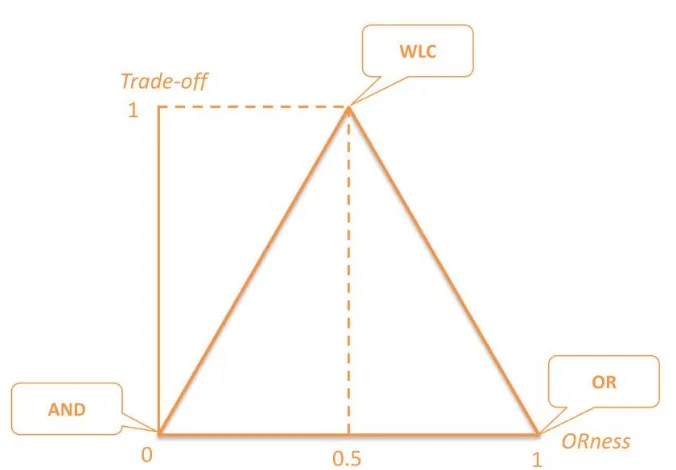
Figure 3-2 Evaluation Strategy Space: the relationship between the measures of ORness and trade-off (Source: Eastman, 1997) ... 20
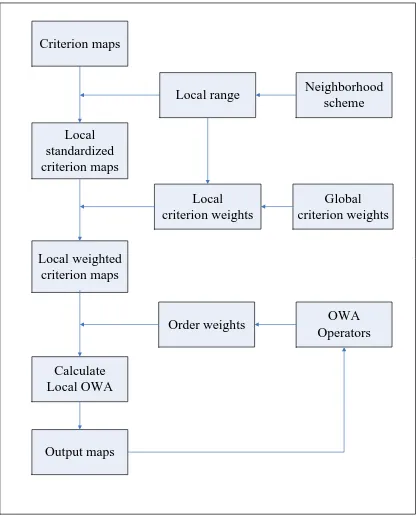
Figure 3-3 Local OWA Procedure ... 22
Figure 3-4 Identifying Neighborhood Using the Distance Based Method ... 24
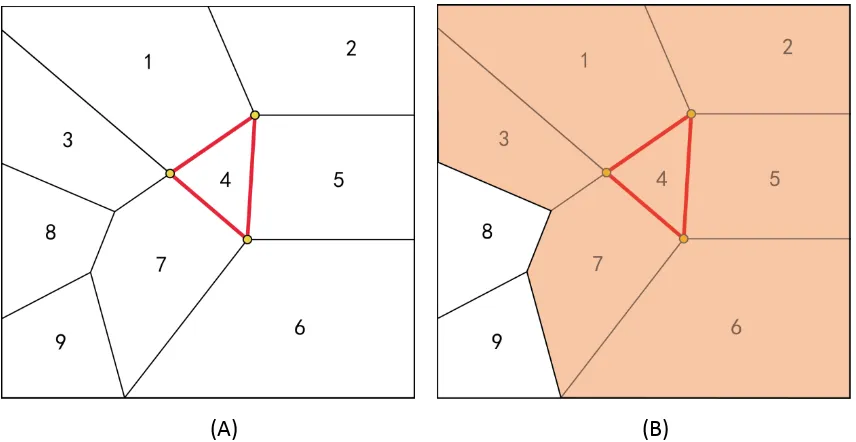
Figure 3-5 Identifying Neighborhood Using the Boundary Based Method ... 24
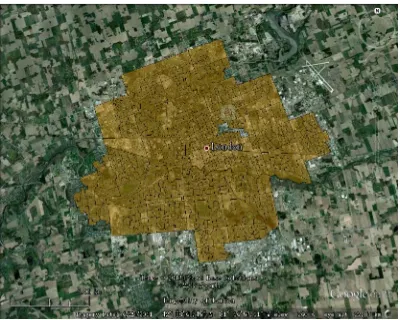
Figure 4-1 The Study Area: London, Ontario (Source: Google Earth) ... 29
Figure 4-2 Global OWA: Standardized Criterion Maps ... 34
Figure 4-3 Local Standardized Criterion Maps Based on the Boundary ... 38
Figure 4-4 Local Standardized Criterion Maps Based on 850m Distance ... 39
Figure 4-5 Local Standardized Criterion Maps Based on 1600m Distance ... 40
Figure 4-6 Local Standardized Criterion Maps Based on 2400m Distance ... 41
Figure 4-7 The Comparison of Global and Local Standardized Criterion Maps for Average Dwelling Value Criterion ... 43
Figure 4-8 Local Weights Based on the Boundary ... 45
Figure 4-9 Local Weights Based on 850m Distance ... 46
Figure 4-10 Local Weights Based on 1600m Distance ... 47
x
Figure 4-12 The Comparison For Global and Local Criterion Weights of AVE_DWE ... 50
Figure 4-13 Output Maps of Global OWA Method ... 54
Figure 4-14 Output Maps of Local OWA based on Boundary Neighborhood Scheme ... 57
Figure 4-15 Output Maps of Local OWA based on 850m Neighborhood Scheme ... 58
Figure 4-16 Output Maps of Local OWA based on 1600m Neighborhood Scheme ... 59
Figure 4-17 Output Maps of Local OWA based 2400m Neighborhood Scheme ... 60
Figure 4-18 WLC Results of Global OWA Method and Local OWA Methods Based on Different Neighborhood Schemes ... 62
Figure 4-19 Spatial Autocorrelation Statistics ... 64
Figure 4-20 Scatter Plots of Global WLC and Local WLC ... 65
Figure 4-21 Selections from the Scatter Plot (Global WLC vs. Local WLC) ... 67
Figure 4-22 Selections from Scatter Plots (Global WLC vs. Local WLC) ... 68
xi
xii
xiii
Chapter 1
1
Introduction
Multicriteria Analysis (MCA) is a systematic procedure for evaluating a set of decision
alternatives based on multiple criteria. It has emerged as an area of research within the
field of environmental economics and regional planning in the early 1970s (Carver,
1991). Over the last two decades there has been substantial growth of MCA applications
(Wallenius et al., 2008). Decision or evaluation problems that involve geographical
(spatial) data are referred to as spatial decision problems. This type of problems is
typically tackled with the use of Geographic Information Systems (GIS). However, GIS
has limited capability for handling preferential information (such as preferences with
respect to relative importance of evaluation criteria). This limitation can be addressed
by integrating GIS and MCA (Malczewski, 1999; Chakhar and Mousseau, 2008).
A number of GIS-based MCA (GIS-MCA) methods have been developed over the last two
decades or so. These include weighted linear combination (WLC) (Eastman et al., 1993;
Malczewski, 2000; Mahini and Gholamalifard, 2006), ideal point methods (Carver, 1991;
Jankowski, 1995), analytical hierarchy process (Banai 1993; Rinner and Taranu, 2006)
and outranking analysis (Joerin et al., 2001; Chakhar and Mousseau, 2008). Among these
procedures, WLC and Boolean overlay approaches are considered as the most
straightforward and are most often employed (Malczewski, 1999). Boolean overlay
approaches apply the logical operators such as intersection (AND) and union (OR) on
Boolean maps to assess criteria (Jiang and Eastman, 2000). Yager (1988) generalized
these approaches and introduced a MCA method based on the ordered weighted
1.1
The Significance of GIS-based OWA
The main rationale for integrating GIS and OWA is that the two sets of methods have
unique and complementary capabilities for tackling spatial decision problems. On one
hand, GIS is efficient at storing and managing data, analyzing spatial information and
visualizing outcomes. On the other hand, OWA is a generic MCA procedure that
provides a platform for analyzing, evaluating, and prioritizing decision (or evaluation)
strategies (Malczewski, 1999; Rinner and Malczewski, 2002).
GIS-based OWA provides a tool for generating and visualizing a wide range of
multicriteria evaluation strategies by applying different operators and associated set of
ordered weights. The strength of OWA is that it can efficiently generate a set of diverse
solutions by changing the set of ordered weights. The OWA method not only provides a
single “optimal” solution, but can also generate a combination of solutions that can be
further examined for developing decision or evaluation scenarios.
1.2
The Limitation of Conventional OWA
In the last two decades, GIS-based OWA has been widely applied for solving a variety of
spatial problems including: use-land suitability problems (Eastman 1997; Malczewski,
2006b; Chen, et al., 2009 ), site-selection problems (Rinner and Raubal, 2004; Valente,
2008; Ekmekçioĝlu, et al., 2010), heat vulnerability assessment (Rinner, et al., 2010),
urban water management (Makropoulos et al., 2003), natural hazards (Gorsevski, et al.,
2010), and personal route planning (Nadi and Delavar, 2011). However, the limitation of
previous researches should be noted. The conventional OWA approach applied in
previous studies is regarded as “global OWA” because of the underlying assumption
about spatial homogeneity of the OWA parameters. The procedures of GIS-MCA,
including GIS-OWA, have mostly been derived from the general theory of decision
analysis (Malczewski, 1999) rather than from spatial theories. Consequently, the
method is based on an assumption that there is spatial homogeneity within the study
area. For instance, in the conventional GIS-OWA procedure, every alternative (location)
is assigned the same criterion weight. The conventional procedure uses a single value
function for the whole study area ignoring the fact that the form of the function may
depend on the local context (Malczewski, 2011). Therefore, all the previous studies are
based on the global OWA method and do not involve an explicit spatial representation
of local contexts.
Both Feick and Hall (2004) and Malczewski (2011) have addressed this limitation of
global GIS-MCA. Feick and Hall (2004) adopt an easy-to-use procedure to examine
weight sensitivity in both criteria and geographic space. They demonstrate a method for
visualizing the spatial dimension of criteria weight sensitivity by mapping the weight
sensitivity in order to detect localized variations of outcomes. Malczewski (2011)
introduces the concept of local weighted linear combination (WLC) to advance the
global WLC method, using the range sensitive principle as a core concept for developing
the local form of WLC model. However, there has been no attempt to develop the local
OWA method. This research is designed to fill this gap in the GIS-OWA studies.
In sum, OWA method is a generic GIS-MCA procedure. The conventional OWA method is
based on an assumption of spatial homogeneity. Consequentially, the conventional
OWA is referred to as the global OWA method. This research aims at advancing the
global OWA approach by developing a new OWA method to take into account the
spatial homogeneity. This new method is called local OWA.
1.3
Research Objectives
(1) To develop a local form of the OWA method. This objective will be achieved by
developing a new algorithm for transforming the global OWA to local OWA using the
range sensitivity principle.
(2) To examine the results of the local and global OWA using a case study of
Chapter 2
2
Theoretic Background
This chapter provides a theoretical background of GIS-MCA methods. It includes the
concept of MCA and spatial MCA.
2.1
Multicriteria Analysis
Multicriteria analysis (MCA) is a set of methods and procedures for evaluating decision
alternatives on the basis of multiple, conflicting criteria and selecting the best
alternative(s) (Voogd, 1983; Janssen and Rietveld, 1990). Criterion is a generic term that
includes both the concept of attributes and objectives (Malczewski, 1999). Hence
multicriteria analysis can be classified into two types: multiobjective and multiattribute
analysis.
Objective is a statement about the desired state of the system under consideration (e.g.,
land-use pattern, spatial pattern of transport facilities, location of public services, spatial
pattern of socioeconomic status, etc.). Objectives are functionally related to, or derived
from a set of attributes, indicating the direction towards which the attributes should be
optimized. Each objective represents one aspect of the desired state of the system. A
set of objectives should summarize all relevant concerns for achieving an overall goal of
the decision or evaluation problem. The multiobjective analysis is a model-oriented,
where the alternatives must be designed using the methods of mathematical
programming (Janssen and Rietveld, 1990; Malczewski, 1999).
Attribute is a measurable characteristic of an object (decision alternative, location, area,
etc.). It is a descriptive value (Drobne and Lisec, 2009). It aims at assessing the degree to
which a given objective might be achieved (Pitz and McKillip, 1984). Attributes are used
means or information sources available to the decision maker for formulating and
achieving the decision maker’s (or expert’s) objectives (Starr and Zeleny, 1977).
Multiattribute analysis is based on the assumption that the set of alternatives are
known. The core of solving multiattribute decision problems is the evolution of (and
choice among) alternatives described by their attributes. For the most part, GIS-MCA
belongs to the multiattribute analysis (Malczewski, 2006). This research is concerned
with multiattribute analysis. Hereafter, the terms multiattribute analysis and
multicriteria analysis will be used interchangeably.
2.2
Spatial Multicriteria Analysis
Spatial MCA focuses on geographically defined decision alternatives which are evaluated
by a set of criteria (Carver, 1991; Jankowski, 1995; Malczewski, 1999). The kernel of
spatial MCA is the integration of MCA and GIS methods. Conventional MCA can be used
to deal with the complexity of the real world problems that may involve a large number
of alternatives and multiple and conflicting evaluation criteria. Nevertheless, to solve
spatial decision problems, MCA also requires spatial analytical functions and the
capacity of processing geographic data. This calls for the integration MCA and GIS.
In spatial multicriteria analysis or GIS-MCA, attributes, represented as map layers, are
the properties of geographical entities; hence attributes can be interpreted as criteria
(criterion maps). The weight associated with a criterion map represents the preference
of decision makers (or experts). It indicates the relative importance of criteria. The
spatial units (locations or areas) represent the decision (or evaluation) alternatives. In
the raster data, each raster cell or a combination of cells is considered as an alternative.
In the vector data, alternatives are represented by points, lines, polygons or a
combination of these three spatial objects.
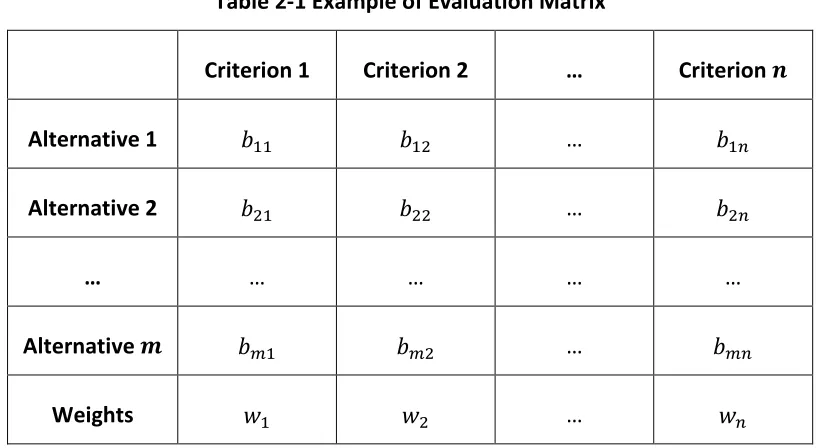
An evaluation matrix can be formed to represent the relationships between alternatives
= 1,2,…, ; where and are the number of alternatives and criteria, respectively. The
criterion weights ( ) are shown in the last row. In the spatial MCA, the evaluation
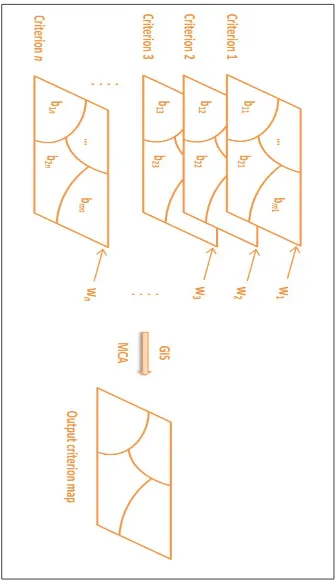
criteria are associated with geographical entities therefore can be represented in the
forms of maps (see Figure 2-1).
Table 2-1 Example of Evaluation Matrix
Criterion 1 Criterion 2 … Criterion
Alternative 1 …
Alternative 2 …
… … … … …
Alternative …
Weights …
A criterion map consists of a set of polygons. Each polygon stands for an alternative in
the evaluation matrix and is described by a set of criterion values (that is, the -th
alternative or polygon is described by for k = 1,2,…, ). Criterion weights are assigned
to each criterion maps. Given the set of criterion maps and associated criterion weights,
the input data can be processed by GIS techniques and MCA methods to obtain the
2.3
GIS-based OWA Method
GIS-based OWA method is the combination of GIS techniques and OWA method.
Eastman (1997) first extended the concept of OWA to GIS application to establish the
decision support model in Idrisi-GIS. In the recent decade, many researches focus on
integrating OWA concept and GIS application to practical problems (Jiang and Eastman,
2000; Malczewski, 2000; Rasmussen et al., 2002; Araújo and Macedo, 2002; Chen et al.,
2009; Charabi and Gastili, 2011; Feizizadeh and Blaschke, 2012).
Criterion values, criterion weights and order weights are three important elements of
OWA. Criterion values are the presentation of attributes. The criterion weights indicate
the importance of each criterion. The order weights are assigned to each reordered
criterion after the reordering process. The determination of order weights is critical on
integrating GIS and OWA (Malczewski, 2006c). Jiang and Eastman (2000) demonstrated
the Idrisi-OWA procedure but failed to provide a method for obtaining the order
weights. Consequently, several researches proposed methods for generating the
optimal order weights: based on the degree of ORness and trade-off (Asproth et al.,
1999; Mendes and Motizuki, 2001; Rasmussen et al., 2002), based on the principles of
maximum dispersion or the maximum trade-off (Rinner and Malczewski, 2002;
Malczewski et al., 2003; Malczewski, 2006c). The approach of maximum trade-off can be
implemented by parameterized OWA. This research applied a linguistic quantifier by
using the parameter to determine the order weights (see Section 3.1.5). The
generality of OWA is related to its capability to implement different OWA operators by
Chapter 3
3
Methods
This chapter consists of two sections: the implementation of global OWA method and
the development of local OWA approach.
3.1
Global OWA Method
3.1.1
Global OWA Procedure
The global or conventional OWA method applies a weighted sum of ordered evaluation
criteria including a set of alternatives (or locations) and a set of evaluation criteria. Each
alternative, , is described by a set of standardized criterion (or attribute) values ( ),
for = 1, 2, … , , and = 1, 2, … , . The OWA is composed of two types of weights:
criterion weights ( ) and ordered weights ( ). The global criterion weights: ( , ∑ = 1) are applied to specific criteria. They represent
the preferences (of the decision maker or expert), with respect to each criterion to
indicate its relative importance. On the other hand, order weights,
( ; ∑ ), are assigned to ordered criteria associated with criterion
Criterion maps
Standardized
criterion maps
Weighted
criterion maps
Global criterion
weights
Order weights
Calculate
OWA
OWA
operators
Output map
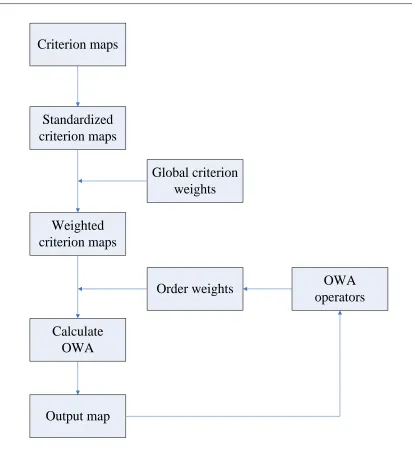
The procedure of global OWA involves the following steps (see Figure 3-1):
(1) standardize criterion values of each criterion maps;
(2) define the global criterion weights according to the preferences of experts;
(3) sort weighted standardized criterion values of each location in descending order;
(4) order global criterion weights according to the ordered criterion values for each
location;
(5) select appropriate ordered weights by adopting different OWA operators;
(6) multiply the weighted standardized values by corresponding order weights;
(7) sum up the products to obtain an overall OWA score for each location.
3.1.2
Standardizing Criterion Maps
The first step of any MCA is to collect relevant data and information about the decision
or evaluation problem. In GIS-MCA, the input data is typically represented in the form of
criterion maps. Since the various criteria are likely to be measured in different system,
the criterion maps must be transformed into a standardized scale (Carver, 1991). The
method for transforming criterion maps into standardized forms is defined as follows:
(3-1)
for -th criterion to be minimized; (3-2)
for -th criterion to be maximized (3-3)
where, refers to the raw (unstandardized) criterion value; and
indicate the maximum and minimum criterion value of the -th criterion, respectively;
is the global range of the -th criterion; is the standardized criterion value,
ranging from 0 to 1, where 0 is the least-desired value, while 1 indicates the
perform the criterion standardization (e.g., a benefit criterion). Equation 3-3 should be
applied for criterion to be minimized (e.g., a cost criterion).
3.1.3
Deriving Criterion Weights using Pairwise Comparisons
Some criteria are more important than the others. The criterion weights estimate the
perceived importance of individual criterion relative to the other criteria (Carver, 1991).
The pairwise comparison method is applied to estimate criterion weights (see Table 3-1).
Table 3-1 Pairwise Comparison Matrix
Criterion 1 Criterion 2 … Criterion n
Criterion 1 1 p12 … p1n
Criterion 2 p21 = 1/p12 1 … p2n
… … … … …
Criterion n pn1 = 1/p1n pn2=1/p2n … 1
In the pairwise comparison method, the pairwise comparison matrix should be
developed first (Table 3-1). Comparing each pair of criteria, decision maker (or expert)
evaluates the relative importance of criteria using the scale shown in Table 3-2. For
instance, if criterion 1 is moderately more important than criterion 2, then p12 = 4; the
comparison value of p21 is calculated using the reciprocal principle (that is, p 21 = 1/p12 =
0.25). Note that the cells on the diagonal in the pairwise comparison matrix have the
same values of 1 because pairwise comparisons represented of those cells are between
a given criterion and itself. Given the pairwise comparison matrix, the pairwise
then the criterion weight is calculated as an average value of the normalized pairwise
comparisons (see Section 4.3.2).
Table 3-2 Scale for Pairwise Comparison (Source: Saaty, 1980)
Intensity of
Importance Definition
1 Equal importance
2 Equal to moderate importance
3 Moderate importance
4 Moderate to strong importance
5 Strong importance
6 Strong to very strong importance
7 Very strong importance
8 Very to extremely strong importance
9 Extreme importance
3.1.4
Sorting Weighted Criteria
The next step is to generate ordered criteria ( ). This is achieved by sorting the
weighted standardized criterion values ( ) for each alternative or location in a
descending order (Yager, 1988; Malczewski and Rinner, 2005). Table 3-3 illustrates the
procedure using a set of four alternatives (locations), three standardized criterion
( ), and associated criterion weights ( = 0.2, =0.5, = 0.3).
The standardized criteria are weighted by multiplying the associated criterion weights.
Further, the weighted criterion values ( ) are sorted in a descending order. The
of weighted criterion values ( = 0.0, = 0.45, = 0.18) associated with
= 1 is arranged in the descending order as follows: = 0.45, = 0.18, = 0.0.
Since the criterion values are shuffled, the corresponding criterion weights are also
rearranged in the sorting process. These rearranged criterion weights form a new matrix,
the ordered criterion weight ( ). The ordered criterion weights are used to
determinate the ordered weights (see Section 3.1.5). The procedures of sorting criterion
values and generating ordered criterion weights have been implemented in a Local MCA
Calculator (see Appendix).
Table 3-3 Illustrative Example: calculating ordered criterion ( )
Criteria
{0.0, 0.7, 1.0 ,0.4} 0.2 {0.0, 0.14, 0.2, 0.08}
{0.9, 0.3, 0.2, 0.6} 0.5 {0.45, 0.13, 0.01, 0.3}
{0.6, 0.8, 0.1, 0.3} 0.3 {0.18, 0.24, 0.03, 0.09}
Criteria
{0.5, 0.3, 0.2, 0.5}
{0.3, 0.2, 0.3, 0.3}
{0.2, 0.5, 0.5, 0.2}
{0.45, 0.24, 0.2, 0.3}
{0.18, 0.14, 0.03, 0.09}
3.1.5
Determining Order Weights
3.1.5.1 Fuzzy linguistic quantifiers
The order weights can be estimated using a number of methods (Yager, 1996). The
linguistic quantifier-based method is one of the most often used in OWA applications.
Linguistic quantifiers can be represented as a fuzzy set (Zadeh, 1983). Consequently, the
term linguistic and fuzzy quantifiers can be used interchangeable. Translating natural
language specifications into mathematics formulas is the core purpose of fuzzy
quantifiers. Yager (1996) proposed a procedure for quantifier-guided MCA that fuzzy
linguistic quantifiers were used to specify the statement about the number (proportion)
of criteria to be satisfied by applying OWA operators (e.g., all criteria must be satisfied,
most of the criteria should be satisfied or at least half of criteria should be satisfied).
To determine the values of order weights, the associated quantifier Q needs to be
specified first. There are two generic classes of linguistic quantifiers: absolute and
relative quantifiers (Zadeh 1983; Yager 1996). The statements such as “about five” or
“more than ten” belong to the class of absolute quantifiers; they are defined as fuzzy
subsets of [0, ]. The relative quantifiers are closely related to imprecise proportions.
They are defined as fuzzy subset of [0, 1] with proportional terms such as “a few”, “half”,
“many”, “most”. Therefore, the relative quantifier can be identified by one of the
simplest and the most often used method to parameterize subset on the unit interval as
following (Yager, 1996):
( ) (3-4)
The ( ) represents a fuzzy set in interval [0, 1], including monotonically increasing
proportions of elements. Hence the whole family of regular increasing monotone (RIM)
quantifier can be generated from this quantifier ( ). Consequently, by changing the
value of parameter , one can obtain a wide range of aggregation operators. Specifically,
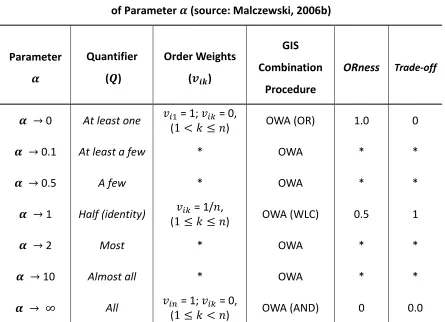
between the two extreme cases of the “at least one” and “all” quantifiers (see Table 3-4)
(Malczewski and Rinner, 2005). For instance, when the value of parameter tends to be
zero, the quantifier ( ) approaches its extreme case of “at least one”. When the value
of parameter approaches infinity, the quantifier ( ) approaches its extreme case of
“all”. Using the parameter , the order weights can be defined as follows (Yager, 1996;
Malczewski, 2006b):
(∑ ) (∑ ) (3-5)
where is the order weight for the k-th criterion associated with the -th location;
is the ordered criterion weights; is the parameter associated with the fuzzy quantifier.
Table 3-4 Properties of Regular Increasing Monotone Quantifiers with selected values
of Parameter (source: Malczewski, 2006b)
Parameter Quantifier
(𝑸) Order Weights (𝒗 ) GIS Combination Procedure
ORness Trade-off
→ 0 At least one = 1; = 0,
( < ≤ ) OWA (OR) 1.0 0
→ 0.1 At least a few * OWA * *
→ 0.5 A few * OWA * *
→ 1 Half (identity) = 1/ ,
( ≤ ≤ ) OWA (WLC) 0.5 1
→ 2 Most * OWA * *
→ 10 Almost all * OWA * *
→ All = 1; = 0,
( ≤ < ) OWA (AND) 0 0.0
Note: * the set of order weights depends on values of sorted criterion weights and
3.1.5.2 OWA operators
The generality of OWA method is related to its ability of implementing a wide range of
combination operators by selecting an appropriate set of order weights (Yager 1988).
The combination operators are called OWA operators. They include the weighted linear
combination (WLC) and Boolean overlay operations such as intersection (AND) and
union (OR) (Yager 1988; Jiang and Eastman, 2000). The AND and OR operators are the
most often used GIS combination procedures.
In fact, the set of order weights determinates the type of the OWA operator. In the
practical application, the AND and OR operators represent the two extreme situations.
For example, when parameter ( → ), the order weights are generated as . This extreme case represents the Boolean OR
combination (see Table 3-4). If parameter = 0.001 ( → 0), only the lowest values are
selected by the OWA operator because the order weights ;
this is an equivalent of the AND type of Boolean combination (see Table 3-4).
Moreover, the WLC operator is determined by a set of equal order weights
( ); that is, the identity quantifier or parameter = 1 is
applied. Hence, the WLC operator does not change in the re-order weighted criterion
value because equal ordered weights are assigned to each ordered weighted criterion.
The AND, OR and WLC operators are only three ‘special’ cases. One can generate a large
number of OWA operators by changing the value of parameter or the quantifiers
ranging from “all” to “at least”.
One can use the measurements ORness and trade-off to classify the OWA operators
with respect to their positions between the AND and OR operators (Yager, 1988;
Eastman, 1997; Jiang and Eastman, 2000):
- = √ ∑ ( ) , 0 ≤trade-off≤ 1 (3-7)
ORness measures the degree similarity of an OWA operator to the logical OR in terms of
its combination behavior (Malczewski et al., 2003). The trade-off is a measurement for
the substitutability (or compensation) of low values on one criterion by high values on
other criterion (Jiang and Eastman, 2000). It indicates the degree of how a good
performance on one criterion under consideration compensates a poor performance on
other criterion (Malczewski et al., 2003). The value of zero conveys no trade-off among
criteria and the value of one indicates a full trade-off.
3.1.5.3 Evaluation strategy space
Evaluation (or decision) strategy space can be formed by two measurements: ORness
and trade-off (Jiang and Eastman, 2000; Rinner and Malczewski, 2002). Figure 3-2 shows
the relationship between ORness and trade-off. The shape of evaluation strategy space
depends on the number of criteria ( ). When two criteria are involved in the evaluating
process, the strategy space has a triangle shape (Figure 3-2). The three vertices of the
triangle represent the three extreme cases of the OWA operators: AND, OR and WLC
(see Figure 3-2). For instance, the top vertex represents the WLC operator ( = 1),
characterized by an intermediate degree of ORness and full trade-off.
As the number of criteria increases from = 2 to → , the shape of decision strategy
space changes to a rectangular form (Malczewski and Rinner, 2005). Specifically under a
given degree of ORness, more criterion maps are involved in the procedure and this
leads to the higher level of trade-off, except for the extreme cases of OWA operators
(AND, OR and WLC operators). For AND, OR and WLC operators, the measures of
trade-off and ORness are fixed irrespectively of the number of criterion maps (Malczewski and
Figure 3-2 Evaluation Strategy Space: the relationship between the measures of
ORness and trade-off (Source: Eastman, 1997)
3.1.6
Defining Global OWA
For a given set of criterion maps, the function of OWA scores is defined as follows (Yager,
1988):
∑ (3-8)
where is the overall OWA score of the -th location or alternative; is the
ordered weight; is the ordered weighted criterion value. The spatial pattern of OWA
scores can be displayed on a map. The location (alternative) with the highest overall
3.2
Local OWA Method
3.2.1
Local OWA Procedure
The local OWA procedure is illustrated in Figure 3-3. It starts with defining the set of
evaluation criterion maps. Next, a neighborhood scheme is specified. Based on the
neighborhood scheme, the range sensitivity principle is applied to obtain the local range
for each location in the study area. This is followed by performing the local
standardization for each criterion map. Then, the global criterion weights are estimated,
providing the basis for calculating local criterion weights. Particularly, the local criterion
weight associated with a given location is a function of the global weight and the local
range. Given the local standardized criteria and local criterion weights, one can generate
local weighted criterion maps. Further, a set of order weights is defined based on the
specified value of parameter . Finally, the local weighted criteria maps and order
weights are combined to obtain the local OWA scores (output map).
The concept of the neighborhood, local range and local criterion weight are critical for
conveying spatial heterogeneity and local context. Therefore, the rest of this chapter
will focus on this concept. The order weights of the local OWA method are obtained in
the same way as in the global OWA approach (see Section 3.1.5). Therefore, the process
of selecting appropriate order weights by specifying different values of parameter is
Criterion maps
Local
standardized
criterion maps
Local weighted
criterion maps
Global
criterion weights
Order weights
Calculate
Local OWA
OWA
Operators
Output maps
Local range
Neighborhood
scheme
Local
criterion weights
3.2.2
Defining Neighborhoods
One of the crucial differences between the local and global OWA methods is the
utilization of the neighborhood scheme for localizing OWA method. In this research, an
alternative is a polygon (or location). Two approaches are applied to identify
neighborhoods: the distance-based method and the boundary-based method.
3.2.2.1 Distance-based neighborhood scheme
In the distance-based method, neighborhoods are generated based on the threshold
distance ( ). The centroid of each polygon must be found in order to measure the
distance between polygons (locations). The threshold distance is assigned according to
specific situation. Once the threshold distance is determined, one can compare the
threshold distance with the distances between focal polygon and other polygons. If the
distance between the focal location and its nearby polygon is smaller than the threshold
distance, then the polygon is defined as a neighbor of the focal polygon. The
neighborhood of focal location consists of the focal location and its neighbors. For the
local OWA method, the value of threshold distance must be large enough to guarantee
that each polygon has at least one polygon as its neighbor. This rule ensures that
the denominator of Equations 3-10, 3-11 and 3-12 is greater than zero. Moreover, if the
threshold distance is large enough to cover the whole study area, then the
neighborhood of each location contains all other locations in the study area. In this case,
the local and global OWA methods generate the same results.
Figure 3-4 shows an example. The study area is represented in a vector format. Points
from 1 to 9 represent the centroids of nine polygons. In Figure 3-4-A, represents the
threshold distance and polygon 4 is the focal polygon. Since the straight line distances
between the centroid of polygon 4 and centroids of polygon 1, 5 and 7 are smaller than
the threshold distance ( ), polygons 1, 4, 5 and 7 form the neighborhood of the focal
(A) (B)
Figure 3-4 Identifying Neighborhood Using the Distance Based Method
3.2.2.2 Boundary-based neighborhood scheme
(A) (B)
Figure 3-5 Identifying Neighborhood Using the Boundary Based Method
In the boundary-based method, neighborhoods are defined as areas which share their
boundaries with the focal area. This research is based on the Queen’s case. If two
neighbors. Any polygon sharing boundaries with a given focal polygon is defined as the
neighbor of that area (see Figure 3-5). For example, the polygon 4 shares three points
and three lines with surrounding polygons (see Figure 3-5-A), therefore polygon 1 to 7
form the neighborhood of polygon 4 (see Figure 3-5-B).
3.2.3
Range Sensitivity Principle and Local Range
The range sensitivity principle is used as a core concept for developing the local form of
OWA method. The range sensitivity is a normative property with respect to the
dependence of criterion weights on the ranges of criterion values (von Nitzsch and
Weber 1993; Fischer, 1995; Malczewski, 2011). In the global OWA method, an
assumption about uniformity of preferences over the whole study area is applied to
global criterion weights. In the process of global standardization, the global
standardized criterion value ( ) is the function of global range ( ) (see Equation 3-2
and 3-3). The global range is the parameter that is defined for the whole study area. It
implies that the spatial heterogeneity is ignored, irrespectively of the local context and
factors that may affect the level of worth associated with a particular criterion value.
The range sensitivity principle assumes that for a given criterion the greater the range of
the criterion values is, the greater the weight of importance assigned to the criterion
should be (von Nitzsch and Weber 1993; Fischer, 1995). To convey local context in the
specific neighborhood, the local range can be generated based on this principle. The
local range ( 𝑞) is defined as the difference between the maximum and minimum
criterion values in the 𝑞q-th neighborhood for the -th criterion. Formally:
𝑞
𝑞{ 𝑞} 𝑞{ 𝑞} (3-9)
where 𝑞{ 𝑞} and 𝑞{ 𝑞} are the minimum and maximum values of the -th
criterion in the q-th neighborhood; 𝑞 is the local range of the -th criterion in the q-th
3.2.4
Local Standardization
The values of each criterion are standardized locally as follows:
𝑞
for the -th criterion to be minimize; (3-10)
𝑞
for the -th criterion to be maximize (3-11)
where 𝑞{ 𝑞} and 𝑞{ 𝑞} are the minimum and maximum values of the 𝑞-th
neighborhood for the k-th criterion; 𝑞 is the local range; 𝑞 is the locally standardized
criterion values, ranging from 0 to 1, where 0 is assigned as the least-desired criterion
value and 1 is assigned as the most-desired value in the q-th neighborhood.
3.2.5
Local Criterion Weights
The value of local criterion weight depends on the scheme used for subdividing a study
area into neighborhoods (zones or regions). Local criterion weight ( 𝑞) can be obtained
as follows:
𝑞
∑
≤ 𝑞 ≤ and ∑ 𝑞 (3-12)
where 𝑞 is the local criterion weight associated with the q-th neighborhood for the
-th criterion; is the global criterion weight of -th criterion; is the global range,
which equals to the maximum minus the minimum criterion value in the -th criterion; 𝑞
is the local range. Since the value of local weight depends on the neighborhood
scheme, it is also referred to the neighborhood-based criterion weights (Feick and Hall
3.2.6
Sorting Local Weighted Criteria
Unlike global criterion weights ( ), which are presented as an array, the local weights
( 𝑞) form a matrix. It implies that each location (spatial unit) on the criterion map has
assigned a corresponding value of the local weight. The calculation process of weighting
local criterion maps involves the matrix multiplication of standardized criterion values
and local criterion weights. The procedure for sorting (ordering) local weighted criteria
is the same as the sorting method for the global OWA method (see Section 3.1.4). Thus,
one can sort the weighted criterion values ( 𝑞 𝑞) to obtain the ordered weighted
criterion values ( 𝑞)
3.2.7
Generating Local Order Weights
In the local OWA method, the procedure of generating local order weights is the same
as of determining order weights in the global OWA method (see Section 3.1.5).
According to Equation 3-5, the order weights ( ) are derived from ordered criterion
weights ( ). Although the local criterion weights ( 𝑞) are different from global
criterion weights ( ), both weights are formed as a matrix. In the local OWA method,
the order weights are defined as follows:
𝑞 (∑ 𝑞
) (∑ 𝑞) (3-13)
where 𝑞 is the local order weight; 𝑞 is the ordered weighted local criterion values for
the -th criterion in the 𝑞-th neighborhood; is the parameter associated with the fuzzy
3.2.8
Calculating Local OWA
The calculation of local OWA scores is defined as follows:
𝑞 ∑ 𝑞
𝑞 (3-14)
where 𝑞 is the overall local OWA score for the 𝑞-th neighborhood; 𝑞 is the local
order weights (see Section 3.2.7); 𝑞 is the ordered weighted local criterion values for
the -th criterion in the 𝑞-th neighborhood(see Section 3.2.7).
3.3
Comparing Local OWA methods and Global OWA methods
The most important difference between local and global OWA methods lies in applying
different criterion weights. In the global OWA method, the relative importance of
evaluation criterion is the only factor to determine the criterion weights, defined as the
global weights. In the local OWA method, however, the local criterion weights are
estimated on the basis of the preferences with respect to relative importance of criteria
and the local context. In addition, the local weights can be considered as the adjusted
global weights depending on the definition of neighborhoods. To be more specific, the
local criterion weight is the function of the global criterion weight modified by the
relationships between the local and global ranges. The ranges in turn depend on the
Chapter 4
4
Case Study
The aim of the case study is to test the local OWA method and to compare the results of
global and local OWA methods by evaluating the socioeconomic status of
neighborhoods in London, Ontario.
4.1
The Study Area
The study area is the City of London, Ontario (see Figure 4.1). London is located in
Southwestern Ontario. It is situated along the Quebec City - Windsor corridor. The city
of London has a population of 366,151 (Statistics Canada, 2011).
4.2
Data Sources
The geographic data of the study area is obtained from a secure website database
distributed through the university’s library system (UWO, 2011). The geographic data
are in the vector format; that is, the census dissemination area is represented by
polygons. ArcMap 10.0 is applied to manipulate the spatial data.
The socioeconomic data for London was derived from the Population Census of 2006
(Statistics Canada, 2006). The census dissemination area is the basic unit of the analysis.
The statistic data for the evaluation criteria is available for 494 dissemination areas in
London, Ontario. The unpopulated Census Tract 0056 is excluded from the analysis.
4.3
The Application of OWA methods
4.3.1
Criteria Selection
The problem of evaluating socioeconomic conditions of residential neighborhoods (and
related problem of measuring quality of life or residential quality) provides a good
example of a situation in which one has to combine a number of evaluation criteria
(indicators) to obtain a composite measure of socioeconomic status. Many studies rely
on multivariate statistics and/or multicriteria evaluation procedures (Can, 1992; Raphael
et al., 1996; CUISR, 2000). The weighted linear combination (WLC) is the most often
used approach for obtaining a composite measure of quality of life (e.g. Raphael et al.,
1996; CUISR, 2000; Massam, 2002). The Federation of Canadian Municipalities (FCM)
provides a reporting system to monitor the quality of life in Canadian municipalities
(FCM, 1999; FCM, 2001). The project is known as the quality of life reporting system
(QOLRS). The selection of evaluation criteria for this case study of assessing the
socioeconomic status in London is based on the QOLRS. The set of criteria includes:
median incomes, incidence of low incomes, employment rate, average values per
criterion, the maximum type indicates that the higher value is more desired. The
minimum type means that the lower value of the criterion is more desired.
Table 4-1 Criteria for Evaluating Socioeconomic Status in London, Ontario
Name Description Type
1 MED_INC* Median incomes ($) Maximum
2 LOW_INC* Incidence of low income (%) Minimum
3 EMP_RAT* Employment rate (%) Maximum
4 AVE_DWE* Average value of dwelling ($) Maximum
5 UNI_EDU* University education
(% population 15 years and over) Maximum
6 RES_BUR** Residential burglary (relative risk ratio) Minimum
( Sources of data: * Statistics Canada, 2006 and ** Poetz, 2003)
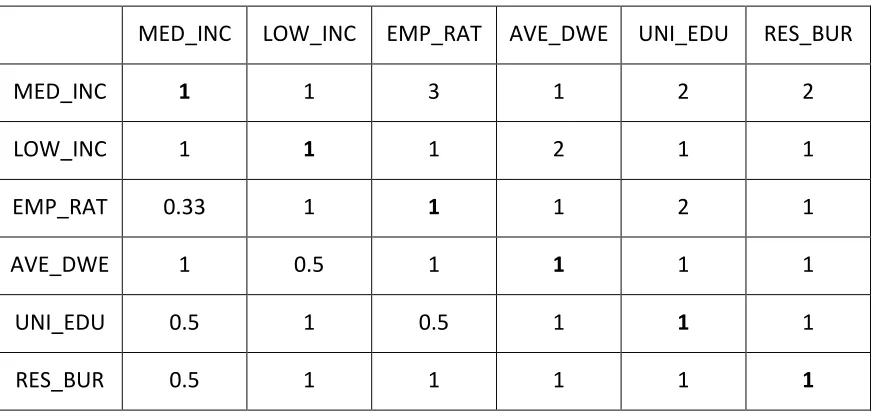
4.3.2
Identify Global Criterion Weights
The global criterion weights represent the relative importance of criteria. To define the
global criterion weights, several scenarios are developed by applying the pairwise
comparison approach (see Section 3.1.3). For the purpose of demonstrating the OWA
procedures, this case study focuses on one of the criterion weighting scenarios. Table
4-2 shows the pairwise comparison matrix. The meaning of scores in the pairwise
comparison matrix is given in Table 3-2. The pairwise comparisons are normalized; that
is, each cell of the matrix is divided by its column total (the results are shown in Table
4-3). Then the global criterion weights are obtained by computing the average value of the
Table 4-2 A Scenario for Global Criterion Weighting: Pairwise Comparison Matrix
MED_INC LOW_INC EMP_RAT AVE_DWE UNI_EDU RES_BUR
MED_INC 1 1 3 1 2 2
LOW_INC 1 1 1 2 1 1
EMP_RAT 0.33 1 1 1 2 1
AVE_DWE 1 0.5 1 1 1 1
UNI_EDU 0.5 1 0.5 1 1 1
RES_BUR 0.5 1 1 1 1 1
Table 4-3 Global Criterion Weights
MED_INC LOW_INC EMP_RAT AVE_DWE UNI_EDU RES_BUR Weights
MED_INC 0.23 0.18 0.40 0.14 0.25 0.29 0.25
LOW_INC 0.23 0.18 0.13 0.29 0.13 0.14 0.18
EMP_RAT 0.08 0.18 0.13 0.14 0.25 0.14 0.15
AVE_DWE 0.23 0.09 0.13 0.14 0.13 0.14 0.14
UNI_EDU 0.12 0.18 0.07 0.14 0.13 0.14 0.13
RES_BUR 0.12 0.18 0.13 0.14 0.13 0.14 0.14
Sum 1.00 1.00 1.00 1.00 1.00 1.00 1.00
Note: theconsistency ratio CR = 0.06 < 0.1 indicates that the global criterion weights are
based on a consistent set of pairwise comparisons (see Section 3.1.3).
4.3.3
Global Standardization
The six standardized global criterion maps are generated according to Equations 3-1, 3-2,
and 3-3 (see Figure 4-2). The Jenks natural breaks classification method is applied to
display criterion maps, where classes are developed on natural groupings inherent in
the data. The class breaks are statistically determined by best grouping similar values
and maximizing the differences between classes in ArcGIS 10.0 (ESRI, 2010). Boundaries
of divided classes are set according to the relatively ‘big jumps’ within data values. The
Jenks natural breaks classification method is applied to all criterion maps in this study.
In the outcome of global standardization, the criterion map of median incomes shows
that the northwestern of London has high values, while the central and southeastern of
the city are characterized by low values of median incomes (see Figure 4-2-A). A similar
spatial pattern can also be observed for criteria of average value per dwelling, university
education and residential burglary (see Figures 4-2-D, 4-2-E and 4-2-F). One can
conclude that the residential neighbourhoods in the northwest part of London are
characterized by higher median incomes, higher average value of dwelling, higher level
of education and lower residential burglary rates. Conversely, the central and southeast
sectors of the city tend to have lower median incomes, lower average value of dwelling,
lower level of education and higher residential burglary rates. For criterion maps of the
incidence of low income and the employment rate (see Figures 4-2-B and 4-2-C), the
spatial pattern is dispersed with a slight tendency of clustering higher values at the
(A) MED_INC (B) LOW_INC
(C) EMP_RAT (D) AVE_DWE
(E) UNI_EDU (F) RES_BUR
4.3.4
Neighborhood Scheme
This research applies two methods of the neighborhood scheme: distance-based and
boundary-based methods (see Section 3.2.2). ArcGIS 10.0 is used as the tool to establish
the neighborhood scheme (ESRI, 2010). Table 4-5 lists the four specific neighborhood
schemes applied in this case study.
Table 4-4 Neighborhood Scheme
Method Descriptions
Based on the distance
d = 850 m
d = 1600 m
d = 2400 m
Based on the boundary Queen’s case
(Note: d = threshold distance)
Implementing the distance-based method in ArcGIS involves two steps: (1) the “Feature
to Point” tool generates centroid points of polygons, and (2) the tool “Point Distance” is
applied to find neighbors according to the threshold distance. The output is a table that
contains the list of the focal polygons and information of about all near polygons
(centroids) within the search radius or threshold distance. Three threshold distances are
used: 850m, 1600m and 2400m (see Table 4-5). The threshold should be large enough
to guarantee that each location (polygon) has at least one neighbor. The distance of
850m is the smallest threshold to meet this constrain, and the distance of 2400m is
selected based on previous research (Malczewski and Poetz, 2005). The research
findings suggest that the processes underlying the relationships between some
socioeconomic variables in London, Ontario operate at a local (neighborhood) scale.
regression that the spatial variability in the relationships is significant at the spatial scale
associated with kernel bandwidths less than 2400 m.
The boundary-based method is another way to identify the neighborhood scheme (see
Section 3.2.2.2). Using the tool “Spatial Join” in ArcGIS 10.0 creates the neighborhood
attribute table for identifying neighborhoods based on shared boundaries (ESRI, 2010).
For instance, the neighborhood attribute table of the example showed in Figure 3-5 is
given in Table 4-5. The Neighbor column of the table indicates the number of polygons
which share the boundary with the target polygon.
Table 4-5 Neighborhood Attribute Table Based on Boundary Method
No. Target Neighbor No. Target Neighbor No. Target Neighbor
1 1 2 14 4 2 27 7 1
2 1 3 15 4 3 28 7 3
3 1 4 16 4 5 29 7 4
4 1 5 17 4 6 30 7 5
5 1 7 18 4 7 31 7 6
6 2 1 19 5 1 32 7 8
7 2 4 20 5 2 33 7 9
8 2 5 21 5 4 34 8 3
9 3 1 22 5 6 35 8 7
10 3 4 23 5 7 36 8 9
11 3 7 24 6 4 37 9 7
12 3 8 25 6 5 38 9 8
Based on the table of neighborhoods, generated by both the distance-base method and
the boundary-based method, one can compute the local range for each dissemination
area (polygon) according to Equation 3-9 (see Section 3.2.3). Since the calculation of the
local range cannot be accomplished in the ArcGIS, a calculator for computing the local
ranges is developed (see Appendix).
4.3.5
Local Standardization
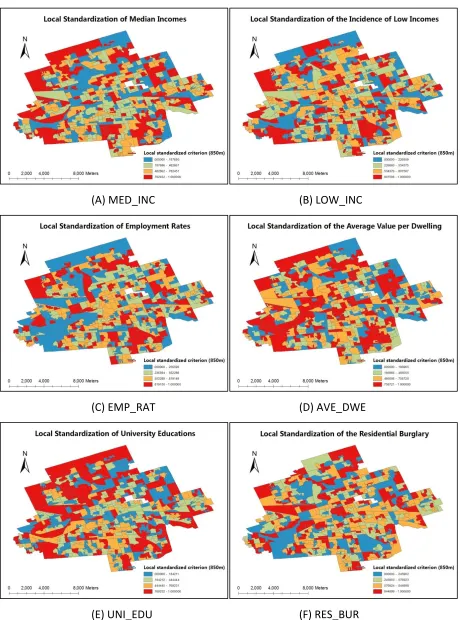
Since four neighborhood schemes are applied in this case study, four sets of local
standardized criterion maps are generated by using Equations 3-10 and 3-11. Figure 4-3
shows the results of local standardization for six criteria according to the
boundary-based neighborhood scheme. The local standardized criterion maps boundary-based on
distance-based neighborhood scheme with the threshold distance of 850m, 1600m and 2400m
are showed in Figures 4-4, 4-5, and 4-6, respectively.
There are essential differences between the global standardized criterion map (Figure
4-2) and corresponding local criterion maps (Figures 4-3, 4-4, 4-5 and 4-6). As expected,
spatial patterns of criterion values generated by the local OWA method are more
localized than the global one. The AVE_DWE criterion (the average value per dwelling) is
used to illustrate the differences between the global and local patterns (see Figure 4-7).
This criterion has the distinct spatial pattern of the global standardization values (see
Section 4.3.3). The spatial pattern with the higher values in the northwestern part of
London can be observed for the global standardization (see Figure 4-7-A). However, the
local standardized criterion maps are characterized by dispersed distribution of peaked
values across the whole study area (see Figures 4-7-B, 4-7-C, 4-7-D, and 4-7-E).
According to the global criterion standardization results, the spatial clustering of less
expensive dwellings in central and southeastern London is greater than in the
(A) MED_INC (B) LOW_INC
(C) EMP_RAT (D) AVE_DWE
(E) UNI_EDU (F) RES_BUR
(A) MED_INC (B) LOW_INC
(C) EMP_RAT (D) AVE_DWE
(E) UNI_EDU (F) RES_BUR
(A) MED_INC (B) LOW_INC
(C) EMP_RAT (D) AVE_DWE
(E) UNI_EDU (F) RES_BUR
(A) MED_INC (B) LOW_INC
(C) EMP_RAT (D) AVE_DWE
(E) UNI_EDU (F) RES_BUR
values can be observed in the central and southeastern parts of the city because local
patterns underscore the relatively high values at the neighborhood scale.
Furthermore, four neighborhood schemes present difference outcomes. The results
based on neighborhoods defined by shared boundaries and threshold distance of 850m
show an ‘evenly’ dispersion of higher values (see Figures 4-7-B and 4-7-C). Comparing
spatial patterns obtained with neighborhood schemes based on different threshold
distances (see Figures 4-7-B, 4-7-C and 4-7-D), one can conclude that with increasing the
threshold distance the number of areas with the highest criterion values decreases. This
can be attributed to the increasing size of the neighborhood as a function of the
increasing threshold distance. In general, the area having the highest value in every
neighborhood is identified as a focal area of that neighborhood. When the size of the
neighborhood increases, the number of peak values decreases.
For the case of 2400m threshold distance (Figure 4-7-D), the high criterion values tend
to cluster in the north and west sections of the study area. This makes the spatial
pattern similar to that generated by the global standardization procedure (Figure 4-7-A).
Note that when the value of threshold distance is sufficiently large, the outcomes of
local and global standardization will be the same. Consequently, the global method can
be deemed as the extreme case of the neighborhood scheme based on the threshold
(A) global standardization
(B) local standardization on the boundary (C) local standardization on 850m
(D) local standardization on 1600m (E) local standardization on 2400m
Figure 4-7 The Comparison of Global and Local Standardized Criterion Maps for
4.3.6
Local Criterion Weight
The local criterion weight is a function of global criterion weights, local range and global
range (Equation 3-12). Given four neighborhood schemes, the results of the local
criterion weighting have four sets of outcomes. Figures 4-8, 4-9, 4-10 and 4-11 show the
spatial patterns of local criterion weights under different neighborhood schemes.
The local criterion weights are the kernel of the local OWA method. The local criterion
weight contains the local context and supports spatial visualization. In the global OWA
method, all locations (areas) are assigned by a single value as the global criterion weight.
For example, the global criterion weight of median incomes is 0.25 (see Table 4-3). Since
the local criterion weight depends on the local range, each location is assigned by a
unique value of local criterion weight. This is because, for a given criterion, values of the
global weight and the global range are constant, while the local criterion weight is a
function of the local range which varies on the location basis (see Equation 3-12). The
local ranges in turn depend on the neighborhood scheme. Therefore, the spatial pattern
of local criterion weights can be considered as an important element of defining the
(A) MED_INC (B) LOW_INC
(C) EMP_RAT (D) AVE_DWE
(E) UNI_EDU (F) RES_BUR
(A) MED_INC (B) LOW_INC
(C) EMP_RAT (D) AVE_DWE
(E) UNI_EDU (F) RES_BUR
(A) MED_INC (B) LOW_INC
(C) EMP_RAT (D) AVE_DWE
(E) UNI_EDU (F) RES_BUR
(A) MED_INC (B) LOW_INC
(C) EMP_RAT (D) AVE_DWE
(E) UNI_EDU (F) RES_BUR