ISSN 2286-4822 www.euacademic.org
Impact Factor: 3.4546 (UIF) DRJI Value: 5.9 (B+)
Capacity analysis of branches and geometric
parameters of existing roundabouts
XHEVAHIR ALIU Faculty of Civil Engineering Tirana, Albania MENTOR BALILAJ Faculty of Civil Engineering Tirana, Albania FLONARD HALILAJ Freelance Engineer, Tirana, Albania
Abstract:
The infrastructure system plays a fundamental role in the development of the economical and social activity of every industrialized country. More than ever is determined that one of the most problematic element in the infrastructure system are the road intersections. Designing such elements requires a commitment not only from the economic perspective but also technical-engineering, from the initial conception phase to the design project phase. From monitoring these parts, were observed problematic phenomena related to its inefficiency, this in regard to problems of traffic blocking or creating big traffic flow near these areas. The technical solution and its efficiency have a close relationship to the professional training, such connected to experience or undertaking the right studies prior to making any decision. So that each intersection to be effective, all its geometrical parameters must be conform the technical conditions and also to meet the capacity criteria for its branches.
drawn the conclusions on the roundabout state and recommendations for possible solutions.
Key words: roundabout, circulating flow, branch, capacity, traffic.
1. INTRODUCTION
The starting point of this article was the excising traffic condition in one of the country most important intersection, at the entrance of Tirana city known as the roundabout of the square “Shqiponja” (“Eagle” square). In the last few years, more than ever priority has been given to the development of the country infrastructure, but in several cases, these investments have been inefficient and not provided the adequate technical-engineering solutions.
In this article it is presented the study assessment on the existing conditions of the intersection, on its geometrical parameters, traffic flow, and corresponding performances for each branch.
2. SCOPE OF STUDY
parameters, building new 3-4 meters sidewalks, increasing the pedestrian safety by building protective banisters and also disciplining their movements on the white lines (pedestrians crossing), etc.
Fig. 1. Aerial photo of the roundabout “Shqiponja”
3. GEOMETRICAL PARAMETERS OF THE INTERSECTION
The roundabout has four branches, from which the north-west branch and the south-east branch have the heavier circulating flow. It is characterized by carriageways with four lines at the entrance and exit, while the north-east branch carriageway has one travel line as for the circulating ring, it has three lines.
Fig. 2. “Shqiponja” roundabout plan
It stands out from other roundabouts for the large diameter of the circular outer ring and from the great size of the entrance-exit areas. The roundabout geometrical parameters are as follow:
The central island diameter is 42 m, the length of the crossable line is 2.5m, while the outer circle diameter is 75m.
The center is elevated (impassable), this area includes, proportional to the edge, an accessible line. The greenness or other elements, inside the central island are outside the visibility triangle so it guaranties a good perception of the central island.
The entry-exit carriageway has four lanes, excluding one branch that has a single travel lane. Its three branches, including the right turn lanes, have a width of 5-5.7 m
The radiuses at the entry of its branches are respectively: 44.3m Centre), 41.5m (branch-Rruga e Durrësit), 76.2m (branch-Unaza Re) and 32.5m (Branch-Laprake);
The width of the entry branches are respectively: 11.5m (Branch-Rruga e Durrësit), 12.5m (Branch-Unaza Re), 11.5m (Branch-Qender) and 4.5m (Branch- Laprake);
The width of the exit branches are respectively: 17m (Branch-Rr. Durrësi), 16.7m (Branch-Unaza Re), 17m (Branch-Qender) and 3.5m (Branch- Laprake);
The splitter islands have a pseudo-triangular shape, with entry radius and exit radius of 50m.
The sidewalks for each branch are 3 m of depth.
4. TRAFFIC ON THE MAIN BRANCHES
recommendation. The data recording was done using table modules (files) pre-prepared for each category of vehicles and for each time interval it were registered the number of vehicles passing for time unit.
For each vehicle category the equivalence with a unit equivalent was done, issuing even their hourly volumes. The gathered data present the daily average for each branch of the roundabout and will help with creating the matrix origin-destination [2], [5] shown below, which furthermore will help with carrying out the necessary verifications
Table 1. Matrix origin-destination
Matrix O/D Branch 1 Branch 2 Branch 3 Branch 4 Unit
Branch 1 0 489 1890 97 Vehicle/h
Branch 2 1295 0 485 47 Vehicle/h
Branch 3 992 233 0 93 Vehicle/h
Branch 4 252 109 0 0 Vehicle/h
5. ASSESSMENT OF BRANCHES CAPACITY
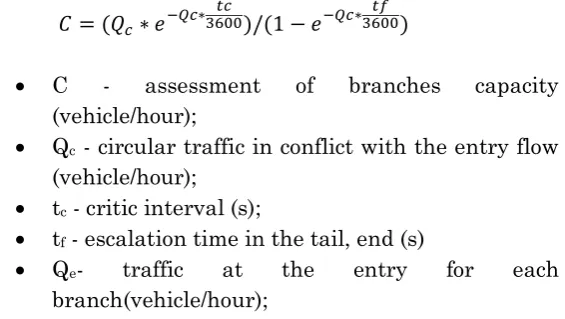
The assessment of branches capacity for the roundabout was prepared using the Highway Capacity Manual (HCM) [1], [3] and the Cetur [4] method. According to the HCM method, the assessment of branches capacity is calculated by the expression below:
where:
C - assessment of branches capacity (vehicle/hour);
Qc - circular traffic in conflict with the entry flow
(vehicle/hour);
tc - critic interval (s);
tf - escalation time in the tail, end (s)
Qe- traffic at the entry for each
In Table 2 are given the obtained results from the verifications according to the expression above.
Table 2. Branch capacity
Branch 1 ( Rr. Durresit)
Branch 2 (Unaza e re)
Branch 3 (Qender)
Branch 4 (Laprake)
C= 855 vehicle/h C= 518 vehicle/h C= 202 vehicle/h C= 116 vehicle/h
Qc= 426 vehicle/h Qc= 1015 vehicle/h Qc= 2068 vehicle/h Qc= 2662 vehicle/h
tc= 4.3 sec tc= 4.3 sec tc= 4.3 sec tc= 4.3 sec
tf= 2.9 sec tf= 2.9 sec tf= 2.9 sec tf= 2.9 sec
e= 2.78 e= 2.78 e= 2.78 e= 2.78
Qe= 2476 vehicle/h Qe= 1827 vehicle/h Qe= 1318 vehicle/h Qe= 361 vehicle/h
Using the HCM method [3], the spare capacity (given in %) is derived from the formula:
In Table 3 are given the results derived from the analysis using the above formula.
Table 3. Spare capacity for each branch
Branch 1 ( Rr. Durresit)
Branch 2 (Unaza e re)
Branch 3 (Qender)
Branch 4 (Laprake)
Rc= -1620 vehicle/h Rc= -1308 vehicle/h Rc= -1115 vehicle/h Rc= -245 vehicle/h
Rc= -65 % Rc= -71.6 % Rc= -84 % Rc= -68 %
Test Test Test Test
Critical Critical Critical Critical
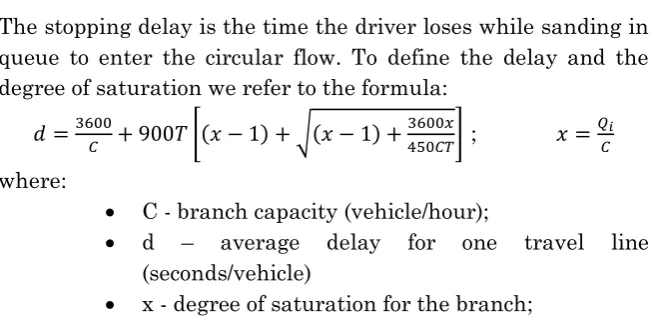
The stopping delay is the time the driver loses while sanding in queue to enter the circular flow. To define the delay and the degree of saturation we refer to the formula:
[ √
] ;
where:
C - branch capacity (vehicle/hour);
d – average delay for one travel line (seconds/vehicle)
T – study period (h), (T = 0.25 for a period of 15 minutes);
Qi –entry flow (vehicle/hour).
If we carry out the calculation for the above expression, we derive the conclusions below:
Table 4. Degree of saturation for each branch
Branch 1 ( Rr. Durresit)
Branch 2 (Unaza e re)
Branch 3 (Qender)
Branch 4 (Laprake)
C= 855 vehicle/h C= 518 vehicle/h C= 202 vehicle/h C= 116 vehicle/h
T= 1 h T= 1 h T= 1 h T= 1 h
x= 2.89 x= 3.52 x= 6.51 x= 3.11
If we carry out the calculation according to the Cetur [4] method, which is very reliable for urban roundabouts as in our case, to define the flow will be used the following expression
where:
C - branch capacity (vehicle/hour);
Qd - heavy flow (vehicle/hour);
Where γ =1, for the entrance to a lane, and γ = 1.5 for entrance to two or more lanes. In our case, for heavy traffic the formula Qd is:
,
where:
b - 1 for (ring lengh) Lc < 8 m; b = 0.9 for Lc ≥ 8 m
and Ri (internal radius) < 20 m; b = 0.7 for ring
length Lc > 8 m and Ri < 20 m; Qc - traffic at the ring (vehicle/hour);
Qu - traffic at the branch exit (vehicle/hour);
Table 5. Branch capacity using CETUR method
Branch 1 ( Rr. Durresit)
Branch 2 (Unaza e re)
Branch 3 (Qender)
Branch 4 (Laprake)
C= 1189 vehicle/h C= 770 vehicle/h C= 201 vehicle/h C= -534 vehicle/h
Qc= 426 vehicle/h Qc= 1015 vehicle/h Qc= 2068 vehicle/h Qc= 2662 vehicle/h
Qd= 848 vehicle/h Qd= 1183 vehicle/h Qd= 1639 vehicle/h Qd= 2227 vehicle/h
x= 2.08 x= 2.37 x= 6.54 x= -0.67
Saturation degree for one lane estimated using “Cetur” method is two, and as a result the time the driver loses queuing is greater.
6. ANALYSIS OF THE GEOMETRICAL PARAMETERS
Below is presented in a summarized way the analysis of the geometrical parameters for the roundabout:
The outer diameter of the central ring is D = 75 m, while the diameter of the central island is d = 42m, classifying it as a urban roundabout with triple carriageway. The diameter for the outer circle ring for urban roundabouts of standard dimensions is at maximum 45-55 m, as a result this roundabout, for the dimension of the central ring, is off standard.
The circulatory roadway is B = 14.5-18.3m. This width is approximately as the entry width. This brings uniformity to the circulation but it is not efficient because of the geometrical irregulatory of the roundabout. It exist a connection between the width of the circulatory roadway and the diameter of the outer ring but in our case this proportionality has not been achieved.
branch, no one of the other roundabouts branches is conforming to the standard. The second branch, has an excessive entry radius, that allows the vehicle to enter with speed the roundabout and is a possible source of accidents.
The width of the entry and exit lane should be equal to the width of the circulatory lane. The lane for right-turn poses a design artifice that distorts the functioning mechanism of the roundabouts. They are used only in cases where the flow of vehicle that turns right is high as it happens at branch 1 and 2. The solution for these two branches is correct. The solution for branches 3 and 4 it is not correct even though the vehicle flow that turn right it is not high, meaning it is not a necessity to have a tuning lane. These lanes have a width of 5m, sufficient for the vehicles.
The central island is elevated, so that the driver has a good perception. The island is 0.5m high and conform the norms recommendations.
The splitter islands are positioned at the branches 1-2-3 of the roundabout, while it is not clear the shape of the fourth branch. This last one only gives an idea of an island as it doesn’t fulfill any of it requirements. Since the ring radius is Rg > 15; the triangle for designing splitter islands must not be equilateral. From this we can conclude that to design splitter island symmetrically it is not correct. The islands are cleared from elements and object that might become an obstacle.
7. CONCLUSIONS
From the analysis of the branches capacity and the geometrical parameters of the roundabout incase, were derived the following conclusions:
The roundabout it is not in good functioning conditions as the saturation degree for the entry carriageway (x) is greater than 0.8-0.9. For the roundabout being studied the saturation is above 2, as a result the driver loses time staying in long queues.
The roundabout at study is in critical exploitation conditions and as such very often it is face with blocking the vehicle flow.
The interventions of the last years to improve the functioning of the intersection resulted being insufficient and ineffective.
As a result of the given study we can conclude that further emergency intervention must be carried out to give a new technical solution, the most suitable solution would be an out of grade intersection (junction).
REFERENCES
[1] ”Design of roundabout”, Designing and verifying the intersections with round circulations. Eng Artur Sulce, Eng Edmond Kazazi
[2] Report n. FHWA-RD-00.067. “Roundabouts: an informational
guide”. U.S. Departament of Transportation. Federal Highway
Administration. June 2000
[3] “Transportation Research Board, Highway Capacity Manual” (H.C.M) 2000, TRB, NRC, Washington, DC, 2000.
[4] CETUR. “Conception des Carrefours a sens Giratoire Implantes en
Milieu Urban”. Centre d’Etudes des Transports Urbains (CETUR)
1998