Insurance and Economic Development
Kulwant Kaur
Assistant Professor in Commerce,Govind National College, Narangwal,Ludhiana,Punjab (Email id –[email protected])
ABSTRACT
The insurance industry of India consists of 53 insurance companies and 24 are in life insurance business and 29 are non-life insurers. Life Insurance Corporation (LIC) is the sole public sector company. Among the non-life insurers there are six public
sector insurers. In addition to
macroeconomic, social, and regulatory changes likely to impact the industry, insurers are coping with longer-term, game-changing trends including the increased
connectivity among household and
workplace devices, the development of autonomous vehicles, and the rising threat of cyber attacks. The paper examines saving projections in insurance sector, role of insurance in infrastructure and compare
compare share of various insurance
companies in market.
KEYWORDS- insurance sector, infrastructure, savings, companies
INTRODUCTION
Insurance has evolved as a process of safeguarding the interest of people from loss and uncertainty. It may be described as a social device to reduce or eliminate risk of loss to life and property. Insurance contributes a lot to the general economic growth of the society by provides stability to the functioning of process. The insurance industries develop financial institutions and reduce uncertainties by improving financial resources. India has a fairly high savings rate of 31.6 percent of GDP of which almost 60 percent is household savings. Of these
savings, 40 percent are in financial assets. Financial savings comprise of currency, deposits, shares and debentures, insurance funds, pension and provident funds and claims on government. Of the financial savings, 57 percent are in cash and deposits, leaving only a small portion of savings in contractual/long term savings.
OBJECTIVE OF STUDY
The present study seeks to achieve following objectives :
To study saving projections in insurance sector
To evaluate total household savings using gross assets and net financial savings
To compare share of various insurance companies in market to study role of insurance in
infrastructure
RESEARCH METHODOLOGY
RESULTS AND DISCUSSION
[A] SAVING PROJECTIONS
There are two types- internal and external sources of generation of savings. The internal savings are the result of voluntarily cut in consumption and forced cut in consumption in form of tax, forced lending to government inflation and so on.The following are the three main sectors from where internal savings flow:
Household sector
Private corporate sector
Public sector
The main proportion of total savings in the economy is constituted by the savings of household sector. The household savings include two types of assets
Physical assets Financial assets
Physical assets can be bought through savings such as land, building, gold,other domestic products. On the other hand the savings may be used to purchase financial assets like bank deposits, shares, debentures, mutual funds, bonds, provident and pension funds, life insurance policies. The larger part of savings is used by financial assets as the economy grows and attain maturity.
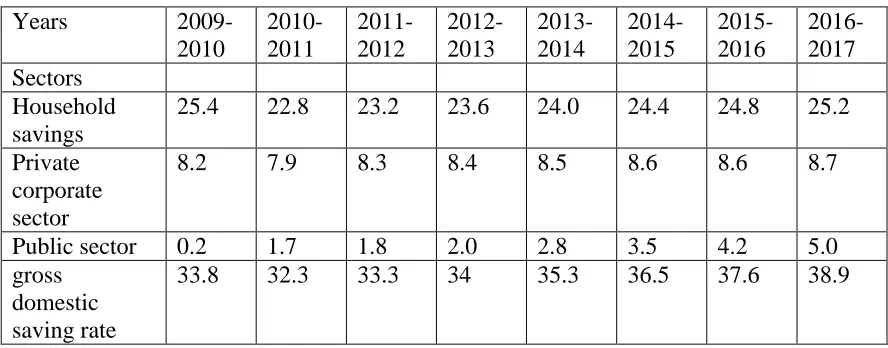
Table 1.Savings projections during 12th plan (%age of GDP)
Table 1 depicts the saving projection related to insurance sector during five year plan. The percentage share in GDP for household savings rate increases from 22.8% in 2010-2011 to 25.2% in 2016-2017, private corporate sector rate increases from 7.9% in
2010-2011 to 8.7% in 2016-2017, public sector savings rate increases from 1.7% in 2010-2011 to 5.0% in 2016-2017 and the gross domestic savings rate increases from 32.3% in 2010-2011 to 38.9% in 2016-2017.
[B] BASELINE PROJECTION OF COMPONENTS OF HOUSEHOLD SAVINGS OVER 12TH PLAN
Years
2009-2010
2010-2011
2011-2012
2012-2013
2013-2014
2014-2015
2015-2016
2016-2017 Sectors
Household savings
25.4 22.8 23.2 23.6 24.0 24.4 24.8 25.2
Private corporate sector
8.2 7.9 8.3 8.4 8.5 8.6 8.6 8.7
Public sector 0.2 1.7 1.8 2.0 2.8 3.5 4.2 5.0 gross
domestic saving rate
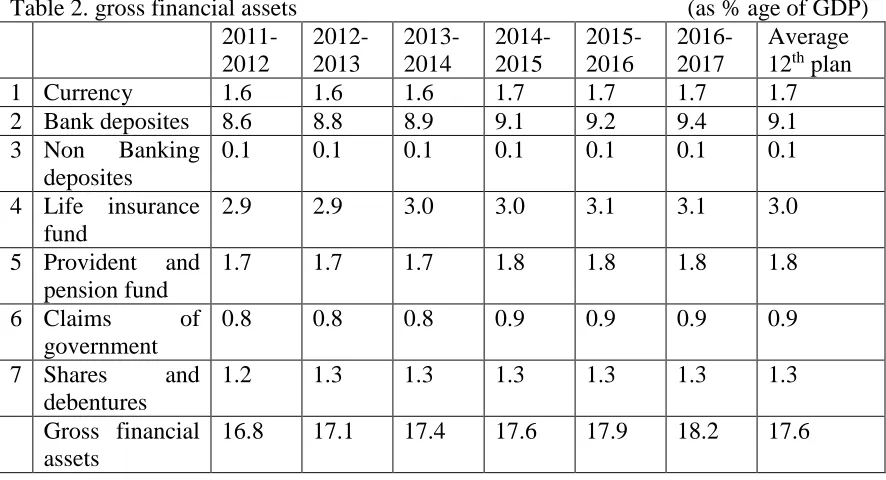
Table 2. gross financial assets (as % age of GDP)
2011-2012
2012-2013
2013-2014
2014-2015
2015-2016
2016-2017
Average 12th plan
1 Currency 1.6 1.6 1.6 1.7 1.7 1.7 1.7
2 Bank deposites 8.6 8.8 8.9 9.1 9.2 9.4 9.1 3 Non Banking
deposites
0.1 0.1 0.1 0.1 0.1 0.1 0.1
4 Life insurance fund
2.9 2.9 3.0 3.0 3.1 3.1 3.0
5 Provident and pension fund
1.7 1.7 1.7 1.8 1.8 1.8 1.8
6 Claims of government
0.8 0.8 0.8 0.9 0.9 0.9 0.9
7 Shares and debentures
1.2 1.3 1.3 1.3 1.3 1.3 1.3
Gross financial assets
16.8 17.1 17.4 17.6 17.9 18.2 17.6
Table 3. Net financial savings
(as % age of GDP)
2011-2012
2012-2013
2013-2014
2014-2015
2015-2016
2016-2017
Average 12th plan Gross financial
assets
16.8 17.1 17.4 17.6 17.9 18.2 17.6
Gross financial liabilities
5.1 5.2 5.3 5.4 5.5 5.5 5.4
Net financial savings
11.7 11.9 12.1 12.3 12.5 12.7 12.3
Table 4. Household total savings
(as % age of GDP)
2011-2012
2012-2013
2013-2014
2014-2015
2015-2016
2016-2017
Average 12th plan Net financial
savings
11.7 11.9 12.1 12.3 12.5 12.7 12.3
Physical savings 11.5 11.7 11.9 12.1 12.3 12.5 12.1 Household total
savings
23.2 23.6 24 24.4 24.8 25.2 24.4
Table 2 shows gross financial assets which includes 7 major items like cuurency, bank deposits, non banking deposits, life insurance fund,
financial assets is gradually rising since last six years. Table 3 shows details of net financial savings and Table 4 tells about total hosehold savings in insurance companies which is rising since last few years at average of 24.4 percentage of GDP.
[C] INSURANCE FINANCING INFRASTRUCTURE
India needs large investments in infrastructure for accelerating inclusive growth aimed at poverty alleviation and improvement in quality of life. Given the fiscal constraints that leave little room for
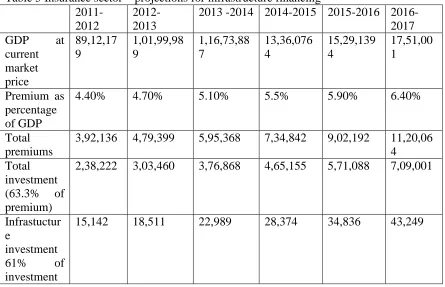
expanding public investment at the scale required, Public-Private Partnership (PPP) has emerged as the principal vehicle for attracting private investment in infrastructure.Expansion and growth of infrastructure sector is vital for the overall growth of Indian economy, and it requires huge capital for developmental activities. Flourishing insurance sector is a reliable source of channelizing funds into housing and infrastructure. IRDA's decision to amend norms pertaining to housing and infrastructure investment is to try and bridge the gap for funding required in this sector that is facing a huge crunch. Table 5 shows yearly how insurance sector is financing infrastructure.
Table 5 Insurance sector – projections for infrastructure financing
2011-2012
2012- 2013
2013 -2014 2014-2015 2015-2016 2016-2017 GDP at
current market price
89,12,17 9
1,01,99,98 9
1,16,73,88 7
13,36,076 4
15,29,139 4
17,51,00 1
Premium as percentage of GDP
4.40% 4.70% 5.10% 5.5% 5.90% 6.40%
Total premiums
3,92,136 4,79,399 5,95,368 7,34,842 9,02,192 11,20,06 4 Total
investment (63.3% of premium)
2,38,222 3,03,460 3,76,868 4,65,155 5,71,088 7,09,001
Infrastuctur e
investment 61% of investment
15,142 18,511 22,989 28,374 34,836 43,249
[D]LEADING INSURANCE COMPANIES
Table 6. Indian insurance industry – market share of leading companies Company Approximate market share
(2011)
LIC 50 70.4
SBI 05 5.1
ICICI 10 4.88
HDFC 06 4.08
Bajaj Alianz 04 2.08
Max Life 03 2.08
Birla Sun Life 04 1.60
Relience Life 05 1.12
Others 13 8.06
Source : TechSci research, LIC- Life Insurance corporation of india
Table 6 compares the market share of various companies in 2011 and 2016. The data depicts thatLIC continues to dominate life insurance sector. As per 2016, life insurance sector has 29 private players in comparison to only four in 2002. With 70.4 per cent share market share in FY16, LIC continues to be the market leader, followed by SBI (5.1 per cent), ICICI (4.9 per cent) and HDFC (4.1 per cent)
The following are some of the major investments and developments in the Indian insurance sector.
New York Life Insurance Company, the largest life insurance company in the US, has invested INR 121 crore (US$ 18.15 million) in Max Ventures and Industries Ltd for a 22.52 per cent stake, which will be used by Max for investing in new focus areas of education and real estate.
Max Life Insurance Co Ltd and HDFC Life Insurance Co Ltd have signed a merger agreement, which is expected to create India's largest private sector life insurance company once the transaction is completed. Aviva Plc, the UK-based Insurance
company, has acquired an additional 23 per cent stake in Aviva Life
Insurance Company India from the joint venture (JV) partner Dabur Invest Corporation for Rs 940 crore (US$ 141.3 million), thereby increasing their stake to 49 per cent in the company.
Insurance firm AIA Group Ltd has decided to increase its stake in Tata AIA Life Insurance Co Ltd, a joint venture owned by Tata Sons Ltd and AIA Group from 26 per cent to 49 per cent.
Nippon Life Insurance, Japan’s second largest life insurance company, has signed definitive agreements to invest Rs 2,265 crore (US$ 332.32 million) in order to increase its stake in Reliance Life Insurance from 26 per cent to 49 per cent.
allowing the increase in stake holding by foreign companies in the insurance sector.
State Bank of India has announced that BNP Paribas Cardiff is keen to increase its stake in SBI Life Insurance from 26 per cent to 36 per cent. Once the foreign joint venture partner increases its stake to 36 per cent, SBI’s stake in SBI Life will get diluted to 64 per cent.
REFERENCES
[1] Gupta, P.(2011), „Insurance and risk Management‟, Second edition, Himalaya Publishing House
[2] IC 33 (2007), Life Insurance,(New Syllabus),Insurance Institute of India, Mumbai, India.
[3] KPMG (2013),„Insurance Industry – Road Ahead, Path for sustainable growth momentum and increasing profitability‟, Available from : www.kpmg,com./in, [15 May 2014]
[4] Ernst & Young(2012), „Insurance industry: Challenges, reforms and realignment‟, Available from: www.ey.com/in, [16 May 2014] [5] Zeithaml, V. & Bitner, M. (2003), „Services Marketing‟, Third Edition, Tata Mc Graw-Hill Publishing Company Limited, New Delhi, p. 60-80
[6] Jain, A.(2011), „Global Trends in Life Insurance: Policy Administration,