Study of Nano Filler Effect on Electrical
Behavior of Polymer Insulating Materials
Using Artificial Intelligence
El-Said A. Othman1, L. S. Nasrat2, Abdelrahman A. Z. Saleh3
Professor, Department of Electrical Power and Machine, Faculty of Engineering, Alazhar University, Cairo, Egypt1 Professor, Department of Electrical Power and Machine, Faculty of Engineering, Aswan University, Aswan, Egypt2
Ph.D. Researcher, Qena, Egypt3
ABSTRACT: Flashover voltage of tour and outdoor insulators affects greatly the reliability of the power system that
caused and depends on different parameters such as the environmental and weather conditions. Laboratory measurements have done on polymeric insulators with nanocomposites Silicon dioxide and Titanium (IV) oxide (polyester with Nano Tio2 and Nano Sio2 fillers) at different weather conditions , different sample lengths and different fillers concentrations. This research predicts the flashover voltage at any value of different inputs such as filler concentration using artificial neural network. Feed forward neural network (FNN) and Recurrent neural network (RNN) are trained and tested with wide range of samples data sets to confirm the principle of generalization and reach the optimum values of the output flashover voltage at the different inputs variables. RNN network achieved the best result and the minimum error compared to FNN network.
KEYWORDS: Flashover, High Voltage, Dielectric, Feed Forward, Recurrent, Neural Network, Nanocomposites,
Polyester, Outdoor, Insulators, Titanium(IV) oxide, Silicon dioxide.
I.INTRODUCTION
Polymer nanocomposites technology is promising technology nowadays and in the future of power technologies to be used in many fields of electrical insulation of power cables, power apparatus and outdoor insulators because of their very high specific surface area. They are the 21st century engineering materials with wide range of markets such as transportation, electrical and electronics, food packaging and building industries [1]. Addition of those Nano fillers to polymer insulators has attractive improvement results on their electrical, mechanical, physical, dielectric and thermal properties in comparison to traditional composites [2,3]. Polyesters are widely popular and used in manufacturing of electrical components in many sectors because of their excellent insulating and mechanical properties, ease of use and their low cost [4]. Estimating of non-ceramic insulator with suitable filler percentage that takes long life time with high voltage values at different weather conditions and the relation between the leakage current and pollution conditions were predicted by Artificial Neural Network [5]. Experimental work on the electrical properties of different elastomer materials with variety of frequency range and temperatures were predicted using neural network and compared with traditional fitting methods [6]. Measurements of Epoxy insulators lifetime and the effect of adding fillers at variety of concentrations on the lifetime of each specimen were compared by two Artificial-Neural-Networks (ANN) methods; Feed-Forward-Neural-Network (FNN) and Recurrent-Neural-Network (RNN) for life time validation in terms of type , percentage of added fillers among different weather conditions[7]. Flashover voltage measurements of hydrophobic polymer insulator Ethylene propylene diene monomer (EPDM) rubber depending on the silicone rubber (SiR) content
(%),water conductivity(μS/cm), volume of water droplet (ml) and number of water droplets on the surface of the polymer insulator. These different case studies were used to evaluate the electrical performance of polymer insulators, modeling and estimating the flashover voltage for different inputs with artificial neural network (ANN) [8].
Nano technology represented in Polymer nanocomposites are introduced, their advantages in comparison to classic and traditional fillers in terms of their electrical, mechanical and thermal properties with investigating of nanocomposites future applications were studied and reported [10,11].
Effects of Nano and Micro Mixture fillers by dispersing Nano-scale layered silicate fillers and micro-scale silica fillers in epoxy resin on the electrical insulation properties were demonstrated and summarized compared to traditional filled epoxy [12].
II.EXPERIMENTAL WORK
A single-phase high voltage transformer (100KV -5 KVA) is used to obtain the AC high voltage. (0-220V) variac regulating panel is used to smoothly control the output voltage of the transformer as shown in Fig.(1). The voltage applied to the transformer primary winding. The power supply was connected across two electrodes. Samples have been prepared from unsaturated polyester with nanocomposites Silicon dioxide and Titanium (IV) oxide (polyester with Nano Tio2 and Nano Sio2 fillers), and they were fabricated as cylindrical rods having 12 mm diameter. Fig.(2) shows nanocomposites Tio2 and Sio2 fillers that have been added to unsaturated polyester. Fig.(3) shows the unsaturated polyester product. Fig.(4) shows the final shapes of unsaturated polyester insulators with Nano fillers after being chemically prepared and during the lab testing.
Fig.(1): Single-phase high voltage transformer
Fig.(3): Unsaturated Polyester product
Fig.(4): Unsaturated Polyester insulator with Nano fillers during test
III.RESULTS AND DISCUSSION
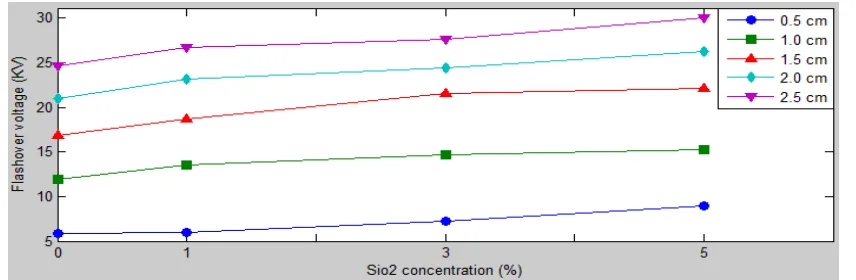
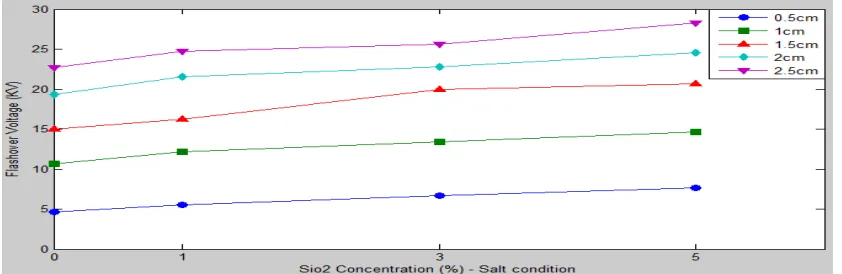
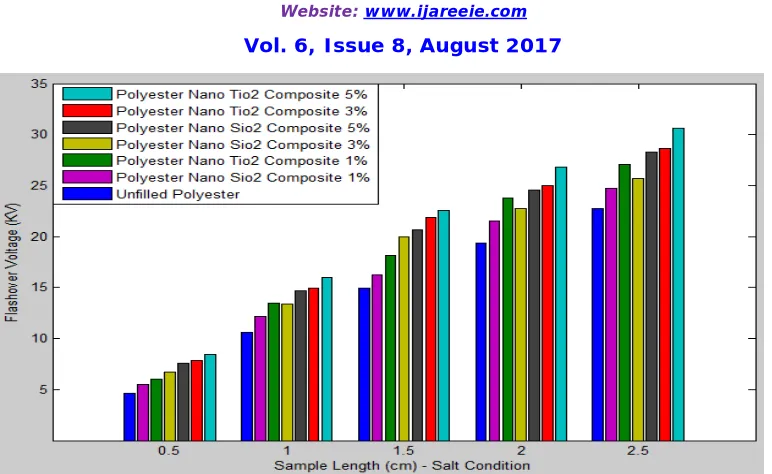
Sio2 filler. Salt polyester nanocomposites Tio2 and Sio2 recorded 27.46 and 26.94 % increase in flashover voltage values with increase of sample length from 0.5 cm to 2.5 cm respectively.
Fig. (5): Flashover voltage of nanocomposites Tio2 filler with Polyester at different concentrations and sample lengths in dry weather
Fig. (6): Flashover voltage of nanocomposites Sio2 filler with Polyester at different concentrations and sample lengths in wet weather
Fig. (8): Flashover voltage of nanocomposites Tio2 filler with Polyester at different weather conditions and concentrations with 2.5 cm sample length
The flashover voltage values of unsaturated Polyester and with different Nano fillers of Tio2 and Sio2 at different lengths of 0.5 cm, 1 cm, 1.5 cm, 2.0 cm and 2.5 cm with addition of Sodium Chloride were measured and are shown in Figures 9, 10.
Fig. (9): Flashover voltage of nanocomposites Tio2 filler with Polyester at different concentrations and sample lengths in salt weather
Fig.(11) shows the flashover voltage values of unsaturated Polyester and with Tio2 Nano filler at different lengths of 0.5 cm, 1 cm, 1.5 cm, 2.0 cm and 2.5 cm that were measured in the lab at wet condition.
Fig. (11): Flashover voltage of nanocomposites Tio2 filler with Polyester at different concentrations and sample lengths in wet weather
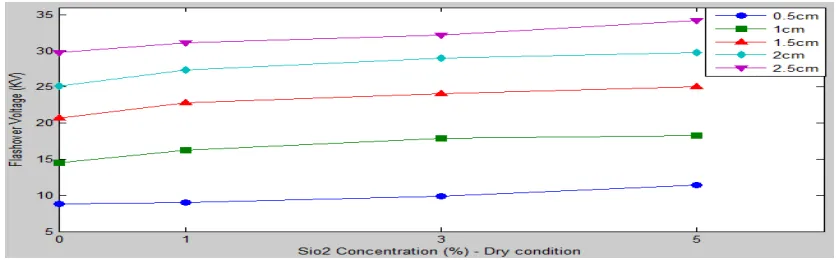
Fig.(12) shows the flashover voltage values of unsaturated Polyester and with Sio2 Nano filler at different lengths of 0.5 cm, 1 cm, 1.5 cm, 2.0 cm and 2.5 cm that were measured in the lab at Dry condition
.
Fig. (12): Flashover voltage of nanocomposites Sio2 filler with Polyester at different concentrations and sample lengths in dry weather
IV.FLASHOVER VOLTAGE PREDICTION WITH NEURAL NETWORK
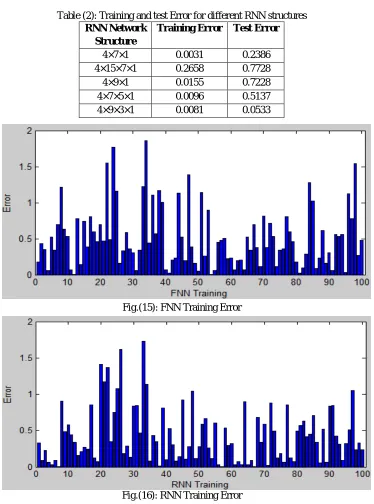
output). [4×9×3×1] structure with two hidden layers is selected with RNN network (4×9×3×1 means four inputs, nine neurons in the first hidden layer , three neurons in the second hidden layer and one output). Fig.(15) and Fig.(16) show values of errors computed with inputs sets in training process of FNN and RNN patterns. RNN network achieved the best result and the minimum error compared to FNN network.
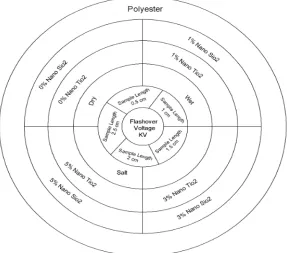
Fig.(13): Mechanism of Flashover Voltage Computing
Fig.(14): The Neural Network Pattern
Table (1): Training and test Error for different FNN structures
FNN Network Structure
Training Error Test Error
4×7×1 0.0172 0.2150
4×15×7×1 0.0145 0.2585
4×9×1 0.0096 0.3111
4×7×5×1 0.0270 0.2470
Table (2): Training and test Error for different RNN structures
RNN Network Structure
Training Error Test Error
4×7×1 0.0031 0.2386
4×15×7×1 0.2658 0.7728
4×9×1 0.0155 0.7228
4×7×5×1 0.0096 0.5137
4×9×3×1 0.0081 0.0533
Fig.(15): FNN Training Error
Fig.(16): RNN Training Error
Table (3) and Table (4) show such as a comparison between experimental values of the output flashover voltage and those estimated and predicted by using FNN and RNN pattern. It is noted that flashover voltage experimental values are similar and very close to values estimated by neural networks FNN and RNN. For example, at 0.5 cm sample length, dry condition and 1% Nano Tio2 filler concentration inputs, the flashover value measured in lab is 9.0385 KV and the flashover voltage estimated by FNN and RNN are 8.8790 and 9.9636 KV respectively.
Table (3): Experimental and FNN output test of the inputs sets
Tio2 FNN Test FNN Output Experimental Output
[0.5;0.9;0.01;0] 8.8790 9.0385
[0.5;0.9;0.03;0] 11.8922 10.1196
[1;0.9;0;0] 15.1114 14.5587
[1;0.5;0.03;0] 16.6195 16.1404
Table (4): Experimental and RNN output test of the inputs sets
Tio2 RNN Test RNN Output Experimental Output
[0.5;0.9;0.01;0] 9.9636 9.0385
[0.5;0.9;0.03;0] 11.8029 10.1196
[1;0.9;0;0] 15.0025 14.5587
[1;0.5;0.03;0] 15.8211 16.1404
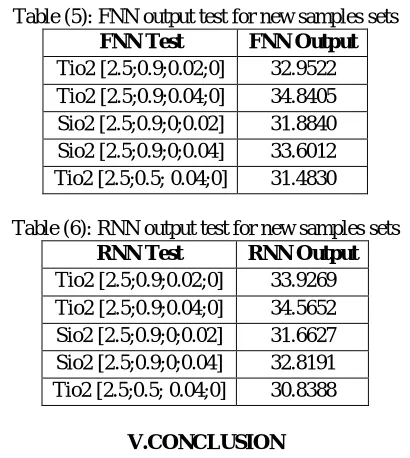
The main advantage of using neural networks in this research is making generalization to predict the output at any inputs variables values, so new samples data are set to measure generalization range of neural networks introduced as shown in Table(5) and Table(6) . For instance, at 2.5 cm sample length, dry condition and 4% Nano Tio2 filler concentration inputs, the flashover voltage estimated by FNN and RNN were 34.8405 and 34.5652 KV respectively.
Table (5): FNN output test for new samples sets
FNN Test FNN Output
Tio2 [2.5;0.9;0.02;0] 32.9522 Tio2 [2.5;0.9;0.04;0] 34.8405 Sio2 [2.5;0.9;0;0.02] 31.8840 Sio2 [2.5;0.9;0;0.04] 33.6012 Tio2 [2.5;0.5; 0.04;0] 31.4830
Table (6): RNN output test for new samples sets
RNN Test RNN Output
Tio2 [2.5;0.9;0.02;0] 33.9269 Tio2 [2.5;0.9;0.04;0] 34.5652 Sio2 [2.5;0.9;0;0.02] 31.6627 Sio2 [2.5;0.9;0;0.04] 32.8191 Tio2 [2.5;0.5; 0.04;0] 30.8388
V.CONCLUSION
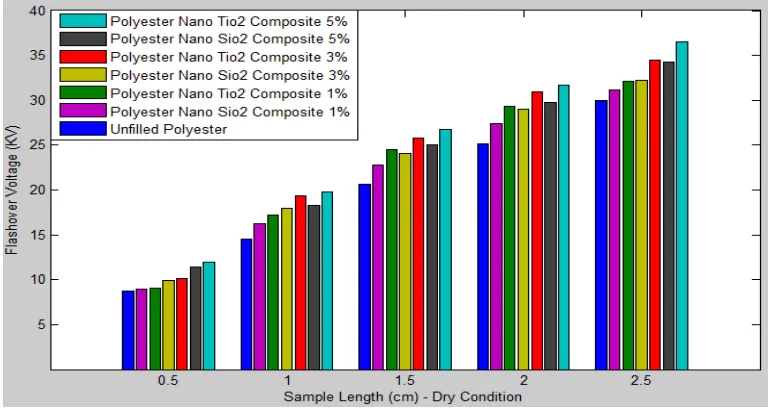
Experimental measurements have recorded that Polyester with Nano Tio2 filler has the best results into comparison with Nano Sio2 filler at all sample lengths, all weather conditions and all concentrations as the maximum flashover voltage of Nano Tio2 was 36.55 KV at 5% concentration, dry condition and 2.5 cm sample length. The maximum flashover voltage estimated with neural networks were 36.5631, 36.0857 KV using FNN, RNN respectively; the insulator is Nano Tio2 5 % concentration at dry condition and 2.5 cm sample length.
FNN results are acceptable and satisfied. RNN results are better than those of FNN as RNN has the least error value and the best accuracy of 98%.
Flashover voltages of unsaturated Polyester with Tio2 and Sio2 Nano fillers that have been measured in the lab at different weather conditions are shown in figures 17- 19.
Fig. (17):Flashover voltage of nanocomposites Tio2 & Sio2 fillers with Polyester at different concentrations and sample lengths in dry weather
Fig. (19): Flashover voltage of nanocomposites Tio2 & Sio2 fillers with Polyester at different concentrations and sample lengths in salt weather
REFERENCES
[1] Pleşa, Ilona, et al. "Properties of Polymer Composites Used in High-Voltage Applications." Polymers 8.5 (2016): 173.
[2] Ding, H-Z., and B. R. Varlow. "Effect of nano-fillers on electrical treeing in epoxy resin subjected to AC voltage." Electrical Insulation and
Dielectric Phenomena, 2004. CEIDP'04. 2004 Annual Report Conference on. IEEE, 2004.
[3] Q. Wang and G. Chen. “Effect of Nano fillers on the Dielectric Properties of Epoxy Nanocomposites”, Advances in Materials Research, An
International Journal, Vol. 1, pp. 93-107, 2012.
[4] Ersoy, Aysel, YasinÖzcelep, and AytenKuntman. "A study on the reliability of polyester insulators blended with borax." Turkish Journal of
Electrical Engineering & Computer Sciences 16.3 (2008): 257-266.
[5] Elkhodary, Salem M., and L. S. Nasrat. "The use of experimental and artificial neural network technique to estimate age against surface leakage
current for non-ceramic insulators." Power Engineering, 2006 Large Engineering Systems Conference on. IEEE, 2006.
[6] Nasrat, L., and R. M. Sharkawy. "On the measurements of the dielectric constant and dissipation factor of various elastomers." Power
Modulator and High Voltage Conference (IPMHVC), 2012 IEEE International. IEEE, 2012.
[7] Ghamry, N., and L. S. Nasrat. "Fuzzy logic approach for the prediction of the lifetime of epoxy insulators." Fuzzy Systems and Knowledge
Discovery (FSKD), 2015 12th International Conference on. IEEE, 2015.
[8] Nasrat, L. S., and SalehAly. "Evaluation of Flashover Voltage Mechanisms on Hydrophobic Polymer Insulators with Artificial Neural Network
Approach." International Journal of Electrical and Computer Engineering 2.4 (2012): 487.
[9] Narayanan, V. Jayaprakash, B. Karthik, and S. Chandrasekar. "Flashover Prediction of Polymeric Insulators Using PD Signal Time-Frequency
Analysis and BPA Neural Network Technique." Journal of Electrical Engineering & Technology 9.4 (2014): 1375-1384.
[10] Tanaka, Toshikatsu. "Dielectric nanocomposites with insulating properties." IEEE Transactions on Dielectrics and Electrical Insulation 12.5
(2005): 914-928.
[11] Tanaka, Toshikatsu, G. C. Montanari, and R. Mulhaupt. "Polymer nanocomposites as dielectrics and electrical insulation-perspectives for
processing technologies, material characterization and future applications." IEEE Transactions on Dielectrics and Electrical Insulation 11.5 (2004): 763-784.
[12] Imai, Takahiro, et al. "Effects of nano-and micro-filler mixture on electrical insulation properties of epoxy based composites." IEEE
Transactions on Dielectrics and Electrical Insulation 13.2 (2006): 319-326.
[13] Ahmad, Ahmad S., et al. "Artificial neural network for contamination severity assessment of high voltage insulators under various
meteorological conditions." Aupec, Perth (2001).