ISSN 2286-4822 www.euacademic.org
Impact Factor: 3.4546 (UIF) DRJI Value: 5.9 (B+)
Adoption of E-Learning in Higher Education:
Expansion of UTAUT Model
ANDY OHEMENG ASARE
School of Management and Economics University of Electronic Science and Technology of China
PROF. SHAO YUN-FEI
School of Management and Economics University of Electronic Science and Technology of China
KENNETH WILSON ADJEI-BUDU
School of Management and Economics University of Electronic Science and Technology of China
Abstract:
This research is aimed at identifying the determinants that influence higher educational students’ behavioral intention to utilize e-learning systems. The study, therefore, proposed an extension of Unified Theory of Acceptance and use of Technology (UTAUT) model by integrating it with four other variables. Data collected from 264 higher educational students using e-learning systems in Ghana through survey questionnaire were used to test the proposed research model. The study indicated that six variables, Performance expectancy (PE), Effort Expectancy (EE), Social Influence (SI), Facilitating Factor (FF), personal innovativeness (PI) and Study Modes (SM) had significant impact on students’ behavioral intention on e-learning system. The empirical outcome reflects both theoretical and practical consideration in promoting e-learning systems in higher education in Ghana.
Key words: Behavioral intention, E-learning system, Unified Theory
1. INTRODUCTION
Technology is recent times has remained as important driver for change. Since the last two decades, there have been several significant innovation and developments in the area of Information and Communication Technology (ICT) which has led to changes in the educational sectors as well. The introduction of e-learning has evolved as an important facilitator of modern teaching and learning process. The term e-learning is not certain, even though it is suggested that the term is most likely originated during the 1980's. Jenkins et al., (2003) defined e-learning as a learning process that is facilitated and supported through the use of Information and Communication Technology (ICT). Curran, (2004) also defined e-learning as a process whereby learners can effectively communicate with their instructors, peers, and access of course or learning materials through the internet or computer. E-learning includes the delivering of contents through network, video recording, interactive TV, CD-ROM, audio, satellite broadcast and so on.
(McFarland & Hamilton, 2006). This has called the need to investigate factors that influence adoption and utilization of e- learning by researchers that appear to promise significant benefits (McFarland & Hamilton, 2006; Xu & Yuan, 2009; Venkatesh, Morris, Davis, & Davis, 2003).
This study, therefore, proposes to examine the impact of behavioral intention by using Unified Theory of Acceptance and use of Technology (UTAUT) as a background theory. The independent variables of this research are Performance expectancy (PE), Effort Expectancy (EE), Social Influence (SI), Facilitating Factor (FF), and Students perceived teaching style (SPTS), Academic Specialization (AS) and Study Modes (SM). Intention to adopt (IA) is considered the dependent variable. The results of this empirical study could be significant for designing and testing theories related to e-learning system acceptance as well as decision makers of higher educational institutions in their planning, appraising and executing the use of e-learning systems in the Ghana. This study also contributes to the literature of Unified Theory of Acceptance use Technology (UTAUT)
2. THEORETICAL FRAMEWORK
2.1 Comparison of Theories with UTAUT Model
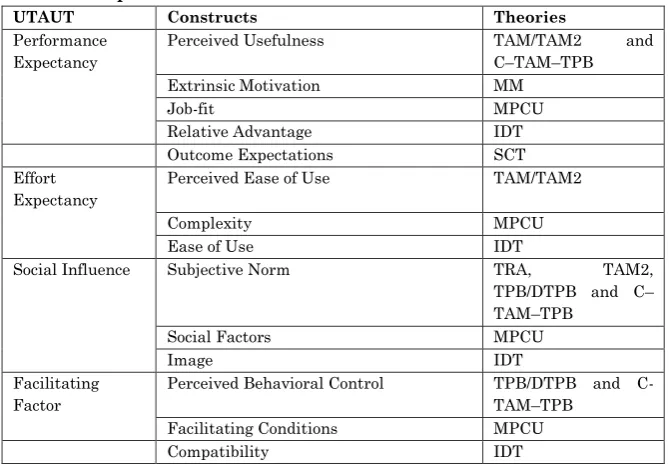
definitions and measurement items. Tables 1 presents comparison of theories with UTAUT model and the root constructs of performance expectancy (PE), effort expectancy (EE), social influence (SI), and facilitating factor (FF) respectively.
Table 1 Comparison of theories with UTAUT Model
UTAUT Constructs Theories
Performance Expectancy
Perceived Usefulness TAM/TAM2 and C–TAM–TPB
Extrinsic Motivation MM
Job-fit MPCU
Relative Advantage IDT
Outcome Expectations SCT
Effort Expectancy
Perceived Ease of Use TAM/TAM2
Complexity MPCU
Ease of Use IDT
Social Influence Subjective Norm TRA, TAM2,
TPB/DTPB and C– TAM–TPB
Social Factors MPCU
Image IDT
Facilitating Factor
Perceived Behavioral Control TPB/DTPB and C-TAM–TPB
Facilitating Conditions MPCU
Compatibility IDT
2.1.1 Technology Acceptance Model (TAM)
Davis (1986) initially proposed the TAM model that explains user’s acceptance of information systems from the stance of the external factors’ that influence users’ acceptance of the technology. Davis (1986) further suggested that the TAM model models the situation where users become adopted of a particular newly developed technology.
particular system would be free of effort, will have an influence on attitude towards using technology that is the internal factors. The Attitude towards the use of technology will also have an impact on user’s behavioral intention (BI) to or not to use the new technology. Behavior intention (BI), finally determines whether or not users use the system (Davis, 1986).
Figure 1 the relationships in the TAM model Davis (1986)
2.1.2 Unified Theory of Acceptance and Use Technology (UTAUT)
Over the past decades, there have been several modification and changes to the original TAM model that UTAUT model stands out to be the most remarkable one. The Unified Theory of Acceptance and Use of Technology (UTAUT) is an acceptance and adoption model developed by Venkatesh et al. in 2003. The model was designed based on individual's adoption and innovation behavior. According to Yoo, Han, & Huang, (2012), the UTAUT model is perfect in determining the level of employees’ motivation regarding adopting new software in a corporate environment and also suitable for analyzing adult learner’s adoption behavior of a new e-learning app.
utilization (MPCU), innovation diffusion theory (IDT), and the social cognitive theory (SCT).
The UTAUT model integrated and unified the essential elements of these eight theories into four final constructs that are performance expectancy, effort expectancy, social influence, and facilitating conditions that are direct determinants of behavioral intention. The facilitating condition is the only construct with direct determinant on user behavior. Gender, age, experience, and voluntariness of use are the four mediating factors that were drawn from extrinsic and objective conditions, with impact on the four constructs.
This study used UTAUT over TAM since; studies have shown that the validation of the UTAUT concludes a 70% variance in usage intention, Venkatesh, et al., (2003). Whiles, TAM, and TAM 2 can only show roughly 30% of acceptance, Meister, and Compeau (2002), both TAM and UTAUT models are significant to the study of individual's intention due to the use of quantitative variables. However, unlike TAM, UTAUT addresses Voluntariness of use and facilitating conditions and has the advantage of adding features between mediators and determinant factors.
3. RESEARCH MODEL AND HYPOTHESIS
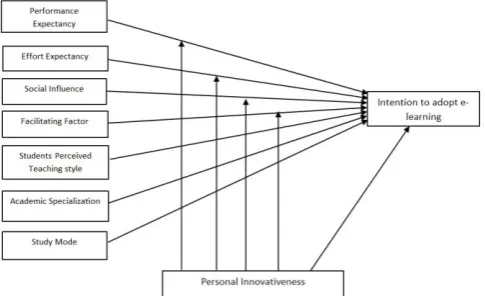
Despite the significance of the UTAUT model in studying individuals’ intention to adopt a technology, from the literature review the model lacks enough data on technology adoption from the unique context of e- learning system. The UTAUT model was therefore enriched with four additional constructs that are student’s perceived teaching style (SPTS), Academic Specialization (AS) and Study Mode (SM) and Personal Innovativeness (PI) bringing the entire constructs to eight. The study also tested the impact of personal Innovativeness on four the variables on UTAUT model (Performance expectancy, effort expectancy, social Influence, and facilitating factor) Figure 3 presents the model with seven dimensions.
3.1 Explanation of Hypothesis development
3.1.1 Performance Expectancy
Performance expectancy can be defined as individual’s estimate or believe for potential job benefit for utilizing technology or the degree to which a person believes the use of a particular technology will improve his or her job performance. Performance expectancy derived from perceived usefulness, job-fit, relative advantage and outcome expectation constructs is the strongest predictor of intention to use a system according to Venkatesh, et al., (2003). Therefore, we hypothesize that;
H1: Performance Expectancy has significant positive influence
on student’s intention to adopt e-learning.
3.1.2 Effort Expectancy
degree to which a user considers using a particular technology with it little or no effort; the construct complexity refers the extent to which a person believes that the utilization of a new system would be a comparably more complex tool in its understanding and usage. Also, the construct of ease of use is the extent whereby an individual perceives the use of innovation as being difficult, Venkatesh et al. (2003). Shih, and Wang, (2009) in their study revealed that there is a significant influence on individual’s intentions in using information technology. Therefore, we hypothesize that;
H2:Effort Expectancy has a great positive influence on student’s
intention to adopt e-learning.
3.1.3 Social Influence
The social influence describes the extent to which a person considers adopting and utilizing a particular technology because of the suggestions of other persons. Social influence is derived from the subjective norm, the social factor, and the image constructs. The subjective norm construct describes the situation in which an individual’s decision about whether or not to adopt an innovation are influenced by other people whose ideas are considered to be important to him or her, (Thompson et al., 1991). The social factor construct refers to the situation in which a person’s decision to adapt to a new technology are influenced by the entire social situation or society (Bandura, 1991). The image construct explains the degree to which the use of innovation is seen to improve or increase a person’s social image or status in the social system. Therefore, we hypothesize that;
H3:Social Influence has significant positive impact on students’
intention to adopt e-learning.
3.1.4 Facilitating Factor
available to support the use of the system, Venkatesh, et al., (2003). The facilitating condition is a significant measure for effective adoption of e-learning. It is made up of three different constructs that are, perceived behavioral control, facilitating conditions, and compatibility. Efficient use of new technology requires training unless the users have a great hand on in handling with such technology. Facilitating Conditions have a significant positive effect on an individual’s use of an information technology, Shih and Wang, (2009). Also, Concannon, et al., (2005), in their study stressed on the importance of providing assistant and technical support for students to facilitate engagement with learning technologies. Thus, we hypothesize that;
H4: Facilitating Factors has a significant positive effect on
student’s behavioral intention to adopt e-learning.
3.1.5 Students-perceived teaching style
Over the decades, the have been several academic research and discussions, raised as the results of how teaching styles affect students’ learning. Perceived and preferred teaching styles are regarded as the most effective factors for student learning according to Razak, et al., (2007). Perceived teaching style of every student is different which influences student’s adoption and usage of e-learning systems, Lin, et al., (2012). Thus, this study uses the student-perceived teaching style instead of the teacher-perceived teaching style. Hence, we hypothesize that;
H5:Students perceived teaching style has a significant influence
on student’s intention to adopt e-learning.
3.1.6 Academic Specialization
medicine involves practical application and might not be suitable through e-learning, (Lateef, 2010). There have been several studies that have examined the relationship between academic specialization with student’s perceptions and usage of e-learning that revealed academic specialization to be a key determinant of adoption decisions, (Yang, 2005; Hsbollah & Idris, 2009). Thus we hypothesize that;
H6: There is a significant relationship between the faculty a
student belongs to and the behavioral intention to adopt e-learning.
3.1.7 Study Mode
Study mode is described as the patterns and intensity of studying (Schuetze & Slowey, 2002). In many countries such as, Canada, United States and the United Kingdom and other European countries, Full-time, part-time and distance learning are the three choices of studying. A full-time student is required to attend class for an average number of hours which involves a full academic load. On the other hand, part-time students normally complete their program of study over a longer period with less academic load. With distance learning, the students are sent with the course syllabus and materials such as textbooks, notes and handouts, videos and audio recordings of the actual lectures. In distance learning, students spend most of their time to study at their homes and offices. Usually, apart from few days introductory or revision sessions, there is no need for attending classes or lectures, except taking examinations on - campus. Within the context of this study, we hypothesize that;
H7: There is a significant relationship between the type of
learning and student behavioral intention to adopt e-learning.
3.1.8 Innovativeness Personal
(Lewis, Agarwal, & Sambamurthy, 2003). In the situation of technological innovations, innovativeness of individual can be defined as the personal ability related to positive attitudes towards the adoption of technological innovations and utilization, (Agarwal and Prasad, 1998). Several innovation studies have proven that highly innovative individuals actively take up information about new concepts. Individuals with higher personal innovativeness are likely to build more positive beliefs about the target technology as well as developing more positive perceptions about the innovation with regards to advantage, ease of use, and compatibility (Lu, 2005). Also, a study by Yi, et al., (2006) posited that “some individuals are more willing to take a risk by adopting technological innovations while others are hesitant to change their practice”. Besides, several organizations now focus much on encouraging their employees to enhance their motivation on the adoption of technological innovations as mentioned by, (Talukder, Harris, & Mapunda, 2008). Furthermore, Lee et al., (2006) summarized that the key to successful adoption of technological innovations within organizations is ascertained on the innovativeness level of its employees. As a result, individuals with a high degree of innovativeness within organizations are likely to demonstrate more keenness towards the adoption of technology innovations (Frambach & Schillewaert, 2002). Agarwal and Prasad (1998) introduced new a construct, personal innovativeness, into Davis’s original TAM. They established the use of definite measurement for the innovativeness construct. For that reason, we hypothesize that;
H8: There is a significant impact of individual innovativeness
H9: There is a significant impact of individual innovativeness on effort expectancy on students’ behavioral intention to adopt e-learning.
H10: There is a significant impact of individual innovativeness
on social influence on students’ behavioral intention to adopt e-learning.
H11: There is a significant impact of individual innovativeness
on facilitating factor on students’ behavioral intention to adopt e-learning.
H12: There is an impact of individual innovativeness on
students’ behavioral intention to adopt e-learning.
Figure 3 Proposed Research Model
4. RESEARCH METHODOLOGY
the use of computers as well as the internet. Since the purpose of the study is to examine students intention to adopt e-learning, demographic characteristics were included in the questionnaire.
Table 2 Demographics of Respondents
Demographics Frequency %
Gender Male Female Age <25 26-35 36-45 >46 Academic Specializations Business Engineering Education Science Art
Higher Education Level First year ( Level 100) Second year ( Level 200) Third year (Level 300) Fourth year ( Level 400) Experience with Computers <1 year 1 – 3 years 3 – 6 years 6 – 9 years >9 years 146 118 117 89 43 15 121 33 51 45 14 95 65 54 50 0 20 11 31 202 55.3 44.7 44.3 33.7 16.3 5.7 45.8 12.5 19.3 17 5.3 36 24.6 20.5 18.9 0 7.6 4.2 11.7 76.5
5. DATA ANALYSIS AND DISCUSSION
percentage of 44.3. Business students dominated the respondents with 45.8 percent, 36 percent of the respondents were first year students dominating the level of higher education students. 76.5 percent of the respondents had experience with the use of computer between >9 years.
5. 1 Data Analysis techniques:
Statistical software: SPSS (statistical package for social sciences) was used for the analysis of the data collected for this study. Data analysis techniques used were Descriptive statistics, correlation and regression.
5.2 Reliability and validity:
Reliability and validity were conducted to assess the internal consistency (Cronbach’s alpha) and to test the reliability of each of the scales. All the measures included in the questionnaires showed the adequate reliability. The internal reliability of the measures ranged from 0.858 for the measure of Personal Innovativeness (PI) to 0.890 for the measure of Effort Expectancy (EE). Table 3 reports the scales descriptive statistics for the measures used, including minimum, maximum, mean, standard deviation, variance and Cronbach’s alpha for each measure of the study. Overall the reliability of all question items is very good since Cronbach’s Alpha values are above 0.70. This means that the higher the coefficient of reliability the higher internal consistency of the instruments.
Table 3 Descriptive Statistics
Constructs N Minimum Maximum Mean Std. Deviation
Variance Cronbach's Alpha
PE 264 4 7 5.17 .871 .759 .867
EE 264 2 7 4.91 1.005 1.009 .890
SI 264 2 7 4.62 1.034 1.068 .876
FF 264 4 7 5.22 .869 .755 .883
SPST 264 2 7 5.07 .959 .919 .871
SM 264 4 7 5.54 .971 .943 .873
PI 264 4 7 5.21 .941 .885 .858
IA 264 4 7 5.11 .796 .634 .863
Valid N (listwise) 264
5.3 Correlation
A correlation analysis was conducted on all the variables to test the relationship between them by correlating eight independent variables (PE, EE, SI, FF, SPST, AS, SM, and PI) with the dependent variable (IA). The table 4 below indicates all positive figures suggesting that correlations are positive and significant at the 0.01 levels (2- tailed) between, all the independent variables and the dependent variables.
Correlations Independent
Variables PE EE SI FF SPST AS SM PI IA
PE Pearson
Correlation 1 EE Pearson
Correlation .376** 1 SI Pearson
Correlation .445** .217** 1 FF Pearson
Correlation .364** .249** .304** 1 SPST Pearson
Correlation .472** .691** .379** .423** 1 AS Pearson
Correlation .723** .292** .444** .301** .476** 1 SM Pearson
Correlation .432** .189** .524** .369** .331** .646** 1 PI Pearson
Correlation .657** .356** .611** .428** .505** .626** .605** 1 IA Pearson
Correlation .618** .260** .595** .567** .473** .553** .589** .760** 1
**. Correlation is significant at the 0.01 level (2-tailed).
5.4 Regression
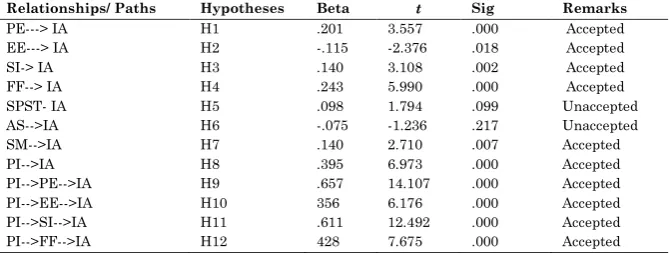
(SPST) and academic specialization (AS) that were not significant lying at significant level of 0.099 and 0.217 respectively. The remaining independent variables were all significant lying within the given range of p < 0.05 therefore our hypotheses were approved.
Table 4 Coefficientsa
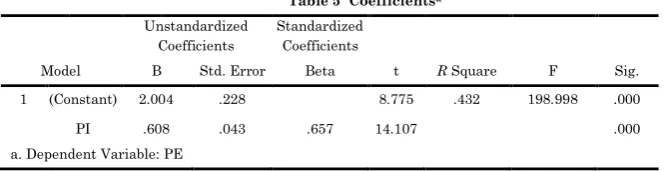
5.5 The Influence of Personal Innovativeness on Performance expectancy on Intention to adopt e-Learning
The table 5 shows that the personal innovativeness in strong influence performance expectancy in students adoption to e-learning
Table 5 Coefficientsa
Model
Unstandardized Coefficients
Standardized Coefficients
t Sig.
B Std. Error Beta R Square F
1 (Constant) 2.004 .228 8.775 .432 198.998 .000
PI .608 .043 .657 14.107 .000
a. Dependent Variable: PE Model
Unstandardized Coefficients
Standardized Coefficients
t Sig.
B Std. Error Beta R Square F
1 (Constant) .519 .221 2.35
Personal Innovativeness has a standardized coefficient β of .657 with a t value of 8.775 and significance level of 0.000. The result indicates that as the influence of personal innovativeness on performance expectancy increases by one unit, students’ behavioral intention to adopt e-learning is influenced positively by .657 units.
5.6 The Influence of Personal Innovativeness on Effort Expectancy on Intention to adopt e-Learning
Table 6 Coefficientsa
Model
Unstandardized Coefficients
Standardized Coefficients
t Sig.
B Std. Error Beta R Square F
1 (Constant) 2.930 .326 8.978 .000
PI .381 .062 356 6.176 .127 38.141 .000
a. Dependent Variable: EE
The results indicate that effort expectancy in terms of e-learning adoption is significantly influenced by the personal innovativeness. Personal innovativeness has a standardized coefficient β of .356 with t value of 8.978 and a significance level of 0.000. The result indicates that as the influence of personal innovativeness on effort expectancy increases by one unit, students’ behavioral intention to adopt e-learning is influenced positively by .356 units.
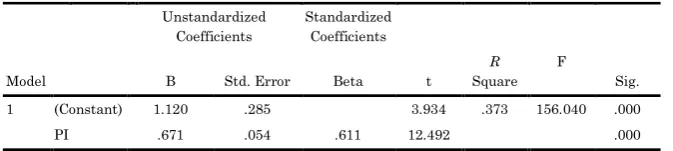
5.7 The Influence of Personal Innovativeness on Social Influence on Intention to adopt e-Learning
Table 7 Coefficientsa
Model
Unstandardized Coefficients
Standardized Coefficients
t Sig.
B Std. Error Beta
R
Square F
1 (Constant) 1.120 .285 3.934 .373 156.040 .000
Table 7 Coefficientsa
Model
Unstandardized Coefficients
Standardized Coefficients
t Sig.
B Std. Error Beta
R
Square F
1 (Constant) 1.120 .285 3.934 .373 156.040 .000
PI .671 .054 .611 12.492 .000
a. Dependent Variable: SI
The results indicate that social influence in terms of e-learning adoption is significantly influenced by the personal innovativeness. Personal innovativeness has a standardized coefficient β of .611 with t value of 12.492 and a significance level of 0.000. The result indicates that as the influence of personal innovativeness on social influence increases by one unit, students’ behavioral intention to adopt e-learning is influenced positively by .611 units.
5.8 The Influence of Personal Innovativeness on Facilitating Factor on Intention to adopt e-Learning
Table 8 Coefficientsa
Model
Unstandardized Coefficients
Standardized Coefficients
t Sig.
B Std. Error Beta
R
Square F
1 (Constant) 3.160 .273 11.572 .184 58.909 .000
PI .396 .052 .428 7.675 .000
a. Dependent Variable: FF
positively by .428 units.
Table 9 Hypothesis and Remarks
Relationships/ Paths Hypotheses Beta t Sig Remarks
PE---> IA H1 .201 3.557 .000 Accepted
EE---> IA H2 -.115 -2.376 .018 Accepted
SI-> IA H3 .140 3.108 .002 Accepted
FF--> IA H4 .243 5.990 .000 Accepted
SPST- IA H5 .098 1.794 .099 Unaccepted
AS-->IA H6 -.075 -1.236 .217 Unaccepted
SM-->IA H7 .140 2.710 .007 Accepted
PI-->IA H8 .395 6.973 .000 Accepted
PI-->PE-->IA H9 .657 14.107 .000 Accepted
PI-->EE-->IA H10 356 6.176 .000 Accepted
PI-->SI-->IA H11 .611 12.492 .000 Accepted
PI-->FF-->IA H12 428 7.675 .000 Accepted
DISCUSSION
This research sought to determine the factors that influence higher education students’ in Ghana intention to use e-learning. The findings indicated that e-learning acceptance is influenced by several factors. The results showed that students’ personal innovativeness is the most significant factor in determining students’ intention to use e-learning. Students’ decision to use e-learning is also influence by facilitating factors, for example the availability of computers and other e-learning tools and support within e-learning institutions. Moreover, the study also revealed that performance expectancy plays a vital role in shaping students behavioral intention with regards to e-learning acceptance.
Finally, performance expectancy, effort expectancy, social influence, and facilitating factor were all influenced by personal innovativeness.
CONCLUSION
In summary this study aimed at identifying the determinants that influence higher educational students’ behavioral intention to utilize e-learning systems in the Greater Accra region of Ghana. Therefore, the Unified Theory of Acceptance and Use of Technology (UTAUT) were proposed by expanding it with four external factors in the research model in order to investigate students’ behavioral intension to adopt e-learning. This study revealed performance expectancy, effort expectancy, social influence, facilitating factor, study mode and personal innovativeness as significant determinants of e-learning adoption among students. Also the study indicated that personal innovativeness has significant impact of performance expectancy, effort expectancy, social influence and facilitating factor in adoption of e-learning by students.
Limitation and Future Research Directions
external factors can be applied as predictors to provide better explanatory power for e-learning behaviors of students.
ACKNOWLEDGEMENT
First and foremost our sincere gratitude goes to God Almighty for His guidance and protection throughout this study. Secondly, Prof. Yun-Fei Shao for her exemplary and constant guidelines in making this studies a success. Also, grateful for National Science Foundation of China under grant No. 71172095, with their research support. Deepest regards to the entire teaching and non-teaching bodies on University of Electronics Science and Technology of China for their immense academic support.
REFERENCES
Agarwal, R. and Prasad, J. 1998. “A conceptual and operational definition of personal innovativeness in the
domain of information technology”. Information Systems
Research 9 (2), 204-215.
Bandura, A. 1991. “Social cognitive theory of self-regulation”. Organizational Behavior and Human Decision Processes, 50, 248-287.
Concannon, Fiona, Antoinette Flynn, and Mark Campbell. 2005. “What Campus-Based Students Think About The
Quality And Benefits Of E-Learning”. Br J Educ Technol
36 (3): 501-512. doi:10.1111/j.1467-8535.2005.00482.x. Curran, C. Strategies for e-learning in universities. 2004.
“Research & Occasional Paper Series: CSHE.7.04.
Davis Jr, Fred D. 1986. “A technology acceptance model for
empirically testing new end- user information
systems: Theory and results.” PhD diss., Massachusetts Institute of Technology.
Frambach, R.T., and Schillewaert, N. 2002. “Organizational innovation adoption a multi-level framework of determinants and opportunities for future research”.
Journal of Business Research 55, 167-176.
Jenkins, Martin, and Janet Hanson. 2003. “A guide for senior
managers”. E-learning Series No. 1: Vol. 1. Learning and
Teaching Support Network Generic Centre.
Johansen, R., & Swigart, R. 1996. Upsizing the Individual in the Downsizing Organization: Managing in the Wake of Reengineering, Globalization, and Overwhelming Technological Change. Reading, MA: Addison-Wesley. Lateef, Fatimah. 2010. “Simulation-based learning: Just like
the real thing.” Journal of emergencies, trauma, and
shock 3, no. 4: 348.
Lee, S., Kim, I., Rhee, S., & Trimi, S. 2006. “The role of exogenous factors in technology acceptance: The case
of object-oriented technology”. Information &
Management 43 (4), 469-480.
Lewis, W., Agarwal, R., Sambamurthy, V. 2003. “Sources of influence of beliefs about information technology use: An
empirical study of knowledge workers”. MIS Quarterly
27(4), 657-678.
Lin, W.-S., & Wang, C.-H. 2012. “Antecedences to continued intentions of adopting e-learning system in blended learning instruction: A contingency framework based on models of information system success and task-technology fit”. Computers & Education.58 (1), 88-99. Lu, J., Yao, J. E., Yu, Chun-Sheng. 2005. “Personal
Innovativeness, social influence, and adoption of
Journal of Strategic Information Systems 14 (3), 245-268.
McFarland, Daniel J., and Diane Hamilton. 2006. “Adding Contextual Specificity to the Technology Acceptance
Model”. Computers In Human Behavior 22 (3): 427-447.
doi:10.1016/j.chb.2004.09.009.
Meister, D. B., and D. R. Compeau. “Infusion of innovation adoption: An individual perspective.” In Proceedings of
the ASAC. 2002.
Mohamad Hsbollah, Hafizah, and Kamil. 2009. “E-Learning
Adoption: The Role Of Relative Advantages,
Trialability And Academic Specialization”.
Campus-Wide Info Systems 26 (1): 54-70.
doi:10.1108/10650740910921564.
Moore, Gary C., and Izak Benbasat. 1991. “Development Of An Instrument To Measure The Perceptions Of Adopting An
Information Technology Innovation”. Information
Systems Research 2 (3): 192-222.
doi:10.1287/isre.2.3.192.
Razak, N.A., Ahmad, F., &Shah, N.P.2007. “Perceived and preferred teaching styles (methods) of English for Specific Purposes (ESP) students. e-BANGI”: Jurnal Sains Sosial dan Kemanusiaan, 2(2). Retrieved from http://journalarticle.ukm.my/1542/
Schuetze, Hans G., and Maria Slowey. 2002. “Participation and exclusion: A comparative analysis of non-traditional students and lifelong learners in higher education.”
Higher education 44, no. 3-4: 309-327.
Shih, Y.-Y., & Huang, S.-S. 2009. “The actual usage of erp
systems: An extended technology acceptance
perspective”. Journal of Research and Practice in
Information Technology, 41(3), 263-276.
Australian study”. Asia Pacific Management Review, 13 (2), 463-480.
Thompson, R. L., Higgins, C. A., Howell, J. M. 1991. “Personal computing: Toward a conceptual model of utilization,”
MIS Quarterly 15(1). 124-143.
Venkatesh, Viswanath, Michael G. Morris, Gordon B. Davis,
and Fred D. Davis. 2003. “User acceptance of
information technology: Toward a unified view.” MIS
quarterly 425-478.
Venkatesh, Viswanath, James YL Thong, and Xin Xu. 2012.
“Consumer acceptance and use of information
technology: extending the unified theory of acceptance and use of technology.” MIS quarterly 36, no. 1: 157-178. Volery, T. and Lord, D. 2000. “Critical success factors in online
education”. The International Journal of Education
Management, 14 (5), 216-223.
Xu, Zhengchuan, and Yufei Yuan. 2009. “Principle-Based
Dispute Resolution for Consumer Protection”.
Knowledge-Based Systems 22 (1): 18-27.
doi:10.1016/j.knosys.2008.04.009.
Yang, Kenneth C.C. 2005. “Exploring Factors Affecting The
Adoption Of Mobile Commerce in Singapore”.
Telematics and Informatics 22 (3): 257-277.
doi:10.1016/j.tele.2004.11.003.
Yi, M., Jackson, J., Park, J., & Probst, J. 2006. “Understanding information technology acceptance by individual
professionals: Toward an integrative view”. Information
& Management, 43(3), 350‐363.
Yoo, S.J., Han, S.H., Huang, W.B. 2012. “The roles of intrinsic motivators and extrinsic motivators in promoting e-learning in the workplace: A case from South Korea”.

![Figure 2 UTAUT. Source: [Error! Bookmark not defined.]](https://thumb-us.123doks.com/thumbv2/123dok_us/7764857.1276179/6.439.96.345.407.528/figure-utaut-source-error-bookmark-defined.webp)