A Novel Approach On Image Compression Based On
Discrete Cosine Transform With MATLAB GUI Coding
Lalit G. Patil
Faculty of Technology and Engineering, Department of Electrical Engineering, The M.S.University of Baroda, Vadodara, Gujarat, India
ABSTRACT
In real life, there are many practical implementation which needs of image compression. Image compression is almost need to use where there is much little storage capacity, like web pages. Each private domain have a limited storage capacity. When there is a need to upload high resolution images, it consumes more space. But by applying image compression algorithm to those images, compresses images, it means it reduces size of that particular image without disturbing its quality. This benefit makes a need to develop an image compression algorithm. Various algorithms were available for image compression called lossless compression and lossy compression. But always there is a trade-off between image quality and compression size. But this proposed algorithm overcomes this limitation is called discrete cosine transform. This paper deals with the development of Graphical user interface based image compression algorithm and making a software on MATLAB.
Key words-
Discrete cosine transform (DCT); GUI; Image Compression; jpeg, quantization
1. INTRODUCTION
Image compression is related with reducing the size of Image without degrading its quality to an acceptable level. This helps in storing an images in a given amount of space on a disk. This also
helps in reducing a time to send image over an internet. There are several ways over which image is compressed. Mostly over internet photographs of jpeg format file is compressed. GIF format is used for geometric shapes and line art. Other methods which are used for compression is fractals and wavelets. This methods have wide compression ratio and accepted widely. But they have degradation in quality. Our proposed method implements an algorithm which is compromise of quality and compression ratio.
2. ALGORITHM
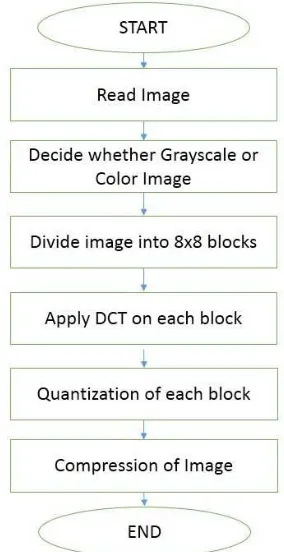
Figure 1 : Algorithm for proposed DCT
The discrete cosine transform is related to the discrete Fourier transform. The Equation of the two-dimensional DCT for an input image and output image is
cos 22 1 cos 22 1 , 0 " " # 10 " " # 1
Where,
$ % & %
' 1
√ , 0
) 2 , 1 " " # 1
*
And
$ % & %
' 1
√ , 0
)2 , 1 " " # 1
*
M and N are the row and column size of Image A, respectively. As we applied the DCT to real data, the result is also real. The
DCT tends to concentrate image
information, making it useful for image compression application.
This will give the DCT matrix as follows for 8x8block image.
[cc,rr] = meshgrid(0:n-1);
c = sqrt(2 / n) * cos(pi * (2*cc + 1) .* rr / (2 * n));
c(1,:) = c(1,:) / sqrt(2);
+ , , , , , ,
-0.3536 0.35360.4904 0.4157 0.35360.2778 0.35360.0975 #0.0975 #0.2778 #0.4157 #0.49040.3536 0.3536 0.3536 0.3536 0.4619 0.1913 #0.1913 #0.4619 #0.4619 #0.1913 0.1913 0.4619 0.4157 #0.0975 #0.4904 #0.2778 0.2778 0.4904 0.0975 #0.4157 0.3536 #0.3536 #0.3536 0.3536 0.3536 #0.3536 #0.3536 0.3536 0.2778 #0.4904 0.0975 0.4157 #0.4157 #0.0975 0.4904 #0.2778 0.1913 #0.4619 0.4619 #0.1913 #0.1913 0.4619 #0.4619 0.1913 0.0975 #0.2778 0.4157 #0.4904 0.4904 #0.4157 0.2778 #0.097567
7 7 7 7 7 8
This is an orthogonal matrix.
And Mask Matrix will be
+ , , , , , ,
-1 1 1 1 0 0 0 01 1 1 0 0 0 0 0 1 1 0 0 0 0 0 0 1 0 0 0 0 0 0 0 0 0 0 0 0 0 0 0 0 0 0 0 0 0 0 0 0 0 0 0 0 0 0 0
0 0 0 0 0 0 0 067
7 7 7 7 7 8
We are designing a DCT matrix for 8x8 block. We take a particular only one block of image.Our original image pixel matrix is
+ , , , , , ,
-195 196 197 196 194 194 196 199199 199 199 199 200 200 200 200 200 198 198 200 203 203 200 197 201 201 201 202 203 204 202 201 200 201 201 200 199 199 201 203 197 199 199 198 196 196 199 202 200 200 200 200 200 200 201 202
200 198 198 200 202 203 200 19867
7 7 7 7 7 8
So, We Subtract 128 from each element.Then we get a matrix
+ , , , , , ,
-67 68 69 68 66 66 68 7171 71 71 71 72 72 72 72 72 70 70 72 75 75 72 69 73 73 73 74 75 76 74 73 72 73 73 72 71 71 73 75 69 71 71 70 68 68 71 74 72 72 72 72 72 72 73 74
72 70 70 72 74 75 72 7067
7 7 7 7 7 8
We are now performing a discrete cosine transformation. Which is performed by matrix manipulation.
D = T*M*Ti’
+ , , , , , ,
- 8.3750 11.7898 11.269112.3100 12.2713 3.7738 #.67569.9949 2.48318.2500 6.48209.8081 13.8272 9.80814.6002 2.4486 11.7591 3.7206 2.5628 16.3103 12.2490 #1.3998 6.3640 13.2511 10.7299 #0.6946 16.5368 5.7102 7.3659 15.4944 #1.3812 14.8828 9 2.5176 11.9224 7.0713 8.8750 10.4359 4.9384 13.0035 6.7766 9.6719 #1.3252 14.2711 9.9949 0.6470 16.0838 8.5459 4.8708 13.8272 6.3640 #1.3438 4.8708 16.3103 15.5773 3.9332 2.4831 9.5357 13.4431 14.6789 12.8301 8.6614 3.8269 0.6661 67
7 7 7 7 7 8
Here there are much low and high frequencies in this matrix. Human eyes are most sensitive to low frequencies. And quantization performs this operation.This block contains total of 64 dct coefficients with eight rows and eight columns.After quantization we get the following matrix.
+ , , , , , ,
- 6.2593 #0.0134 0.00101 3.2435 0 0 0 0#0.0193 0.0014 #0.0016 0 0 0 0 0
#0.0302 #0.0005 0 0 0 0 0 0
#0.0306 0 0 0 0 0 0 0
0 0 0 0 0 0 0 0
0 0 0 0 0 0 0 0
0 0 0 0 0 0 0 0
0 0 0 0 0 0 0 067
7 7 7 7 7 8
The coefficients situated near the upper left corner correspond to the low frequencies to which human eye is most sensitive. Zero represents the less important part, and higher frequencies are discarded giving rise to lossy part of compression. The only remaining
nonzero coefficients were used to
reconstruct the image.
3.RESULTS
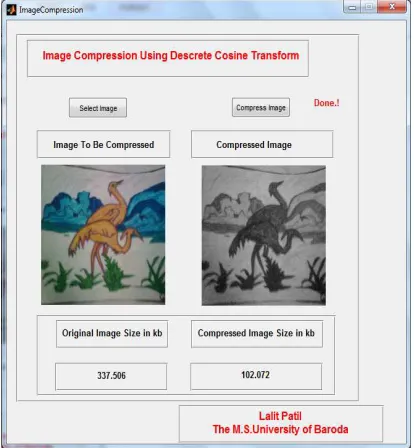
The following table shows the result of implemented algorithm which is tested upon different images. The whole script is written in MATLAB and Graphical user interface is also prepared in MATLAB.
Figure 2 : MATLAB GUI for Proposed Algorithm
a. Original image b. DCT imagec. Compressed Image
Table for Result Images
Image Name Original
Image Size(kb)
Lena.png 592.883 21.2852
Scene.jpg 364.83 86.5059
Personal.jpg 337.506 102.072
Table 1 : Result table
4. CONCLUSION
The algorithm is implemented for jpg, bmp, png and tiff format images. After running above algorithm implemented program, the compression ratio of original images to compressed images, obtained is 1:4 for jpg images, 1:13 for bmp images and 1:28 for png images.And it is also observed thatthere is no or negligible reduction in image quality. We can conclude that above proposed algorithm is much accurate for image compression.
5. APPLICATIONS
Image compression has wide range of applications in our day to day use as well in industrial applications from which some of are listed below.
satellite imagery Mini discs MP3 technology Fax
Digital cameras DVD technology Modems
Wireless telephony Database design
Storage and transmission of CT and MRI scans
Mammography
6. REFERENCES
[1] Jain, Anil K., Fundamentals of
Digital Image Processing,
Englewood Cliffs, NJ, Prentice Hall, 1989, pp. 150-153.
[2] Pennebaker, William B., and Joan L.
Mitchell, JPEG: Still Image Data
Compression Standard, Van
Nostrand Reinhold, 1993.
[3] Yen-Yu Chen: Medical image
compression using DCT-based
subband decomposition and
modified SPIHT data organization, International journal of medical informatics 76 (2007) 717-725,
journal homepage: www.intl.
elsevierhealth.com/journals/ijm.
[4] Alain Horé MOIVRE, DjemelZiou MOIVRE: Image quality metrics: PSNR vs. SSIM, 2010 international conference on pattern recognition, 1051-4651/10 @2010 IEEE. DOI 10.1109/ICPR 2010.579.
[5] Ms.Pallavi M. Sune, Prof.Vijaya K.
Shandilya, Image Compression
Techniques based On Wavelet and
Huffman Coding, International
Journal of Advanced Research in Computer Science and Software Engineering, Volume 3, Issue 4, April 2013, ISSN: 2277 128X
[6] Koon-Pong Wong, Fractal image
coding for emission tomographic image compression,
IEEEXplore Digital library, 4-10 Nov. 2001, ISBN: 0-7803-7324-3
[7] Leung, T. Marcellin,, M.W.Bilgin,
Windowed Images,IEEEXplore Digital library, 20-22 March 2013, ISBN: 978-1-4673-6037-1
[8] Donapati, S. Yagain H, A
Comparative Study of Effects of CSC on Image Compression Ratios While Using JPEG-XR,IEEEXplore Digital library, 10-12 Dec. 2013,
ISBN:
978-0-7695-5143-2
Lalit G Patil,
Teaching Assistant,
Department of
Electrical Engineering, The M.S.University of Baroda. He has completed his B.E in Electronics and Communication Engineering from Gujarat University in 2011. During his academics he has an experience of Technical Industrial training at Hitachi-Home and Life Solutions as well at Sify technologies. He has completed his masters from The M.S.University of Baroda, Gujarat. During Masters he has an experience of
Research project at Semitronik