Heading into new virtual environments:
What skills do design team members
need?
Sher, W, Sherratt, S, Williams, A and Gameson, RN
Title
Heading into new virtual environments: What skills do design team
members need?
Authors
Sher, W, Sherratt, S, Williams, A and Gameson, RN
Type
Article
URL
This version is available at: http://usir.salford.ac.uk/28414/
Published Date
2009
USIR is a digital collection of the research output of the University of Salford. Where copyright
permits, full text material held in the repository is made freely available online and can be read,
downloaded and copied for noncommercial private study or research purposes. Please check the
manuscript for any further copyright restrictions.
HEADING INTO NEW VIRTUAL ENVIRONMENTS: WHAT SKILLS
DO DESIGN TEAM MEMBERS NEED?
October 2008 William Sher,
University of Newcastle, Australia [email protected]
Sue Sherratt, Dr,
University of Newcastle, Australia [email protected]
Anthony Williams, Assoc Prof University of Newcastle, Australia [email protected]
Rodney Gameson, Dr, Wolverhampton, UK [email protected]
SUMMARY: Information and Communication Technology (ICT) is increasingly being integrated in the design and management of construction projects. Not only are sophisticated electronic tools being widely used to help construction professionals design and manage buildings - ICT is assisting these people to work in virtual, collaborative electronic environments. As a result there is a trend to move from co-located to virtual team collaboration. The operational differences inherent in these environments and their impact on the generic skills of design professionals are the basis of the research reported here. We developed a generic skills coding framework for the activities of designers working in virtual teams. We then audio and video recorded designers working in teams designing different buildings and analysed the resulting data using our generic skills framework. We identified changes in the skills profiles of design team members between different operational states (low bandwidth-high bandwidth). The major conclusion of our analysis is that there are significant differences between the operational conditions: face-to-face, whiteboard and 3D virtual world, for the generic skills profiles.
KEYWORDS: design teams, generic skills, virtual teams.
1.
INTRODUCTION
Recent developments in virtual communication technologies have the potential to dramatically improve collaboration in the construction industry (Gameson & Sher, 2002). Furthermore, virtual teams “hold significant promise for organizations that implement them because they enable unprecedented levels of flexibility and responsiveness.” (Powell, Piccoli, & Ives, 2004, p. 6). Indeed, some authors observe that virtual teams are here to stay (Bell & Kozlowski, 2002). However, the skills required to work productively in virtual environments are presently ill-defined.
2.
VIRTUAL TEAMWORK
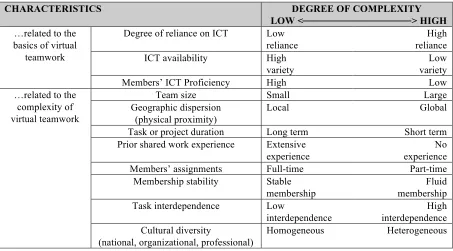
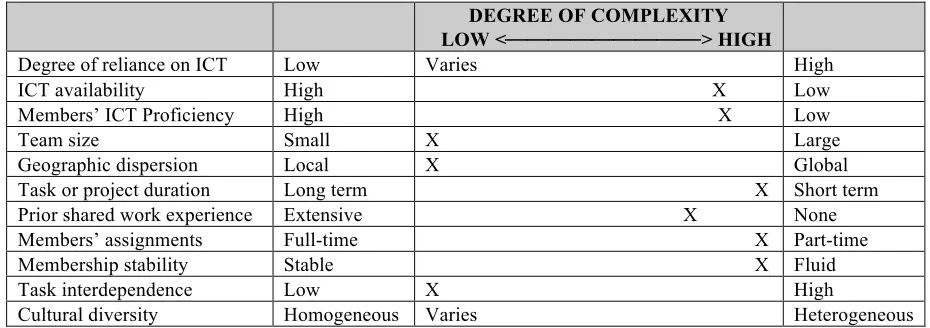
There are numerous definitions of teams. For this paper teams are defined as a cluster of two or more people usually occupying different roles and skill levels that interact “…adaptively, interdependently, and dynamically towards a common and valued goal” (Salas, Shawn Burke, & Cannon-Bowers, 2000, p. 341). At present the term “virtual teams” is used by different authors to mean different things. A more detailed exploration of the various facets of virtual teams is provided by (Dubé & Paré, 2004) and is summarised in Table 1. Virtual teams may differ significantly depending upon these aspects and Dubé & Paré suggest that this table could also be used as a diagnostic tool to help assess the level of complexity in a virtual team. The profile of the participants in this investigation is detailed later in this paper.
CHARACTERISTICS DEGREE OF COMPLEXITY
LOW < > HIGH Degree of reliance on ICT Low
reliance
High reliance ICT availability High
variety
Low variety …related to the
basics of virtual teamwork
Members’ ICT Proficiency High Low
Team size Small Large
Geographic dispersion (physical proximity)
Local Global
Task or project duration Long term Short term
Prior shared work experience Extensive experience
No experience
Members’ assignments Full-time Part-time
Membership stability Stable membership
Fluid membership Task interdependence Low
interdependence
High interdependence …related to the
complexity of virtual teamwork
Cultural diversity
(national, organizational, professional)
[image:3.595.72.525.201.452.2]Homogeneous Heterogeneous
TABLE 1: Key Characteristics of Virtual Teams (Dubé & Paré, 2004)
3.
GENERIC SKILLS
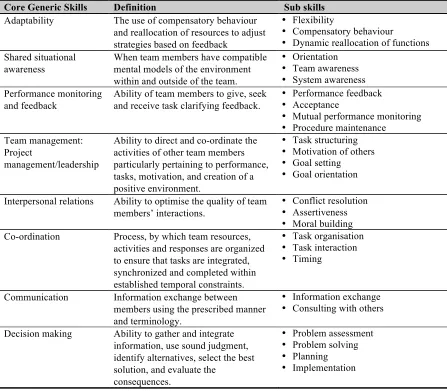
There is still much discussion about the core set of knowledge, skills and abilities that constitute teamwork (Salas et al., 2000). We sought to contribute to this debate by identifying the skills that transferred from a traditional face to face (F2F) environment and the ones that required refining for virtual environments. Furthermore, we wished to identify if virtual teamworkers needed any new skills. As a starting point, we investigated the generic skills workers acquire and use on a daily basis. Generic skills are defined by Salas et al (2000: p, 344) as, “…the knowledge, skills and attitudes that a team member possesses when completing a task or communicating with fellow members, whether in a co-located or virtual environment”. Generic skills influence both individuals and teams; they are skills which are “…transportable and applicable across teams.” (Salas et al., 2000, p. 344). A review of generic skills (Cannon-Bowers, Tannenbaum, Salas, & Volpe, 1995) was used to identify the generic skills used by design team members and is summarised in Table 2.
Core Generic Skills Definition Sub skills
Adaptability The use of compensatory behaviour and reallocation of resources to adjust strategies based on feedback
• Flexibility
• Compensatory behaviour
• Dynamic reallocation of functions Shared situational
awareness
When team members have compatible mental models of the environment within and outside of the team.
• Orientation • Team awareness • System awareness Performance monitoring
and feedback
Ability of team members to give, seek and receive task clarifying feedback.
• Performance feedback • Acceptance
• Mutual performance monitoring • Procedure maintenance
Team management: Project
management/leadership
Ability to direct and co-ordinate the activities of other team members particularly pertaining to performance, tasks, motivation, and creation of a positive environment.
• Task structuring • Motivation of others • Goal setting • Goal orientation
Interpersonal relations Ability to optimise the quality of team members’ interactions.
• Conflict resolution • Assertiveness • Moral building Co-ordination Process, by which team resources,
activities and responses are organized to ensure that tasks are integrated, synchronized and completed within established temporal constraints.
• Task organisation • Task interaction • Timing
Communication Information exchange between members using the prescribed manner and terminology.
• Information exchange • Consulting with others Decision making Ability to gather and integrate
information, use sound judgment, identify alternatives, select the best solution, and evaluate the
consequences.
[image:4.595.76.523.83.474.2]• Problem assessment • Problem solving • Planning • Implementation
TABLE 2: Integrated skills (as adapted from Cannon-Bowers et al 1995)
Content Analysis, according to (Wallace, 1987), involves coding transcripts of communications in terms of frequency analyses because the underlying assumption is that “the verbal content produced by the individual is representative of the thought processes at work in his or her mind” (p. 121).
shown in Table 4.
In addition to the Generic Skills analysis presented here, three other techniques were used to analyse the data: 1. Bales’s Interaction Process Analysis (Bales, 1951) - to analyse the interactions between design team
members, so that aspects such as decision-making, communication and control could be examined.
2. A Communication Technique Framework (Williams & Cowdroy, 2002) – to investigate the techniques which the designers used to communicate.
3. Linguistic analyses - to evaluate the communication occurring in teamwork. The approach adopted was derived from systemic functional linguistic theory (Halliday & Matthiessen, 2004).
At this stage we have analysed the data from each approach independently and these will be reported in papers currently being prepared.
The aims of this study were to identity and examine the generic skills which facilitate teamwork in three settings, ranging from face-to-face to 3D virtual environments. Teamwork occurred during the conceptual stages of designing construction projects.
3.1
Data collection
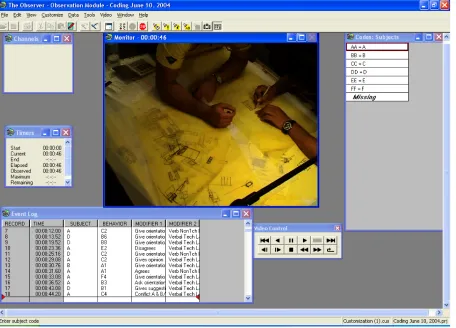
Video and audio recordings of designers collaborating in teams were collected using Noldus Observer Pro (Burfield, Cadee, Grieco, Mayton, & Spink, 2003) to store, code and analyse our data. Noldus is ethnographic video analysis software which facilitates the collection, management, analysis and presentation of observational data. It allows researchers to view video footage and score the frequency of specific behaviours, and to note how these behaviours interact with each other or with independent variables. The advantages of such recordings include: being able to review interactions and behaviours as well as being able to compare different coders’ or viewers’ interpretations (Guerlain, Turrentine, Adams, & Forrest Calland, 2004).
3.2
Participants
Stratified purposive sampling (Rice & Ezzy, 1999) was used to select a heterogenous group of ten participants to reflect the reality of design teams. It is often the case that design team members are drawn from different backgrounds/cultures, ages, and experience (Marchman III, 1998), especially in multi-disciplinary design teams collaborating on an entire project. Participants were both male and female, of varying ages, cultures and had differing levels of experience and influence, ranging from higher management to junior staff.
3.3
Task
Data were collected in three experimental conditions:
• Traditional face-to-face collaborative design between the design team members (including interactions such as talking and sketching).
• Virtual design using a shared electronic whiteboard (incorporating synchronous audio and visual communication) which allowed drawings, images and text to be shared.
• Virtual design using a high bandwidth 3D virtual world (Activeworlds-Corporation, 2008) (incorporating synchronous audio communication) which allowed drawings, images and text to be shared. This tool represents team members as “avatars” and allowed them to manipulate 3D representations of a design and communicate using audio as well as text “chat” facilities.
DEGREE OF COMPLEXITY LOW < > HIGH
Degree of reliance on ICT Low Varies High
ICT availability High X Low
Members’ ICT Proficiency High X Low
Team size Small X Large
Geographic dispersion Local X Global
Task or project duration Long term X Short term
Prior shared work experience Extensive X None
Members’ assignments Full-time X Part-time
Membership stability Stable X Fluid
Task interdependence Low X High
[image:6.595.62.527.82.246.2]Cultural diversity Homogeneous Varies Heterogeneous
TABLE 3: Typical characteristics of the virtual teams engaged in this project (adapted from Dubé & Paré, 2004)
All tasks were conducted in an identical sequence (i.e. participants first worked “face-to-face”, then used a “whiteboard” and finally designed in the “3D virtual world”). This procedure was prescribed by our research directorate and was designed primarily for the first two strands of our overall research project (Maher, 2002). We are conscious that participants may have become familiar with aspects of the tasks that they were asked to complete, and may also have become fatigued (Pring, 2005). As the designers gained experience of working together, one would assume they would be able to work more effectively over time. If this is so, their final collaboration would have been the optimal one and this would have occurred when they were designing in the 3D virtual world. Conversely, if they had become fatigued or bored, their last task performed would have been the one most affected. It is thus not possible to determine whether sequence affected the outcomes of this research.
3.4
Coding of Data
FIGURE 1: Screen showing coding of video data in Noldus Observer Pro
The resulting scores were statistically analysed using a Repeated Measures Analysis of Variance parametric test to establish the differences between participants’ performance on the three tasks (traditional face-to-face design, virtual design using a electronic whiteboard, and virtual design using a high bandwidth 3D virtual world) (Riedlinger, Gallois, McKay, & Pittam, 2004). The results of the ANOVA tests were interpreted using Mauchly’s Test of Sphericity which examines the covariance of the dependent samples. The data were also examined to determine which shift in condition (i.e. face-to-face to whiteboard or whiteboard to 3D virtual world) was responsible for any significance. SPSS Version 12 was used for all statistical analyses.
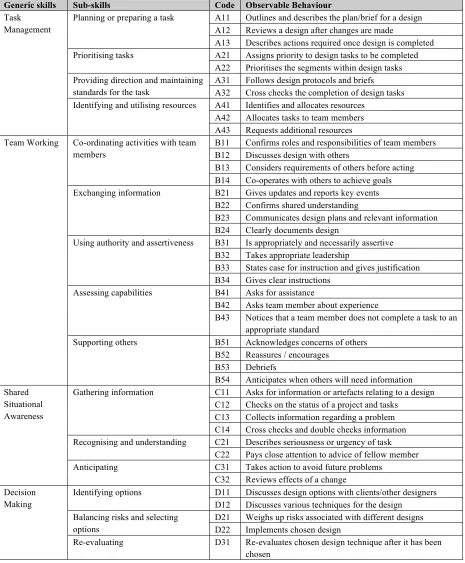
Generic skills Sub-skills Code Observable Behaviour
Planning or preparing a task A11 Outlines and describes the plan/brief for a design A12 Reviews a design after changes are made
A13 Describes actions required once design is completed Prioritising tasks A21 Assigns priority to design tasks to be completed
A22 Prioritises the segments within design tasks A31 Follows design protocols and briefs Providing direction and maintaining
standards for the task A32 Cross checks the completion of design tasks A41 Identifies and allocates resources
A42 Allocates tasks to team members Task
Management
Identifying and utilising resources
A43 Requests additional resources
B11 Confirms roles and responsibilities of team members B12 Discusses design with others
B13 Considers requirements of others before acting Co-ordinating activities with team
members
B14 Co-operates with others to achieve goals Exchanging information B21 Gives updates and reports key events
B22 Confirms shared understanding
B23 Communicates design plans and relevant information B24 Clearly documents design
B31 Is appropriately and necessarily assertive B32 Takes appropriate leadership
B33 States case for instruction and gives justification Using authority and assertiveness
B34 Gives clear instructions Assessing capabilities B41 Asks for assistance
B42 Asks team member about experience
B43 Notices that a team member does not complete a task to an appropriate standard
Supporting others B51 Acknowledges concerns of others B52 Reassures / encourages
B53 Debriefs Team Working
B54 Anticipates when others will need information Gathering information C11 Asks for information or artefacts relating to a design
C12 Checks on the status of a project and tasks C13 Collects information regarding a problem C14 Cross checks and double checks information Recognising and understanding C21 Describes seriousness or urgency of task
C22 Pays close attention to advice of fellow member Anticipating C31 Takes action to avoid future problems
Shared Situational Awareness
C32 Reviews effects of a change
Identifying options D11 Discusses design options with clients/other designers D12 Discusses various techniques for the design
D21 Weighs up risks associated with different designs Balancing risks and selecting
options D22 Implements chosen design Decision
Making
[image:8.595.67.532.73.636.2]Re-evaluating D31 Re-evaluates chosen design technique after it has been chosen
4.
RESULTS
4.1
Generic Skills
The generic skill Shared Situational Awareness increased significantly (F(2, 8) = 4.903, p < .05). The Within-Subject Contrasts test indicated a significant difference between face-to-face and whiteboard conditions (F(1, 4) = 19.478, p < .05).
For the skill of Decision Making, there was a significant decrease (F(2, 8) = 42.431, p < .001) in frequency as the design conditions moved from low to high bandwidth conditions. The Within-Subject Contrasts test demonstrated a significant difference between both the face-to-face to whiteboard and whiteboard to 3D virtual world (F(1, 4) = 120.274, p < .001 and F(1, 4) = 8.685, p < .05 respectively).
For the skill of Task Management, the decrease in frequency from face-to-face to whiteboard approached significance (F(1, 4) = 4.799, p > .1).
4.2
Observable behaviours
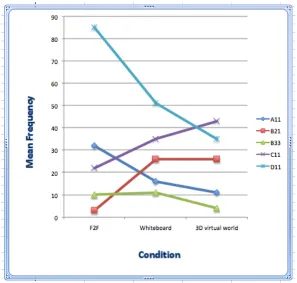
The following five observable skills (see Figure 2) were significantly affected by the experimental conditions: • A11 (“Outlines and describes the plan/brief for the design” indicative of Task Management). There was a
[image:9.595.72.369.355.638.2]significant decrease (F(2, 8) = 9.021, p < .05) in the incidence of this behaviour from low to high bandwidth levels. The Within-Subjects Contrasts test indicates that the move from face-to-face to whiteboard was significant (F(1, 4) = 7.943, p < .05).
FIGURE 2: Frequency of significant observable behaviours A11, B21, B33, C11, D11, in 3 conditions
• B33 (“States case for instruction and gives justification”, also demonstrating Team Working). The movement from low to high bandwidth demonstrated a significant decrease in this behaviour (F(2, 6) = 5.362, p < .05). A significant difference between whiteboard and 3D virtual world was found to be approaching significance (F(1, 3) = 5.642, p = .098).
• C11 (“Asks for documents and/or information regarding a design” indicating Shared Situational Awareness). This increased significantly as the design process moved from low to high bandwidth (F(2, 8) = 5.526, p < .05). The Within-Subjects Contrasts test showed a significant change (F(1, 4) = 15.751, p < .05) for the shift from face-to-face to whiteboard conditions.
• D11 (“Discusses design options with clients/other designers” demonstrating Decision-Making). As the design collaborators shifted from low to high bandwidth, the frequency of the behaviour decreased significantly (F(2, 8) = 25.383, p < .001). In addition, significant differences were also found between face-to-face and whiteboard and whiteboard and 3D virtual world (F(1, 4) = 46.24, p < .05 and F(1, 4) = 8.095, p
< .05, respectively).
In addition, two other statistical results from the generic skill Team Working are worth noting:-
• B23 (Communicates design plans and relevant information to relevant members). The Within-Subjects Contrasts test indicates that the mean frequency of B23 reduced significantly (F(1, 4) = 23.774 p < .05) between the face-to-face and whiteboard conditions.
• B52 (Reassures/Encourages) was the only observable behaviour that approached significance (F(2, 8) = 3.462 p < .1). The decrease in frequency of this behaviour between whiteboard and 3D virtual world (F(1, 4) = 5.956 p < .1) is also approaching significance.
Changes in the incidence of the remaining observable behaviours were non-significant, in some cases due to limited or non-existent data.
5.
DISCUSSION
This study examined the generic skills of five design teams in three settings: face-to-face and two levels of virtual technology (viz. whiteboard and 3D virtual world). The behaviours underpinning the generic skills designers use during the conceptual stages of a variety of projects were recorded and analysed. The major findings were a significant increase in the frequency of Shared Situational Awareness and a significant decrease in Decision Making as bandwidth conditions increased.
5.1
Shared Situational Awareness
There was a significant and consistent increase in Shared Situational Awareness as the design process moved from low to high bandwidth as well as a significant increase between face-to-face and whiteboard conditions. This generic skill incorporates the sub-skills of gathering information, recognising and understanding as well as anticipating. One of this skill’s observable behaviours (C11 “asks for documents and/or information regarding an idea or design”) increased significantly as bandwidth increased and also between face-to face and whiteboard conditions. This behaviour is associated with information gathering and involves designers asking questions about a design, a site, an idea or an artefact. An increase in the frequency of this behaviour may indicate escalating levels of uncertainty (Gay & Lentini, 1995; Kayworth & Leidner, 2000) and it is conceivable that moving to unfamiliar design environments may have engendered such concerns. Furthermore, designing in 2D is markedly different from designing in 3D. Many designers traditionally work in 2D, and this approach is conveniently facilitated by whiteboard technologies. 3D virtual environments provide additional challenges as few designers have worked in them before. So, not only do 3D environments require designers to exercise their visualisation skills in a more complex way, they require them to use new tools (e.g. avatars, 3D geometric modelling tools etc) to express their conceptual designs. An increase in the incidence of C11 is therefore understandable.
such interactions and the level of shared understanding between individuals is not always assured. A way to enrich such communications is to use multiple communication channels or modes simultaneously (Gay & Lentini, 1995; Kayworth & Leidner, 2000). Instead of relying on a single mode of communication it is advantageous to support such communication with artefacts, such as sketches, as designers do in face-to-face situations. Verbal commentary is another way to enhance virtual communication. Where these environments support audio communication, verbal commentary and / or explanation provides valuable supplementary support. We therefore recommend that multiple modes of communication be used concurrently to increase shared understanding between design team members in virtual conditions.
5.2
Decision Making
There was a significant and consistent decrease in the frequency of DecisionMaking as design processes moved from low to high bandwidth and also between face to face and whiteboard, and between whiteboard and 3D. The sub-skills associated with this generic skill are identifying options, balancing risks and selecting options, and re-evaluating. The behaviour “discusses design options with clients/other designers” demonstrated a similarly significant decrease. The reduced frequency of such interactions suggests that designers using virtual environments more readily accept design proposals as solutions and do not explore as many alternatives as they would have had they been communicating face-to-face. It would seem that, because of the sometimes cumbersome nature of virtual communication, designers working in virtual environments find it more convenient to accept ideas rather than engage in discussions to explore alternative solutions. We therefore speculate that in virtual environments some designers’ perspectives may not be offered for discussion, that when they do their ideas may not be acknowledged and / or explored, and that as a consequence, the quality of solutions may suffer. It is therefore important for designers working in virtual contexts to recognise the potential limitations of their solutions, and to challenge the proposals of their colleagues.
5.3
Other notable results
The generic skill of Task Management demonstrated a decrease between face-to-face and whiteboard conditions that approached significance whilst there was a significant decrease in the behaviour of outlining and describing the plan/brief for the design. Task Management incorporates the sub-skills of planning or preparing a task, prioritising tasks, providing direction and maintaining standards for the task, and identifying and utilising resources. Management of virtual teams is acknowledged as being challenging (Kayworth & Leidner, 2000) and it may well be that the results apparent here relate to the small team size and personal management style of those involved.
Team Working skills incorporate co-ordinating activities with team members, exchanging information, using authority and assertiveness, assessing capabilities and supporting others. In demonstrating this generic skill, team members increased the frequency of giving updates and reporting key events significantly, whilst they significantly less frequently stated the case for instruction or gave justification as they working in higher bandwidth conditions. The change in condition from face-to-face to whiteboard resulted in significantly more updates and reports of key events, as well as significantly fewer design plans and relevant information being communicated to relevant members. In contrast, the move from whiteboard to 3D virtual environments resulted in the change towards fewer reassuring or encouraging comments and towards more stating of the case for instruction and giving justification approaching significance. This skill thus appears to present opportunities for further investigations. There are clearly many factors influencing designers’ behaviours here and further investigations to distil contributions and interactions should provide interesting insights.
6.
LIMITATIONS
The following are the main limitations of this study:
• The data were collected under laboratory conditions. It was not possible to video designers working at their normal place of work, nor was it possible to record their work on real-life design projects. Although the designs the participants were asked to work were fictitious, they represented possible design projects. It is difficult to determine the relative differences in complexity between the five projects provided.
• All participants were from one discipline (architecture) and our results may therefore reflect the teamwork culture of the architectural profession.
7.
IMPLICATIONS FOR FUTURE RESEARCH
An ability to map and measure the generic skills of individuals and teams is crucial for the construction/design industry because it allows specific training needs to be identified. Without a direction, those seeking to improve virtual teamwork may or may not succeed.
Virtual environments do not support non-verbal interactions as effectively as co-located conditions do and this deficiency inevitably leads designers to use different skills and / or skills in a different manner. A number of future research directions stem from this, including further examination of non-verbal interactions, team protocols and the possible impact of prior experience of ICT systems.
It is essential that designers understand the characteristics of the different environments in which they find themselves working. Specific generic skills may be needed for team members to function efficiently and effectively, particularly in virtual, high-bandwidth design environments. By examining the effects of technology on these generic skills, the particular strategies which facilitate and hinder teamwork when different levels of technology are used, can be ascertained. These strategies can then be incorporated into the briefing and training sessions provided to construction design teams as they move to make greater use of electronic whiteboards, 3D virtual worlds and other technologies. In this context it is pertinent to note that currently training usually focuses on the use of new software and hardware, rather than on the generic skills that facilitate communication and collaboration. There is clearly a need to raise designers’ awareness of the skills required for effective virtual collaboration, and to this end we have developed an interactive CD to assist those new to working in virtual environments (Newcastle, 2008; Williams & Sher, 2007). Additional skills development tools would provide valuable continuing professional development opportunities for design professionals.
Although the method documented in this paper has highlighted some aspects of the generic skills used by teams of designers, additional techniques are likely to reveal nuances that have eluded this approach. For example, in-depth linguistic analyses, and analyses based on Bales’s Interaction Process Analysis (Bales, 1951) should provide valuable supplementary insights.
8.
CONCLUSIONS
The major conclusion drawn from our analysis of design collaboration is that there are significant differences between the operational conditions; face-to-face, whiteboard and 3D virtual world, for the generic skills profiles. This was true for the overall design activity of the five teams.
9.
ACKNOWLEDGEMENT
We wish to acknowledge the Cooperative Research Centre for Construction Innovation (CRC-CI), part of the Australian Government’s CRC program, who funded this project (Project 2002-024-B), and Tom Bellamy, who was one of our researchers.
10.
REFERENCES
Activeworlds-Corporation. (2008). Active Worlds. Retrieved 28 Sept 2008, from http://www.activeworlds.com/
Bales, R. (1951). Interaction process analysis. Cambridge: Addison-Wesley Press Inc.
Bell, B. S., & Kozlowski, S. W. J. (2002). A typology of virtual teams: Implications for effective leadership.
Group and organization management, 27(1), 14 - 49.
Burfield, I., Cadee, N., Grieco, F., Mayton, T., & Spink, A. (2003). The observer: Reference manual ver 5.: Wageningen, Neth: Noldus Information Technology.
Cannon-Bowers, J., Tannenbaum, S., Salas, E., & Volpe, C. (1995). Defining competencies and establishing team training requirements. In R. A. Guzzo & E. Salas (Eds.), Team effectiveness and decision making in organisations (pp. 333 - 380). San Francisco, CA: Jossey-Bass.
Carletta, J., Anderson, A. H., & McEwan, R. (2000). The effects of multimedia communication technology on non-collocated teams: a case study. Ergonomics, 43(8), 1237 - 1251.
Carthey, J., de Leval, M. R., Wright, D. J., Farewell, V. T., & Reason, J. T. (2003). Behavioural markers of surgical excellence. Safety Science, 41(5), 409-425.
Cross, N., Christiaans, H., & K., D. (1996). Introduction: The Delft protocols workshop. Analysing Design Activity. Chichester: John Wiley and Sons.
Dubé, L., & Paré, G. (2004). The Multifaceted Nature of Virtual Teams. In D. J. Pauleen (Ed.), Virtual teams: projects, protocols and processes: Idea Group.
Ericsson, K., & Simon, H. (1993). Protocol analysis: Verbal reports as data (Revised version). Cambridge: MIT Press.
Fletcher, G., Flin, R., McGeorge, P., Glavin, R., Maran, N., & Patey, R. (2003). Anaesthetists' Non-Technical Skills (ANTS): evaluation of a behavioural marker system{dagger}. Br. J. Anaesth., 90(5), 580-588. Gameson, R., & Sher, W. (2002). An investigation into perceptions of project team dynamics and the utilisation
of virtual environments, Association of Researchers in Construction Management (ARCOM) (Vol. 1, pp. 177 - 186). Northumbria University, UK.
Gay, G., & Lentini, M. (1995). Use of Communication Resources in a Networked Collaborative Design Environment. Journal of Computer-Mediated Communication, 1(1), 0-0.
Guerlain, S., Turrentine, B., Adams, R., & Forrest Calland, J. (2004). Using video data for the analysis and training of medical personnel. Cognition, Technology and Work, 6, 131 - 138.
Halliday, M. A. K., & Matthiessen, C. M. I. M. (2004). An Introduction to Functional Grammar (3rd ed.). London: Hodder Arnold.
Kanawattanachai, P., & Yoo, Y. (2002). Dynamic nature of trust in virtual teams. The Journal of Strategic Information Systems, 11(3-4), 187-213.
Kayworth, T., & Leidner, D. (2000). The global virtual manager: a prescription for success. European Management Journal, 18(2), 183-194.
Kazdin, A. (1982). Single-case research designs. New York: Oxford University Press.
Klampfer, B., Flin, R., Helmreich, R., Hausler, R., Sexton, B., Fletcher, G., et al. (2001, 5 - 6 July 2001).
Paper presented at the GROUP '03 Conference.
Maher, M. L. (2002). Team Collaboration in High Bandwidth Virtual Environments. Retrieved 6 Sept 2008, 2008, from http://www.construction-innovation.info/index.php?id=63
Marchman III, J. F. (1998). Multinational, Multidisciplinary, Vertically Integrated Team Experience in Aircraft Design. International Journal of Engineering Design, 14(5), 328 - 334.
Newcastle, U. o. (2008). Training and CPD. Retrieved 13 Oct 2008, 2008, from http://www.construction-innovation.info/index.php?id=1107
Powell, A., Piccoli, G., & Ives, B. (2004). Virtual teams: a review of current literature and directions for future research. SIGMIS Database, 35(1), 6-36.
Pring, T. (2005). Research Methods in Communication Disorders. London: Whurr Publishers.
Rice, P. L., & Ezzy, D. (1999). Qualitative Research Methods: A Health Focus. South Melbourne (Australia): Oxford University Press.
Riedlinger, M. E., Gallois, C., McKay, S., & Pittam, J. (2004). Impact of social group processes and functional diversity on communication in networked organizations. Journal of Applied Communication Research, 32(1), 55 - 79.
Salas, E., Shawn Burke, C., & Cannon-Bowers, J. A. (2000). Teamwork: emerging principles. International Journal of Management Reviews, 2(4), 339-356.
Wallace, W. (1987). The influence of design team communication content upon the architectural decision making process in the pre contract design stages. Edinburgh: Department of Building. , UK, Heriot-Watt University.
Williams, A., & Cowdroy, R. (2002). How designers communicate ideas to each other in design meetings. Paper presented at the Design 2002, International Design Conference.
Williams, A., & Sher, W. (2007, 12 - 15 Nov). The Alignment of Research, Education and Industry Application.