ISSN (Print) : 2320 – 3765 ISSN (Online): 2278 – 8875
I
nternational
J
ournal of
A
dvanced
R
esearch in
E
lectrical,
E
lectronics and
I
nstrumentation
E
ngineering
(An ISO 3297: 2007 Certified Organization)
Vol. 4, Issue 11, November 2015
A Study on Mobile Communication in Global
Systems for VANET
B.Chandrasekaran
1,K.DivakarChowdary
2, Challa Kowndinya
3Dr.C.Paratasarathy
4Research scholar, Dept. of ECE, SCSVMV University, Kanchipuram, India1
IV Year Student, Dept. of ECE, SCSVMV University, Kanchipuram, India2
IV Year Student, ECE, SCSVMV University, Kanchipuram, India3
Asst. Professor, Dept. of Dept. of IT, SCSVMV, Kanchipuram, India4
ABSTRACT:
Global system for mobile communication (GSM) is universally accepted standard for digital cellularcommunication. GSM is the name of a calibration groupestablished in 1982 to create a common European mobile telephone standard that would formulate specifications for a pan-European mobile cellular radio system operating at 900 MHzthis paper provides an introduction to basic GSM thoughts, conditions, networks, and facilities. A short antiquity of network evolution is provided in order
to
set the background for understanding GSM. In addition to digital transmission, GSM includes many advanced services and landscapes, including ISDN compatibility and worldwide roaming in other GSM networks.KEYWORDS: GSM, Digital cellular communication, mobile cellular radio system, ISDN
I.
INTRODUCTIONCellular is one of the wildest growing and most demanding telecommunications applications. Today, it signifies a continuously increasing percentage of all new telephone subscriptions around the world. Presently there are more than 45 million cellular subscribers universal, and closely 50 percent of those subscribers are located in the United States. It is forecast that cellular systems using a digital technology will become the universal method of telecommunications. By the year 2005, predictors predict that there will be more than 100 million cellular subscribers worldwide.
ISSN (Print) : 2320 – 3765 ISSN (Online): 2278 – 8875
I
nternational
J
ournal of
A
dvanced
R
esearch in
E
lectrical,
E
lectronics and
I
nstrumentation
E
ngineering
(An ISO 3297: 2007 Certified Organization)
Vol. 4, Issue 11, November 2015
The concept of cellular service is the use of low-power transmitters where frequencies can be reused within a geographic area. The knowledge of cell-based mobile radio service was expressed in the United States at Bell Labs in the early 1970s. However, the Nordic were the first to announce cellular services for commercial use with the introduction of the Nordic Mobile Telephone (NMT) in 1981. Cellular systems inaugurated in the United States with the release of the advanced mobile phone service (AMPS) system in 1983. The AMPS standard was acceptedby Asia, Latin America, and Oceanic countries, creating the largest possible market in the world for cellular. In the initial 1980s, maximum mobile telephone systems were analog slightly than digital, like today's fresher systems. One task facing analog systems was the incapability to handle the growing capacity needs in a cost-efficient method. As a result, digital technology was greeted. The advantages of digital systems over analog systems include comfortof the Signaling, lower levels of the meddling, additionof transmission and switching, and increased ability to happen capacity anxietie
II.GSM
Year Mobile System
1981 Nordic Mobile Telephone (NMT)
1983 American Mobile Phone System (AMPS)
1985 Total AccessCommunicationSystem(TACS)
1986 Nordic Mobile Telephony (NMT)
1991 American Digital Cellular (ADC)
1991GlobalSystemforMobileCommunication
1992 Digital Cellular System (DCS)
1994 Personal Digital Cellular (PDC)
1995 PCS 1900—Canada
1996 PCS—United States
Throughout the evolution of cellular telecommunications, various systems have been developed without the benefit of standardizedSpecifications. This presented many problems directly connected to compatibility, particularly with the expansionof digital radio technology. The GSM standard is planned to address these difficulties from 1982 to 1985 discussions were held to decide between building an analog or digital system. After numerous field tests, a digital system was accepted for GSM. The next task was to decide between a narrow or broadband explanation. In May 1987, the narrowband time division multiple access (TDMA) solution was chosen.
III.THE GSM NETWORK
ISSN (Print) : 2320 – 3765 ISSN (Online): 2278 – 8875
I
nternational
J
ournal of
A
dvanced
R
esearch in
E
lectrical,
E
lectronics and
I
nstrumentation
E
ngineering
(An ISO 3297: 2007 Certified Organization)
Vol. 4, Issue 11, November 2015
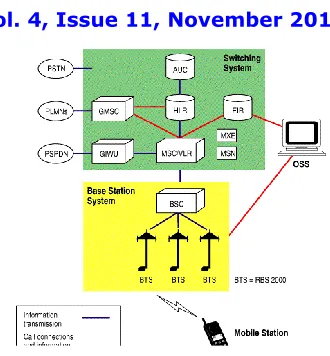
Figure 2. GSM Network Elements
The Switching System
The switching system (SS) is responsible for performing call processing and subscriber-related purposes. The switching system includes the following functional units:
Home location registers (HLR)—The HLR is a database used for storage and management of subscriptions. The HLR is measured themost important database, as it stores perpetual data around subscribers, including a subscriber's facility profile, locationinformation, and action status. When an individual purchase asubscription from one of the PCS operatives, he or she is registered inthe HLR of that operator.
Mobile services switching center (MSC)—The MSC performs the telephony switching functions of the system. It panels calls to and from other telephone and data systems. It also attains such functionsas toll ticketing, network interfacing, sharedchannel signals, andothers.
Visitor location registers (VLR)—The VLR is a database that contains brief information about subscribers that is needed by the MSC in Order to service visiting subscribers. The VLR is always combined with the MSC. When a mobile station roves into a new MSC area, the VLR connected to that MSC will demand data about the mobile station from the HLR. Later, if the mobile station kinds a call, the VLR will havethe indication needed for call setup without having to interview the HLR each time.
Authentication center (AUC) - A unit called the AUC provides authentication and encryption parameters that verify the user's identity and ensure the confidentiality of each call. The AUC keeps network operators from different types of fraud found in today's cellular world.
Equipment identity register (EIR)—The EIR is a database thatcontains information about the identity of mobile equipment that avoids calls from taken, unauthorized, or defective mobile stations. The AUC and EIR are applied as Stand-alone nodes or as a combined AUC/EIR node.
The Base Station System (BSS)
All radio-related functions are achieved in the BSS, which consists of basestation controllers (BSCs) and the base transceiver stations (BTSs).
BSC—The BSC provides all the control purposes and physical links among the MSC and BTS. It is a high-capacity switch that provides functions such as handover, cell formationdata and controller of radio frequency (RF) power levels in base transceiver stations. A number of BSCs are aided by an MSC.
ISSN (Print) : 2320 – 3765 ISSN (Online): 2278 – 8875
I
nternational
J
ournal of
A
dvanced
R
esearch in
E
lectrical,
E
lectronics and
I
nstrumentation
E
ngineering
(An ISO 3297: 2007 Certified Organization)
Vol. 4, Issue 11, November 2015
The Operation and Support System
The operations and maintenance center (OMC) is connected to all apparatus in the switching system and to the BSC. The application of OMC is called the operation and support system (OSS). The OSS is the functional object from whichthe network operator monitors and controls the system. The determination of OSS is tooffer the customer cost-effective support for federal, regional and localoperational and maintenance activities that are required for a GSM network. Animportant function of OSS is to beProvide a network overview and supportthemaintenance activities of different operation and maintenance organizations.
Additional Functional Elements
Message center (MXE)—The MXE is a node that providesintegrated voice, fax, and statistic messaging. Exactly, the MXEknobs short message facility, cell broadcast, voice mail, fax mailing, email, andannouncement.
Mobile service node (MSN)—The MSN is the node that handles the mobile intelligent network (IN) services.
Gateway mobile services switching center (GMSC)—A gateway is a node used to interconnect two networks. The gateway is frequently implemented in an MSC. The MSC is then declared to as the GMSC.
GSM interworking unit (GIWU)—The GIWU consists of bothhardware and software that deliversaboundary to various networks for data communications. Through the GIWU, users can diverse between speech and data during thesame call. The GIWU hardware equipment is substantially located at the MSC/VLR.
IV. GSM NETWORK AREAS
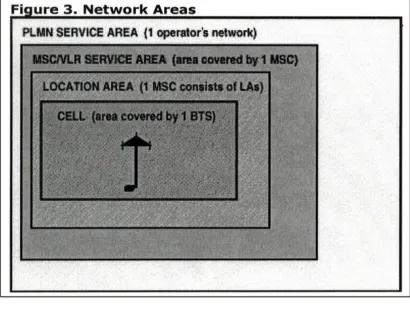
The GSM network is made up of geographic areas. As shown in fig 3, these areas include cells, location areas (LAs), MSC/VLR service areas, and public land mobile network (PLMN) areas.
Figure 3. Network Areas
Location Areas
An MSC/VLR service area signifies the part of the GSM network that is covered by one MSC and which is accessible, as it is registered in the VLR of the MSC.
V.GSM SPECIFICATIONS
Before looking at the GSM specifications, it is important to comprehend thefollowing basic terms: Bandwidth—Thechoice of a channel's limits; the broader the bandwidth, the faster data can be sent. Bits per second (bps)—A single on-off pulse of data; eight bits are equivalent to one byte
ISSN (Print) : 2320 – 3765 ISSN (Online): 2278 – 8875
I
nternational
J
ournal of
A
dvanced
R
esearch in
E
lectrical,
E
lectronics and
I
nstrumentation
E
ngineering
(An ISO 3297: 2007 Certified Organization)
Vol. 4, Issue 11, November 2015
Kilo (k)—kilo is the description for 1,000; the abbreviation kbps signifies 1,000 bits per second Megahertz (MHz)—1,000,000 hertz (cycles per second)
Milliseconds (MS)—one-thousandth of a second
Watt (W)—A measure of power of a transmitter Specifications for the different personal communication services (PCS) systems varyamong the different PCS networks. Listed below is aexplanation of the specifications and characteristics for GSM.
Frequency band—The frequency range specified for GSM is 1,850 to 1,990 MHz (mobile station to base station). Duplex distance—The duplex distance is 80 MHz Duplex distance is the reserve between the uplink and downlink frequencies. A networkhas two frequencies 80 MHz apart.
Channel separation—The separation between together carrier frequencies. In GSM, there is 200 kHz.
Modulation—Modulation is the process of sending a signal by changing the characteristics of a carrier frequency. This is whole in GSM via
Gaussian minimum shift keying (GMSK).
Transmission rate—GSM is a digital system with an over-the-air bit rate of 270 kbps.
Access method—GSM uses the time division multiple access (TDMA) concept. TDMA is a method in which several different calls may
share the same carrier. Each call is allotted a particular time slot.
Speech coder—GSM uses linear predictive coding (LPC). The purpose of LPC is to reduce the bit rate. The LPC delivers parameters for a filter that mimics the vocal area. The signal passes through this filter, leaving behind a remaining signal. Speech is resolute at 13 kbps.
VI. GSM SUBSCRIBER SERVICES
There are two basic types of services accessibleover GSM: telephony (also referred to as tele services) and data (also referred to as bearer services).Telephony services are mainly voice services that provide subscribers with the complete capability (including necessary terminal equipment) to communicate with other subscribers. Data services deliver the capacity necessary to transmit suitable data signals between two access points creating aboundary to the network. In addition to usual telephony and emergency calling, the following subscriber services are maintained by GSM:
Dual-tone multifrequency (DTMF)—DTMF is a tone signaling system often used for various control purposes via the telephone network, such as remote control of areplying machine. GSM chains full-originating DTMF.
Facsimile group III—GSM supports CCITT Group 3 reproduction. As standard fax machines are designed to be connected to a telephone using analog signals, a special fax converter linkedto the discussionis used in the GSM system. Thisallows a GSM–connected fax to communicate with any analog fax in the network.
Short message services—Asuitable facility of the GSM network is the short message service. A message involving of a maximum of 160 alphanumeric characters can be sent to or from a mobile station. This service can be viewed as liberal form of alphanumeric contacting with a number of advantages. If the subscriber’s mobile component ispowered off or has left the coverage area, the message is kept and accessible back to the subscriber.
Cell broadcast—A variation of the short message service is the cell broadcast facility. A message of aextreme of 93 characters can be broadcast to all mobile subscribers in certain geographic area. Typical applications contain traffic congestion warnings and reports on accidents.
Voicemail—This service is actually an answering machine within the network, which is measured by the subscriber. Calls can be advancedto the subscriber's voice-mail box and the subscriber forms for messages via a personal security code. Fax mail—with this service, the subscriber can accept fax messages at any fax machine. The messages are deposited in a service center from which they can be retrieved by the subscriber via a personal security code to the desired fax number. Call forwarding—This service gives the subscriber the skill to forward incoming calls to another number if the called mobile unit is notreachable, if it is busy, if there is no response, or if call forwarding is allowed absolutely.
ISSN (Print) : 2320 – 3765 ISSN (Online): 2278 – 8875
I
nternational
J
ournal of
A
dvanced
R
esearch in
E
lectrical,
E
lectronics and
I
nstrumentation
E
ngineering
(An ISO 3297: 2007 Certified Organization)
Vol. 4, Issue 11, November 2015
Barring of incoming calls—This function allows the subscriber to prevent incoming calls. The following two circumstances for incoming call barring exists: bearing of all incoming calls and barring of incoming calls when roaming outside the home PLMN.
Advice of charge (AoC)—The AoC service provides the mobile subscriber with an estimate of the call cares. There are two kinds of AoCInformation: One that provides the subscriber with an approximation of the bill and one that can be used for immediate charging purposes. AoCfor data calls is providing on the basis of time measurements.
Call hold—This service allows the subscriber to disruption an ongoing call and then subsequently regenerate the call. The call hold service is only applicable to normal telephony.
Call waiting—This service allows the mobile subscriber to be notified of an incoming call during a conversation. The subscriber can answer, discard, or disregard the incoming call. Call waiting is applicable to all GSM telecommunications services using a circuit-switched connection.
Multiparty service—The multiparty service enables a mobile subscriber to establish a multiparty conversation—that is animmediate conversation between three and six subscribers. This service is only appropriate to normal telephony.
Calling line identification presentation/restriction—Theseservices source the called party with the integrated services digital network (ISDN) number of the calling party. The restraint service allows the calling party to control the presentation. The restraintdominates the presentation.
VII. CONCLUSION
The communication growth and the increase of living standard of people are directlyrelated to
the more use of cellular mobile. Cellular mobile radio-the high end cultured technology that allowseveryone to communicate anywhere with anybody. The mobile telephony industry quickly growing and that has become support for business success and competence a part of modern lifestyles all over the world. In near forth coming days, the third generation mobile telephony becomes available whole finished the world, which will give the ability of videoconference in mobile telephone.
REFERENCES
[1] Stefano Avallone, Antonio Pescape, and GiorgioVentre. Analysis and experimentation of Internet
Traffic Generator. InProc. of the Int. Conf. on Next Generation Tele traffic and Wired/Wireless Advanced Networking, 2004. [2] Peter Benko, Gabor Malicsko, and AndrasVeres.A Large-scale, Passive Analysis of End-to-EndTCP Performance overGprs. [3] R. Chakravorty, J. Cartwright, and I. Pratt.Practical Experience with TCP over GPRS, 2002.
[4] R. Chakravorty and I. Pratt. Performance IssuesWith General Packet Radio Service, 2002.
[5] P. Doherty, P. Haslum, F. Heintz, T. Merz, T. Persson, and B. Wingman. A DistributedArchitecture for Autonomous Unmanned Aerial Vehicle Experimentation. In Proc. of theInt. Symp. on Distributed Autonomous RoboticSystems
[6] Gunnar Heine and Holger Sagkob.GPRS Gateway to Third Generation Mobile Networks. ArtechHouse, Inc, 2003.
[7] T. Merz. Building a System for Autonomous Aerial Robotics Research. In Proc. of the IFACSymp. On Intelligent Autonomous Vehicles, 2004. [8] Micro Edition Java 2 Platform.http://java.sun.com/j2me/
[9] David L. Mills. Internet Time Synchronization