Vol. 4, Issue 10, October 2015
Design a Cross Platform Mobile Application
for Student Information System
Dr. G. Shankar Lingam1
Professor, Dept. of CSE, Chaitanya Institute of Technology& Science, Warangal, Telangana, India1
ABSTRACT: In Institutions ofbetter schooling, using mobile smartphone is greater thancomputer systems. With mobile devices, we will have “Information atour finger guidelines everywhere at any time”, so that users could have ahigher experience to get right of entry to facts and revel in manyapplications. There is a threat to transplant academic affairsand facts from computer to mobile phones to improveservice exceptional and management efficiency. The applicationscreated via PhoneGap mobile improvement framework arecross-platform which enables avoid growing equal sort ofapplication one at a time. This paper aims at sharingrecords between college students, team of workers participants, departmentsand college management. The utility will help college studentsto check their effects, attendance, view private information, testfor bulletins and many others. Staff members and college students can viewtheir time table of lessons and additionally, offer more value-introducedservices that are clean to apply without delay from mobile phones.This paper objectives to expand a Cross-Platform MobileApplication for Student Information System (SIS).
KEYWORDS:Cross-Platform, Information System, MobileApplication, SIS, PhoneGap, Web Service
I. INTRODUCTION
Mobile improvement nowadays is developing exponentially. Today each and everyindividual in this worldwide has a smart-phone in his pocket. Smartphone’s integrate more than a few functions including mediagamers, camera and GPS with advanced computing capabilities and touch panels are enjoying ever increasingpopularity. Smartphone’s help us to attain a variety of tasks via something called packages or Appsto brief. According to Gartner [3], Google’s Android, Apple’s iOS and RIM’s Blackberry all have at the least a 10% marketplace share. For completing this assessment paper and observe about this subject matter a total of 4studies papershad been used which helped to recognize conceptual and contemporary scenario of Cross-platform cell softwaredevelopment.
CIDER[1-2] is essentially a working device compatibility architecture that can run packages constructed fordifferent mobile ecosystems preferably iOS and Android collectively on the identical Smartphone or tablet. Basicallyin less complicated phrases CIDER had the capacity to run unmodified iOS binaries at the Android subsystem without anysort of modification. CIDER achieves the venture of increasing the capability of home Android kernel throughconcurrently the use of the space kernel and the slave kernel that is the utility binary interface in our case.
User area of the slave kernel gets in touch with the Cider enabled kernel in exactly the same approaches as theslave kernel. That is, the iOS programs get in to Linux based totally kernel approach as if they're operating on ahome kernel of iOS subsystem that is going for walks on a regular iOS based tool. Instance of a foreign kernel, andreuse and run unmodified foreign user space library code. Now coming to the structure of those twooperating systems. IOS runs on ARM CPUs like Android, however has a very distinct software program ecosystem. IOS isbuilt at the XNU [8] kernel, a hybrid aggregate of a monolithic BSD kernel and a Mach microkernel [5]walking in asingle kernel handle with space. When we communicate about Android, Each Android app is compiled intoDalvik[4] byte code (dex) layout, and runs in a separate Dalvik VM instance.
Vol. 4, Issue 10, October 2015
solutions and cross-compiling. Up to now, there aren't any production-readysolutions of this category. Hence, until this sorts of methods are concentrates on move-platform solutions thatcombine the supply code of an app with a runtime environment. Some of the examples of pass-platformapplication improvement tools are Phone Gap, which is a Hybrid framework and Titanium. The most outstandinghybrid framework till date for pass platform application development is Phone Gap. Phone Gap was firstlycreated through Nitobi Soft-ware, which has been acquired by Adobe.
The improvement now takes area inside theApache Cordova task of the Apache Foundation, of which Phone Gap is a distribution. Phone Gap a completelypopular cross-platform mobile software improvement device is loosely primarily based on jQuery which is a totally fastlibrary conversion tool. This research paper helped to analyse how differentapparatus which can be currently to be had in the market function and interact with every different.Also the technology on which cross-platform cellular software development tools which might bepresently to be had inside the marketplace are currently based on a number of those technologies which care currently verypopular are HTML5, Javscript and open supply libraries such as jQuery[7] and jQtouch[6]. Thus developers canuse an outstanding a part of their abilities to increase mobile programs. Mobile-internet applications are programs whichuse an example of mobile internet browser to run the utility. These are perfect for mobile websites likem.Yahoo.Com, m.Fb.Com. These applications are developed the usage of pass-platform SDK’s and open supplylibraries including jQuery, jQtouch, and so forth. The user interface (UI) is developed in HTML5 and common sense is described by means ofJavaScript. The very last deliverable is a fixed of files that can be hosted on an internet server and the application can beaccessed the usage of any net browser which might be from a PC, Android device, iOS tool or a Blackberry device.
Hybrid cellular applications are a mixture of the preceding utility kinds. These applications areadvanced the use of open supply libraries however additionally have access to a number of the native competencies of a tool which includesCamera, GPS and so on. So in easy phrases, pass-platform mobile improvement with the assistance of taking instance of HTML5 primarily basedweb software which can be accessed from any form of Mobile Browser.
The objective of thispaper is to creation and management of accurate and up-to date information for staff, students and college authorities.It will ensure data integrity and validation and support forstrong error-handling system. This system is expected toincrease efficiency; users can access as well as share theinformation from mobile phones. The system utilizes userauthentication, displaying only information necessary foran individual.
II. RELATED WORK
Little research is available comparing CPDTs. Some comparison of features has beendone in [9] and [11] although they lack some depth. The CPDT evaluators used a 13item chart in [9] to allow comparison of tool features. Many important items likestorage and camera access are covered in the survey. However, neither of thesereports includes performance evaluation or discussion of development practices anddetailed costs.
In [10], the authors discuss many CPDTs and provide partial comparison. Theirwork includes discussion of native versus web-based user interface elements and theimportance of well performing applications. However, the authors state that they arenot concerned with the internal workings of the tools and only if the applications willbe approved for the application stores as the main development need. The articlediscusses the lack of debugging tools in many current CPDTs and provides an 8 pointfeature comparison. The authors develop a simple application that creates a screenwith a text label and measured the RAM usage and start time for nine CPDTs.
The results show the quick launch time for the application built using the nativeAndroid SDK but a much slower start for other tools such as Titanium and PhoneGap.Runtime based CPDTs seem to fare the worst and have large RAM footprints. Thisinformation provides useful understanding of the possible performance differenceswith developing applications on the Android platform using CPDTs but does notinclude other platforms or more extensive tests beyond initialization. It is possiblewith further testing that an application may perform poorly for initialization but runremarkably well afterwards but this cannot be determined by this test.
Vol. 4, Issue 10, October 2015
Furthermore, it also takes care of the interfacingbetween JavaScript API’s that are used by the applicationwith native API’s that are used by mobile OS’s. Thefunctionality of this layer is to maintain the relationshipbetween JavaScript API’s and native API’s of each mobileOS. PhoneGap supports most of the mobile operatingsystems like iPhone, Windows Mobile, BlackBerry,Android Symbian, and WebOS which can be worked alongwith other operating systems like Linux, Mac andWindows. It also supports scripting languages like HTML,JavaScript, and CSS which makes it an easy tool to workwith. PhoneGap provides JavaScript API’s to developersthat allow the access to advanced device functionality, suchas Accelerometer, Barcode, Bluetooth, Calendar, Camera,Compass, Connection, Contacts, File, GPS, Menu, NFC,etc. [13].
Figure 2: interfacing layers of the phonegap architecture
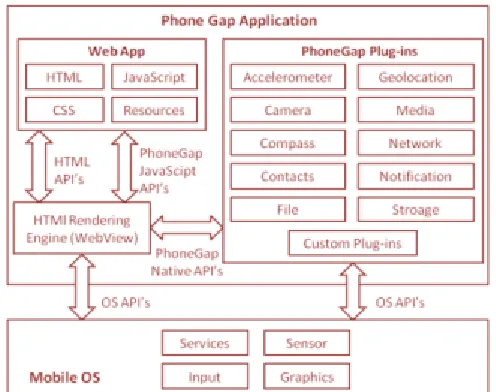
In Fig. 3 is shown a more detailed architecture schemaprovided by IBM. It represents all components about theweb application, HTML rendering engine, PhoneGap API’sand OS layers. Moreover, some different interfaces areshown in detail, such as the interfacing between PhoneGapAPI’s and native API’s layers.
Figure 3: complete schema of phonegap architecture and interfacing among components [14].
III.SUGGESTED SCHEME
Vol. 4, Issue 10, October 2015
look and feel environment etc.All the manual difficulties in managing the details of SIShave been rectified by implementing app on mobile device.
A. DESIGN OF SIS
PhoneGap is used to make the transition from the nativemobile languages to web based programming languages inall three operating systems.
The backend code of every platform is written in locallanguage. As seen in Figure.4, the PhoneGap frameworkbridges the gap between the local language and HTML viarunning as a wrapper for the app and generating JavaScriptused inside the app for gaining access to the native API. Due to jQueryand jQuery Mobile the utility is written in one HTMLdocument thus allowing every page to be inside a div andfiguring out them with different ID’s while used to navigateover the app. The content material proven within the app differsdepending on what page the user has navigated to.The software is constructed with one-of-a-kind views thatthe person navigates through.
Figure 4: structure of a phonegap produced app [15].
The home screen lets the usersee a top level view of all of the available pages the consumer cannavigate to, see Figure.5. The paper intended for a familiarappearance and sense of the application in order that a user without problems canapprehend the navigation through the app. With the assist ofjQuery Mobile the design of the utility is comparable inicons and toolbars with most common packages. Withina web page, a header changed into created that includes a navigation bar,permitting the user to return lower back to preceding web page or crossat once to the home screen.
Vol. 4, Issue 10, October 2015
As shown in Figure.6, SIS can be classified into threelayers according to system functions. They are data layer,business layer and presentation layer.
A. DATA LAYER
This provides basic data for the upper layers and storesthe data into the database system, including timetable,attendance, students and staff profiles, announcements etc.
B. BUSINESS LAYER
This provides business logic and functions for storingand retrieving data from the database, and works as amediator between the Presentation layer and Data layer.
C. PRESENTATION LAYER
This provides the user interface that allows the user tointeract with the application.PhoneGap application acts as a client for the user tointeract with. PhoneGap client communicates with anapplication server to receive data. The application serverhandles business logic and communicates with a back-enddata repository. The application server is normally a webserver (Apache, IIS, etc...) and has a server side scriptinglanguage such as ColdFusion, Java, .NET, PHP, etc.PhoneGap is agnostic of back-end technologies and canwork with any application server using standard web protocols [25]. The application server performs businesslogic and calculations, and generally retrieves or persistsdata from a separate data repository - this is normally arelational database, but could be any structure ormechanism for data persistence.PhoneGap applications cannot communicate directly to adatabase; communication is routed through an applicationserver. The client to application server communicationcan be based upon standard HTTP requests for HTMLcontent, RESTful XML services, JSON services, or SOAP.These are the exact same techniques that can be used for adesktop-browser based AJAX application.
Figure.6: architecture of sis.
The client-side architecture generally uses the singlepage application model, where the application logic isinside a single HTML page. This page is never unloadedfrom memory. All data will be displayed by updating theHTML DOM, data is retrieved from the application serverusing AJAX techniques, and variables are kept inmemory within JavaScript.
IV.CONCLUSION
Vol. 4, Issue 10, October 2015
can be extra in the futurebecause mobiledevices are flexible, clean to apply in actualtime. PhoneGap is used for cross-platform development ofmobile apps for multiple structures by using the usage of general webdevelopment technology.
REFERENCES
[1]. Cider: Native Execution of iOS Apps on Android, Jeremy Andrus, Alexander Vant Hof, Naser AlDuaij, Christof-fer Dall, NicolasViennot, and Jason Nieh, IEEE Micro, 2008,Vol.1.
[2]. Heitktter, Henning, Sebastian Hanschke, and Tim A. Ma-jchrzak. ”Evaluating cross-platform development approaches for mobileapplications.” Web Information Systems and Technologies. Springer Berlin Heidelberg, 2013. 120-138.
[3]. About PhoneGap (2011), http://phonegap.com/about
[4]. Android Development Tools plugin for Eclipse (2012), http://developer.android.com/sdk/eclipse-adt.html [5]. D Keuper, (s1019775, XNU a security evaluation), University of Twente and Certified Secure, December 13, 2012. [6]. http://developer.apple.com/members
[7]. http://source.google.com
[8]. https://developer.apple.com/xcode
[9] G. Hartmann, G. Stead, and A. DeGani, "Cross-platform mobile development,"Tribal, Lincoln House, The Paddocks, Tech. Rep. March 2011.
[Online].http://www.mole-project.net/images/documents/deliverables/WP4_crossplatform_mobile_development_March2011.pdf.
[10] J. Ohrt and V. Turau, "Cross-Platform Development Tools for SmartphoneApplications," Computer, vol. 45, no. 9, pp. 72-79, September 2012. [11] Vision Mobile, "Cross-Platform Developer Tools 2012," London, Tech. rep.2012. [Online]. http://www.visionmobile.com/product/cross-platformdeveloper-tools-2012/.
[12] Manuel P, Inderjeet Singh, Antonio Cicchetti, “Comparison ofCross-Platform Mobile Development Tools”, 2012 16th InternationalConference on Intelligence in Next Generation Networks.
[13] http://phonegap.com/about/feature/.
[14] http://www.slideshare.net/drbac/phonegap-day-ibm-phonegap-andthe-enterprise.
[15] http://publications.lib.chalmers.se/records/fulltext/167502.pdf
BIOGRAPHY