Pulse Width Modulation Based Adaptive
Hysteresis Current Controller Using
Intelligent Technique
Aasha Chauhan1, Dr. Ravindra Pratap Singh2
Ph.D Research Scholar, Dept. of Electrical, JJT University, Jhunjhunu, Rajasthan, India1
Ph.D Research Guide, Dept. of Electrical, NC College of Engineering, Israna, Panipat, India2
ABSTRACT: Recently wide spread of power electronic equipment has caused an increase of the harmonic disturbances in the power systems. The nonlinear loads draw harmonic and reactive power components of current from ac mains. Current harmonics generated by nonlinear loads such as adjustable speed drives, static power supplies and UPS. Thus a perfect compensator is required to avoid the consequences due to harmonics. This paper comprehensively analyses the relationship between adaptive hysteresis current controller and three-phase carrier-based pulse width modulation (PWM). Adaptive hysteresis current controller (HCC) technique for a three phase shunt active power filter with pulse width modulation for current harmonics mitigation is proposed. Harmonics extraction is based on the instantaneous active and reactive power theorem in time domain by calculating the power compensation. A closed loop control system is implemented and the error current is the difference between the reference current obtained from the power compensation and the actual current that needs to be injected back into the line. Most applications of three-phase voltage-source pulse width modulated(VS-PWM) converters, ac motor drives, active filters, high power factor ac/dc converters, uninterruptible power supply (UPS) systems, and ac power supplies have a control structure comprising an internal current feedback loop. Therefore, current control of PWM converters is one of the most important subjects of modern power electronics.
KEYWORDS: Fuzzy Logic Controller (FLC), Harmonic Current Controller, Harmonics Mitigation, Pulse width Modulation (PWM), Total Harmonic Distortion (THD).
I. INTRODUCTION
Since the rapid development of the semiconductor industry, power electronics, these power electronics devices have benefited the electrical and electronics industry, these devices are also the main source of power harmonics in the power system. The widespread use of electronic equipment, such as information technology equipment, power electronics such as adjustable speed drives (ASD), programmable logic controllers (PLC), energy-efficient lighting, led to a complete change of electric loads nature. These power harmonics are called electrical pollution which will degrade the quality of the power supply. As a result, filtering process for these harmonics is needed in order to improve the quality of the power supply. Power Quality (PQ) related issues are of most concern nowadays. These loads are simultaneously the major causers and the major victims of power quality problems. Due to their non-linearity, all these loads cause disturbances in the voltage waveform Along with technology advance, the organization of the worldwide economy has evolved towards globalization and the profit margins of many activities tend to decrease.
performance characteristics. As for the power electronic devices, these loads control the flow of power by supplying the voltages and currents in certain intervals of the fundamental period. Thus, the current drawn by the load is no longer sinusoidal but appears chopped or flattened.
II. PULSE WIDTH MODULATION
A carrier-based PWM modulator is comprised of modulation signals and carrier signal. The operation of PWM can be divided into two modes
A. Linear Mode-In the linear mode, the peak of a modulation signal is less than or equal to the peak of the carrier signal. When the carrier frequency is greater than 20 modulation signal frequency, the gain of PWM
B. Nonlinear Mode-When the peak of a modulation signal is greater than the peak of the carrier signal, over- modulation occurs with. The six-step mode marks the end of the nonlinear mode. The THD of output switched waveforms increases.
A variety of approaches, such as hysteresis-based current control, PWM current or voltage control, deadbeat control, sliding mode of current control, fuzzy-based current control, etc., are implemented, to obtain the control signals for the switching devices of the APF's.
In the basic sinusoidal PWM method the reference signals of all phases are sinusoidal. However in other PWM methods the reference signal of each phase is shifted with an offset signal which is the same for all phases [5]. For these PWM methods, the average value of the output phase voltage pulses over a Ts switching period forms a waveform not equal to a pure sinusoidal signal (unless the offset signal is zero). However the average value of the line-to-line voltage pulses is sinusoidal since all phase signals are shifted (up or down) equally.
Figure- 1 Generation method of the PWM signals and the corresponding phase voltage waveform for phase “a”
III. ADAPTIVE HYSTERESIS CURRENT CONTROLLER
An adaptive hysteresis-band current control PWM technique can be programmed as a function of the active filter and supply parameters to minimize the influence of current distortions on a modulated waveform.
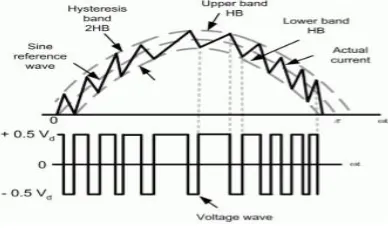
Hysteresis-band PWM is basically an instantaneous feedback current control method of PWM where the actual current continually tracks the command current within a hysteresis band. Hysteresis control schemes are based on a nonlinear feedback loop with two level hysteresis comparators. The switching signals are produced directly when the error exceeds an assigned tolerance band as shown in figure 2.
Figure 3 shows the operation principle of the hysteresis modulation/control scheme. The controller generates the sinusoidal reference current of desired magnitude and frequency that is compared with the actual line current. If the current exceeds the upper limit of the hysteresis band, the upper switch of the inverter arm is turned off and the lower switch is turned on. As a result, the current starts to decay. If the current crosses the lower limit of the hysteresis band, the lower switch of the inverter arm is turned off and the upper switch is turned on. As a result, the current gets back into the hysteresis band [11]. Hence, the actual current is forced to track the reference current within the hysteresis band.
Figure-3 Principles of Hysteresis Controller
Figure 4 shows the hysteresis current controller operation where the current references has been compared with the input supply current and the error signal is generated which is fed in the inverter drive circuits respectively.
Figure-4 Typically Hysteresis Current Controller Operation
IV. FUZZY LOGIC CONTROLLER (FLC)
Fuzzy logic unlike Boolean or crisp logic, deal with problems that have vagueness, uncertainty or imprecision and uses membership functions with values varying between 0 and 1. Fuzzy logic uses fuzzy set theory, in which a variable is a member of one or more sets, with a specified degree of membership. Fuzzy logic allow us to emulate the human reasoning process in computers, quantify imprecise information, make decision based on vague and in complete date, yet by applying a “defuzziciation” process, arrive at definite conclusions.
The block diagram representation of a fuzzy logic controller (FLC) is shown in figure 5. The actual capacitor voltage is compared with a set reference value. The error signal is then processed through a Fuzzy controller, which provides zero steady error in tracking the reference current signal
.
In fuzzy logic controller a linguistic control strategy has been converted into an automatic control strategy with the use of different fuzzy rules. These fuzzy rules are constructed by expert experience or knowledge data-base available with the system. So the first step of working of fuzzy controller will be comparison of input voltage Vdc and the input reference voltage Vdc-ref.
Figure 6 shows the fuzzy editor tool where input variable is compared with the output variable.
Figure- 6 FIS Editor
The input variable has been selected and the membership function of input variable is entered with all the fuzzy rules as shown in figure 7 below.
Figure- 7 Membership Function of Input Variable
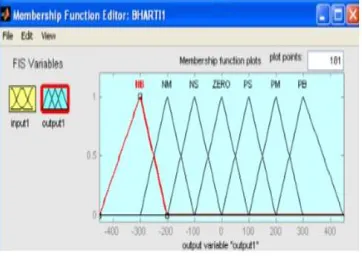
Similarly, the output variable has been selected and the membership function of output variable is entered with all the fuzzy rules as shown in figure 8 below. Then the output variable of the fuzzy logic controller is followed by the limiter which generates control current Imax.
Figure- 8 Membership Function of Output Variable
V. RESULT AND DISCUSSION
The simulation results are analysed and the model is built by using the Simulation toolbox and is simulated and for each stage of the design block.
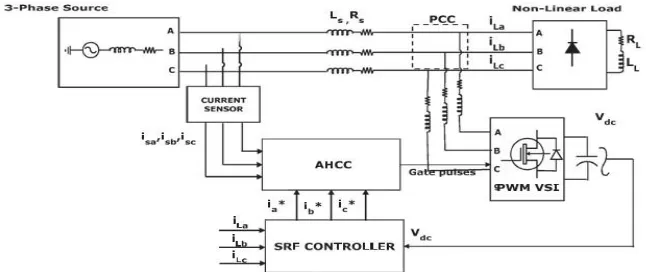
Figure 10 shows the Adaptive Hysteresis Current Controller Block with PWM in which harmonic compensation block is present where the current harmonics can be reduced by subtracting the load current by compensated current and then it can be applied to harmonic limiter block where it can be converted into Boolean form in order to get the pulses which can be fed to gate pulses of the universal bridge.
Figure- 10 Adaptive Hysteresis Current Controller implemented with Pulse Width Modulation VSI configuration
Figure 11 shows the simulation block of the proposed scheme where adaptive hysteresis current controller generates the signal which is given to the gating signal.
Figure- 11 Simulation Block Diagram of proposed scheme
Figure 12 shows the DC bus capacitor voltage which delivers the reactive power demanded by the proposed scheme. As the reactive power comes from the DC-bus capacitor and this reactive energy transfers between the load and the DC-bus capacitor (charging and discharging of the DC-bus capacitor), the average DC-bus voltage can be maintained at a prescribed value. Here, DC bus voltage has been maintained at 0.2sec. If KP and KI are large, the DC-bus voltage
regulation is dominant, and the steady-state DC-bus voltage error is low. On the hand, if KP and KI are small, the real
power unbalanced gives little effect to the transient performance. Therefore, the proper selection of KP and KI is
Figure- 12 DC Voltage Scope
Figure 13-17 shows the Simulation result of PWM based AHCC with and without Fuzzy Logic Controller.
The proposed scheme without fuzzy logic controller shows distortion in the three phases of the pulse width modulation which is based on the adaptive hysteresis current controller as shown below.
Figure-13 Simuation result of Three Phase PWM based AHCC without Fuzzy Logic Controller
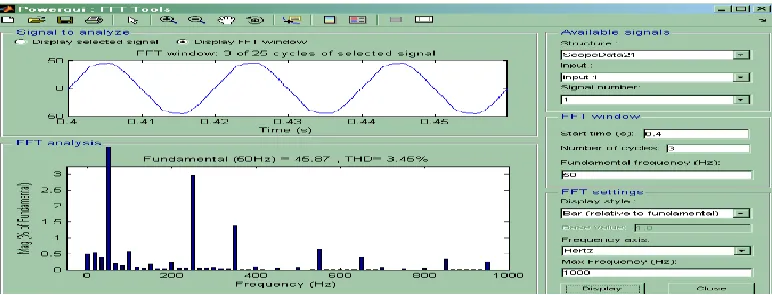
The system reduces the current harmonics present in the system to 3.45% as shown with three phase source current without Fuzzy Logic Controller.
Figure 15 shows the proposed methodology with fuzzy logic controller. In this, distortions present in all the three phases have been reduced with the FLC controller.
Figure- 15 Simuation result of Three Phase PWM based AHCC with Fuzzy Logic Controller
Figure 16 shows this methodology with non-linear load present in the system. Here the distortion has been reduced in the source side of current with the help of FLC controller.
\
Figure- 16 Non-Linear Load current and Sinusoidal Source current with Fuzzy Logic Controller
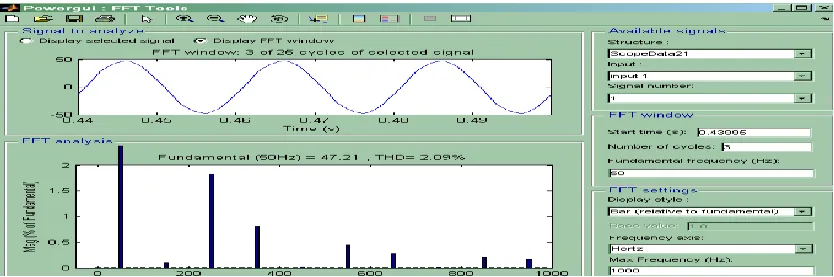
Figure 17 shows that the distortions have been reduced in the system with the total harmonic distortion of three phase source current at 0.4s upto 2.09% respectively as shown below:
Figure- 17 Total Harmonic Distortion of three phase Source Current is 2.09% at t = 0.4s.
total harmonic distortion has been reduced upto 2.09% which comes under the standard form respectively.
VI. CONCLUSION
The improvements in the control techniques result in rather satisfactory performance levels for proposed scheme. However, the results of the comparison show a certain superiority of the hysteresis control. Indeed, the performance of this control strategy is almost unaffected on the basis of the performance indices considered in the paper, i.e., harmonic content and THD turns out to be better than the other techniques. The substantial increase in the use of solid-state power control results in harmonic pollution above the tolerable limits. Utilities are finding it difficult to maintain the power quality at the consumer end, and consumers are paying the penalties indirectly in the form of increased plant downtimes, etc. At present, Shunt Active Power Filter (SAPF) technology is well developed, and many manufacturers are fabricating SAPF's with large capacities. The utilities in the long run will induce the consumers with nonlinear loads to use the SAPF's for maintaining the power quality at acceptable levels. The proposed scheme of Pulse Width Modulation based on Adaptive Hysteresis Current Controller with and without fuzzy logic controller have been achieved by reducing the harmonic components that exist in a power system with a chosen non-linear load with THD upto 2.09%. However, the system can be further improved in future by various methodologies such as neural network method and by Genetic Algorithm method.
REFERENCES
[1] Mikkili Suresh, Anup Kumar Panda, Y. Suresh “Fuzzy Controller Based 3Phase 4Wire Shunt Active Filter for Mitigation of Current Harmonics with Combined p-q and I d-Iq Control Strategies” Energy and Power Engineering, 2011, 3, Published Online February 2011.
[2] Karuppanan P., Mahapatra K.K., “PLL with fuzzy logic controller based shunt active power filter for harmonic and reactive power compensation” IEEE Conference, IICPT, Power Electronics, (2011):pp.1-6.
[3] Galli, W., Skvarenina, T. L., Chowdhury, B. H. and Akagi, H. Power Quality and Utility Interface Issues. In: Skvarenina, T. L. The Power Electronics Handbook. United State of America: CRC Press LLC. Chap. 17: 1-48. 2002.
[4] Akagi, Hirofumi. Trends in Active Power Line Conditioners. IEEE Transactions on Power Electronics. 1994. 9 (3): 263-268. [5] Clemmensen, J. M. Estimating the Cost of Power Quality. IEEE Spectrum.1993. 40-41.
[6] Bhavaraju, V. B. Analysis and Design of Some New Active Power Filters for Power Quality Enhancement. Ph.D. Thesis. Texas A&M University;1994.
[7] Aasha Chauhan, „Power Quality Improvement By Suppression Of Current Harmonics Using Hysteresis Controller Technique‟, in IJRTE, Volume-2, Issue-2, May 2013, ISSN: 2277-3878.
[8] Akagi, Hirofumi. Active Filters for Power Conditioning. In Timothy L.Skvarenina. The Power Electronics Handbook: Industrial Electronics Series. United State of America: CRC Press. Chap. 17:30-63. 2002.
[9] .Peng, F. Z., Akagi, H. and Nabae, A. A Novel Harmonics Power Filter.IEEE Transactions on Power Electronics Specialists Conference. April 11-14. PESC ‟88 Record: IEEE. 1988. 1151-1159.
[10] Aasha Chauhan, „Hysteresis Control For Current Harmonics Suppression Using Shunt Active Filter‟, in IJOART Volume 1, Issue 6 November, 2012, ISSN 2278-7763.
[11] Akagi, Hirofumi. New Trends in Active Filters for Power Conditioning. IEEE Transactions on Industry Application. 1996. 32 (6): 1312-1322. [12] Casaravilla, G, Salvia, A., Briozzo, C. and Watanabe, E. Control Strategies of Selective Harmonics Current Shunt Active Filter. IEE Proc.-Generation, Transmission and Distribution 2002. 149 (6): 689-694.
[13] Grady, W. M., Samotyi, M. J. and Noyola, A. H. Survey of Active Line Conditioning Methodologies. IEEE Transactions on Power Delivery.1990. 5 (3): 1536-1542.
[14] Dahono P.A, “New hysteresis current controller for single-phase bridge inverters” IET journal on Power electronics, vol.2 (2009):pp. 585-594.