A Survey on Face Recognition Methods
Dr. P. Kannan1, M. S. Sivagama Sundari2, Dr. K. R. Suja3
Associate Professor and Head, Department of ECE, Amrita College of Engineering and Technology, Nagercoil, India1
Assistant Professor, Department of EEE, Amrita College of Engineering and Technology, Nagercoil, India2
Associate Professor and Head, Department of EEE, Amrita College of Engineering and Technology, Nagercoil, India3
ABSTRACT:Nowadays, face recognition technique plays a vital role in security issues in all fields and firms. Some are not necessarily high security applications, but face recognition can help to overcome a large number of unsolved identification problems. The necessity behind the biometric recognition system is that it needs the cooperation of users, also the computing systems are usually expensive. Therefore, the face recognition system has received considerable attention. The faces are highly dynamic and having more problems with different poses and challenges for recognition. The researchers proposed many solutions to reduce such difficulties so as to improve the recognition accuracy.As many approaches have been proposed, efforts are also put in to provide an extensive survey of the methods developed over the years. The objective of this paper is to provide a survey of face recognition papers that appeared in the literature over the past decade under all severe conditions that were not discussed in the previous survey and to categorize them into meaningful approaches, viz. appearance based, feature based, and soft computing based. A comparative study of merits and demerits of these approaches have been presented.
KEYWORDS: Receiver operating characteristic (ROC), PR (Precision and Recall, Linear Discriminant Analysis (LDA), Complete Kernel Fisher Discriminant analysis (CKFD), Independent Component Analysis (ICA), local XOR pattern (LXP), Principal Component Analysis (PCA)Face Recognition.
I. INTRODUCTION
Face recognition has attained significance in different fields such as areas in which one has to abide by the rules and regulations, information security, entertainment, and surveillance, and it is recognized as one of the most typical applications of image analysis and understanding.
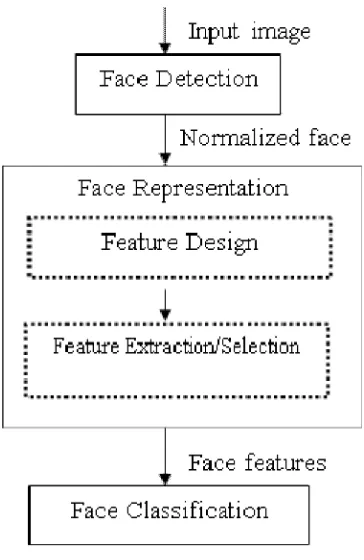
Several methodologies have been proposed for face recognition, and a lot of improvement has been made in the last few years. However, recognizing human faces perfectly under the unrestrained environments is still difficult for a machine. The slight changes that occur within a person which arise due to different lighting conditions, poses, rotations, translations, expressions, cluttering, occlusions and other factors include the main challenges.A general face recognition system comprises three steps such as detecting faces, effective representation of facial features and face classification as shown in Figure 1. The work in this paper is divided in two stages. 1) Text- Detection 2) Inpainting. Text detection is done by applying morphological open-close and close-open filters and combines the images. Thereafter, gradient is applied to detect the edges followed by thresholding and morphological dilation, erosion operation. Then, connected component labelling is performed to label each object separately. Finally, the set of selection criteria is applied to filter out non-text regions. After text detection, text inpainting is accomplished by using exemplar based Inpainting algorithm.
Face detection
Knowledge-based Face Detection
The a priori information of the face in terms of rules is expressed in knowledge-based algorithms. The rules usually capture the relationship between the facial features. These algorithms aim to determine the position of faces in an image which are primarily designed for face localization. Hierarchical knowledge-based and horizontal/vertical projection-based method are the two types of knowledge-projection-based algorithms which are available (Chellappa et al 1995) [3].
Fig 1: Architecture of a typical face recognition system
The multi-resolution hierarchy of images and specific rules defined at each image level is composed of hierarchical knowledge-based method. Image sub-sampling builds the hierarchy. The face detection procedure is started from the highest layer in the hierarchy (with the lowest resolution), and possible face candidates are extracted based on the general look of faces. Then the rule of more details such as the alignment of facial features verifies if each face candidate is carried out in the middle and bottom layers. This method provides ineffective results due to variations in rotation, scaling and translation. High detection rate is also not achieved in this method (Jain et al 2004).
Feature Invariant-based Face Detection
The structural features are found out from the image based on feature invariant algorithms that exist even when the pose, view point, or lighting conditions vary, and the face localization is carried out by using these structural features. Face localization is mainly carried out by feature invariant - based methods. The feature invariant approaches, started with feature extraction process, secondly finding candidates face, and finally verifying each candidate by spatial relations among these features. But the information of the whole image is exploited if face detection is done by the knowledge-based methods.
Template Matching-based Face Detection
A number of standard patterns of a face are stored to describe the face as a whole or the facial feature separately in template matching method. In this method, the correlations between an input image and the stored pattern are computed for detection. The deformation constraints are determined based on user-defined rules such as first-or-second-order derivative properties in the traditional deformable template matching techniques. These constraints are seeking for the smooth nature or some prior knowledge and this is not for all the patterns. Furthermore, the traditional techniques are mainly used for shape or boundary matching, and this is not for texture matching. These methods have been used for both face localization and detection. Adaptive appearance model is an excellent face detection technique based on deformable template matching.
Appearance-based Face Detection
Appearance-based method is not tried for detecting faces based on any prior knowledge about the appearance of the face, but rather some important features directly from a representative training set of faces is extracted. In other words, appearance-based techniques combine the a priori information of the face indirectly into the system through training schemes. These knowledgeable models are then used for detection.
Face feature representation
In the second step of classical face recognition system, the internal representation from the normalized face image is formed, which is commonly believed to be the key to the effective face recognition system. The face representation process has two consecutive steps such as designing facial features and extracting or selecting facial features as shown in Fig 1.
Feature Design
Particularly, a face feature descriptor from one face image is generated by using some transformation techniques generated by the feature design procedure, e.g. Gabor wavelets, Discrete Fourier transform or Designed operators (e.g. Local Binary Patterns (Ahonenet al 2006)).
Feature Extraction/Selection
In feature-based methods, information is extracted directly from some detected important points from the face such as eyes, nose, lips, etc. These points are usually determined from domain knowledge.
Traditional template-matching is just like using distance metric for face recognition, which means for each class (person), a set of symbolic templates is selected. Computation between a test image and each class is done to measure the similarity, and the class with the highest similarity score is selected as the correct match. Significant parts from the face image are detected in the part-based methods, and the part appearances are combined with machine learning tools for recognition, while in the feature-based methods features are extracted from facial feature points or the whole face, and these features are compared to achieve high recognition rate.
Face classification
Face recognition is the third step in which both face identification and face verification (also called authentication) are included. In face verification stage, approving a requested identity is based on the image of a face, either accepting or discarding the request (one-to-one matching). In face identification stage, the query face has to be compared with all the recorded face images of persons (one-to-many matching) in the trained database.
Performance measures for face recognition
Every system needs to be measured quantitatively for analysing its performance effectiveness. Face recognition needs a performance measure to know how efficiently the system performed in identifying the claimed identity of the face (Patrick et al 2010). The National Institute of Standards and Technology (NIST), a measurement standard laboratory, aims at enhancing economic security and improving quality of human life through promoting innovation and industrial competitiveness by advancing measurement science, standards, and technology. In NIST Multi-Biometric Evaluation 2010 (MBE 2010) series, the performance of the face recognition system is evaluated by the Receiver Operating Characteristics (ROC) curve and PR (Precision and Recall) curve.
Receiver Operating Characteristics
Receiver operating characteristic (ROC) curves are conventional methods for evaluating the performance of unsatisfactory pattern matching systems. A ROC curve plots, parametrically as a function of the decision threshold, the rate of “false positives” (i.e. impersonator attempts recognised) on the x-axis, against the corresponding rate of “true positives” (i.e. genuine attempts recognised) on the y-axis. ROC curves are threshold-independent, allowing performance comparison of different systems under similar conditions, or of single system under differing conditions.
In the two-class recognition case, True Positive (TP) means the number of faces to be detected by the system, while False Positive (FP) means the number of non-faces to be detected as faces. Also, False Negative (FN) means the number of non-faces missed to be detected as non-faces by the system.
Precision and Recall
A measure of the ability of a system to present only relevant items by a factor is called precision.
(%) = × 100 (1)
A measure of the ability of a system to present all relevant items by a factor is called recall.
(%) = × 100 (2)
( ) = × 100
(3)
(4)
= 1−( ) × 100 (5)
Applications of face recognition
Face Recognition system has proved to be useful in a wide range of applications such as commercial and research perspectives.
In the commercial perspective, face recognition plays a major role in security systems placed in airports, railway stations, ATM, etc. to identify the culprits. Face recognition system also protects privacy of the personal information store in personal computers, mobile phones, personal gadgets and so on. Face recognition further improves the authentication of the system by replacing the existing number systems such as PIN numbers, User ID and password.
In the visual perspective, face recognition has widened the area of research in image and video processing. To achieve higher recognition rate, research is also done in the area of neural networks in the human face. Finally, face recognition has broadened the way for advances in the realm of computer vision.
II.RELATEDWORK
SOFTWARE IMPLEMENTATION OF FACE RECOGNITION ALGORITHMS
Face detection plays an important role in a wide range of applications like security access control, model-based video coding, content-based video indexing, or advanced human and computer interaction (Zhao et al 2003). Face detection is very difficult if face pattern can have variable appearances due to lighting conditions, pose and expressions and occlusions (Chen &Wotao 2006).
There are two different methods in vogue to recognize a face. The first one uses a still image from a camera’s single shot. The other method uses a series of video frames to collect information about the face. In controlled situations like an airport check-in, where posture and illuminations do not vary much, the still image-based face recognition method shows higher resolution and more accuracy (Yampolskly& Jain 2012) [4].
But video-based face recognition is better, for example, in a public place where the subject has to be viewed through a security camera (Zhao et al 2003). Here, the image resolution is low and the situation is in a flux. Video-based algorithm fares well, when time and space vary as in an uncontrolled situation [5]. Still, the distance involved and the feeble information from the available low count pixels may pose a definite disadvantage. So, either of these approaches may be used as the situation demands (Klare& Jain 2013) [6].
Holistic-based Face Recognition Algorithms
In Holistic-based face recognition approach, the whole information about the facial image is considered. The transformation is taken on the whole facial image for the compact representation of face features. The transformation basis is generally obtained from statistical learning and analysis. This method is also called appearance-based method. During the past twenty years, this method attracted the most consideration against the other techniques. The following subsections discuss various holistic-based algorithms in detail.
Eigen Faces and Principal Component Analysis
illumination are not considerable [7]. Here, a face is projected on to a face space that has a stored up maximum variation among faces in a mathematical form. The second order correlation patterns are designed for face feature representation of this system. This system has two phases: training and recognition.
In the training phase, each face is represented as a column vector with the corresponding image pixel entry. These image vectors are normalized against the average face. The algorithm finds the Eigenvectors of the covariance of normalized faces. This Eigen vector matrix is multiplied by each of the face vectors, and their corresponding face space projections are calculated. Finally, the recognition threshold is computed based on the maximum distance between any two face projections.
In the recognition phase, using the Eigen vector matrix, a face is normalized against the average face and projected on to the face space. The Euclidean distance between the new face and known faces is calculated. The minimum value of these comparisons is chosen and compared with the training phase threshold. Values greater than the threshold ascertain a new face. If not, the face is a known one. The limitation of conventional PCA-based face recognition system is that it is sensitive to variations in pose and expression.
Yang et al (2002) pointed out extraction of face features and face recognition using Kernel PCA method. In this technique, Higher Order Statistics (HOS) of correlation patterns are constructed instead of second order statistics of correlation patterns for the face feature representation [8]. This system outperforms the classical Eigen faces method. But, Kernel PCA is computationally more expensive than PCA.
Jian et al (2004) proposed a new algorithm for image representation based on two-dimensional principal component analysis (2DPCA). In this technique, there is no need of matrix transformation since 2DPCA is based on 2D image matrices rather than 1D vector for feature extraction [9]. They constructed a covariance matrix from the original image matrices and their Eigen vectors directly for the face feature extraction. They conducted experiments and evaluated the designed system performance on ORL, AR, and Yale face databases. The experimental results showed that 2DPCA-based features are more efficient than PCA and Kernel PCA because 2DPCA-2DPCA-based covariance matrix is designed more accurately than the conventional PCA- based method. The limitation of 2DPCA is that it needs more coefficients for image representation than PCA.
Fisher Faces and Linear Discriminant Analysis
Belhumeur et al (1997) presented Linear Discriminant Analysis (LDA)- based face recognition algorithm which is insensitive to variation in facial expressions and lighting directions. LDA takes in multiple images of an individual for a set of individuals [10]. The face space created in LDA gives more weight to the variations between individuals than those of the same individual. So, LDA is not easily affected by changes in expression, pose or lighting variations. Based on respective formulas, LDA calculates within-the-class-scatter matrix and between-the-class-scatter matrix. The optimal projection “maximizes the ratio of the determinant of the between-classes-scatter matrix of the projected samples to the determinant of the within-class-scatter matrix of the projected samples”. PCA that is applied to the initial image set prevents the within-class-scatter matrix from being singular. The given mathematical formula ensures the class to which the target face belongs. They tested both the proposed and Eigen face algorithms on Harvard and Yale face databases. It was found that the proposed LDA has lower error rates than the conventional PCA method. The main disadvantages of this system are it is more complicated than PCA, and some of the individuals are only recognised under one lighting condition.
Jian Yang et al (2005) developed a new face recognition algorithm based on Complete Kernel Fisher Discriminant analysis (CKFD) algorithm. CKFD used double discriminant subspaces for two kinds of discriminant information such as regular and irregular. The performance of CKFD algorithm is tested and evaluated using FERET and CENPARMI handwritten numeral databases [12]. The proposed CKFD experimental results showed that it outperformed the other Kernel-based and conventional Fisher faces-based techniques. The limitation of KFD and CKFD is solution of an Eigen value problem.
Independent Component Analysis
Bartlett et al (2002) propounded a novel algorithm for face recognition which is named as Independent Component Analysis (ICA) which proved the importance of higher-order relationship between the pixels for face recognition [13]. Phase spectrum contains information through which humans identify faces. ICA algorithms use higher order relationship between the pixels and can capture the phase spectrum, unlike PCA which can capture only the amplitude spectrum, representing second order inter-pixel relationships.
The ICA InfoMax algorithm represents the input as an n-dimensional random vector, which then is reduced using PCA (without loss of higher order statistics). The covariance matrix of the result gives its factorized form. The independent constituent components of the individual’s face space are detained after whitening, rotation and normalization. ICA is noise-proof due to its use of higher order relationship between pixels. So, changes in make-up, hair style, facial expression or lighting do not affect the face recognition process in ICA. The performance of the proposed system is evaluated on FERET face databases. The major demerit of ICA-based face recognition system is that the reverse dimensionality problem that is, the separation of independent sources in smaller subspaces linearly by the ICA is not possible.
Laplacian Faces and Nonlinear Dimensionality Reduction
Xiaofei He et al (2005) presented an appearance-based face recognition technique called the Laplacian face approach. The face images are mapped into a face subspace for analysis by using Locality Preserving Projections (LPP). The Euclidean structure of face space is found, local information by embedding technique is preserved by LPP, and then a face subspace that best detects the essential face manifold structure is obtained. The optimal linear approximations to the Eigen functions of the Laplace Beltrami operator on the face manifold are obtained by the Laplacian faces [14]. This system is insensitive with respect to changes in lighting, facial expression, and poses. The effectiveness of the proposed Laplacian face approach is evaluated on three different face databases such as PIE, Yale and MSRA. Experimental results suggested that the proposed Laplacian face approach has better representation and lower error rates than the other face recognition methods such as PCA and LDA. The difficulty that the proposed system faces is learning Laplacian faces for unlabeled samples.
Neural Networks
In the recognition phase, a reduced image is placed at the input of every network. The network bearing the highest number of outputs represents the correct match. Since there is no clear method to find the initial network topologies and the training time taken to recognize each individual is long, neural network method is not suited for real time applications. The efficiency of the system is evaluated using ORL databases. The main drawback of this system is that it is very sensitive to varying head poses.
Genetic Algorithm
Chengjun Liuet al (2000)proposed Genetic Algorithm (GA)-based face recognition system. The proposed system recognises face by greedy search algorithm. The accuracy and generalization capability of the developed system is evaluated under varying illumination conditions of an image [16]. Genetic Algorithms mimic the function of chromosomes just like the neural networks which mimic the function of a neuron. Genetic algorithms are suited to recognize a limited number of individuals. They are usually not scalable. Images belonging to the target person class and the other people class are transformed into a binary coded truth table. Each of these classes is further subdivided into F-tables and tables. Each image occupies a row in the table. Out of the initial mismatch between F-table and T-table rows, the changing of some of the T-tables to don’t-cares makes some rows across the T-tables match. So, the F-table gets the generalization ability. The modified F-Table includes as many rows in the T-F-table as possible. At the end of the evolution process, the modifications that result in the best fitness are selected for each category of target as well as unknown persons and applied to the F-table.
In the recognition phase, the input image is passed through the tables corresponding to both the categories. Two counters trace the number of pixels matches in both the categories. The counter with the highest value classifies the input face as of the corresponding category. Every table has to be created each time a new face is to be detected. Training for multiple target faces involves experimental complexity, stalling the scalability of the algorithm. These are the negative factors of Genetic algorithm.
Sparse Representation
John Wright et al (2009) proposed image-based classification algorithm for face recognition system via sparse representation of facial features for the solution of multiple linear regression model classification. The proposed system predicted the amount of occlusion handled by the sparse representation algorithm and maximized the robustness of the face feature representation under occlusion conditions. The robustness of the developed system is measured using AR databases. The demerit of spare representation system is that it is sensitive to varying pose.
Feature-based Face Recognition Algorithms
In feature-based methods, face features are directly extracted from some fiducial points such as eyes, nose and lips. The domain knowledge is generally used to determine the fiducial points and other pieces of information are discarded. This paper discusses two outstanding features for face recognition in the following sub sections.
Gabor Wavelet Features
LaurenzWiskott et al (1997) presented a face recognition system for recognizing human faces from single images out of a large database containing one image per person. In their research, the Face Bunch Graph (FBG) is constructed to find the feature points like eyes and mouth [18]. Then wavelets are used to extract the features from the selected feature points. The system experiments are carried out on the FERET database as well as the Bochum database under varying poses. The limitation of the proposed system is that it is very sensitive to varying illumination.
Chengjun Liu et al (2002) introduced a novel Gabor Fisher Classifier (GFC) for robust face recognition [19]. Gabor features are derived from the Gabor wavelet representation of the face images. The dimensionality of derived Gabor features is reduced by Enhanced Fisher Linear Discriminant Model (EFM). The feasibility of the new GFC method is effectively tested on face recognition using 600 FERET frontal face images corresponding to 200 subjects, which are acquired under variable illumination and facial expressions. The 100% accuracy is achieved by novel GFC method on face recognition using only 62 features.
Binary Features
Ahonen et al (2004) propounded a novel approach for face recognition based on effective face representation using both shape and textures. The facial image is initially divided into a number of small regions. The features are extracted from each small region by the Local Binary Pattern (LBP) histograms technique and concatenated into a single face feature vector [20]. Then, classification is carried out by the nearest neighbour classifier called Chi- square metric (dissimilarity measure). The experiments are performed on FERET test sets with various face recognition issues like varying lighting condition, expression and aging. The proposed LBP-based face recognition system is sensitive to varying pose and misalignment.
Wenchao Zhang et al (2005) proposed a novel non-statistic-based feature descriptor called Local Gabor Binary Pattern Histogram Sequence (LGBPHS) for robust face recognition system. The generalizability problem is naturally avoided in LGBPHS-based face recognition system since training procedure is not needed to construct the face model [21]. In their work, “histogram sequence” is used to model the face image from the concatenation of the histograms of all the local regions of all the local Gabor magnitude binary pattern maps. The classification is done by the nearest neighborhood technique. The experimental results showed that the best results are achieved using FERET face database than using AR database under partially occluded face images. The limitation of the proposed LGBPHS-based face recognition system is that it provided very less recognition accuracy for varying poses.
Xiaoyang Tan et al (2007) introduced a face recognition algorithm which combined both local texture descriptor called Local Ternary Pattern-(LTP) based face representation and matching metrics based on distance transform [22]. The performance of the developed system is evaluated on various standard databases such as Face Recognition Grand Challenge version 1 (FRGC.1), extended Yale B and CMU-PIE under varying illumination conditions. The drawback of LTP-based face recognition system that it is more sensitive to varying poses.
Template Matching-based Face Recognition Algorithm
In holistic-based and feature-based methods, the feature extraction for all face images stored in the database is generally performed, and classifiers are trained or metric which is used to compute the similarity of a test image with all trained images is defined. If the number of samples for each person is more, the system needs more space for accommodating all samples in the database. This difficulty is avoided in template matching-based technique.
\
Cootes et al (1998) presented a new framework for interpreting face images and image sequences using an Active Appearance Model (AAM). In their work, a statistical, photo-realistic model of the shape and grey-level appearance of faces is designed for the recognition of faces. The use of the AAM’s efficient iterative matching scheme for image interpretation is demonstrated in their work [23]. The experimental results proved that good results are obtained for different images using AAM as basis for face recognition. The optimal use of the evidence from either a single image or image sequence is made by AAM approach. The AAM-based face recognition system is more sensitive to illumination variations, different facial expressions and occluding facial images.
Part-based Face Recognition Algorithms
In part-based method, the facial characteristic parts, that is the significant facial parts that are robust against pose or illumination variation, are detected from the face image, and a machine learning tool is needed to combine the part appearances.
Component-based Algorithm
Bernd Heisele et al (2003) proposed a component-based method and two global methods for face recognition [24]. The system performance is evaluated with respect to robustness against pose changes by them. In the component-based system, first facial components are located and extracted, then they are combined into a single feature vector. The classification is carried out by support vector machine (SVM). A single SVM classifier is enough to train each person in the database by the first global system. A set of view-specific SVM classifiers are needed to train each person in the database by the second global system and the cluster is formed during the training time. The system performed extensive tests on a database which included faces rotated up to about 40° in depth. The limitation of component-based method is that there arise classification errors due to inaccurate extraction of the component.
Scale Invariant Feature Transform-based Algorithm
Jun Luo et al (2007) presented a face recognition system based on person-specificScale Invariant Feature Transform (SIFT) features and a simple non-statistical matching strategy combined with local and global similarity which is used to form clusters [25]. The experiments are carried out using FERET and CASPEAL face databases. The effectiveness of the proposed system is compared with the other systems which are non-person-specific features such as Gabor wavelet feature and Local Binary Pattern feature. The experimental results demonstrated the robustness of SIFT features under varying expression and pose.
Maya &SethuSelvi (2013) presented a feature level fusion algorithm-based person authentication system, and they tested their algorithm on chimeric databases. They achieved maximum Genuine Acceptance Rate of 97.15% using Curvelet-PCA features [26]. (Chude-Olisah et al 2014) presented edge-based Gabor feature for plastic surgery-altered images. In this system, experiments are carried out on the Georgia Tech and Labelled faces in the wild (LFW) databases [27].
HARDWAREIMPLEMENTATIONOFFACERECOGNITIONALGORITHMS
In the training stage, 8-bit images are used to represent the faces. The chromosome evolution technique is implemented in which each pixel is manipulated at 8 different levels. The first level replaced the least significant bit by a don’t-care, and then each level adds a don’t-care to the next least significant bit gradually. The last level contains all eight bits which are replaced by don’t-cares.
The logic synthesizer is employed to synthesize the circuits. Also, fault tolerance tests are made on the system. The system exhibited graceful degradation as more stack-at faults are introduced.
Gottumukkal et al (2003) presented an FPGA Implementation using composite/Modular PCA. Composite or Modular PCA is a varied version of the PCA algorithm. Each and every face image contains global information which is expressed with a different set of weights [29]. When the images are with varying face expression, pose and illumination, the PCA algorithm does not work well. The different weights are measured for different images under varying conditions which will change those that are in the original database. In Modular/composite algorithm, the face images are divided into different regions, and weight functions are computed based on the regions. The weight functions will be changed, and the regions of the face will be changed when there are variations in the image such as face expressions, light and pose.
Composite PCA algorithm is based on pixel calculations. Four individual processing elements are used in the recognition stage. This processing element involves twenty individual lanes. Among these, each lane belongs to a separate Eigen vector. Eigen space projection is computed by using a parallel processing unit which is done before doing distance calculations. The classification module is the next hardware block which performs two major functions. An accumulator is doing the first function which reads the output from the processing elements and stores it in the register. A single register is used for each of the twenty processing lanes [30]. Next block is classification block which is used to detect the face with minimum distance (Hau et al 2005).
This system is implemented on an Altera Quartus board (clocked at 91 MHz). The parallel hardware blocks used to compare the performance and required calculations are performed in this algorithm. Further to this, more processing elements are added in parallel, and the design is scaled for larger databases. This system provided the improved performance for larger-sized databases.
Next, FPGA implementation strategy that gives some more good performance results with Composite PCA relies on two process blocks, 16 pairs of which are connected in parallel for high throughput calculations. The Eigen vectors and test images are read by first block. Along with this, required multiplications are performed. The second processing block measures the distance using a formula to reduce the complexity of hardware implementation. Distance grouper is used to connect all the sixteen blocks, and a comparator is used to remove all redundant distance calculations and determine the minimum distance respectively.
This hardware implementation is designed on an Altera Quartus II board (clocked at 100 MHz), and it is able to recognize the face effectively. Next, the performance is compared to a parallel design hardware using a composite algorithm.
Ja Jeon et al (2003) presented the FPGA implementation using Evolutionary Reconfigurable Architecture. An evolutionary reconfigurable architecture is used for a final implementation strategy for face recognition on an FPGA [31]. This method is applied in order to improve the functionality of face recognition when environment condition varies. A reconfigurable filter module (RFM), a reconfigurable feature space module (RFSM), and an evolutionary module (EM) are the three main stages of face recognition under this architecture.
effect is also reduced. This is done by reducing brightness and emphasizing contrast in a frequency domain. The last filtering technique is an illumination compensation filter which can improve the brightness of the image. The redundancy and noise in the image are reduced by Gabor wavelet in the RFSM module. Next module called the EM module which uses the technique named as survival-of-the-fittest to filter out through each known face and face recognition is performed by using genetic algorithm.
The RFM module and the EM module are implemented on an FPGA in hardware. Also, the RFSM module is implemented on a host computer. Filter programming is done in C language, and then the code is moved to hardware. The processing time is improved by implementing multipliers in parallel operation.
Ando et al (2004) proposed FPGA implementation using PCA. Software running on a PC is used to test the first stages of implementation on prototype. The reduced RGB image (100 x 100 pixels) is read by software. Skin color is detected to perform the face detection, and the detected area is applied with PCA [32]. The programming language used is Visual C++, and the prototype software is designed on an XEON-based multi-CPU system. The USB camera device is connected to the PC which is used as the input to the system.
The face recognition system is implemented using FPGA. As such, in order to implement PCA algorithm, some custom hardware blocks are designed. As the Initial stage, the images in the database are pre-processed which are stored in the memory of the FPGA board. An input image is applied into the subtraction unit for normalization. Then the pre-processed image is passed on to a multiplier/accumulator unit. Memory contains Eigen vectors which are read by multiplier/ accumulator and perform the projection done by the algorithm. Next step is applying Eigen space projection into the matching circuit, which contains an evaluation block. This block reads the Eigen space projections of known faces from memory and performs the necessary Euclidean distance calculations. The last step is a decision unit which reads these distances, and decision is made for recognizing faces based on the requirements of the algorithm. The FPGA board used is a Xilinx Virtex-II Pro (XC2VP7) clocked at 100 MHz, and the image size is 20 by 20 pixels.
Li et al (2004) proposed the implementation of FPGA using Artificial Neural Networks. Neural network algorithms for face recognition have been applied extensively on FPGA boards. This implementation is done using both a soft-core processor and a hardware module, referred to as a co-design approach. The neural network consists of 3 layers with pixel intensity (0 to 255) used as the input [33].
Training phase and testing phase are the two phases in the face recognition system. An image data is sent to a Target Generator in the training phase, which encodes the images and feeds them to the Learning System. The Learning System output is compared with the output of the Target Generator, and then the difference is fed back to the Learning System to decrease the error. Here forward, backward, and updating calculations are typical functions of neural network training. The testing phase of the implementation simply consists of an Image Sender, a trained Learning System, and an Output Interpreter. The Image Sender sends the image to the Learning System, whose output is passed through the Output Interpreter. This interpreter extracts data from the Learning System to classify the individual.
A Xilinx Virtex-II XC2V2000 FPGA board is used for the implementation. The feed-forward and backward calculations are implemented on a MicroBlaze core. Also, the updating calculations are delegated to a Hardware Update Module (HUM).
Sudha et al (2011) proposed a self-configurable systolic architecture using very large-scale integration implementation of a face recognition system. They applied principal component neural network (PCNN) with generalized Hebbian learning algorithm for extracting Eigen faces from the database [34]. They evaluated their system performance on Yale and FRGC databases with degrees of variability of illumination and expression using Xilinx ML403 platform with Virtex-4 XC4VFX12 FPGA. The main drawback of this system is that it is more complex.
Ahmad et al (2011) presented a combination of novel feature vectors construction approach for face recognition using DWT and FPGA. They conducted four experiments including DWT feature selection and filter choice, feature optimisation and feature threshold. They implemented two hardware architectures, namely 2-D Haar wavelet transform (HWT) with transpose-based and dynamic partial configuration (DPR) on Xilinx Virtex-5 FPGAs. Also, they discussed the synthesis results of the proposed architectures using performance analysis parameters such as area, power consumption and maximum frequency. The limitation of their system is that it provides less face recognition accuracy [35].
III.FACERECOGNITIONISSUES
From the above discussion, it can be noted that some face recognition issues are addressed. The descriptions of the issues are as follows:
In many of the face detection and recognition researches, the illumination variation is widely discussed. The cause for such illumination variation is lighting environments, and it is found that there are larger appearance differences than the differences caused by the different identities. Due to the illumination changes, the face identification or the point out of the positions of facial features cannot be predicted or ensured accurately [36]. This problem arises when the same face appears at different lighting conditions and uncontrolled environments (Adini et al 1997; Best-Rowden et al 2014).
The pose variation alters the spatial relations among the facial features, and it results in serious distortion on the traditional appearance-based face recognition algorithms, namely Eigen faces, and Fisher faces. During the acquisition process, the varied angles and locations cause the pose variation. In this paper, the pose variation is noticed when it combines with illumination variations.
The human face produces various facial expressions to express feelings and tempers. The facial expression variation is also a common problem in face recognition system. The accuracy of recognition falls if only one image of an individual is present. Thus, the literature survey signifies that when multi images are available, the facial expression changes are absorbed using face recognition algorithms such as PCA. The facial expression variation causes two types of changes, namely spatial relation change and facial feature-shape change [37]. The important thing to be noticed is that even though during facial expression changes, parts of face remain largely unchanged (Chen & Wu 2005).
The RST variation specifies the Rotation, Scaling and Translation variations. The main reason for the RST variation is the variation in image acquisition process. Thus, due to the variations in image acquisition process, the difficulties in face detection and recognition arise [38]. The solution for this problem is that it may require meticulous searching in the detection process over all RST parameters which are available (Georghiades et al 2001).
The cluttering is another issue that causes changes in facial appearances. The main cause for the cluttering to occur is the influence of environments and backgrounds, i.e. the background and environment around the individual in an image causes cluttering. The cluttering affects factors such as face detection and recognition accuracy, system performance, etc.
though some other design issues such as execution speed of the system and training data size occur while designing a face detection and face recognition system.
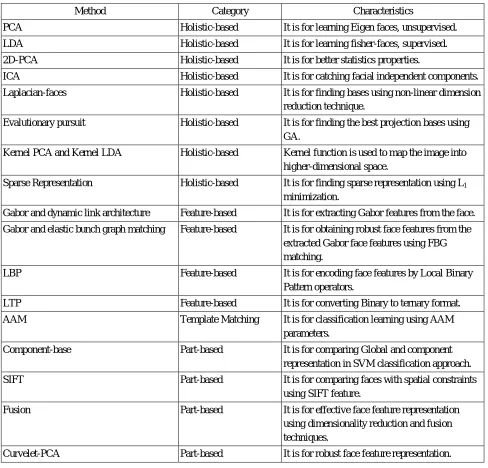
Table 1: The Summary of the face recognition techniques
Method Category Characteristics
PCA Holistic-based It is for learning Eigen faces, unsupervised.
LDA Holistic-based It is for learning fisher-faces, supervised.
2D-PCA Holistic-based It is for better statistics properties.
ICA Holistic-based It is for catching facial independent components.
Laplacian-faces Holistic-based It is for finding bases using non-linear dimension
reduction technique.
Evalutionary pursuit Holistic-based It is for finding the best projection bases using
GA.
Kernel PCA and Kernel LDA Holistic-based Kernel function is used to map the image into
higher-dimensional space.
Sparse Representation Holistic-based It is for finding sparse representation using L1
minimization.
Gabor and dynamic link architecture Feature-based It is for extracting Gabor features from the face.
Gabor and elastic bunch graph matching Feature-based It is for obtaining robust face features from the
extracted Gabor face features using FBG matching.
LBP Feature-based It is for encoding face features by Local Binary
Pattern operators.
LTP Feature-based It is for converting Binary to ternary format.
AAM Template Matching It is for classification learning using AAM
parameters.
Component-base Part-based It is for comparing Global and component
representation in SVM classification approach.
SIFT Part-based It is for comparing faces with spatial constraints
using SIFT feature.
Fusion Part-based It is for effective face feature representation
using dimensionality reduction and fusion techniques.
IV.CONCLUSION
In this paper, the chronological development of face specific features, face recognition algorithms and implementation of face recognition on FPGA are presented. Moreover, the face data set used for experimental analysis in the face recognition system during the past twenty years is described in this paper. In this paper, the six types of appearance-variant factors in a face recognition system are discussed. The works done so far in face recognition system do not address one of the face recognition issues- slanting faces. Therefore, the proposed face recognition system is performed with slanting faces. Table 1 shows the summary of face recognition techniques which are presented in this paper.
Among the face feature representation techniques, the appearance-based methods have difficulty in extracting the stable features from the face images under the unconstrained situations like varying illumination conditions and head poses such as slanting faces. Research has been done to ensure that stable face recognition system is achieved. A large number of alternate techniques which compensate for the change of various head positions and illumination changes are being proposed by different researchers.Meanwhile, the best and the most successful technique introduced for face recognition is the existing Gabor-based methods. Even though they are successful, they have some limitations or shortcomings. When such limitations are properly solved, they could form improved face recognition techniques. The main limitations are emphasized here. The first limitation is that the existing Gabor-based methods extract and design face feature representation using the magnitude information of Gabor wavelets without consideration of Gabor phase information.An increase of the data size is neglected due to the large filter bank that equalizes the number of filters in the filter bank which further triggers the need for downsampling strategies that often discard information leading to prove that it is useful for recognizing faces.The third limitation is that the need for effective face descriptors is due to Gabor magnitude features which are more sensitive with respect to varying illumination conditions.
It is inferred from the above limitations that when the Gabor phase information is considered or combined with the Gabor magnitude information, the performance of the proposed Gabor-based face recognition system is improved. However, it is preferable to have stand-alone embedded face representation system in the real-world application, and the reason is the greater dynamic level of robustness, optimization of hardware components and ease of integration provided by such systems. To carry out the system implementation, the Field Programmable Gate Array (FPGA) is chosen by the researcher as the reconfigurable platform.
.
REFERENCES
1. R. L. Hsu, M. AbdelMottaleb, A. K. Jain, “Face detection in color images”, IEEE Transaction on Pattern Analysis and Machine Intelligence, vol. 24, no. 5, 696-706, 2002.
2. J. Brubaker, C. Mullin, J. M. Rehg, “Fast asymmetric learning for cascade face detection”, IEEE Transactions on Pattern Analysis and Machine Intelligence, vol. 30, no. 3, pp. 369-382, 2008.
3. R. Chellappa, C. L. Wilson, S. Sirohey, “Human and machine recognition of faces: a survey”, Proceedings of IEEE, vol. 83, no. 5, pp. 705-740, 1995.
4. R. V. Yampolskiy, A. K. Jain, “Face Recognition in the Virtual World: Recognizing Avatar Faces”, ICMLA, Boca Raton, vol. 1, pp. 40-45, 2012.
5. D. Zhang, W.K. Kong, J. You, M. Wong, “Online palm print identification”, IEEE Transactions on Pattern Analysis and Machine Intelligence, vol. 25, no. 9, pp. 1041-1050, 2003.
6. B. Klare, A. K. Jain, “Heterogeneous Face Recognition using Kernel Prototype Similarities”, IEEE Transactions on Pattern Analysis and Machine Intelligence, vol. 35, no. 6, pp. 1410-1422, 2013.
7. M. Turk, A. Pentland, “Eigen-faces for recognition”, Journal of Cognitive Neuroscience, vol. 3, no.1, pp. 72-86,1991.
8. M. H. Yang, “Kernel Eigenfaces vs. Kernel Fisherfaces: Face recognition using kernel methods”, Proceedings of Fifth IEEE International
Conference on Automatic Face Gesture Recognition,
pp. 215-220, 2002.
9. Jian Yang, A. F. Frangi, J. Yang, “Two-dimensional PCA: A new approach to appearance-based face representation and recognition”, IEEE Transactions on Pattern Analysis and Machine Intelligence, vol. 26, no. 1, pp. 131-137, 2004.
11. Ming-Hsuan Yang, “Kernel Eigenfaces vs. Kernel Fisherfaces: Face recognition using kernel methods”, Proceedings of Fifth IEEE
International Conference on Automatic Face Gesture Recognition,
pp. 215-220, 2002.
12. Jian Yang, D. Zhang, A. F. Frangi, J.Yang, “A new kernel Fisher discriminant algorithm with application to face recognition’, Neurocomputing”, Elsevier, vol. 56, pp. 415-421, 2005.
13. M. S. Bartlett, J. R. Movellan, T. J. Sejnowski, “Face Recognition by Independent Component Analysis”, IEEE Transactions on Neural Networks, vol. 13, no. 6, pp. 1450-1464, 2002.
14. Xiaofei He, S. Yan, Y. Hu, P. Niyogi, H. Zhang, “Face recognition using Laplacian faces”, IEEE Transactions on Pattern Analysis and Machine Intelligence, vol. 27, no. 3, pp. 328-340, 2005.
15. S. Thakur, J. K. Sing, “Face Recognition Using Principal Component Analysis and RBF Neural Networks”,IJSSST, vol. 10, no. 5, pp. 1473-8031, 2008.
16. Chengjun Liu,H. Wechsler, “Evolutionary pursuit and its application to face recognition”, IEEE Transactions onPattern Analysis and Machine Intelligence, vol. 22, no. 6, pp. 570-582, 2000.
17. Martin Lades, J. C. Vorbrüggen, J.Buhmann, J. Lange, C. V. D.Malsburg, R. P. Würtz, W.Konen, “Distortion invariant object recognition in the dynamic link architecture”, IEEE Transactions on Computers, vol. 42, no. 3, pp. 300-311, 1993.
18. L. Wiskott, J. Fellous, N. Kruger, C. Malsburg, “Face recognition by elastic bunch graph matching”, IEEE Transaction on Pattern Analysis and Machine Intelligence, vol. 19, no.7, pp. 775-779, 1997.
19. Chengjun Liu,H. Wechsler, “Gabor feature based classification using the enhanced fisher linear discriminant model for face recognition”, IEEETransactions on Image Processing, vol. 11, no. 4, pp. 467-476, 2002.
20. Timo Ahonen, A. Hadid, M.Pietikainen, “Face Recognition with Local Binary Patterns”, ECCV, Springer, LNCS 3021, pp. 469-481, 2004. 21. Wenchao Zhang, S. Shan, W. Gao, X. Chen, H. Zhang, “Local Gabor Binary Pattern Histogram Sequence (LGBPHS): A novel non-statistical
model for face representation and recognition”, Proceedings of International Conference onComputer Vision, pp. 786-791, 2005.
22. X. Tan, B.Triggs, “Enhanced local texture feature sets for face recognition under difficult lighting conditions”, IEEE International Workshop on Analysis and Modeling of Faces and Gestures, pp. 168–182, 2007.
23. T. F. Cootes, G. J. Edwards, C. J. Taylor,“Active appearance models, Computer Vision - ECCV’98”, Springer, Lecture Notes in Computer Science 1407, vol. 2, pp. 484-498, 1998.
24. B. Heisele, P. Ho, J. Wu, T.Poggio, “Face Recognition: Component-based versus global approaches”, Computer Vision and Image Understanding, vol. 91, nos. 1-2, pp. 6-21, 2003.
25. M. A. Y. Jun Luo, E.Takikawa, S. Lao, M.Kawade, Bao-Liang Lu,“Person-Specific SIFT Features for Face Recognition”, ICASSP, pp. 593-596, 2007.
26. Maya V Karki,S.SethuSelvi, “Multimodal Biometrics at Feature level fusion using Texture features”, International Journal of Biometrics and Bioinformatics, vol. 7, no. 1, pp. 58-73, 2013.
27. ChudeOlisha, Ghazali Sulong,“Face recognition via edge-based Gabor feature representation for plastic surgery-altered images”, EURASIP
Journal on Advances in Signal Processing, vol. 1, no. 102,
pp. 1-15, 2014.
28. MoritoshiYasunaga, Taro Nakamura,Ikuo Yoshihara,“A Fault-tolerant Evolvable Face Identification Chip”, Proceedings of the International Conferece on Neural Information Processing, Perth, pp.125-130, 1999.
29. R. Gottumukkal, K. V. Asari, “System Level Design of Real Time Face Recognition Architecture Based on Composite PCA”, Proceedings of GLSVLSI, pp. 157-160, 2003.
30. T. Hau, RajkiranGottumukkal, K. Vijayan, “A Flexible and Efficient Hardware Architecture for Real-Time Face Recognition Based on Eigen face in VLSI”, Proceedings of IEEE Computer Society Annual Symposium on VLSI: New Frontiers in VLSI Design (ISVLSI'05), pp. 280-281, 2005.
31. Ja Jeon, Boung Mo Choi,PhillKyu Rhee,“Evolutionary Reconfigurable Architecture for Robust Face Recognition’, International Parallel and Distributed Processing Symposium (IPDPS'03), pp. 22-26, 2003.
32. H. Ando, N. Fuchigami, M. Sasaki, A. Iwata, “A Prototype Software System for Multi-object Recognition and its FPGA Implementation”, Proceedings of the 3rd Hiroshima International Workshop on Nano-electronics for Terra-Bit Information Processing, 2004.
33. X. Li, S.Areibi, “A Hardware/Software Co-design Approach for Face Recognition”, Proceedings of 16th International Conference on
Microelectronics, Tunis, Tunisia, 2004.
34. N. Sudha, N, A. R. Mohan, K. Pramod, Meher, “A Self-Configurable Systolic Architecture for Face Recognition System Based on Principal Component Neural Network”, IEEE Transaction on Circuits and Systems for Video Technology, vol. 21, no. 8, pp. 1071-1084, 2011.
35. Afandi Ahmad, Abbes Amira,“FPGA-based IP cores implementation for Face Recognition using Dynamic Partial Reconfiguration”, Journal of Real Time Image Processing, Springer, DO1 10.10071s11554-011-0221, 2011.
36. L. Best-Rowden, H. Han, C. Otto, A. K. Jain, “Unconstrained Face Recognition: Identifying a Person of Interest from a Media Collection”, IEEE Transactions on Information Forensics and Security, vol. 9, no. 12, pp. 2144-2157, 2014.
37. W. Chen, M. J. Er, S. Wu, “PCA and LDA in DCT domain”, Pattern Recognition Letters, vol. 26, no. 15, pp. 2474-2482, 2005.