IMPROVING THE LIFETIME OF THE WIRELESS SENSOR
NODES USING PREDICTION USING PROBABILITY
BASED SCHEDULING
Mahalakshmi R M1, Xavier Mary A2 and Subashini 3 1
CSE Department, RVS Educational Trust group of institutions, Coimbatore, Tamil Nadu, India
2
CSE Department, RVS Educational Trust group of institutions, Coimbatore, Tamil Nadu, India
3
CSE Department, RVS Educational Trust group of institutions, Coimbatore, Tamil Nadu, India
Abstract
Target tracking is one of the most important applications of wireless sensor networks that involve long-term and low-cost monitoring and actuating. In these applications, sensor nodes use batteries as the sole energy source. Therefore, energy efficiency becomes critical. When nodes operate in a duty cycling mode, tracking performance can be improved if the target motion can be predicted and nodes along the trajectory can be proactively awakened. However, this will negatively influence the energy efficiency and constrain the benefits of duty cycling. In this dissertation, Probability-based Prediction and Sleep Scheduling protocol to improve energy efficiency of proactive wake up is used. In PPSS, traffic is only forwarded to the predicted sensor nodes, and the rest of the sensor nodes turn off their radios to save energy. The rotation of multiple predictions make sure that the energy consumption of all sensor nodes is balanced, which fully utilizes the energy and achieves a longer network lifetime compared to the existing techniques.
Keywords: Energy conservation, prediction, Target tracking, Sleep Scheduling, Target Prediction.
1. Introduction
Wireless sensor networks are used for collecting data such as physical or environmental properties, from a geographical region[1]. WSNs are composed of large number of low cost sensors. Sensor nodes are powered by the batteries.
Tracing is the one of the main application of wireless sensor networks. Tracking system requires low detection delay and high coverage level. Therefore, the most stringent criterion of target tracking is to track with zero detection delay or 100 percent coverage.
Energy efficiency is the critical feature of WSNs for the purpose of the extending the network lifetime. However if energy efficiency is enhanced, the quality of service of target tracing is highly likely negatively influenced. For example, forcing the nodes to sleep state may result in missing the passing target and lowering the target coverage. Therefore, energy-efficiency target tracing should improve the tradeoff between energy efficiency and tracking performance – e.g., by improving energy efficiency at the expense of relatively small loss on tracing performance.
For target tracing tracking applications, idle listening is a major source of energy waste [7]. To reduce the energy consumption during the idle listening duty cycling is one of the most commonly used approaches [8]. The idea of duty cycling is to put nodes in the sleep state for most of the time, and only wake them up periodically. In certain cases, the sleep pattern of nodes may also be explicitly scheduled, i.e., forced to sleep or awakened on demand. This is usually called sleep scheduling .
exact route of a target, it will be sufficient to awaken those nodes that cover the route during the time when the target is expected to traverse their sensing areas.
In this paper, a probability-based target prediction and sleep scheduling protocol (PPSS) is presented to improve the efficiency of proactive wake up and enhance the energy efficiency with limited loss on the tracking performance. With a target prediction scheme based on both kinematics rules and theory of probability, PPSS not only predicts a target’s next location, but also describes the probabilities with which it moves along all the directions. Unlike other physics-based prediction work [14], target prediction of PPSS provides a directional probability as the foundation of differentiated sleep scheduling in a geographical area. Then, based on the prediction results, PPSS enhances energy efficiency by reducing the number of proactively awakened nodes and controlling their active time in an integrated manner. In addition, we design distributed algorithms for PPSS that can run on individual nodes. This will improve the scalability of PPSS for large-scale WSNs.
2. RELATED WORKS
Major An Energy efficiency has been extensively studied either independently or jointly with other features. In [17], the authors proposed, analyzed, and evaluated the energy consumption models in WSNs with probabilistic distance distributions to optimize grid size and minimize energy consumption accurately. An experimental effort based on real implementation is conducted for energy conservation.
As one of the most important applications of WSNs, target tracking was widely studied from many perspectives. First, tracking was studied as a series of continuous localization operations in many existing efforts. Second, target tracking was sometimes considered as a dynamic state estimation problem on the trajectory, and Bayesian estimation methods, e.g., particle filtering, were used to obtain optimal or approximately optimal solutions. Third, in some cases, target tracking was considered as an objective application when corresponding performance metrics, e.g., energy efficiency [6] or real-time feature [4], were the focus. Fourth, a few efforts were conducted based on real implementation, and emphasized the actual mea-surement for a tracking application [4]. Finally, a few target tracking efforts did not explicitly distinguish tracking from similar efforts, such as detection [6] and classification .
Although sleep scheduling and target tracking have been well studied in the past, only a few efforts [6], [12] investigated them in an integrated manner. In [6], the authors utilize a ―circle-based scheme‖ (Circle) to schedule the sleep pattern of neighbor nodes simply based on their distances from the target. In such a legacy Circle scheme, all the nodes in a circle follow the same sleep pattern, without distinguishing among various directions and distances. In [12], Jeong et al. present the MCTA algorithm to enhance energy efficiency by solely reducing the number of awakened nodes. MCTA depends on kinematics to predict the contour of tracking areas, which are usually much smaller than the circles of Circle scheme. However, MCTA keeps all the nodes in the contour active without any differentiated sleep scheduling.
Typical target prediction methods include kinematics-based prediction [12], [14], dynamics-kinematics-based prediction, and Bayesian estimation methods. Kinematics and dynamics are two branches of the classical mechanics. Kinematics describes the motion of objects without con-sidering the circumstances that cause the motion, while dynamics studies the relationship between the object motion and its causes. In fact, most of past work about target prediction uses kinematics rules as the foundation, even for those that use Bayesian estimation methods.
3. SYSTEM DESIGN
All PPSS is designed based on proactive wake up: when a node (i.e., alarm node) detects a target, it broadcasts an alarm message to proactively awaken its neighbor nodes (i.e., awakened node) to prepare for the approaching target. To enhance energy efficiency, we modify this basic proactive wake-up method to sleep-schedule nodes precisely. Specifically, PPSS selects some of the neighbor nodes (i.e., candidate node) that are likely to detect the target to awaken. On receiving an alarm message, each candidate may individually make the decision on whether or not to be an awakened node, and if yes, when and how long to wake up and wake-up method to sleep-schedule nodes precisely
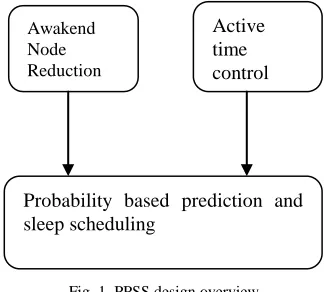
Fig. 1. PPSS design overview
PPSS selects some of the neighbor nodes (i.e., candidate node) that are likely to detect the target to awaken. On receiving an alarm message, each candidate may individually make the decision on whether or not to be an awakened node, and if yes, when and how long to wake up.
Two approaches to reduce the energy consumption during this proactive wake-up process:
1. Reduce the number of awakened nodes.
2. Schedule their sleep pattern to shorten the active time.
First, the number of awakened nodes can be reduced significantly, because: 1) those nodes that the target may have already passed during the sleep delay do not need to be awakened; 2) nodes that lie on a direction that the target has a low probability of passing by could be chosen to be awakened with a low probability. For this purpose, we introduce a concept of awake region and a mechanism for computing the scope of an awake region.
Second, the active time of chosen awakened nodes can be curtailed as much as possible, because they could wake up and keep active only when the target is expected to traverse their sensing area. For this purpose, we present a sleep scheduling protocol, which schedules the sleep patterns of awakened nodes individually according to their distance and direction away from the current motion state of the target.
Both of these energy reducing approaches are built upon target prediction results. Unlike the existing efforts of target prediction [12], [14], [25], we develop a target prediction model based on both kinematics rules and probability theory. Kinematics-based prediction calculates the expected displacement of the target in a sleep delay, which shows the position and the moving direction that the target is most likely to be in and move along. Based on this expected displacement, probability-based prediction establishes probabilistic models for the scalar displacement and the deviation. Once a target’s potential movement is predicted, we may make sleep scheduling decisions based on these probabilistic models: take a high probability to awaken nodes on a direction along which the target is highly probable to move, and take a low one to awaken nodes that are not likely to detect the target.
Fig. 1 shows the three components of PPSS:
1. Target prediction. The proposed target prediction scheme consists of three steps: current state calcula-tion, kinematics-based prediction, and probability-based prediction. After calculating the current state, the kinematics-based prediction step calculates the expected displacement from the current location within the next sleep delay, and the probability-based prediction step establishes probabilistic models for the scalar displacement and the deviation.
2. Awakened node reduction. The number of awakened nodes is reduced with two efforts: controlling the scope of awake regions, and choose a subset of nodes in an awake region.
3. Active time control. Based on the probabilistic models that are established with target prediction, PPSS schedules an awakened node to be active, so that the probability that it detects the target is close to 1.
4. Problem Description
4.1 Energy conservation
In this section, the concept of awake region is used and the proactive wake-up process with awake Probability based prediction and
sleep scheduling Awakend Node Reduction
regions, and then describe the approaches for reducing the energy consumption are described.
Proactive Wake up with Awake Regions
An awake region is defined as the region that a target may traverse in a next short term, which should be covered probabilistically by active nodes. The term awake region is similar to the concept of a cluster used in the network architecture work in that it encompasses some of a cluster’s functions. However, unlike a cluster’s head, neither an alarm node aggregates data from member nodes of the awake region, nor it imposes any control over members. An alarm node’s responsibility here is just to broadcast an alarm message on detecting a target. In fact, an awake region is only a virtual concept. No functions are built upon this concept, except for the selection of awakened nodes.
This is a distributed process: based on the alarm broadcasting, each node makes the sleep scheduling decision, and returns to the default duty cycling mode all by itself. An alarm message that is used to make this decision contains the following information:
• ID and the position of the alarm node • The state vector
• The prediction results Awakened Node Reduction
Usually, a sensor node’s transmission range R is far longer than its sensing range r. Thus, when the nodes are densely deployed to guarantee the sensing coverage, a broadcast alarm message will reach all the neighbors within the transmission range. However, some of these neighbors can only detect the target with a relatively low probability, and some others may even never detect the target. Then, the energy consumed for being active on these nodes will be wasted. A more effective approach is to determine a subset among all the neighbor nodes to reduce the number of awakened nodes. During the sleep delay, the target may move away from the alarm node for a distance. Then, it is unnecessary for nodes within this distance to wake up, since the target has already passed by. Meanwhile, all the nodes in an awake region must in the one-hop transmission range of the alarm.
4.2 Active time control
After reducing the number of awakened nodes, energy efficiency can be enhanced further by scheduling the sleep patterns of awakened nodes, as not all the awakened nodes need to keep active all the time. Schedule the sleep patterns of awakened nodes by setting a start time and an end time of the active period. Out of this active period, awakened nodes do not have to keep active.
Therefore, the time that an awakened node has to keep active could be reduced compared with the Circle scheme.
4.3 Distributed algorithm
For the actual implementation, all of these mechanisms presented, have to be distributed on each sensor node. Procedure is a handler for the event of detecting a target, which can be triggered by an interrupt that is raised on sensing something.
OnDetectingTarget () — Triggered when detecting a target
1 if (scheduled to be active) then
2 if (The target is NOT leaving the current awake region) then
3 return;
4 end if 5 end if
6 (Optional :) Run an alarm election algorithm; 7if (selected as the alarm node) then
8 Calculate vn and an; 9 Predict Sn+1; 10 Compute Sn+1; 11 Broadcast idr; 12 end if
13return;
5. Conclusions
In a duty-cycled sensor network, proactive wake up and sleep scheduling can create a local active environment to provide guarantee for the tracking performance. By effectively limiting the scope of this local active environ-ment (i.e., reducing low value-added nodes that have a low probability of detecting the target), PPSS improves the energy efficiency with an acceptable loss on the tracking performance. In addition, the design of PPSS protocol shows that it is possible to precisely sleep-schedule nodes without involving much physics.
Though the emulation is sometimes unavoidable, our prototype implementation can still provide more real and convincing results than the simulation. For example, be-sides exposing motes to real environmental noises and unstable links, the implementation itself can verify the rationality of the solutions, and the feasibility of applying them into the constrained resources of actual mote hard-ware platforms.
difficult to configure the protocol toward the best energy-performance tradeoff for a specific network environment. However, the optimization is difficult for PPSS, because it will involve many physics problems, which are out of this paper’s scope. Instead, we make an experiment-based effort that evaluates the performance of PPSS under various conditions. Second, the prediction method of PPSS cannot cover special cases such as the target movement with abrupt direction changes. This is the expense that PPSS pays for the energy efficiency enhancement. Given these limitations, the potential future work includes optimization-based sleep scheduling and target prediction for abrupt direction changes.
Acknowledgments
This work was supported by R.V.S Faculty of Engineering in Computer Science Engineering Department of Coimbatore.
References
[1] I.F. Akyildiz, W. Su, Y. Sankarasubramaniam, and E. Cayirci, ―Wireless Sensor Networks: A Survey,‖ Computer Networks, vol. 38, no. 4, pp. 393-422, 2002.
[2] Q. Cao, T. Yan, J. Stankovic, and T. Abdelzaher, ―Analysis of Target Detection Performance for Wireless Sensor Networks,‖ Proc. Int’l Conf. Distributed Computing in Sensor Systems (DCOSS), pp. 276-292, 2005. [3] G. Wittenburg, N. Dziengel, C. Wartenburger, and J.
Schiller, ―A System for Distributed Event Detection in Wireless Sensor Networks,‖ Proc. Ninth ACM/IEEE Int’l Conf. Information Processing in Sensor Networks (IPSN ’10), pp. 94-104, 2010.
[4] T. He, P. Vicaire, T. Yan, L. Luo, L. Gu, G. Zhou, R. Stoleru, Q. Cao, J.A. Stankovic, and T. Abdelzaher, ―Achieving Real-Time Target Tracking Using Wireless Sensor Networks,‖ Proc. 12th IEEE Real-Time and
Embedded Technology and Applications Symp. (RTAS ’06), pp. 37-48, 2006.
[5] C. Gui and P. Mohapatra, ―Power Conservation and Quality of Surveillance in Target Tracking Sensor Networks,‖ Proc. 10th Ann. Int’l Conf. Mobile Computing and Networking, pp. 129-143, 2004.
[6] X. Wang, J.-J. Ma, S. Wang, and D.-W. Bi, ―Cluster-Based Dynamic Energy Management for Collaborative Target Tracking in Wireless Sensor Networks,‖ Sensors, vol. 7, pp. 1193-1215, 2007.
[7] J. Fuemmeler and V. Veeravalli, ―Smart Sleeping Policies for Energy Efficient Tracking in Sensor Networks,‖ IEEE Trans. Signal Processing, vol. 56, no. 5, pp. 2091-2101, May 2008.