Available online: http://edupediapublications.org/journals/index.php/IJR/ P a g e | 1230
Automation Framework for Network Management
Applications
Renukaprasad P SM. Tech Student, Dept. of IS&E,
Sri Jayachamarajendra College of Engineering,
Autonomous under VTU, Mysore, Karnataka, India
Prathibha R J
Assistant Professor, Dept. of IS&E,
Sri Jayachamarajendra College of Engineering, Autonomous under VTU, Mysore, Karnataka, India
ABSTRACT: In today’s software development lifecycle, the mantra is to deliver working and stable product over every iteration cycle. It’s a challenge to meet without automation. It implies the importance of automation for the successful working products. There are different types of automation for different needs though and no single automation approach works everywhere.
The objective is to deliver complete automation coverage. This would involve designing and developing test automation
suite framework for Network management application.
Design and development of framework to automate the application is carried out.
KEY WORDS: QA – Quality Assurance, AT – Automation Tool, GUI – Graphical User Interface, TS- Testing System, AUT-Application under Test, SOA- Service Oriented Architecture
INTRODUCTION:
Available online: http://edupediapublications.org/journals/index.php/IJR/ P a g e | 1231 automation. It implies the importance of
automation for the successful working products. There are different types of automation for different needs though and no single automation approach works everywhere.
There is a simplistic perception about test automation with user groups not belonging to quality assurance (QA). But the Test Automation is more than a set of tests run to generate apparent results. It includes picking right automation methodology, designing test harness, implementing automated test cases, monitoring and interpreting a broad range of results. Automation by simply running test cases without human interaction is not going to catch any application issues.
Enterprise, Telecom and Finance software are complex in nature. Few of the factors which give rise to this complexity include but not limited to:
i. User interface with disparate 3rd party and legacy systems
ii. Multiple releases of systems in product families.
iii. Multiple platform and browser types and versions support
iv. Use cases are inherently complex comprising of many steps on the user interface
The number of combinations of test environment is simply enormous and many times manually testing the software is just not feasible, even if the time permits it. Test automation can automate some repetitive but necessary tasks in a formalized testing process already in place, or add additional testing that would be difficult to perform manually.
This paper provides the detailed automation implementation of Network Management a web based GUI application that manages complex network.
LITERATURE SURVEY
Available online: http://edupediapublications.org/journals/index.php/IJR/ P a g e | 1232
1
.
Network Management Application:Network management vision for the enterprise calls for a new level of synergy between people, the collaborative real-time applications they use, and the underlying, enabling network. A key building block for this vision is the foundational network. As real-time communications continue the evolution to IP, the data network becomes completely integrated into the delivery of communications-enabled business services and mission critical business applications. Networking provides advanced enterprise-class reliability, performance, and security that organizations throughout the world depend on to run their businesses. Because solutions are streamlined to better utilize and manage networking resources, a data network can uniquely deliver both mission critical dependability and superior return on investment.
Centralized Provisioning for
Networking Devices
Automatic Detection of changes and re-provisioning of Network Devices
Simplified Device set-up and
Administration
Enhanced Application Performance and Troubleshooting
The Right Tool for the Job
Configuration and Orchestration Manager
Virtualization Provisioning Service
WLAN Management Software
IP Flow Manager
Visualization Performance and Fault Manager
2. Decision to automate
As per the automation industry “Involve early and test often” so it is better to identify automation at the earliest of development cycle. There are many factors which can influence the decision to automate. The key factors which are considered during the decision process are
What to automate?
Available online: http://edupediapublications.org/journals/index.php/IJR/ P a g e | 1233 automate, keep it in mind that the test
program must not duplicate AUT program logic. If a test is repeated only a few times, it must be left out. The criteria to pick automation candidates are as given below:
Is TC (Test Case) repetitive? Is TC executed successfully?
Does TC involve any manual steps for end-to-end automation?
Is TC steps are readable and executable?
Is TC test data available?
Is TC time consuming one to execute manually?
Is TC fit for Data Driven approach? Is TC covers core functionality?
When to automate?
There are certain times that automation is not advantageous at all whereas manual testing is. For an instance:
User interface (GUI) under constant changes
User interface (GUI) is not stable Short deadline for release
In these times manual testing is best bet to take the product to market quickly. Because initial investment in automation is high and need ample time to build up a framework. Here is the list of criteria considered to decide when to automate:
Products with long lifespan
Project follows Agile process which insists on extreme programming For continuous integration and
nightly builds
Multiple and parallel releases
Cross Browser and Platform support
METHODOLOGY
1. Automation Framework architecture
Available online: http://edupediapublications.org/journals/index.php/IJR/ P a g e | 1234 frameworks. There are many benefits
can be stated depends on the framework, but the key ones are speed and reusability. Yes it truly improves the pace of the automation development as it provides all basic functionalities required to create test scripts. There are different type of approaches can be considered while designing framework. However, it all depends up on the schedule, resources and application types. The Data Driven approach is
chosen for Network Management
application automation as they are naturally driven by data. The other reasons are it takes less time to develop compare to other approaches and can increase the test coverage rapidly.
2. Design Principles
The proposed design was based the following principles.
Plug and Play architecture: The framework designed can be used
for automating multiple
applications. The user needs to get the designed framework and do some scripting to perform
automating particular
functionality. User should not be worrying about taking care of whole application, generating report and logs .
Highly portable and configurable: Framework is highly transferrable. It can be used for many applications. It can be customized as well based on the user requirement. So configuration based on the need is provided in the designed framework.
Data Driven: Suppose similar kind of test cases are to be repeated multiple times with just the change in the data. Such cases can be data driven from the xls sheet. Framework should handle those things.
Available online: http://edupediapublications.org/journals/index.php/IJR/ P a g e | 1235
effectively handled in our
framework.
Single suite for multiple solutions: The suite can be used for multiple solutions. This suite can be used for regression testing, sanity testing etc.
Consistency and Reliability: The suite is reliable and consistent in the operation. It has got recovery system as well. Scalable: The suite is scalable to
new features added to the application. It can also be scaled to load, longevity testing calls.
3. Framework components
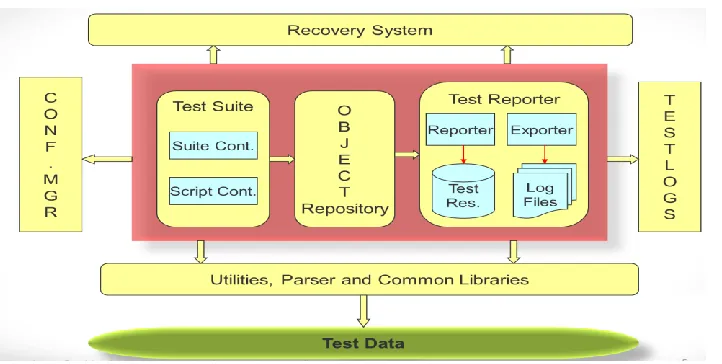
This phase will discuss about automation components which are put together to create an automation framework. At high level it‟ s completely black box and it‟ s important
to decompose to understand its
architecture and other design concepts. It consists of:
Configuration manager Data Driven functionality
Automation approach and coding standards
Class, objects and methods for CLI apps - is based on SOA (service oriented architecture)
Utilities for various tasks conceived – is again based on SOA
3rd party Tools identified Functional architecture Recovery system Result Managements Error handling
Object repository specific to apps Key constants
Available online: http://edupediapublications.org/journals/index.php/IJR/ P a g e | 1236 Figure 1: Automation Framework architecture
IMPLEMENTATION:
This phase will outline how to
approach implementation and phases
involved with. Since High level test plan and test script are designed, it is now just to follow test development process to implement those designs. As we know that the test script development process is almost similar to Development cycles. So, introducing the test script development phases might help automation team to speed up the implementations.
Design test plan and test script
Develop functions/methods and test case
Do unit test of functions/methods and test case from test script
Debug and fix issues if any found Integrate test cases with test plan Do integration testing by selecting
and executing set of test cases in unattended manner
Debug and fix if any issues found Add the sub-plans into regression
master plan
Do system testing by executing regression suite overnight
Debug and fix if any issues found
1. Development
Available online: http://edupediapublications.org/journals/index.php/IJR/ P a g e | 1237
verify the expected results
automatically.
2. Test Execution and Management
After creating a robust regression suite, it’s time to execute as many times as possible and manage the automated suite with the help of Test management tool or some other means.
3. Automation Tasks
Executing an automated
regression suite is typically a time
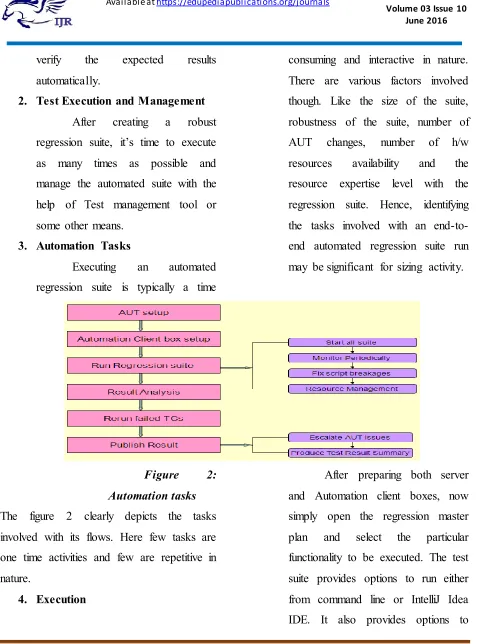
consuming and interactive in nature. There are various factors involved though. Like the size of the suite, robustness of the suite, number of AUT changes, number of h/w resources availability and the resource expertise level with the regression suite. Hence, identifying the tasks involved with an end-to-end automated regression suite run may be significant for sizing activity.
Figure 2:
Automation tasks The figure 2 clearly depicts the tasks involved with its flows. Here few tasks are one time activities and few are repetitive in nature.
4. Execution
Available online: http://edupediapublications.org/journals/index.php/IJR/ P a g e | 1238 create a schedule job for repetitive
runs. The daily sanity deployment is one of them which must be scheduled as its continuous one. Please refer the figure 2 Tasks diagram for tasks involved during execution. It’s estimated that a complete UI regression run might take 3 to 5 man days with 3 servers and 8-10 client boxes setups
TEST RESULTS AND OBSERVATION
The purpose of testing is to discover errors. Testing is the process of trying to discover every conceivable fault or weakness in a work product. It provides a way to check the functionality of components, sub-assemblies, assemblies and/or a finished product. It is the process of exercising software with the intent of ensuring that the software system meets its requirements and user expectations and does not fail in an unacceptable manner.
Once our framework is ready, the suite is used to test the test cases mentioned in the excel sheet. The test cases and its steps are mentioned in the excel sheet. Step by step execution of test cases is achieved. Verification of the test case execution is
performed using testing assert statements and a report is generated.
As regression suite is broken and started on multiple client boxes, the completion time of each suite run is short and quick. So the test results may be available for analysis the very next day. As
mentioned earlier without human
interactions the results make no
sense/difference. So, it‟ s one of the important phases of whole automation process. In different words creating, maintaining and running scripts are only one part of the overall automated testing process. However, analyzing the result and isolating script and application failures usually takes much longer than the actual test itself. So it is so critical for successful runs. If the failures are isolated as script issues, it must be fixed if it s simple and not time consuming ones. Select all failed scripts and rerun them after the quick fix. Finally merge the successful scripts with master regression result files. Its one of the ways to reduce number of failures for analysis.
Available online: http://edupediapublications.org/journals/index.php/IJR/ P a g e | 1239 1. https://en.wikipedia.org/wiki/Microsoft_
UI_Automation
2. [Website]http://www.oracle.com/techne twork/articles/entarch/shrivastava-automated-frameworks-1692936.html
3. [Website] Selenium [OB/HB
methodology].
http://http://www.seleniumhq.org
4. HOFFMAN, D.: Test Automation