ISSN(Online): 2319-8753 ISSN (Print): 2347-6710
I
nternational
J
ournal of
I
nnovative
R
esearch in
S
cience,
E
ngineering and
T
echnology
(A High Impact Factor, Monthly, Peer Reviewed Journal) Visit: www.ijirset.com
Vol. 8, Issue 12, December 2019
Analysis of Face Recognition system Using
SIFT and DRLBP Algorithm
Abhishek Kumawat, Rahul Sharama
Research Scholar (DC), RIET, Jaipur, India
Assistant Professor, RIET, Jaipur, India
ABSTARCT: The greatest motivation for designing automatic face recognition is based on human facial features and identification ability. One method is by comparing face features selected from a test image and a face database. Usually a one-to-one or one-to-many schema is used to match the face image of the test item with the gallery data. One-to-one and one-to-many matching is called verification and recognition. On the other hand, feature extraction is usually used to retrieve relevant facial features from the data, such as face area, changes, angles, or measurements. . There are other applications at this stage, such as facial feature tracking or emotion recognition. Appropriate choice of function plays an important role in the performance of face recognition algorithms. This phase involves comparison methods, classification algorithms and accuracy measures On MATLAB Simulation Where Accuracy Achieved 98%.
KEYWORDS: Feature Descriptors, Feature Detectors, Feature Extraction, SIFT, DRLBP
I. INTRODUCTION
Among various feature detector, the scale invariant Feature transformation (SIFT) algorithm is one of the best methods. This algorithm is mainly suitable for multi-level images. The features extracted using the SIFT algorithm are inconsistent with image scaling, rotation, and transition, while partially inconsistent in terms of viewpoint in lighting and 3D camera. The SIFT algorithm is mainly divided into two modules. They are a keyboard detection module and a description generation module. To improve the performance of the algorithm, the method used in the descriptor generator module has been changed. In the existing system, window rotation technology is used which becomes the bottleneck of the key point detection module. In the proposed method is the new window Divided into sub regions and histogram rearrangement techniques along 16 directions in descriptor generation. The descriptor generation module is 15 times faster than The latest solutions. Feature extraction and matching are the basis of many computer vision problems, such as object recognition and stereo matching. Existing work introduces architecture scale-invariant function transformation (SIFT) for real-time extraction of image functions. Among various feature detectors, the Scale Invariant Feature Transform (SIFT) algorithm is one of the best methods. This algorithm is mainly suitable for multi-scale images. Face recognition systems are mainly used as major security measures and user authentication. Faces are easy to recognize, but automatic recognition of faces by machines is a difficult and complex task. Moreover, people cannot always convey the same expression. The expression of his face changed coincidentally with his mood. Therefore, it becomes more challenging to compare faces in different emotions with neutral faces stored only in the database. Many methods of face recognition have been proposed. SIFT has properties that match different images and objects [1]. The SIFT algorithm extracts interesting key points from images to generate feature descriptions. These extant functions are constant for orientation, scaling, light changes and refining transformations. So they are good for facial descriptions
ISSN(Online): 2319-8753 ISSN (Print): 2347-6710
I
nternational
J
ournal of
I
nnovative
R
esearch in
S
cience,
E
ngineering and
T
echnology
(A High Impact Factor, Monthly, Peer Reviewed Journal) Visit: www.ijirset.com
Vol. 8, Issue 12, December 2019
match their descriptions to find the closest matching feature. Provides a "feature" description of the object. This description can be used when trying to find an object in an image that contains many other objects. There are many considerations when extracting these features and how to record them. SIFT image functions provide a set of functions of an object that is not affected by the many complexities encountered in other methods, such as object scaling and rotation. While allowing the identification of objects in larger images, the SIFT image feature also allows the identification of objects in multiple images in the same location, taken from different locations in the environment. The SIFT function is also very resistant to the "noise" effect in the image.
The SIFT method for generating image functions takes an image and converts it into a "large set of local function vectors" (from "Object recognition from local scale invariant functions" by David G. Lowe). Each of these feature vectors is independent of any scaling, rotation, or translation of the image. This method has many functions of neuron response in primate vision. To help extract these features, the SIFT algorithm uses a four-step filtering method:
Scale-Space Detection: This stage of the filtering attempts to identify those locations and scales that are identifiable from different views of the same object. This can be efficiently achieved using a "scale space" function. Further it has been shown under reasonable assumptions it must be based on the Gaussian function. The scale space is defined by the function:
L(x, y, σ) = G(x, y, σ) * I(x, y)
Where * is the convolution operator, G(x, y, σ) is a variable-scale Gaussian and I(x, y) is the input image. Various techniques can then be used to detect stable key point locations in the scale-space. Difference of Gaussians is one such technique, locating scale-space extreme, D(x, y, σ) by computing the difference between two images, one with scale k times the other. D(x, y, σ) is then given by:
D(x, y, σ) = L(x, y, kσ) - L(x, y, σ)
To detect the local maxima and minima of D(x, y, σ) each point is compared with its 8 neighbours at the same scale, and its 9 neighbours up and down one scale. If this value is the minimum or maximum of all these points then this point is an extreme.
SIFT Feature Detectors Feature detection is the process of inspecting each pixel to see if that pixel has features. For human movement recognition, the calculated space and time scale and direction can be used to crop the area (patches) centered on the detected pixels. The algorithm used to generate functions and patches can be called a function detector. Function detectors usually select the spatiotemporal position, scale, and direction of a video by maximizing a particular salt function.
ISSN(Online): 2319-8753 ISSN (Print): 2347-6710
I
nternational
J
ournal of
I
nnovative
R
esearch in
S
cience,
E
ngineering and
T
echnology
(A High Impact Factor, Monthly, Peer Reviewed Journal) Visit: www.ijirset.com
Vol. 8, Issue 12, December 2019
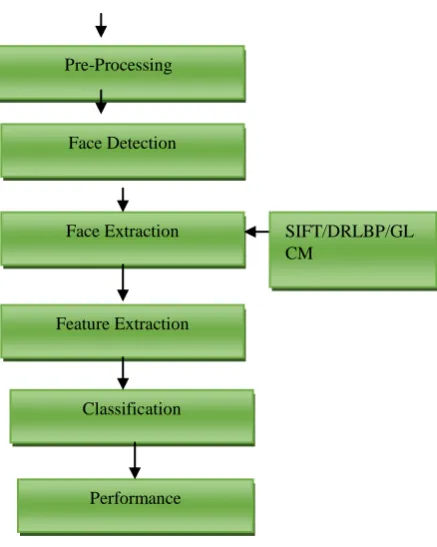
converts the color image into its grayscale representation and then performs face detection. In the next step, the detected faces are further extracted from the image. This module can also detect the face of an object in the detected face area and transform and resize the face. The feature extraction module is used to create a face representation. It detects SIFT key points and creates a set of SIFT descriptors for face image representation.
Figure 1 Proposed Flow Chart
The next module is used to select the most representative face vector to create an accurate face model. Then face recognition. The identified face is compared to a face model stored in the "Face Gallery" and the most similar model is selected as the recognized face model The final confidence measurement module is used to identify whether the recognition result is correct before classification .The storage of the face representation is shown by the Face Gallery. Images taken from data set gallery the first module deals with Resize & Normalization followed by preprocessing this preprocessing module converts a color image into its grey-scale representation, then it performs face detection
Pre-Processing
Face Detection
Face Extraction
Feature Extraction
Classification
Performance
ISSN(Online): 2319-8753 ISSN (Print): 2347-6710
I
nternational
J
ournal of
I
nnovative
R
esearch in
S
cience,
E
ngineering and
T
echnology
(A High Impact Factor, Monthly, Peer Reviewed Journal) Visit: www.ijirset.com
Vol. 8, Issue 12, December 2019
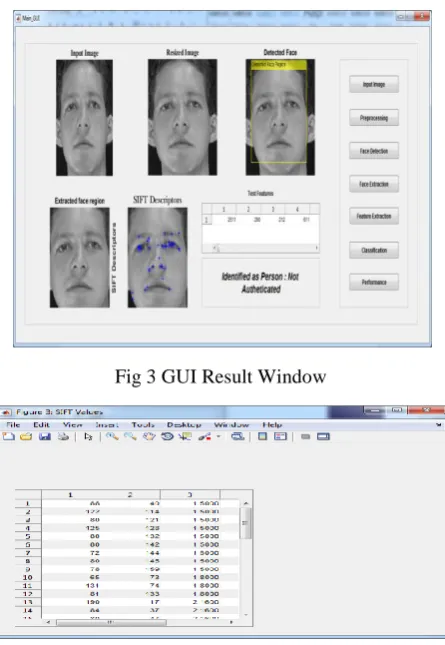
Fig. 2 result window
Then face recognition. A recognized face is compared to the face models stored in the Face Gallery and the most similar model is chosen as the recognized one
ISSN(Online): 2319-8753 ISSN (Print): 2347-6710
I
nternational
J
ournal of
I
nnovative
R
esearch in
S
cience,
E
ngineering and
T
echnology
(A High Impact Factor, Monthly, Peer Reviewed Journal) Visit: www.ijirset.com
Vol. 8, Issue 12, December 2019
This module also detects the face of object in the detected face region and transforms and resizes the face. The feature extraction module is used to create the face representation. It detects the SIFT key-points and creates a set of SIFT descriptors for a representation of the face image
Fig.5 DRLBP feature Values
ISSN(Online): 2319-8753 ISSN (Print): 2347-6710
I
nternational
J
ournal of
I
nnovative
R
esearch in
S
cience,
E
ngineering and
T
echnology
(A High Impact Factor, Monthly, Peer Reviewed Journal) Visit: www.ijirset.com
Vol. 8, Issue 12, December 2019
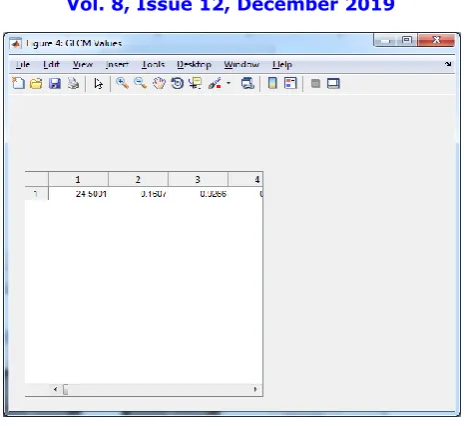
Fig. 7 GLCM feature Values
ISSN(Online): 2319-8753 ISSN (Print): 2347-6710
I
nternational
J
ournal of
I
nnovative
R
esearch in
S
cience,
E
ngineering and
T
echnology
(A High Impact Factor, Monthly, Peer Reviewed Journal) Visit: www.ijirset.com
Vol. 8, Issue 12, December 2019
Fig.9 DRLBP Image
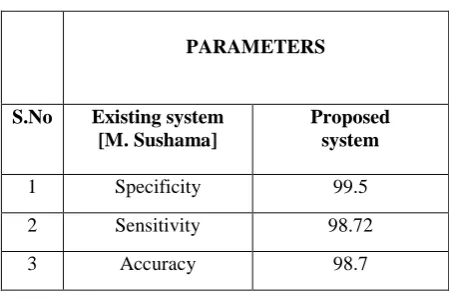
The results show that compared to the use of DRLBP and GLCM technology, this method can improve the recovery accuracy. Finally, evaluate performance factors such as accuracy, recall, and accuracy
Table .1 Result Comparisons
VI CONCLUSION
In this paper we came into an approach for Face recognition using DRLBP &SIFT Feature Extraction. This can be used by ATM Securities and many more Home appropriate military services. This idea has come through the criminal detection that could help policemen to identify the face of the criminal. Paper on face recognition. This paper is used to find number of true faces and number of false faces are identified. Hence, their accuracy for finding the images is 99% We proposed a framework on can be face recognition using dominant rotate local binary pattern and scale invariant feature extraction to detect whether the person is an authenticate or an unauthenticated. Hence by using the parameters like sensitivity, specificity and accuracy has high performance Accuracy-99.538%Sensitivity-98.7287%, Specificity-98.7287% carried out by matlab simulation .the novelty of the method is reduced database size, as it requires only neutral images to store instead of all the expressions of the same face image
PARAMETERS
S.No Existing system [M. Sushama]
Proposed system
1 Specificity 99.5
2 Sensitivity 98.72
ISSN(Online): 2319-8753 ISSN (Print): 2347-6710
I
nternational
J
ournal of
I
nnovative
R
esearch in
S
cience,
E
ngineering and
T
echnology
(A High Impact Factor, Monthly, Peer Reviewed Journal) Visit: www.ijirset.com
Vol. 8, Issue 12, December 2019
REFERENCES
1 M. Sushama E.Rajinikanth Face Recognition Using DRLBP and SIFT Feature Extraction 2018 International Conference on Communication and Signal Processing (ICCSP)
2. Mokoena ; Kishor Representation of Pose Invariant Face Images Using SIFT Descriptors Nthabiseng Nair2018 International Conference on Advances in Big Data, Computing and Data Communication Systems (icABCD)
3. W. Sylvia Lilly Jebarani T. Kamalaharidharini PNN-SIFT: An enhanced face recognition and classification system in image processing 2017 4th International Conference on Electronics and Communication Systems (ICECS)
4. Jebarani T. Kamalaharidharini Robust face recognition and classification system based on SIFT and DCP techniques in image processing W. Sylvia Lilly 2017 International Conference on Intelligent Computing and Control (I2C2)
5. S. R. Khot Image matching with SIFT feature Rajkumar N. Satare ; 2018 2nd International Conference on Inventive Systems and Control (ICISC) 6 B. Moghaddam, C. Nastar and A. Pentland, “A Bayesian similarity measure for deformable image matching,” Image and Vision Computing, vol. 19, no. 5, pp. 235-244, 2001.
7. B. Shan, “A Novel Image Correlation Matching Approach,” JMM, vol. 5, no. 3, 2010.
8. David G Lowe, “Distinctive Image Features from Scale-Invariant Keypoints,” International Journal of Computer Vision, vol.50, No. 2, 2004, pp.91-110.
9.E. Karami, M. Shehata, A. Smith, “Image Identification Using SIFT Algorithm: Performance Analysis Against Different Image