Image Security System using Encryption and
Steganography
Pooja
Rani
1,
Apoorva
Arora
2P.G. Student, Department of CSE, Chandigarh Engineering College Landran, Mohali, India1 Associate Professor, Department of CSE, Chandigarh Engineering College, Landran, Mohali, India2
ABSTRACT: The image security on internet transfers is the concern of the hour as the breaching attacks into the
image databases are rising every year. The hackers take advantage of the stolen personal and important images to fulfill their dangerous and unethical intentions. The image data theft can be used to defame a person on the internet by posting the illegal and unacceptable images of that person (internet user). Hence the images transfers have to be secure to ensure the privacy of the user’s image data. In this research, a number of image security systems have been studied to evaluate the research gap. Majority of the existing image security systems are not up to date to protect against the latest breaching attacks. So, we have proposed an effective and robust image security framework particularly designed for the images. The proposed has been designed and implemented using MATLAB. In this research, a hybrid image security framework has been proposed to overcome the problem stated earlier, which will be implemented by combining various techniques together to achieve the image security goal. The techniques included in the combination would be image compression, cryptography and steganography. DWT compression has been used, because it is a stronger compression algorithm. The steganographed image would be compressed to reduce its size. Blowfish encryption algorithm would be used for the encryption purposes. It offers maximum throughput (faster) and also energy efficient. Compressed image would be encrypted to enhance the image security. Real image will be hidden into another image. A cluster based steganographic technique will be used. Real image and face image would be analyzed, and the real image would be embedded in those areas of face image, where color schemes of the real image and face image would be most similar. Kmeans or Hierarchical clustering would be used as a clustering technique. An all new comparative analysis technique would be applied to make the comparison between real image and base image on the basis of color patterns.
KEYWORDS: Transfers Image Security, Image compression, Image steganography, Image encryption, image.
I. INTRODUCTION
sometimes be broken by cryptanalysis, also called code-breaking, although modern cryptography techniques are virtually unbreakable. In computer science and information theory, data compression, source coding, or bit-rate reduction involves encoding information using fewer bits than the original representation. Compression can be either lossy or lossless. Lossless compression reduces bits by identifying and eliminating statistical redundancy. No information is lost in lossless compression. Lossy compression reduces bits by identifying unnecessary information and removing it. The process of reducing the size of a data file is popularly referred to as data compression, although its formal name is source coding (coding done at the source of the data before it is stored or transmitted).
With the fast growing network, many people utilize the various applications to transfer digital image data. Most of people share their personal images with other users using the social application. Hacking attacks on these applications can cause great losses to the user security which can lower the number of active users and so the business popularity. Now-a-days users access these applications from their portable devices (smart phone, tablet, etc.). To prevent the hacking attacks on those web or mobile application architectures, there is various data security mechanism for image, video or text data. These existing security mechanisms are either using encryption or steganography, or their combinations. There is various securable and perfect system of image encryption that can be well protected from unauthorized access [1]. When it comes to the image transfers over the internet, image security becomes the major security concern for military, security agencies, social or mobile applications. To achieve the goal of image security, a number of image security and image processing algorithms are in use individually or in a combination to provide the effective image security. But these existing image security mechanisms fail to provide the best image security and sometimes proved to be breakable or hack-able. Image compression is an additional function, which can be applied on the image to lower their memory size. The known and popular algorithms used for the data compression are DFT,DCT, DWT, etc. [1].
Image transfers over internet or intranet are prone to hacking. The image transferred over internet or intranet can be hacked by hackers using some attacks: [2].
• Passive attacks: A passive attack attempts to learn or make use of information from the system but does not affect system resources. It is of two types: Release of message content, Traffic analysis.
• Active attacks: Active attacks involve some modification of the data stream or the creation of a false stream. And subdivided into masquerade, replay, and modification of messages and denial of service.
End to end authentication can be also used to keep image transfer integrity intact, but end to end authentication is not possible in case of many image transfers, because many server based internet services like Facebook, Whatsapp, etc. does not let a user to save the content in secure formats, and does not allow the end-to-end authentication based protocols [2].
II. LITERATURE REVIEW
Eman A. Al-Hilo, Rusul Zehwar [2014]: In this paper, the fractal compression technique proposed by Jacquin is
Creighton T. R. Hager worked on the Performance and Energy Efficiency of Block Ciphers in Personal Digital
Assistants [3]: The author has performed a comparative analysis of various encryption algorithms on various kinds of
data. This research has proved that blowfish outperforms all other encryption algorithms. Blowfish is the best, unbreakable and fast encryption algorithm than others. Gary C.Kessler has written an Overview of Cryptography:
Cryptographic [3]: This is an old published paper on cryptography by Gary C. Kessler, and since then it was
continuously updated till date. It was last updated in 2014. The author suggested the great source for the cryptography algorithms again. It is very important to understand the encryption algorithm structure before putting it in the use.
Navita Agarwal et al. have develope Efficient Pixel-shuffling Based Approach to Simultaneously Perform Image
Compression, Encryption and Steganography [1]: The authors have conducted a similar research, where they have
applied compression, encryption and steganography on the digital image data. Pixel shuffling based symmetric encryption algorithm, DCT for compression, WinRAR to Image steganography are used to achieve the proposed model in this paper.
Gary C.Kessler has also written An overview of steganography for the computer forensics examiner [9]: This is
an online article and it is continuously updated. This link is the best source for the information and study about the various encryption algorithms, their working flow, algorithmic structure, etc. This link proved to be the major source behind my encryption algorithm studies. Chanu Y. J, have given a Survey on Image Steganography and
Steganalysis [6]: In this paper, the authorhas conducted a detailed survey on various steganography techniques. From
this paper it is easy to understand and compare the steganography techniques. This paper is the major source behind my study on steganography. Chamkour Singh et al. have developed cluster based Image Steganography using Pattern
Matching”[7]: A novel steganography technique is proposed in this paper, which perform color based analysis on the
image by using color clustering technique to hide the image data effectively into another image. This method is more secure than all other image steganography methods because it makes it difficult to detect the hidden image in the masking image.
III. EXPERIMENTAL DESIGN
Our first goal in this project is the image compression. Various compression schemes have been studied under the first objective. The major compression schemes evaluated under the preliminary study for this research are DFT (Discrete Fourier Transformation), DCT (Discrete Cosine Transformation) and DWT (Discrete Wavelet Transformation) because of their popularity and effectiveness.[10, 11] For images, the JPEG images are taken into account as it preferred DWT over DCT or DFT. [12, 13] In DFT, execution time is lower and it provides lower compression as compare to the other techniques. In DCT is simple compression algorithm, because computation count in this algorithm is limited, hence provides lower compression ratio. DWT on the other hand, is complex and computation count is very high and it provides higher compression ratio as compared to later two and also proven to be more effective. In wavelet transform system the entire image is transformed and compressed as a single data object rather than block by block as in a DCT based compression system. It can provide better image quality than DCT, especially on higher compression ratio. [10] After preliminary study of literature based on these compression techniques we evaluated that DWT with HAAR Wavelet is the best performer among all other compression techniques available in our selection in terms of compression ratio and elapsed time. Finally, the decision is made to use DWT for its effectiveness and robustness over DCT and DFT.[10, 11]
Algorithm 1: Compression Method
1. The image is broken in smaller parts, say 8x8 pixels
4. The array of compressed blocks that constitute the image is stored in a drastically reduced amount of space. 5. When desired, the image is reconstructed through decompression, a process that uses the inverse discrete
wavelet transform (iDWT).
To perform the encryption in the second object, blowfish encryption algorithm is used to hide the image details of hidden object.[1,3-4,8] A significant number of research papers on the performance evaluation and work flow of encryption algorithms has been studies under the literature survey part. The AES and Blowfish algorithms were selected in the final short listing of encryption algorithms, because these two provide the best encryption security. [4, 8] Out of the two shortlisted ones, the conclusion was obtained that the blowfish encryption algorithm is considered the fastest one among the all other options. [4] Blowfish encryption algorithm is designed in a customized way to work with images in MATLAB environment. The algorithm code is designed to perform various rounds of encryption. The encryption algorithm is used here to hide the image details and to create a new image with dizzy image details. The image details are made hidden in chaotic way to create a new image with less number of details. The image is not made completely unreadable because it provokes the hacker to crack into the encryption, whereas a low resolution less detail encryption can be easily mistaken as a bad image. [3, 8]. The decryption process is the reverse process, which is used to obtain the original image by using the reverse engineering of the cryptographic process on the receiver’s end. [3] For the decryption, user has to enter the same key as it was entered on the sender’s side while encrypting the image. The decryption process returns the full resolution original image from the encrypted image once the process is complete. [8]
Algorithm 2: Blowfish encryption
Blowfish has 16 rounds.
1. The input is a 64-bit data element, x. 2. Divide x into two 32-bit halves: xL, xR. 3. Then, for i = 1 to 16:
4. xL = xL XOR Pi 5. xR = F(xL) XOR xR 6. Swap xL and xR
7. After the sixteenth round, swap xL and xR again to undo the last swap. 8. Then, xR = xR XOR P17 and xL = xL XOR P18.
9. Finally, recombine xL and xR to get the ciphertext.
To perform the steganography in the third objective, which is used to embed image(secret object) into image (cover object), A number of papers have studied for the selection of best steganography technique for the development of our security model.[5, 6, 7, 9, 12, 13] Steganography is a security mechanism which is used to hide the message into another object which may be a text, image, audio, video etc. 2-D discrete wavelet transform has been used to perform the decomposition of the image matrix up to two level decomposition. DB1 or HAAR wavelet is used for the decomposition to compute the 2-D DWT decomposition for steganography.[5, 6] This decomposition will produce four decomposed matrices which include CA (Absolute Coefficient) and CD (Detailed Coefficient) in the first level and again applying filtering on these coefficients will produce CH (Horizontal Detailed Coefficient), CV (Vertical Detailed Coefficient) in the second level.[Coutesy: Wikipedia]
matrices would be recomposed to form the stego object image and an index value is embedded inside the stego object to identity the specific decomposition matrix in which the hidden object is embedded. [5-6]. For steganalysis or image extraction, the stego object undergoes the decomposition using the HAAR wavelet. [5] The program reads the index to identify the decomposition matrix where the hidden object was embedded. The specific decomposition matrix undergoes the extraction process using the reverse matrix calculation to obtain the secret image hidden inside it. [1, 6-7]
Algorithm 3: Steganography Method
A. At Sender side:
1) Input Image: Select a color image to be used as a cover media.
2) Pattern Matching: Scan image according to basic colors by using pattern matching.
3) Clustering: Create cluster (using pattern matching) based on color feature.
4) Selection of Cluster: Select cluster in which the secret data is to be hidden.
5) Apply Steganography: Hide data in the color image.
6) Send Image: Send the stego-image over the channel.
B. At Receiver side:
1) Input Stego-Image: Take the stego-image as input.
2) Pattern Matching: Scan image by using pattern matching.
3) Clustering: Create cluster according to color.
4) Identify Cluster: Identify the cluster in which information is hidden.
5) Extraction: Extract the hidden data.
The fourth objective is yet partially achieved by implementing the code for compression and steganography in MATLAB using normal coding in Matlab and Image Processing Tool Box. The compression module is completed by using 2-D HAAR wavelet for decomposition of image matrix using Haar wavelet based low pass and high pass filter and results in Approximation Coefficient Matrix and Detailed Coefficient Matrix. Then built-in Matlab function for calculation of threshold using Birge-Massart Algorithm based on 2-D wavelet. This function returns level-dependent thresholds THR and numbers of coefficients to be kept NKEEP, for de-noising or compression. THR is obtained using a wavelet coefficients selection rule based on the Birge-Massart strategy. [14] In next step, the threshold value will been used to perform the compression on the image matrix. This step returns a de-noised or compressed version of 2-D image matrix from input image matrix obtained by wavelet packets coefficients thresholding, again based on HAAR wavelet.
IV. RESULT ANALYSIS
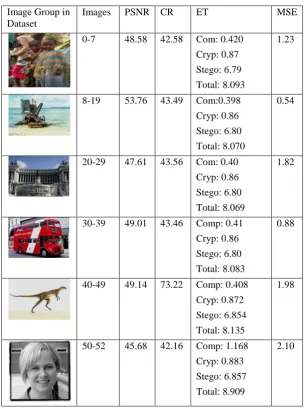
Image Group in Dataset
Images PSNR CR ET MSE
0-7 48.58 42.58 Com: 0.420 Cryp: 0.87 Stego: 6.79 Total: 8.093
1.23
8-19 53.76 43.49 Com:0.398 Cryp: 0.86 Stego: 6.80 Total: 8.070
0.54
20-29 47.61 43.56 Com: 0.40 Cryp: 0.86 Stego: 6.80 Total: 8.069
1.82
30-39 49.01 43.46 Comp: 0.41 Cryp: 0.86 Stego: 6.80 Total: 8.083
0.88
40-49 49.14 73.22 Comp: 0.408 Cryp: 0.872 Stego: 6.854 Total: 8.135
1.98
50-52 45.68 42.16 Comp: 1.168 Cryp: 0.883 Stego: 6.857 Total: 8.909
2.10
Table 1: The comparison of images of various categories in the Image dataset. The above table describes the performance of the proposed model on the basis of compression ratio, mean squared error, peak signal to noise ratio and elapsed time. The proposed model has been deeply evaluated for its performance on the given dataset.
The digital images fall in the noisy image category. The human cannot determine the noise in these images. But, sometimes, the noise degrades the image quality at a large. The sixth type of images is grayscale image. These images carries lower color details and prone to processing and transmission noises.
Image Group in Dataset
Data Set Index
PSNR Compression Ratio (CR)
MSE Elapsed Time (ET)
Proposed Existing Proposed Existing Proposed Existing Proposed Existing 0-7 48.58 30.65 42.58 5.237552 0.420 1.90 1.23 3.54
8-19 53.76 29.42 43.49 14.71 0.398 0.69 0.54 1.80
20-29
47.61 14.94 43.56 11.96 0.40 1.45 1.82 3.12
30-39
49.01 26.37 43.46 9.79 0.41 0.504 0.88 2.10
40-49
49.14 37.48 73.22 12.37 0.408 0.819 1.98 4.04
50-52
45.68 35.13 42.16 21.04 1.168 1.56 2.10 3.68
Table 2: Comparison of proposed technique with Existing technique. The above table compares the proposed model performance with the existing model. Both of the models have been compared on the basis of compression
ratio, PSNR, MSE and time parameters.
Figure 1: Elapsed time between proposed and existing system. The above bar graph shows the time based comparison of the proposed model and existing model. The proposed model has been proved for its efficiency in
terms of elapsed time.
Elapsed time is the total time taken by system to execute its operations for compression mechanism on the selected data. The above graph has clearly shown that proposed algorithm has done way better than the existing algorithm. The elapsed time of the proposed algorithm is lower for all image categories in the dataset.
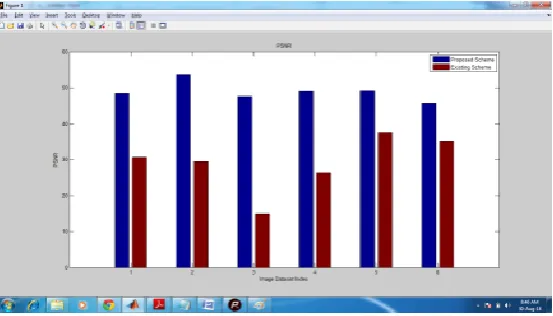
Figure 2: PSNR comparison between proposed and existing system. The proposed model has performed well on the basis on PSNR. PSNR is the parameter which indicates the quality of the images after processing
Figure 3: MSE comparison between proposed and existing. The mean squared error indicates the overall bit error between two data matrices. The proposed has been recorded quite lower in terms of MSE than the existing
model, which shows the efficiency of the proposed model.
Mean squared error is calculated by calculating the error bits over all bits, which represents the total error in the received data when it is compared to the data sent at the other end or data before and after processing. MSE value should be less to represent the less damage to the quality of the image. In the above graph, the MSE value for proposed system is lower as compared to the existing system on different image categories in the image dataset.
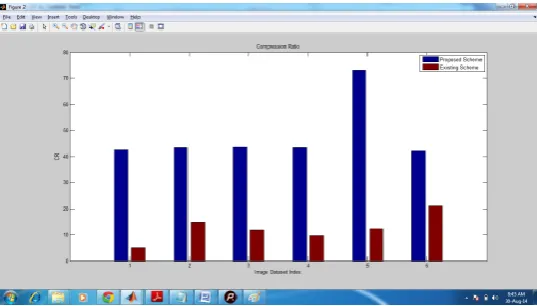
Figure 4: Compression Ratio. Compression ratio is the size difference between the real data and its compressed form. The higher compression ratio signifies the fast transmission of the data due to smaller size. The proposed
model
Compression Ratio represents the reduction in the size of the image after the compression process. Higher is the compression ratio; lower is the transmission effort and disk space consumption. In the case of proposed model, the compression is recorded way higher than the existing model.
V. CONCLUSION
squared error (MSE). The proposed scheme consisted of three components: compression, encryption and steganography. For the compression, the discrete wavelet transform is modified for robust image compression, whereas the blowfish algorithm has been selected for the image encryption. The image encryption hides the image details by performing mathematical computation on image data. The steganography is the process of hiding one image into another image to fool the hackers and to deliver the secret data without any visual data transmission details. The proposed algorithm has been designed to ensure the image security during the transmission over the image sharing enabled social media applications. These applications usually do not have strong security mechanisms to protect the user data. The proposed algorithm is designed to fill that certain gap of stronger security mechanism for image sharing based social media applications. The results of the proposed algorithm have shown that the proposed algorithm have performed more stronger and lossless compression on the images in comparison with the existing compression system. The overall system performance has been evaluated with four performance parameters: Peak signal to noise ratio (PSNR), mean squared error (MSE), Elapsed time (ET) and Compression Ratio (CR). The overall system performance has shown that the new system is robust, quick and effective for the image security. The proposed system has been tested on a classified image dataset. The image dataset is shortlisted to five six categories. The results on all of the six categories have proved the proposed system better than the existing system.
VI. FUTURE WORK
In the future, the proposed security mechanism can be improved to generate better and quick results. Also, other forms of compression, steganography or compression can be tried with the proposed system to take the advantage on different type of datasets of images or other type of digital media. The proposed algorithm can be implemented on the live system to obtain its performance in the real time on the application server in the future.
REFERENCES
[1]NavitaAgarwal, Himanshu Sharma “An Efficient Pixel-shuffling Based Approach to Simultaneously Perform Image Compression, Encryption and Steganography”, IJCSMC, vol. 2 issue 5,pp. 376-385, May 2013.
[2] Mohammadi S., Abbasimehr H., “A high level security mechanism for internet polls”, ICSPS, vol. 3, pp. 101-105, IEEE, 2010. [3] Gary C.Kessler, “An Overview of Cryptography: Cryptographic”, HLAN, ver. 1,1999-2014.
[4] Milind Mathur, Ayush Kesarwani, “Comparison between DES, 3DES, RC2, RC6, BLOWFISH and AES”, NCNHIT vol. 1 143-148,2013. [5] Ashwin S., “Novel and secure encoding and hiding techniques using image steganography: A survey”, ICETEEEM, vol. 1, pp. 171-177, IEEE, 2012
[6] Chanu Y. J, “A short survey on image steganography and steganalysis techniques”, NCETAS, vol. 1, pp. 52-55, IEEE, 2012. [7] Chamkour Singh, Gauravdeep, “Cluster based Image Steganography using Pattern Matching”, IJAIR, vol. 2, issue 5, 2013. [8] Verma O.P., Agarwal R., Dafouti D., “Performance analysis of data encryption algorithms”, ICECT, vol. 5, pp. 399-403, IEEE, 2011 [9] Gary C.Kessler, “An overview of steganography for the computer forensics examinier”, vol. 6, no. 3, Forensic science communications, 2011. [10] Xiangui Kang, Jiwu Huang, “A DWT-DFT Composite Watermarking Scheme Robust to Both Affine Transform and JPEG Compression”, ITCSVT, vol. 13, issue 8, pp. 776-786, IEEE, 2003.
[11] Sonja Grgic, Mislav Grgic, “Performance Analysis of Image Compression Using Wavelets”, ITIE, vol. 48, issue 3, pp. 682-695, IEEE, 2001. [12] Domenico Bloisi and Luca Iocchi, “IMAGE BASED STEGANOGRAPHY AND CRYPTOGRAPHY”, Sapienza University of Rome, Italy, 2002.
[13] Morkel, Tayana, Jan HP Eloff, and Martin S. Olivier. "An overview of image steganography." ISSA. 2005.
[14] Jalal Karam, “A New Approach In Wavelet Based Speech Compression”, Mathematical Methods, Computational Techniques, Non-Linear Systems, Intelligent Systems, pp. 228-233, 2008