Algebraic partitioning:
Fully compact and (almost) tightly secure cryptography
Dennis Hofheinz∗ October 12, 2015
Abstract
We describe a new technique for conducting “partitioning arguments”. Partitioning argu-ments are a popular way to prove the security of a cryptographic scheme. For instance, to prove the security of a signature scheme, a partitioning argument could divide the set of messages into “signable” messages for which a signature can be simulated during the proof, and “unsignable” ones for which any signature would allow to solve a computational problem. During the se-curity proof, we would then hope that an adversary only requests signatures for signable mes-sages, and later forges a signature for an unsignable one.
In this work, we develop a new class of partitioning arguments from simple assumptions. Unlike previous partitioning strategies, ours is based upon an algebraic property of the parti-tioned elements (e.g., the signed messages), and not on their bit structure. This allows to perform the partitioning efficiently in a “hidden” way, such that already a single “slot” for a partitioning operation in the scheme can be used to implement many different partitionings sequentially, one after the other. As a consequence, we can construct complex partitionings out of simple basic (but algebraic) partitionings in a very space-efficient way.
As a demonstration of our technique, we provide the first signature and public-key encryp-tion schemes that achieve the following properties simultaneously: they are (almost) tightly secure under a simple assumption, and they are fully compact (in the sense that parameters, keys, and signatures, resp. ciphertexts only comprise a constant number of group elements). Keywords. Partitioning arguments, tight security proofs, digital signatures, public-key encryp-tion.
∗
1
Introduction
Partitioning arguments. Many security reductions rely on apartitioning argument. Informally, a partitioning argument divides the parts of a large system into those parts that are under the control of the simulation, and those parts into which a computational challenge can be embedded. For instance, a partitioning argument for a signature scheme could divide the set of message into “signable messages” (for which a signature can be generated by the security reduction), and “unsignable messages” (for which any signature would solve an underlying problem). During the security reduction, we hope that an adversary only asks for the signa-tures of signable messages, but forges a signature for an unsignable one. Partitioning argu-ments are a popular means for proving the security of signature schemes (e.g., [35, 17, 38, 29]), identity-based encyption schemes (e.g., [10, 9, 38, 14]), or tightly secure cryptosystems (e.g., [15, 6, 32]).
The complexity of bit-based partitioning. All of the above works (except for [17, 10], which use a programmable random oracle to implement a partitioning) partition messages or identi-ties according to their bit representation. For instance, in the signature scheme from [29], mes-sages are signable precisely if they do not start with a particular bit prefix. This non-algebraic approach requires a certain preparation in the scheme itself: already the scheme must establish certain distinctions of messages based on their bit representation. For instance, the signature
scheme of [38] uses a hash function of the formH(M) = h0
Q
jhj,Mj, whereMjare the bits of
the signed messageM, andh0 and thehj,b are public group elements. This leads to
compar-atively large public parameters or keys, in particular because all potential distinctions (based
on the values of theMj) are already present in the scheme.
Our contribution. In this work, we develop an entirely different partitioning approach: in-stead of partitioning based on the bit representation, we partition according to a simple
al-gebraic predicate. Namely, we view a message M as above as a Zp-element, and consider
various Legendre symbolsLj = fj(M)
p
for different affine functions fj. Taken together,
suf-ficiently manyLj uniquely determineM, but the computation of eachLjcan be encoded as a
series of Zp-operations.1 Intuitively, this algebraic property allows to “internalize” and hide
the computations of theLj, e.g., by hiding thefjinside a homomorphic commitment. As a
con-sequence, only one “universal” partitioning (according to a singleLj) needs to be performed
in the scheme itself; in the analysis, several simple partitionings can then be implemented
sequentially, by varying thefj.
Comparison with previous partitioning techniques. Compared to previous, bit-based parti-tioning approaches, our new strategy has the advantage that it simultaneously leads to com-pact schemes and to a tight security reduction. Previous partitioning strategies were either based on more complex partitionings (such as [35, 9, 38, 29]) that lead to a non-tight security reduction, or on a sequence of simple bit-based partitionings (such as [15, 6, 32]) that lead to large public parameters or keys. In contrast, we support many simple algebraic partitionings (and thus a tight security reduction), but we occupy only one “partitioning slot” in the public parameters. This leads to tightly secure and very compact applications, as we will detail next.
Applications. Specifically, we demonstrate the usefulness of our partitioning technique by describing the first (almost) tightly secure signature and PKE schemes that are fully compact, in the sense that parameters, keys, and signatures (resp. ciphertexts) only contain a constant
number of group elements. Our security reduction loses only a factor of O(k), where k is
the security parameter. In particular, our security reduction does not degrade in the number of
1Technically, we will not even need to explicitly computeL
j, but only prove thatLj=1. This is possible using
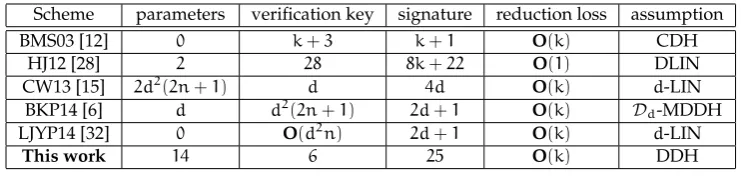
users or signatures, resp. ciphertexts. The security of our schemes is based upon the Decisional Diffie-Hellman (DDH) assumption in both preimage groups of a pairing. (This assumption is also called “Symmetric External Diffie-Hellman” or SXDH.) Tables 1 and 2 give a more detailed comparison with existing schemes.
In the following, we give more details on our techniques and results. To do so, we start with a little background concerning our applications.
Tight security reductions. To argue for the security of a given cryptographic scheme S, we usually employ a security reduction. That is, we try to argue that every hypothetical adversary
ASon Scan be converted into an adversaryAP on an allegedly hard computational problem
P. In that sense, the only way to break Sis to solve P. Of course, we are mostly interested
in reductions to well-investigated problemsP. Furthermore, there are reasons to consider the
tightnessof the reduction: a tight reduction guarantees thatAP’s successεP in solvingP (in a
reasonable metric) is about the same asAS’s successεSin attackingS.
To explain the impact of a (non-)tight reduction in more detail, consider a public-key
en-cryption (PKE) scheme S that is deployed in a many-user environment. In this setting, an
adversaryASonS may observe, say,nCciphertexts generated for each of the, say,nU users.
Most known security reductions in this setting are non-tight, in the sense thatεP ≤ εS
nU·nC.
As a consequence, keylength recommendations should also takenU andnCinto account; no
“universal” keylength recommendation can be given for such a scheme. This is particularly problematic in settings that grow significantly beyond initial expectations.
Tightly secure encryption and signature schemes. The construction of tightly secure crypto-graphic schemes appears to be a nontrivial task. For instance, although already explicitly con-sidered in 2000 [3], tightly secure PKE schemes have only been constructed very recently [28, 2,
15, 6, 32].2,3 Moreover, the schemes from [28, 2] have rather large ciphertexts, and the schemes
induced by [15, 6] and from [32] require large parameters (but offer small keys and ciphertexts). The situation for tightly secure signature schemes is somewhat brighter, but results are still
limited. There are efficient signature schemes that are tightly secure under “q-type” [8, 16, 36]
or interactive [21] assumptions, or in the random oracle model [24, 5, 30]. There are also more
recent and somewhat less efficient schemes tightly secure under simple4 assumptions [12, 28,
15, 6, 32] (see also [1, 2]). Some of these latter schemes can even be converted into tightly secure PKE schemes; however, all of the schemes [12, 28, 2, 15, 6, 32] suffer from asymptotically large parameters, keys, or signatures (resp. ciphertexts).
The scheme of Chen and Wee. Our technical ideas are best presented with our signature scheme. At a very high level, we follow the strategy of Chen and Wee [15] (see also [6]), where we interpret their IBE scheme as a signature scheme using Naor’s trick [11]. In their scheme, signatures are of the form
σ = h0, sigk· n Y
i=1
hi,Mi, (1)
where sigk is the secret key, M = (Mi)in=1 ∈ {0, 1}n is the bit representation of the signed
message, andh0,(hi,0, hi,1)ni=1are group elements chosen from a joint public distribution.5
2Actually, [15, 6] construct tightly secure identity-based encryption (IBE) schemes. However, those IBE schemes
can be viewed as tightly secure signature schemes (using Naor’s trick [11]), and then converted into tightly secure PKE schemes using the transformation from [28]. In fact, the PKE scheme of [32] can be viewed as a (modified and highly optimized) conversion of the IBE scheme from [15].
3We note that earlier PKE schemes achieve at least a certain form of tight security under “q-type”
assump-tions [22, 23, 27], or in the random oracle model [20, 13, 7].
4With a “simple” assumption, we mean one in which the adversary gets a challenge whose size only depends
on the security parameter, and is then supposed to output a unique solution without further interaction. Examples of simple assumptions are DLOG, DDH,d-LIN, or RSA, but not, say, Strong Diffie-Hellman [8] orq-ABDHE [22].
Scheme parameters verification key signature reduction loss assumption
BMS03 [12] 0 k+3 k+1 O(k) CDH
HJ12 [28] 2 28 8k+22 O(1) DLIN
CW13 [15] 2d2(2n+1) d 4d O(k) d-LIN BKP14 [6] d d2(2n+1) 2d+1 O(k) Dd-MDDH
LJYP14 [32] 0 O(d2n) 2d+1 O(k) d-LIN
This work 14 6 25 O(k) DDH
Table 1: Comparison of different (at least almost) tightly EUF-CMA secure signature schemes from simple4 as-sumptions in pairing-friendly groups. Theparameters, verification key, andsignaturecolumns denote space complexity, measured in group elements. Thereduction losscolumn denotes the (multiplicative) loss of the secu-rity reduction to the respectiveassumption. For the schemes from [15, 6], we assume the signature scheme induced by the presented IBE scheme. Furthermore,n= Θ(k)denotes the bitlength of the signed message (if the signed message is a bitstring and not a group element or an exponent). We note that [32] mention that their scheme can be generalized to thed-LIN assumption (including1-LIN=DDH). However, since they only give explicit complex-ities for the arising signatures (identical to the ones from [6]), we restrict to their DLIN-based scheme. Finally, we remark that all of these schemes (except for [12]) imply tightly secure PKE schemes (cf. Table 2).
Scheme parameters public key ciphertext reduction loss assumption HJ12 [28] O(1) O(1) O(k) O(1) DLIN AKDNO13 [2] O(1) O(1) O(k) O(1) DLIN CW13 [15] O(d2k) O(d) O(d) O(k) d-LIN BKP14 [6] O(d) O(d2k) O(d) O(k) D
d-MDDH
LJYP14 [32] O(1) O(d2k) O(d) O(k) d-LIN
LJYP14 [32] 3 24k+30 69 O(k) DLIN
This work 15 2 60 O(k) DDH
Table 2: Comparison of different (at least almost) tightly IND-CCA secure PKE schemes from simple4assumptions. As in Table 1, theparameters,public key, andciphertextcolumns denote space complexity, measured in group elements, and thereduction losscolumn denotes the (multiplicative) loss of the security reduction to the respective
assumption. For the schemes from [15, 6], we assume the PKE scheme induced by the respective signature scheme
when going through the construction of [28]. We note that [32] only describe a symmetric-pairing version of their scheme, so their DDH-based scheme is not explicit. However, we expect that their DDH-based scheme has slightly more compact ciphertexts than ours.
During their proof of existential unforgeability (EUF-CMA security), Chen and Wee
grad-ually modify signatures generated by the security experiment for an adversaryA. This is done
via a small hybrid argument over the bit indices of messages, and thus yields a security proof
that loses a factor ofO(n). Concretely, in thei-th hybrid, generated signatures are of the form
σ= (h0,sigkM
1,...,Mi·
Qn
j=1hj,Mj), wheresigkM1,...,Mi =R(M1, . . . , Mi)for a truly random
func-tionR. Similarly, a forged message-signature pair(M∗, σ∗)fromAis only considered valid if
it is consistent withsigkM∗
1,...,M
∗
i (instead ofsigk). In other words, in the
i-th hybrid, the secret
key used in signatures depends on the firstibits of the signed message.
Thus, the difference between the(i−1)-th and thei-th hybrid is an additional dependency
of used secret keys on thei-th message bitMi. To progress from hybridi−1to hybridi, Chen
and Wee first partition the message space in two halves (according to Mi). Then, using an
elaborate argument, they consistently modify the secret keys used for messages from one half, and thus essentially decouple those keys from the keys used for messages from the other half.
This creates an additional dependency onMi. Aftern = |M|such steps, each signature uses
a different secret key (up to multiple signatures of the same message). In particular, A gets
no information about the secret keysigkM∗
1,...,M∗n used to verify its own forgery, and existential
unforgeability follows.
We would like to highlight the partitioning character of their analysis: in their proof, Chen
and Wee introduce more and more dependencies of signatures on the corresponding messages,
and each such dependency is based upon a different partitioning of the message space.6 Now
observe that already regular signatures (as in (1)) feature distinctions based on all bits ofM.
These distinctions provide the technical tool to introduce dependencies in the security proof. However, as a consequence, rather complex joint distributions need to be sampled during
signature generation, which results in public parameters ofO(n)group elements.
Algebraic partitioning. In a nutshell, our main technical tool is a new way to partition the message space of a signature scheme. We call this tool “algebraic partitioning.” Concretely,
a signature for a messageM ∈ Zp in our scheme consists essentially of an encryption of the
secret keyX, along with a consistency proof:
σ = (C=Enc(pk, X), π). (2)
The corresponding encryption key pk is part of the verification keyvk, and the consistency
proofπproves the following statement:
“Either Cencrypts the secret keyX, or f(M)∈Zpis a quadratic residue (or both).”
Here,pis the order of the underlying group, andf: Zp → Zp is an affine function fixed (but
hidden) in the verification key. Implicitly, this provides asinglepartitioning of messages into
those for whichf(M)is a quadratic residue, and those for whichf(M)is not. However, sincef
is hidden, many partitionings can be induced (one after the other) by varyingfduring a proof.
In fact, during the security proof, this partitioning will fulfill the same role as the bit-based partitioning in the analysis of Chen and Wee. In particular, it will help to introduce additional
dependencies of the signature on the message. More specifically, in the i-th hybrid of the
security proof,Cwill not encryptX, but a valueXM that depends on theiLegendre symbols
fj(M)
p
for randomly chosen (but fixed) affine functionsf1, . . . , fi. Each new such dependency
is introduced by first refreshing the affine function f hidden in vk, and then modifying all
values encrypted in signatures whenever possible (i.e., wheneverf(M)is a quadratic residue).7
Observe that the single explicit partitioning in regular signatures is used several times (for
different fj) to introduce many dependencies of signatures on messages in the proof. The
remaining strategy can then be implemented as in [15].
Our different strategy to partition the message space results in a very compact scheme. Namely, since only one explicit partitioning step is performed in the scheme, parameters, keys, and signatures comprise only a constant number of group elements. Specifically, parameters,
keys, and signatures contain14, 6, and25group elements, respectively. Besides, our scheme
is compatible with Groth-Sahai proofs [26]. Hence, when used in the construction of [28], we immediately get the first compact (in the above sense) PKE scheme that is tightly IND-CCA
secure under a simple assumption.8
Different perspective: our scheme as a MAC. So far our high-level discussion can be equally used to justify a similar message authentication code (MAC), in which verification is non-public. Such a MAC can then be converted into a signature scheme, e.g., using the technique
of Bellare and Goldwasser [4].9 One could hope that this yields a more modular construction,
6We note that a similar technique has also been used in the context of pseudorandom functions [25, 33]. 7This neglects a number of details. For instance, in the somewhat simplified scheme above,πalways ties the
ciphertexts in signatures for quadratic non-residuesf(M)to a single valueX. In our actual proof, we will thus simulate a part ofπ, such that the encrypted values can be decoupled from the original secret keyX.
8Actually, plugging our scheme directly into the construction of [28] yields an asymptotically compact, but not
very efficient scheme. Thus, we provide a more direct and efficient explicit PKE construction with parameters, public keys, and ciphertexts comprised of15,2, and60group elements, respectively.
9In a signature scheme derived using the conversion of Bellare and Goldwasser, the verification key contains
possibly with a MAC as a simpler basic building block. (In particular, this approach was suggested by a reviewer.)
In this work, we still present our idea directly in terms of a signature scheme. One reason is that a MAC following the strategy described above would actually not be significantly less complex than a full signature scheme. In particular, already a MAC would require Groth-Sahai proofs. Moreover, a modular approach in the spirit of [4] would require “algebraically compatible” building blocks (to allow for an efficient and tightly secure overall scheme), and would seem to lead to a more complex presentation.
Open problems. Besides of course obtaining more efficient (and compact) schemes, it would be interesting to apply similar ideas in the identity-based setting. Specifically, currently there is no fully compact identity-based encryption (IBE) scheme whose security can be tightly based
on a standard assumption.10 However, it is not obvious how to use algebraic partitioning in
the identity-based setting. Specifically, it is not clear how to “derive functionality” from valid signature proofs, in the following sense.
Namely, first note that IBE schemes can be interpreted as signature schemes, in a sense
noted by Naor (cf. [11]): IBE user secret keys for an identityM correspond to signatures for
messageM, and verification simply checks whether the alleged signature works as a
decryp-tion key for identity M. It is natural to use the same interpretation to try to “upgrade” a
signature scheme to an IBE scheme. For this strategy, however, one must find a way to make
a signatureσact as a decryption trapdoor, and thus to “derive functionality from σ” (as
op-posed to just checkσfor validity). In common discrete-log-based IBE schemes, this
functional-ity property is achieved by the fact that a pairing operation is used to pair IBE user secret keys with ciphertext elements. The result of this pairing operation is then a common secret that is shared between encryptor and decryptor.
Our strategy, however, crucially uses quadratic Zp-equations in signatures (to implement
the algebraic partitioning of messages). In particular, our signature scheme uses a pairing op-eration already to implement these quadratic equations (even though signatures in our scheme consist solely of group elements in the source group of the pairing). As a consequence, the pair-ing operation cannot be used anymore to derive a common secret shared with the encryptor.
Hence, at least a straightforward way to turn our signature scheme into an IBE scheme fails.11
Roadmap. After recalling some basic definitions, we present our signature scheme in Sec-tion 3. In SecSec-tion 4, we give a direct construcSec-tion of a PKE scheme derived from our signature scheme. In Appendix A, we give more details on the exact Groth-Sahai equations arising from the consistency proofs of signatures and ciphertexts. In Appendix B, we provide additional illustrations for the proof of our signature scheme.
Acknowledgements. The author would like to thank Eike Kiltz, Julia Hesse, Willi Geiselmann, and the anonymous reviewers for helpful feedback.
2
Preliminaries
Notation. Throughout the paper, k ∈ N denotes the security parameter. For n ∈ N, let
[n] := {1, . . . , n}. For a finite setS, we denote withs ←Sthe process of samplingsuniformly
fromS. For a probabilistic algorithmA, we denote withy ← A(x;R) the process of running
A on input xand with randomness R, and assigning y the result. We write y ← A(x) for
10The schemes of [22, 23] are tightly secure and fully compact, but rely on a nonstandard (q-type) assumption.
On the other hand, IBE schemes obtained through the “dual systems” technique (e.g., [37, 31]) are compact and secure under standard assumptions, but not known to be tightly secure.
11We realize that this explanation is somewhat technical and may not seem very compelling. We wish we had a
y ← A(x;R)with uniformly chosen R, and we write A(x) = yfor the event thatA(x;R) (for
uniform R) outputs y. IfA’s running time is polynomial ink, then Ais called probabilistic
polynomial-time (PPT). A functionf:N→Ris negligible if it vanishes faster than the inverse
of any polynomial (i.e., if∀c∃k0∀k≥k0 :|f(x)|≤1/kc).
Collision-resistant hashing. A hash function generator is a PPT algorithmHthat, on input
1k, outputs (the description of) an efficiently computable function H:{0, 1}∗ →{0, 1}k.
Definition 2.1(Collision-resistance). We say that a hash function generator H outputs collision-resistant functionsH(or, when the reference toHis clear, that such anHis collision-resistant), if
AdvcrH,A(k) = Pr
h
x6=x0 ∧ H(x) =H(x0)
H←H(1
k),(x, x0)←A(1k,H)i
is negligible for every PPT adversaryA.
Signature schemes. A signature scheme SIG consists of four PPT algorithms SPars,SGen,Sig,
Ver. Parameter generation SPars(1k)outputs public parameterssppthat are shared among all
users. Key generation SGen(spp)takes public parametersspp, and outputs a verification keyvk
and a signing keysigk. The signature algorithm Sig(spp,sigk, M)takes public parametersspp,
a signing keysigk, and a messageM, and outputs a signatureσ. Verification Ver(spp,vk, M, σ)
takes public parametersspp, a verification keyvk, a messageM, and a potential signatureσ,
and outputs a verdict b ∈ {0, 1}. For correctness, we require that1 ← Ver(spp,vk, M, σ) = 1
always and for allM, all(vk,sigk) ← SGen(1k), and allσ← Sig(spp,sigk, M). For the sake of
readability, we will omit the public parameterssppfrom invocations of Sig and Ver when the
reference is clear.
Definition 2.2(Multi-user (one-time) existential unforgeability). LetSIGbe a signature scheme as above, and consider the following experiment for an adversaryA:
1. Aspecifies (in unary) the numbernU ∈Nof desired scheme instances.
2. The experiment then samples parameters spp←SPars(1k)as well asnUkeypairs(vk(`),sigk(`))←
SGen(spp).
3. A is invoked on input(1k,spp,(vk(`))nU
`=1), and gets access to signing oraclesSig(sigk
(`),·)
for all `∈[nU]. Finally,Aoutputs an index`∗ ∈[nU]and a potential forgery(M∗, σ∗).
4. Awins iffVer(vk(`∗), M∗, σ∗) =1andM∗has not been queried toSig(sigk(`∗),·).
LetAdveuf-mcmaSIG,A (k)denote the probability that Awins in the above experiment. We say thatSIGis
existentially unforgeable under chosen-message attacks in the multi-user setting (EUF-mCMA secure) iffAdveuf-mcmaSIG,A (k)is negligible for every PPTA. LetAdvot-euf-mcmaSIG,A (k)be the probability thatAwins
in the slightly modified experiment in which only oneSig-query to each scheme instance`is allowed. We say thatSIGis existentially unforgeable under one-time chosen-message attacks in the multi-user setting (OT-EUF-mCMA secure) iffAdvot-euf-mcmaSIG,A (k)is negligible for every PPTA.
Public-key encryption schemes. A public-key encryption (PKE) scheme PKE consists of four
PPT algorithms(EPars,EGen,Enc,Dec). The parameter generation algorithm EPars(1k)
out-puts public parameters epp. Key generation EGen(epp) outputs a public key pk and a
se-cret key sk. Encryption Enc(epp,pk, M) takes parameters epp, a public key pk, and a
mes-sageM, and outputs a ciphertext C. Decryption Dec(epp,sk, C) takes public parametersepp,
a secret key sk, and a ciphertext C, and outputs a message M. For correctness, we require
Dec(epp,sk, C) =Malways and for allM, allepp← EPars(1k), all(pk,sk) ← EGen(epp), and allC ← Enc(epp,pk, M). As with signatures, we usually omit the public parameterseppfrom invocations of Enc and Dec.
1. Aspecifies (in unary) the numbernU ∈Nof desired scheme instances.
2. The experiment samples parameters epp ← EPars(1k), and nU keypairs through (pk(`),sk(`)) ←
EGen(epp), and uniformly chooses a bitb←{0, 1}. 3. Ais invoked on input(1k,epp,(pk(`))nU
`=1), and gets access to challenge oraclesO(`)and decryption oraclesDec(sk(`),·) for all` ∈ [nU]. Here, challenge oracleO(`), on input two messagesM0, M1, outputs an encryptionC←Enc(pk(`), Mb)ofMb.
4. Finally,Aoutputs a bitb0, and the experiment outputs1iffb=b0.
A PPT adversary A is valid if every pair(M0, M1) of messages submitted to an O(`) byA satisfies |M0|= |M1|, and ifAnever submits any challenge ciphertext (previously received from anO(`)) to the corresponding decryption oracleDec(sk(`),·). Let
Advind-mccaPKE,A (k) = Pr h
Expind-mccaPKE,A (k) =1
i
−1/2.
We say thatPKEhas indistinguishable ciphertexts under chosen-ciphertext attacks in the multi-user, multi-challenge setting (short: is IND-mCCA secure) iffAdvind-mccaPKE,A (k) is negligible for all validA.
LetAdvind-mcpaPKE,A be defined similarly, except thatAhas no access to anyDecoracles.PKEhas indistin-guishable ciphertexts under chosen-plaintext attacks in the multi-user, multi-challenge setting (short: is IND-mCPA secure) iffAdvind-mcpaPKE,A (k)is negligible for all validA.
Quadratic residues and Legendre symbols. Let pbe a prime. Then, QRp ⊆ Z∗pis the set of
quadratic residues modulop, i.e., the set of allx∈Z∗p for which anr ∈Z∗pwithr2 =xmodp
exists. Given p and an x ∈ QRp, such an r can be computed efficiently. For x ∈ Zp, we
let xp
= xp−21 modpdenote the Legendre ofxmodulop. We have x
p
∈ {−1, 0, 1}, and in
particular px=1 ⇔ x∈QRp, as well as xp
=0 ⇔ x=0, and xp= −1 ⇔ x∈Z∗p\QRp.
Group and pairing generators. A group generator G is a PPT algorithm that, on input1k,
outputs the description of a groupG, along with its (prime) orderp, and a generatorgofG. A
pairing generatorP is a PPT algorithm that, on input1k, outputs descriptions of:
• three groupsG,G^,GT of the same prime orderp, along withp, and generatorsg,g^ofG,G^,
• a bilinear mape:G×G^ →GT that is non-degenerate in the sense ofe(g,g^)6=1∈GT.
Occasionally, it will also be useful to consider a pairing generatorPas a group generator (that
only outputs(G, p, g)or( ^G, p,g^)).
Assumption 2.4 (Decisional Diffie-Hellman). For a group generator G and an adversary A, let AdvddhG,A(k)be the following difference:
PrhA(1k,G, p, g, gx, gy, gxy) =1i−PrhA(1k,G, p, g, gx, gy, gz) =1i.
Here, the probability is over(G, p, g) ← G(1k)and uniformly chosen x, y, z ∈ Zp. We say that the Decisional Diffie-Hellman (DDH) assumption holds with respect toGiffAdvddhG,Ais negligible for every
PPTA. When the reference toGis clear, we also say that the DDH assumption holds inG(and write AdvddhG,A). On occasion, we might also say that the DDH assumption holds in groupsGorG^ sampled
by a pairing generator, with the obvious meaning.
ElGamal encryption. The ElGamal encryption scheme PKEegis defined as follows, where we
assume a suitable group generatorG.
• EParseg(1k)runs(G, p, g)←G(1k)and outputsepp= (G, p, g).
• EGeneg(epp)picks a uniformsk←Zp, setspk=gsk, and outputs(pk,sk).
• Enc(pk, M), forM∈G, picks anR←Zp, and outputsC= (gR,pkR·M).
• Dec(sk, C), forC= (C1, C2)∈G2, outputsM=C
The ElGamal scheme is tightly IND-mCPA secure under the DDH assumption in G.
Con-cretely, for every valid IND-mCPA adversaryA, there is a DDH adversaryB(of roughly the
same complexity as the IND-mCPA experiment withA) with AdvddhG,B(k) =Adv
ind-mcpa PKEeg,A(k).
Groth-Sahai proofs. In a setting with a pairing generator, Groth-Sahai proofs [26] provide a very versatile and efficient way to prove the satisfiability of very general classes of equations
overGandG^. We will not need them in full generality, and the next definition only captures
a number of abstract properties of Groth-Sahai proofs we will use. In particular, we will not formalize the exact classes of languages amenable to Groth-Sahai proofs. (For the exact lan-guages used in our application, however, we give more details in Appendix A.1.) Like [19, 18],
we formalize Groth-Sahai proofs ascommit-and-provesystems:
Definition 2.5(GS proofs [26]). The Groth-Sahai proof system for a given pairing generatorP con-sists of the following PPT algorithms, where gpp denotes group parameters sampled byP.
Common reference strings. HGen(gpp)andBGen(gpp)sample hiding, resp. binding common ref-erence strings (CRSs)CRS.
Commitments. For a (hiding or binding) CRSCRSand aG-,G-, or^ Zp-elementv, the commitment algorithmCom(gpp,CRS, v;R)outputs a commitmentC, whereRdenotes the used random coins.
Proofs. LetCRSbe a CRS, and letX be a system of equations. Each equation may be overG,G, or^ Zp, and involve variables and constants. Let(vi)ibe a variable assignment that satisfiesX, and let
(Ri)ibe a vector of random coins forCom. ThenProve(gpp,CRS,X,(vi, Ri)i)outputs a proofπ.
Verification. For a CRSCRS, a systemX of equations, a commitment vector(Ci)ito an assignment of the variables inX, and a proofπ,Verify(gpp,CRS,X,(Ci)i, π)outputs a verdictb∈{0, 1}.
Simulation. For a hiding CRS generated as CRS ← HGen(gpp;RCRS), a system X of equations, and a vector(Ri)i of commitment random coins, we have thatSim(gpp, RCRS,X,(Ri)i)outputs a simulated proofπ.
As with signatures and encryption, we usually omit the group parametersgppon
invoca-tions of Com,Prove,Verify,Sim when the reference is clear.
Theorem 2.6(Properties of GS proofs [26]). The algorithms from Definition 2.5 satisfy the following for all choices group parameters gpp←P(1k)(unless noted otherwise):
Homomorphic commitments. For any (hiding or binding) CRSCRS, any two given commitments Com(CRS, v;R)andCom(CRS, v0;R0)toG-elementsv, v0 allow to efficiently compute a commit-mentCom(CRS, v·v0;R·R0)tov·v0. (Note that the corresponding random coinsR·R0 can be efficiently computed fromRandR0.) The same holds for two commitments toG^-elements, and two commitments toZp-elements (where the homomorphic operation onZp-elements is addition).
Dual-mode commitments. Consider a commitmentC←Com(CRS, v;R). IfCRSis binding, then Cuniquely determinesv, and ifCRSis hiding, then the distribution ofCdoes not depend onv.
CRS indistinguishability. For every PPT adversaryA, there are PPT adversariesA1andA2with
Pr
h
A(1k,HGen(gpp)) =1
i
−Pr
h
A(1k,BGen(gpp)) =1
i
≤
Adv ddh
G,A1(k)
+
Adv
ddh ^
G,A2(k)
,
where the probability is over gpp←P(1k), and the random coins ofHGen,BGen, andA.
Perfect completeness. For every (hiding or binding) CRSCRS, every systemX of equations, every satisfying assignment(vi)iofX, and every possible vector(Ci)iof commitments generated through Ci ←Com(CRS, vi;Ri), we always haveVerify(CRS,X,(Ci)i,Prove(CRS,X,(vi, Ri)i)) =1.
Perfect simulation. For every hiding CRSCRS ← HGen(gpp;RCRS), and every systemX of equa-tions that is satisfied by a variable assignment(vi)i, the following two distributions are identical:
(Ci)i, Prove(CRS,X,(vi, Ri)i)
forCi ←Com(CRS, vi;Ri)and freshRi,
(Ci)i, Sim(RCRS,X,(Ri)i)
forCi ←Com(CRS, 1;Ri)and freshRi.
(The probability space consists of theRiand the coins ofProveandSim.)
Since simulation is perfect (in the sense above), it also holds for reused commitments (i.e.,
when multiple adaptively chosen statementsX that involve the same variables and
commit-ments are proven, see also [18]). Besides, perfect simulation directly implies perfect
witness-indistinguishability (under a hiding CRS): for any two vectors (vi)i and (vi0)i of satisfying
assignments of a given system X of equations, the corresponding commitments and proofs
((Ci)i, π)and((Ci0)i, π0)are identically distributed. Again, this holds even if the same
commit-ments are used in several proofs for adaptively generated statecommit-mentsX.
3
The signature scheme
3.1 Scheme description
Setting and ingredients. We assume the following ingredients:
• A pairing generatorP that outputs groupsG=hgiandG^ =hg^iof prime orderp > 2kand
an asymmetric pairinge:G×G^ →GT. We make the DDH assumption in bothGandG^.
• The ElGamal encryption scheme (given by algorithms EGeneg,Enceg,Deceg) overG. (That
is, we will usePin place of EParsegto generate the groupGfor ElGamal.)
• A Groth-Sahai proof system for P (see Definition 2.5), given by algorithms HGen,BGen,
Com,Prove,Verify,Sim.
Public parameters. SPars(1k)samples group parameters
gpp= (G,G^,GT, p, g,g, e^ )←P(1k)
and sets eppeg = (G, p, g). Then, SPars generates two binding Groth-Sahai CRSs and two
ElGamal keypairs:
CRS1←BGen(gpp) (pk0,sk0)←EGeneg(eppeg)
CRS2←BGen(gpp) (pk1,sk1)←EGeneg(eppeg).
The public parameters are then defined as
spp= (gpp,CRS1,CRS2,pk0,pk1).
Key generation. SGen(spp)first sets up the exponents
Z=X←Z∗p and α=β=0,
and commits to them using fresh random coinsRZ, Rα, Rβ:
Cα←Com(CRS1, α;Rα), Cβ←Com(CRS1, β;Rβ), CZ←Com(CRS2, Z;RZ).
Verification and signing key are given by
vk= (CZ, Cα, Cβ) sigk= (X, RZ, Rα, Rβ).
Signature generation. Sig(sigk, M), forM∈Zp, picks fresh random coinsRand encrypts
C0=Enceg(pk0, gZ0;R) C1=Enceg(pk1, gZ1;R)
forZ0 = Z1 = X ∈ Zp, using the same coinsR in both encryptions for efficiency. Then, Sig
generates proofsπ1andπ2for the respective statements
Z0 =Z1 | {z }
S1
∨ f(M)∈QRp∪{0}
| {z }
S2
and Z| {z }0=Z
S3
. (3)
Here,Z0, Z1, Z, frefer to the values encrypted (resp. committed to) inC0, C1, CZ,(Cα, Cβ).
Con-cretely, Sig generates a proofπ1 forS1∨S2 under CRS1, using as witnessZ0 = Z1 = Xand
the encryption coinsR. Also, Sig computes a proofπ2forS3under CRS2, using as witnessX
andRZ, R. We stress thatπ1andπ2are independently generated, with different (fresh)
Groth-Sahai commitments to the respective witnesses. We describe the exact Groth-Groth-Sahai equations for these proofs in Appendix A.1, and give some intuition on the meaning of the statements
S1-S3in Section 3.2 below.
The signature is then defined as
σ= (C0, C1, π1, π2).
Verification. Ver(spp,vk, M, σ) outputs1 if and only if both proofs π1 andπ2 inσare valid
with respect toM, C0, C1, CZ, Cα, Cβ.
Correctness. The completeness of Groth-Sahai proofs implies the correctness of SIG.
Efficiency. SIG has the following efficiency characteristics (cf. Appendix A.1):
• The public parameters consist of8G- and6G^-elements, plus the group parametersgpp.
• Each verification key contains2G- and4G^-elements.
• Each signing key contains7Zp-exponents.
• Each signature contains11G- and14G^-elements.
3.2 Security analysis
More details on the role ofπ1andπ2in signatures. Before we proceed to the proof, we give
some intuition on the proofsπ1andπ2published in signatures (and the statementsS1-S3):
• π1proves thateitherC0andC1encrypt the same valueorthat the signed message satisfies a
special propertyS2(or both). In the scheme, all messages are special in this sense (because
f(M) = 0 for all M). However, in the proof, we can adjust f and, e.g., partition the set
of messages into special and non-special ones in a random and roughly balanced way.
Intuitively, this provides a means to make the double encryption(C0, C1)inconsistent (and
subsequently change the encrypted values) in signatures for special messages. At the same
time, any valid adversarial forgery on anon-specialmessage (that does not satisfyS2) must
carry a consistent double encryption(C0, C1).
• In the scheme,π2ties the plaintext encrypted inC0to the master secretZ. In the simulation,
we will remove that connection by simulating π2. Specifically, recall that π1 and π2 are
independently generated, using independently generated Groth-Sahai commitments to the
respective witnesses. Thus, in the proof, we can simulateπ2without witness (by choosing
a hiding CRS2 and using Sim), while preserving the soundness of π1 (assuming CRS1 is
binding). This simulation ofπ2will be instrumental in changing the message encrypted in
Theorem 3.1(Security of SIG). Under the DDH assumptions inGandG, the signature scheme^ SIG from Section 3.1 is EUF-mCMA secure. Concretely, for every EUF-mCMA adversaryAonSIG, there exist DDH adversariesBandB0(of roughly the same complexity as the EUF-mCMA experiment with AandSIG) with
Adveuf-mcmaSIG,A (k) ≤ (8n+1)·
Advddh
G,B(k)
+ (4n+1)·
Advddh^
G,B0(k)
+O(n/2k) (4)
forn=2dlog2(p)e+k, wherepdenotes the order ofGandG, and^ kis the security parameter.
Proof outline. The proof starts with a number of preparations for the core argument. Our
main goal during this phase will be to implement an additional and explicit check of A’s
forgery σ∗ = (C∗0, C∗1, π∗1, π∗2) for Deceg(sk0, C∗0) = gX
∗
. (Note that in the default key setup,
this explicit check is redundant, since valid signaturesmustfulfill statementS3from (3).)
In the core argument (from Game4 to Game5, detailed in Lemma 3.2), we replace the
valueXused in generated signatures and the additional forgery check with a valueH(M)that
depends on the signed message. We start with a constant functionH(M) = X(which
corre-sponds to Game4), and then introduce more and more dependencies ofH(M)on the Legendre
symbols fj(M)
p
for independently and randomly selected (invertible) affine functionsfj.
Each such dependency is introduced as follows. We start by committing to (the coefficients
of) a new random functionf∗ inCα, Cβ. This change allows us to modify the messagesZ0, Z1
encrypted in generated signatures for allMwithf∗(M) ∈ QRp∪{0}(and only for thoseM),
by provingS2(and notS1) in signatures. We will also abort ifA’s forgery satisfiesf∗(M∗) ∈
QRp ∪{0}, and we will keep enforcing our forgery check on C∗0. Hence, from A’s point of
view, an additional dependency on f∗(pM)
is consistently introduced onallsignatures. More
importantly, this dependency is also enforced during the additional forgery check.
After sufficiently many such dependencies are introduced (for several differentf∗), all
sig-natures are consistently generated with (or checked for)Z0 = Z1 = R(M)for a truly random
functionR. At this point,Ahas to predict a truly random functionRon a fresh inputM∗ in
order to produce a valid forgery. Hence,A’s forgery success must be negligible.
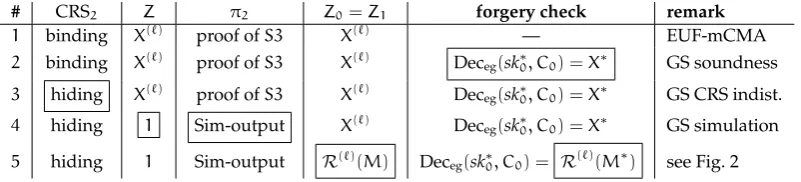
Figs. 1 and 2 (on page 22 and page 23) give a more technical summary of the game transi-tions of the proof (also taking into account the notation for the multi-user case). The remainder of this section is devoted to a detailed proof.
Proof of Theorem 3.1. We proceed in games. Letoutidenote the output of Gamei.
Game1is the original EUF-mCMA game withAand SIG. Of course,
Pr[out1=1] = Adveuf-mcmaSIG,A (k). (5)
In the following, we apply a superscript to variables to denote to which SIG instance they
belong. For instance, we denote with X(`) and sk0(`),sk(1`) the respective values from the`-th
used SIG instance. Furthermore, we writeX∗forX(`∗)for the challenge instance`∗ selected by
Afor his forgery, and similarly forsk∗0andsk∗1.
Thus, inGame2, we implement an additional “forgery check”. Concretely, we only
con-sider a forgeryσ∗= (C∗0, C1∗, π∗1, π∗2)fromAas valid ifπ∗1andπ∗2are validandif Deceg(sk∗0, C∗0) =
gX∗. (Otherwise, the game outputs0.) This change is purely conceptual: indeed, since CRS2is
binding, we can use the soundness of Groth-Sahai proofs. Thus, any valid proofπ∗2guarantees
thatS3(from (3)) holds, and so Deceg(sk∗0, C∗0) =gX
∗
. We obtain
InGame3, we generate both CRS1and CRS2as hiding CRSs, using HGen. The CRS indis-tinguishability of Groth-Sahai proofs yields
Pr[out3=1] −Pr[out2=1] = AdvddhG,B3(k) +Adv
ddh ^
G,B30
(k) (7)
for suitable DDH adversariesB3andB30. (Here, we use the re-randomizability of DDH tuples.
This enables a reduction that loses only a factor of1instead of2.)
InGame4, we simulate all proofsπ2in signatures generated forA, using the Groth-Sahai
simulator Sim (on input the random coins RCRSused to prepare CRS). We also generate the
corresponding commitmentsCZin all verification keys asCZ ←Com(CRS2, 1). We stress that
allX(`)are still chosen randomly, and all signatures are generated with encryptionsC0, C1 of
X(`). By the simulation property of Groth-Sahai proofs (see Theorem 2.6 and the following
comment concerning the reuse of commitments), these changes do not affectA’s view:
Pr[out4=1] = Pr[out3=1]. (8)
InGame5, we change the generation of signaturesandthe forgery check from Game2as
follows. To describe these changes, letR(`) :
Zp → Z∗p (for all scheme instances` ∈ [nU]) be
truly random functions. Our changes in Game5are then as follows:
• All signatures generated forAcontain encryptionsC0, C1of exponentsZ0=Z1 =R(`)(M)
(encoded as gZ0, gZ1) instead ofZ
0 = Z1 = X(`), where Mis the signed message. As in
Game4, the corresponding proofπis generated using witnesses forS1andS3from (3).
• Any forgeryσ∗ = (C∗0, C∗1, π∗1, π∗2)for a (fresh) messageM∗fromAis considered valid only
ifπ∗1 andπ∗2 are validandDeceg(sk∗0, C∗0) = R∗(M∗)holds. Otherwise, the game outputs0.
(Again, we use the shorthand notationR∗ =R(`∗)
for the challenge instance`∗.)
In particular, the second change implies that
Pr[out5=1] ≤ 1/(p−1) ≤ 1/2k, (9)
sinceR∗(M∗)is information-theoretically hidden fromA.
Hence, it remains to relate Game4and Game5:
Lemma 3.2. Forn=2dlog2(p)e+kand suitable DDH adversariesB5andB0
5, we have
Pr[out5=1] −Pr[out4=1]
≤ 8n·
Advddh
G,B5(k)
+4n·
Advddh^
G,B0
5
(k)+O(n/2k). (10)
Before we prove Lemma 3.2, we remark that putting together (5-10), we obtain (27), which is sufficient to show Theorem 3.1.
Proof of Lemma 3.2. We will consider a series of hybrid games between Game4 and Game5.
Concretely, Game4.i(fori≥0) is defined like Game4, except for the following changes:
• We initially uniformly and independently chooseiinvertible affine functionsfj :Zp →Zp
(forj∈[i]). Thefjdefine a “partial fingerprint” functionLi :Zp→{−1, 0, 1}ithrough
Li(M) =
f1(M)
p
, . . . ,
fi(M)
p
. (11)
For every scheme instance`∈[nU], letHi(`):Zp→Z∗pbe the composition ofLiwith a truly
random functionR(i`):{−1, 0, 1}i→Z∗p(so thatH
(`)
i (M) =R
(`)
i (Li(M))).
• Signatures forAcontain encryptionsC0, C1of exponentsZ0=Z1=H(i`)(M).
• Any forgeryσ∗ = (C∗0, C∗1, π∗1, π∗2)for a (fresh) messageM∗fromAis considered valid only
ifπ∗1andπ∗2are validandDeceg(sk∗0, C∗0) =H
(`)
i (M
Note that everyH(0`) is a constant function that maps every inputMto the same random
value. Hence, Game4.0is identical to Game4:
Pr[out4.0 =1] = Pr[out4=1]. (12)
Conversely, for large enoughiand with high probability, the “fingerprint function”Libecomes
injective, so that allH(i`)become independent truly random functions fromZptoZ∗p:
Lemma 3.3. Forn= 2dlog2(p)e+k, the functionLn from (11) is injective, except with probability 1/2k(over the choice of the invertible affine functionsfj:Zp→Zp).
We postpone a proof of Lemma 3.3 for now.
Hence, the functionsH(n`)= R(n`)◦ Lnused in Game4.n(forn=2dlog2(p)e+k) are
statis-tically close to truly random functionsR(`)(as used in Game5):
Pr[out4.n =1] −Pr[out5=1]
≤ 1/2k. (13)
The algebraic partitioning. Thus, we only need to show that there is no detectable difference
between Game4.i and Game4.(i+1) for anyi. We do so using a hybrid argument (i.e., a
sequence of games) that interpolates between Game4.iand Game4.(i+1). (See Fig. 2 for an
overview.) In short, we first refresh the affine functionffromCα, Cβ to a fresh random (but
invertible) affine functionf∗. Next, we usef∗to implement a different treatment of signatures,
depending on f(Mp)
. We detail these steps in the following.
Concretely,Game4.i.0is identical to Game4.i. Thus,
Pr[out4.i.0=1] = Pr[out4.i=1]. (14)
Step 1: refreshf. InGame4.i.1, we initially choose an invertible affine functionf∗ :Zp →Zp
uniformly, and we abort (with output 0) if the message M∗ for which A finally prepares a
forgery satisfiesf∗(M∗) ∈QRp∪{0}. We stress thatf∗ is not (yet) committed to in anyCα, Cβ,
and thus completely hidden fromA. Hence, an abort occurs with probability p2p+1 = 12 + 2p1,
independently ofA’s view, so
Pr[out4.i.1=1] =
1
2 −
1 2p
·Pr[out4.i.0=1] ≥
1
2·Pr[out4.i.0=1] −
1
2p. (15)
In Game4.i.2, we commit to the coefficients f∗0, f∗1 of the function f∗ from Game4.i.1 in
Cα, Cβfor all verification keys (instead of the coefficientsα=β=0). Accordingly, we generate
all signatures forAby proving statementS2(and notS1) from (3) whenever possible (i.e., upon
all signature queries withf∗(M) ∈ QRp∪{0}). Since CRS1 is hiding, we can use the
witness-indistinguishability of Groth-Sahai proofs to obtain
Pr[out4.i.2=1] = Pr[out4.i.1=1]. (16)
Step 2: usef∗ to decouple signatures. To describe our change in Game4.i.3, recall that in Game4.i.2, functionsH(i`)is used to determine both the valuesZ0 =Z1 = H(i`)(M)encrypted
inC0, C1 upon signature queries, and to implement the forgery check. In Game4.i.3, we use
three such functions H(i`),Zi(`),Q(i`) : Zp → Z∗p. Each of these functions is defined like H
(`)
i ,
for the same fingerprint functionLi, but with different (i.e., independently chosen) random
functionsR(i`). (In other words, we can writeH(i`)=F◦ Li, andZi(`)=F0◦ Li, andQ(i`)=F00◦ Li
for independently random functionsF, F0, F00 :{−1, 0, 1}i → Z∗p. Intuitively, thus,Zi(`)andQ(i`)
Our goal will be to use the functions H(i`),Zi(`),Qi(`) for messages M satisfying f∗(M) ∈/
QRp, f∗(M) = 0, and f∗(M) ∈ QRp, respectively. (Hence the symbols Z andQ.) This will
be conceptually identical to using a single functionH(i`+)1 for all messages of a given scheme
instance`. At this point, however, we can only partially implement this strategy, since we can
only replace the messages encrypted inC1, but not those fromC0. (Indeed,sk∗0 is still required
to implement the additional forgery check in Game4.i.3.)
Thus, in Game4.i.3, for every scheme instance`∈[nU], we use the respective functionH(i`)
to generate all ciphertextsC0, C1in signatures (as in Game4.i.2), with the following exceptions:
• For signature queries withf∗(M) =0, we encryptZ1 =Zi(`)(M)(instead ofZ1= H(i`)(M))
in the ciphertextC1of the generated signature.
• For signature queries withf∗(M)∈QRp, we encryptZ1=Q(i`)(M)inC1.
Note that for signatures withf∗(M)∈QRp∪{0}, the random coins used to generateC1(orC0)
are not used as a witness in the process of constructingπ. Furthermore, no secret keysk(1`)has
to be known to the game. A reduction to the (tight) IND-mCPA security of ElGamal yields
n−1
X
i=0
Pr[out4.i.3=1] −Pr[out4.i.2 =1] = n·AdvddhG,B4.i.3(k) (17)
for a suitable DDH adversaryB4.i.3. (We note that even though the random coins Rof C1 are
not known explicitly toB4.i.3, aC0with reusedRcan be constructed fromsk(0`)and a givengR.)
Our next step will be to replace the values encrypted in C0 in a similar way. To do so,
however, we need some preparations, since Game4.i.3 still knows the secret keys sk(0`) (to
finally implement the forgery check). Fortunately, however, we can alternatively use thesk(1`)
to implement this check. (To see why this yields the same functionality, recall that by our abort
rule from Game1, we may restrict to forgeries withf∗(M∗) ∈/ QRp∪{0}. However, by (3), a
valid forgery for such a message must containC∗0 andC∗1that encrypt the same message.)
As a first step, in Game4.i.4, we initially generate a binding CRS CRS1 (using CRS1 ←
BGen(gpp)). The CRS indistinguishability of Groth-Sahai proofs ensures that
n−1
X
i=0
Pr[out4.i.4=1] −Pr[out4.i.3=1] = n·
AdvddhG,B4.i.4(k) +Adv
ddh ^
G,B0
4.i.4
(k) (18)
for suitable DDH adversariesB4.i.4andB0
4.i.4.
Next, inGame4.i.5, we implement the forgery check rule from Game2usingsk∗1 (and not
sk∗0). That is, whenA submits a forgery σ∗ = (C∗0, C
∗
1, π
∗
1, π
∗
2), we check if Deceg(sk
∗
1, C∗1) =
H∗
i(M∗) holds (and reject the forgery if not). We may assume that M∗ ∈/ QRp ∪{0} (since
otherwise, we trivially abort anyway). But for suchM∗, a valid forgerymustfulfillS1from (3),
since at this point, CRS1is binding. In other words, we have Deceg(sk∗1, C∗1) = H
∗
i(M
∗)
if and
only if Deceg(sk∗0, C∗0) = H∗i(M∗). Hence, the change in Game4.i.5is purely conceptual, and
we get:
Pr[out4.i.5=1] = Pr[out4.i.4=1]. (19)
Since we no longer use sk∗0 (or the random coins from anyC1generated upon a signature
query), we can continue with our strategy. Specifically, inGame4.i.6, we generate all
cipher-textsC0, C1in signatures as follows:
• For queries withf∗(M)∈/ QRp, we encryptZ0=Z1=H(i`)(M)inC0andC1.
• For queries withf∗(M) =0, we encryptZ0=Z1=Zi(`)(M)inC0andC1.
Observe that the only difference to Game4.i.5is that the messagesZ0encrypted in ciphertexts
C0in signatures withf∗(M)∈QRp∪{0}are changed. For such encryptions, neither secret key
nor random coins are used by the game. Hence, a reduction to the (tight) IND-mCPA security of ElGamal yields
n−1
X
i=0
Pr[out4.i.6=1] −Pr[out4.i.5 =1] = n·AdvddhG,B4.i.6(k) (20)
for a suitable DDH adversaryB4.i.6. (Again, a reuse of random coins betweenC0 andC1 is
possible since the secret keysk1is known toB4.i.6during the reduction.)
Step 3: clean up. Now in Game4.i.6, we handle both signature queries andA’s forgery with
either H(i`), Zi(`), or Q(i`), depending on the Legendre symbol Mp
of M. This is equivalent
to handling all messages with a single function H(i`+)1 by the definition ofH(i`) (see also (11)).
Hence, we already “almost” implement the rules of Game4.(i+1), and we only need to clean
up things a little.
Namely, inGame4.i.7, we again implement the forgery check from Game2usingsk∗0(and
notsk∗1). With the same reasoning as in Game5, we get:
Pr[out4.i.7=1] = Pr[out4.i.6=1]. (21)
Next, in Game4.i.8, we again set up CRS1 as a hiding CRS (using HGen). Again, CRS
indistinguishability guarantees
n−1
X
i=0
Pr[out4.i.8=1] −Pr[out4.i.7=1] = n·
AdvddhG,B4.i.8(k) +Adv
ddh ^
G,B4.i.80
(k) (22)
for suitable DDH adversariesB4.i.8andB4.i.80 .
InGame4.i.9, we again set up the commitmentsCα, Cβin all verification keys as
commit-ments toα = β = 0. Accordingly, we generate all signatures for Aby proving statementS1
from (3). (Note that this is possible again since all generated pairs(C0, C1)do encrypt the same
message.) By the witness-indistinguishability of Groth-Sahai proofs,
Pr[out4.i.9=1] = Pr[out4.i.8=1]. (23)
Finally, in Game4.i.10, we do not abort anymore. (That is, we take back the abort rule
from Game1.) To see how this change affects the game’s output, we make a few observations.
First, note that in both Game4.i.9 and Game4.i.10, A’s view only depends on the way f∗
partitions the set of messages depending on f∗(pM)
, but not onwhichmessagesMare mapped
by f∗ to squares, and which to non-squares. (Indeed, any partitioning of theM is invariant
under multiplyingf∗ with an invertible non-square modulop. However, multiplication with
an invertible non-square inverts the Legendre symbol off∗(M).)
Thus, the probability forA to successfully forge a signature with f∗(Mp∗)
= 1 is exactly
the same as that to forge a signature with f∗(Mp∗)
= −1. Hence, if we cease to abort upon
f∗(M∗)∈QRp∪{0}, weat leastdoubleA’s success probability:
Pr[out4.i.10=1] ≥ 2·Pr[out4.i.9=1]. (24)
At the same time, Game4.i.10 is identical to Game4.(i+1). (As argued, the use of three
H(i+`)1in Game4.(i+1). Furthermore, CRS1is hiding, theCα, Cβare set up as commitments to
α=β=0, and the signatures use proofs of statementS1.) Thus,
Pr[out4.i.10=1] = Pr
out4.(i+1)=1
. (25)
Collecting all differences of probabilities from (14-25), we obtain
Pr[out4.0=1] −Pr[out4.n=1] ≤
n−1
X
i=0
Pr[out4.i=1] −Pr
out4.(i+1)=1
≤ 8n·
Advddh
G,B5(k)
+4n·
Advddh^
G,B50
(k)+O(n/2k)
for DDH adversaries B5 andB0
5 that combine all adversaries from the collected differences.
Together with (12) and (13), we obtain (10).
It remains to prove Lemma 3.3:
Proof of Lemma 3.3. For any distinct M0, M1 ∈ Zp and a uniformly chosen invertible affine
functionf : Zp → Zp, we have Prhf(M0)
p
=f(M1)
p
i
≤ 1/2, since fis pairwise
indepen-dent. As allfjfrom (11) are chosen independently, we get
Pr[Ln(M0) =Ln(M1)] ≤ 1/2n
for any two distinct M0, M1. A union bound over all O(p2) such pairs (M0, M1) shows the
claim.
4
Compact and (almost) tightly secure public-key encryption
Our signature scheme SIG from Section 3 is “almost” automorphic (in the sense of [1]). Namely, while its verification can be expressed as a system of equations that is compatible with Groth-Sahai proofs, its messages are exponents (as opposed to group elements). However, our scheme can still be used in the generic construction of [28]. This yields an (almost) tightly secure public-key encryption scheme with compact parameters, keys and ciphertexts. (Here, “compact” means “comprised of only a constant number of group elements or exponents.”)
But although compact in the above sense, the resulting encryption scheme would be rather inefficient (in particular since it would use nested Groth-Sahai proofs). Thus, here we describe an optimized and more compact (almost) tightly secure public-key encryption scheme PKE.
Setting and ingredients. The basis for our PKE construction is the signature scheme SIG from
Section 3, and we assume similar ingredients. In particular, we assume groupsGandG^, along
with the ElGamal encryption and Groth-Sahai proofs overG. Additionally, we assume:
• An OT-EUF-mCMA secure signature scheme with message spaceZp, given by algorithms
OPars,OGen,OSig,OVer. For concreteness, in all of the following, we assume the one-time
signature schemeTOTSfrom [28] inG. Its OT-EUF-mCMA security can be tightly reduced
to the discrete logarithm assumption inG(which is implied by the DDH assumption inG).
• A generator Hof collision-resistant hash functions H : {0, 1}∗ → {0, 1}k. We will interpret
All ingredients can be instantiated under the DDH assumptions inGandG^.
Public parameters. EPars(1k)first proceeds like the parameter generation of SIG, and samples
group parametersgpp, a hiding Groth-Sahai CRS, and two ElGamal public keyspk0,pk1. Then,
EPars sets up exponentsZ, α, βandciphertexts
Cα←Enceg(pk0, g
α;R
α), Cβ ←Enceg(pk0, g
β;R
β), CZ←Enceg(pk0, g
Z;R
Z).
Note that here, we encrypt (and do not commit to)Z, α, βin order to be able to produce slightly
more compact proofs involvingZ, α, βlater on. However, we note that conceptually, we could
have as well committed toZ, α, βas with SIG.
Finally, EPars chooses parametersopp←OPars(1k)and a hash function H, and outputs
epp= (gpp,CRS,pk0,pk1,opp,H, Cα, Cβ, CZ).
Key generation. EGen(epp)samples two ElGamal keypairs
(pk00,sk00)←EGeneg(G, p, g) (pk10,sk10)←EGeneg(G, p, g),
and outputs a public and a secret key as
pk= (pk00,pk10) sk= (d,skd0)
for a uniformly chosen bitd←{0, 1}.
Encryption. Intuitively, encryption corresponds to a Naor-Yung style double encryption with consistency proof [34]. The consistency proof itself proceeds as in [28], and essentially proves that either the double encryption is consistent, or a signature to a fresh value is known. (A suitable fresh value will be hash of a freshly sampled verification key of the one-time signature
scheme.) Concretely, Enc(pk, M), forM∈G, chooses a one-time signature keypair
(ovk,osk)←OGen(opp),
and encrypts the valuesZ00 =Z10 =M∈GandZ0=Z1=0as
C00 =Enceg(pk00, Z00;R0) C0 =Enceg(pk0, gZ0;R)
C10 =Enceg(pk10, Z
0
1;R0) C1 =Enceg(pk1, g
Z1;R).
(Note that for efficiency and to simplify proofs involving these values, we reuse the encryption
random coinsR0andR.) Then, Enc generates a proofπ(under CRS) of the statement
Z00 =Z10 ∨
Z0=Z1 ∨ f(H(ovk))∈QRp∪{0}
∧ Z0=Z ∨ Z=0
. (26)
Enc will prove the left branchS10 of the outer∨clause, using as witness the encryption
ran-domnessR0. Hence,πessentially proves consistency ofC00, C10,orthe same statement as for a
SIG-signature for H(ovk). (There are some slight differences compared to a SIG-signature: first,
we use only one CRS. Hence, we cannot simulate proofs for substatementZ0 = Zduring the
proof. Instead, however, we can setZ=0to be able to generate proofs forS30without
knowl-edge ofZ0. Second, because the random coins used forCα, Cβ, CZare not known at encryption
time, the proof of quadratic residuosity becomes somewhat less efficient than the one in SIG’s signing algorithm. We refer to Appendix A.2 for more details on the exact proof equations.)
Finally, Enc signs
and outputs the ciphertext
C= (C00, C10, C0, C1, π,ovk, σ).
Decryption. Dec(sk, C)checks the validity ofσandπ. If bothσandπare valid, Dec outputs
M←Deceg(skd0, Cd0); otherwise, Dec outputs⊥.
Efficiency. PKE has the following efficiency characteristics (cf. Appendix A.2):
• The public parameters consist of12 G- and3G^-elements, plus the group parametersgpp,
and a description of the hash function H.
• Each public key contains2G-elements.
• Each secret key contains oneZp-exponent and a bit.
• Each ciphertext contains27G- and30G^-elements, and3Zp-exponents.
Theorem 4.1(Security of PKE). Under the DDH assumptions inGandG, and assuming that^ His collision-resistant, the PKE schemePKEdescribed above is IND-mCCA secure. Concretely, for every EUF-mCMA adversaryAonSIG, there exist DDH adversariesBandB0, and an adversaryCon the
collision-resistance ofH(of roughly the same complexity as the EUF-mCMA experiment withAand SIG) with
Adveuf-mcmaSIG,A (k) ≤ O(k)·
Advddh
G,B(k)
+O(k)·
Advddh^
G,B0(k)
+AdvcrH,C(k) +O(k/2k). (27)
Proof sketch. The proof combines the strategy from [28] with our concrete signature scheme, and thus we outline only the main strategy. This strategy proceeds in games, and modifies an
IND-mCCA attack with adversaryAas follows:
• First, the consistency proofs in all ciphertexts are prepared with different witnesses. More
specifically, instead of provingZ00 = Z10, we prove the right branch of (26). (Note that this
right branch corresponds to the validity of a SIG-signature for message H(ovk).) Thanks to
the witness-indistinguishability of Groth-Sahai proofs, this change is not detectable byA.
• Next, all challenge ciphertexts generated forAare made inconsistent. (This is possible since
the ciphertext consistency proofs are prepared from signature witnesses now.) Concretely,
recall that so far we have encrypted the respective challenge message M∗b (for the secret
bitbchosen by the IND-mCCA experiment) in bothC00 andC10 of all challenge ciphertexts.
Now we encrypt M∗binCd0 andM1∗−b inC10−d, wheredis the bit chosen for the respective
PKE instancei. Hence, we change the encrypted message for all ElGamal instances whose
secret key is not used. Since only the secret keys skd0 (but not the sk10−d) are used in the
experiment, this game modification can be justified with the (tight) security of ElGamal.
• We now reject all inconsistent (in the sense Deceg(sk00, C00) =6 Deceg(sk10, C10)) decryption
queries fromA. At this point in the proof, we know bothsk00 andsk10 for all PKE-instances,
and can thus recognize the first inconsistent (in the above sense) decryption query with a valid consistency proof. Note that any such query implies a valid SIG-signature for a
mes-sage H(ovk). The security of the one-time signature scheme guarantees that this message is
fresh, so thatAhas essentially forged a SIG-signature. Any such forgery can be excluded
with the same strategy as in the proof of Theorem 3.1 (with the differences described above). This step entails the dominant terms in (27) related to DDH reductions.
At this point,A gets no information about the IND-mCCA secretbanymore. Namely, each
challenge ciphertext contains ElGamal encryptions of bothM∗0andM∗1, in an order determined
byd⊕b, whereddenotes which ElGamal secret keyskd0 the experiment uses to decrypt for this
instance. Now since inconsistent ciphertexts are rejected, the game’s answer toA’s decryption
queries does not depend on the any of the bitsd. Moreover, unless (any)dis known, alsob
is hidden. Hence, A’s view is now completely independent of b, and thus A’s IND-mCCA