Privacy-preserving Context-aware Recommender Systems:
Analysis and New Solutions
Qiang Tang and Jun Wang
APSIA group, SnT, University of Luxembourg 6, rue Richard Coudenhove-Kalergi, L-1359 Luxembourg
{qiang.tang, jun.wang}@uni.lu
April 9, 2015
Abstract. Nowadays, recommender systems have become an indispensable part of our daily life and provide personalized services for almost everything. However, nothing is for free – such systems have also upset the society with severe privacy concerns because they accumulate a lot of personal information in order to provide recommendations. In this work, we construct privacy-preserving recommendation protocols by incorporating cryptographic techniques and the inherent data characteristics in recommender systems. We first revisit the protocols by Jeckmans et al. at ESORICS 2013 and show a number of security and usability issues. Then, we propose two privacy-preserving protocols, which compute predicted ratings for a user based on inputs from both the user’s friends and a set of randomly chosen strangers. A user has the flexibility to retrieve either a predicted rating for an unrated item or the Top-N unrated items. The proposed protocols prevent information leakage from both protocol executions and the protocol outputs: a somewhat homomorphic encryption scheme is used to make all computations run in encrypted form, and inputs from the randomly-chosen strangers guarantee that the inputs of a user’s friends will not be compromised even if this user’s outputs are leaked. Finally, we use the well-known MovieLens 100k dataset to evaluate the performances for different parameter sizes.
1
Introduction
As e-commerce websites began to develop, users were finding it very difficult to make the most appropriate choices from the immense variety of items (products and services) that these websites were offering. Take an online book store as an example, going through the lengthy book catalogue not only wastes a lot of time but also frequently overwhelms users and leads them to make poor decisions. As such, the availability of choices, instead of producing a benefit, started to decrease users’ well-being. Eventually, this need led to the development of recommender systems (or, recommendation systems). Informally, recommender systems are a subclass of information filtering systems that seek to predict the ’rating’ or ’preference’ that a user would give to an item (e.g. music, book, or movie) they had not yet considered, using a model built from the characteristics of items and/or users. Today, recommender systems play an important role in highly rated commercial websites such as Amazon, Facebook, Netflix, Yahoo, and YouTube. Netflix even awarded a million dollars prize to the team that first succeeded in improving substantially the performance of its recommender system. Besides these well-known examples, recommender systems can also be found in every corner of our daily life.
concern for general data mining services [16]. Recently Calandrino et al. [7] showed inference attacks which allow an attacker with some auxiliary information to infer a user’s transactions from temporal changes in the public outputs of a recommender system. In practice, advanced recommender systems collect more personal information (e.g. context information such as location and social surroundings) than ratings, and they inevitably cause more severe privacy concerns.
1.1 State-of-the-Art
Broadly speaking, existing privacy-protection solutions for recommender systems can be di-vided into two categories. One category is cryptographic solutions, which heavily rely on cryptographic primitives (e.g. homomorphic encryption, zero knowledge proof, threshold en-cryption, commitment, private information retrieval, and a variety of two-party or multi-party cryptographic protocols). For example, the solutions from [2, 8, 9, 12–15, 20, 24, 25, 28, 32, 36] fall into this category. More specifically, the solutions from [2, 8, 9, 12, 15, 20, 32] focus on distributed setting where every individual user is expected to participate in the recommendation computa-tion, while those from [13, 14, 24, 25, 28, 36] focus on partitioned dataset, where several organi-zations wish to compute recommendations for their own users by joining their private dataset. These solutions typically assume semi-honest attackers and apply existing cryptographic prim-itives to secure the procedures in standard recommender protocols. This approach has two advantages: rigorous security guarantee in the sense of secure computation (namely, every user only learns the recommendation results and the server learns nothing) can be achieved, and there is no degradation in accuracy. The disadvantage lies in the fact that these solutions are all computation-intensive so that they become impractical when user/item populations get large.
The other category is data obfuscation based solutions, which mainly rely on adding noise to the original data or computation results to achieve privacy. The solutions from [5, 19, 21–23, 26, 27, 31, 35] fall into this category. These solutions usually do not incur complicated manipulations on the users’ inputs, so that they are much more efficient. The drawback is that they often lack rigorous privacy guarantees and downgrade the recommendation accuracy to some extent. With respect to privacy guarantees, an exception is the differential privacy based approach from [19] which does provide mathematically sound privacy notions. However, cryptographic primitives are required for all users to generate the accumulated data subjects (e.g. sums and covariance matrix).
1.2 Our Contribution
While most privacy-preserving solutions focus on recommender systems which only take into account users’ ratings as inputs, Jeckmans, Peter, and Hartel [14] moved a step further to propose privacy-preserving recommendation protocols for context-aware recommender systems, which include social relationships as part of the inputs to compute recommendations. Generally the protocols are referred to as the JPH protocols, and more specifically they are referred to as JPH online protocol and JPH offline protocol respectively. Interestingly, the JPH protocols make use of the recent advances in somewhat homomorphic encryption schemes [6]. In this paper, our contribution is three-fold.
protocol execution predicted ratings are required to be computed for all items, namely not only for unrated items but also already-rated items. This incurs not only computational overhead but also unnecessary information leakage.
Secondly, we revise the prediction computation formula from [14] by incorporating inputs from both friends and strangers. This change not only aligns the formula with standard recom-mender algorithms [18] but also enables us to avoid the cold start problem of the JPH protocols. Security wise, it helps us prevent potential information leakages through the outputs of friends. We then propose two privacy preserving protocols. One enables a user to check whether a spe-cific unrated item might be of his interest, and the other returns the Top-N unrated items. Therefore, we provide more flexible choices for users to discover their interests in practice. Both protocols are secure against envisioned threats in our threat model.
Thirdly, we analyze accuracy performances of the new protocols, and show that for some parameters the accuracy is even better than some other well-known recommendation protocols, e.g. those from [18].
1.3 Organization
The rest of this paper is organized as follows. In Section 2, we present preliminaries on nota-tion and building blocks. In Secnota-tion 3, we demonstrate the security and usability issues with the JPH protocols. In Section 4, we propose our new formulation and trust assumptions for recommender systems. In Section 5, we present two protocols for single prediction and Top-N recommendations respectively. In Section 6, we present security and accuracy analysis for the proposed protocols. In Section 7, we conclude the paper.
2
Preliminary
– WhenXis a set,x←$ Xmeans thatxis chosen fromXuniformly at random, and|X|means the size ofX. Ifχis a distribution, thens←χmeans thatsis sampled according toχ.
– We use bold letter, such asX, to denote a vector. Given two vectorXandY, we useX·Yto denote their inner product.
– In a recommender system, the item set is denoted by a vectorB=(1,2,· · ·,b,· · ·,|B|), and a userx’s ratings are denoted by a vectorRx = (rx,1,· · · ,rx,b,· · ·,rx,|B|). The rating value is often an integer from{0,1,2,3,4,5}. If itemihas not been rated, thenrx,iis set to be 0. With
respect toRx, a binary vectorQx =(qx,1,· · ·,qx,b,· · ·,qx,|B|) is defined as follows:qx,b=1 iff
rx,b,0 for every 1≤b≤ |B|.
2.1 Brakerski-Vaikuntanathan SWHE Scheme
Letλbe the security parameter. The Brakerski-Vaikuntanathan public-key SWHE scheme [6] is parameterized by two primesq,t∈poly(λ)∈Nwheret<q, a degreenpolynomial f(x)∈Z[x], two error distributionsχandχ′over the ringRq=Zq[x]/⟨f(x)⟩. The message space isM=Rt =
Zt[x]/⟨f(x)⟩. An additional parameter isD∈N, namely the maximal degree of homomorphism
allowed (and to the maximal ciphertext length). The parametersn,f,q,t, χ, χ′,Dare public.
– Keygen(λ): (1) sample s,e0 ← χ anda0 ∈ Rq; (2) computes = (1,s,s2, . . . ,sD) ∈ RDq+1; (3)
outputSK=sandPK=(a0,b0 =a0s+te0).
– Enc(PK,m): (1) samplev,e′←χande′′←χ′; (2) computec0=b0v+te′′+m,c1=−(a0v+te′); (3) outputc=(c0,c1).
– Dec(SK,c=(c0, . . . ,cD)∈RqD+1): outputm=(c·smodq) modt.
is why theDecalgorithm generally assumes the ciphertext to be a vector ofD+1 elements (if the ciphertext has less elements, simply pad 0s).
Eval(+,cα,cβ)=(cα0+cβ0,cα1+cβ1). Eval(·,cα,cβ)=(cα0·cβ0,cα0·cβ1+cα1·cβ0,cα1·cβ1).
When the evaluations are done to a ciphertext and a plaintext message, there is a simpler form for the evaluation algorithm, denoted asEval∗. This has been used in [14].
Eval∗(+,cα,m′)=(cα0+m′,cα1). Eval∗(·,cα,m′)=(cα0·m′,cα1·m′).
Throughout the paper, given a public/private key pair (PKu,SKu) for some useru, we use
[m]uto denote a ciphertext of the messagemunder public keyPKu. In comparison,Enc(PKu,m)
represents the probabilistic output of runningEncfor the messagem. Whenmis a vector of messages, we useEnc(PKu,m) to denote the vector of ciphertexts, where encryption is done for
each element independently. We use the notation∑1≤i≤N[mi]uto denote the result of sequentially
applyingEval(+, ,) to the cipheretxts.
3
Analysis of JPH Protocols
Let the active user, who wants to receive new recommendations, be denoted as useru. Let the friends of userube denoted byFu. Every friend f ∈Fuand useruassigns each other weights
wf,u,wu,f respectively, and these values can be regarded as the perceived importance to each
other. Then, the predicted rating for an unrated itemb∈Bfor useruis computed as follows.
pu,b=
∑
f∈Fuqf,b·rf,b·(
wu,f+wf,u
2 ) ∑
f∈Fuqf,b·(
wu,f+wf,u
2 ) =
∑
f∈Furf,b·(wu,f +wf,u)
∑
f∈Fuqf,b·(wu,f+wf,u)
(1)
In the JPH protocols [14], Jeckmans et al. did not explicitly explain their notation [x]u+yand
[x]u·y. We assume these operations are as [x]u+y=Eval∗(+,[x]u,y) and [x]u·y=Eval∗(·,[x]u,y).
In any case, this assumption only affects the Insecurity against Semi-honest Serverissue for the JPH online protocol. All other issues still exist even if this assumption is not true.
3.1 JPH Online Protocol
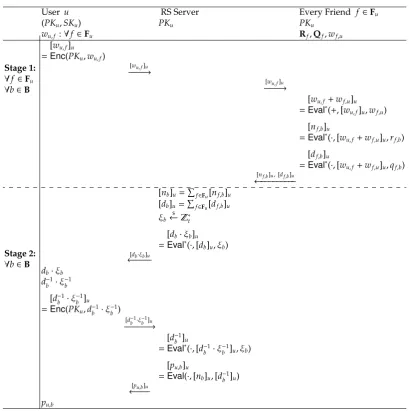
In the online scenario, the recommendation protocol is executed between the active useru, the server, and useru’s friends. In theinitialization phase, userugenerates a public/private key pair for the Brakerski-Vaikuntanathan SWHE scheme, and all his friends and the server obtain a valid copy of his public key. The protocol runs in two stages as described in Fig. 1.
1. In the first stage, userusends his encrypted weights to all his friends, who will then add their parts to the weights and prepare their contributions for computing the final predication as required by Equation (1).
User u RS Server Every Friend f∈Fu
(PKu,SKu) PKu PKu
wu,f :∀f∈Fu Rf,Qf,wf,u
Stage 1:
∀f ∈Fu
∀b∈B
[wu,f]u
=Enc(PKu,wu,f)
[wu,f]u
−−−−→
[wu,f]u
−−−−→
[wu,f+wf,u]u
=Eval∗(+,[wu,f]u,wf,u)
[nf,b]u
=Eval∗(·,[wu,f+wf,u]u,rf,b)
[df,b]u
=Eval∗(·,[wu,f+wf,u]u,qf,b)
[nf,b]u,[df,b]u
←−−−−−−−−−
Stage 2:
∀b∈B
[nb]u=
∑
f∈Fu[nf,b]u
[db]u=
∑
f∈Fu[df,b]u
ξb
$ ←Z∗
t
[db·ξb]u
=Eval∗(·,[db]u, ξb)
[db·ξb]u
←−−−−−
db·ξb
d−1
b ·ξ−
1
b
[d−1
b ·ξ−
1
b ]u
=Enc(PKu,d−b1·ξ−b1)
[d−1
b ·ξ−b1]u
−−−−−−−→ [d−1
b ]u
=Eval∗(·,[d−1
b ·ξ−
1
b ]u, ξb)
[pu,b]u
=Eval(·,[nb]u,[d−b1]u)
[pu,b]u
←−−−−
pu,b
Fig. 1.JPH Online Protocol
It is worth noting that the friends only need to be involved in the first stage. Despite the security analysis in the original paper, we observe the following security issues.
– Hidden assumption. Jeckmans et al. [14] did not mention any assumption on the
commu-nication channel between users and the server. In fact, if the commucommu-nication channel be-tween any user f and the server does not provide confidentiality, then userucan obtain [nf,b]u, [df,b]uby passive eavesdropping. Then, userucan trivially recoverqf,bandrf,b.
– Insecurity against Semi-honest Server. With [df,b]u, the server can trivially recoverqf,b, i.e. if
[df,b]u = 0 then qf,b = 0; otherwiseqf,b = 1. After recoveringqf,b, the server can trivially
recoverrf,b=
[nf,b]u
[df,b]u. The root of the problem is the homomorphic operations have been done
in the naive way, withEval∗(·, ,) andEval∗(+, ,).
– Encrypted Division Problems. The first concern is that it may not be able to determine the predicted ratingpu,b. As a toy example, let t = 7. In this case, both⌊23⌉ = 1 and ⌊31⌉ = 3
link to the index 2·3−1 = 3·1−1 = 3 mod 7. If p
u,b = 3, then user u will not be able
that the representation of pu,b in the protocol may leak more information than the to-be
predicted value⌊nb
db⌉. As an example,⌊
2
3⌉ = ⌊34⌉ = 1. Clearly, giving 2·3−1 or 3·4−1 leaks more information than the to-be predicted value 1.
– Potential Information Leakage through Friends. For useru, his friends may not be friends with each other. For example, it may happen that some friend f ∈ Fu is not a friend of any
other user fromFu . Suppose that the usersFu\f have learned the the valuepu,b or some
approximation of it (this is realistic as they are friends of useru). Then, they may be able to infer whether user f has rated the itemband the actual rating.
Besides the above security issues, there are some usability issues with the protocol as well. One issue is that, at the time of protocol execution, maybe only a few friends are online. In this case, the predicted rating may not be very accurate. It can also happen thatpu,b cannot
be computed, because none of useru’s friends has rated itemb. This is the typical cold start problem in recommender systems [1]. The other issue is that the predicted rating needs to computed for everyb∈Beven if useruhas already rated this item. Otherwise, userumay leak information to the server, e.g. which items have been rated. This not only leaks unnecessary information to useru, but also makes it very inefficient when useruonly wants a prediction for a certain unrated item.
3.2 JPH Offline Protocol
In the offline scenario, the friendsFuneed to delegate their data to the server to enable useruto
run the recommendation protocol when they are offline. Inevitably, this leads to a more complex
initialization phase. In this phase, both useruand the server generate their own public/private key pair for the Brakerski-Vaikuntanathan SWHE scheme and they hold a copy of the valid public key of each other. Moreover, every friend f ∈Funeeds to pre-processRf,Qf, andwf,u.
The rating vectorRf is additively split into two setsSf andTf. The splitting for every rating
rf,bis straightforward, namely chooser
$
←Z∗
t and setsf,b=randtf,b=rf,b−r modt. Similarly,
the weightwf,uis split intoxf,uandyf,u. It is assumed thatTf andQf will be delivered to user
uthrough proxy re-encryption schemes.
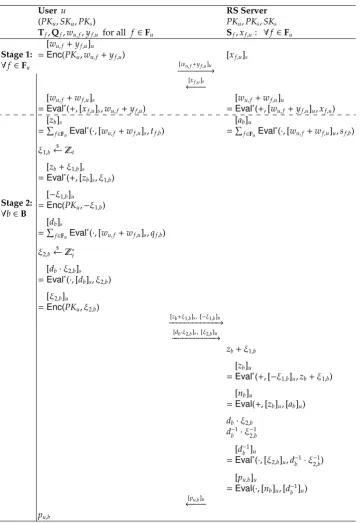
Running between useruand the server, the two-stage protocol is described in Fig. 2.
1. In the first stage, useruencrypt the partially-combined weights underPKuand sends the
ciphertexts to the server, which can then compute the encrypted weights between user
uand all his friends. The server encrypts the random weight shares from useru’s friends underPKsand sends the ciphertexts to useru, who can then compute the encrypted weights
under the server’s public key.
2. In the second stage, useruand the server run some sort of two-party protocol so that the server can compute Equation (1) without learning useru’s ratings and letting useruknow his friends’ contributions.
This protocol has exactly the same encrypted division,potential information leakage through friendsand usability issues, as stated in Section 3.1. In addition, we have the following new concerns.
– Explicit Information Disclosure. It is assumed that theQf values for all f ∈ Fu are obtained
by useruin clear. This is a direct violation of these users’ privacy because it has shown that leaking what has been rated by a user can breach his privacy [34].
– Key Recovery Attacks against the Server. Chenal and Tang [10] have shown that given a certain number of decryption oracle queries an attacker can recover the private key of the Brakerski-Vaikuntanathan SWHE scheme. We show that userucan manipulate the protocol and recover the server’s private keySKu. Before the attack, userusets up a fake accountu′
and a set of fake friendsFu′(e.g. through Sybil attacks [11]). The key recovery attack relies on multiple executions of the protocol, and it works as follows in each execution.
1. Useru′chooses a carefully-chosen ciphertextcand replaces [zb+ξ1,b]swithc. He also
User u RS Server
(PKu,SKu,PKs) PKu,PKs,SKs
Tf,Qf,wu,f,yf,u for all f ∈Fu Sf,xf,u: ∀f∈Fu
Stage 1:
∀f∈Fu
[wu,f+yf,u]u
=Enc(PKu,wu,f +yf,u) [xf,u]s
[wu,f+yf,u]u
−−−−−−−−→
[xf,u]s
←−−−−
[wu,f+wf,u]s [wu,f +wf,u]u
=Eval∗(+,[xf,u]s,wu,f +yf,u) =Eval∗(+,[wu,f +yf,u]u,xf,u)
Stage 2:
∀b∈B
[zb]s [ab]u
=∑f∈FuEval ∗(·,[w
u,f+wf,u]s,tf,b) =
∑
f∈FuEval
∗(·,[w
u,f +wf,u]u,sf,b)
ξ1,b
$ ←Zt
[zb+ξ1,b]s
=Eval∗(+,[zb]s, ξ1,b)
[−ξ1,b]u
=Enc(PKu,−ξ1,b)
[db]s
=∑f∈FuEval ∗(·,[w
u,f+wf,u]s,qf,b)
ξ2,b
$ ←Z∗
t
[db·ξ2,b]s
=Eval∗(·,[db]s, ξ2,b)
[ξ2,b]u
=Enc(PKu, ξ2,b)
[zb+ξ1,b]s,[−ξ1,b]u
−−−−−−−−−−−−→
[db·ξ2,b]s,[ξ2,b]u
−−−−−−−−−−−→
zb+ξ1,b
[zb]u
=Eval∗(+,[−ξ1,b]u,zb+ξ1,b)
[nb]u
=Eval(+,[zb]u,[ab]u)
db·ξ2,b
d−1
b ·ξ−
1 2,b
[d−1
b ]u
=Eval∗(·,[ξ2,b]u,d−b1·ξ−2,1b)
[pu,b]u
=Eval(·,[nb]u,[d−b1]u)
[pu,b]u
←−−−−
pu,b
Fig. 2.JPH Offline Protocol
2. When receiving [pu′,b]u′, useru′can recover the constant inDec(SKs,c) because he knows
abandd−b1(note that useru′forged all his friendsFu′).
It is straightforward to verify that, ifcis chosen according to the specifics in [10] then user
u′ (and user u) can recover SKs in a polynomial number of executions. WithSKs, useru
can recover the weights from his real friends inFuand then infer their ratings. It is worth
If a user f has changed his rating, then he needs to update every element inSf. Otherwise, the
server will know which item has been newly rated. Moreover,Tf,Qf need to be delivered to
all f’s friends through proxy re-encryption schemes. Suppose that, in a certain period, a subset
F′u of users have updated their ratings. If the server somehow learns that userugets a high recommendation for an itemb′, then it can conclude that some users fromF′u have recently ratedb′.
Remark 1. As to the aforementioned key recovery attacks concern, there is one subtlety. In the original Brakerski-Vaikuntanathan SWHE scheme, the plaintext isZt[x], while the
recommen-dation protocol only requires the plaintext space to beZt. It can be argued that the described
attack can be prevented if the server performs a validity check when decrypting [zb+ξ1,b]s: if
the decrypted value does not fall intoZt then output a decryption error. This will invalidate
our attack (and the attack from [10]), but it does guarantee there is no another attack. We leave a further investigation of this issue as a future work.
4
New Formulation of Recommender System
In this section, we provide a new approach to compute recommendations and define fine-grained trust assumptions among the participants in a recommender system.
4.1 Computing Predicted Ratings
In our solution, we compute the predicted rating for useru based on inputs from both his friends and some strangers for both accuracy and security reasons. In reality friends like and consume similar items, but it might happen that very few friends have rated the itemb. If this happens, the predicated value from Equation (1) may not be very accurate (cold start problem). In Section 3, we have shown that the private information of useru’s friends might be leaked through useru’s outputs. This is because the outputs are computed solely based on the inputs of useru’s friends. It is reasonable to believe that, by taking into account some randomly chosen strangers, we will mitigate both problems.
When factoring in the inputs from randomly chosen strangers, we will use the simple Bias From Mean (BFM) scheme for the purpose of simplicity. It is worth stressing that there are a lot of different choices for this task. Nevertheless, as to the accuracy, this scheme has similar performance to many other more sophisticated schemes, such as Slope One and Perason/Cosine similarity-based collaborative filtering schemes [18]. Let the stranger set beTu, the predicted
valuep∗u,bfor an unrated itembis computed as follows. Note thatrt is usert’s average rating,
namely⌈ ∑
i∈Brt,i
∑
i∈Bqt,i⌋.
p∗u,b=ru+
∑
t∈Tu∑qt,b·(rt,b−rt)
t∈Tuqt,b
(2)
When factoring in the inputs from the friends, we make two changes to Equation (1) from Section 3.1. One is to only take into account the weight value from useru. This makes more sense because how important a friend means to useruis a very subjective matter foruonly. Jeckmans et al. averaged the weights for the purpose of limiting information leakage [14]. The other is to compute the predication based on bothu’s average rating and the weighted rating deviations from his friends. Let the friend set beFu, the predicted valuep∗∗u,bfor an unrated item
bis computed as follows. Note thatrf is user f’s average rating, namely⌈
∑
i∈Brf,i
∑
i∈Bqf,i⌋.
p∗∗u,b=ru+
∑
f∈Fu∑qf,b·(rf,b−rf)·wu,f
f∈Fuqf,b·wu,f
(3)
example, a user Alice may be very mean and assign a score 3 to most of her favorite items while her friends may be very generous and assign a score 5 to their favorite items. Using the Equation (1), we will likely generate a score 5 for an unrated item for Alice, who may just rate a score 3 for the item even if she likes it. In this regard, Equation (3) is more appropriate because
rureflects the user’s rating style and
∑
f∈F∑uqf,b·(rf,b−rf)·wf,u
f∈Fuqf,b·wf,u reflects the user’s preference based on
inputs from his friends.
Based on the inputs from the strangers and friends, a combined predicted valuepu,bfor an
unrated itembcan be computed aspu,b=ρ·p∗u,b+(1−ρ)·p∗∗u,bfor some 0≤ρ≤1. Due to the fact
that cryptographic primitives are normally designed for dealing with integers, we rephrase the formula as follows, whereα, βare two integers.
pu,b=
β
α+β·p∗u,b+
α
α+β·p∗∗u,b (4)
4.2 Threat Model
As to communication, we assume all communications are mediated by the RS server and the communication channels are integrity and confidentiality protected. Instead of making a general semi-honest assumption on all participants, we distinguish the following.
1. Threat from semi-honest RS server. In the view of all users, the RS server will follow the protocol specification but it may try to infer their private information from openly collected transaction records.
2. Threat from a semi-honest friend.In the view of a user, none of his friends will collude with the RS server or another party to breach his privacy. We believe the social norm deters such colluding attacks, and the deterrence comes from the fact that once such a collusion is known to the victim user then the friendship may be jeopardized. Nevertheless, we still need to consider possible privacy threats in two scenarios.
– In the view off ∈Fu, userumay attempt to learn his private information when running
the recommendation protocol. In the view of useru, his friend f ∈ Fumay also try to
infer his information as well.
– In the view off ∈Fu, useru’s output (e.g. a new rated item and predicted rating value)
may be leaked. If another party obtains such auxiliary information, then userf’s private information may be at risk. For example, thePotential Information Leakage through Friends
security issue in Section 3.1 falls into this scenario.
3. Threat from strangers.We consider the following two scenarios.
– In the view of useruand his friends, a stranger may try to learn their private information.
– In the view of a stranger, who is involved in the protocol execution of useru, useru
may try to learn his private information.
5
New Privacy-Preserving Recommender Protocols
In this section, we propose two privacy-preserving protocols: one for the active user to learn the predicted rating for an unrated item, and the other is for the active user to learn Top-N unrated items. Both protocols share the sameinitialization phase.
In the initialization phase, user u generates a public/private key pair (PKu,SKu) for the
Brakerski-Vaikuntanathan SWHE scheme and sends PKu to the server. For the purpose of
enabling strangers to validate his public key, useruasks his friends to certify his public key and puts the certification information on the server. In addition, useruassigns a weightwu,f
to each of his friend f ∈Fu. All other users perform the same operations in this phase. Besides
Before describing the new protocols, it is worth stressing ourdesign principlefirst. We require that all inputs (namely,qf,b,qt,b,rf,b,rt,bfor all f ∈Fuandt∈Tu) are freshly encrypted locally
in each computation step. This seemingly unnecessary procedure makes the protocols immune to the vulnerabilities of the JPH online protocol ( whererf,bandqf,bare directly multiplied to
other ciphertexts). Moreover, instead of giving useruthe predicted ratings, we only return a yes/no answer in the single prediction protocol and the Top-N list in the Top-N protocol. This reduces potential information leakages.
5.1 Recommendation Protocol for Single Prediction
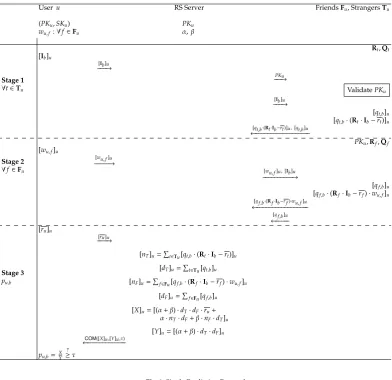
When useruwants to figure out whether the predicted rating for an unrated itembis above a certain thresholdτin his mind, he initiates the protocol in Fig. 3. In more details, the protocol runs in three stages.
1. In the first stage, userugenerates a binary vectorIb, which only has 1 for theb-th element,
and sends the ciphertext [Ib]u = Enc(PKu,Ib) to the server. The server first sendsPKu to
some randomly chosen strangers who are the friends of user u’s friends in the system1. Such a usertcan then validatePKuby checking whether their mutual friends have certified
PKu. After the server has successfully found a viable stranger setTu, it forwards [Ib]u to
every user in Tu. WithPKu and (Rt,Qt), usertcan compute the following based on the
homomorphic properties. For notation purpose, assume [Ib]u=([I(1)b ]u,· · ·,[I(b|B|)]u)
[qt,b]u=
∑
1≤i≤|B|
Eval(·,Enc(PKu,qt,i),[I(bi)]u)
[Rt·Ib]u=
∑
1≤i≤|B|
Eval(·,Enc(PKu,rt,i),[I(bi)]u)
temp= ∑
1≤i≤|B|
Eval(·,Enc(PKu,qt,i),[I(bi)]u)
[qt,b·(Rt·Ib−rt)]u=Eval(·,temp,Eval(+,[Rt·Ib]u,−Enc(PKu,rt)))
2. In the second stage, for every friend f ∈ Fu, userusends the encrypted weight [wu,f]u =
Enc(PKu,wu,f) to the server, which then forwards [wu,f]uand [Ib]uto userf. WithPKu, [Ib]u,
[wu,f]uand (Rf,Qf), user f can compute the following.
[qf,b]u=
∑
1≤i≤|B|
Eval(·,Enc(PKu,qf,i),[I(bi)]u)
[Rf·Ib]u=
∑
1≤i≤|B|
Eval(·,Enc(PKu,rf,i),[I(bi)]u)
temp= ∑
1≤i≤|B|
Eval(·,Enc(PKu,qf,i),[I(bi)]u)
[qf,b·(Rf·Ib−rf)·wu,f]u=Eval(·,Eval(·,temp,[wu,f]u),Eval(+,[Rf·Ib]u,−Enc(PKu,rf)))
3. In the third stage, user u sends his encrypted average rating [ru]u = Enc(PKu,ru) to the
server. The server first computes [nT]u,[dT]u,[nF]u,[dF]uas shown in Fig. 3, and then compute
[X]u,[Y]uas follows.
temp1=Eval(·,Eval(·,Eval(·,[dF]u,[ru]u),[dT]u),Enc(PKu, α+β))
1Due to the small world phenomenon, the population of friends of friends can already be very large (see
[3] and http://sysomos.com/insidetwitter/sixdegrees/). Therefore, such kind of strangers can provide enough randomness for security. Generally, we can allow the server to choose the strangers randomly. Then, the server needs to provide a friendship path for the stranger to validate the public keyPKuand
temp2=Eval(·,Eval(·,[nT]u,[dF]u),Enc(PKu, β))
temp3=Eval(·,Eval(·,[nF]u,[dT]u),Enc(PKu, α))
[X]u=Eval(+,Eval(+,temp1,temp2),temp3),[Y]u=Eval(·,Eval(·,[dF]u,[dT]u),Enc(PKu, α+β))
Referring to Equations (2) and (3), we havep∗u,b =ru+ndTT andp∗∗u,b =ru+ ndFF. The ultimate
predictionpu,bcan be denoted as follows.
pu,b=
β
α+β·p∗u,b+
α α+β·p∗∗u,b
= (α+β)·dT·dF·ru+β·nT·dF+α·nF·dT
(α+β)·dT·dF
= X
Y
Due to the fact that all values are encrypted underPKu, useruneeds to run a comparison
protocolCOMwith the server to learn whetherpu,b ≥τ. SinceX,Y, τare integers,COMis
indeed an encrypted integer comparison protocol: where useruholds the private keysku
andτ, the server holds [X]u,[Y]u, and the protocol outputs a bit to useruindicating whether
X≥τ·Y. Many such protocols exist, and that by Veugen [33] is the most efficient one.
Useru RS Server FriendsFu, StrangersTu
(PKu,SKu) PKu
wu,f:∀f∈Fu α, β
Stage 1
∀t∈Tu
Rt,Qt
[Ib]u
[Ib]u
−−−→
PKu
−−−→
ValidatePKu
[Ib]u
−−−→
[qt,b]u
[qt,b·(Rt·Ib−rt)]u
[qt,b·(Rt·Ib−rt)]u,[qt,b]u
←−−−−−−−−−−−−−−−−−−
Stage 2
∀f∈Fu
PKu,Rf,Qf
[wu,f]u
[wu,f]u
−−−−−→
[wu,f]u,[Ib]u
−−−−−−−−−−→
[qf,b]u
[qf,b·(Rf·Ib−rf)·wu,f]u
[q f,b·(Rf·Ib−r f)·wu,f]u
←−−−−−−−−−−−−−−−−− [q f,b]u
←−−−−−
Stage 3
pu,b
[ru]u
[ru]u
−−−−→
[nT]u=∑t∈Tu[qt,b·(Rt·Ib−rt)]u
[dT]u=∑t∈Tu[qt,b]u
[nF]u=∑f∈Fu[qf,b·(Rf·Ib−rf)·wu,f]u
[dF]u=∑f∈Fu[qf,b]u
[X]u=[(α+β)·dT·dF·ru+
α·nT·dF+β·nF·dT]u
[Y]u=[(α+β)·dT·dF]u
COM([X]u,[Y]u,τ) ←−−−−−−−−−−−−−
pu,b=XY
? ≥τ
5.2 Recommendation Protocol for Top-N Items
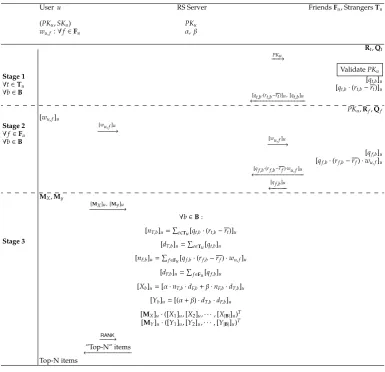
When the active useruwants to figure out Top-N unrated items, he initiates the protocol in Fig. 4. In more details, the protocol runs in three stages.
1. In the first stage, the server sendsPKuto some randomly chosen strangers who can then
validatePKuas in the previous protocol. Suppose that the server has successfully foundTu.
WithPKuand (Rt,Qt), usert∈Tucan compute [qt,b·(rt,b−rt)]u=Enc(PKu,qt,b·(rt,b−rt)) and
[qt,b]u=Enc(PKu,qt,b) for every 1≤b≤ |B|. All encrypted values are sent back to the server.
2. In the second stage, to every friend f ∈ Fu, user usends the encrypted weight [wu,f]u =
Enc(PKu,wu,f). WithPKu, [wu,f]uand (Rf,Qf), user f can compute [qf,b]uand
[qf,b·(rf,b−rf)·wu,f]u=Eval(·,Enc(PKu,qf,b·(rf,b−rf)),[wu,f]u)
for every 1≤b≤ |B|. All encrypted values are sent back to the server.
3. In the third stage, userugenerates two matricesMX,MYas follows: (1) generate a|B| × |B|
identity matrix; (2) randomly permute the columns to obtainMY; (3) to obtainMX, for every
b, if itembhas been rated then replace the element 1 inb-th column with 0.
1 0 · · ·0
0 1 · · ·0
· · · ·
0 0 · · ·1
−−−−−−−−−−−−→permutationcolumn MY=
0 1 · · ·0
0 0 · · ·1
· · · ·
1 0 · · ·0
zeroing −−−−−−−−−−−→
rated items MX=
0 1 · · ·0
0 0 · · ·0
· · · ·
1 0 · · ·0
Useru encrypts the matrices (element by element) and sends [MX]u,[MY]uto the server,
which then proceeds as follows.
(a) The server first computes [nT,b]u, [dT,b]u, [nF,b]u, [dF,b]u, [Xb]u, [Yb]ufor every 1≤b≤ |B|as
shown in Fig. 4, in the same way as in the previous protocol. Referring to Equation (4), we see thatruappears inpu,bfor everyb.For simplicity, we ignore this term when comparing
the predictions for different unrated items.With this simplification, the predictionpu,bcan
be denoted as follows.
pu,b=
β α+β·
nT,b
dT,b +
α α+β·
nF,b
dF,b
= β·nT,b·dF,b+α·nF,b·dT,b
(α+β)·dT,b·dF,b
= Xb
Yb
(b) The server permutes the ciphertexts vector (([X1]u,[Y1]u),([X2]u,[Y2]u),· · · ,([X|B|]u,[Y|B|]u))
in an oblivious manner as follows.
([U1]u,[U2]u,· · ·,[U|B|]u)=[MX]u·([X1]u,[X2]u,· · · ,[X|B|]u)T
([V1]u,[V2]u,· · ·,[V|B|]u)=[MY]u·([Y1]u,[Y2]u,· · · ,[Y|B|]u)T
The multiplication between the ciphertext matrix and ciphertext vector is done in the standard way, except that the multiplication between two elements is done withEval(·, ,) and the addition is done with Eval(+, ,). Suppose item bhas been rated before and ([Xb]u,[Yb]u) is permuted to ([Ui]u,[Vi]u), then Ui = 0 because the element 1 in b-th
column has been set to 0.
(c) Based on someCOMprotocol, e.g. that used in the previous protocol, the server ranks
Ui
Vi (1≤i≤ |B)|in the encrypted form using any standard ranking algorithm, where
(d) After the ranking, the server sends the ”Top-N” indexes (e.g. the permuted Top-N indexes) to useru, who can then recover the real Top-N indexes.
Useru RS Server FriendsFu, StrangersTu
(PKu,SKu) PKu
wu,f:∀f∈Fu α, β
Stage 1
∀t∈Tu
∀b∈B
Rt,Qt PKu
−−−→
ValidatePKu
[qt,b]u
[qt,b·(rt,b−rt)]u
[qt,b·(rt,b−rt)]u,[qt,b]u
←−−−−−−−−−−−−−−−−−
Stage 2
∀f∈Fu
∀b∈B
PKu,Rf,Qf
[wu,f]u
[wu,f]u
−−−−−→
[wu,f]u
−−−−−→
[qf,b]u
[qf,b·(rf,b−rf)·wu,f]u
[q f,b·(r f,b−r f)·wu,f]u
←−−−−−−−−−−−−−−−− [q f,b]u
←−−−−−
Stage 3
MX,My
[MX]u,[My]u
−−−−−−−−−−−→
∀b∈B: [nT,b]u=∑t∈Tu[qt,b·(rt,b−rt)]u
[dT,b]u=∑t∈Tu[qt,b]u
[nF,b]u=∑f∈Fu[qf,b·(rf,b−rf)·wu,f]u
[dF,b]u=∑f∈Fu[qf,b]u
[Xb]u=[α·nT,b·dF,b+β·nF,b·dT,b]u
[Yb]u=[(α+β)·dT,b·dF,b]u
[MX]u·([X1]u,[X2]u,· · ·,[X|B|]u)T
[MY]u·([Y1]u,[Y2]u,· · ·,[Y|B|]u)T
RANK −−−−→ ”Top-N” items ←−−−−−−−−−−−−−− Top-N items
Fig. 4.Top-N Protocol
The usage of matrix MXin the random permutation of stage 3 guarantees that the rated
items will all appear in the end of the list after ranking. As a result, the rated items will not appear in the recommended Top-N items.
6
Evaluating the Proposed Protocols
6.1 Parameters and Performances
The selection of the global parametersα, βand the sizes ofFuand Tucan affect the security,
in particular when considering the threat from a semi-trusted friend. If α+βα gets larger or the size ofTugets smaller, then the inputs from friends contribute more to the final outputs of user
u. This will in turn make information reference attacks easier (for useruto infer the inputs of his friends). However, if α+βα gets smaller andTugets larger, then we will lose the motivation
of explicitly distinguishing friends and strangers in computing recommendations, namely the accuracy of recommendations may get worse. How to choose these parameters will depend on the application scenarios and the overall distributions of users’ ratings.
In order to get some rough idea about how these parameters influence the accuracy of recommendation results. We choose the MovieLens 100k dataset 2 and define friends and strangers as follows. Given a user u, we first calculate the Cosine similarities with all other users and generate a neighborhood for useru. Then, we choose a certain number of users from the neighborhood as the friends, and randomly choose a certain number of users from the rest as strangers3. For different parameters, the Mean Average Error (MAE) [30] of the proposed protocols is shown in Table 1. Note that lower MAE implies more accurate recommendations.
PPPPPP PP (|Fu|,|Tu|)
α
α+β 0.5 0.6 0.7 0.8 0.9 1.0
(10, 10) 0.8222 0.8168 0.8158 0.8193 0.8265 0.8444 (20, 10) 0.8075 0.7996 0.7964 0.8009 0.8077 0.8194 (30, 10) 0.8033 0.7896 0.7819 0.7849 0.7871 0.7999 (40, 10) 0.7965 0.7801 0.7728 0.7695 0.7755 0.7814 (50, 10) 0.7909 0.7762 0.7666 0.7623 0.7623 0.7684 (60, 10) 0.7840 0.7722 0.7604 0.7552 0.7559 0.7588 (70, 10) 0.7824 0.7685 0.7538 0.7483 0.7460 0.7506 (80, 10) 0.7818 0.7643 0.7540 0.7432 0.7390 0.7432 (90, 10) 0.7785 0.7598 0.7494 0.7419 0.7356 0.7378 (100, 10) 0.7757 0.7559 0.7448 0.7390 0.7338 0.7312
Table 1.MAE of Experiments
From the numbers, it is clear that the more friends are involved the more accurate recom-mendation results useruwill obtain (i.e. the MAE is lower). There is also a trend that the MAE becomes smaller when the contribution factor α+βα becomes larger. According to the accuracy results by Lemire and Maclachlan (in Table 1 of [18] where the values are MAE divided by 4), their smallest MAE is 0.752=0.188×4. From the above Table 1, we can easily get lower MAE when|Fu| ≥70 by adjustingα+βα .
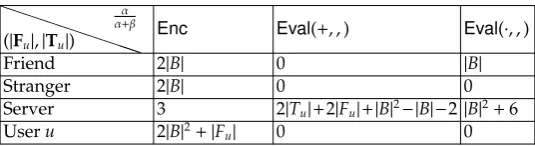
With respect to the computational complexity of the proposed protocols, we simply count the number of different computations required. For the single prediction protocol, the numbers are listed in Table 2. There is the additional cost ofCOMprotocol between useruand the server. For the Top-N protocol, the numbers are listed in Table 3. There is the additional cost ofRANK
protocol between useruand the server. One interesting fact is that, in order to hide the itemb, the single prediction protocol requires more computations from the strangers than the Top-N protocol. We leave a further investigation of the computational performances as a future work.
2http://grouplens.org/datasets/movielens/
3The algorithms are here: https://github.com/thelakers/moophs/blob/master/
PPPPPP PP (|Fu|,|Tu|)
α
α+β Enc Eval(+, ,) Eval(·, ,)
Friend 1+3|B| 3|B| −2 3|B|+2 Stranger 1+3|B| 3|B| −2 3|B|+1 Server 3 2|Tu|+2|Fu| −2 9
Useru |B|+|Fu|+1 0 0
Table 2.(Partial) Complexity of Single Prediction Protocol
PPPPPP P P (|Fu|,|Tu|)
α
α+β Enc Eval(+, ,) Eval(·, ,)
Friend 2|B| 0 |B|
Stranger 2|B| 0 0
Server 3 2|Tu|+2|Fu|+|B|2−|B|−2|B|2+6
Useru 2|B|2+|F
u| 0 0
Table 3.(Partial) Complexity of Top-N Protocol
6.2 Security Analysis
Informally, the protocols are secure due to two facts: (1) all inputs are first freshly encrypted and then used in the computations; (2) all computations (e.g. computing predictions and ranking) done by the server and other users are in the encrypted form. As to the single prediction protocol in Section 5.1, we have the following arguments.
1. Threat from semi-honest RS server.Given theCOMprotocol is secure (namely, the server does not learn anything in the process). Then the server learns nothing about any user’s private input information, e.g.b, τ,Ru,Qu,Rf,Qf,wu,f,Rt,Qtfor allfandt, because every element is
freshly encrypted in the computation and all left computations are done homomorphically. Moreover, the server learns nothing aboutpu,b
?
≥τbased on the security ofCOM. 2. Threat from a semi-honest friend.We consider two scenarios.
– Informally, a friend f’s contribution topu,bis protected by the inputs from usersFu\f
and the strangersTu. Given a randomly chosen unrated item for useruand a randomly
chosen friendf ∈Fu, we perform a simple experiment to show howf’s input influences
the predicted rating. We setα+βα =0.8 and the (|Fu|,|Tu|)=(30,10) in all tests, and choose
strangers randomly in every test.
XXXXXXXXX Rating Value
Tests
Test 1 Test 2 Test 3 Test 4 Test 5
With f’s input (r) 4.0351 3.7165 3.9125 3.9125 4.0667 Without f’s input (r′) 3.7014 4.0343 3.9125 3.9698 3.9556
r−r′ 0.3337 -0.3178 0.0000 -0.0573 0.1111
Table 4.Influence of a Single Friend
– For similar reasons, it will be hard forFu\f to infer user f’s data even if they learned
useru’s output at the end of a protocol execution.
3. Threat from strangers.We consider the following two scenarios.
– In the view of strangers, all values are encrypted under useru’s public key, so that they will not be able to derive any information about the inputs and outputs of useruand his friends.
– For the strangers involved in a protocol execution, it does not leak much information for several reasons. Firstly, user u does not know which stranger is involved in the protocol execution. Secondly, the inputs of a group strangers are blended in the output to useru. We perform a simple experiment to show how strangers’ inputs influence the predicted ratings for useru. We setα+βα =0.8 and the (|Fu|,|Tu|)=(30,10). Table 5 shows
the rating differences for 5 unrated items, depending on whether a stranger is involved in the computational or not. It is clear that very little information about a stranger can be inferred from useru’s outputs.
``````````` Strangers
Unrated Items
Item1 Item2 Item3 Item4 Item5
Stranger1 0.0 -0.0825 0.0 0.0 0.0
Stranger2 0.0 0.0 0.0 0.0 0.0
Stranger3 0.0 0.0211 0.0 0.0 0.0
Stranger4 0.0913, 0.0 0.0 0.0 0.0
Stranger5 0.0 0.0134 0.0702 0.0 0.1375
Table 5.Influence of Strangers
Thirdly, the strangers are independently chosen in different protocol executions, so that it is difficult to leverage on the accumulated information.
The same analysis applies to the Top-N protocol in Section 5.2. As to useru’s outputs, the matrices [MX]u,[MY]urandomly permuted the predictions so that the ranking does not leak
any information about the Top-N items.
7
Conclusion
Acknowledgements
The authors are supported by a CORE (junior track) grant from the National Research Fund, Luxembourg.
References
1. G. Adomavicius and A. Tuzhilin. Toward the next generation of recommender systems: A survey of the state-of-the-art and possible extensions.IEEE Trans. Knowl. Data Eng., 17(6):734–749, 2005. 2. E. A¨ımeur, G. Brassard, J. M. Fernandez, and F. S. M. Onana. Alambic: a privacy-preserving
recom-mender system for electronic commerce.Int. J. Inf. Secur., 7:307–334, 2008.
3. L. Backstrom, P. Boldi, M. Rosa, J. Ugander, and S. Vigna. Four degrees of separation. InProceedings of the 4th Annual ACM Web Science Conference, pages 33–42, 2012.
4. M. Beye, A. Jeckmans, Z. Erkin, Q. Tang, P. Hartel, and I. Lagendijk. Social Media Retrieval, chapter Privacy in Recommender systems, pages 263–281. Springer, 2013.
5. A. Bilge and H. Polat. A scalable privacy-preserving recommendation scheme via bisecting k-means clustering.Information Processing & Management, 49(4):912 – 927, 2013.
6. Z. Brakerski and V. Vaikuntanathan. Fully homomorphic encryption from ring-lwe and security for key dependent messages. InAdvances in Cryptology — CRYPTO 2011, pages 505–524. Springer, 2011. 7. J. A. Calandrino, A. Kilzer, A. Narayanan, E. W. Felten, and V. Shmatikov. ”you might also like: ”
privacy risks of collaborative filtering. In32nd IEEE Symposium on Security and Privacy, S&P 2011., pages 231–246, 2011.
8. J. F. Canny. Collaborative filtering with privacy. InIEEE Symposium on Security and Privacy, pages 45–57, 2002.
9. J. F. Canny. Collaborative filtering with privacy via factor analysis. InProceedings of the 25th Annual International ACM SIGIR Conference on Research and Development in Information Retrieval, pages 238–245, 2002.
10. M. Chenal and Q. Tang. On key recovery attacks against existing somewhat homomorphic encryption schemes. InProgress in Cryptology – LATINCRYPT 2014, page to appear, 2014.
11. J. R. Douceur. The sybil attack. InPeer-to-Peer Systems, First International Workshop, IPTPS 2002, volume 2429 ofLNCS, pages 251–260. Springer, 2002.
12. Z. Erkin, M. Beye, T. Veugen, and R. L. Lagendijk. Efficiently computing private recommendations. InInternational Conference on Acoustic, Speech and Signal Processing, 2011.
13. S. Han, W. K. Ng, and P. S. Yu. Privacy-preserving singular value decomposition. In Y. E. Ioannidis, D. L. Lee, and R. T. Ng, editors,Proceedings of the 25th International Conference on Data Engineering, pages 1267–1270. IEEE, 2009.
14. A. Jeckmans, A. Peter, and P. H. Hartel. Efficient privacy-enhanced familiarity-based recommender system. In J. Crampton, S. Jajodia, and K. Mayes, editors,Computer Security - ESORICS 2013 - 18th European Symposium on Research in Computer Security, volume 8134 ofLNCS, pages 400–417. Springer, 2013.
15. A. Jeckmans, Q. Tang, and P. Hartel. Privacy-preserving collaborative filtering based on horizontally partitioned dataset. In2012 International Symposium on Security in Collaboration Technologies and Systems (CTS 2012), pages 439–446, 2012.
16. M. Kantarcioglu, J. Jin, and C. Clifton. When do data mining results violate privacy. InThe Tenth ACM SIGMOD International Conference on Knowledge Discovery and Data Mining, pages 599–604. ACM, 2004. 17. S. K. Lam, D. Frankowski, and J. Riedl. Do you trust your recommendations? an exploration of security and privacy issues in recommender systems. In G. Muller, editor,Emerging Trends in Information and Communication Security, volume 3995 ofLNCS, pages 14–29. Springer, 2006.
18. D. Lemire and A. Maclachlan. Slope one predictors for online rating-based collaborative filtering. In H. Kargupta, J. Srivastava, C. Kamath, and A. Goodman, editors, Proceedings of the 2005 SIAM International Conference on Data Mining, SDM 2005, pages 471–475. SIAM, 2005.
19. F. McSherry and I. Mironov. Differentially private recommender systems: building privacy into the Netflix prize contenders. InProceedings of the 15th ACM SIGKDD international conference on Knowledge discovery and data mining, pages 627–636, 2009.
20. V. Nikolaenko, S. Ioannidis, U. Weinsberg, M. Joye, N. Taft, and D. Boneh. Privacy-preserving matrix factorization. InProceedings of the 2013 ACM SIGSAC Conference on Computer & Communications Security, pages 801–812, 2013.
22. H. Polat and W. Du. Privacy-preserving collaborative filtering using randomized perturbation tech-niques. InProceedings of the Third IEEE International Conference on Data Mining, pages 625–628, 2003. 23. H. Polat and W. Du. Privacy-preserving collaborative filtering. International journal of electronic
commerce, 9:9–36, 2005.
24. H. Polat and W. Du. Privacy-preserving collaborative filtering on vertically partitioned data. In9th European Conference on Principles and Practice of Knowledge Discovery in Databases, volume 3721 ofLNCS, pages 651–658, 2005.
25. H. Polat and W. Du. Privacy-preserving top-n recommendation on horizontally partitioned data. In
2005 IEEE/WIC/ACM International Conference on Web Intelligence (WI 2005), pages 725–731. IEEE Computer Society, 2005.
26. H. Polat and W. Du. Svd-based collaborative filtering with privacy. InProceedings of the 2005 ACM Symposium on Applied Computing (SAC), pages 791–795. ACM, 2005.
27. H. Polat and W. Du. Achieving private recommendations using randomized response techniques. InAdvances in Knowledge Discovery and Data Mining, 10th Pacific-Asia Conference, PAKDD 2006, pages 637–646. Springer, 2006.
28. H. Polat and W. Du. Privacy-preserving top-N recommendation on distributed data.J. Am. Soc. Inf. Sci. Technol., 59:1093–1108, 2008.
29. N. Ramakrishnan, B.J. Keller, B.J. Mirza, and A. Y. Grama. Privacy risks in recommender systems.
Internet Computing, IEEE, 5:54–63, 2001.
30. G. Shani and A. Gunawardana. Evaluating recommendation systems. In F. Ricci, L. Rokach, B. Shapira, and P. B. Kantor, editors,Recommender Systems Handbook, pages 257–297. Springer, 2011.
31. R. Shokri, P. Pedarsani, G. Theodorakopoulos, and J. Hubaux. Preserving privacy in collaborative filtering through distributed aggregation of offline profiles. InProceedings of the third ACM conference on Recommender systems (RecSys ’09), pages 157–164, 2009.
32. Q. Tang. Cryptographic framework for analyzing the privacy of recommender algorithms. In2012 International Symposium on Security in Collaboration Technologies and Systems (CTS 2012), pages 455–462, 2012.
33. T. Veugen. Comparing encrypted data. http://bioinformatics.tudelft.nl/sites/default/files/Comparing2011. 34. U. Weinsberg, S. Bhagat, S. Ioannidis, and N. Taft. Blurme: inferring and obfuscating user gender
based on ratings. In P. Cunningham, N. J. Hurley, I. Guy, and S. S. Anand, editors,Sixth ACM Conference on Recommender Systems, RecSys ’12, pages 195–202. ACM, 2012.
35. I. Yakut and H. Polat. Arbitrarily distributed data-based recommendations with privacy. Data & Knowledge Engineering, 72(0):239 – 256, 2012.
36. J. Zhan, C. Hsieh, I. Wang, T. Hsu, C. Liau, and D. Wang. Privacy-preserving collaborative recom-mender systems.Trans. Sys. Man Cyber Part C, 40:472–476, 2010.
Appendix I: More Performance Tests
For every friend fiof useru, randomly choose an unrated item, we compute the predicted
rating difference with and withoutf’s input. We set α+βα =0.8 and the (|Fu|,|Tu|)=(30,10) in all
tests, but the strangers are chosen randomly in every test.
``````````` Rating Differences
Tests
Test 1 Test 2 Test 3 Test 4 Test 5
W.r.tf1 -0.0616 0.0549 0.0593 -0.2166 0.036
W.r.tf2 -0.0057 -0.2945 0.0 0.0 0.0993
W.r.tf3 0.07080 0.0 0.2037 -0.0351 -0.1788
W.r.tf4 -0.1658 -0.024 0.0124 -0.0558 0.0325
W.r.tf5 -0.2477 -0.004 -0.0671 0.0302 0.2273