R E S E A R C H
Open Access
Kernel generalized neighbor discriminant
embedding for SAR automatic target recognition
Yulin Huang, Jifang Pei
*, Jianyu Yang, Tao Wang, Haiguang Yang and Bing Wang
Abstract
In this paper, we propose a new supervised feature extraction algorithm in synthetic aperture radar automatic target recognition (SAR ATR), called generalized neighbor discriminant embedding (GNDE). Based on manifold learning, GNDE integrates class and neighborhood information to enhance discriminative power of extracted feature. Besides, the kernelized counterpart of this algorithm is also proposed, called kernel-GNDE (KGNDE). The experiment in this paper shows that the proposed algorithms have better recognition performance than PCA and KPCA.
Keywords:Synthetic aperture radar; Automatic target recognition; Feature extraction; Manifold learning
1 Introduction
Synthetic aperture radar (SAR) has been widely used in many fields, such as terrain surveying, marine monitor-ing, and earth observation, because of its time, all-weather, penetrating ability and high resolution. SAR automatic target recognition (ATR) is the essential tech-nology in SAR image interpretation and analysis.
Generally, the procedure of SAR ATR can be divided into four major steps: detection, discrimination, feature extraction, and recognition. The goal of detection is to locate the potential region of interest. In the discrimin-ation phase, the region of interest is processed to remove the false alarms. The feature extraction is one of the cru-cial steps for SAR ATR, which can reduce the dimen-sionality of SAR images greatly and improve recognition efficiency. Finally, the extracted features of the target clips are recognized in the last stage of SAR ATR system.
It has been observed that many feather extraction techniques have been proposed. Principal component analysis (PCA) and linear discriminant analysis (LDA) were used for SAR image feature extraction [1,2] be-cause of their simplicity and effectiveness. Both of them are based on a global linear structure and need to trans-form a two-dimensional image into a one-dimensional vector. This will cause a large calculation burden since feather extraction is implemented in a very high-dimensional vector space.
In addition, the kernel trick [3,4] is applied to extend-ing linear feature extraction algorithms to nonlinear ones. These methods transform input space to other higher or even infinite dimensional inner product space, using nonlinear operators, which is performed by a nel mapping function. Kernel PCA (KPCA) [5] and ker-nel LDA (KLDA) [6] describe that in detail.
Recently, the manifold learning algorithm-local pre-serving projection (LPP) is proposed [7]. But it might not be suitable for SAR ATR, because of its minimization problem, which results in discarding larger principle components.
Based on the manifold learning method, we design neighborhood geometry and target function using the average of similar dispersion of dataset, and then, calcu-late the linear embedding mapping, according to cat-egory information. When this method was extended to vector space, we named it as generalized neighbor dis-criminant embedding (GNDE). In order to reduce calcu-lation burden, a kernel function was employed to replace the high-dimensional vector inner product. This is the kernel GNDE (KGNDE) method mainly discussed in this paper. It was hoped to solve the nonlinear problem better and improve target identification rate in SAR ATR.
The rest of this paper is organized as follows: We introduce the GNDE in section 2, and KGNDE is pro-posed in section 3. In section 4, we verify GNDE and KGNDE by the MSTAR database. Finally, we conclude the paper in section 5.
* Correspondence:[email protected]
Department of Electronic Engineering, University of Electronic Science and Technology of China (UESTC), Chengdu, China
i i i
2,…,N), l≪m, so that samples in the same class keep their neighborhood information and samples in different classes apart from each other. The object function of GNDE is as follows:
JV ¼
Equation 1 shows that maximizing JV makes samples
from different classes apart from each other while sam-ples in the same class proximate in the feature space, which is helpful for discrimination.
Referring to (1) and (2), we can infer that
JV ¼ We define an object matrixMV
MV ¼XLXT ð4Þ
where El×lisl × lunit matrix. Finally, optimization prob-lem reduces to find:
arg max
is the set of orthogonal eigenvectors of MVcorresponding
to thellargest eigenvalue.
GNDE is formally stated as follows:
1) Compute affinity weight matrixWaccording to (2). 2) According to (3) and (4), compute object matrixMV,
resolve the maximization problem as (7) and get the optimal embedding mapV.
3) Feature extraction: given a testing samplexT, extracted feature iszT=VTxi.
3 Kernel generalized neighbor discriminant embedding
The kernel function is widely used to enhance the classi-fication of linear dimensionality reduction methods. GNDE can be further improved by kernel function, which is named KGNDE. Assume that a nonlinear map-ping φ:xi∈ℝm→φ(xi)∈ℝH is introduced, where His a
certain high-dimensional feature space.
The main purpose of KGNDE is to find embedding mapΦ∈ℝH×l:xi∈ℝm→ k(zi) =ΦTφ(xi)∈ℝl(i= 1, 2,…,
N), l≪m. According to kernel trick property, Φ=
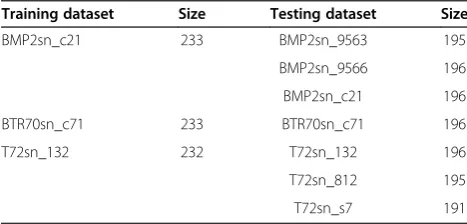
Table 1 Training and testing datasets
Training dataset Size Testing dataset Size
BMP2sn_c21 233 BMP2sn_9563 195
BMP2sn_9566 196
BMP2sn_c21 196
BTR70sn_c71 233 BTR70sn_c71 196
T72sn_132 232 T72sn_132 196
T72sn_812 195
[Φ1,Φ2,⋯,Φl], whereΦk¼
XN
p¼1
αk
pφ xp ,αkp∈ℝ. The
ob-jective function of KGNDE is as follows:
JK ¼
Based on kernel theory, each element of kernel matrix K= [kij]∈ℝN×Nis as follows:
kij¼φð Þxi ;φ xj ¼φð Þxi Tφ xj ð9Þ
Sometimes, we use Gauss or polynomial function in-stead of (9). Furthermore, we can recomputek(zi):
kð Þ ¼zi ΦTφð Þ ¼xi
According to (8) and (10), we can get
JK ¼
Define an object matrixMK,
MK ¼ X
i≤j
wijK•iK•iT−K•iK•jT ð12Þ
We can infer that
JK ¼ATMKA ð13Þ
Impose the additional constraint:
ATA¼E
ll ð14Þ
Finally, the object function can be written as:
arg max is the set of orthogonal eigenvectors ofMKcorresponding
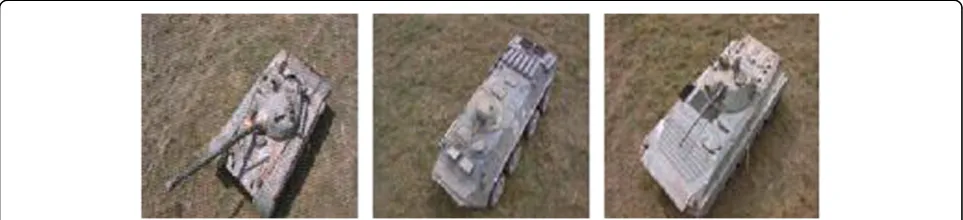
to thellargest eigenvalue. Figure 1Optical images for three targets in MSTAR database.
KGNDE is formally stated as follows:
1) Compute the affinity weight matrixWaccording to (2), compute kernel matrixKaccording to (9). 2) According to (11) and (12), compute the object
matrixMK, resolve the maximization problem as (15) and get the optimal embedding mapA. 3) Feature extraction: given a testing samplexT,
extracted feature isk(zT) =ATK•i.
Now, we concern the computational complexity of the proposed algorithms. In most cases, the number of training samples is less than the dimension of the
train-ing sample (N≪m). Therefore, like most of other
fea-ture extraction methods, the computational bottlenecks of GNDE and KGNDE are solving the generalized eigen-value problems, whose computational complexity are O(m3
) and O(N3), respectively.
4 Experiment
We use the Moving and Stationary Target Acquisition and Recognition (MSTAR) dataset to evaluate GNDE and KGNDE. The training dataset contains SAR images at the depression angle 17°, and testing dataset contains SAR images at the depression angle 15°. Both training dataset and testing dataset cover full 0° ~ 360° aspect ranges. Table 1 lists a detailed information about the type and number included in the training and testing datasets [9].
4.1 Experiment steps
1) Image pre-processing: Speckle suppression and target segmentation are used for removing speckles and background clutters, respectively. Then we use gray enhancement based on power function to enhance information in the dataset. Finally, we get
Figure 3Preprocessed SAR images of three targets.
the dataset {xi∈ℝm,i= 1, 2,…,N} called DATA,
wherexidonates each SAR image vectors and its dimensionsm= 61 × 61 = 3, 721. The optical images and the corresponding SAR images of the three targets in the MSTAR dataset are shown in Figures1
and2. Images of the targets after processing are shown in Figure3.
2) Feature extraction: Both GNDE and KGNDE are utilized to extract feature of DATA. In order to examine recognition performance of these methods, PCA and KPCA are also used to extract feature. In this paper, both KPCA and KGNDE use polynomial function as the kernel function, as is shown in (16):
kij¼xiTxjþ1μ ð16Þ
whereμis the function parameter. In this paper, we chooseμ= 5.
3) Classification: Nearest neighbor classifier (NNC) [10] is utilized to classify extracted feature based on this algorithm.
4.2 Experiment results
Firstly, we compare GNDE with PCA. As is shown in Figure 4, GNDE performs better than PCA. PCA is an
unsupervised method based on a linear structure, while GNDE is a supervised method based on manifold struc-ture. Global linear structure is not applicable for high-dimensional dataset, but manifold structure is. Besides, supervised method is conducive to cluster so that classi-fication is easier. Therefore, GNDE is superior to PCA.
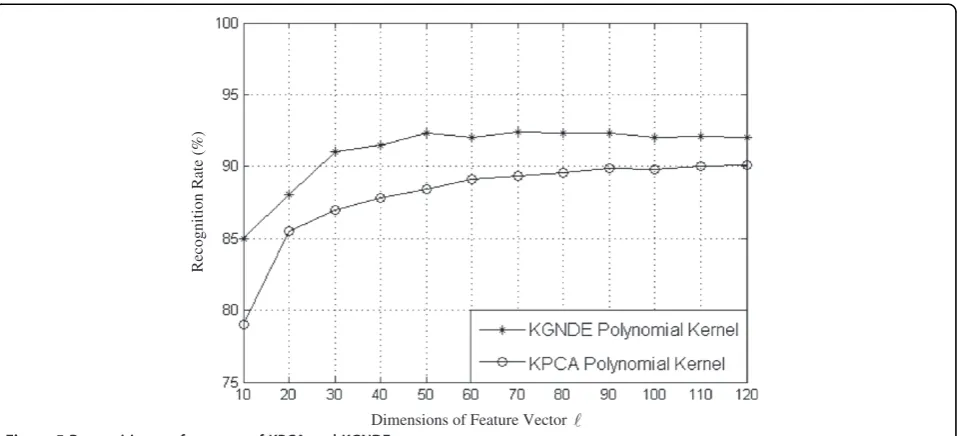
Secondly, KGNDE is compared with KPCA. From Figure 5, we can see that KGNDE performs better than KPCA as well. The kernel trick can handle nonlinear problems in a high-dimensional dataset. However, KGNDE is a supervised method based on not only the kernel trick but also the manifold structure. The mani-fold structure can fit the real structure of the dataset, and the supervised method is a benefit to classification. So, KGNDE performs better than KPCA.
Finally, as is shown in Table 2, KGNDE performs slightly poorer than GNDE. Recognition performance of kernel trick is closely related to kernel functions; polyno-mial function may not be suitable for DATA feature extraction.
5 Conclusions
Feature extraction is the key step in SAR ATR. In this paper, a new feature extraction algorithm and its kernel counterpart are proposed. Based on the manifold struc-ture, both GNDE and KGNDE get linear transformation to achieve low-dimensional embedding of the dataset. Compared with the linear structure, the manifold ways can detect the underlying nonlinear structure, which preserves local information so that manifold ways is more robust. In addition, GNDE and KGNDE are super-vised methods. Through these algorithms, the extracted feature can gain better clustering effect than unsuper-vised methods, which is helpful for classification. Figure 5Recognition performance of KPCA and KGNDE.
Table 2 Best recognition performance by various algorithms
Algorithms Best recognition rate (%) Feature dimensions
PCA 84.67 70
GNDE 94.18 60
KPCA 90.13 120
1. AK Mishra, B Mulgrew, Bistatic SAR ATR Using PCA-based Features, in Proceedings of the SPIE 6234, Automatic Target Recognition XVI, ed. by (University of Edinburgh, United Kingdom). 18 May 2006, doi:10.1117/ 12.664117
2. AK Mishra,Validation of PCA and LDA for SAR ATR. Paper presented at IEEE Region 10 Conference(IIT Guwahati, Guwahati). 19–21 Nov 2008 3. SR Gunn,Support Vector Machines for Classification and Regression(Analyst,
University of Southampton, Technical Report, 2010). doi:10.1039/B918972F 4. Q Zhao, JC Principe, Support vector machines for SAR automatic target
recognition. IEEE Trans. Aerosp. Electron. Syst.2, 643–654 (2001) 5. Y Li, XQ Zhang, BD Bai, YN Zhang,Information Compression and Speckle
Reduction for Multifrequency Polarimetric SAR Imagery using KPCA. Paper presented at the 2007 International Conference on Machine Learning and Cybernetics(Northwest Polytechnical University, Xi’an). 19–22 Aug 2007 6. P Han, RB Wu, YH Wang, ZH Wang,An efficient SAR ATR approach. Paper
presented at the 2003 IEEE International Conference on the ICASSP(Tian jin University, Tian jin). 6–10 April 2003
7. X He, P Niyogi, Locality preserving projections. Paper presented at the 16th Processing Conference on the Neural Information Processing Systems. (2003) 8. S Yan, D Xu, BY Zhang, HJ Zhang, Q Yang, S Li, Graph embedding and
extensions: a general framework for dimensionality reduction. IEEE Trans. Pattern Anal. Mach. Intell.1, 40–51 (2007). doi:10.1109/TPAMI.2007.250598 9. T Ross, S Worrell, V Velten, J Mossing, M Bryant, Standard SAR ATR
evaluation experiments using the MSTAR public release data set. Paper presented at the Processing Conference on the SPIE. 15 September 1998 10. TM Cover, Estimation by the nearest neighbor rule. IEEE Trans. Inf. Theory
1, 50–55 (1968)
doi:10.1186/1687-6180-2014-72
Cite this article as:Huanget al.:Kernel generalized neighbor discriminant embedding for SAR automatic target recognition.EURASIP Journal on Advances in Signal Processing20142014:72.
Submit your manuscript to a
journal and benefi t from:
7 Convenient online submission
7 Rigorous peer review
7 Immediate publication on acceptance
7 Open access: articles freely available online
7 High visibility within the fi eld
7 Retaining the copyright to your article