Construction of Private Methodical Query Services in the
Cloud with RASP Data Commotion
Mudduluru Avinash
1& Ch.V.Swarna Kumari
21
B-Tech, Department: CSE, Narayana Engineering College, Nellore. Email Id: [email protected]
2
Associate Professor, Department: CSE,Narayana Engineering College, Nellore.
Email Id:[email protected]
ABSTRACT
HOSTING input/data in the cloud is an alluring approach because it provides advantages like
scalability and cost-saving. The service owner can increase or decrease the service of cloud
infrastructure and pay as per uses. Due to its work the cloud features is very much attractive. It is highly
cost and wasteful to serve such forceful workloads with in-house infrastructures. The data owners
always desire to submit their quires after realizing the privacy assurance of the cloud. In this aspect
researchers have introduced few techniques such as RASP, kNN Algorithm etc. Many a times, data into
cloud is stored by maintaining confidentiality, query privacy, efficient query processing at low cost
(CPEL Criteria). However, the data owners always desire to submit their quires after realizing the
privacy assurance of the cloud. In this aspect researchers have introduced few techniques such as RASP
(Random Space Perturbation), k-NN (k-Nearest Neighbour) Algorithm etc. The main problem across
RASP technique is, generating the encryption key which is too large and its implementation makes the
time and space overhead. Grate information bother technique along with k-NN algorithm is exploited to
furnish privacy to the cloud. Wherein, issues such as categorical data and leaked query in the model are
identified and addressed, by holding no change in designing the k-NN-R algorithm.
1. INTRODUCTION:
With the wide deployment of public cloud
computing infrastructures, using clouds to host
data query services has become an appealing
solution for the advantages on scalability and
cost-saving. With the cloud infrastructures, the
service owners can conveniently scale up or
down the service and only pay for the hours of
using the servers. While new approaches are
needed to preserve data confidentiality and query
privacy, the efficiency of query services and the
benefits of using the clouds should also be
preserved. It will not be meaningful to provide
slow query services as a result of security and
data owner to use a significant amount of
in-house resources, because the purpose of using
cloud resources is to reduce the need of
maintaining scalable in-house infrastructures.
Therefore, there is an intricate relationship
among the data confidentiality, query privacy,
the quality of service, and the economics of using
the cloud.
Here we summarize these requirements
for constructing a practical query service in the
cloud as the CPEL criteria: data confidentiality,
query privacy, efficient query processing, and
in-house processing cost. Satisfying these
requirements will dramatically increase the
complexity of constructing query services in the
cloud. Some related approaches have been
developed to address some aspects of the
problem. However, they do not satisfactorily
address all of these aspects. For example, the
cryptoindex and order preserving encryption
(OPE) are vulnerable to the attacks. The
enhanced cryptoindex approach puts heavy
burden on the in-house infrastructure to improve
the security and privacy. The New Casper
approach uses cloaking boxes to protect data
objects and queries, which affects the efficiency
of query processing and the inhouse workload.
We propose the random space perturbation
(RASP) approach to constructing practical range
query and k-nearest- neighbor (kNN) query
services in the cloud. The proposed approach
will address all the four aspects of the CPEL
criteria and aim to achieve a good balance on
them. The RASP kNN query service (kNN-R)
uses the RASP range query service to process
kNN queries.
The RASP perturbation is a unique
combination of OPE, dimensionality expansion,
random noise injection, and random projection,
which provides strong confidentiality guarantee.
We have carefully evaluated our approach with
synthetic and real data sets. The results show its
unique advantages on all aspects of the CPEL
criteria. The RASP method and its combination
provide confidentiality of data and this approach
is mainly used to protect the multidimensional
range of queries in secure manner, with indexing
and efficient query processing. The range query
is used in database for retrieving the stored
data’s. It will retrieve the records from the
database where it can denote some value between
upper and lower boundary. The kNN query
denotes k-Nearest Neighbor query. K denotes
positive integer and this query are used to find
the value of nearest neighbor to k. The RASP
perturbation embeds the multidimensional data
into a secret higher dimensional space, enhanced
with random noise addition to protect the
2. RELATED WORK
Importance of RASP
Distributed computing is a rising technology.
Posting information serious question
administrations in the cloud is progressively
prominent as a result of the one of a kind points
of interest in versatility and expense sparing. But
data privacy and confidentiality has become the
major concerns. In summary, the prospective
path has a number of individual contributions:
The RASP perturbation technique is a unique
combination of order preserving encryption,
dimensionality expansion, random noise
injection, and random projection, which provides
the guarantee of strong confidentiality. The
proposed approaches are able to reduce the
processing workload because of the low
commotion cost and high rigor query results.
This is an important feature enabling practical
cloud-based solutions.
RASP using kNN
The proposed methodology RASP with kNN will
address all the four angles to keep up the CPEL
criteria and mean to accomplish a decent adjust
on them. The primary concern is to decide
multidimensional information sets with a blend
of request safeguarding encryption,
dimensionality development, arbitrary
commotion infusion, and irregular task. Scratch
does not hold the separation between the records,
and KNN question is utilized to decide the reach
esteem. KNN calculation depends on the reach
inquiries and uses the file in extent question
handling and uses the file in reach inquiry
preparing and subsequently quick handling of
reach inquiries happens.
Processing of KNN algorithm
The main goal of KNN algorithm is to determine
the KNN adjacent point in the spherical range
that centred at the query point. It uses the
spectrum value instead of spherical range.
However it has to overcome the few issues such
as whether the data privacy and query privacy
are present, whether these are an increment in the
service workload and to find the minimal square
range that exactly contains the KNN-nearest
points. The KNN algorithm consists of three
rounds of interaction between service and the
applicant.
1. First, the applicant will sent, the upper-bound
range which contains greater value than K points
and the lower- bound range which contains less
than K-points to the server. The server finds the
focal range and then returns to the applicant.
2. Second, the client finds the outer range
depending upon the inner range and returns to
the server. The server finds the outer range and
then returns to the applicant.
3. Third, the client decrypts the records and finds
How kNN Works
The RASP perturbation technique is designed in
such a way that the queried ranges are securely
transformed into polyhedral in the commotion
data space, which can be effectively prepared
with the backing of indexing structures in the
irritated space. Algorithm is a process or
different types of formulas are used for
calculations or other problem-solving operations,
especially by a computer.
Details about K nearest neighbour algorithm:
K Nearest Neighbours’ is a simple algorithm that
used to store all available cases and predicts the
actual target based on an affinity measure for
e.g., distance function. kNN has been used to
determine the nearestvalue.
design acknowledgment which is as of now at
the outset of 1970's as a non-parametric method.
A straightforward usage of kNN relapse is to
ascertain the normal of the numeric focus of the
K closest neighbours. Another methodology
utilizes a reverse separation weighted normal of
the K closest neighbours. kNN relapse utilizes
the same separation capacity as kNN
characterization. For closest neighbour questions
Knn calculation is utilized. Knn is a
non-parametric strategy utilized for order and relapse.
There will be n-training vectors; knn identifies k-
nearest neighbour of the class regardless of
labels.
Example for Knn algorithm
Fig 1: Initial State
Fig 2: Identifying Nearest
neighbors
Fig 3: Assigning label to nearest
Class
Two classes “a” and “o” are given with some elements, label “c” (fig 1) has to be assigned to
nearest neighbor region has to find out based on
K value ie, 3 (fig 2). The element “c” is
assigned to the class based on the K elements as
shown in fig (3). Apart from k nearest neighbor
algorithm I will be using the following
algorithms:
SHA1 - Secure Hash Algorithm for Digital
Signature.
RSA - For Secret Key Generation.
AES - Cryptography technique (For Data
Encryption and Decryption)
Query Service
Query is mainly used to search. Queries
are constructed by using structured query
language. It is mainly used to fetch the essential
information from the database. Query services
are the method for services that are exposed
through an implementation of service provider.
Here by using RASP, range query and kNN
query in cloud provide protected, fast storing and
retrieving process of encryption and decryption
of a data from database.
3. SYSTEM ARCHITECTURE
Cloud computing infrastructures used to
store large datasets and query services. The
architecture shows two main parts in it. The
data’s can be stored in the cloud by data owners
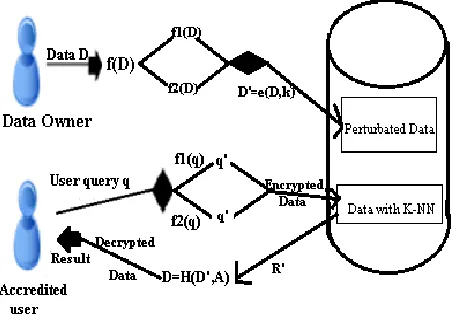
d=n (d, k) here d represents data, n represents
normal form of data, k represents key value
given by the data owner. This format will be
saved in the cloud as encrypted form D1=e (D, k)
here e represents encryption. When user request
to cloud for any data, and while downloading the
data, Decryption H, will performed with
encrypted data D1 along with key k. i.e.,
D=H(D1, k);
All metadata stored in the cloud database
are perturbated. Any application running on a
legitimate client can transparently issue SQL
operations (e.g., SELECT, INSERT, UPDATE
and DELETE) to the cloud database through the
perturbated database interface. Data transferred
between the user application and the index
engines are in plain format, whereas information
is always encrypted before sending it to the cloud
database. When an application issues a new SQL
operation, the perturbated database interface
contacts the perturbated engine that retrieves the
metadata. In order to improve performance, the
plain metadata are cached locally by the client as
volatile information. After obtaining the
metadata, the encryption engine is able to
execute the SQL operation on encrypted data,
and then to decrypt the results. The results are
returned to the user application through the
encrypted database interface. Do not reveal
Fig. 4 System Architecture using RASP method
The above diagram shows two separate
parties. They are customer who is the trusted
party store their data in cloud and second are
cloud provider who is storing the data in
encrypted format. In the customer party it
includes data and service owners, proxy server of
in-house process and users. Here the owner can
store their data in cloud while those data will
encrypted in cloud and stored in the cloud
database and also the data owner will provide
key value by using that key value only cloud will
encrypt the data by using random space
perturbation method. The user will send query to
retrieve the data from cloud, user can send range
query and kNN query to get the data. In the
cloud, the cloud providers have to host the user
query services and have to protect the data stored
in the cloud database. The basic procedure in the
diagram is: (1) the owner sends the data to store
in cloud that data will be encrypted by using
random space perturbation method and stored in
cloud database based on datatype (VARCHAR
OR INT). (2) the user will send the range query
or kNN query to retrieve the data that query will
be encrypted and send to cloud storage. (3) the
cloud storage will send the data for that query
after processing the query inside cloud storage
and it will be decrypted and finally the data will
send to the user.
Security Analysis
The security analysis in the architecture shows
the following i) Users have been authorized by
using the key value provided by the owner. So an
authorized user is not being a malicious and only
those users can send the queries for retrieving the
data. ii) The communication process between the
user, owner and cloud and client system are well
secured, the data and queries cannot be leaked
from the cloud.
iii) RASP method is used to protect the query
privacy and confidentiality of the data. Attacker
Process: The main process of attacker is to hack
the data from the database and they will try to
find the perturbed data and they will try to find
the queries.
4. MODULES
Three modules are used. They are RASP, range
RASP:
RASP denotes Random Space Perturbation. It
also combines OPE, random projection and
random noise injection. Here OPE denotes Order
Preserving Encryption is used for data that
allows any comparison. And that comparison
will be applied for the encrypted data; this will
be done without decryption. Random projection
is mainly used to process the high dimensional
data into low dimensional data representations. It
contains features like good scaling potential and
good performances. Random noise injection is
mainly used to adding noise to the input to get
proper output when we compare it to the
estimated power. The RASP method and its
combination provide confidentiality of data and
this approach is mainly used to protect the
multidimensional range of queries in secure
manner and also with indexing and efficient
query processing will be done. RASP has some
important features. In RASP the use of matrix
multiplication does not protect the dimensional
values so no need to suffer from the distribution
based attack.
Range Query
Range query is the query used to retrieve the data
from the database. It will retrieve the data value
that is between the upper bound and lower
bound. The range query is not usual because user
won’t know in advance about the result for the
query, how much entries will come as result for
the query. For example
SELECT id FROM table name
WHERE id (
SELECT top 10*
FROM United States
WHERE age >50
);
The above example shows the sample
query for range query. Here the example query is
to retrieve the entries from United States it will
retrieve the persons who are above 50 years in
the top 10 list from the record of United States.
The range search is mainly used to return the
values that are present between the two specified
values given in the query. For example database
name is AAAworkers2012 then Go
SELECT product id
FROM
AAAworkers2012.production
WHERE price BETWEEN 40 and
60
The above example will show an another
example of range query search it will provide the
entries of what are product id that are present in
production database with price above 40 and
within 60. So by using range query user can
easily retrieve the data’s from records and this
the speed of the query process will also
increased.
kNN QUERY
kNN query represents k-Nearest Neighbor query.
This query is mainly used to retrieve the nearest
neighbor values of k. here k used to denote
positive integer value. kNN algorithm is mainly
used for classification and regression. In this it
uses kNN-R algorithm to process the range query
to kNN query. This algorithm consists of two
methods. That is used to make interaction
between the client and the server. The client will
send the query to the server with initial upper
bound and lower bound.
This upper bound range has to be more
than the k points and the lower bound range have
to be less than the k points. The above process is
used to give the inner range of the database by
the server. With that inner range the client will
calculate the outer range and send this outer
range to the server. Then the server will search
and find the records in the outer range from the
database and send it to client and then the client
will decrypt the record and find the top k files to
provide the final result. This algorithm is used to
find the compact inner square range for
providing high precision and it has two difficult
processes in it. They are to find the number of
points that are present in the square range and
updating of the boundary (i.e) upper bound and
lower bound is difficult because range queries
are well secured by using random space
perturbation. The security of kNN query and
range query is equal.
5. STUDY OF PROPOSED PROCESS
Problem: In Categorical Data, a set of data is
sorted or divided into different categories,
according to the attributes of the data.
Example: Number of user { set } є Number of
data
When there is a mixture of numerical and
categorical variables present in the data set,
Hamming Code Distance is used for
standardization.
Manhattan\Hamming Code Distance
K
D
H = ∑ | Xi – Yi | x = y => D = 0
i=1
x ≠ y => D = 1
We describe the details of the adaptive layer
mechanism by referring to an example. Let us
consider a table T with columns id of type int
and name of type string, and a tenant client
preparing to issue the following statement to the
encrypted cloud database: SELECT * FROM T
WHERE id < 10. The client perturbation engine
analyzes the SQL statement, and identifies that
encrypted database. Then, the client reads the
metadata and checks whether there is the INT
attribute associated to the column id because this
is the only INT data type.
For INT data type
Input: Select Data D;
Output: data D1;
Let String S=null;
S=D;
for ( char c: S)
c byte b;
temp = b;
temp = temp-rand();
b=temp + b;
endfor;
D1=rand(c) + b;
return D1;
For varchar data type
Input: Select Data D;
Output: data D1;
Let S=null;
b=0;
temp = Timestamp (Date and Time);
b=temp;
D1=rand(char) + b;
return D1;
Threat model: It is a process for optimizing
network / application harmed the internet
security by identifying objective and
vulnerability a threat is a potential or actual
undesirable event that may be malicious such as
DOS attack or incidental failure of a storage
device. Threat model is a panel activity for
identifying and assessing application threats and
vulnerabilities.
Leaked Query: It reveals that the application is
vulnerable, then accidental leaking of sensitive
information through data queries.
6. EXPERIMENTAL RESULT:
We do explore the effectiveness of the various
perturbation techniques in detail here due to the
extensive coverage of this facet of these
perturbation techniques in our previous work.
Nevertheless, we do highlight some general’s
trends with regard to search effectiveness.
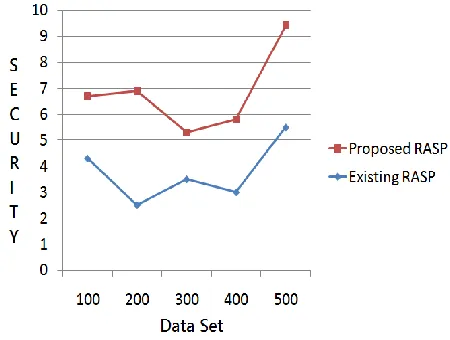
Fig: 5 Performance Graph
Fig. 5 graphs precision with two perturbation
techniques. Graph is comparable to the number
this metric has been used in a number of previous
evaluations. The figure reveals two interesting
trends. First, the security levels of with existing
RASP, and Second, the security levels of with
Proposed RASP with two level of security.
7. CONCLUSIONS:
We proposed RASP method with range query
and kNN query. This method mainly used to
perturb the data given by the owner and saved in
cloud storage it also combines random injection,
order preserving encryption and random noise
projection and also it has contains CPEL criteria
in it. By using the range query and kNN query
user can retrieve their data’s in secured manner
and the processing time of the query is
minimized. And also we continue our studies to
improve the effect of query.
8. REFERENCES
[1] R. Buyya, C. S. Yeo, S. Venugopal, J. Broberg, and I. Brandic, “Cloud computing and emerging it platforms: Vision, hype, and reality for delivering computing as the 5th utility,” Future Generation Computer Systems, vol. 25, no. 6, pp. 599–616, 2009.
[2] T. Mather, S. Kumaraswamy, and S. Latif, Cloud security and privacy: an enterprise perspective on risks and compliance. O’Reilly Media, Incorporated, 2009.
[3] H.-L. Truong and S. Dustdar, “Composable cost estimation and monitoring for computational applications in cloud computing environments,”
Procedia Computer Science, vol. 1, no. 1, pp. 2175 – 2184, 2010, iCCS 2010.
[4] E. Deelman, G. Singh, M. Livny, B. Berriman, and J. Good, “The cost of doing science on the cloud: the montage example,” in Proc. 2008 ACM/IEEE Conf. Supercomputing, ser. SC ’08. Piscataway, NJ, USA: IEEE Press, 2008, pp. 50:1–50:12.
[5] H. Hacig ¨um¨us¸, B. Iyer, and S. Mehrotra, “Providing database as a service,” in Proc. 18th IEEE Int’l Conf. Data Engineering, Feb. 2002.
[6] G. Wang, Q. Liu, and J. Wu, “Hierarchical attribute-based encryption for fine-grained access control in cloud storage services,” in Proc. 17th ACM Conf. Computer and communications security. ACM, 2010, pp. 735–737.
[7] Google, “Google Cloud Platform Storage
with server-side encryption,”
http://googlecloudplatform.blogspot.it/2013/08/
google-cloud-storage-now-provides.html, Mar.
2014.
[8] H. Hacig ¨um¨us¸, B. Iyer, C. Li, and S. Mehrotra, “Executing sql over encrypted data in the database-service-provider model,” in Proc. ACM SIGMOD Int’l Conf. Management of data, June 2002.
[10] R. A. Popa, C. M. S. Redfield, N. Zeldovich, and H. Balakrishnan, “CryptDB: protecting confidentiality with encrypted query processing,” in Proc. 23rd ACM Symp. Operating Systems Principles, Oct. 2011.
[11] C. Gentry, “Fully homomorphic encryption using ideal lattices,” in Proc. 41st ACM Symp. Theory of computing, May 2009.
[12] A. Boldyreva, N. Chenette, and A. O’Neill,
“Order-preserving encryption revisited:
Improved security analysis and alternative solutions,” in Proc. Advances in Cryptology – CRYPTO 2011. Springer, Aug. 2011.
[13] P. Paillier, “Public-key cryptosystems based on composite degree residuosity classes,” in
Proc. Advances in Cryptology –
EUROCRYPT99. Springer, May 1999.
[14] D. Song, D. Wagner, and A. Perrig, “Practical techniques for searches on encrypted data,” in Proc. IEEE Symposium on Security and Privacy., May 2000.
[15] L. Ferretti, F. Pierazzi, M. Colajanni, and M. Marchetti, “Security and confidentiality solutions for public cloud database services,” in Proc.
Seventh Int’l Conf. Emerging Security
Information, Systems and Technologies, Aug. 2013.
[16] A. Greenberg, J. Hamilton, D. A. Maltz, and P. Patel, “The cost of a cloud: research problems in data center networks,” SIGCOMM Comput. Commun. Rev., vol. 39, no. 1, pp. 68–73, Jan. 2008.
[17] L. Popa, S. Ratnasamy, G. Iannaccone, A. Krishnamurthy , and I. Stoica, “A Cost
Comparison of Data Center Network
Architectures,” in Proc. ACM Int’l Conf.
Emerging Networking Experiments and
Technologies, 2010.