TwitIE: An Open-Source Information Extraction Pipeline
for Microblog Text
Kalina Bontcheva, Leon Derczynski, Adam Funk,
Mark A. Greenwood, Diana Maynard, Niraj Aswani
University of Sheffield
[email protected]
Abstract
Twitter is the largest source of microblog text, responsible for gigabytes of human discourse every day. Processing microblog text is diffi-cult: the genre is noisy, documents have lit-tle context, and utterances are very short. As such, conventional NLP tools fail when faced with tweets and other microblog text. We present TwitIE, an open-source NLP pipeline customised to microblog text at every stage. Additionally, it includes Twitter-specific data import and metadata handling. This paper in-troduces each stage of the TwitIE pipeline, which is a modification of the GATE ANNIE open-source pipeline for news text. An eval-uation against some state-of-the-art systems is also presented.
1
Introduction
Researchers have started recently to study the prob-lem of mining social media content automatically (e.g. (Rowe et al., 2013; Nagarajan and Gamon, 2011; Farzindar and Inkpen, 2012; Bontcheva and Rout, 2013)). The focus of this paper is on information ex-traction, but other active topics include opinion min-ing (Maynard et al., 2012; Pak and Paroubek, 2010), summarisation (e.g. (Chakrabarti and Punera, 2011)), and visual analytics and user and community mod-elling (Bontcheva and Rout, 2013). Social media min-ing is relevant in many application contexts, includ-ing knowledge management, competitor intelligence, customer relation management, eHealth, and eGovern-ment.
Information extraction from social media content has only recently become an active research topic, following early experiments which showed this genre to be extremely challenging for state-of-the-art algo-rithms (Derczynski et al., 2013a). Simple domain adaptation techniques (e.g. (Daum´e and Marcu, 2007) are not so useful on this genre, in part due to its un-usual structure and representation of discourse, which can switch between one-to-one conversation, multi-party conversation and broadcast messages. For in-stance, named entity recognition methods typically have 85-90% accuracy on longer texts, but 30-50% on tweets (Ritter et al., 2011; Liu et al., 2012).
This paper introduces the TwitIE information extraction system, which has been specifically adapted to microblog content. It is based on the most recent GATE (Cunningham et al., 2013) algorithms and is available as a GATE plugin available to download from https://gate.ac.uk/wiki/twitie.html, usable both via the GATE Developer user interface and via the GATE API. Comparisons against other state-of-the-art research on this topic are also made.
2
Related Work
In terms of Named Entity Recognition (NER), and In-formation Extraction (IE) in general, microblogs are possibly the hardest kind of content to process. First, their shortness (maximum 140 characters for tweets) makes them hard to interpret. Consequently, ambigu-ity is a major problem since IE methods cannot easily make use of coreference information. Unlike longer news articles, there is a low amount of discourse infor-mation per microblog document, and threaded struc-ture is fragmented across multiple documents, flowing in multiple directions.
Second, microtexts also exhibit much more language variation, tend to be less grammatical than longer posts, contain unorthodox capitalisation, and make frequent use of emoticons, abbreviations and hashtags, which can form an important part of the meaning.
To combat these problems, research has focused on microblog-specific information extraction algorithms (e.g. named entity recognition for Twitter using CRFs (Ritter et al., 2011), Wikipedia-based topic and entity disambiguation (van Erp et al., 2013)). Partic-ular attention is given to microtext normalisation, as a way of removing some of the linguistic noise prior to part-of-speech tagging and entity recognition (Der-czynski et al., 2013a; Han and Baldwin, 2011; Han et al., 2012).
Named entity recognition of longer texts, such as news, is a very well studied problem (cf. (Nadeau and Sekine, 2007; Roberts et al., 2008; Marrero et al., 2009)).
For Twitter, some approaches have been proposed but often they are not freely available. Ritter et al. (Rit-ter et al., 2011) take a pipeline approach performing first tokenisation and POS tagging before using topic models to find named entities. Liu (Liu et al., 2012)
do-Language Identification
TwitIE Tokeniser
Gazetteer Lookup
Sentence Splitter
Input: URL or text
Document format (JSON, XML, HTML, etc)
GATE Document
Social-media specific language
footprints
Lists of Names (e.g. days of week)
JAPE Sentence Patterns
Normaliser
Stanford POS Tagger
Spelling and orthographic dictionary
GATE Document XML dump of IE Annotations Output:
TwitIE
IE modules
NOTE: square boxes are processes, rounded ones are data.
Named Entity
Recogniser JAPE GrammarCascade
Twitter Adapted Model Character
Class Sequence Rules
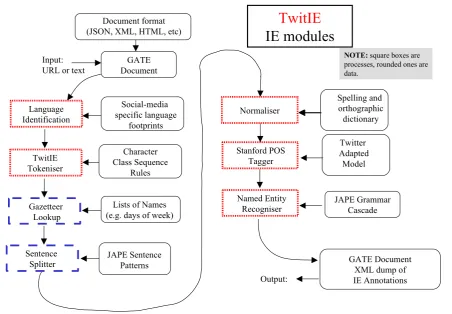
Figure 1: The TwitIE Information Extraction Pipeline
Multiple tweet objects in the same JSON le are sep-arated by blank lines (which are not covered by Tweet annotations.
3.2 Language Identification
The TwitIE system uses the TextCat (Cavnar and Tren-kle, 1994) language identification algorithm, which re-lies on n-gram frequency models to discriminate be-tween languages. More specifically, we have integrated the TextCat adaptation to Twitter (Carter et al., 2013) which works currently on five languages. It is 97.4% accurate overall, with per language accuracy ranging between 95.2% for French and 99.4% for English (Der-czynski et al., 2013a). These results demonstrate that language identification is hard on tweets, but neverthe-less, can be achieved with reasonable accuracy.
Due to the shortness of tweets, TwitIE makes the assumption that each tweet is written in only one lan-guage. The choice of languages used for categorisation is specified through a configuration file, supplied as an initialisation parameter.
Figure 2 shows three tweets – one English, one Ger-man, and one French. TwitIE TextCat was used to as-sign automatically the lang feature to the tweet text (de-noted by the Tweet annotation).
Given a collection of tweets in a new language,
it is possible to train TwitIE TextCat to support that new language as well. This is done by us-ing the Fus-ingerprint Generation PR, included in the Language_Identification plugin. It builds a new ngerprint from a corpus of documents.
Reliable tweet language identification allows us to only process those tweets written in English with the TwitIE English POS tagger and named entity recog-niser. This is achieved by making the execution of these components conditional on the respective tweet being in English, by using a Conditional Corpus Pipeline. GATE also provides POS tagging and named entity recognition in French and German, so it is possible to extend TwitIE towards these languages with some training and adaptation effort.
3.3 Tokenisation
Commonly distinguished types of tokens are numbers, symbols (e.g., $, %), punctuation and words of dif-ferent kinds, e.g., uppercase, lowercase, mixed case. Tokenising well-written text is generally reliable and reusable, since it tends to be domain-independent, e.g. the Unicode tokeniser bundled with the ANNIE system in GATE.
Figure 2: Example Tweets Annotated for Language
handle specific tokens like URLs, hashtags (e.g. #nl-proc), user mentions in microblogs (e.g. @GateAcUk), special abbreviations (e.g. RT, ROFL), and emoticons. A study of 1.1 million tweets established that 26% of English tweets have a URL, 16.6% – a hashtag, and 54.8% – a user name mention (Carter et al., 2013). These elements prove particularly disruptive to conven-tional NLP tools (Derczynski et al., 2013a). Therefore, tokenising these accurately is important.
To take part of a tweet as an example:
#WiredBizCon #nike vp said when @Apple saw what http://nikeplus.com did, #SteveJobs was like wow I didn’t...
One option is to tokenise on white space alone, but this does not work that well for hashtags and username mentions. In our example, if we have #nike and @Ap-ple as one token each, this will make their recogni-tion as company names harder, since the named entity recognition algorithm will need to look at sub-token level. Similarly, tokenising on white space and punc-tuation does not work well since URLs become split into many tokens (e.g. http, nikeplus), as do emoticons and email addresses.
The TwitIE tokeniser is an adaptation of ANNIE’s English tokeniser. It follows Ritter’s tokenisation scheme (Ritter et al., 2011). More specifically, it treats abbreviations (e.g. RT, ROFL) and URLs as one token each. Hashtags and user mentions are two tokens (i.e., \#andnike in the above example) with a separate annotation HashTag covering both. Capitalisation is preserved and an orthography feature added. Normal-isation and emoticons are handled in optional separate modules, since information about them is not always needed. Consequently, tokenisation is fast and generic,
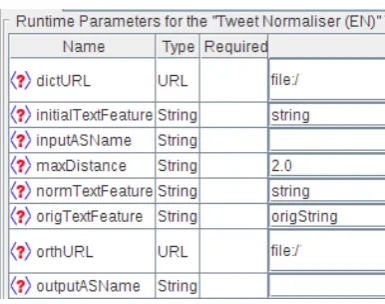
Figure 3: Configuration options for the TwitIE nor-maliser
while tailored to the needs of named entity recognition.
3.4 Normalisation
Noisy environments such as microblog text pose chal-lenges to existing tools, being rich in previously un-seen tokens, elision of words, and unusual grammar. Normalisation is commonly proposed as a solution for overcoming or reducing linguistic noise (Sproat et al., 2001). The task is generally approached in two stages: first, the identification of orthographic errors in an input discourse, and second, the correction of these errors.
The TwitIE Normaliser is a combination of a generic spelling-correction dictionary and a spelling correction dictionary, specific to social media. The latter contains entries such as “2moro” and “brb”, similar to Han et al. (2012). Figure 4 shows an example tweet, where the abbreviation “Govt” has been normalised to gov-ernment.
Figure 4: Comparing POS Tagger Output: A Normalisation Example
System Precision Recall F1 Newswire
ANNIE 78% 74% 77%
Stanford - - 89%
Microblog
ANNIE 47% 83% 60%
TwitIE 77% 83% 80%
Stanford 59% 32% 41%
Stanford-twitter 54% 45% 49%
Ritter 73% 49% 59%
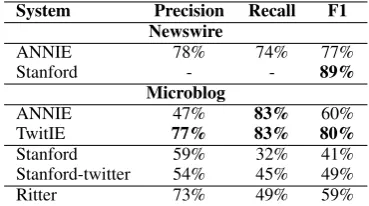
Table 1: Whole-pipeline named entity recognition per-formance, before and after genre adaptation. Newswire performance is over the CoNLL 2003 English dataset; microblog performance is over the development part of the Ritter dataset
NEs represented in lowercase (e.g. skype) were fre-quently ignored. However, handling capitalisation is hard from trivial (Derczynski et al., 2013a) and this is an area where we plan more future work, combined with the creation of a larger, human-annotated corpus of NER-annotated tweets.
4
Conclusion
This paper presented the TwitIE open-source NER pipeline, specifically developed to handle microblogs. Issues related to microblog NER were discussed, and the requirement for domain adaptation demonstrated. As can be seen from the evaluation results reported here, significant inroads have been made into this
chal-lenging problem. By releasing TwitIE as open source, we hope to give researchers also an easily repeatable, baseline system against which they can compare new Twitter NER algorithms.
As already discussed, there is still a significant gap in NER performance on microblogs, as compared against news content. This gap is due to some degree to in-sufficient linguistic context and the noisiness of tweets. However, there is also a severe lack of labeled train-ing data, which hinders the adaptation of state-of-the-art NER algorithms, such as the Stanford CRF tagger. These are all areas of ongoing and future work, as well as the adaptation of the entire TwitIE pipeline to lan-guages other than English.
Acknowledgments
This work was supported by UK EPSRC grants Nos. EP/I004327/1 and EP/K017896/1 uComp,1and by the
European Union under grant agreement No. 270239 Arcomem.2
References
H. Becker, M. Naaman, and L. Gravano. 2011a. Se-lecting Quality Twitter Content for Events. In
Pro-1
http://www.ucomp.eu
A. Pak and P. Paroubek. 2010. Twitter as a corpus for sentiment analysis and opinion mining. In Pro-ceedings of the Seventh conference on International Language Resources and Evaluation (LREC).
A. Ritter, S. Clark, Mausam, and O. Etzioni. 2011. Named entity recognition in tweets: An experimen-tal study. InProc. of Empirical Methods for Natural Language Processing (EMNLP), Edinburgh, UK.
A. Roberts, R. Gaizauskas, M. Hepple, and Y. Guo. 2008. Combining terminology resources and sta-tistical methods for entity recognition: an evalua-tion. Proceedings of the Conference on Language Resources and Evaluation (LRE’08).
M. Rowe, M. Stankovic, A. Dadzie, B. Nunes, and A. Cano. 2013. Making sense of microposts (#msm2013): Big things come in small packages. In Proceedings of the WWW Conference - Workshops.
R. Sproat, A. Black, S. Chen, S. Kumar, M. Osten-dorf, and C. Richards. 2001. Normalization of non-standard words. Computer Speech & Language, 15(3):287–333.
K. Toutanova, D. Klein, C. D. Manning, and Y. Singer. 2003. Feature-rich part-of-speech tagging with a cyclic dependency network. InProceedings of the 2003 Conference of the North American Chapter of the Association for Computational Linguistics on Human Language Technology, NAACL ’03, pages 173–180.
M. van Erp, G. Rizzo, and R. Troncy. 2013. Learning with the Web: Spotting Named Entities on the in-tersection of NERD and Machine Learning. In Pro-ceedings of the 3rd Workshop on Making Sense of