ON TROPICAL MATRIX ALGEBRA
MATVEI KOTOV AND ALEXANDER USHAKOV
Abstract. In this paper we consider a two party key-exchange
proto-col proposed in [4, Section 2] which uses tropical matrix algebra as a platform. Our analysis shows that the scheme is not secure.
Keywords. Tropical algebra, cryptography, key-exchange, min-plus systems.
2010 Mathematics Subject Classification. 94A60, 68W30.
1. Introduction
In this paper we analyze a key-exchange protocol based on tropical matrix algebra proposed in [4, Section 2]. Ideas similar to [4] were used before in the “classic” case, i.e., for algebras with familiar addition and multiplication. However in classic case these schemes were shown to be vulnerable to various linear algebra attacks. The idea to use an algebra with another addition and multiplication came as an attempt to avoid those attacks, as there are no known algorithms for solving systems of linear equations in tropical sense (it is an active field of research currently).
1.1. Tropical algebra. Consider the extended set of real numbersR∪{∞} and binary operations ⊕,⊗defined by:
x⊕y= min(x, y),
x⊗y=x+y.
A setS ⊆R∪ {∞} closed under +, containing 0 and∞ is called a tropical semi-ring. It is straightforward to check that (S,⊕,⊗) satisfies all axioms of a commutative ring with unity 0 except for existence of additive inverses. In this paperS =Z∪ {∞}.
The set of alln×nmatricesMn(S) with entries fromS can be equipped
with operations⊕and ⊗as well, as defined below:
(aij)⊕(bij) = (aij⊕bij)
(aij)⊗(bij) = (ai1⊗b1j⊕. . .⊕ain⊗bnj).
The obtained algebraR = (Mn(S),⊕,⊗) is called atropical matrix algebra.
Date: December 9, 2015.
The first author has been partially supported by RFBR, project No. 14-01-00068. The second author has been partially supported by NSF grant DMS-1318716.
For more information on tropical algebras see [1]. For more on non-commutative algebraic structures used in cryptography see [6].
1.2. The protocol. Here we describe a two party key-exchange protocol proposed in [4, Section 2]. Let A, B ∈ R be matrices satisfying A⊗B 6=
B⊗A, calledpublic base matrices.
(1) Alice generates random polynomials p1(x), p2(x) ∈ Z[x] and sends
U =p1(A)⊗p2(B) to Bob.
(2) Bob generates random polynomials q1(x), q2(x) ∈ Z[x] and sends
V =q1(A)⊗q2(B) to Alice.
(3) Alice computes KA=p1(A)⊗V ⊗p2(B). (4) Bob computes KB=q1(A)⊗U⊗q2(B).
It is easy to check that Alice and Bob finally compute the same matrix
K =KA=KB, called theshared key.
The following key generation method is suggested in [4, Section 2.5].
• The size of matricesn= 10.
• The entries of matricesA and B are integers, selected randomly in [−1010,1010].
• The degrees of polynomialsp1(x), p2(x), q1(x), q2(x) are selected uni-formly randomly in the range [1,10].
• The coefficients of p1(x), p2(x), q1(x), q2(x) are selected uniformly randomly in [−1000,1000].
1.3. Computational assumption. For a passive eavesdropper to break the protocol means to be able to compute the value of K based on the values of A, B, U, V. For that it clearly suffices to find a pair of matrices
X, Y satisfying the following conditions:
(1)
X⊗A=A⊗X, Y ⊗B =B⊗Y, X⊗Y =U,
or to solve a similar system for Bob’s public key. Indeed, ifX, Y satisfy the conditions above, then the productX⊗V ⊗Y is equal to K. In the case of matrix algebra over (Z,+,·) one would reduce the system above to a system of linear equations (as in [8, 7]). The same approach does not seem to work with tropical algebra as explained in [4].
2. Simple heuristic for original key generation method
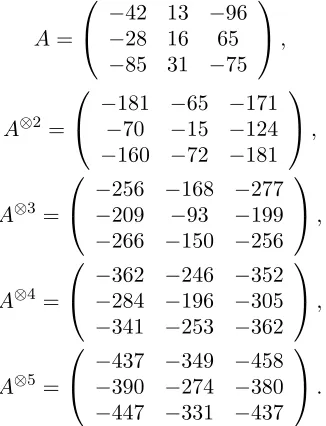
Consider a particular 3×3 matrix A with entries chosen uniformly ran-domly in the range [−100,100] and its tropical powers:
A=
−42 13 −96
−28 16 65
−85 31 −75
,
A⊗2 =
−181 −65 −171
−70 −15 −124
−160 −72 −181
,
A⊗3 =
−256 −168 −277
−209 −93 −199
−266 −150 −256
,
A⊗4 =
−362 −246 −352
−284 −196 −305
−341 −253 −362
,
A⊗5 =
−437 −349 −458
−390 −274 −380
−447 −331 −437
.
As we can see the entries in A⊗i very soon become negative and decrease linearly with i. In a linear combination of A⊗i’s with sufficiently small coefficients xi, say −10 ≤ xi ≤ 10, smaller monomials are irrelevant com-pared with the leading monomial, i.e., for any choice of the coefficients
−10≤xi ≤10 we have:
(2)
5
M i=0
xi⊗A⊗i=x5⊗A⊗5.
This is precisely the case for key generation proposed in [4]. Half of the entries in A and B have negative value. The entries in the tropical-powers
A⊗i and B⊗i become all negative very fast (when i ≥ 2) and decrease
faster than the range for coefficients which makes lower monomials in the polynomialsp1, p2irrelevant. Based on that observation one can expect that the system (1) has a solution of the form:
X=c⊗A⊗i and Y =B⊗j
for somei, j ∈[1, D] and c∈Z, where Dis the upper bound for degrees of polynomials in the protocol.
This gives us the following simple heuristic attack. For each i, j∈[1, D] we compute the matrix Tij = U −A⊗i ⊗B⊗j. If Tij = (c)kl for some
constant c, then X =c⊗A⊗i,Y = B⊗j is a required solution to (1), and the algorithm successfully stops. If there are not such i and j, then the algorithm fails.
range for coefficients in polynomialsp1, p2. It becomes negligible if we allow only non-negative entries in A and B. Below we suggest an attack which works well in this case.
Range for coeff. of polynomials [−103,103] [−1010,1010] [0,1010] Range for entries of matrices [−1010,1010] [−1010,1010] [0,1010]
Avg. time 0.5 sec 0.6 sec 1.2 sec
Success rate 97% 71% 2%
Table 1. Experimental results of the simple heuristical algorithm
3. General attack
In this section we discuss a general attack on the protocol. The success rate of this attack does not depend on parameters of key generation and equals 100%. We find matricesX and Y of the form:
X=
D M
i=0
xi,⊗A⊗i, Y = D M
j=0
yj⊗B⊗j
with unknown coefficientsxi, yj ∈Z. Clearly for such matrices the first and the second equality in (1) are satisfied. Notice that:
X⊗Y =
D M i,j=0
xi⊗yj ⊗A⊗i⊗B⊗j.
Therefore to break the protocol we need to find x0, . . . , xD, y0, . . . , yD ∈ Z such that:
D M i,j=0
xi⊗yj⊗A⊗i⊗B⊗j =U.
Using the definition of ⊕and ⊗, we get a system of equations
(3) min
i,j
xi+yj +Tklij
= 0, for each k, l∈[1, n],
whereTij =A⊗i⊗B⊗j−U. Solving the system (3) is the main goal of this section.
Denote by mij the least entry in the matrix Tij and by Pij the set of entries where the minimum is achieved:
mij = min
k,l T ij
kl, Pij ={(k, l)|T ij
kl =mij}.
Notice that any solution xi, yj, 0 ≤ i, j ≤ D, of (3) satisfies the following conditions:
• xi+yj ≥ −mij;
Range for coef. of polynomials [−103,103] [−1010,1010] [0,1010] Range for entries of matrices [−1010,1010] [−1010,1010] [0,1010]
Maximal number of covers 102 296 20736
Avg. number of covers 4.2 16.52 705.5
Median of number of covers 1 1 7.5
Avg. number of tested covers 1 1.03 1.57
Median of number of tested covers 1 1 1
Avg. time 1.9 sec 2.0 sec 2.5 sec
Success rate 100% 100% 100%
Table 2. Experimental results of the general attack
Therefore, to solve (3) we need to find a cover C ⊆ {P00, P01, . . . , PDD} of the set [1, n]×[1, n] and valuesxi, yj, 0≤i, j≤D,satisfying:
(4)
xi+yj =−mij ifPij ∈C, xi+yi ≥ −mij otherwise.
Hence, in order to solve (3) we need to enumerate all minimal covers for [1, n]×[1, n] and then find those that define consistent systems of equalities and inequalities (4).
Recall that finding a minimal set cover problem is one of Karp’s 21 prob-lems shown to be NP-complete in 1972. Nevertheless, for all randomly generated instances of the protocol it was relatively easy to enumerate all possible minimal covers.
To enumerate the covers we use a simple recursive procedure and a couple of heuristics. As one can see in Table 2, often the number of covers is small, and rarely it is greater than 10000. In every experiment we were able to enumerate all the minimal covers in a few seconds.
Also, we noticed that often an appropriate cover (a cover defining a con-sistent system (4)) is smaller than most other covers produced by our algo-rithm. Furthermore, for covers of the same size an appropriate cover often has smaller value of
|{i| ∃j Pij ∈C}| · |{j| ∃i Pij ∈C}|
than others. Therefore, to speed up computations we sort the covers using these criteria. This strategy works very well, as shown in Table 2, on average we have to test only one or two covers to find a solution.
Finally, to determine if a system (4) is consistent for a particular coverC
we use the simplex method, see [2].
4. Conclusion
The protocol described in [4, Section 2] is not secure when used with the proposed parameter values. It is not clear how to modify key generation to provide a sufficient level of security. We encourage an interested reader to use our code [5] and perform his/her computational experiments over the tropical algebra.
References
[1] P. Butkoviˇc. Max-linear Systems: Theory and Algorithms. Springer Monographs in Mathematics. Springer London, 2010.
[2] T. Cormen, C. Leiserson, R. Rivest, and C. Stein. Introduction to Algorithms. The MIT Press, 3 edition, 2009.
[3] The GAP Group.GAP – Groups, Algorithms, and Programming, Version 4.7.7, 2015. [4] D. Grigoriev and V. Shpilrain. Tropical cryptography.Comm. Algebra, 43:2624–2632,
2014.
[5] M. Kotov and A. Ushakov. Implementation of attacks on a key excange protocol based on tropical matrix algebra. Available athttps://github.com/mkotov/tropical. [6] A. G. Miasnikov, V. Shpilrain, and A. Ushakov.Non-Commutative Cryptography and
Complexity of Group-Theoretic Problems. Mathematical Surveys and Monographs. AMS, 2011.
[7] C. Mullan. Cryptanalysing variants of Stickel’s key agreement scheme. preprint, 2010. [8] V. Shpilrain. Cryptanalysis of Stickel’s key exchange scheme. InComputer Science in Russia – CSR 2008, volume 5010 ofLecture Notes Comp. Sc., pages 283–288. Springer, 2008.
Department of Mathematics, Stevens Institute of Technology, Hoboken, NJ, USA