Article
A Computational Procedure for the Recognition and
Classification of Maize Leaf Diseases out of Healthy
Leaves Using Convolutional Neural Networks
Malusi Sibiya * and Mbuyu Sumbwanyambe University of South Africa; [email protected] * Correspondence: [email protected]
Abstract: Plant leaf diseases can affect the plants’ leaves to an extent that the plants can collapse and die completely. These diseases may drastically drop the supply of vegetables and fruits to the market, and result in a low agricultural economy. In the literature, different laboratory methods of plant leaf disease detection have been used. These methods were time consuming and could not cover large areas for the detection of leaf diseases. This study infiltrates through the facilitated principles of the Convolutional Neural Networks (CNN) in order to model a network for image recognition and classification of these diseases. Neuroph was used to perform the training of a CNN network that recognized and classified images of the maize leaf diseases that were collected by use of a smart phone camera. A novel way of training and the methodology used, expedite a quick and easy implementation of the system in practice. The developed model was able to recognize 3 different types of maize leaf diseases out of healthy leaves. The Northern Corn Leaf Blight (Exserohilum), Common Rust (Puccinia sorghi) and Gray Leaf Spot (Cerospora) diseases were chosen for this study as they affect most parts of Southern Africa’s maize fields.
Keywords: Northern Corn Leaf Blight (Exserohilum); Gray Leaf Spot (Cerospora); Common Rust (Puccinia sorghi); Convolutional Neural Networks (CNN); Neuroph Studio
1. Introduction
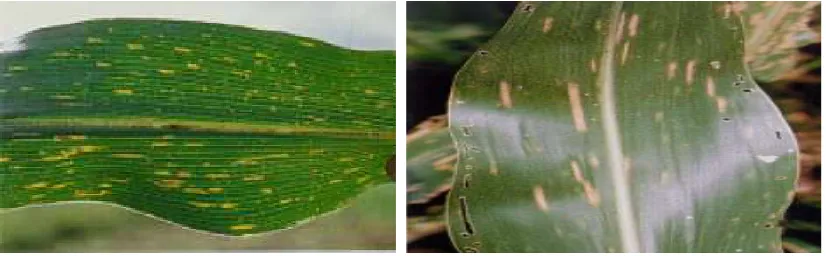
A Gray leaf spot of maize, is a maize disease caused by Cerospora zeae-maydis fungus. It is now seen as one of the most significant yield-limiting diseases of maize (corn) worldwide, posing a serious threat to maize production in many areas of the eastern United States and, more recently, in large areas of the U.S. Corn Belt and Africa. Typically, its symptoms are observed on the lower leaves [1]. Figures 1 and 2 show the stages of Gray leaf spot of maize in terms of maturity.
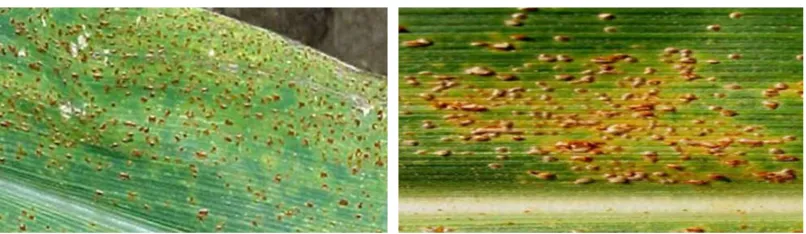
Common Rust maize disease, otherwise caused by Puccinia sorghi pathogen is favoured by cool temperatures (16-23º C) and high relative humidity (100%) [2]. The functional leaf area and photosynthesis are reduced by the disease lesions. Spots are found on both upper and lower leaf surfaces [3]. Figures 3 and 4 show early Common rust lesions and more advanced disease development respectively.
Northern Corn Leaf Blight is a maize disease caused by a fungus, Exsrerohilum turcicum. Cool to moderate temperatures and high relative humidity favour the development of the Northern Corn Leaf Blight. The symptoms are recognised by the relatively large gray cigar-shaped lesions that can develop on leaves [4]. The changing stages of Northern Corn Leaf Blight due to a fungus concentration are as shown in Figures 5 and 6.
In the literature, there are several algorithms of machine learning that were used for the recognition and detection of plant leaf diseases. [5], used Caffe, a deep learning framework developed by Berkley Vision and Learning Centre for the recognition of plant leaf diseases by means of Convolutional Neural Networks (CNN). With feature extraction methods based on Open CV, the experimental results of the developed model achieved between 91% and 98% of precision, and 93% on average for separate class tests [5].
By use of Deep learning methods, a public dataset of 54,306 images of diseased and healthy plant leaves was collected under controlled conditions and used to train a deep convolutional neural network to identify 14 crop species and 26 diseases. The feasibility of this approach was demonstrated by a trained model that achieved an accuracy of 99.35% on a held-out test set [6].
A study was carried out to apply the Artificial Neural Network (ANN) analysis technique for discriminating and classifying fungal infections in oil palm trees by [7]. Raw, first and second derivative spectra radiometer datasets were used at an early stage. These were acquired from 1,016 spectral signatures of foliar samples in four disease levels (T1: healthy, T2: mildly-infected, T3: moderately infected, and T4: severely infected) [7].
A web based tool was proposed that helped farmers in the identification of fruit diseases by uploading fruit images to the system. Already trained datasets of the pomegranate fruit were used by the system. The images to be analysed were given by the user to undergo several processing steps in order to detect the severity of the diseases by comparing them with the trained dataset images. The experimental results of the proposed approach demonstrated 82% of accuracy for the identification of the pomegranate disease [8].
Very little is known about the implementation of Convolutional Neural Networks for plant disease recognition built on a framework that utilizes GUI to train the network by use of raw images with feature extractions embedded in the program’s library. The main objective of this study was to design a system that would recognise and classify the maize leaf diseases out of healthy leaves by means of facilitated Convolutional Neural Networks (CNN). The development and novelty of the proposed model lay in its simplicity; background images and healthy leaves were in accordance with other classes, empowering the model to distinguish between diseased leaves and sound ones or from the environment by utilizing deep CNN.
The rest of the paper is organized as follows: Materials and Methods are presented in Section2, achieved experimental results and related discussions are presented in Section3, Section 4 discusses the results, and finally Section 5 draws up our conclusions of the study.
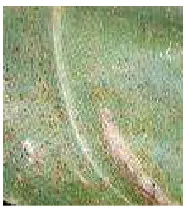
Figure 1. Immature Gray leaf spot lesions on maize leaf appear as small tan spots, often with chlorotic borders.
Figure 3. Early lesions begin as flecks on leaves that develop into small tan spots.
Figure 4. More advanced disease development with spots of jagged appearance turning into elongated brick-red to cinnamon-brown pustules.
Figure 5. Northern Corn Leaf Blight lesion
usually large, cigar-shaped, and tan to gray. Figure 6.Leaf Blight to produce large amounts of spores The fungus can cause Northern Corn on the surface of lesions, giving them a dark appearance.
1.1 Related work
The use of machine learning algorithms for the detection of plant leaf disease is so dominant in
the literature. Machine learning models for the prediction of these plant leaf diseases were found to differ in accuracy. Various techniques are at present being used for the recognition of plant leaf diseases by the application of Computer Vision. One of them is disease detection by colour feature extraction from the images. Convolutional Neural Networks (CNN) are known to outsmart the classification and identification of images by use of a colour feature extraction. For such reasons, [5] performed the deep CNN training for plant disease recognition and classification. The test results on the created model accomplished accuracy somewhere in the range of 91% and 98%, for separate class tests, on average 96.3%.
Utilizing an open dataset of 54,306 images of diseased and healthy plant leaves gathered under controlled conditions, [6] trained a deep Convolutional Neural Network (CNN) to distinguish 14 crop species and 26 diseases. The trained model accomplished a precision of 99.35% on a held-out test set, showing the plausibility of this approach.
was progressively reasonable for identification and classification of plant diseases. An SVM classifier proved to be 92.17% accurate than ANN classifier which was 87.4% accurate.
Recently, wheat disease detection through leaf image and data processing techniques are used extensively to assist farmers in monitoring the big plantation area. Researchers such as Dixit and Ema applied SVM for the recognition and classification of wheat diseases. In their study, they mentioned in detail the key issues and challenges in wheat leaf detection by means of Support Vector Machines (SVM) [10].
The purpose of this study is to model a facilitated GUI based Convolutional Neural Network (CNN) for the recognition and classification of maize leaf diseases. The use of image recognition feature in the Neuroph Studio framework enabled the design of Convolutional Neural Networks (CNN) with feature extraction features embedded in the program’s library. The overall system’s accuracy showed a progressive 99.9% for the classification of Northern Corn Leaf Blight (Exserohilum), 91% of Gray Leaf Spot (Cerospora), 87% of Common Rust (Puccinia sorghi), and 93.5% of healthy leaves using a maize data set of 100 diseases for each disease class, and 100 healthy leaves of maize data set.
2. Materials and Methods
2.1 The concept of Convolutional Neural Networks (CNN)
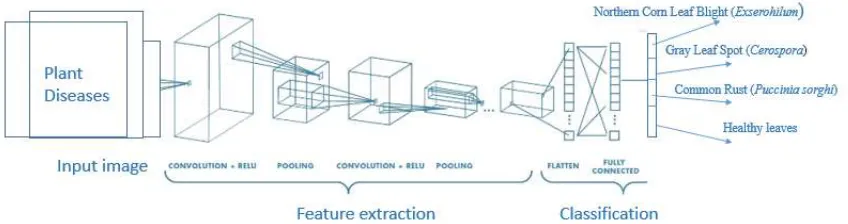
The regular Neural Network (NN) is not equipped for managing the images. If regular Neural Networks (NN) was to be used with the images, then each pixel of the image would have to be connected to its neuron resulting in a network which would be computationally expensive. Convolutional Neural Network (CNN) handles the images in various ways, yet at the same time it pursues the general idea of regular Neural Network (NN). Figure 7 shows an architecture of the Convolutional Neural Network (CNN).
Figure 7. Convolutional Neural Network Architecture.
Methods of image feature extraction in a Convolutional Neural Network (CNN) are Convolution and Pooling.
Classification: The input images are classified by a fully connected layer just after the convolution and max pooling layers. Neurons in a fully connected layer have connections to all activations in the previous layer, as seen in the regular neural network. Figure 7 shows the maize plant diseases that were recognised and classified by a fully connected layer of the proposed CNN.
3.2 Materials
The Neuroph Framework consists of the Java neural network library and integrated Neural Network & Java IDE based on NetBeans Platform - Neuroph Studio. It is the integrated environment to create and deploy neural networks to Java programs. Neuroph supports common neural network architectures, and it is very flexible so you can easily extend it to suit your specific needs. The basic structure of the framework packages is shown in Figure 8.
Figure 8. Neuroph Framework.
2.3 Methodology
A Convolutional Neural Network (CNN) was built on the Windows PC platform. Neuroph Studio framework was used to build a Convolutional Neural Network with 50 hidden layers for the recognition and classification of maize leaf diseases out of healthy leaves. The network was trained by using 100 colour images of each disease and healthy leaves with resolution settings configured as 10 x 20 x 3 (height x width x RGB). With the latterly mentioned image resolution settings, the Convolutional Neural Network (CNN) was modelled to have 600 inputs through the input layer of the neural network classifier. Of 100 available images for each class to be recognised, 70% was used for training and 30% for testing of the CNN. Back propagation was used as the learning algorithm to train the CNN network.
A mathematical model of the proposed CNN was implemented as shown below:
The order taken from the CNN was an order 3 tensor as its input. The input images that were tested for possible diseases were imaged with H rows, W columns, and 3 channels (R, G, B colour channels). An abstract description of our CNN model is illustrated by equation 1.
𝑥 → 𝒘𝟏→ 𝑥 → ⋯ → 𝑥 → 𝒘𝑳 𝟏→ 𝑥 → 𝒘𝑳→ (1)
error propagation for learning parameter values in the CNN. The last layer was a loss layer. A simple loss function we used is as shown in (2).
𝑧 = ∥ 𝑡 − 𝑥 ∥ (2)
In (2),𝑡 denotes the corresponding target value for the input 𝑥 The loss function formula in (2) was used to measure the discrepancy between CNN prediction𝑥 and 𝑡 . Alternatively, the output prediction of the CNN was given as shown in (3)
𝑎𝑟𝑔 𝑚𝑎𝑥 𝑥 (3)
The loss layer was not needed in the prediction, but was useful in learning of CNN parameters using
a set of diseased and healthy maize leaf data sets as training sets. Our CNN model used the stochastic gradient descent (SGD) in order to learn the model parameters. Instead of outputting a prediction, we
compared the prediction with target t corresponding to input. The loss Z was then a supervision signal, guiding how the parameters of the model were to be updated. SGD way of modifying the
parameters was as shown in (4).
𝑤 ← 𝑤 − 𝜂 (4)
where 𝜂 represents the learning rate. The learning rate was chosen to be 0.01
Equation (5) has a superscript “time” index (e.g., training epochs/iterations)
(𝑤 ) = (𝑤 ) − 𝜂 ( ) (5)
The activation function used in the convolution layer was the ReLU (Rectified Linear Unit) function. The ReLU can be regarded as a truncation performed individually for every element in the input. The ReLU is presented by (6).
𝑗, , = max {0, 𝑥, , } (6)
The l-th layer, had inputs that formed an order 3 tensor 𝑥 with 𝑥 ∈ 𝑅
.
Thus, for this reasonwe needed a triplet index set (𝑖 , 𝑗 , 𝑑 ) to locate any specific element in 𝑥. Based on (6), it is obvious that
, , , ,
= 𝑥, , > 0 (7)
where ⟦ . ⟧ was the indicator function, being 1 if its argument was true, and 0 otherwise.
Hence, we had
, , = , ,
𝑖𝑓 𝑥, , > 0
0 𝑜𝑡ℎ𝑒𝑟𝑤𝑖𝑠𝑒
(8)
𝑦 is an alias of 𝑥 . An alias means that a variable can be reshaped into another form. To be specific,
Focusing on the convolution layer, the normalized Kernel was used to convolve the input images of both diseased and healthy maize leaves. The convolution operation is explained by (9).
𝑠(𝑥, 𝑦) = ∑ ∑ ℎ(𝑚, 𝑛)𝑓(𝑥 − 𝑚, 𝑦 − 𝑚) (9)
ℎ(𝑚, 𝑛) is a filtering mask of size 𝑀𝑥𝑁. Each element in this filter mask represents the weights used
in the linear combination. It is at this stage where the ReLU activation function was used with the convoluted input images of both diseased and healthy maize leaves in order to bring non linearity. The filter that we used for the convolution of the input images in this study, is as shown by (10).
(10)
As previously explained in this study, pooling was used to down sample the convoluted non-linear image in order to form an input signal inputted to a fully connected classifier.
2.4 Data collection and testing of the CNN
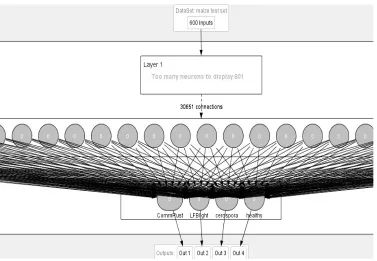
Figure 9. Neural network classifier after the convolution and pooling were completed in the Neuroph library.
Figure 10. Image recognition and classification test in Neuroph framework.
Figure 11. Gray Leaf Spot (Cerospora). Figure 12. Common Rust (Puccinia sorghi).
Figure 13. Healthy. Figure 14. Northern Corn Leaf Blight (Exserohilum).
3. Results
Figure 15 shows the iterations during training of the CNN that were executed to minimize the error from 0.275 to a reduced error of 0.001. As it can be seen in Figure 15, an approximated total of 150 iterations was executed to reduce the error to 0.01.
Figure 15. Total Network error graph during and after training of the CNN network on a Neuroph framework.
Figure 16. Assignment of the weights to each of the 50 hidden layers of the CNN.
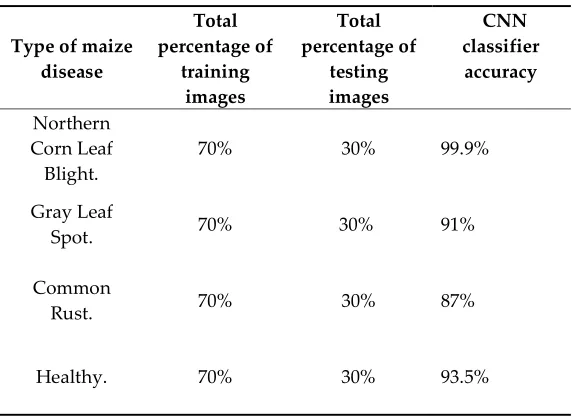
The results for separate class tests are shown in Table 1. The CNN was so accurate in the recognition and classification of Northern Corn Leaf Blight (Exserohilum) with an outstanding accuracy of 99.9%. Some of the test images contained the characteristics of both Gray Leaf Spot (Cerospora) and Common Rust (Puccinia sorghi), a reason which justified the CNN’s under performance when it came to the classification of the two diseases
Table 1. Accuracy results of the CNN in the classification and recognition of maize leaf diseases and healthy leaves.
Type of maize
disease Total percentage of
training
images Total percentage of
testing
images CNN classifier
accuracy
Northern Corn Leaf
Blight. 70% 30% 99.9%
Gray Leaf
Spot. 70% 30% 91%
Common
Rust. 70% 30% 87%
Healthy. 70% 30% 93.5%
The CNN’s Overall accuracy was determined by (11).
The overall classifier accuracy of the CNN was 92.85%. The test results of the proposed CNN model achieved accuracies somewhere in the range of 87% and 99.9%, for separate class tests, and 92.85% on average.
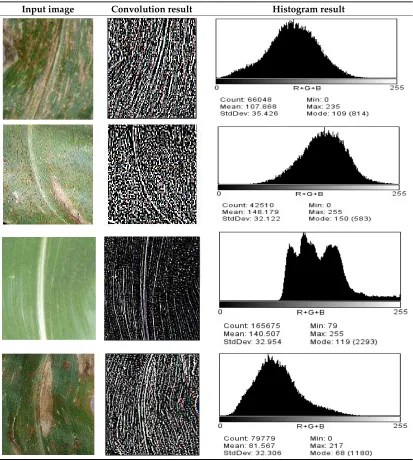
Table 2 shows the results of convoluted input images as well as histogram results of the input images through the proposed CNN
Table 2. Table of convoluted results and histogram results for select few input test images through the CNN.
4. Discussion
These results have further strengthened our hypothesis that the CNN was capable of recognizing and classifying the maize leaf diseases at an overall accuracy of 92.85%. The CNN was trained using approximately 150 iterations to reach a minimal error by 0.01. This proved that the model was so quick to learn from the training data. In separate class tests, the model achieved accuracies of 99.9% for Northern Corn Leaf Blight, 91% for Gray Leaf Spot, 87% for Common Rust and 93.5% of healthy maize leaves.
5. Conclusions
In this study, we have reviewed related works in the literature for the plant leaf disease classification algorithms of machine learning. Neuroph Studio framework was used as an IDE to build a more facilitated deep Convolutional Neural Network (CNN) whereby the convolution and pooling feature extractions were embedded in the Neuroph library. The proposed CNN was trained and tested using datasets from Plant village’s online website. The CNN’s overall accuracy of 92.85% proved its feasibility. The CNN was also tested using the maize collected data and the results approximated to the results we obtained during the usage of the testing data
Acknowledgments: The research presented in this paper was supported by South African National Space Agency (SANSA) in partnership with the Agricultural Research Council (ARC), South Africa.
Conflicts of Interest: The authors declare no conflict of interest.
References
[1] J. M. J. Ward, E. L. Stromberg, and D. C. Nowell, “Gray leaf Spot: A Disease of Global Importance in Maize Production,” no. March, 2015.
[2] Indian Council of agricultural research.2012(Revised). “Inoculation methods and disease rating scales for maize diseases”. Directorate of maize research 2016.
[3] H.R Dillard, and R.C Seem. “Incidence-Severity Relationships for common Maize Rust on Sweet corn”. The American Phytopathological Society 1990.
[4] T. A. Jackson-ziems, “NebGuide,” 2016.
[5] S. Sladojevic, M. Arsenovic, A. Anderla, D. Culibrk, and D. Stefanovic, “Deep Neural Networks Based Recognition of Plant Diseases by Leaf Image Classification,” Comput. Intell. Neurosci., vol. 2016, 2016.
[6] S. P. Mohanty, D. P. Hughes, and M. Salathe, “Using Deep Learning for Image-Based Plant Disease Detection,” Front. Plant Sci., 2016.
[7] P. Ahmadi, F. M. Muharam, K. Ahmad, S. Mansor, and I. Abu Seman, “Early Detection of Ganoderma Basal Stem Rot of Oil Palms Using Artificial Neural Network Spectral Analysis,” Plant Dis., 2017.
[8] Bhange, Manisha, and H. A. Hingoliwala. "Smart farming: Pomegranate disease detection using image processing," Procedia Computer Science 58, 2015: 280-288
[9] J. D.Pujari, R. Yakkundimath, and A. S. Byadgi, “SVM and ANN Based Classification of Plant Diseases Using Feature Reduction Technique,” Int. J. Interact. Multimed. Artif. Intell., vol. 3, no. 7, p. 6, 2016.
[10] M. Computing, A. Dixit, and S. Nema, “Wheat Leaf Disease Detection Using Machine Learning Method- A Review,” vol. 7, no. 5, pp. 124–129, 2018.