A Study on the Effect of Detergent on
Megascolexkonkanensis
Amala Thomas
1, Rakhi T.V
1, Sunish K.S
2U.G. Student, Department of Zoology, Maharaja’s College, Ernakulam, Kerala, India1
Assistant Professor, Department of Zoology, Maharaja’s College, Ernakulam, Kerala, India2
ABSTRACT: Today detergent has become essential in laundry purposes. The objective of the present study is to characterize the effect of detergents on earthworm and if there is any effect, to point out that it will adversely affect our ecological balance. The effect of detergent on Megascolexkonkanensis(weight, length, diameter and motility) was studied under different doses of detergent for 60 days. The observations after treatment with low concentration of detergent (0.1 gm, 0.5 gm, 1 gm) showed normal growth of earthworms. The weight, length and diameter of earthworms increased. Normal motility was observed. When we increased the concentration of detergent (5 gm, 3 gm, 1 gm) there was considerable decrease in weight, length and diameter. When compared, marked changes were observed in weight, length, diameter and motility of earthworms treated with high concentrations. The present work indicates towards the deleterious effect of high concentration of detergent on the survival of earthworm community in soil.
KEYWORDS:Earthworms, Detergent, Weight, Length, Diameter, Motility.
I. INTRODUCTION
The natural environment encompasses all living and nonliving things occurring naturally. The term is most often applied to the earth or some parts of the earth. This environment encompasses the interaction of all living species, climate, weather and natural resources that affect human survival and economic activity (Zimmerman, Corinne 2007).
The soil environment consist of a variety of physical, chemical and biological factors that affect the abundance and diversity of microbes found in the soil. At its basic level the soil environment consist of a solid and porous fraction. Within these fractions, a variety of physical and chemical factors affect soil fertility, microbes and soil organisms. Soil environment directly affects type of microbes and organisms as well as rates of processes they perform. Billions of organisms inhibit the upper layers of the soil, where they break down dead organic matter, releasing the nutrients necessary of plant growth. The microorganisms include bacteria, actinomycetes, algae and fungi. Macroorganisms include earthworms and arthropods such as insects, mites and millipeds. Each group plays a role in the soil ecosystems and can help the organic farmer in producing a healthy crop.
Most important group of larger soil organisms are the earthworms. A wealth of studies has documented that earthworms play an essential role in soil formation, turnover of soil (Edwards & Bohlen 1996, Lavelle et.al. 1999), soil aeration and drainage (Edwards & Lofty 1978, Tisdall 1978, Carter et.al. 1982), organic matter breakdownand incorporation into the soil (Satchell 1967, Edwards & Bohlen 1996), and nutrient mobilisation (Lee 1985, Edwards & Bohlen 1996). In recent years it has been stressed that the role of earthworms does not stop belowground but they also affect the aboveground subsystem, especially plant performance and plant community composition (Scheu et.al. 1999, Wurst et.al. 2003).
invertebrates in the soil as soil macro fauna and play a vital role in structuring and enhancing plant nutrients and hence they can be successfully used as bioindicators for the evaluation of toxic risks of xenobiotics in terrestrial ecosytems (A.J Reinecke& S.A Reinecke 2004). Earthworm population are influenced by various factors (soil, temperature, moisture and pH) and the availability of organic matter, which may come from plant residues and animal or human waste applied to the land (G.Baker et.al. 1992). The abundance of earthworms in soils represents the health of soil ecosystems and the level of environmental safety (H.Xiao et.al. 2004, K.E Lee 1985 and C.E Edwards et.al. 1995).
Soil texture can influence earthworm population because of its effects on other soil properties, such as soil moisture relationships, nutrient status and cation exchange capacity, all of which can have important influences on earthworm population. A survey indicates that the family Megascolecidae represents all the soil types in Kerala (sand, clay, gravelly sandy clay,sandy loam,clay loam,gravelly loam,sandy clay,gravelly loam,gravelly clay,sandy clay loam,sandy loam and gravelly sandy loam). It was noticed that L.mauritti, M.konkanensis and P.corethrurus were found in all the soil types in Kerala (C. SathishAthira, Babu C. Athira et.al, 2016).
Detergents are cleaning products manufactured from synthetic chemical compounds, as opposed to soap, which originate with natural substances like lye and plant saponins. A detergent is a surfactant or a mixture of surfactants with cleaning properties in dilute solutions. Detergents figure in an extensive array of industrial and home cleaning applications, including laundry and freshwater detergents. Releasing these detergents into soil can have far reaching impacts.
II. RELATEDWORKS
In the study, Effect of Chemical Fertilizers and Organic Fertilizers on EiseniafoetidaNidhiRai et.al, (2014) studied the effects of soil fertilization with inorganic and organic fertilizers on earthworm rearing (populations, biomass, number of cocoons, juveniles etc.) under different doses for 60 days. When compared, marked changes were observed in the activity of
Eiseniafoetida in both type of fertilizers introduced. This work indicates towards the deleterious effect of inorganic fertilizers on the survival of earthworm community in soil.
In the study conducted by K. S. Abbiramy, and P. Ronald Ross (2013), an acute toxicity test of urea to earthworm
(Eiseniafetida) was performed using a simple paper contact method proposed by OECD (Organization for Economical Cooperation and Development) testing guideline no.207. The lethal concentration was recorded as 28μg/cm2. Based on the LC 50 value study, urea was categorized as “very toxic” to earthworm according to Roberts and Dorough (1984). The result of this study demonstrates that inorganic fertilizers can also be toxic to earthworms when contacted directly. Thus there arises an unavoidable need for monitoring the usage of fertilizer dosage on agricultural lands, particularly the urea.
H. Lalthanzara, and S.N. Ramanujam (2010), studied the effect of inorganic fertilizer (NPK) on earthworm population under different plantations at Sakawrtuichhun (SKT) and Pachhunga University College (PUC) agroforestry sites in Mizoram, north-eastern state of India. Five species of earthworms under three families were identified in the study sites. Detailed study was carried out under different soil strata and on different age group of e arthworms in plantations like maize+Leucenaleucocephala (ML) and pine apple+citrus+Leucenaleucocephala (PCL). The most versatile species was found to be Drawida species. An epigeic species, P. excavatus showed significant population variation between NPK treatment and control in both study sites. Four species of earthworms showed a significant variation between the two treatments in PCL plantations of PUC. The uppermost stratum (0-10 cm) seemed to be the most affected by fertilizer treatment among the three strata. The Juvenile and immature worms were found to be most influenced by NPK application. The impact of NPK application on earthworm population was greater in PCL plantation compared to ML plantation.
III. MATERIALS AND METHODS
Experimental model: Earthworms were procured from soil. They were maintained in laboratory conditions and acclimatized for seven days.
Preparation of soil beds: The experiment was conducted as per method of NidhiRai et.al (2014). Four plastic trays were used for the preparation of soil beds. Soil mixed with dried and powdered cow dung was filled in all trays. Cow dung was added to avoid starvation. Each tray was divided into three sections to obtain replicates.
Experimental set up: Earthworms were introduced to the trays in such a way that one earthworm lies in each section. Length, diameter and weight of earthworms were measured before introducing them into trays. The trays were covered with wet cotton cloth so that the moisture level needed by the worms was maintained and also it will prevent them to crawl out of the tray. They were maintained in this setup to acclimatize with it for seven days.
Addition of Detergent: After one week, measurements were with respect to length, diameter and weight followed by treatment with detergent in concentrations 0.1 gm, 0.5 gm and 1 gm in trays 1, 2, and 3 respectively. Thus one control set (tray 4) and three experimental set (tray 1, 2 and 3) were prepared. To maintain up to 70% moisture level water was supplied regularly. After each week the changes were observed in length, diameter and weight of earthworms and detergent treatment was continued with same dosage for three weeks. Motility was also observed.
After 3 weeks, the concentration of detergent for treatment was increased to 5 gm, 3 gm and 1 gm in trays 1, 2 and 3 respectively. The experiment was continued for 3 weeks and observations were recorded.
IV. EXPERIMENTAL RESULTS AND DISCUSSION
EFFECT OF DETERGENT ON WEIGHT OF Megascolexkonkanensis(Low concentration)
TRAY 1
(Detergent conc.: 0.1 gm) [gm]
TRAY 2
(Detergent conc.: 0.5 gm) [gm]
TRAY 3
(Detergent conc.: 1 gm) [gm]
TRAY 4
(Control set) [gm]
1
2
3
A
1
2
3
A
1
2
3
A
1
2
3
A
Before experiment 0.758 0.328 0.379 0.488 0.697 0.501 0.382 0.527 0.600 0.434 0.513 0.516 0.534 0.395 0.416 0.448
Before treatment 1.135 0.439 0.497 0.690 0.739 0.744 0.510 0.664 0.678 0.545 0.533 0.585 0.681 0.473 0.344 0.499
1st observation after treatment &
2nd treatment
1.397 0.988 0.565 0.983 0.815 1.005 0.524 0.781 0.716 0.626 0.609 0.650 0.724 0.674 0.406 0.601
2nd observation & 3rd treatment
1.482 1.163 0.693 1.113 0.840 1.013 0.593 0.815 0.729 0.652 0.703 0.695 0.937 0.768 0.435 0.713
3rd observation 1.513 1.639 0.963 1.372 0.938 1.145 0.631 0.904 0.802 0.724 0.765 0.764 0.989 0.798 0.593 0.793
A–AVERAGE
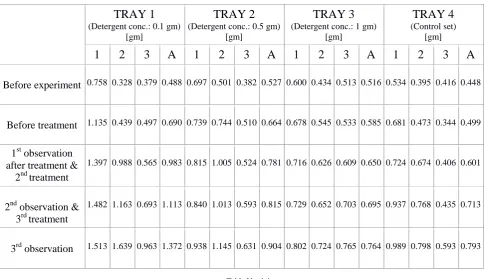
Treatment of earthworm with low concentration of detergent showed increase in its weight. 0.1 gm, 0.5 gm & 1 gm concentration of detergent was used for the treatment in tray 1, 2 & 3 respectively. A control setup was run parallel to the experimental setup in tray 4. After three weeks of observation, average weight gained by earthworms in tray 1, 2, 3 & 4 was 0.682 gm, 0.24 gm, 0.179 gm & 0.294 gm respectively.
EFFECT OF DETERGENT ON WEIGHT OF Megascolexkonkanensis(High concentration)
TRAY 1
(Detergent conc.: 5 gm) [gm]
TRAY 2
(Detergent conc.: 3 gm) [gm]
TRAY 3
(Detergent conc.: 1 gm) [gm]
TRAY 4
(Control set) [gm]
1
2
3
A
1
2
3
A
1
2
3
A
1
2
3
A
Before treatment
1.513 1.639 0.963 1.372 0.938 1.145 0.631 0.904 0.802 0.724 0.765 0.764 0.989 0.798 0.593 0.793
1st observation
& 2nd treatment
1.028 0.920 0.613 0.854 0.912 0.885 0.616 0.804 0.834 0.747 0.791 0.791 0.994 0.791 0.655 0.813
2nd observation
& 3rd treatment
0.756 0.601 0.541 0.634 0.852 0.771 0.582 0.735 0.878 0.792 0.836 0.835 0.981 0.844 0.698 0.841
3rd observation
0.701 0.582 0.492 0.592 0.799 0.723 0.521 0.681 0.914 0.869 0.873 0.885 1.115 1.004 0.987 1.035 Fig No: 1.1
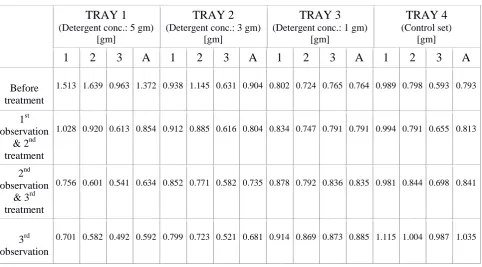
Earthworms treated with high concentration of detergent showed decrease in weight. 5 gm, 3 gm & 1 gm concentration of detergent was used for the treatment in tray 1, 2 & 3 respectively. A control setup was run parallel to the experimental set up in tray 4. Tray 1 & 2 showed average weight loss by 0.78 gm & 0.223 gm respectively. Earthworms treated with 1 gm concentration of detergent and those in control set showed increase in weight. Their average weight increased by 0.121 gm & 0.242 gm respectively after three weeks of observation.
EFFECT OF DETERGENT ON LENGTH OF Megascolexkonkanensis(Low concentration)
A - AVERAGE
TRAY 1 (Detergent conc.: 0.1 gm)
[cm]
TRAY 2 (Detergent conc.: 0.5 gm)
[cm]
TRAY 3 (Detergent conc.: 1 gm)
[cm]
TRAY 4 (Control set)
[cm]
1 2 3 A 1 2 3 A 1 2 3 A 1 2 3 A
Before experiment
11 9 6.8 8.93 5.2 11.5 7 7.9 8.8 7 5.6 7.13 8 6.5 4.7 6.4
Before treatment
12.5 10 8 10.17 6 13 7.8 8.93 9.5 8 6 7.83 9 7.5 5 7.17
1st observation
& 2nd treatment
13 10.5 9 10.83 6.5 14 8 9.5 10 8.5 6.9 8.47 10 8 6.5 8.17
2nd observation
& 3rd treatment
14 11 10 11.67 8 15 8.5 10.5 11 8.8 7.1 8.97 11.5 8.5 6.9 8.97
3rd observation
15.5 12.3 10.6 12.8 8.4 15.6 9 11 12 9.1 7.4 9.5 12 9.8 7.3 9.7 Fig No: 1.2
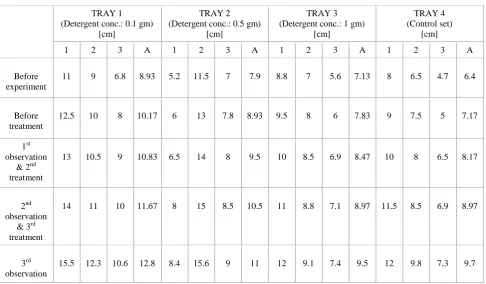
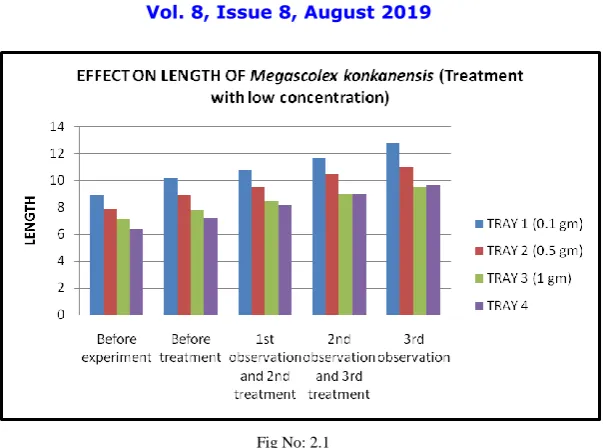
Treatment of earthworm with low concentration of detergent showed increase in its length. 0.1 gm, 0.5 gm & 1 gm concentration of detergent was used for the treatment in tray 1, 2 & 3 respectively. A control setup was run parallel to the experimental set up in tray 4. After three weeks of observation, average length gained by earthworms in tray 1, 2, 3 & 4 was 2.63 cm, 2.07 cm, 1.67 cm & 2.53 cm respectively.
EFFECT OF DETERGENT ON LENGTH OF Megascolexkonkanensis(High concentration)
TRAY 1 (Detergent conc.: 5 gm)
[cm]
TRAY 2 (Detergent conc.: 3 gm)
[cm]
TRAY 3 (Detergent conc.: 1 gm)
[cm]
TRAY 4 (Control set)
[cm]
1 2 3 A 1 2 3 A 1 2 3 A 1 2 3 A
Before treatment
15.5 12.3 10.6 12.8 8.4 15.6 9 11 12 9.1 7.4 9.5 12 9.8 7.3 9.7
1st observation
& 2nd treatment
16 12.6 11 13.2 8.8 16 9.2 11.33 12.5 9.3 7.8 9.87 12.5 10 8 10.17
2nd observation
& 3rd treatment
16.2 12.9 11.4 13.5 9 16.3 9.5 11.6 12.9 9.6 8.3 10.27 13 10.5 9 10.83
3rd observation
16.3 13.1 11.7 13.7 9.3 16.6 9.6 11.8 13.3 10 8 10.67 13.4 11 9.5 11.3
Treatment of earthworm with high concentration of detergent showed increase in its length. 0.9 cm, 0.8 cm, 1.17 cm & 1.6 cm increase in average length was observed in tray 1, 2, 3 & 4 respectively. But when compared to the treatment with low concentration of detergent, average increase in length was very low.
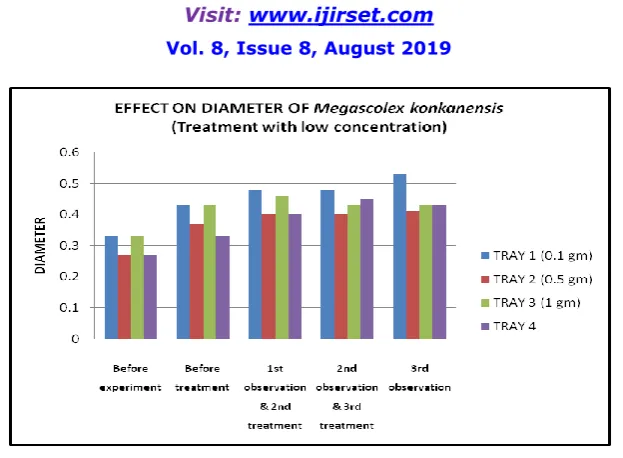
EFFECT OF DETERGENT ON DIAMETER OF Megascolexkonkanensis(Low concentration)
TRAY 1 (Detergent conc.: 0.1 gm)
[cm]
TRAY 2 (Detergent conc.: 0.5 gm)
[cm]
TRAY 3 (Detergent conc.: 1 gm)
[cm]
TRAY 4 (Control set)
[cm]
1 2 3 A 1 2 3 A 1 2 3 A 1 2 3 A
Before experiment
0.4 0.3 0.3 0.33 0.3 0.3 0.2 0.27 0.4 0.3 0.3 0.33 0.3 0.2 0.3 0.27
Before treatment
0.5 0.4 0.4 0.43 0.4 0.4 0.3 0.37 0.5 0.4 0.4 0.43 0.4 0.3 0.3 0.33
1st observation
after treatment
0.5 0.5 0.4 0.48 0.4 0.4 0.4 0.4 0.56 0.42 0.4 0.46 0.4 0.4 0.4 0.4
2nd observation
& 3rd
treatment
0.5 0.5 0.43 0.48 0.4 0.4 0.4 0.4 0.5 0.4 0.4 0.43 0.5 0.44 0.4 0.45
3rd observation
0.6 0.5 0.5 0.53 0.4 0.5 0.43 0.41 0.5 0.4 0.4 0.43 0.5 0.4 0.4 0.43
A - AVERAGE
Fig No: 2.2
Table No: 3.1
0 2 4 6 8 10 12 14 16 Before treatment 1st observation & 2nd treatment 2nd observation & 3rd treatment 3rd observation LE N GTH
EFFECT ON LENGTH OF Megascolex konkanensis (Treatment with high concentration)
TRAY 1 (5 gm)
TRAY 2 (3 gm)
TRAY 3 (1 gm)
Treatment of earthworm with low concentration of detergent (0.1 gm, 0.5 gm & 1 gm concentration of detergent in tray 1, 2 & 3 respectively) showed increase in its diameter. A control set up was run parallel to the experimental set up in tray 4. After three weeks of observation, average diameter gained by earthworms in tray 1, 2, 3 & 4 was 0.2 cm, 0.14 cm, 0.1 cm & 0.16 cm respectively.
EFFECT OF DETERGENT ON DIAMETER OFMegascolexkonkanenesis (High concentration)
TRAY 1 (Detergent conc.: 5 gm)
[cm]
TRAY 2 (Detergent conc.: 3 gm)
[cm]
TRAY 3 (Detergent conc.: 1 gm)
[cm]
TRAY 4 (Control set)
[cm]
1 2 3 A 1 2 3 A 1 2 3 A 1 2 3 A
Before treatment
0.6 0.5 0.5 0.53 0.4 0.5 0.43 0.41 0.5 0.4 0.4 0.43 0.5 0.4 0.4 0.43
1st observation
& 2nd treatment
0.5 0.4 0.3 0.4 0.4 0.4 0.4 0.4 0.4 0.4 0.4 0.4 0.5 0.5 0.5 0.5
2nd observation
& 3rd treatment
0.4 0.3 0.3 0.33 0.3 0.4 0.3 0.33 0.4 0.38 0.4 0.39 0.48 0.5 0.5 0.49
3rd observation
0.3 0.3 0.3 0.3 0.3 0.4 0.2 0.3 0.4 0.4 0.4 0.4 0.5 0.5 0.5 0.5
A – AVERAGE
Fig No: 3.1
Earthworms treated with high concentration of detergent showed decrease in diameter. 5 gm, 3 gm & 1 gm concentration of detergent was used for the treatment in tray 1, 2 & 3 respectively. A control set up was run parallel to the experimental set up in tray 4. Tray 1 & 2 showed average decrease in diameter by 0.23 cm & 0.11 cm respectively and in tray 3 & 4, average diameter was increased by 0.03 cm & 0.07 cm respectively.
Detergents are commonly used in every household in India. The overused detergent may affect the soil organisms especially the earthworms which are known well for their role in soil fertility. The experiment conducted during this investigation revealed many interesting facts. The detergent was found to be quite detrimental to earthworms in higher concentrations. Different doses of detergent were administered to the soil in trays. A control set up was run parallel to the experimental setup. There were significant changes in weight, length and diameter of tested earthworms after exposure to high doses of detergent. The weight of earthworms exposed to high concentration of detergent decreased steadily. The sharp decrease in the weight of earthworms revealed that high concentration of detergent was detrimental to the worms. However, at low concentration of detergent there was no significant change in morphological parameters like weight, length and diameter of the earthworms.
In this experiment, to maintain moisture level and to avoid starvation, water and cow dung was supplied regularly. The observations after treatment with low concentration of detergent (0.1 gm, 0.5 gm, 1 gm) showed normal growth of earthworms. The weight, length and diameter of earthworms increased. Also normal motility was observed. When we increased the concentration of detergent (5 gm, 3 gm, 1 gm) there was considerable decrease in weight and diameter. Even though increase in length was observed in Megascolexkonkanensisafter treatment with high concentrations of detergent, average increase in length was very low when compared to that of treatment with low concentration of detergent. By the third observation after the treatment with increased concentration of detergent, there was decrease in motility of earthworms. Earthworms treated with 5 gm concentration of detergent showed great decrease in the studied parameters. A study on the effect of chemical and organic fertilizers on Eiseniafoetida shows similar results (NidhiRai, PriyankaAshiya, DevendrasinghRathore, 2014).
The deleterious effect of detergents on earthworms was found under the doses 5 gm and 3 gm within a week even though the rest of the doses of detergent, earthworms were unaffected.
V. CONCLUSION
This study is thus to examine the effects of detergent on earthworm. By this work, we conclude that low concentration of detergent used in this study is not harmful for earthworms. Since the approximate amount of detergent that we normally used per week and that may fall into an approximate area of soil is low, it does not affect earthworms. Even though the low concentration of detergent is discharged into soil, if the earthworms get enough food and moisture, they are able to grow normally. Probably this may be the reason why worm casts are seen in the soil around the domestic laundry area.When a high concentration of detergent is discharged into the same area of soil, it adversely affects earthworms. It will make a considerable decrease in growth and functioning of earthworms. Even if a low concentration of detergent is discharged to the soil repeatedly, thus there is a probability for the bioaccumulation of detergent in the soil as well as inside earthworm and it may affect its normal functions.
REFERENCES
[1] A.J. Reinecke, and S.A. Reinecke, -Earthworms as test organisms in ecotoxicological assessment of toxicant impacts on ecosystems, In: Edwards C.A. (ed.): Earthworm Ecology. CRC Press, Boca Raton, 299-320, 2004.
[2] C.A. Edwards, P.J. Bohlen, D.R. Linden, and S. Subler, Earthworms in Agroecosystems, Hendrix P.F. (ed.) Earthworm Ecology and Biogeography. Lewis, Boca Raton, Floridhea, 185-206, 1995.
[3] C. SatheeshAthira, Babu C. Athira, Jeff James, KarthihaSivaraman, K.S. Kavya, Bijily V.B. Midhuna,K.B. Rajaneesh, P.G. Remya, T. Roshini, PrasadM.D. Vishnu, AjaManazhy, Jaya Manazhy and John W.;Studies on the biology and ecology of earthworms collected from urban and suburban areas of thrissur district, kerala,india;megadrilogica Volume 21, Number 1, September 2016.
[4] D. Jordan, R.J. Miles, V.C. Hubbard, and T. Lorenz, Effect of management practices and cropping systems on earthworm abundance and microbial activity in Sanborn Field: a 115-year-old agricultural field, Pedobiologia, 48: 155-169, 2004.
[5] Edwards C.A and Bohlen P. Biology and ecology of earthworms. Chapman and Hall, London. 1996.
[6] G. Baker, J. Buckerfield, R. Grey-Gardner, R. Merry, and B. Doube, The abundance and diversity of earthworms in pasture soils in the FleurieuPenrnsula, South Australia Soil BiolBiochem. 12: 1389 1395, 1992.
[7] H. Lalthanzara, and S.N. Ramanujam, ―Effect of fertilizer (NPK) on earthworm population in the agroforestry system of Mizoram, India,‖ Science Vision, 10(4): 159 – 167, 2010.
[8] H. Xiao, Q.X. Zhou, and J.D. Liang, -Single and joint effects of acetochlor and urea on earthworm E. Fetida populations in phaiozem, Environmental Geochemistry and Health, 26: 277-283, 2004.
[9] K.E. Lee, Earthworms: Their ecology and relationships with soils and land use, Academic Press, Sydney, 1985.
[10] K. S. Abbiramy, and P. Ronald Ross, ―Determination of acute toxicity of urea to Eiseniafetida by a simple paper contact method‖, International Journal of Science, Environment and Technology, Vol. 2, No 5, 2013, 886 – 891, 2013.
[11]Lavelle P, Brussaard L, Hendrix P.F. Earthworm management in tropical agroecosystems. CAB international, Wallingford. 1999.
[12]MunnoliPrakashMallappa, A. Teixeria da Selva Jaime, and BhosleSaroj, -Dynamics of Soil-Earthworm-Plant Relationship: A Review, Dynamic Soil, Dynamic Plant, Global Science books, 2010.
[13]NidhiRai, PriyankaAshiya, Devendra Singh Rathore, “Comparative study of effect of chemical fertilizer and organic fertilizer on Eiseniafoetida”, International Journal of Innovative Research in Science, Engineering and Technology, 2014.
[14] Satchell J.E. Lumbricidae, pp. 259-322, in A Buurges, F Raw (eds.). Soil biology.Academic press, Sydney.