THE STUDY OF STABILIZING EFFECT OF POLYVINYL ALCOHOL IN
ABSORBANCE OF ANIONIC DETERGENT SOLUTIONS
Enkela Noçka1 , Ariola DEVOLLI2,Ilva Gjika1
1
Polytechnic University of Tirana, General and Inorganic Chemistry Department 2
Department of Chemistry,Faculty of Food and Biotechnology, Agricultural University of Tirana, Albania.
ABSTRACT
The wide use both domestic and industrial of AD has brought their increase in concentration on
the environment. So, the development of quick, sensitive and selective methods for the
determination of AD is considered an important analytical problem. The methods used for the
determination of AD can be divided into two major groups:
1- Methods for the determination of the total content of AD. These methods are mainly used for
the evaluation of the environmental pollution.
2- Methods for the determination of the specific components of AD. They are mainly new and
expensive methods as GC-MS, HPLC, IR-Spectroscopy, ionic chromatography, etc., and they are
used mainly in scientific research. We are interested in the first group of methods, in particular
in those that use common analytical techniques, as UV-VIS spectroscopy, SAA and
electroanalytical techniques, ion-selective potentiometry, etc. The difficulty of determination of
AD in environmental samples is due to the wide range of the concentrations, insufficient
selectivity and sensitivity of the analytical procedures and the lack of the standard samples.
Materials and methods
a) laboratory equipment used: Turbidimetric measurements are performed with UV-VIS
spectophotometer type Pye-UNICAM SP6-550, we used wavelengths 700 nm and glass
container 1 = 1,0 cm. Time measurement is calculated from the moment of casting the last jet
b) reagents and solutions
- Anionic Detergents: Sodium dodecyl sulfate (SDS), 98% and Sodium signature
Dodecylbenzensulfonic acid sodium salt (Aldrich) were used. Basic water solution concentration
1000 mg/liter (or 500 mg/liter) are stored in the cold (refrigerator, 4 ° C), while the diluted
solvates are prepared freshly (day use).
-Etiviolet (Cationic dyestuff) (EV) the Aldrich Company. The solution with concentration 10-3 is
prepared by dissolving 0,050 g jet in 100 ml water, and is stored in cold.
- Polyvinyl alcohol (PVA) with molecular weight 13,000 to 23,000 of the Aldrich Company.
Aqueous solution of 0.5% and 1% (m / v) are stored in cold.
-Buffer Phosphate, 1M, pH 6.4: 34 gram dissolved in 250ml water, added KOH
solution to pH 6.4 (the pH-meter).
c) Cleaning of glass vessels:
A special care was devoted to glass containers cleaning. The glass containers that are going to be
used for the AD determination should not be cleaned with powdered or liquid detergent. In our
work we have followed this procedure to improve cleaning before we use these glass containers:
- water-washing
- washing with hypochlorite solution
-rinse out water and distilled water
-washing with HNO3
-rinse out distilled water
-sponge the mixture HCl + alcohol (ethyl or methyl) 1: 1
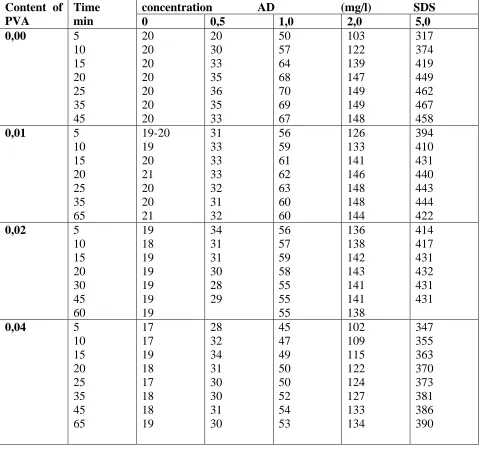
Experiment 2: The impact of PVA concentration. PVA is a non-ionic detergent and his addition
in solution has a stabilizing effect in associate size DA-EV , so and in absorbance measured
values. The impact of PVA concentration from 0 to 0,04% in absorbance values measured at
different times (till to 60 min) and for SDS solution with different (from 0 to 5mg/liter) is given
in Table 2 and so in figure 2.
Table 2: Absorbance values Ax to 700nm versus time, for standard solution of SDS with different contents of PVA.
Content of PVA
Time min
concentration AD (mg/l) SDS
0 0,5 1,0 2,0 5,0
0,00 5
10 15 20 25 35 45 20 20 20 20 20 20 20 20 30 33 35 36 35 33 50 57 64 68 70 69 67 103 122 139 147 149 149 148 317 374 419 449 462 467 458
0,01 5
10 15 20 25 35 65 19-20 19 20 21 20 20 21 31 33 33 33 32 31 32 56 59 61 62 63 60 60 126 133 141 146 148 148 144 394 410 431 440 443 444 422
0,02 5
10 15 20 30 45 60 19 18 19 19 19 19 19 34 31 31 30 28 29 56 57 59 58 55 55 55 136 138 142 143 141 141 138 414 417 431 432 431 431
0,04 5
[image:3.612.67.547.246.706.2]a) 0 mg/l
b) 0.01 mg/l 0
50 100 150 200 250 300 350 400 450 500
5 min 10 min 15 min 20 min 25 min 35 min 45 min
0,00 (mg/l)
0 (mg/l) 0,5 (mg/l) 1,0 (mg/l) 2,0 (mg/l) 5,0 (mg/l)
0 50 100 150 200 250 300 350 400 450
5 min 10 min 15 min 20 min 25 min 35 min 65 min
0,01 (mg/l)
0 (mg/l)
0,5 (mg/l)
1,0 (mg/l)
2,0 (mg/l)
C) 0.02 mg/l
[image:5.612.72.436.357.611.2]d) 0.04 mg/l
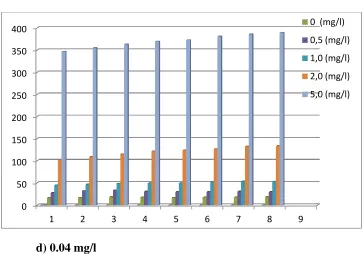
Figure 2: The influence of PVA content to absorbance values in different times. 0
50 100 150 200 250 300 350 400 450
5 min 10 min 15 min 20 min 30 min 45 min 60 min
0,02 (mg/l)
0 (mg/l)
0,5 (mg/l)
1,0 (mg/l)
2,0 (mg/l)
5,0 (mg/l)
0 50 100 150 200 250 300 350 400
1 2 3 4 5 6 7 8 9
0 (mg/l)
0,5 (mg/l)
1,0 (mg/l)
2,0 (mg/l)
Conclusions
It is noted that with incrising of PVA content the absorbance values are more stable over time
(especially for solution more dilute). But, on other hand, with increasing of PVA content is
reduced enough sensitivity of measurements. Also it is noted from the data obtained that optimal
time of measurement for all cases ranges from 20 to 45 min. For this reason we chose as optimal
concentration 0,02% PVA to measurement solution (0,5 ml solution PVA 1% to 25ml) and the
optimal time of measurement is about 30 min.
LITERATURE
Allan W., Moore and Raymond A. Kolbesaon (1956) Determination of anionic detergents in surface water, Vol 28(2), pp. 161-164
Chinnick, C.C.T., and Lincoln, P.A. (1954) Proceeding, 1st world Conference on Surface Active Agents. Paris, France
Marron, T.V. and Scifferli, F.Ind. Eng. Chem, Anal. Ed. (1986) Standart Methods of Chemical Analysis. Volume II (A and B)