Error Detection in Monotone Span Programs
with Application to Communication-Efficient
Multi-Party Computation
Nigel P. Smart1,2and Tim Wood1,2 1 University of Bristol, Bristol, UK.
2
KU Leuven, Leuven, Belgium. [email protected],[email protected]
Abstract. Recent improvements in the state-of-the-art of MPC for non-full-threshold access structures introduced the idea of using a collision-resistant hash functions and redundancy in the secret-sharing scheme to construct a communication-efficient MPC protocol which is computationally-secure against malicious adversaries, with abort. The prior work is based on replicated secret-sharing; in this work we extend this methodology to anyLSSS implementing aQ2access structure. To do so we need to estab-lish a folklore property of error detection for such LSSS and their asso-ciated Monotone Span Programs. In doing so we obtain communication-efficient online and offline protocols for MPC in the pre-processing model.
1
Introduction
Secure multi-party computation (MPC) allows a set of parties to compute a function on their combined secret inputs so that all parties learn the output of the function and no party can learn anything that cannot be inferred from the output and their own inputs alone. As a field it has recently received a lot of attention and has been explored in a variety of contexts: for example, private auctions [13], secure statistical analysis of personal information [11] and protection against side-channel attacks in hardware [8,35,36].
Most MPC protocols fall into one of two broad categories: garbled circuits, and linear-secret-sharing-scheme-based (LSSS-based) MPC. The garbled-circuit approach, which began with the work of Yao [38], involves some collection of parties “garbling” a circuit to conceal the internal circuit evaluations, and then later a single party or a collection of parties jointly evaluating the garbled cir-cuit. By contrast, the LSSS-based approach involves using a so-called linear secret-sharing scheme, in which the parties: “share” a secret into severalshares
such as somewhat-homomorphic encryption (SHE) [25] or oblivious transfer (OT) [32]. In this paper, we focus on computationally-secure LSSS-based MPC. An access structure for a set of parties defines which subsets of parties are allowed to discover the secret if they pool their information. Such quorums of parties are often calledqualifiedsets of parties. An access structure is calledQ` (for` ∈N) if the union of any set of` unqualified sets of parties is missing at least one party. We discuss this in some detail later, but for now the reader can think of an (n, t)-threshold scheme where t < n/` which is where a subset of parties is qualified if and only if it is of size at least t+ 1. Computationally-secure LSSS-based MPC has recently seen significant, efficient instantiations for full-threshold access structures [7,23,25,32], which is where the protocol is secure if at least one party is honest, even if the adversary causes the corrupt parties to run arbitrary code (though this behaviour may cause the protocol to abort rather than provide output to the parties). In the threshold case similar efficient instantiations are known, such as the older VIFF protocol [21] which uses (essentially) information-theoretic primitives only.
While protocols providing full-threshold security are an important research goal, in the real world such guarantees of security do not always match the use-cases that appear. Different applications call for different access structures, and not necessarily the usual threshold examples. For example, a company may have four directors (CEO, CTO, CSO and CFO) and access may be granted in the two combinations (CEO and CFO) or (CTO and CSO and CFO). In such a situation it may be more efficient to tailor the protocol to this structure, rather than try to shoe-horn the application into a more standard (i.e. full-threshold) structure. Indeed, while it is possible that a computation can be performed in a full-threshold setting and then the outputs distributed in accordance with the access structure, such a process requires all parties to participate equally in the computation, which may not be feasible in the real world, especially if the computing parties are distributed over a wide network, and susceptible to outages if the total number of parties is large.
Most LSSS-based MPC protocols split the computation into two parts: an of-fline phase, in which parties interact using “expensive” public-key cryptography to lay the groundwork for an online phasein which only “cheap” information-theoretic primitives are required. The online phase is where the actual circuit evaluation takes place. For the access structures considered in this work, namely
Q2 structures, the offline phase is almost as fast as the online phase. Thus the goal here is to minimize the cost of communication in both phases.
possible if the access structure isQ3. The latter has seen various optimisations in the literature, for example [22], making use of packed secret sharing to obtain a bandwidth-efficient perfectly-secure protocol.
In recent work [33], Keller et al. show that by generalising a method of Araki et al [1,27] communication-efficient computationally-secure MPC with abort can be realised forQ2 access structures, if replicated secret-sharing is used. The methodology in [1,27,33] uses the explicit properties of replicated secret-sharing so as to authenticate various shares. This enables active security with abort to be achieved relatively cheaply, albeit at the expense in general of the pre-deployment of a large number, depending on the access structure, of symmetric keys to enable the generation of pseudo-random secret sharings (PRSSs) in a non-interactive manner. A disadvantage of replicated sharing is the potentially larger (than average) memory footprint needed for each party per secret, and consequently there is still a relatively large communication cost involved when the parties need to send shares across the network. In this work we extend this prior work to produce a protocol for any LSSS that supports the Q2 access structure.
1.1 Authentication of Shares
Many of practical MPC protocols begin with a basic passively-secure (a.k.a.
semi-honest or honest-but-curious) protocol, in which corrupt parties execute the protocol honestly but try to deduce anything they can about other par-ties’ data from their own data and the communication tapes. Such passively-secure protocols forQ2access structures are highly efficient, and are information-theoretically secure. The passively secure protocols are then augmented to obtain active security with abort by using some form of “share authentication”; in this security setting, corrupt parties may deviate arbitrarily from the protocol de-scription but if they do so the honest parties will abort the protocol.
At a high level, modern actively-secure LSSS-based MPC protocols combine: 1. A linear (i.e. additively homomorphic) secret sharing scheme;
2. A passive multiplication protocol; and 3. An authentication protocol.
The communication efficiency of the computation (usually an arithmetic or Boolean circuit) depends heavily on how authentication is performed.
One important branch of this authentication methodology contributing sig-nificantly to their practical performance is the amortisation of verification costs by batch-checking MACs, a technique developed in [6,25], amongst other works. A different approach to batch verification for authentication of shares, in the case of Q2 access structures, was introduced by Furakawa et al. [27], in the context of the three-party honest-majority setting, i.e. a (3,1)-threshold access structure. This work extended a passively-secure protocol of Araki et al. [1] in the same threshold setting. This approach dispenses with the MACs and instead achieves authentication of shares using a collision-resistant hash function when authenticating an open-to-all operation, and uses redundancy of the underlying secret sharing scheme in an open-to-one operation. Their protocol can be viewed as a bootstrapping of the passively-secure protocol of Beaver and Wool [3], with an optimised sharing procedure (highly tailored to the (3,1)-threshold access structure), to provide a communication-efficient actively-secure protocol (with abort). By using a hash function they sacrifice the information-theoretic security of Beaver-Wool for computational security, and also use computationally-secure share generation operations to improve the offline phase.
The above protocols for replicated sharing in a (3,1)-threshold access struc-ture of [1,27] simultaneously reduce the number of secure communication chan-nels neededandthe total number of bits sent per multiplication. Recent work [33] has shown that these techniques can be generalised from (3,1)-threshold toany Q2access structure, using replicated secret-sharing. Both [27] and [33] make use of the fact that replicated sharing provides a trivial method to authenticate a full set of shares; i.e. it somehow offers a form of error-detection.
A recent protocol due to Chida et al. [17] also considers actively-secure honest-majority MPC and makes use of MACs. In their work, the communica-tion cost is a constant number of elements per multiplicacommunica-tion, but the messages are broadcast, so this cost is linear in the number of parties. Our protocol also has linear overhead, but following the methodology of [33], the total number of uni-directional channels is reduced and so the asymptotic cost is lower (for threshold access structures). The benefit of the Chida protocol is that there is no offline processing, and the total cost of active computation is less than ours (they achieve roughly twice the cost of passive multiplication as opposed to our roughly threefold cost). However, if one is interested purely in online times then our protocol is more efficient than that of Chida et al.
1.2 Our contribution
While the replicated secret-sharing of [33] offers flexibility in being able to realise
anyaccess structure, unfortunately itcanrequire an exponentially-large number of shares to be held by each party for each shared secret. As threshold access structures illustrate, using a general MSP may enable the same access structure to be realised in a more efficient manner, which motivates our work in this area.
The two main contributions of this work are as follows:
Beaver triples, this gives us active security with abort, at the cost of replacing information-theoretic with computational security.
– We also provide, a generic way to reduce the amount of communication required for the passive multiplication subprotocol in the offline phase for multiplicative MSPs.
Thus we generalise the online phase of [33] to arbitrary MSPs, hence allowing the benefits of that work to be achieved without necessarily requiring the cost of replicated secret sharing. Whereas many of the previous protocols are optimised for access structures on specific numbers of parties, or use specific secret-sharing schemes, our optimisation of the passive online multiplication is generic in the sense that it only uses theQ2 nature of the access structure for authentication: [27] and [33] are special cases of our optimisation.
Our contribution, then, is not so much our full MPC protocol as it is the mechanism for an actively-secure multiplication in theQ2 setting. Viewing the protocol in this more modular sense allows us to separate the LSSS from the actual multiplication and thus allows us to reduce the search for finding an efficient MPC protocol for a given Q2 access structure to finding an LSSS with a small total number of shares.
To conclude this section, we briefly remark how our work relates to the cor-respondence between LSSSs and linear codes. Cramer et al. [20] showed how the correspondence between linear secret-sharing schemes and linear codes reveals an efficient method by which qualified parties can correct any errors in a set of shares for some secret. The ability to do so requires the access structure to be Q3, since if this holds then a strongly-multiplicative LSSS realising it allows honest parties to correct any errors introduced by the adversary. This is not a direct connection to error-correction codes since such LSSSs do not necessarily allow unique decoding of the entire share vector: it is only the component of the share vector corresponding to thesecret that is guaranteed to be correct. In our work we show that if the access structure isQ2then any LSSS realising it allows honest parties to agree on whether or not the secret is correct: thus we obtain a form of error-detection. This reveals why the protocols above (viz., [27,33]) are able to perform the error-detection causing abort. This result seems to be folklore – but we could find no statement or proof in the literature to this effect, and so we prove the required properties here.
2
Preliminaries
2.1 Notation
LetF denote a finite field; we write F=Fq forq some prime power ifF is the
field of q elements. We write r ←$ F to mean that r is sampled uniformly at random fromF. Vectors are written in bold and are taken to be column vectors. We denote by 0a vector consisting entirely of zeros of appropriate dimension, determined by the context, and similarly by 1 a vector consisting entirely of ones. For a vector xwe write theith component as x
ithvector from a sequence of vectors. We use the notationeifor theithstandard basis vector (defined byei
j :=δij where δij is the Kronecker delta). We denote by [n] the set∪n
i=1{i}, and by P the complete set of parties, which we take to be {Pi}i∈[n]. Given some setS, a subset of some larger set S0, we write a6∈S to indicate that elementais inS0\S; in general,S0 will be implicit, according to context. We define the functionsupp:Fm→2P vias7→ {i∈[m] :si6= 0}. We use the notationA⊆B to mean thatAis a (not necessarily proper) subset ofB, contrasted withA(B whereAis a proper subset of B. We writeλand
κfor the statistical and computational security parameters respectively. Given a vector spaceV ⊆Fd, we denote byV⊥ the orthogonal complement;
that is,V⊥ ={w∈Fd:hv,wi= 0}, wherehv,wi=v>·wis the standard inner
product. From basic linear algebra, (V⊥)⊥ =V. For a matrix M ∈ Fm×d, we
writeM>for the transpose. IfM is a matrix representing a linear mapFd→Fm,
then im(M>) = ker(M)⊥ by the fundamental theorem of linear algebra.
2.2 Access Structures, MSPs, LSSSs and Linear Codes
Access structures: Fix P = {Pi}i∈[n] and let Γ ⊆ 2P be a monotonically increasing set, i.e. Γ is closed under taking supersets: if Q ∈ Γ and Q0 ⊇ Q
then Q0 ∈Γ. Similarly, let∆⊆2P be a monotonically decreasing set, i.e.∆ is closed under taking subsets: if U ∈ ∆ and U0 ⊆U then U0 ∈ ∆. We call the pair (Γ, ∆) amonotone access structureifΓ ∩∆=∅. If∆ = 2P\Γ, then we
say the access structure is complete. In this paper, we will only be concerned with complete monotone access structures and so this is assumed throughout without qualification. The sets inΓ, usually denoted byQ, are calledqualified, and the sets in∆, usually denoted byU, are calledunqualified. Partial ordering is induced on Γ and ∆ by the standard subset relation denoted by “⊆”: we writeΓ− for the set ofminimally qualified setswhere minimality is with respect to “⊆”:Γ− ={Q ∈Γ : ifQ0 ∈Γ andQ0 ⊆QthenQ0 = Q}; similarly, ∆+ denotes the set ofmaximally unqualified sets where maximality is with respect to “⊆”:∆+={U ∈∆: ifU0 ∈∆andU ⊆U0 thenU0=U}
An access structure is said to beQ2 (resp.Q3) if the union of no two (resp. three) sets in∆ is the whole ofP. A consequence of this is that in a Q2 access structure, the complement of a qualified set is unqualified, and vice versa.
In an (n, t)-threshold access structure, any set of t+ 1 parties is qualified, whilst any set oftor fewer parties is unqualified. ThusΓ−contains t+1n sets in total. The termfull threshold refers to an (n, n−1)-threshold access structure. For an arbitrary complete monotone access structure, the set of minimally qual-ified sets together with the set of maximally unqualqual-ified sets uniquely determine the entire structure. The dual access structure Γ∗ of an access structureΓ is defined by Γ∗ := {Q ∈ 2P : 2P \Q 6∈ Γ}. Cramer et al. [20] showed that an access structureΓ isQ2 if and only ifΓ∗⊆Γ.
Linear Secret Sharing Schemes:An LSSS is a method of sharing secret data amongst parties. It consists of three multi-party algorithms: Input, Open, and
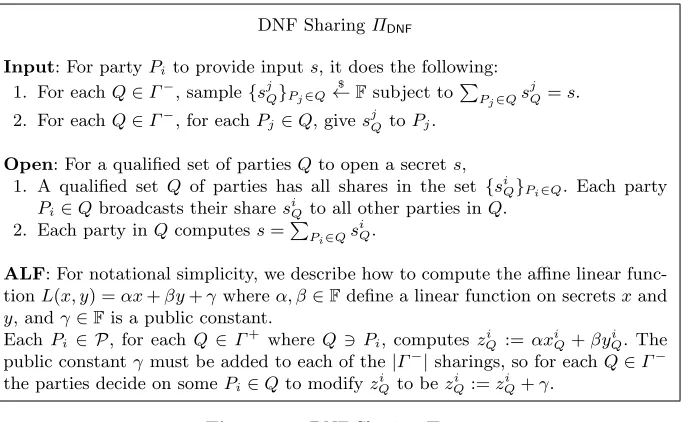
open) secrets, and compute an affine linear function on shared secrets. In a prac-tical sense, this means that the parties can add secrets, multiply by scalars, and add public constants to a shared secret, all by local computations. In this work we consider, as examples, the three most well-known secret-sharing schemes: Shamir; replicated, also known as CNF-based (conjunctive-normal-form-based); and DNF-based (disjunctive-normal-form-based). We assume the reader is fa-miliar with these schemes, but for completeness we give a recap in AppendixA. We will use the term additive sharing to mean that a secret s takes the value
s=Pni=1si wheresiis held byPiand thesi’s are uniformly random subject to the constraint that they sum tos.
An LSSS is calledmultiplicativeif the whole set of partiesP can compute an additive sharing of the product of two secrets by performing only local computa-tions. If the product is to be kept as a secret and used further in the computation, it is usually necessary for the parties to engage in one or more rounds of commu-nication to convert the additive sharing into a sharing in the LSSS being used. A secret-sharing scheme is calledstrongly multiplicativeif, for anyU ∈∆, the par-ties inP\Ucan compute an additive sharing of the product of two secrets by local computations. Such schemes offer robustness, since the adversary, corrupting an unqualified set of parties, cannot prevent the honest parties from reconstructing the desired secret. Cramer et al. [19] showed that any (non-multiplicative) LSSS realising a Q2 access structure can be converted to a multiplicative LSSS for the same access structure so that each party holds at most twice the number of shares it held originally. There is currently no known construction to convert an arbitrary Q3 LSSS to a strongly multiplicative LSSS with only polynomial blow-up in the number of shares each party must hold [19,20].
Monotone Span Programs: Span programs, and monotone span programs
specifically, were introduced by Karchmer and Wigderson [31] as a model of computation. It has been shown that MSPs have a close relationship to secret-sharing schemes, as discussed informally below.
Definition 1. AMonotone Span Program(MSP), denoted byM, is a quadru-ple (F, M,ε, ψ) whereF is a field, M ∈Fm×d is a full-rank matrix for some m
andd≤m,ε∈Fd is an arbitrary non-zero vector called thetarget vector, and
ψ: [m]P is a surjective “labelling” map of rows to parties. The size of Mis defined to be m, the number of rows of the matrixM.
Typically,ε=e1 orε=1, but it can be an arbitrary non-zero vector: changing it simply changes how the vector xis selected, and corresponds to performing column operations on the columns ofM, which does not change the access struc-ture the MSP realises by results of Beimel et al. [4]. Some definitions of MSP do not require thatM have full rank, since if this is not the case, one can iteratively remove any columns which are linearly dependent on preceding columns without changing the access structure M computes. We make this assumption for the sake of simplicity later on.
indexed by the set {i ∈[m] :ψ(i)∈ S}, and similarly sS is the subvector ofs whose entries are indexed by the same. Later, we will somewhat abuse notation by denoting again by MS, where now S ⊆ [m], the submatrix whose rows are indexed byS. Context will determine which matrix we mean since the indexing set is either a set of parties, or a set of row indices. Ifs∈Fm, then we callsQ a
qualified subvectorofsifQ∈Γ, and anunqualified subvectorotherwise. An MSP
Mis said to compute an access structureΓ if it holds thatQ∈Γ if and only if
∃λQ∈Fm(i.e. depending onQ) such thatM>·λQ=εandψ(supp(λQ))⊆Q.
In other words, ε ∈ Im(MQ>) if and only if Q is qualified. Note that we write λQ to show that this vector is associated to the setQ; compare withλQQ, which is the subvector of λQ whose co-ordinates are indexed by Q, to be consistent with the notation above. This means that the parties in the setQ “own” rows of the matrixM which can be combined in a public, known linear combination encoded as the vectorλQ, to obtain the target vectorε.
Monotone Span Programs induce LSSSs in the following way: Samplex←$ Fd subject tohx,εi=s, the secret. Now lets=M ·xand for eachi∈[m], givesi (that is, theith co-ordinate) to partyψ(i). Thus party P
i has the vector s{Pi}.
We callxtherandomness vectorsincexis chosen uniformly at random, subject tohx,εi=s, to generates:=M ·x, theshare vector. The co-ordinates ofsare precisely the shares of the secret which are distributed to parties according to the mapping ψ. We say that a share vector s encodes a secret s if s =M ·x
for somex wherehx,εi=s. An MSP is calledideal ifψis injective; since it is surjective by definition, an ideal MSP is an MSP for which ψ is bijective – i.e. each party receives exactly one share.
The associated access structure for an MSP is such that ε is contained in the linear span of the rows ofM owned by any qualified set of parties, and also so that ε isnot in the linear span of the rows owned by any unqualified set of parties. It is well known that, given a monotone access structure (Γ, ∆), there exists an MSPMcomputing it [26,30,31].
In more detail: A qualified set of partiesQ∈Γ can compute the secret from the qualified subvector sQ because by construction of M there is a publicly-known recombination vectorλassociated to this setQsuch thatψ(supp(λ))⊆Q
andM>λ=ε. Note that while ψ(supp(λ))⊆Q, this subset ofQmust still be qualified – it just may be the case that not all of the parties’ shares are required to reconstruct the secret (for example, if multiple parties hold the same share). Since
ψ(supp(λ))⊆Q, we havehλ,si=hλQ,sQi, so givensQthe parties can compute
hλQ,sQi, and since hλQ,sQi = hλ,si = hλ, M·xi =hM>λ,xi = hε,xi = s, they can thus determine the secret.
Conversely, for any unqualified set of partiesU ∈∆, again by construction of M we have that ε 6∈ im(MU>), which is equivalent to each of the following three statements:
– ε6∈ker(MU)⊥
– ∃k∈ker(MU) such thathε,ki 6= 0
From the last statement, we can see that for any secret s, for any randomness vectorx∈Fd encoding it – i.e. wherehx,εi=s– for any other secrets0∈
Fwe
haveMUx=MUx+0=MUx+MU((s0−s)·k) =MU(x+ (s0−s)·k). Thus if
xencodes the secrets, then the randomness vectorx+ (s0−s)·kencodess0 by linearity of the inner product, but the share vectors held by parties inU are the same. Thus the set of shares received by an unqualified set of parties provides no information about the secret.
In this work we show that for any MSP computing anyQ2 access structure, there exists a matrixNsuch that for any vectore6=0for whichψ(supp(e))6∈Γ, we either haveN·e6=0, orN·e=0andhe,εi= 0. The matrixN is essentially the parity-check matrix of the code generated by the matrixM of the MSP and turns out to be very useful for efficiently detecting cheating behaviour.
2.3 MPC
Network:We assume secure point-to-point channels. When broadcasting shares but we do not assume broadcast channels: in this context we mean an honest party sends the same element to each other party over the given secure channel.
Security Model:Our protocols are modelled and proved secure in the Univer-sal Composability (UC) framework introduced by Canetti [14] and we assume the reader is familiar with it. We assume static corruptions by the adversary, meaning that the adversary corrupts some set of parties once at the beginning of the protocol. We will usually denote the set of parties the adversary corrupts by
A⊆ P. We assume the adversary is active, meaning that the corrupted parties may execute arbitrary code determined by the adversary, and additionally we allow the protocol to abort prematurely – i.e. the protocols are actively-secure with abort. The protocol is secure against a computationally bounded adversary, who must find a collision of the hash function to cheat without causing the pro-tocol to abort.
Pre-processing: Many modern MPC protocols split computation into two
phases, the offlineor pre-processing phaseand the online phase. In the offline phase, the parties engage in several rounds of communication to produce data which can then be used in the online phase. The purpose of doing this is that the pre-processing can be done at any time prior to the execution of the on-line phase, can be made independent of the function to be computed, and may use expensive public-key primitives, in order to allow the online phase to use only fast information-theoretic primitives. In our protocol design, we follow this model, although we only require symmetric-key primitives throughout since the access structure isQ2.
Hash API
The hash API implemented via the hash functionH:F∗→ {0,1}λ consists of the following three algorithms:
– H.Initialise(): the hash function is initialised.
– H.Update(s): the hash function is updated with the vectors. – H.Output(): the hash function is evaluated and output provided.
Figure 1.Hash API
parties to obtain all shares, but does not ensure that the one corrupt party sent the correct share. This is where the hash evaluation comes in: after a secret is opened, all parties update their hash function locally with all three shares (the two they held and the one they received); after possibly many secrets are opened, the parties broadcast (here meaning each party sends to the other two parties over a secure channel) the outputs of their hash evaluations and compare what they received with what they computed themselves. If any hashes differ, they abort. This process ensures that the shares held by all parties are consistent, even though each party need only send one share to one party per opening. If many shares are opened in the execution of the protocol (as is the case in SPDZ-like protocols, since every multiplication requires two secrets to be opened), this significantly reduces communication overhead, at the cost of cryptographic assumptions for the existence of a collision-resistant hash function. This was generalised to any replicated schemeQ2 LSSS by Keller et al. [33].
In our work, we apply similar techniques to Furukawa et al. and Keller et al. to the problem of opening values to parties, but in a significantly more general case. We achieve this by proving the folklore results that say an LSSS is error-detecting if and only if it is Q2. Our protocol will use the “standard” hash function API given in Figure1; in brief, our methods are as follows:
– If single partyPi is required to learn a secret, all the other parties send all of their shares toPi, and thenPi performs an error-detection check on the shares received, telling all parties to abort if errors are detected.
– If all parties are required to learn a secret, the parties engage in a round of communication in which not all parties need to communicate with each other. The parties reconstruct a view of what they think other parties have received, even if they have not communicated with all other parties. After opening possibly many secrets, each party callsOutputon the hash function, broadcasts their output, and checks every other party’s hash value against their own; we will see that this process authenticates the secrets.
3
Opening a Value to One Party
In this section, we show that for an LSSS realising a Q2 access structure, if the share vector s for some secret s is modified with an error vector e with unqualified support thens+eis either no longer a valid share vector (i.e. is not in im(M)), or the error vector encodes 0, and so by linearitys+ealso encodes
s. In our MPC protocol, this will provide an efficient method by which a party to whom a secret is opened (by all other parties sending that party all of their shares) can check whether or not the adversary has introduced an error. The procedure of opening to a single party is necessary in order for the parties to provide input and obtain output in an actively-secure manner.
Lemma 1. For any MSPM= (F, M,ε, ψ)computing aQ2access structureΓ,
for any vector s∈Fm,
ψ(supp(s))6∈Γ =⇒
(
s6∈im(M), or
s∈im(M)ands=Mx for somex∈Fd where hx,εi= 0.
Proof. Ifψ(supp(s))6∈Γ then P \ψ(supp(s))∈Γ since the access structure is
Q2. Thus there is at least one set Q∈Γ where Q⊆ P \ψ(supp(s)) for which
si= 0 for alli∈[m] whereψ(i)∈Q(i.e.sQ=0), by definition of supp. Recall that for a qualified setQof parties to reconstruct the secret, they take the appropriate recombination vectorλ(which has the property thatψ(supp(λ))⊆ Q) and computes=hλ,si. For this particularQand corresponding recombina-tion vectorλ, we havehλ,si=hλQ,sQisinceψ(supp(λ))⊆Q, and hλQ,sQi=
hλQ,0i= 0 by the above, so the secret is 0.
If s ∈ im(M) then every set Q ∈ Γ must compute the secret as 0 by the definition of MSP (though note that it is not necessarily the case thatsQ =0 for allQ∈Γ). Thus the share vectorsis in im(M) and encodes the secrets= 0.
Otherwise,s6∈im(M), and we are done. ut
We now show that if the adversary (controlling an unqualified set of parties) adds an error vectoreto a share vectors, the resulting vectorc:=s+ewill either not be a valid share vector, or will encode the same secret as s(by linearity). Adding in an errorethat does not change the value of the secret can be viewed as the adversary re-randomising the shares he holds for corrupt parties.
Lemma 2. Let M = (F, M,ε, ψ) be an MSP computing Q2 access structure
Γ andc =s+e be the observed set of shares, given as a valid share vector s encoding secrets, with errore. Then there exists a matrixN such that
ψ(supp(e))6∈Γ =⇒ either eencodes the errore= 0, or N·c6=0 Proof. LetN be any matrix whose rows form a basis of ker(M>) and suppose
e∈Fm. By the fundamental theorem of linear algebra, ker(M>) = im(M)⊥, so
Ife∈im(M) thene= 0 and we are done, whilst ife6∈im(M) thenN·e6=0. In the latter case, sinces∈im(M) we haveN·s=0and henceN·c=N·(s+e) =
N·s+N·e=0+N·e6=0. ut
The matrix N is usually called the cokernel of M, and can be viewed as the parity-check matrix of the code defined by generator matrixM. The method to open a secret to a single partyPi is then immediate: all parties send their shares toPi, who then concatenates the shares into a share vectorsand computesN·s. Since the adversary controls an unqualified set of parties, if N·s= 0 then by Lemma 2 the share vector s encodes the correct secret. In this case, Pi recalls any recombination vectorλand computes the secret ass=hλ,si, and otherwise tells the parties to abort.
4
Opening a Value to All Parties
To motivate our procedure for opening to all parties and to show that it is correct, we first discuss the na¨ıve method of opening shares in a semi-honest protocol, then show how to reduce the communication, and then explain how to obtain a version which is actively-secure (with abort).
To open a secret in a passively-secure protocol, all parties can broadcast all of their shares so that all parties can reconstruct the secret. This method contains redundancy if the access structure is not full-threshold since proper subsets of parties can reconstruct the secret by definition of the access structure. This implies the existence of “minimal” communication patterns for each access structure and LSSS, in which parties only communicate sufficiently for every party to have all shares corresponding to a qualified set of parties.
When bootstrapping to active security, we see that the redundancy allows verification of opened secrets: honest parties can checkallother parties’ broad-casted shares for correctness. When reducing communication with the aim of avoiding the redundancy of broadcasting, honest parties must still be able to detect when the adversary sends inconsistent or erroneous shares. In particular, partiesnotreceiving shares from the adversary must also be able to detect that cheating has occurred in spite of not directly being sent erroneous shares.
To achieve this, in our protocol each party will receive enough shares from other parties to determine “optimistically” all shares held by all parties – that is, reconstruct the entire share vector – and then all parties will compare their reconstructed share vectors. To amortise the cost of comparison, the parties will actually update a local collision-resistant hash function each time they recon-struct a new share vector and will then compare the final output of the hash function at the end of the computation, when output is required. This, in essence, is the idea behind the protocols of Furakawa et al. [27] and Keller et al. [33] that are tailored to replicated secret-sharing.
but additionally enables determining the entire polynomial (the coefficients of which are the share vector for the scheme) and consequently all other shares. For some LSSSs it is not the case thatany qualified set of parties have enough information to reconstruct all shares3.
To allow the parties to perform reconstruction, each party is assigned a set of shares that it will receive, which we encode as a map q:P →2[m] defined as follows: for eachPi ∈ P, define q(Pi) to be a setSi⊆[m] such that:
– ker(MSi) = {0}; that is, the kernel of the submatrix M restricted to the
rows indexed bySi, is trivial; and
– ψ−1({Pi})⊆Si, whereψ−1denotes the preimage of the row-mapψ; that is, each party includes all of their own shares in the setSi.
These sets are used as follows. EachPireceives a set of shares, denoted bysiq(Pi),
for a given secret. Then in order to reconstruct all shares,Pitries to findxisuch that si
q(Pi) =Mq(Pi)·x
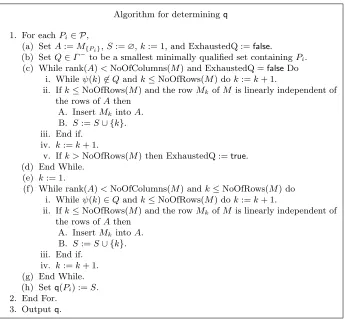
i and then computes si = M ·xi as the reconstructed share vector, which is then used to update the hash function (locally). Trivially, we can take q(Pi) = [m] for allPi ∈ P, which corresponds to broadcasting all shares; however, better choices of q result in better communication efficiency. In Appendix C we give a somewhat-optimised algorithm for finding a “good” map q for a given MSP. We remark that finding the map q is not always as straightforward as it is for replicated secret-sharing in which each party must obtain precisely all the shares it does not have; for many LSSSs, this is overkill: for example, Shamir sharing only requires receivingtshares from other parties, not alln−1 other shares it does not possess.
If such anxidoes not exist then it must be because the adversary sent one or more incorrect shares, becausesi
q(Pi)should be a subvector ofsomeshare vector.
In this case, the party or parties unable to reconstruct tell all parties to abort. If such anxi does exist for each party then the adversary could still cause different parties to reconstruct different share vectors (and thus output different secrets), but then the hashes would differ and the honest parties would abort. The first condition, ker(MSi) ={0}, ensures that if all parties follow the protocol,
they all reconstruct thesameshare vector, since there are multiple possible share vectors for a given secret, otherwise an honest execution may lead to an abort.
Indeed, the only thing the adversary can do without causing abort – either immediately or later on when hashes are compared – is to change his shares so that his shares combined with the honest parties’ shares form a valid share vector. Intuitively, one can think of this as the adversary re-randomising the shares owned only by corrupt parties, which is not possible in Shamir or replicated secret-sharing, but is in DNF-based sharing, and in general is possible if and only if the LSSS admits non-trivial share vectors with unqualified support.
3 In AppendixDwe provide a formal description of MSPs in which all qualified sets
ProtocolΠOpening
For eachPi∈ P, the parties decide on someλi, which is any recombination vector such thatsupp(λi)⊆q(Pi). See Section4for the definition ofq. We denote byHi the hash function updated locally byPiwhich will be initialised as in Figure5, at the start of the MPC protocol. If at any point a party receives the messageAbort, it runs the subprotocolAbort.
OpenTo(i):
Ifi= 0, the secretsencoded via share vectors, is to be opened to all, otherwise it is to be opened only to playerPi.
Ifi= 0 then eachPj∈ P does the following:
1. Retrieve from memory the recombination vectorλj.
2. For eachP`∈ P, for eachk∈q(P`), ifψ(k) =Pj then sendsktoP`. 3. For eachk∈q(Pj), wait to receivesk from partyψ(k).
4. Concatenate local and received shares into a vector denoted bysjq(P
j)∈F
|q(Pj)|.
5. (Locally) outputs=hλjq(P
j),s
j
q(Pj)i.
6. SolveMq(Pj)·x
j =sjq(P
j) forx
j
. If there are no solutions, runAbort.
7. ExecuteHj.Update(Mxj).
Ifi 6= 0, the secret encoded via share vectors is to be opened to party Pi. The parties do the following:
1. Each Pj ∈ P \ {Pi} sends s{Pj} to Pi, who concatenates local and received
shares into a vectors.
2. PartyPicomputesN·s; if it is equal to0,Pi(locally) outputss=hλi,si, and otherwise runsAbort.
Verify: EachPi∈ P does the following: 1. Computehi:=Hi.Output(). 2. Sendhito all other partiesP
j∈ P \ {Pi}over pair-wise secure channels. 3. Wait forhjfrom all other partiesPj∈ P \ {Pi}.
4. Ifhj6=hifor anyj, runAbort.
Abort: If a party calls this subroutine, it sends a messageAbortto all parties and aborts. If a party receives a messageAbort, it aborts.
Broadcast: WhenPicalls this procedure to broadcast a values,
1. PartyPisends the secretsto all other players over pair-wise secure channels. 2. When partyPjreceives the share, it executesHj.Update(s).
Figure 2.ProtocolΠOpening
More formally, we have the following lemma that shows that if all partiescan
Lemma 3. Let q: P → 2[m] be defined as above and let si
q(i) denote the
sub-vector of shares received by party Pi for a given secret. Suppose it is possible for
each partyPi∈ P to find a vectorxi such thatsqi(Pi)=Mq(Pi)x
i; letsi:=M·xi
for eachi∈[n]. Ifsi =sj for all honest partiesP
i andPj, then the adversary
did not introduce an error on the secret.
Proof. The existence of q follows from the fact that “at worst” we can take
q(Pi) = [m] for allPi∈ P. There is a uniquexi solvingsiq(Pi)=Mq(Pi)·x
i(not
a priori necessarily the same for all parties) because ker(Mq(Pi)) ={0} for all
Pi∈ P by the first requirement in the definition ofq.
LetA denote the set of corrupt parties. SinceA is unqualified, the honest parties form a qualified set Q=P \Asince the access structure isQ2.
Each honest party uses their own shares in the reconstruction process by the second requirement in the definition of q, so if si = sj for all honest parties
Pi andPj, then in particular they all agree on a qualified subvector defined by honest shares – i.e.si
Q=s j
Qfor all honest partiesPiandPj. Thus some qualified subvector of the share vector is well defined, which uniquely defines the secret
by definition of MSP. ut
As mentioned in the introduction, our results in the last two sections are somewhat analogous to the result of Cramer et al. [20, Thm 1] which roughly shows that for a strongly multiplicative LSSS implementing aQ3 access struc-ture, honest parties can always agree on the correct secret (when all parties broadcast their shares). In Figure 2 we present the methods we use to open secret shared data in different situations.
FunctionalityFPrep
The functionality maintains a listValueof secrets that it stores. The setAindexes the corrupt parties (unknown to the honest parties).
Triples: On input (Triple, NT) from all parties, the functionality does the following: 1. Forifrom 1 toNT:
(a) Sampleai, bi←$ Fand compute share vectorsaiandbi. (b) Send (ai
A,biA) to the adversary.
(c) Receive a subvector of shares ˜ciA from the adversary. (d) Compute a vector ci=M ·xi
c such thathxic,εi=ai·bi andciA = ˜ciA. If no such vectorci exists, set an internal flagAbortto true and continue. 2. Wait for a messageOKorAbortfrom the adversary.
3. If the response isOKand the internal flagAborthas not been set to true, for each honestPi∈ P, send (ai{Pi},b
i {Pi},c
i {Pi})
NT
i=1to each honest partyPi, and otherwise output the messageAbortto all honest parties and abort.
FunctionalityFMPC
Initialise: On input Init from all parties, the functionality initialises the array Value[]. Accept a message OKor Abortfrom the adversary; if the message is OK then continue, and otherwise send the messageAbortto all parties and abort.
Input: On input (Input,id, x) from partyPiand (Input,id,⊥) from all other parties, whereid is a fresh identifer, the functionality setsValue[id] :=x.
Add: On input (Add,id1,id2,id3) from all parties, if id3 is a fresh identifier and Value[id1] and Value[id2] have been defined, the functionality sets Value[id3] := Value[id1] +Value[id2].
Multiply: On input (Multiply,id1,id2,id3) from all parties, ifid3is a fresh identifier andValue[id1] andValue[id2] have been defined, the functionality waits for a message OKor Abort from the adversary. If the adversary sends the message Abort, send the messageAbort to all parties and the adversary and abort, and otherwise set Value[id3] :=Value[id1]·Value[id2].
Output: On input (Output,id, i) from all parties, ifValue[id] has been defined, the functionality does the following:
– If i = 0, send Value[id] to the adversary and wait for a signal OK or Abort in return. If it signals Abort, send the message Abort to all parties and the adversary and abort, and otherwise sendValue[id] to all parties. If not aborted, wait for another signal OKor Abort. If the adversary signals Abort, send the messageAbortto all parties and the adversary and abort.
– Ifi6= 0 andPiis corrupt, then the functionality sendsValue[id] to the adversary and waits for the adversary to signalOKorAbort. If it signalsAbort, send the messageAbortto all parties and abort.
– If i6= 0 and Pi is honest, the functionality waits for the adversary to signal OKorAbort. If it signalsAbort, send the messageAbortto all parties and the adversary and abort, and otherwise sendValue[id] toPi.
Figure 4.FunctionalityFMPC
5
MPC Protocol
Correctness of our input procedure follows from the input method given in the non-interactive pseudo-random secret-sharing protocol of [18]. In particular for partyPito provide an inputsin a secret-shared forms, the parties will first take a secret-sharing r of a uniformly random secretr – which is some a or b
from a Beaver triple – and open it by calling OpenTo(i). Then Pi determines the encoded secret (using any recombination vector) and broadcasts :=s−r. The parties compute the share vector ass:=·u+rwhere uis a pre-agreed sharing of 1, which may be the same vector used to compute all inputs, by which we mean that for i∈[m], partyψ(i) computessi :=·ui+ri. Since this r is uniformly random by assumption, it hides the inputsin the broadcast of. This is proved formally in our simulation proof.
We have the following proposition, which we prove in AppendixBunder the UC framework of Canetti [15]. Here we use (ΠMPCkΠOpening) to mean simply that the union of the procedures from both protocols are used.
Proposition 1. The protocol(ΠMPCkΠOpening)securely realisesFMPC for aQ2
access structure in the presence of a computationally-bounded active adversary, corrupting any unqualified set of parties, in theFPrep-hybrid model, assuming the
existence of a collision-resistant hash function and point-to-point secure chan-nels.
We note that since we do not use MACs, we can also instantiate our protocol over small finite fields4, or indeed using a LSSS over a ring. The latter will hold
as long as the reconstruction vectors can be defined over the said ring. By taking a ring such asZ/232Zwe thus generalise the Sharemind methodology [12] to an
arbitraryQ2 structure. Also note that we can extendFPrep in a trivial way so as to obtain other forms of pre-processing such shares of bits etc. as in [23].
6
Improved Offline Phase
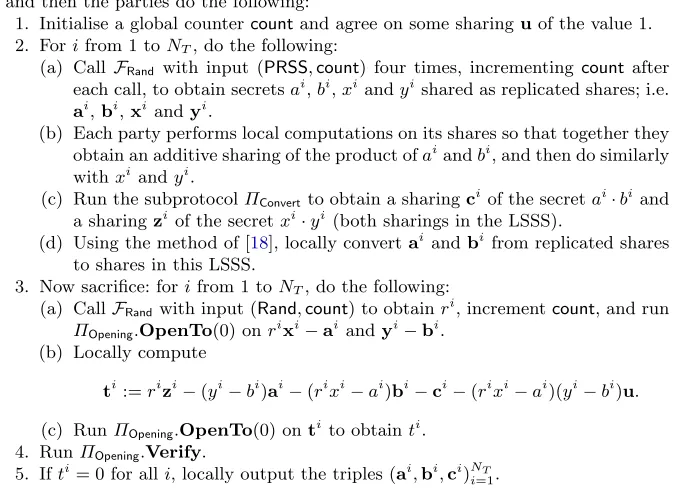
In this section we give an offline subprotocol. Recall that the offline phase of MPC protocols involves the generation of so-called Beaver triples: triples of share vectors, (a,b,c) such that cencodes the product of the secrets encoded by a and b. As is relatively standard practice for MPC protocols in the pre-processing model, we provide a semi-honest multiplication procedure, which is then bootstrapped to active security using the standard technique known as
sacrificing to catch if errors were introduced.
The Beaver triples must be share-vectors with respect to the LSSS used in the online phase. Perhaps the most obvious methods of achieving this are the following:
– Method 1 Use standard techniques to generate uniformly random shares (e.g. all parties act as the dealer to share a uniform secret, then the par-ties sum alln share vectors); then use Maurer’s protocol to do the passive multiplication, and then sacrifice for active security.
4
– Method 2Use [33] to do all of the pre-processing, and then use the technique by Cramer et al. [18] to convert the replicated shares into shares under any LSSS computing the same access structure by local computations (after an inexpensive one-time set-up phase).
– Method 3Generalise the procedure from [33] to convert additive sharings to replicated.
We would expect the second method to be extremely efficient in many situa-tions, since after setting up keys for generating random secrets efficiently, every party only needs to sendΘ(n) field elements to different parties for each passive multiplication. The main problem is that the required number of PRF (pseudo-random function) keys grows linearly with the number of maximally unqualified sets. Indeed, for a (84,41)-threshold access structure using the former method, the parties would need to agree on 8443>280keys. We note that the optimisation in [33], requiring PRF keys to generate some shares of a product deterministi-cally, can be instantiated using keys already set up for generating the PRSS shares. The computational cost is asymptotically O(2n/√n) PRF evaluations per party; nevertheless this computational cost reduces the communication cost, so there is a trade-off here.
In this section we propose an optimisation to the plain resharing protocol of Maurer, and use this to improve on pre-processing when the key-agreement becomes prohibitively expensive. For an ideal secret sharing, such as Shamir’s, we obtain the same communication costs as in the optimised version of [33], but without additional computational costs. For general secret sharing schemes/ac-cess structures, the choice of whether replicated sharing and the protocol in [33], or using the method for general MSPs presented here, depends on the precise nature of the access structure and associated MSP.
Generating random secrets If we dispense with the PRF keys (as inMethod 1andMethod 3) then we are required to generate several random secrets for use as Beaver triples. This can done in different ways; for example, here are two different methods:
1. Take the largest maximally unqualified set, say of sizet, take its complement, and let the parties in this set each generate a random share vector and distribute the shares. The parties then sum the share vectors. Correctness comes from the fact that this set ofn−t parties must contain at least one honest party, so the secret is always uniform. The cost is then the cost of sending (n−t) share vectors per random secret.
2. Apply the “randomness extraction” method of [24] to obtainn−t random sharings fromnrandom sharings.
we assume pair-wise PRF keys have been created during a one-time setup phase (as in the protocol given) by eachPi computing
ti:= X j6=i,j∈S
Fκi,j(count)−Fκj,i(count).
Our extension by the procedureRandis possible if we assume the existence of random oracles (but we note that this assumption is required for the sacrifice step in any case).
6.1 Method 1: Bootstrap Maurer’s Protocol
After obtaining shares of random secrets (as above), the parties do the following: 1. Perform local computations on shares to obtain an additive sharing of the
product of the secrets.
2. Each party reshares its summand in the LSSS by acting as the dealer in the sharing protocol.
3. Each party sums the nsharings that result.
4. Use the sacrificing technique to check that the triples were generated cor-rectly.
The chief advantage of this method is that it is computationally relatively lightweight. The local computation cost becomes crucially important when con-sidering large numbers of parties due to the exponential blow-up of the total number of shares in replicated secret-sharing.
We include this method for doing the offline protocol as for very small num-bers of parties it is likely to be as good as any other protocol, and for very large numbers of parties it does not need unreasonably many PRF keys.
6.2 Method 2: Use offline protocol of [33]
The basic structure of the [33] triple-generation protocol is:
1. Retrieve two replicated shares from memory and perform the (local) multi-plication procedure to get an additive sharing of the product;
2. Convert the additive sharing to a replicated sharing.
3. Use the sacrificing technique to check that the triples were generated cor-rectly.
Recall that an MSP is multiplicative if the parties can perform local compu-tations to obtain an additive sharing of the product of two secrets, and that replicated secret-sharing is always multiplicative if the access structure isQ2.
sent to the players who are supposed to hold them. This obviates the need for each player to reshare their additive share as proposed inMethod 1.
The obvious way to obtain Beaver triples for any LSSS for any Q2 access structure, then, would be to use [33] to generate replicated shares and then convert using [18]. Note that unlike withMethod 1above, the final LSSSneed not be multiplicative. Curiously, then, this gives an online protocol for any Q2 access structure using any LSSS that realises it.
An optimisation to the plain [33] protocol is for each party to designate some s∗ ∈Si as the one which will be communicated, and for all other shares
s ∈ Si\ {s∗} to be computed as s := Fκs(count) where κs is a key known
to all parties who are supposed to hold the share s and F is the chosen PRF keyed withκs; then partyPi with sharexi computes the special share ass∗:=
xi−Ps∈Si\{s∗}Fκs(count) and sends this to the parties who are supposed to
hold shares∗. This significantly reduces the communication cost and requires no more PRF keys than are required to generate the random secrets for the triples in the first place.
6.3 Method 3: New Offline Protocol
This method principally involves an efficient method of converting an additively-shared secret to a sharing in the LSSS. The starting point is therefore any random secrets shared using a multiplicative LSSS, and sharings of random secrets may be obtained either using standard techniques as described above, or using pre-shared PRF keys.
Since we expect that [33] will outperform other methods when the number of parties is small, we will make the assumption that the secrets are merely shared using some multiplicative LSSS and not necessarily replicated sharings created using PRF evaluations as inMethod 2.
That said, we note that if the parties start with a multiplicative LSSS re-alising the access structure, they can perform the local computations to obtain an additive sharing of the product, and then reshare this to any (not necessarily multiplicative) LSSS.
First we provide an algorithm in Figure6that, given an MSP provided by the user, transforms the the MSP into a new MSP which realises the same LSSS but has properties amenable to be used in an efficient share-conversion procedure. Then we provide a protocol ΠConvert in Figure 7, which shows how to use this MSP to convert additive shares into shares in the LSSS in a communication-efficient manner. One way of viewing our protocol is simply as an communication-efficient computationally-secure resharing method optimised for resharing additive (i.e. full-threshold) sharings.
Correctness of Transformation Algorithm Any MSP can be converted to
vector, but share vectors in an LSSS are just vectors in the column-space of the generating matrixM, so in fact share vectors under the altered scheme are equally-well viewed as share vectors under the original scheme: one can think of the difference as choosing different randomness vectors to generate the share vector. Note also that column operations do not change the multiplicativity of the LSSS since it merely represents a change of basis for the space of share vectors5.
In particular, it is always possible for the matrixM withdcolumns and rank
dto be reduced via column operations so that all of the standard basis vectors
{ek}d
i=1 appear in the rows of M. The map χ is well-defined since we assume the matrix and target vector are non-zero.
Correctness of ΠConvert We discuss when the protocol aborts in detail in the proof of security, AppendixB; here we just consider correctness of the conversion procedure.
So far, for consistency with the literature, we have denoted byψthe map from rows ofM to parties inP. For clean notation, we now defineρ: [m]→[n] by the following: for allj∈[m],ρ(j) :=iif and only if ψ(j) =Pi. Thusψ(j) =Pρ(j).
The goal is to reshare the additively-sharedx, which we denote byhxiwhere party Pi holds xi and
Pn
i=1xi = x, under the LSSS. To do this, the parties essentially distribute an additive sharing of a share-vector sharing the sum. In more detail, each party Pi first adds on its share t0i of a PRZS ht0i – that is, a sharing where Pi holds ti where
Pn
i=1ti = 0 – onto its share xi and then samples a set {xi,k}k∈Ki∩Sε where Ki := {χ(i)} ∪([d]\im(χ)) and Sε is the
support of ε, such that xi +t0i = P
k∈Ki∩Sεxi,k. In other words, xi+t
0 i is reshared into as many pieces as there are unassigned columns, plus one for the column assigned by χ, and except where εk = 0. Then for each k ∈ Ki∩Sε,
Pi chooses its contribution to the kth co-ordinate of a randomness vector x to be ri,j :=xi,k/εk. For columns whereεk = 0 for somek ∈[d], each party will sample some randomnessri,k←Fas their contribution to the co-ordinatexk of the randomness vectorx. This is because this part of the randomness vector will be cancelled out upon reconstruction, and as such the parties cannot pack part of their summandxiin this column. Note that the definition ofχprecludes any party from being mapped to a column k where εk = 0, so the columns where εk = 0 necessarily lie in [d]\im(χ).
Definingxin this way means that overall (i.e. after all parties have done the above) we have
• xk=Pi∈χ−1({k})xi,k/εk for allk∈im(χ);
• xk= Pn
i=1xi,k/εk fork∈[d]\im(χ) whereεk6= 0; and
5 In brief, the proof of this fact involves computing the pair-wise tensor of each row
• xk= Pn
i=1ri,k fork∈[d]\im(χ) whereεk = 0. Hence the following:
hx,εi= X k∈im(χ)
xk·εk+
X k∈([d]\im(χ))∩Sε
xk·εk+
X k∈([d]\im(χ))\Sε
xk·εk
= X
k∈im(χ) X i∈χ−1({k})
(xi,k/εk)·εk
+ X
k∈([d]\im(χ))∩Sε
n X i=1
(xi,k/εk)·εk+ n X i=1
X k∈([d]\im(χ))\Sε
ri,k·0
= n X i=1
(xi,χ(i)/εχ(i))·εχ(i)+ n X i=1
X k∈([d]\im(χ))∩Sε
(xi,k/εk)·εk
= n X i=1
xi,χ(i)+
X k∈([d]\im(χ))∩Sε xi,k = n X i=1 X k∈Ki∩Sε
xi,k= n X i=1
xi=x,
i.e. the share vector where x is the randomness vector shares the secret x = Pn
i=1xi.
We will now discuss in more detail how the shares of the share vector with randomness vector defined as above are distributed amongst the parties. Each share is then computed in one of two different ways.
– For each row of the matrix which is not a standard basis vector, the parties each compute
aji := X k∈Ki∩Sε
Mj[k]·ri,k !
+tji
where htji is an n-party PRZS and in the protocol and above we defined
ri,k := xi,k/εk for k ∈ Ki ∩Sε and sampled ri,k
$
← F for k ∈ Ki \Sε; the recipient simply sums all incoming share and adds its own contribution computed in the same way. Thus the party obtains:
n X i=1
aji = n X i=1 X k∈Ki∩Sε
Mj[k]·xi,k/εk !
+
X k∈Ki\Sε
Mj[k]·ri,k +t
j i = n X i=1 X k∈Ki∩Sε
Mj[k]·xi,k/εk !
+
X k∈Ki\Sε
Mj[k]·ri,k + n X i=1
tji
= X
k∈im(χ)
X i∈χ−1({k})
Mj[k]·xi,k/εk + X k∈([d]\im(χ))∩Sε n X i=1
+ X k∈([d]\im(χ))\Sε
n X i=1
Mj[k]·ri,k !
= d X k=1
Mj[k]·xk =hMj,xi.
– For each rowjwhich is a standard basis vector, the parties do the following: letkbe the column index of the non-zero entry of the row; then the parties inPiwithk∈Kiretrieve a PRZS amongst them and send their contribution
ri,k to party ψ(j):
aji :=Mj[k]·ri,k+tji
where hereMj[k] = 1. Note that if it holds for some party Pi thatKi⊇Kj for somej 6=ithenPiwill potentially be able to compute the value ofxj+t0j; this is one reason for adding then-party PRZS. The recipient again simply sums all values received.
The result of the protocol is that the parties have converted an additive sharing into a sharing in the LSSS with which they are working. The cost of doing so
6.4 Full Pre-processing Protocol
In Figure9 we provide the full pre-processing protocol when usingMethod 3, which shows howΠConvert interfaces with our more specialised opening protocol
ΠOpening. For the sake of simplicity of exposition, we will assume sharings of ran-dom secrets are still generated usingFRand and are therefore replicated sharings, but we emphasise that the purpose of our protocol is to avoid using replicated secret-sharing in practice. (It makes almost no difference to the protocol descrip-tion, since the only property of replicated sharing that is used is multiplicativity.) When it is necessary to produce random sharings for large numbers of parties, one of the methods outlined at the beginning of this section may be used. In our comparison of the costs in Section 6.5 , we assume replicated secret-sharing is
not used.
At a high level,ΠPrepgenerates Beaver triples in an actively-secure manner assuming black-box access to a functionality generating additive sharings of zero and replicated sharings of random secrets. Active security is obtained by doing a multiplication passively and then employing the standard technique of sacri-ficing. Extending the protocol to produce other forms of pre-processing (such as
shared bits – see [23] for details) is trivial and therefore omitted. Recall we use
ΠA||ΠB to denote a protocol comprising the union of the procedures ofΠAand
ΠB.
Proposition 2. For aQ2 access structure, the protocol (ΠPrep||ΠOpening)
6.5 Costs
To make some comparisons with the other protocols, we now consider the asymp-totic costs involved in Maurer’s protocol [34], the protocol of Keller et al. [33], and our protocol. The communication costs are summarised in Table 1. Note that we donot assume PRFs are used to generate random secrets for our proto-col in our cost analysis, though our description ofΠPrepdoes to ease exposition: instead, we assume in Maurer’s protocol and our own that each random secret is generated by all parties sampling a random secret and dealing shares as in the sharing protocol, and finally all parties summing the shares locally.
Notably, our protocol is as good or better than Maurer’s protocol in all of the most expensive subroutines run in the pre-processing, and indeed the cost of setting up PRF keys and of performing authentication in our protocol is negligible considering the number of triples one typically needs to evaluate a reasonable circuit.
Our protocol is also considerably cheaper than [33] in these methods where even compared to the optimised version we replace a large binomial term with a linear term in the sacrifice step. This proves the importance of removing the dependence on replicated secret-sharing.
We note that while we have anO(n2) cost associated with generating random secrets in our protocol compared to [33], which arises from the fact that in our case the parties do not agree on nt PRF keys, our protocol is much more scalable. Indeed, the key set-up of [33] begins to become prohibitively expensive even with only 20 parties, where potentially 209 >217 PRF keys need to be agreed upon in the honest majority setting.
An additional goal of [33] was to reduce the number of communication chan-nels required to perform MPC. In Table 2 we compare the number of channels used in each protocol at different points. Our protocol uses a smaller number of channels than Maurer’s protocol [34] and uses the same as [33] in the threshold case for most subroutines.
Acknowledgements
We thank for the anonymous reviewers for their helpful comments and remarks. This work has been supported in part by ERC Advanced Grant ERC-2015-AdG-IMPaCT, by the Defense Advanced Research Projects Agency (DARPA) and Space and Naval Warfare Systems Center, Pacific (SSC Pacific) under contract No. N66001-15-C-4070, and by EPSRC via grant EP/N021940/1.
References
Protocol [34] [33] Optimised [33] Ours
Key set-up 0 κn (n−1) + n−t1κn (n−1) + n−t1 κn(n−1)
Random secret gen. n(n−1) 0 0 n(n−1)
Passive mult. n(n−1) nt
·(n−t−1) n(n−t−1) n(n−t−1)
Sacrifice 3n(n−1) 3 nt·t 3 nt·t 3nt
Authentication 0 256n(n−1) 256n(n−1) 256n(n−1)
Table 1. A comparison of communication cost given in number of bits. The rows Key set-upand Authentication are the number of bits, the rest are the number of field elements. We assume the hash function is SHA256 to give 128 bits of security against collision by the birthday bound; κ is the computational security parameter and is the key-length of the PRF. In [34]’s and our protocol we use Shamir’s secret-sharing whereas [33] (necessarily) uses the standard replicated MSP. Note that while our protocol comparatively little key set-up, the sharings of random secrets used in Beaver triples are more expensive to generate in terms of communication.
Protocol [34] [33] Optimised [33] Ours
Key set-up 0 n(n−1) n(n−1) n(n−1)
Random secret gen. n(n−1) 0 0 n(n−1)
Passive mult. n(n−1)n(n−t−1) n(n−t−1) n(n−t−1)
Sacrifice n(n−1) nt nt nt
2. Beaver, D.: Efficient multiparty protocols using circuit randomization. In: Feigen-baum, J. (ed.) CRYPTO’91. LNCS, vol. 576, pp. 420–432. Springer, Heidelberg (Aug 1992)
3. Beaver, D., Wool, A.: Quorum-based secure multi-party computation. In: Nyberg, K. (ed.) EUROCRYPT’98. LNCS, vol. 1403, pp. 375–390. Springer, Heidelberg (May / Jun 1998)
4. Beimel, A., G´al, A., Paterson, M.: Lower bounds for monotone span programs. In: 36th FOCS. pp. 674–681. IEEE Computer Society Press (Oct 1995)
5. Ben-Or, M., Goldwasser, S., Wigderson, A.: Completeness theorems for non-cryptographic fault-tolerant distributed computation (extended abstract). In: 20th ACM STOC. pp. 1–10. ACM Press (May 1988)
6. Ben-Sasson, E., Fehr, S., Ostrovsky, R.: Near-linear unconditionally-secure mul-tiparty computation with a dishonest minority. In: Safavi-Naini, R., Canetti, R. (eds.) CRYPTO 2012. LNCS, vol. 7417, pp. 663–680. Springer, Heidelberg (Aug 2012)
7. Bendlin, R., Damg˚ard, I., Orlandi, C., Zakarias, S.: Semi-homomorphic encryption and multiparty computation. In: Paterson, K.G. (ed.) EUROCRYPT 2011. LNCS, vol. 6632, pp. 169–188. Springer, Heidelberg (May 2011)
8. Bilgin, B., Gierlichs, B., Nikova, S., Nikov, V., Rijmen, V.: Higher-order threshold implementations. In: Sarkar, P., Iwata, T. (eds.) ASIACRYPT 2014, Part II. LNCS, vol. 8874, pp. 326–343. Springer, Heidelberg (Dec 2014)
9. Blakley, G.R.: Safeguarding cryptographic keys. Proceedings of AFIPS 1979 Na-tional Computer Conference 48, 313–317 (1979)
10. Blakley, G.R., Meadows, C.: Security of ramp schemes. In: Blakley, G.R., Chaum, D. (eds.) CRYPTO’84. LNCS, vol. 196, pp. 242–268. Springer, Heidelberg (Aug 1984)
11. Bogdanov, D., Kamm, L., Kubo, B., Rebane, R., Sokk, V., Talviste, R.: Students and taxes: a privacy-preserving social study using secure computation. Cryptology ePrint Archive, Report 2015/1159 (2015),http://eprint.iacr.org/2015/1159 12. Bogdanov, D., Laur, S., Willemson, J.: Sharemind: A framework for fast
privacy-preserving computations. In: Jajodia, S., L´opez, J. (eds.) ESORICS 2008. LNCS, vol. 5283, pp. 192–206. Springer, Heidelberg (Oct 2008)
13. Bogetoft, P., Christensen, D.L., Damg˚ard, I., Geisler, M., Jakobsen, T., Krøigaard, M., Nielsen, J.D., Nielsen, J.B., Nielsen, K., Pagter, J., Schwartzbach, M.I., Toft, T.: Secure multiparty computation goes live. In: Dingledine, R., Golle, P. (eds.) FC 2009. LNCS, vol. 5628, pp. 325–343. Springer, Heidelberg (Feb 2009)
14. Canetti, R.: Security and composition of multiparty cryptographic protocols. Jour-nal of Cryptology 13(1), 143–202 (2000)
15. Canetti, R.: Universally composable security: A new paradigm for cryptographic protocols. Cryptology ePrint Archive, Report 2000/067 (2000), http://eprint. iacr.org/2000/067
16. Chaum, D., Cr´epeau, C., Damg˚ard, I.: Multiparty unconditionally secure protocols (extended abstract). In: 20th ACM STOC. pp. 11–19. ACM Press (May 1988) 17. Chida, K., Genkin, D., Hamada, K., Ikarashi, D., Kikuchi, R., Lindell, Y., Nof,
A.: Fast large-scale honest-majority MPC for malicious adversaries. In: Advances in Cryptology - CRYPTO 2018, Part III. LNCS, vol. 10993, pp. 34–64. Springer (2018)
19. Cramer, R., Damg˚ard, I., Maurer, U.M.: General secure multi-party computation from any linear secret-sharing scheme. In: Preneel, B. (ed.) EUROCRYPT 2000. LNCS, vol. 1807, pp. 316–334. Springer, Heidelberg (May 2000)
20. Cramer, R., Daza, V., Gracia, I., Urroz, J.J., Leander, G., Mart´ı-Farr´e, J., Padr´o, C.: On codes, matroids and secure multi-party computation from linear secret sharing schemes. In: Shoup, V. (ed.) CRYPTO 2005. LNCS, vol. 3621, pp. 327– 343. Springer, Heidelberg (Aug 2005)
21. Damg˚ard, I., Geisler, M., Krøigaard, M., Nielsen, J.B.: Asynchronous multi-party computation: Theory and implementation. In: Jarecki, S., Tsudik, G. (eds.) PKC 2009. LNCS, vol. 5443, pp. 160–179. Springer, Heidelberg (Mar 2009) 22. Damg˚ard, I., Ishai, Y., Krøigaard, M.: Perfectly secure multiparty computation
and the computational overhead of cryptography. In: Gilbert, H. (ed.) EURO-CRYPT 2010. LNCS, vol. 6110, pp. 445–465. Springer, Heidelberg (May / Jun 2010)
23. Damg˚ard, I., Keller, M., Larraia, E., Pastro, V., Scholl, P., Smart, N.P.: Practical covertly secure MPC for dishonest majority - or: Breaking the SPDZ limits. In: Crampton, J., Jajodia, S., Mayes, K. (eds.) ESORICS 2013. LNCS, vol. 8134, pp. 1–18. Springer, Heidelberg (Sep 2013)
24. Damg˚ard, I., Nielsen, J.B.: Scalable and unconditionally secure multiparty com-putation. In: Menezes, A. (ed.) CRYPTO 2007. LNCS, vol. 4622, pp. 572–590. Springer, Heidelberg (Aug 2007)
25. Damg˚ard, I., Pastro, V., Smart, N.P., Zakarias, S.: Multiparty computation from somewhat homomorphic encryption. In: Safavi-Naini, R., Canetti, R. (eds.) CRYPTO 2012. LNCS, vol. 7417, pp. 643–662. Springer, Heidelberg (Aug 2012) 26. van Dijk, M.: Secret Key Sharing and Secret Key Generation. Ph.D. thesis,
Eind-hoven University of Technology (1997)
27. Furukawa, J., Lindell, Y., Nof, A., Weinstein, O.: High-throughput secure three-party computation for malicious adversaries and an honest majority. In: Coron, J., Nielsen, J.B. (eds.) EUROCRYPT 2017, Part II. LNCS, vol. 10211, pp. 225–255. Springer, Heidelberg (Apr / May 2017)
28. Goldreich, O., Micali, S., Wigderson, A.: How to play any mental game or A completeness theorem for protocols with honest majority. In: Aho, A. (ed.) 19th ACM STOC. pp. 218–229. ACM Press (May 1987)
29. Hirt, M., Maurer, U.M.: Complete characterization of adversaries tolerable in se-cure multi-party computation (extended abstract). In: Burns, J.E., Attiya, H. (eds.) 16th ACM PODC. pp. 25–34. ACM (Aug 1997)
30. Ito, M., Saito, A., Nishizeki, T.: Secret sharing schemes realizing general access structure. In: Proc. IEEE Global Telecommunication Conf. (Globecom’87). pp. 99–102 (1987)
31. Karchmer, M., Wigderson, A.: On span programs. In: Proceedings of Structures in Complexity Theory. pp. 102–111 (1993)
32. Keller, M., Orsini, E., Scholl, P.: MASCOT: Faster malicious arithmetic secure computation with oblivious transfer. In: Weippl, E.R., Katzenbeisser, S., Kruegel, C., Myers, A.C., Halevi, S. (eds.) ACM CCS 16. pp. 830–842. ACM Press (Oct 2016)
33. Keller, M., Rotaru, D., P. Smart, N., Wood, T.: Reducing communication channels in MPC. In: International Conference on Security in Communication Networks, SCN 2018. pp. 181–199 (01 2018)
35. Nikova, S., Rijmen, V., Schl¨affer, M.: Secure hardware implementation of nonlinear functions in the presence of glitches. Journal of Cryptology 24(2), 292–321 (Apr 2011)
36. Reparaz, O., Bilgin, B., Nikova, S., Gierlichs, B., Verbauwhede, I.: Consolidating masking schemes. In: Gennaro, R., Robshaw, M.J.B. (eds.) CRYPTO 2015, Part I. LNCS, vol. 9215, pp. 764–783. Springer, Heidelberg (Aug 2015)
37. Shamir, A.: How to share a secret. Communications of the Association for Com-puting Machinery 22(11), 612–613 (Nov 1979)