Ahmad Ahmadi, Reihaneh Safavi-Naini and Mamunur Akand University of Calgary, Canada
{ahmadi, rei, mdmamunurrashid.akan}@ucalgary.ca Abstract
Anonymous Distance-Bounding (DB) protocols allow a prover to convince a verifier that they are within a distance bound from them, without revealing their identity. This is an attractive property that enables the prover to enjoy proximity based services, while their privacy is maintained. Combination of anonymity and distance-bounding however introduces new security challenges. We consider two new realistic attacks: a physical layer attack that usesdirectional antenna, and acollusion attackthat involves multiple users. We show all existing anonymous DB protocols become insecure against at least one of these attacks, and then propose a new security model that captures these new attacks, and finally construct two protocols with provable security in this model with two different computational assumptions. Our protocols are the only known anonymous DB protocols with provable security against all known attacks.
1
Introduction
Distance upper bounding (DB) protocols were first proposed in [20] to provide security against Man-in-the-middle (MiM) attack in authentication protocols, and later found wide applications in location and proximity based services [12, 29, 22, 17]. Early DB protocols are symmetric key protocols where the prover and the verifier share a secret key.
More recently public key DB protocols have also been proposed [32] to alleviate the traceability of the prover by the verifier. In this paper we consider this latter type of protocols. In these protocols there are three types ofparticipants:proverswho areregistered userof the system and have secret keys, an honest verifierwho knows the public keys of the provers, andactorswho are not unregistered participants of the system, but would like to be accepted by the verifier, individually, or by helping a dishonest prover. A secure DB protocol estimates the distance between prover and verifier by measuring the round trip time of challenge and response bits that are exchanged between the two during thefast challenge-response rounds. The prover responds to a challenge immediately after it is received. The correct response to challenges in a protocol execution is stored in thechallenge-response tablethat is calculated at the start of the protocol, and depends on the provers’ secret key as well as nonces that are exchanged during the initialization phase.
In a DB protocol with distance boundD, participants who are closer thanDto the verifier are calledD asclose-byparticipants, and those who are farther thanD, are called asfar-awayparticipants. Widely considered attacks against public key DB protocols are;
(A1) Distance-Fraud [13]; where a dishonest far-away prover tries to be accepted in the protocol. Distance-Hijacking [17]is a special case of this attack, where a far-away prover takes advantage of the communication of honest close-by provers to succeed in the protocol.
(A3) Terrorist-Fraud (TF) [20];a dishonest far-away prover colludes with a close-by actor, in order to succeed in the protocol. Inoriginal TF-resistancedefinition, it’s assumed that the prover does not leak their secret key to the actor. Inrecent TF-resistance[31] however, the key leakage is allowed, but success of the TF attack requires negligible improvement in future impersonation attacks by the actor.
Security of public DB protocols has been formalized and protocols with provable properties [21, 11] have been constructed.
Distance-bounding protocols leak the identity of prover to verifier: in symmetric key DB, prover and verifier share a secret key, and in public-key DB, prover’s response is compared against the public-key of a specific user. Anonymous DB can be used to prove that the distance of a registered user is less than a prescribed bound, without revealing their exact identity. Security of anonymous DB protocols has also been formalized [4, 14, 8] against DF, MF and TF. In these model that we refer to assingle-usermodel, attack involves at most a single corrupted user, possibly helped by an actor.
Our contributions. We introduce two new type of attacks that although applicable to all DB protocols, become particularly effective against anonymous DB protocols.
Directional antennas. The use of directional antennas in consumer devices has grown tremendously in recent years [1]. We consider the effect of employing these antennas by a malicious prover, on the security of anonymous DB. Note that verifiers need to use omni-directional antennas because they want estimate the distance of the prover without knowing their location. However malicious provers (or actors) may use directional antennas with a narrow beam to target messages to the verifier. In Section 3.1 we show that using directional antennas by malicious provers can break all existing anonymous DB protocols.
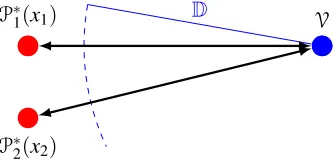
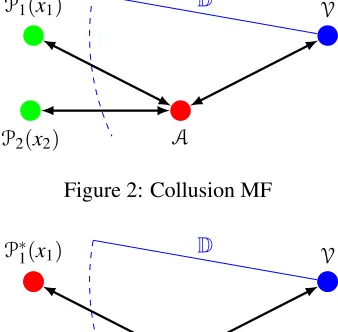
Collusion attacks. In a collusion attack multiple users, each with a secret key, participate in the attack that can be on DF, MF or TF form as shown in Figure 1, Figure 2 and Figure 3. These attacks had not been considered before and need not to be considered as long as the secret keys of two users are independently generated, and so (without anonymity) a protocol transcript can be linked to a user through their key information and so cannot be combined with other transcripts to form a new forged transcript. In anonymous DB protocols however, the verifier should not be able to link the transcript of a protocol to a single user and so combining protocol transcripts can give advantage to colluders. In Section 3.2 we show that collusion TF attack can be used to subvert traceability property of anonymous DB. This functionality is necessary in all anonymous DB protocols to ensure user accountability by allowing a third party that holds a master key, to "open" a transcript and identify the user, when required.
V P∗
1(x1)
P∗ 2(x2)
D
Figure 1: Collusion DF
A
V P1(x1)
P2(x2)
D
Figure 2: Collusion MF
H
V P∗
1(x1)
P∗ 2(x2)
D
Figure 3: Collusion TF
that is offered by anonymous DB protocols. None of the existing anonymous DB protocols provide security against these attacks, and as shown later, there are concrete attacks against all existing protocols. We will then show how collusion TF attack succeeds on a modified version of SPADE that is secure against a single-user non-directional TF attack. In this attack, a close-by user can interact with the verifier and get accepted, while credentials of a far-away user is used. Thus the close-by user can be au-thenticated, and later during the opening phase a far-away user be identified. The system fails to provide security because the far-away user can present alibi that they have not been the protocol participant. Model:We propose a formal model that captures the above two new classes of attacks. Our formalization uses a cryptographic approach and models an anonymous DB protocol as a cryptographic identification protocol [19] where the prover, in addition to proving their cryptographic credentials, prove that they are within a distance bound from the verifier. This builds on the model of public-key DB [2], by including directional antennas and collusion DF, MF and TF.
We formalize anonymity in terms of indistinguishability of candidate provers, given the protocol tran-script. The challenge is to include sufficient information about the user in the transcript to allow a third party that holds the master key be able to open the transcript and identify the user.
Construction.We construct two anonymous DB protocol and prove their security in our proposed model. Our constructions can be seen as modular construction that adds anonymity and security in the new model by introducing an additional layer of group identification to a public-key DB protocol with provable security in a single-user model. The proposed protocols consist of a phase in which the prover commits to a temporary public-key, followed by a public-key DB. These protocols are designed for two different cryptosystems; Goldwasser-Micali cryptosystem [24] and Pedersen commitment [28].
The underlying public key DB protocols in our construction areProProx[32], whose security in single-user DBID model was proven in [2], and POXY [3]. We reduce security of the new protocols in our proposed model (including directional antenna and collusion) to the security of the single-user model, and prove its anonymity and correctness of traceability.
Paper organization Section 2 includes preliminaries. Section 3.1 proposes new directional TF attack that breaks all anonymous DB protocols and Section 3.2 proposes collusion DB attacks, generalizing traditional DB attacks. Section 4 presents our model, Section 5 Section 6 give the constructions and security proofs. Section 7 gives a summary of related works, and Section 8 concludes the paper.
2
Preliminaries
In this section we introduce the primitives that we will later use in our model and constructions.
AΣ-protocolis a 3-message cryptographic protocol between a proverPand a verifierV, that allowsP to prove validity of a statement toV. The two parties have a common inputy, andPhas a private input x for which the relationR(x,y) holds. Σ-protocolis used in many important cryptographic systems
[18, 23, 27, 26, 30].
Definition 1. (Σ-protocol). Prover P and verifier V execute three algorithms (Commit,Response, Check)using inputs(x,y)and(y), respectively. x is private and y is public.
LetC,HandRdenote three sets:Cis the set of possible input that is chosen by the prover;His the set
of possible challenges chosen by the verifier; andRis the set of possible responses of the prover. The steps of the protocol are as follows:
1. P randomly chooses a∈Cand computes the commitment A=Commit(a). P sends A to V .
2. Challenge/Response is a pair of messages:
(a) V randomly chooses a challenge c∈Hand sends it to P,
(b) P computes r=Response(x,a,c,c)ˆ ∈R, wherec is the list of all challenges before c, andˆ
sends it to V ,
Steps 2-(a) and 2-(b) may be repeated a number of times.
3. V calculates ret=Check(y,[c],[r],A), where ret∈ {accept,re ject}and[c]and[r]are lists of all challenges and responses, respectively.
At the end of the protocol, V outputs OutV =1if ret=accept, and OutV =0if ret=re ject.
Here we define a more general form ofΣ-protocols, calledΣ∗-protocols, in which the verifier
consec-utively sends multiple challenges, each (except the first one) after receiving the response to the previous challenges.
Definition 2. (Σ∗-protocol).A prover P and verifier V run the following
LetC,HandRdenote three sets defined as follows. Cis the set of possible input that is chosen by the
prover;His the set of possible challenges chosen by the verifier; andRis the set of possible responses
of the prover. The steps of the protocol are as follows:
1. P randomly chooses a∈C, computes the commitment A=Commit(a), and sends A to V .
2. Challenge and Response messages that are defined as follows:
(a) V randomly chooses a challenge c∈Hand sends it to P,
Steps 2-(a) and 2-(b) may be repeated a number of times.
3. V calculates ret=Check(y,[c],[r],A), where ret∈ {accept,re ject}and[c]and[r]are lists of all challenges and responses, respectively.
At the end of the protocol, V outputs OutV =1if ret=accept, and OutV =0otherwise.
In a cryptographicidentification scheme(ID), a proverPconvinces a verifierVthat they know a witness xrelated to a public value y. Witness is a value that is in a certain relation with the public value,i.e., R(x,y)holds for a defined relationR.
The scheme is specified by the tupleID=(KeyGen,Π). The key generation algorithm(x,y)←KetGen(1λ)
is a PPT algorithm that takes the security parameterλand generates a key pair(x,y).Πis a PPT protocol
between the prover and the verifier. The prover P(x,y) and the verifierV(y) take the values of(x,y) andyrespectively, as input. At the end of the protocol, the verifier returns eitheracceptorre ject. The protocolΠ= (Commit,Response,Check)consists of two PPT algorithmsCommitandResponse, and a functionCheck, as defined in Definition 1.
AnID scheme is correct if the Checkfunction outputs accept ifR(x,y) holds, and re ject otherwise. AnIDscheme is secure if an adversary with access to a set of valid transcriptsT={(A,[c],[r])}, cannot generate a valid transcript(A0,[c0],[r0])for ac0that has not appeared inT. Note that a transcript(A,[c],[r]) is valid according to public-keyy, if the functionCheck(y,[c],[r],A)returnsaccept.
2.1 DBID
DBIDmodel [2] is a security model for public-key DB protocols, that is based on cryptographic identifi-cation schemes.
Definition 3. (DBID). Let λ∈N denote the security parameter. A distance-bounding identification
(DBID) is a tuple(X,Y,S,P,D,pnoise,Init,KeyGen,Π,Revoke), where;
(I) X andY are sets of possible master and public keys of the system, chosen based on the
secu-rity parameterλ. The system master key msk∈X, and public key gpk∈Yare generated using
(msk,gpk)←Init(1λ)algorithm;
(II) SandPare sets of possible (private, public) key pairs of users, with their size chosen according to
the security parameterλ. A (private, public) key pair is generated using(sk,pk)←KeyGen(1λ,msk,gpk)
algorithm;
(III) Πis aΣ∗-protocol (Definition 2) between a prover P(sk,pk)and the verifier V(pk), that convinces
the verifier that the prover is located within the distance boundD∈Rto the verifier. This happens by round trip time measurement of some messages by the verifier.
(IV) The transmitted bits of a fast challenge-response round inΠprotocol are affected by noise where
pnoise∈[0,1]is the probability of a bit flip on each fast challenge-response message.
(V) Revoke(msk,gpk,i)is an algorithm that removes the corresponding user ui from the system and updates the group public key accordingly.
At the end of the protocolΠ, V outputs OutV =1if they accept, or0if they reject.
active user that is represented by multiple provers, sharing the same secret key. For honest users, only a single prover is active in a run. For corrupted users, no restriction on the number of active provers exists. In our construction we considerDBIDschemes for which public and private key of users are generated using Goldwasser-Micali (probabilistic) [24] encryption system and Pedersen [28] commitment scheme. We refer to DBID schemes with the property as these classes ofDBIDschemes as DBIDGM andDBIDP, respectively. An example ofDBIDGMscheme isProProx[32] and an example ofDBIDPscheme isPOXY [3].
Security properties ofDBIDschemes are:
• Completeness: in the absence of an adversary, the verifier accepts an execution ofΠwith high
probability when the prover is within the distance bound.
• Soundness: the success chance of a close-by adversary who is trying to take advantage of sessions of a far-away honest prover or a close-by inactive prover, is negligible.
• DF resistance: the verifier rejects an execution ofΠwith high probability if there is no close-by prover.
• TF resistance: if a dishonest far-away prover and a close-by helper succeeds in an execution of
Π, then the helper can impersonate the prover in futureΠexecutions with high probability.
We omit the formal definition of these properties (that appear in [2]) and present them in an expanded form in the formalization of anonymous DB in Section 4.
2.2 Camenisch-Lysyanskaya Signature Scheme
Camenisch and Lysyanskaya [16] proposed a special signature scheme (CLSig), that allows the users to commit to a message and then prove the knowledge of a signature on the message without leaking information about the message. This scheme is based on the standard definition of signature schemes due toGoldwasser, Micali, and Rivest[25].
Definition 4. (CLSig).Letλdenote the security parameter.CLSigis a tuple(X,Y,S,M,KeyGen,Sign,
Verify,BSign,SPK), where;
(I) XandYare sets of possible private and public keys of the signature scheme, chosen based on the
security parameterλand the input parameter L. The private key sk∈X, and public key pk∈Y
are generated using
(sk,pk)←KeyGen(1λ,L)algorithm;
(II) Mis the set of possible messages. A message is a string that represented as a string of integers
M={m1, . . . ,mL}, where mi∈P can be chosen arbitrarily. The set P is chosen based on the
security parameterλ. i.e,M=PL;
(III) Sis the set of possible signatures that is chosen based on the security parameterλ. A signature σ∈Sis generated using
σ←Sign(1λ,sk,M)algorithm that is run by the signature authority who owns sk;
(IV) accept/re ject←Verify(M,σ,pk)is a function that validates the generated signatureσ accord-ing to the message M and the public key pk;
gen-erate a valid signatureσon the message M, that satisfies accept←Verify(M,σ,pk). At the end
of the protocolBSign, both the prover and the signature authority output a valid signatureσon
the message M, while the signature authority does not learn any information about M.
(VI) SPKis a protocol between a prover P(M,σ)and the verifier V(pk). The prover first commits to a
message M and then convinces the verifier that the prover is in possession of the message M and a signatureσthat satisfies accept←Verify(M,σ,pk), without leaking information about M orσ. At the end of the protocolSPK, V outputs the commitment of the message M and OutV =1if they accept, or OutV =0if they reject, while P outputs the randomness of the commitment.
Security properties ofCLSigcan be informally stated as follows:
• Completeness; if the prover and the signature authority are honest in the protocolBSign, and then the prover and the verifier are honest in the protocolSPK, then the verifier outputsOutV =1 at the end ofSPK.
• Unforgeability; even if an adversary has oracle access to the Sign algorithm to generate valid signature on any message that adversary chooses, the adversary cannot generate a valid signature on a message that is not explicitly queried.
• Soundness; if an adversary doesn’t have access to any valid pair of message and signature(M,σ),
then the verifier rejects execution ofSPKwith high probability.
• Zero-Knowledge; if the prover is honest in theBSignprotocol then the signature authority learns no information about the message M, and if the prover is honest in the SPK protocol then the verifier learns no information about the pair(M,σ).
We formally definezero-knowledgeproperty for a general two party protocol, but omit the formal defi-nition of the other properties.
Definition 5. (Zero-Knowledge Protocol [32]). A protocol between a pair of ITMs (P(α),V(z)) is ζ-zero-knowledge for P(α), if for any PPT interactive machine V∗(z,aux) there is a PPT simulator
S(z,aux)such that for any PPT distinguisherA, any(α:z)∈L, and any aux∈ {0,1}∗, the advantage of
Abetween the final view of V∗in the interaction P(α)↔V∗(z,aux), and output of the simulator S(z,aux)
is bounded byζ.
In this paper we use the termzero-knowledgeas the short form ofζ-zero-knowledgefor negligible value
ofζ.
BBS+[16] is aCLSigsignature scheme that uses Pedersen commitment in the non-interactiveSPK pro-tocol, and providescompleteness,unforgeability,soundnessandzero-knowledge[6].
3
New attacks
We present two new classes of attacks and show their effectiveness on anonymous DB protocols.
3.1 Directional TF Attack on Anonymous DB
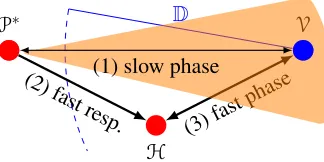
directional antenna a malicious prover can target the messages of the two phases such that the initializa-tion messages are only received by the verifier and not the helper. This strategy allows the prover to send the whole challenge and response table of a particular protocol run to the helper, and so take advantage of the location of the helper, without leaking their long term key and so succeed in TF attack. Note that the prover is not leaking its identity to the helper. Figure 4 shows a directional TF, where the helperH does not receive slow phase messages sent by a malicious proverP∗ toV using a directional antenna (orange ribbon in Figure 4). Before the start of the fast-phase,P∗sends the fast challenge-response table toH, makingHin-charge of responding to the fast-phase challenges.
H
V
P∗ D
(2) fast
resp.
(3)fast phase (1) slow phase
Figure 4: Directional TF
In the following we describe how this setting helps a malicious prover to succeed in terrorist-fraud against all known anonymous DB protocols:PDB[4],SPADE[14] andTREAD[8].
3.1.1 Directional TF onPDB
The presented model of [4] follows the original definition of TF (A3), and so our attack can be seen as outside their model. However, we showed that the original definition of TF is not suitable for anonymous distance-bounding protocols. In this section we present a TF attack againstPDB, using the more recent definition of TF (A3).
TheΠprotocol inPDBscheme consists of the following five sub-protocols between the verifier (V) and the prover (P). At the end of each sub-protocol, the state of each of the two parties become the starting state of the next sub-protocol.
Step (i) SPKis a signature proof-of-knowledge protocol, in which the prover uses the secret keyskiand a secret membership certificate (σi), and the verifier uses group public-key (gpk), as inputs. At the end of the protocol, the verifier will be convinced that the prover has a valid secret-key ski and membership certificateσi, in zero-knowledge (i.e., the verifier doesn’t learn anything about the prover’s secrets). The verifier also learns the value of a commitmentC=gski
1 .gr2, that will be used in the last step. This protocol uses theBBS+signature scheme [16] for generating the membership certificateσiand theSPKprotocol.
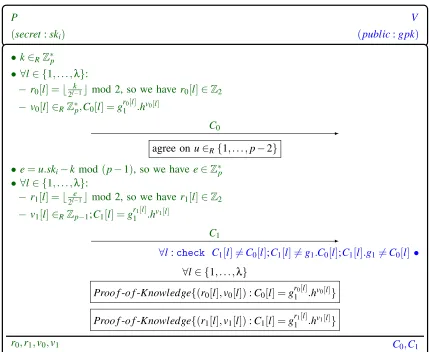
Step (ii) Bit Commitmentis a commitment protocol, in which the prover uses the secret keyski, and the verifier uses the group public-key (gpk), as input. In this protocol, the prover decides on the "fast challenge-response table" and commits to each bit in the table. The verifier learns the committed values of every single bit of the fast challenge-response table. This table consists of two rows: {rb[l]}l={1,...,λ},b∈{0,1}, whererb[l]is the response in theithfast challenge-response round. The corresponding committed values are{Cb[l]}l={1,...,λ},b={0,1}, and the
correspond-ing randomness of commitments are indicated by {vb[l]}l={1,...,λ},b={0,1}, where vb[l]∈Z∗p. The commitment function is as follows: Cb[l] =grb[l]
1 .h
g1,h∈Zp. The committed table and the randomness is kept secret at the prover, while the commitments are sent to the verifier. Figure 5 shows the details of this step. The parts that are shown in a box, are sub-protocols whose details are omitted.
P V
(secret:ski) (public:gpk)
•k∈RZ∗p
• ∀l∈ {1, . . . ,λ}:
−r0[l] =b2lk−1c mod 2, so we have r0[l]∈Z2
−v0[l]∈RZ∗p,C0[l] =g r0[l]
1 .h
v0[l]
C0
agree on u∈R{1, . . . ,p−2}
•e=u.ski−k mod (p−1), so we have e∈Z∗p • ∀l∈ {1, . . . ,λ}:
−r1[l] =b e
2l−1c mod 2, so we have r1[l]∈Z2
−v1[l]∈RZp−1;C1[l] =g
r1[l]
1 .hv1[l]
C1
∀l:check C1[l]6=C0[l];C1[l]6=g1.C0[l];C1[l].g16=C0[l]•
∀l∈ {1, . . . ,λ}
Proo f-o f-Knowledge{(r0[l],v0[l]):C0[l] =g r0[l] 1 .h
v0[l]}
Proo f-o f-Knowledge{(r1[l],v1[l]):C1[l] =gr1[l] 1 .h
v1[l]}
r0,r1,v0,v1 C0,C1
Figure 5:PDBStep (ii):Bit Commitment
P V
(secret:r0,r1) ()
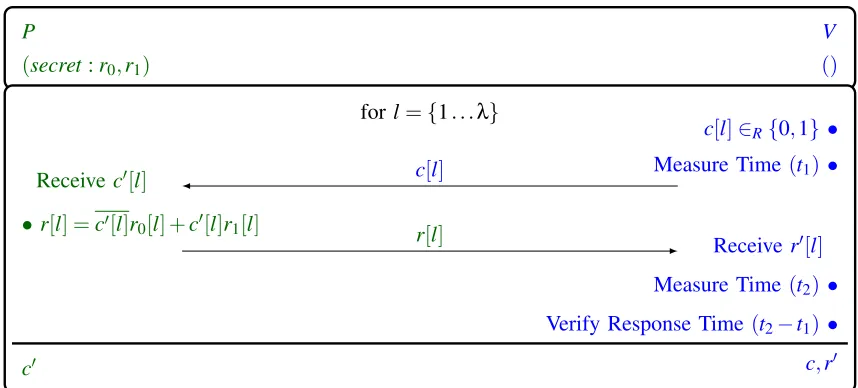
forl={1. . .λ}
c[l]∈R{0,1} •
Measure Time(t1) •
c[l] Receivec0[l]
•r[l] =c0[l]r0[l] +c0[l]r1[l] r[l]
Receive r0[l]
Measure Time(t2) •
Verify Response Time (t2−t1) •
c,r0
c0
Figure 6:PDBStep (iii): Fast Challenge/Response
P V
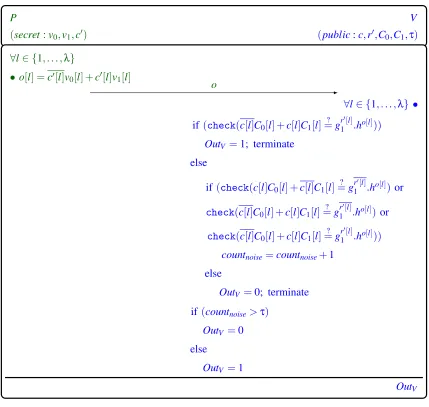
(secret:v0,v1,c0) (public:c,r0,C0,C1,τ)
∀l∈ {1, . . . ,λ}
•o[l] =c0[l]v0[l] +c0[l]v1[l]
o
∀l∈ {1, . . . ,λ} •
if(check(c[l]C0[l] +c[l]C1[l]=? gr
0[l]
1 .ho[l]))
OutV =1; terminate
else
if(check(c[l]C0[l] +c[l]C1[l] ?
=gr10[l].ho[l]) or
check(c[l]C0[l] +c[l]C1[l] ?
=gr10[l].ho[l]) or
check(c[l]C0[l] +c[l]C1[l] ?
=gr
0[l]
1 .ho[l]))
countnoise=countnoise+1
else
OutV =0; terminate
if (countnoise>τ)
OutV =0
else
OutV =1
OutV
Figure 7:Commitment Openingstep ofPDBprotocol
Step (v) Proof-of-Knowledgeis a protocol for zero-knowledge proof of equality that shows the secret key of step (i) and the committed secret key of step (ii) are the same. In this protocol, the prover uses the secret keyskiand the commitment randomness of step (i) and step (ii), and the verifier uses the committed values of step (i) and step (ii), as input. Cis the committed value of step (i),ris the commitment randomness of step (i),zis the accumulation of the committed values of step (ii) as z=∏λl=1(C0[l]C1[l])2
l−1
mod p, andv is the accumulation of the commitment
randomness of step (ii) asv=∑λl=12l.(v0[l] +v1[l])mod(p−1).
This protocol runs t iterations of ZK proof where z andC satisfy the following relation: PoK[(ski,v,r):z=gu.ski.hv∧C=gski.gr
2].
If all five steps terminate successfully, then the verifier outputsOutV =1.
Lemma 1. In theΠprotocol ofPDBscheme, the fast challenge-response table does not leak information about the membership certificateσiof the prover, unless negligible probability.
table is the output of random function that takes sk as input. So it cannot leak any information about other independent secrets of the prover.
A valid membership certificateσis the signature of registration authority on the secret-key sk. If there
is an adversary A that can calculate the membership certificate from the secret-key sk, then A is a successful forgery adversary of the signature scheme. Therefore, since we assume the signature scheme
is forgery resistant, then the success chance ofAis negligible.
Attack Psends toV the slow phase messages of step (i) and step (ii), using directional antenna. Before the start of the fast phase,Psends the fast challenge-response table,∀i∈ {1, ...,λ}:(r0[i],r1[i]), toH, allowingHto respond toV’s challenges.Psends toV the slow phase messages of step (iv) and step (v), using directional antenna. In this way, the helper can respond in time and correctly to the challenges of the verifier during the fast challenge-response rounds. This attack makes the verifier to accept the protocol. Note that the fast challenge-response table does not leak the membership certificateσi, according to
Lemma 1.
Since the helper has no information aboutσi, it cannot succeed in step (i) of future impersonation attacks.
Therefore, it cannot impersonate the prove in future, which is required for a successful TF attack (See Property 4).
3.1.2 Directional TF onSPADE
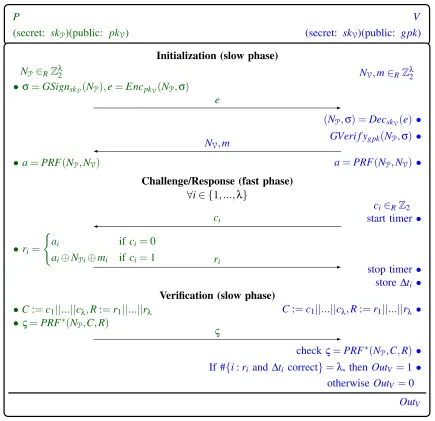
P V
(secret: skP)(public: pkV) (secret: skV)(public: gpk)
Initialization (slow phase)
NP∈RZλ2 NV,m∈RZλ2
• σ=GSignskP(NP),e=EncpkV(NP,σ)
e
(NP,σ) =DecskV(e)•
GVeri f ygpk(NP,σ)• NV,m
• a=PRF(NP,NV) a=PRF(NP,NV)•
Challenge/Response (fast phase) ∀i∈ {1, ...,λ}
ci∈RZ2
start timer•
ci
• ri=
(
ai ifci=0
ai⊕NPi⊕mi ifci=1 ri
stop timer• store ∆ti • Verification (slow phase)
•C:=c1||...||cλ,R:=r1||...||rλ C:=c1||...||cλ,R:=r1||...||rλ•
• ς=PRF∗(NP,C,R)
ς
check ς=PRF∗(NP,C,R)• If #{i:ri and∆ti correct}=λ, then OutV =1•
otherwiseOutV =0
OutV
Figure 8: Π protocol of SPADE scheme. (GSignsk,GVeri f ypk) is a group signature scheme. (Encpk,Decsk) is a secure public-key encryption scheme. PRF :Zλ2×Zλ2 →Zλ2 is a pseudo-random
function.λis the security parameter. NPand(NV,m)are nonce values of prover and verifier,(ci,ri)is a
pair of challenge and response.
Lemma 2. In theΠprotocol ofSPADEscheme, the fast challenge-response table does not leak informa-tion about the secret of prover.
Proof 2. The fast challenge-response table is ri=
(
ai
ai⊕NPi⊕mi
for i={1, ...,λ}. In each instance ofΠprotocol, NPand m are fresh and chosen randomly, and a=PRF(NP,NV)is the output of a
pseudo-random function, fed by two fresh pseudo-random values. Therefore, this table is independent from the secret
value skP.
Hto respond toV’s challenges. The collusion ofPandHmakesV to accept (i.e.,OutV =1) and this is withoutPsending toHany information that is dependent on the secret key ofP(i.e.,skP). Note that the secret key ofPis required for generation of the messageewhich will not be known byH.
According to Lemma 2, the fast challenge-response table does not leak any information about the prover’s long-term secretskP. Since the helper has no information aboutskP, it cannot generate a valid messagee in future, as the secret of prover is required to generate it. So its’ success chance in a future impersonation attack will not be improved. This completes a successful TF attack (See Property 4).
3.1.3 Directional TF onTREAD
TREAD [8] is an anonymous DB system that use a group signature GSignsk() to register users in an authorized group. The verifier needs to be registered and have a key-pair of their own. The structure of TREADis very similar toSPADE. A registered user can use their credentials to participate in the protocol without leaking their identity, hence ensuring anonymity. Figure 9 presents the Πdistance bounding protocol ofTREADscheme.
P V
(secret: sk,idpub,idprv)(public: ek) (secret: dk)(public: vk)
Initialization (slow phase)
α,β∈RZλ2 m∈RZλ2
• σ=GSignsk(α||β||idprv),e=Encek(α||β||idprv||σ)
e||idpub
(α||β||idprv||σ) =Decdk(e)•
GVeri f yvk(α||β||idprv||σ)•
m
Challenge/Response (fast phase) ∀i∈ {1, ...,λ}
ci∈RZ2
start timer•
ci
• ri=
(
αi if ci=0
βi⊕mi if ci=1 ri
stop timer• store ∆ti • Verification (slow phase)
If #{i:ri and∆ti correct}=λ, then OutV =1•
otherwiseOutV =0
OutV
Figure 9: Πprotocol ofTREADscheme. (GSign,GVeri f y)is a group signature scheme. (Enc,Dec)is a secure encryption scheme.
Proof 3. The fast challenge-response table is ri=
(
αi if ci=0
βi⊕mi if ci=1
for i={1, ...,λ}. In each instance ofΠprotocol,β,αand m are fresh and chosen randomly. Therefore, this table is independent from the
secret value skP.
Attack Psends toV the slow phase messagee||i fpub toV using directional antenna. Before the start of the fast phase,Psends the fast challenge-response table,∀i∈ {1, ...,λ}:(αi,βi⊕mi), toH, allowing Hto respond toV’s challenges. The collusion ofPandHmakesV to accept (i.e.,OutV =1) and this is withoutPsending toHany information that is dependent on the secret key ofP(i.e.,sk). Note that the secret key ofPis required for generation of the messageewhich will not be known byH.
According to Lemma 3, the fast challenge-response table does not leak any information about the prover’s long-term secretsk. Since the helper has no information aboutsk, its’ success chance in a future imper-sonation attack will not be improved, as the secret of prover is required to generate a valid messagee. So its’ success chance in a future impersonation attack will not be improved. This completes a successful TF attack (See Property 4).
3.1.4 Concluding Remarks on Directional TF
In all existing anonymous DB protocols, the fast challenge-response table does not determine the prover’s credential with overwhelming probability. Directional TF attack allows the prover to limit the view of helper to the fast challenge-response table and so TF succeeds because the leaked information to the helper, does not allow the helper to succeed in a future attack individually, as required by the definition of TF attacks (see Property 4).
3.2 Collusion TF on Anonymous DB
In a traditional DB protocol attacks, collusion of at most a single registered user and an actor (non-registered user) is considered. We show that in anonymous DB protocols collusion of multiple (non-registered users must be considered also.
We consider two types of collusion TFshown in Figure 10a and Figure 10b. In collusion TFtype 1 attack, both colluding users are outside the bound and use a helper that is inside the bound. Incollusion TFtype 2, the helper can be a prover of a user, that tries to help the far-away provers of another user. Note that in type 2 attack there is a close-by proverP∗2who can succeed in the protocol by themselves. However by colluding withP∗1, can succeed without being traced! (This attack also works in public-key DB protocols such as [15], where users choose their own private-keys, and so can collude and choose related keys that leads to the success of the above attack.)
H
V P∗
1(x1)
P∗ 2(x2)
D
(a) Collusion TF Type 1
P∗ 2(x2)
V P∗
1(x1) D
(b) Collusion TF Type 2 Figure 10: Collusion TF Attacks
SPADE∗(modifiedSPADE).We modify the challenge-response table of theSPADEprotocol to the follow-ing: ri=
(
ai ifci=0
ai⊕xi ifci=1, wherexis part of the prover secret-key that is chosen independent ofskP, and|x|=λ. The verification phase will also be revised to accommodate this change and allow the veri-fier can check if the correct parameters are used in the challenge-response table. The challenge-response table ofSPADE∗contains the secret-key of the prover, which makes the protocol intuitively secure against single-user TF attacks (let’s assume that). This if the whole table is leaked to the helper, the helper can learn the secret key of the (malicious) prover by XORing the two response bits of each challenge. Now we propose a collusion TF Type 2 (Figure 10b) againstSPADE∗;
Collusion TF Type 2 Attack: First, P∗1(x1)runs the "Initialization" phase ofSPADE∗ with the verifier from outside the distance bound, and sendsatoP∗2(x2). ThenP∗2(x2) runs the challenge-response and verification phase with the verifier from inside the distance bound with its own credentials (x2).
The intuition for the attack is that the challenge-response table is not linked to the long-term secret key of the user (group signature key). The verifier seesσwhich is the group signature of the far-away prover
P∗
1, but runs the distance bounding phase using a key that is not related to group signature key. Thus the tracing authority will link the session tox1, which is a violation of TF-resistance (Property 4).
4
Model
Firstly we define the settings of the system,i.e., entities and how they communicate, protocol and view of an entity, adversary and their capability. Then we provide a definition of anonymous distance-bounding (AnonDB) and also describe AnonDBexperiment, which captures an AnonDBscheme in execution. Fi-nally, we formalize six security properties (Completeness, MiM-resistance,DF-resistance, Soundness,
Traceability, Anonymity) of anonymous distance-bounding systems based on a game (AnonDBgame),
which is anAnonDBexperiment played between a challenger and an adversary.
Entities. There aremusers in the systemU={u1, . . . ,um}. Each user in the system can have multiple provers, which captures the practical scenario of a single person having multiple devices. We denote the list of provers for a useruiasPi. Thus, we havemlist of provers forming the prover setP={P1, . . . ,Pm}. A trusted group manger generates the public parameters of the system, registers users and issues a unique group membership certificate to each user. A userui(1≤i≤m) is identifiable by their certificate. The certificate, that must be kept secret, forms the secret input of the user in proving their membership in the group. The certificate of useruiis shared by all provers of the listPi.
Each participant has a locationloc= (x,y)∈R×R, that is an element of a metric space equipped with Euclidean distance, and is fixed during the protocol. The distance function d(loc1,loc2) returns the distance between any two locations. Message travel time between locationsloc1andloc2 is d(loc1,loc2)
L ,
whereLis the speed of light. A bit sent over the channel may flip with probabilitypnoise(0≤pnoise≤1). Participants, if located within a predefined distance bound Dfrom V, are called close-byparticipants, otherwise they are calledfar-awayparticipants.
Communication Structure. Each participant is equipped with a directional and an omni-directional antennas. Having directional antennas enables them to choose the angle of the transmission beam such that only the intended participants receive the message.
View. The view of an entity at any point (in time) of a protocol consists of: all the inputs of the entity (including random coin tosses) and the set of messages received by that entity up to that point. Any instance of receiving message is called anevent.ViewΓ
x(e)is a random variable that denotes the view of an entityxright after the eventein protocolΓ.ViewΓ
x denotes the view ofxat the end of the protocolΓ, i.e.,ViewΓ
x =ViewΓx(elast)whereelastis the last event inΓ.
Adversary. An adversary can corrupt any subset of participantsX∗⊂P∪V∪T. Corrupting one prover from a prover subset (e.g.,x∈Pj) effectively corrupts the whole subset, since all members of that subset share the same certificate (of useruj). Provers of uncorrupted subset follow the protocol, and only one prover from the subset executes the protocol at a time. We do not restrict provers of corrupted subset from doing this.
For each security property, the adversary has certain goals, which is reflected as restrictions ofX∗; • inCompletenessX∗=0/,
• inSoundnessX∗⊆T, • inDF-resistanceX∗⊆P,
• inTF-resistanceandTraceabilityX∗⊆P∪T, and • inAnonymityX∗⊆V∪T.
Below we use the approach of [2] to defineAnonDBscheme.
Definition 6. (Anonymous Distance-Bounding Scheme). For a security parameterλ, an anonymous
distance-bounding (AnonDB) scheme is defined by a tuple(X,Y,S,D,pnoise,Init,CertGen,CertVer, Π,Revoke,Open), where;
(I) XandYare sets of possible system master keys and group public-keys, respectively.
Init(1λ)is the function that the group manager uses to generate the system master key msk, and the group public-key gpk.
(II) Sis set of possible user membership certificates.
CertGen(1λ,msk,gpk,i)function generates a user membership certificate si, andCertVer(si,gpk) validates a user’s certificate with respect to the group public-key.
(III) Πis a DB protocol between prover P(si,gpk)and verifier V(gpk), in which V verifies that a group
member is located within the distance boundDto the verifier.
(V) Revoke(msk,gpk,i) is an algorithm that removes a user (ui) from the system and updates the master secret-key and group public key accordingly.
(VI) Open(msk,ViewΠ
V)is an algorithm that identifies the user (ui) that is involved in theΠprotocol, using view of the verifier.
The operationsOpenandRevokeare optional in anAnonDBscheme. Note thatI−Vabove is the same as I−V in Definition 3, with the only difference that inDBID, each user owns a key-pair, while inAnonDB, each user owns a membership certificate that allows them to prove their membership according to the group public-key.
Adversary’s capability is modeled as their access to queries presented to the challenger. The security properties of an anonymous DB protocol are based on a game (AnonDBGame) between a challenger and an adversary. Note that we allow provers to have access to directional antenna (to captures the directional attack introduced in Sec 3.1), and presence of multiple, possibly colluding users (with different secret keys) in the system (to capture multiple user collusion attack introduced in Sec 3.2).
Below we describe a general execution of an instance of the AnonDBscheme, which we call AnonDB experiment. And after that, we defineAnonDBgame as an specialAnonDBexperiment.
Definition 7. (AnonDBExperiment). AnAnonDBexperiment is defined by a tuple(AnonDB;U;P;V;T), where
(i) AnonDBis an anonymous distance-bounding scheme as defined in Definition 6.
(ii) Uis the set of users that are members of the group; each user uj∈Uhas the following attributes:
• uj.Cert that is a secret group membership certificate generated by the group manager,
• uj.RT that is the registration time of the user that can be any time, and
• uj.Rev that is a flag that shows if the user is revoked.
(iii) Pis the set of provers; each prover has access to the membership certificate of a single user.
(iv) Vis the set of verifiers; that have access to the group public-key of theAnonDBsystem. We consider the case whereVhas a single member.
(v) Tis the set of actors; each actor has access to the group public key of theAnonDBsystem.
Members of the setX=P∪V∪Tare called participants of the system. Each of the participants x∈X
has the following attributes:
a1. x.Loc is the location of the participant,
a2. x.Code is the code to run by the participant,
a3. x.St that is the start time of the x.Code execution, and
a4. x.Corr is a flag indicating if the participant is corrupted or not.
In addition to these attributes, each prover p∈Phas two extra attribute:
a5. p.Key that is the secret certificate of the corresponding user, i.e., p.Key=uj.Cert for user uj∈U, and
All the provers that share the same certificate are called a prover subset, i.e.,Pj ={p:p∈P,p.Key= uj.Cert}. The start time of all provers is after registration time of the corresponding user, i.e.,∀uj ∈ U,∀p∈Pj:p.St>uj.RT .
Members of a prover subset are either all honest or all dishonest. i.e.,∀Pj∈P,∀p∈Pj:p.Corr= f lag, where f lag∈ {true,f lase}. All members of an honest prover subset p∈Pj follow the
Πprotocol (i.e., p.Code=AnonDB.Π.P(.)) and there is no overlap in the execution time of the members of an honest
prover subset. If the verifier is honest, then it follows theΠprotocol (i.e., v.Code=AnonDB.Π.V(.)for
v∈V).
The experiment is run by a simulator that sets the attributes of the participants, and interacts with the group manager to assign keys to the provers of a user. If there is an adversary in the system, it interacts with the simulator to influence the experiment.
The experiment, without any adversary, proceeds as follows:
1. Setup.
(a) Initialize: The group manager runs(msk/gpk)←AnonDB.Init(1λ)algorithm to generate the master secret-key and group public-key.
(b) Generate Players: The simulator forms the sets(U,V,P,T) and sets their attributes. The simulator interacts with the group manager obtain and assign keys of the provers. It also simulates the behavior of malicious players by setting their code (x.Code).
2. Run: The simulator starts the execution of x.Code for all participants x∈X=P∪V∪Tat time x.St.
We assume the existence of a system clock that assigns time to events. The start and finish time of a proto-colΓis denoted asstTime(Γ)and f shTime(Γ)respectively, which form the execution timeexTime(Γ) =
(stTime(Γ),f shTime(Γ))as a range of time and the execution lengthexLen(Γ) =f shTime(Γ)−stTime(Γ).
Members of a prover list (Pi, 1≤i≤m) have different execution time period (i.e., they participate in a protocol from timet1tot2), and possibly different locations.
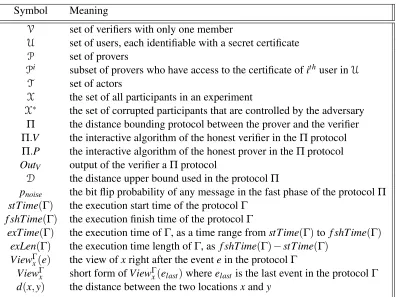
Symbol Meaning
V set of verifiers with only one member
U set of users, each identifiable with a secret certificate P set of provers
Pi subset of provers who have access to the certificate ofithuser inU T set of actors
X the set of all participants in an experiment
X∗ the set of corrupted participants that are controlled by the adversary
Π the distance bounding protocol between the prover and the verifier Π.V the interactive algorithm of the honest verifier in theΠprotocol
Π.P the interactive algorithm of the honest prover in theΠprotocol
OutV output of the verifier aΠprotocol
D the distance upper bound used in the protocolΠ
pnoise the bit flip probability of any message in the fast phase of the protocolΠ
stTime(Γ) the execution start time of the protocolΓ
f shTime(Γ) the execution finish time of the protocolΓ
exTime(Γ) the execution time ofΓ, as a time range fromstTime(Γ)to f shTime(Γ)
exLen(Γ) the execution time length ofΓ, as f shTime(Γ)−stTime(Γ)
ViewΓ
x(e) the view ofxright after the eventein the protocolΓ ViewΓ
x short form ofViewΓx(elast)whereelastis the last event in the protocolΓ
d(x,y) the distance between the two locationsxandy
Table 1: Notations
In the following, we define a game between challenger and an adversary. This game is a limitedAnonDB experiment that is run by the challenger who interacts with an adversary. In this game, the challenger plays both roles of the simulator and the group manager in theAnonDBexperiment (Definition 7). The adversary’s capabilities is modeled as access to a query that it presents to the challenger.
Definition 8. (AnonDBGame). An AnonDBgame between a challenger and adversary is an AnonDB
experiment that is defined by a tuple(AnonDB;U;P;V;T;CorruptParties)where • AnonDBis an anonymous distance-bounding scheme as defined in Definition 6.
• U,P,VandTare the sets of users, provers, verifiers and actors, as defined in Definition 7, that are determined through interaction of the challenger and the adversary.
• CorruptParties(Q) is a query that allows the adversary to plan their attack. Q is a set of participants, that may exist in the system or be introduced by the adversary.
In more details:
1. Setup.
(a) Initialize: Challenger runs(msk/gpk)←AnonDB.Init(1λ) and publishes gpk. Note that the execution codes of honest prover and verifier are known by the challenger and the adver-sary at this point, and referred asAnonDB.Π.P andAnonDB.Π.V respectively.
(b) Generate Players:The sets(U,V,P,T)are formed through the interaction of the challenger and the adversary:
• V={v}, where:
a1. v.Loc=loc0,
a2. v.Code=AnonDB.Π.V ,
a3. v.St =0, and a4. v.Corr= f alse.
• U={uj}j={1,...,m}, where uj.Cert is generated byAnonDB.CertGen(1λ,msk,gpk,j) function. The registration time of the users are set as uj.RT=0and their revocation flag is set as uj.Rev= f alse.
• P=∪m
j=1Pj, where Pj is created as the prover subset of uj ∈U. For all p∈ Pj
{j=1...m}assigns their attributes: a1. p.Loc is set arbitrarily,
a2. p.Code=AnonDB.Π.P,
a3. p.St is set arbitrarily such that there is no overlap in the execution time of the provers inPj,
a4. p.Corr= f alse, and
a5. secret-key p.Key=uj.Cert.
• T=0/
ii. The challenger sends the attributes(x.Loc,x.Code,x.St)for all x∈X=P∪V∪T, along with all prover subsetsPj∈Pto the adversary. The size of the setXis n.
iii. The adversary generatesCorruptParties(Q)query and sends to the challenger. The challenger sends the secret information of the corrupted participants in Q to the adver-sary and their behavior (Code, Location and Start Time) is assigned according to the adversary instruction and their corruption flag is set to True. For all values of j=1...m, if any prover p∈Pj gets corrupted, then all provers inPjget corrupted too.
iv. Upon receiving theCorruptParties(Q)where Q={q1, ...,qn0}, the challenger runs:
• For a qithat qi.type=veri f ier, then v.Code=qi.code and v.Corr=true for v∈V.
• For each qi that qi.type=user and qi.usr≤m, sets the users’ revocation flag as uj.Rev=true where j=qi.U sr, runs(msk0,gpk0)←Revoke(msk,gpk,qi.usr), then update the group master key msk←msk0and the group public key gpk←gpk0. This applies only if theAnonDBscheme has user revocation.
• For each qi that qi.type= prover, find the prover subset Pj for j=qi.U sr. For each member p of subset Pj, set their corruption flag p.Corr=true. If qi is not corresponding to an existing prover, then create a new prover p and add it to the prover subsetPj. Set the attributes of the participant p as follows:
a1. location p.Loc=qi.location,
a2. execution code p.Code=qi.code,
a4. corruption flag p.Corr=true, and
a5. secret-key p.Key=uj.Cert.
• For each qi that qi.type=actor, add a new actor x to the set T, and assign its attributes as follows:
a1. location x.Loc=qi.location,
a2. execution code x.Code=qi.code,
a3. start time x.St=qi.time, and
a4. corruption flag x.Corr=true.
v. The challenger sends the key of the corrupted provers and the certificate of revoked users to the adversary, i.e., p.Key for all p∈Psuch that p.Corr=true and u.Cert for all u∈Usuch that u.Rev=true.
2. Run:Challenger activates all participants x∈X=P∪V∪Tat time x.St for execution of x.Code.
The game ends when the last participant’s code completes its execution.
We define five properties for anonymous distance-bounding protocols based onAnonDBGame, condi-tions to win the game varies from one property to another.
Property 1. (AnonDBCompleteness). Consider anAnonDBscheme and anAnonDBgame when Q=0/
in theCorruptParties(Q)query and the setPis not empty.
TheAnonDBscheme is(τ,δ)-complete for0≤τ,δ≤1, if the verifier returns OutV =1with probability
at least1−δ, under the following assumptions:
• the fast challenge-response rounds are independently affected by noise and at leastτ portion of them are noiseless, and
• τ>1−pnoise−εfor some constantε>0.
A complete protocol must have negligibleδ to be able to function in the presence of communication
noises.
Property 2. (AnonDBSoundness).Consider anAnonDBscheme and anAnonDBgame with the following restrictions:
• ∀p in the nonempty setP, and v as the only member ofV, we have d(p.Loc,v.Loc)>AnonDB.D, and
• in theCorruptParties(Q)query we have qi.type=actor for all qi∈Q.
TheAnonDBscheme isγ-sound if the probability of the verifier outputting OutV =1is at mostγ.
This general definition captures the following attacks by considering special values for game parameters; • relay attack [13] happens when the MiM attacker only relays the messages between the honest verifier and a far-away honest prover. The MiM attacker tries to convince the verifier that the prover is located close to the verifier. This attack is achieved by adding extra restrictions on the adversary of Property 2 as follows:
⇒ ∀qi∈Qwe haveqi.code=”relay messages”.
The attacker listens to the legitimate communications for a while, before running the attack as the learning phase. This attack corresponds to adding extra restrictions on the adversary in Property 2 as follows:
⇒the set of provers consists of only one prover subset,i.e.,P=P1, and
⇒ ∀qi∈Qwe haved(qi.location,v.Loc)≤AnonDB.Dforv∈V.
• impersonation attack[7] happens when there is an honest verifier and a single close-by attacker who tries to convince the verifier that the prover is located close to the verifier. The attacker can have a learning phase before running the attack. We can achieve this attack by adding extra restrictions on the adversary of Property 2 as follows:
⇒Pis nonempty, and
⇒ ∀qi∈Qwe haved(qi.location,v.Loc)≤AnonDB.Dforv∈V, and
⇒among all the successfulAnonDB.Πprotocols (Πsuccset) during the game,∃π∈Πsucc,∀p∈P: t=f shTime(π),t∈/[p.St,p.St+exLen(p.Code)].
• multi-user MF: there is an honest verifier, multiple honest far-away provers, and a close-by MiM attacker who tries to convince the verifier that one of the provers is located close to the verifier. The attacker can have a learning phase before running the attack. The extra restrictions on the adversary in Property 2 is as follows:
⇒the set of provers consists of a least two prover subsets,i.e.,∃p1,p2∈P:p1.Key6=p2.Key, and
⇒ ∀qi∈Qwe haved(qi.location,v.Loc)≤AnonDB.Dforv∈V.
• strong-impersonation [2] happens when either mafia-fraud or impersonation happens. We can
achieve this attack by adding extra restrictions on the adversary of Property 2 as follows:
⇒the set of provers consists of one prover subset,i.e.,P=P1,
⇒ ∀qi∈Qwe haved(qi.location,v.Loc)≤AnonDB.Dforv∈V, and
⇒among all the successfulAnonDB.Πprotocols (Πsucc set) during the game, at least one of the
following conditions hold:
(i) ∃π∈Πsucc,∀p∈P:t= f shTime(π),t∈/[p.St,p.St+exLen(p.Code)]
(ii) ∃p∈P,∃π∈Πsucc,v∈V:t=f shTime(π),t∈[p.St,p.St+exLen(p.Code)]∧d(p.Loc,v.Loc)>
AnonDB.D.
We consider two types of attacks by a dishonest prover: multi-user far-away dishonest provers (Property 3), and multi-user far-away dishonest provers with close-by helpers (Property 4).
Property 3. (AnonDB Distance-Fraud).Consider an AnonDBscheme and an AnonDBgame with the
following restrictions:
• ∀p in the nonempty setP, and v as the only member ofV, we have d(p.Loc,v.Loc)>AnonDB.D, and
• in theCorruptParties(Q) query, qi.type=prover and d(qi.location,v.Loc)>AnonDB.Dfor all qi∈Q.
TheAnonDBscheme isα-DF-resistant if, for anyAnonDB.Πprotocol in such game, we havePr[OutV = 1]≤α.
In the following we define the TF-resistance of anonymous DB protocols.
Property 4. (AnonDBTerrorist-Fraud). Consider anAnonDBscheme and an AnonDBgame with the
• ∀p in the nonempty setP, and v as the only member ofV, we have d(p.Loc,v.Loc)>AnonDB.D,
• corrupted parties are either prover or actor∀qi∈Q:qi.type∈ {prover,actor}, and
• at least for one value of j∈ {1...m}we have d(qi.location,v.Loc)>AnonDB.Dfor all qi∈Q∩Pj. TheAnonDBscheme is µ-TF-resistant, if the following holds about the above game: if the verifier returns OutV =1in theΠprotocol of gameΓwith non-negligible probabilityκthat is not traceable to any user
with close-by provers (Property 6), then there is an impersonation attack (as anAnonDBgameΓ0 with
honest verifier, no prover and one close-by actor) that takes the view of close-by participants of gameΓ
–excluding the verifier– as input, and makes the verifier return OutV =1with probability at leastκ−µ
in theΠprotocol ofΓ0game.
In this definition, any directional message that is sent to the verifier from outside the distance bound, is not included in the input of the impersonator. Therefore any protocol that is secure in this property, is also secure against directional TF attacks. Note that this definition captures collusion TF (Figure 10a and Figure 10b). In anonymous DB, breaking traceability is the only target of the adversary in collusion TF Type 2. Lemma 4 formally shows this claim.
The above attacks define security of the DB game. Now we defineanonymityin terms of the distinguish-ing advantage of the adversary between two protocol sessions of two users.
Property 5. (AnonDBAnonymity).Consider anAnonDBscheme and anAnonDBgame with the
follow-ing restrictions:
• P={P1,P2}where the size of each of the setsP1andP2is equal to l>0, and • in theCorruptParties(Q)query, qi.type∈ {veri f ier,actor}for all qi∈Q.
In this game, there are two subsets of honest provers of the same size, the adversary corrupts the verifier and adds a set of actors and sets their locations. Before activating the participants, the challenger randomly chooses b∈R{0,1}l, and deactivates the ithprover inPb[i], i.e.,∀1≤i≤l:P
b[i]
i .Code=∅.
At the end of the game,Areturns b0∈ {0,1}l. A protocol is
α-anonymous if for any such experiment, for
all values of i∈ {1, ...,l}we have|Pr[b[i] =b0[i]]−1 2| ≤α.
We definetraceability as a guarantee for the group manager to be able to identify the users from their protocol transcripts.
Property 6. (AnonDBTraceability).Consider anAnonDBscheme and anAnonDBgame with the follow-ing restrictions:
• Pis nonempty, and
• in theCorruptParties(Q)query, qi.type∈ {prover,actor}for all qi∈Q.
A protocol is calledγ-traceable, if the success chance of theAnonDB.Open algorithm in identifying a user that has a prover inAnonDB.Πprotocol, from the transcript that is seen by the verifier, is a least
as high as the chance of verifier outputting OutV =1in theAnonDB.Πprotocol plusγ. i.e.,Pr[identi f y user]≥γ+Pr[OutV =1].
Note that anAnonDBgame considers multiple honest users being active at the same time. Therefore, all properties are according to collusion scenarios.
Proof 4. The main difference between directional antenna and omni-directional antenna, from informa-tion security perspective, is that omni-direcinforma-tional antenna allows the participants, within the communi-cation range, to have similar view from the transmitted messages, while the directional antenna makes the view of those participant to be different.
The rationality of Property 4 is that the higher the chance of future impersonation is, the scheme is more TF-resistant. So, the goal of a successful directional TF attack is to add the lowest amount of information to the view of the impersonation attacker.
In a TF attack (Property 4), all close-by participants, except the verifier, are controlled by the adversary. So, using any directional antenna to communicate with close-by participants that is not towards the verifier, is adding the transmitted message to the view of adversary. As a result, replacing that antenna with an omni-directional antenna does not reduce the knowledge of adversary, and so does not decrease its’ chance in future impersonation. Therefore, we assume the only communications that are done by directional antenna, are those that are sent directly to the verifier.
Messages that are sent by directional antenna to the verifier, are not included in the view of impersonation adversary, i.e., ViewΓ
β. Based on Property 4, if there is a TF attack against a scheme, the TF-resistant property guarantees the existence of impersonation attack by taking ViewΓ
βas input, which is the mini-mum view of the adversary from a directional TF attack. Therefore, in a TF-resistantAnonDBscheme, a
successful directional TF attack implies the existence of future impersonation attack.
5
AnonDB
Construction:
dbid2an
GMWe refer to ourAnonDBscheme asdbid2anGMto emphasize conversion of aDBIDscheme to an anony-mousDBID. Roughly the idea is: instead of using a long-term public key for the prover in the DBID scheme, generate and use a temporary public key for the prover everytime it is involved in a DBID proto-col, while making sure that the prover knows the valid credentials that were used in generating this key; thus providing anonymity.
The first of our two proposed AnonDB constructions requires aDBID scheme that uses Goldwasser-Micali encryption system [24] for key generation. This construction is based on factorization assumption. We first give an overview of our proposed scheme and then provide the details. Indbid2anGM, a user is first enrolled in the system and is provided with a verifiable "membership" certificate. In addition to verifying the membership of a user, the certificate is used to generate a temporary public-key, which is later used in a public-keyDBIDprotocol. At the end of a successful execution, the verifier is convinced that a valid member of the group is within the given distance bound.
Recall (Definition 6) that for a security parameterλ, an anonymous distance-bounding (AnonDB) scheme
is defined by a tuple(X,Y,S,D,pnoise,Init,CertGen,CertVer,Π,Revoke,Open). For our proposed
(AnonDB) scheme dbid2anGM, we name these operations as dbid2anGM.Init, dbid2anGM.CertGen, dbid2anGM.CertVer,dbid2anGM.Π,dbid2anGM.Revokeanddbid2anGM.Open.
Indbid2anGM.CertGen, the group manager generates a membership certificate for a new user, and ac-cumulates the certificates of all users to form a public commitment on them. Then thedbid2anGM.Π
protocol takes place as below:
ii) a temporary public-key is generated for the prover. The temporary public-key is generated using Goldwasser-Micali encryption,i.e., we haveC[j] =EncGM(xl[j],vl[j])where for the j=1...λ: xl[j]is
certificate of the user,vl[j]is a random value chosen by the prover, andC[j]is temporary public-key. In this paper we refer toEncGM(., .), asCommitGM(., .)function. This temporary public-key generation is equivalent to theDBIDGM.KeyGenfunction. After establishing the temporary public-key, the prover and the verifier run aDBIDGM.Πprotocol, where the prover uses(xl,vl) as input, and the verifier usesCas input.
In our construction ofdbid2anGM, we useProProx[32] as theDBIDGMscheme, which is proven secure in the model ofDBIDschemes (directional antenna and single user attacks) [2].
In this scheme we use a hash functionHmaking coins forCommitGM, we define a deterministic commit-ment byComHe(x,v) = (CommitGM(x1,H(x,1).H(v,1)e), ...,CommitGM(xλ,H(x,λ).H(v,λ)
e),CommitGM(v
1,H(v,1)), ...,CommitGM( vλ,H(v,λ)))forx,v∈Zλ2 andCommitGM(., .)being Goldwasser-Micali encryption function. We assume
H(0,i) =1 for all values ofi, and also assume thatComHis a one-way function. Now we provide the details of the operations:
dbid2anGM.Init: (msk,gpk)←Init(1λ). The group manager initiates the system as follows:
• Initialize Goldwasser-Micali cryptosystem:(p,q,N,θ)←DBIDGM.Init(1λ)for
λbit security choose
N=p.qfor random prime values ofpandq, andθas a quadratic residue moduloN. Private:(p,q)
and Public:(N,θ).
• Initialize RSA cryptosystem for the sameN: generate(d,e) such thatgcd(e,φ(N)) =1 andd=
e−1(modφ(N)).dis private andeis public.
The group master key is msk= (p,q,d,U) where U is the list of all user private-keys, initialized to U=0/. The group public-key isgpk= (e,N,θ,y,ˆ y,˜ Ξ)where ˆy is commitment accumulation vector of user private-keys, ˜yis signature vector of group manager on ˆy andΞis the list of all user membership
signatures. These are initialized to ˆy=y˜= [0]λandΞ=0/.
dbid2anGM.CertGen: (s,msk0,gpk0)←CertGen(msk,gpk). The group manager first generates a certificate s= (xl,σl) and sends it to a new user (xl is called user private-key, and σl is called user membership signatures). And second, the system master key and public-key get updated accordingly, i.e.,msk←msk0andgpk←gpk0. The details is as follows, assumingl−1 users have already joined the group:
1. randomly choosexl ∈Zλ2,
2. yl=ComHe(xl,0), which implies∀j∈ {1, . . . ,λ}:yl[j] =CommitGM(xl[j],H(xl,j)) =θxl[j].H(xl,j)2modN andyl[λ+j] =1. Signσl[j] = (yl[j])d.
3. ∀j∈ {1, . . . ,λ}:
• accumulate jthbit of all user private-keys into a single bit ˆx[j] =x1[j]⊕. . .⊕xl[j], • accumulate hash values ˆv[j] =∏1≤i≤lH(xi,j), and
• commit to accumulated values ˆy[j] =CommitGM(x[ˆ j],v[ˆ j]) =θxˆ[j]v[ˆ j]2modN.
The updated group master key ismsk0= (p,q,d,U)whereU={x1, ...,xl}, and the updated group public-key isgpk0= (e,N,θ,y,ˆ y,˜ Ξ)whereΞ={σ1, ...,σl}. The certificates= (xl,σl) is securely sent to the
new user.
dbid2anGM.CertVer: accept/re ject←CertVer(s,gpk). Upon receiving a certificates= (x,σ), the
user can check its validity. By reading the group public-keygpk= (e,N,θ,y,ˆ y,˜ Ξ), the user calculates
y=ComHe(x,0)and checksy[j] ?
= (σ[j])emodN, for j={1...λ}.
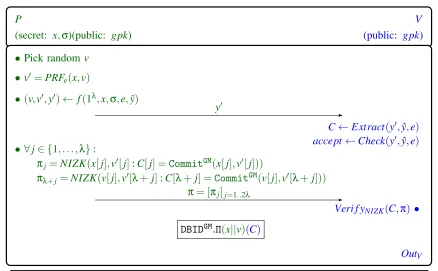
dbid2anGM.Π: accept/re ject ←Π{P(s,gpk)↔V(gpk)}. When a prover (Pl) of a registered user wants to run theAnonDB.Πprotocol with the verifier, they will follow the protocol described in Figure 11. The protocol consists of two main steps. The first step is a message from the prover to the verifier (y0,π)
that generates a temporary public-key (C), and then provides a non-interactive zero-knowledge (NIZK), which proves that the prover knows the privates related to the temporary public-keyC. Note that in the non-interactive zero-knowledge proof, the verifier does not send any message to the prover [10, 9]. The second step is running theDBIDGM.Πprotocol.
P V
(secret: x,σ)(public: gpk) (public: gpk)
•Pick randomv
•v0=PRFe(x,v)
•(v,v0,y0)← f(1λ,x, σ,e,y˜)
y0
C←Extract(y0,yˆ,e)
accept←Check(y0,yˆ,e) • ∀j∈ {1, . . . ,λ}:
πj=NIZK(x[j],v0[j]:C[j] =CommitGM(x[j],v0[j]))
πλ+j=NIZK(v[j],v0[λ+j]:C[λ+j] =CommitGM(v[j],v0[λ+j]))
π= [πj]j=1..2λ
Veri f yNIZK(C,π)•
DBIDGM.Π(x||v)(C)
OutV
Figure 11: Πprotocol indbid2anGMscheme for thelthuser. PRFe is a pseudo-random function,Check is a boolean function. The two messages πandy0 contain random commitment to secret x and zero-knowledge signature proof of zero-knowledge onx. fandExtractfunctions will be described in the following.
The functions of Figure 11 are as follows:
• v0←PRFe(x,v)function is∀j∈ {1, . . . ,λ}:v0[j] =H(x,j).H(v,j)e andv0[λ+j] =H(v,j).
• (v,v0,y0)← f(1λ,x,
– v0=PRFe(x,v),
– ∀j∈ {1, . . . ,λ}:y0[j] =σ[j].˜y[j].H(v,j)2andy0[λ+j] =CommitGM(v[j],H(v,j)).
• C←Extract(y0,y,ˆ e)creates a list as∀j∈ {1, . . . ,λ}:C[j] = (y0[j])e.y[ˆ j]modN=CommitGM(x[j],v0[j]) andC[λ+j] =y0[λ+j].
• accept/re ject←Check(y0,y,e)ˆ function is checking the validity of∀j∈ {1, . . . ,λ}:y0[j]∈ {/ 0,1,y[ˆ j]}
andC[j]6=1.
dbid2anGM.Open: (l)←Open(msk,transcript). The tracing authority who holds the group master key msk, uses the verifier’s view of a successful run of Π with the prover Pl, and returns index of the corresponding user in U. The algorithm runs as follows, knowing that the group master key is msk= (p,q,d,U={x1, ...,xm}):
1. ˆyd= [y[1]ˆ d, ...,y[ˆλ]d].
2. Parse verifier’s view of the protocol to obtainy0and extractC. 3. Return the firsti∈ {1, . . . ,m}that all the following holds:
• for all j∈ {1, . . . ,λ}calculatev0jfromv0j2=y0[j].ˆy[j]d.(yi[j])−dmodN(we know thatv0j2is quadratic residue and have access topandq), whereyi=ComHe(xi,0)modN.
• CheckC[j]=? CommitGM(xi[j],v0[j])modN.
dbid2anGM.Revoke: (msk0,gpk0)←Revoke(msk,gpk,l). In this operation, the entity holding the group master key msk, updates the group master key and the group public key such that the provers oflth user (l∈ {1...m}) cannot succeed in any Π protocol anymore. The algorithm runs as follows,
knowing that the group master key ismsk= (p,q,d,U={x1, ...,xm})and the group public key isgpk= (e,N,θ,y,ˆ y,˜ Ξ)whereΞ={σ1, ...,σm};
1. ∀j∈ {1, . . . ,λ}:
• ˆx[j] =x1[j]⊕. . .xl−1[j]⊕xl+1[j]⊕. . .⊕xm[j], • ˆv[j] =∏i∈{1,...,l−1,l+1,...m}H(xi,j),
• ˆy0[j] =CommitGM(x[ˆ j]; ˆv[j]) =θxˆ[j]v[ˆ j]2modN,
• ˜y0[j] =yˆ0[j]−d, and 2. Ξ0=Ξ\ {σl}.
After this operation, the group master key ismsk0= (p,q,d,U={x1, ...,xl−1,xl+1, ...,xm})and the group
public key isgpk0= (e,N,yˆ0,y˜0,Ξ0).
5.1 Security Analysis
Theorem 1. (dbid2anGMSecurity Properties).If (i) theDBIDGMscheme is(τ,δ)-complete,γ0-sound,θ
-DF-resistant, µ0-TF-resistant andDBIDGM.Πis zero-knowledge, and (ii) the temporary public-key (C) and
the private key (xl,vl) ofDBIDGM.Πare related as C=EncN(xl,vl)where EncN(., .)is the Goldwasser-Micali encryption algorithm for modulus N withλ-bit security,
thendbid2anGMis anAnonDBscheme that is(τ,δ)-complete (Prop1),θ-DF-resistant (Prop3),γ-Sound
(Prop2), µ-TF-resistant (Prop4),α-anonymous (Prop5) andγ-traceable (Prop6), for negligible values of α, δ, γ, γ0, µ, µ0 andθ, assuming that quadratic residuosity, factorization and RSA problems are hard problems.
In the following, we prove each of the properties of the theorem in a separate lemma. We prove security properties of the protocol based on the model described in Section 4. The underlyingDBIDGM protocol provides single user directional antenna security [2]. The main challenge for the new model is to prove collusion security.
Lemma 5. (Completeness).dbid2anGMis a(τ,δ)-completeAnonDB(Prop1) scheme, if theDBIDscheme is(τ,δ)-complete.
Proof 5. Consider anAnonDBgame with dbid2anGMscheme, in which the provers and the verifier are honest. In eachdbid2anGM.Πprotocol, the steps before theDBID.Πprotocol succeed. This is because if
the prover behaves honestly,∀j∈ {1, . . . ,λ}: y0[j]∈ {/ 0,1,y[ˆ j]}and C[j]6=1, which makes the "Check" function to return accept. Here indbid2anGM scheme, standard NIZK operations are used, which are assumed to be complete. TheDBID.Πprotocol succeeds with probability at leastδ, since theDBIDscheme is(τ,δ)-complete. Therefore, thedbid2anGM.Πsucceeds with probability at leastδ, which implies(τ,δ
)-completeness ofdbid2anGMscheme.
Lemma 6. (DF-resistance).dbid2anGMis aθ-DF-resistantAnonDB(Prop3) scheme, if theDBIDscheme isθ-DF-resistant.
Proof 6. Consider anAnonDB game withdbid2anGM scheme, in which the provers are far-away and
the verifier is honest. In each AnonDB.Π protocol, the verifier gets a temporary public-key and then participates in aDBID.Πprotocol with that temporary public-key. Note that dishonest provers of a single
user can operate simultaneously, that implies they can generate different temporary public-keys at the same time in differentDBID.Πprotocols. Therefore, having multiple users in the system does not increase the chance of adversary against theDBIDscheme.
Let’s consider the case that the verifier is simultaneously interacting with multiple provers (either from one user or more) in differentAnonDB.Πprotocols. We assume all the temporary public-key generations
are successful. As a result, the verifier has access to a list of public-keys{C}, and provers have access to the corresponding secret-key x and the related randomness v. The relation between a public-key, secret-key and the corresponding randomness is C=Enc(x||v,r), where Enc is the Goldwasser-Micali encryption algorithm and r is output of a pseudo-random function taking(x,v)as input. This relation is checked by verifier by the end of Veri f yNIZKoperation.
After generation of the temporary public-keys (right after Veri f yNIZK operation), the adversary runs differentDBID.Πprotocols simultaneously with the verifier. Since theDBID scheme isθ-DF-resistant,
then for all instances ofDBID.Πprotocols, the acceptance chance of the verifier is limited by negligible valueθ. As a result, the acceptance chance of thedbid2anGM.Πprotocol is limited byθtoo. Note that
the DF-resistant property ofDBIDscheme is considering collusion scenario.
Lemma 7. (TF-resistance). dbid2anGM is a µ-TF-resistant AnonDB (Prop4) scheme, if the DBIDGM
scheme is µ0-TF-resistant for negligible values of µ and µ0.