Crash-tolerant Consensus in Directed Graph Revisited
∗Ashish Choudhury† Gayathri Garimella‡ Arpita Patra§ Divya Ravi¶ Pratik Sarkark
Abstract
Fault-tolerant distributed consensus is a fundamental problem in secure distributed computing. In this work, we consider the problem of distributed consensus in directed graphs tolerating crash failures. Tseng and Vaidya (PODC’15) presented necessary and sufficient condition for the existence of consen-sus protocols in directed graphs. We improve the round and communication complexity of their protocol. Moreover, we prove that our protocol requires the optimal number of communication rounds, required by any protocol belonging to a restricted class of crash-tolerant consensus protocols in directed graphs.
Keywords: Directed graph, Consensus, Crash failure, Round complexity.
1
Introduction
Fault-tolerant reliable consensus [11,6,7] is a fundamental problem in distributed computing. Informally, a consensus protocol allows a set ofnmutually distrusting parties, each with some private input, to agree on a common output. This is ensured even in the presence of acomputationally unboundedcentralized adversary, who may corrupt anyfout of thenparties and try to prevent the remaining parties from achieving consen-sus. Since its inception [11], the problem has been widely studied in the literature and several interesting results have been obtained regarding the possibility, feasibility and optimality of reliable consensus (see [10,2,8,13] and their references for the exhaustive list of work done in this area). However, all these results are derived assuming the underlying communication network to be acomplete undirected graph, where the parties are assumed to be directly connected with each other by pair-wise private and authentic channels. There are scenarios, where such undirected graphs may not be available. For example, in a typical wireless network, the communication links may support only uni-directional communication. In a radio network, a base station can communicate to the receiving nodes, but communication in the other direction may not be possible. Further, it may be the case that a node is connected to some other node “indirectly” via inter-mediate nodes. Thus in a practical network like the Internet it is hard to ensure that every user is directly connected with every other user by a dedicated channel. This scenario can be appropriately modelled by a more generic incomplete directed graph. We are interested in the consensus problem in such arbitrary directed graphs.
∗
A preliminary version of this paper got published as a brief announcement in DISC 2017. †
International Institute of Information Technology, Bangalore India. Email: [email protected]. Financial support from Infosys foundation acknowledged.
‡
International Institute of Information Technology, Bangalore India. Email:[email protected].
§
Department of Computer Science and Automation, Indian Institute of Science, Bangalore India. Email:
¶
Department of Computer Science and Automation, Indian Institute of Science, Bangalore India. Email:
k
Department of Computer Science and Automation, Indian Institute of Science, Bangalore India. Email:
In a series of beautiful work [14, 15, 16], the possibility of consensus protocols in arbitrary directed graphs is studied, where necessary and sufficient conditions are presented for the existence of consensus protocols. Separate conditions are derived for the fail-stopandByzantineadversary model. The fail-stop model is a weaker adversary model and assumes that the adversary can crash anyf nodes during the execu-tion of a protocol. The more stronger Byzantine adversary model assumes that the adversary has full control over the set off nodes under its control, which can be forced to behave in any arbitrary fashion during the protocol execution. In this work, we revisit the crash-tolerant version of the consensus problem in arbitrary directed graphs; specifically we look into the round complexity of crash-tolerant consensus protocols in arbitrary directed graphs. We stress that even though the fail-stop model is a weaker adversary model, it is practically motivated. For instance, in a typical distributed system, the chances that some of the “compo-nents” of the system stop working are more compared to some of the components behaving erratically. More specifically, it is relatively simpler for an attacker to crash a system and make it stop working completely, compared to taking full control of it and make it behave in an erroneous fashion. Hence studying the round complexity of consensus protocols in arbitrary directed networks against fail-stop corruption is practically motivated.
Existing Results for Crash-tolerant Consensus in Directed Graphs: The necessary (and sufficient) con-dition for the existence of crash-tolerant consensus protocol in directed graphs is presented in [14] and this is not a straight-forward extension of the necessary condition for the existence of crash-tolerant consensus in undirected1graphs. Informally, in directed graphs the necessary condition demands that even if an arbitrary
set off nodes crashes, there should still exist a special node in the graph, calledsource, which should have a directed path to every other node in the remaining graph (see Section2for the formal definition of source node and other related terms). The authors in [14] proved the sufficiency of their necessity condition by presenting two consensus protocols, one for the binary and the other for the multi-valued case.2
The protocols of [14] are significantly different from the traditional consensus protocols developed for undirected graphs. Specially they belong to a special class of consensus protocols, based on “flooding”. In more detail, the protocols consist of several “phases”, each consisting ofdrounds of “send-receive-update”, wheredis called thecrash-tolerant diameterof a directed graph. Informally, dis the maximum distance of any node from a potential source in the graph. Thus any given potential source can propagate its value to all remaining nodes in a single phase within thedrounds of flooding. In a round every node (including the source) broadcasts its value to its neighbours. At the end of the round, each node “updates” its value, by locally applying an update function to the received values. In the subsequent round, nodes broadcast their updated value. Now, two types of update function applied are a min function for amin phase and a max function for a max phase. The min function requires nodes to update their value by taking the minimum of all the received values (including its own value) and symmetrically in the max function nodes update by taking the maximum of all the received values. In [14], it was also shown that the usage of two different types of update function is necessary to achieve consensus foranonymousdirected graphs.
The binary consensus protocol of [14] requires2f + 2alternate min-max phases, each withdrounds. The round complexity of the protocol is(2f+ 2)·drounds and the communication complexity isO(nf d) bits (the number of neighbours of a node isO(n)). In [14] the authors claimed that their binary consen-sus protocol based on min-max strategy cannot be extended trivially to the multi-valued case. Hence they present a different multi-valued consensus protocol, which in essence runs their binary consensus protocol
K times, when the inputs are in the set{0, . . . , K}. The idea is to run an instance of the min-max based binary consensus for each candidatek∈ {0, . . . , K}to verify if some source node has a valuekand if so,
1
In undirected graphs,f+ 1node connectivity is both and necessary and sufficient for the existence of crash-tolerant consensus.
2
then try to reach agreement on this valuek. The protocol requires(2f+ 2)·d·Krounds of communication and the communication complexity isO(nf dKlogK)bits since a node has to communicatelogKbits to every neighbour in a round. Clearly the protocol has exponential round and communication complexity, as
K = 2logK.
Our Motivation and Results: In this work, we revisit the consensus protocols of [14] based on min-max strategy. Our main motivation is to improve the round and communication complexity of their protocols because the number of communication rounds and the amount of communication done in each round are crucial resources in a distributed protocol. We consider the binary consensus protocol of [14] and observe that if instead ofd, we allowd+ 1 rounds of communication in each of the phases, then it is possible to achieve consensus with justf+2alternate min-max phases, thus making the round complexity(f+2)(d+1). We then show an optimization of our protocol, where we allowonlydrounds in thefirstand thelastphase, thus reducing the round complexity to(f + 2)(d+ 1)−2. Interestingly, we show that our protocol works even for the multi-valued case, withno modifications what so ever. Hence, unlike [14], the round com-plexity of our multi-valued consensus protocol isindependentofK. The communication complexity of our protocol isO(nf dlogK)bits and for significantly large values ofKour protocol improves upon the round and communication complexity of the multi-valued consensus protocols of [14]. Moreover, we improve the number of rounds for the binary consensus, for everyf, d≥2.
We also address the problem of lower bound on the minimum number of rounds required by any crash-tolerant consensus protocol in a directed graph, based on min-max strategy and derive three interesting lower bounds. We first consider the case, where onlyf+1min-max phases are allowed in the protocol and withno restrictionon the number of communication rounds in each phase. We show that it is impossible to achieve crash-tolerant consensus withinf + 1phases. Next we consider min-max based consensus protocols with
at least drounds in each phase. For such protocols, we show that it is impossible to achieve consensus in general with (f + 2)(d+ 1)−3rounds in total. This further shows that our min-max based protocol with(f+ 2)(d+ 1)−2rounds isround optimal. Finally we consider min-max based consensus protocols withexactlydrounds of communication in each phase. Note that the consensus protocols of [14] belong to this class. For several values off andd, we show that the minimum number of phases required to achieve consensus in this case is2f + 2, thus showing that the binary consensus protocol of [14] has theoptimal
number of communication rounds.
All the above lower bounds are derived by presenting non-trivial directed graphs and corresponding adversary strategies, which ensure that consensus is not achieved till sufficient number of min-max phases are allowed in the underlying protocol. We stress that different graphs and adversary strategies are required to derive the lower bound for different cases. Even though the lower bounds are for a restricted class of protocols (namely the one based on min-max strategy), to the best of our knowledge, these are the first (non-trivial) lower bounds on the round complexity of consensus protocols in directed graphs. More importantly, the lower bounds establish that our protocol is the best in terms of the round complexity if one is interested to design consensus protocols based on min-max strategy. Hence to obtain further improvements in the round complexity, a different approach (other than the min-max based strategy) is required.
con-sensus will be achieved within these two phases. On the other hand, if during the crashed phase the single node to be crashed is a source node, then at least one of new source nodes will be at a distance ofonefrom the crashed source (this observation lies at the heart of our protocol). If the crashed source node sends its value to one of the new source node before crashing, there will be stilldrounds left for this new source node in the crashed phase to further propagate the crashed source node’s value in the remaining graph. So in essence, we still get the effect of two consecutive crash-free phases. We further show that withf + 2 alternate min-max phases, there always exist either two crash-free phases or a crashed phase with a single crash, followed by a crash-free phase, irrespective of the way adversary crashes thef nodes.
Moving from the binary case to the multi-valued case, we find that the above ideas are applicable even for the multi-valued case. For simplicity, we consider the case when there are two crash-free phases and without loss of generality, let these be a min phase followed by a max phase. Letλmin be the least value among the source nodes at the beginning of crash-free min phase. If the non-source nodes have their value greater than or equal toλmin at the beginning of this phase, then clearly consensus will be achieved at the end of this min phase itself; this is because each node will update their value toλminat the end of the min phase. On the other hand, if somenon-sourcenode has a value smaller thanλmin at the beginning of the crash-free min phase, then consensus will not be achieved in this phase. However, at the end of this min phase, the modified values of all the nodes (both source as well as non-source) is upper bounded byλmin; moreover all thesource nodes will haveλmin as their modified value. Hence in the next crash-free phase which is a max phase, the valueλminof the source nodes will be the maximum value in the graph and hence consensus will be achieved at the end of the crash-free max phase3. The above argument also works for the
case when there is a crashed phase followed by a crash-free phase, where it is guaranteed that exactly one node crashes during the crashed phase.
Related Work: In [5], possibility of approximate crash-tolerant consensus in dynamic directed graphs is studied; informally in an approximate consensus protocol, the fault-free nodes are supposed to produce outputs within a certain constantof each other, where > 0. On contrary, we are interested in theexact
consensus, where = 0. As mentioned earlier, most of the literature on consensus considers a complete graph, where parties are connected by pair-wise reliable channels and where the graph is assumed to be
static. However, there are few works which consider different variations of this model. For example, [3] considersundirectedgraphs and shows that all-pair reliable communication is not necessary to achieve con-sensus againstByzantineadversary, provided nodes can use some authentication mechanism. In [1], Byzan-tine consensus inunknownnetworks is considered, where the underlying network remainsfully connected. [4,9] considersfault-free, approximateconsensus protocols where there are no faults, but the underlying graph is partially connected anddynamic. In [12], the authors consider edge corruptions, where edges may get Byzantine corrupted, but nodes remain fault-free. All these variations of consensus is different from the setting considered in this paper and so these results are incomparable to ours. Hence we do not consider these works for further discussion.
Future directions: Our protocol as well as the protocols of [14, 15] are based on min-max strategy. It will be interesting to explore other classes of consensus protocols, based on the combination of different strategies. One could also explore a combination of different update functions in each phase, instead of the same update function being used throughout a phase. We explored only exact consensus in the synchronous communication setting against crash faults. Finding lower bounds on the round complexity of consensus protocols (both exact and approximate) in directed graphs against Byzantine adversary is left as a very interesting and challenging open problem.
3
2
Preliminaries, Definitions and Notations
We consider a distributed synchronous network modelled as a simple directed graphG= (V,E)whereV
represents the set ofnnodes{v1, v2, . . . , vn}andErepresents the set of directed edges between the nodes
inV. The communication network is assumed to bestatic; i.e. edges and nodes are not allowed to be inserted or deleted dynamically. Nodevi can communicate to nodevj if and only if the directed edge(vi, vj) ∈E.
Moreover we assume that each node can send messages to itself. For a node v ∈ V, the setN+v denotes the set of “outgoing neighbours” ofvinG. That is, N+v = {vj|(v, vj) ∈ E}. Thus,vcan “directly” send
messages to the nodes in the setN+v. The setN−v denotes the set of “incoming neighbours” ofvinG. That is,N−v ={vj|(vj, v)∈E}. Thus, the nodes inN−v can “directly” send messages to the nodev. The network
is assumed to be synchronous where all the nodes are synchronised and there exists a known upper bound on message delay. Any protocol in such a network is assumed to proceed as a sequence of rounds, where in every round, each node sends messages to its outgoing neighbours, receives messages sent by its incoming neighbours in that round, followed by local computation. We assume acomputationally unboundedadaptive adversaryA, which can corrupt anyf nodes inGin a fail-stop fashion, where a corrupted node can crash at any point of time during the execution of a protocol; however till the node crashes, it honestlyfollows the instructions of the underlying protocol. We also assume that if a node crashes during a round, then an arbitrary subset of its outgoing messages for that round are delivered to the corresponding neighbours, as decided byA. We next define the consensus problem.
Definition 2.1(Multi-valued Crash-Tolerant Consensus[14]). LetΠbe a synchronous protocol for the
n nodes in G, where each node vi ∈ V has an input ini ∈ {0, . . . , K} and each party has an output
outi ∈ {0, . . . , K}, whereK is publicly known. Then Π is called a crash-tolerant consensus protocol
toleratingAif the following holds:(1) Agreement: All fault-free nodes should have the same output. That is, for every fault-free nodesvi, vj ∈ V, the conditionouti =outj holds. (2) Validity: the output at any
fault-free node must be some node’s input. That isouti ∈ {in1, . . . , inn}should hold. (3) Termination:
every fault-free node eventually decides on an output.
We next recall few definitions from [14].
Definition 2.2(Reduced Graph[14]). Given a directed graphG= (V,E)and a subsetF⊂V, the reduced graph induced byFisGF= (VF,EF), whereVF =V−FandEF =E\ {(vi, vj)|vi ∈Forvj ∈F}.
Definition 2.3(Crash-tolerant Node Connectivity[14]). A graphG = (V,E)is said to satisfyk crash-tolerant node connectivity if for anyF ⊂ Vwith|F| ≤ k, there is at least one nodes ∈ V\Fthat has a directed path to all the nodes in the corresponding reduced graphGF.
Definition 2.4(Source of a Reduced Graph [14]). LetG = (V,E)be a graph and letF ⊂ V, withGF
being the corresponding reduced graph. Then a nodevs inGF is called the source ofGF if there exists a
directed path fromvsto all the nodes inGF.
For a reduced graphGF, we denote bySGF the set of source nodes. The necessity condition for the existence
of crash-tolerant consensus in a directed graph is given in Theorem2.5.
Theorem 2.5(Necessary Condition for Crash-Tolerant Consensus [14]). Crash-tolerant consensus tol-eratingAis possible in a directed graphGonly ifGhasf crash-tolerant node connectivity.
We end this section with the definition of crash-tolerant diameterdof a directed graph. Informally it denotes the maximum number of rounds over all possible reduced graphs induced by various subsets of size atmost
Definition 2.6(Crash-tolerant Diameter [14]). A spanning tree in a directed graph G = (V,E)is said to be a rooted spanning tree rooted at a nodevr ∈ V ifvr has a directed path to all the nodes inV. Let
tree(vr,G)denote the set of rooted spanning trees, rooted atvr. We defineheight(vr,G)as the minimum
height of all the treesT ∈tree(vr,G). That is:
height(vr,G) = min T∈tree(vr,G)
(height of T).
The crash-tolerant diameterdis defined as follows:
d= max
F⊂V,|F| ≤f vsmax∈SGF
(height(vs,GF)).
Note that in a directed graph withnnodes,dis always upper bounded byn.
2.1 Some Properties of Graphs withf Crash-Tolerant Node Connectivity
In this section we state few properties of reduced graphs which will be used in the rest of the paper. In the rest of this section we consider an arbitrary directed graph G = (V,E) which has f crash-tolerant node connectivity. Moreover we consider a scenario where during the execution of an arbitrary protocol,
A crashes a subset of nodes F ⊂ V, where |F| ≤ f. The corresponding reduced graph is denoted as GF = (VF,EF). IfAfurther crashes additional|T|nodes inGF, with|F∪T| ≤ f, then the corresponding
reduced graph is denoted asGF0 = (VF0,EF0), whereF0 = F∪Tdenotes the set of nodes, crashed byA
so far. We use the notationGF → GF0 to denote the transition when the additional nodes inTget crashed.
The setSGF andSGF0 will denote the set of source nodes forGF andGF0 respectively. Note that bothSGF
andSGF0 will be non-empty, as we are assumingGto havef crash-tolerant node connectivity. Due to space
constraints, the proofs of the following properties are available in AppendixA.
The following proposition states that if a node has a directed path to a source node in a reduced graph then the node also is a source node of the reduced graph.
Proposition 2.7. If a nodevi ∈VFhas a directed path to any nodevj ∈SGF inGF, thenvi ∈SGF.
As an immediate corollary of the above we get the following:
Corollary 2.8. Letvi, vj ∈SGFwithvi6=vj. Then all intermediate nodes along any directed path
4between
viandvjalso belong toSGF.
We next claim that during the execution of a protocol, a non-source node in a reduced graph cannot become a source node in the next reduced graph, as long as there exists at least one source node in the old reduced graph that is not crashed by the adversary.
Claim 2.9. Consider an arbitraryvi ∈VF, such thatvi ∈/ SGF. Moreover letvi ∈ VF0 (i.e. nodeviis not
crashed during the transitionGF→GF0). Let there exist at least one node, sayvj ∈SGF that is not crashed
by the adversary during the transitionGF→GF0 (i.e.vj 6∈T). Thenvi ∈/SGF0.
Based on the above claim, we next claim that during the execution of a protocol, the source set remains intact in reduced graphs, unless some subset of nodes within the source set crashes.
Claim 2.10. If during the transitionGF→GF0 T∩SGF =∅, thenSGF =SGF0.
Finally we claim that if a source node ofGF crashes during the transitionGF → GF0, then at least one of
the outgoing neighbours of this crashed source node will be the source for the next reduced graph.
Claim 2.11. LetT = {vs}, wherevs ∈ SGF (i.e. duringGF → GF0 the only node to crash isvs). Then N+vs∩SGF0 6=∅, whereN
+
vs denotes the set of outgoing neighbours ofvsin the reduced graphGF.
4
3
Multi-valued Consensus Protocol Based on Min-Max Strategy
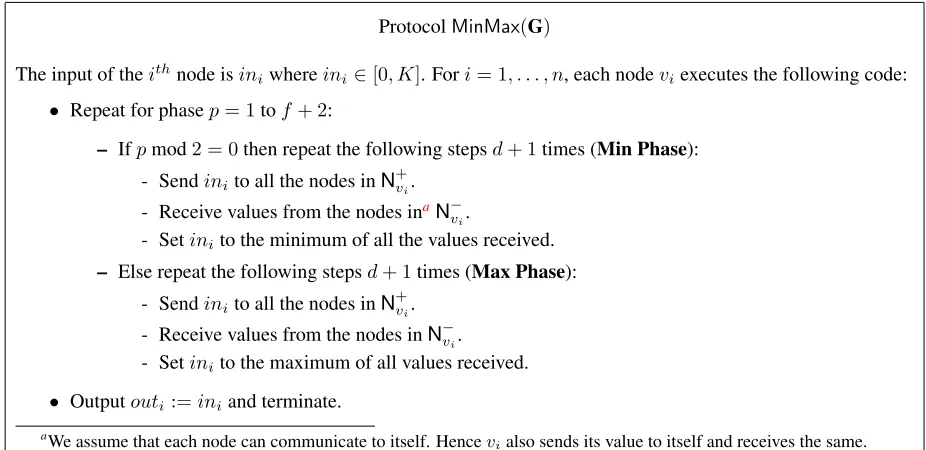
LetG= (V,E)be a directed graph where|V|=n, such thatGhasf crash-tolerant node connectivity. We present a multi-valued crash-tolerant consensus protocol calledMinMax(see Figure1) toleratingA. Similar to the consensus protocols of [14], the algorithm is based on min-max strategy, consisting off+ 2phases, with even numbered phases being a min phase while odd numbered phases being a max phase. Each phase further consists ofd+ 1rounds, whereddenotes the crash-tolerant diameter ofG.
ProtocolMinMax(G)
The input of theithnode isin
iwhereini∈[0, K]. Fori= 1, . . . , n, each nodeviexecutes the following code: • Repeat for phasep= 1tof+ 2:
– Ifpmod2 = 0then repeat the following stepsd+ 1times (Min Phase): - Sendinito all the nodes inN+vi.
- Receive values from the nodes inaN−
vi.
- Setinito the minimum of all the values received.
– Else repeat the following stepsd+ 1times (Max Phase): - Sendinito all the nodes inN+vi.
- Receive values from the nodes inN−vi.
- Setinito the maximum of all values received.
• Outputouti :=iniand terminate.
aWe assume that each node can communicate to itself. Hencev
ialso sends its value to itself and receives the same.
Figure 1: Multi-valued crash-tolerant consensus based on min-max strategy
We now prove the properties ofMinMax. We first claim that irrespective of the strategy followed byA
during the execution ofMinMax, there always exist either two consecutive crash-free phases or a crashed phase with a single crash, followed by a crash-free phase. Formally, letkidenote the total number of crashes
that occur during theithphase ofMinMax, wherek1+. . .+kf+2≤fand eachki ∈ {0, . . . , f}. Then we
have the following lemma.
Lemma 3.1. Irrespective of the strategy followed byAduringMinMax, there exists at least one subsequence
ki−1ki such that eitherki−1 = 0, ki= 0orki−1 = 1, ki = 0, wherei∈ {2, . . . f+ 2}.
Proof. We prove the lemma using strong induction, over the values off.
1. Consider the base case where,f = 1and the number of phases aref + 2 = 3. The set of all possible sequencek1k2k3is{000,100,010,001}and each of them has either the subsequence00or10.
2. Assume the lemma is true for allf where1≤f ≤t−1; i.e. either the subsequence00or10occurs among all possible sequencek1k2. . . kf+2, wheref ≤t−1.
3. Now considerf =t. We focus on the last termkt+2, where there are two possible cases:
– Ifkt+2≥1then it implies that at mostt−1faults could occur in the firstt+ 1phases. However
by induction hypothesis it follows that irrespective of the adversary strategy, the subsequence00 or10will occur among all possible sequencek1k2. . . kt+1 if at mostt−1faults are allowed
– Ifkt+2 = 0then we further focus on the termkt+1. Ifkt+1 has value1or0we meet our
subse-quence requirement. However ifkt+1 ≥2then it implies that at mostt−2faults could occur in
the firsttphases. However by induction hypothesis it follows that irrespective of the adversary strategy, the subsequence00or10will occur among all possible sequencek1k2. . . ktif at most
t−2faults are allowed duringtphases. This automatically implies that the subsequence00or 10will occur among all possible sequencek1k2. . . kt+2.
We next claim that if there are two consecutive crash-free phases then protocolMinMaxachieves consensus within those two phases. The idea behind the proof has been already discussed earlier (see section1). The formal proof is available in AppendixBdue to space constraints.
Lemma 3.2. LetGhavef crash-tolerant node connectivity. If during the execution ofMinMaxthere are two consecutive phases, sayptandpt+1, such that no crash occurs in any of these two phases then consensus is achieved by the end of phasept+1.
We next show that consensus will be achieved even if there is crashed phase followed by a crash-free phase, provided only one node crashes during the crashed phase.
Lemma 3.3. LetGhavef crash-tolerant node connectivity. If during the execution ofMinMaxthere are two consecutive phases, sayptandpt+1, such that only one node crashes duringptand no node crashes duringpt+1, then consensus is achieved by the end of phasept+1.
Proof: Without loss of generality letptbe a min phase andpt+1be a max phase. LetFdenote the nodes that
have crashed before the phaseptand letGF = (VF,EF) be the reduced graph at the beginning ofpt. Let
GF → GF0 denote the transition, where a single node inGF, sayvc, crashes during the phasept, resulting
in the reduced graphGF0. LetSG
F andSGF0 denote the set of source nodes for the reduced graphsGFand
GF0 respectively. If the crashed nodevc6∈ SG
F then the proof of the lemma is exactly the same as Lemma
3.2, as in this caseSGF =SGF0 (follows from Claim2.10). So we next consider the case whenvc ∈ SGF.
We have two further sub-cases:
• If the nodevccrashes during the first round ofptand without propagating its value to any node in
SGF0: in this case we can effectively ignore the effect of the initial source set SGF. Moreover, from
the second round onward ofpt, each node in the source setSGF0 will get the requireddrounds of
communication to propagate their value to every other node inGF0 duringpt. Furthermore, during
pt+1, the source set remains the same asSGF0. In essence, this is equivalent to as ifptandpt+1 are
executed over the reduced graphGF0 with at leastdrounds of communication, with the source set
beingSGF0 and with no crash occurring in these phases. So using exactly the same arguments as in
Lemma3.2, we can conclude that consensus will be achieved by the end of phasept+1.
• If the nodevccrashes after propagating its value to at least one node inSGF0: letλdenote the value
ofvcat the beginning ofpt. We first note that there exists at least one source node, sayvs0 ∈ SG
F0,
such thatvs0 receivesλfromvcat the end of the first round ofpt. This is because the nodevs0 will be
an outgoing neighbour of the nodevcinGF(this follows from Claim2.11). Moreover, the nodevs0
can propagateλto all the remaining nodes inGF0 duringpt. This follows from the definition ofdand
the fact thatpthas stilldrounds of communication left.
LetλminG0 denote the minimum value among the nodes inSGF0 at the beginning ofptand letλmin =
min(λ, λminG0 ). We claim that at the end of pt, all the nodes in SGF0 will haveλ
min as their updated
value. This is because no node inSGF0 will ever see a value smaller thanλminbeing propagated. Next
at the end ofpt. More specifically, if the non-source nodes inGF0 have their value greater thanλmin
at the beginning of phasept, then all these non-source nodes will setλmin as their updated value at
the end ofptand consensus will be achieved at the end ofpt. This is becauseλminwill be propagated
to all these nodes. On the other hand, if some non-source node has a value smaller thanλmin at the beginning ofpt, then the node will set a value smaller thanλminas its updated value at the end ofpt.
In this case, at the beginning ofpt+1, the valueλminwill be maximum value of any node. Moreover,
all the nodes inSGF0 will have λ
min as their value. Since p
t+1 is a max phase and no crash occurs
duringpt+1, it follows from the definition ofdthatλminwill be propagated to all the nodes inGF0and
every node will setλminas their updated value at the end ofpt+1, thus attaining consensus. 2
The following theorem follows from Lemma3.1-3.3and the fact that every node will terminate the protocol after(f+ 2)(d+ 1)rounds. In every round, each node has to sendlog|K|bits to all its outgoing neighbours and there areO(n)outgoing neighbours of every node; this proves the communication complexity.
Theorem 3.4. LetG = (V,E) be a directed graph with f tolerant node connectivity and crash-tolerant diameterd, where|V|=n. Then protocolMinMaxis a(f + 2)(d+ 1)round protocol for multi-valued consensus toleratingA. The protocol has communication complexityO(nf dlog|K|)bits.
Further optimization in the round complexity ofMinMax: In AppendixCwe present a modified version ofMinMax calledMinMax00, where we allow the first phase and the last phase to have exactlydrounds; the remainingf phases still consist ofd+ 1rounds of communication. Hence the total round complexity is(f + 2)(d+ 1)−2. We show thatMinMax00still achieves consensus. The idea is as follows: we first consider a variationMinMax0 ofMinMax, where only the first phase is restricted todrounds and show that
MinMax0 still achieves consensus within f + 2 phases. This is argued depending upon whether the first phase ofMinMax0 is crash-free or not. If it is crash-free, then the execution ofMinMax0is “equivalent” to that ofMinMax, where there ared+ 1rounds in the first phase and where the first phase is crash-free. On the other hand, if the first phase ofMinMax0 is not crash-free, then in the remainingf + 1phases (each of which hasd+ 1rounds), at mostf−1crashes can occur. Now using Lemma3.1, we can say that in these
f+ 1phases, either there will be at least two consecutive crash-free phases or a crashed phase with a single crash followed by a crash-free phase. So consensus will be achieved by the end of(f + 2)thphase. We then consider protocolMinMax00, which is a variation ofMinMax0 in that the last phase is now restricted to
drounds. Now again depending upon whether the last phase ofMinMax00is crash-free or not we show that consensus will be achieved byMinMax00.
4
Lower Bounds on Round Complexity of Consensus Protocols Based on
Min-Max strategy
In this section we consider crash-tolerant consensus protocols based on min-max strategy, consisting of alternate min and max phases and show few impossibility results regarding the minimum number of rounds required by consensus protocols. Based on these results, we conclude that our protocolMinMaxrequires
optimal number of communication rounds. We assume protocols which have alternate min-max phases, where the first phase is a min phase (this is without loss of generality).
4.1 Impossibility of Consensus inf+ 1Phases (Irrespective of the Number of Rounds)
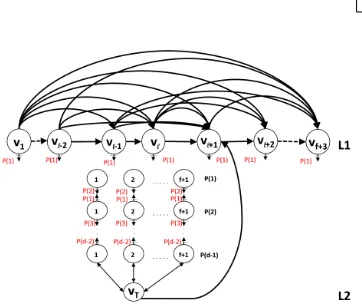
Consider the family of directed graphs withf-crash-tolerant node connectivity such that every graphG= (V,E) has the following properties (see Figure2): V = {v1, v2, ..., vf+3}. The edge set E = {(vi, vj)},
vf+2, vf+3, which do not have any outgoing edges. Nodev1 has input value1, while nodesv2, . . . , vf+3
have input value 0. The graph has d = 1.
Figure 2: The family of graphs in which it is impossible to achieve consensus in f + 1 phases.
LetΠMinMaxbe an arbitrary protocol forG, consisting off + 1 al-ternate min-max phases, where the first phase is a min phase. Moreover, each phase hasat least d rounds of communication5. We consider the following adversary strategy AMinMax by A duringΠMinMax: No crash occurs during phasep1. Adversary crashes node vi during phase pi+1
fori= 1, . . . , f in the following fashion: during the first round ofpi+1,
the nodevi sends its value to nodesvi+2, . . . , vf+3 and crashes. Hence,
exceptvi+1, all the neighbours ofvi receivevi’s value. The adversarial
strategy ensures the following: ifpi+1 is a min (resp. max) phase, then
viwill be the source node at the beginning ofpi+1with value0(resp.1),
while all the remaining nodesvi+1, . . . , vf+3 will have value1(resp. 0).
At the end ofpi+1, the nodevi+1 will be the source node with value1(resp. 0), while all the remaining
nodesvi+2, . . . , vf+3 will have value0(resp. 1). Hence at the end of each min (resp. max) phase, all the
nodes in the graph except the source will have value0 (resp. 1). So at the end ofΠMinMax, the reduced graph will have nodesvf+1, vf+2andvf+3, withvf+1being the source and wherevf+2andvf+3will have
values, different fromvf+1. The formal proof is available in AppendixD.
Theorem 4.1. Consensus will not be achieved inG(Figure2) byΠMinMaxagainst the strategyAMinMax.
4.2 Impossibility of Consensus with(f + 2)(d+ 1)−3Rounds in Total
Here we consider min-max protocols withf+2phases and(f+2)(d+1)−3rounds in total, with each phase having at leastdrounds. We present a family of directed graphs and a corresponding adversarial strategy against which consensus will not be achieved at the end of f + 2phases. This shows that the minimum number of rounds required is(f + 2)(d+ 1)−2, implying that our protocolMinMax00(optimized variant ofMinMax) isround optimal. Note that the adversarial strategyAMinMaxand the graph of Fig2cannot be used to derive the lower bound. This is because if we allowf + 2phases then consensus will be achieved in the graph of Fig2againstAMinMax. Hence we need to modify the graph and also the adversary strategy. The detailed proof can be found in AppendixE.
4.3 Impossibility of Consensus based on Min-Max Strategy in2f+ 1Phases with d Rounds
Here we consider protocols based on min-max strategy, consisting of2f+ 1alternate min and max phases, with each phase havingdrounds of communication. For several values off andd, we show that there exist graphs for which it is impossible to reach consensus within2f+1phases. The adversary strategy in all these graphs will be the following: without loss of generality, we will assume that the first phase is a min phase. Hence there will bef + 1min phases andf max phases. There will benocrash during the min phases and during each max phase,one newnode will get crashed by the adversary. Moreover, the node to be crashed will be thesourcenode of the reduced graph at the beginning of that phase. It will be always ensured that every reduced graph hasonly onesource node. It will be ensured that no consensus is achieved during any of the min phases. This is achieved by ensuring that at the beginning of each min phase, the source has value1and there exists at least one non-source node with value0. As a result, at the end of each min phase, the source will retain1as its value (as it will never see the value0during the min phase because there will be only one source), while there will be at least one node, which retains0as its value. During each of the
5
f max phases, the adversary will crash the source node. The crashed node will crash during the first round of a max phase, after sending its value1onlyto the new source of the reduced graph. The new source will further getd−1rounds to propagate the value1that it received from the crashed source. However, it will be ensured that that there is some node with value0which isddistance apart from the new source, such that it never sees the value1during the max phase and as a result, it retains its original value0, thus preventing consensus being achieved during the crashed max phase.
Presenting a generalized graph which maintains the above properties for a general value off anddis an extremely challenging task. But we believe that indeed it is possible to come up with a graph and corre-sponding adversary strategy for any arbitrary value offandd. In AppendixF, we present graphs for several values off andd, where consensus is achieved only at the end of2f + 2phases.
References
[1] E. Alchieri, A. N. Bessani, J. S. Fraga, and F. Greve. Byzantine Consensus with Unknown Participants. InOPODIS, pages 22–40, 2008.
[2] H. Attiya and J. Welch. Distributed Computing: Fundamentals, Simulation and Advanced Topics. Wiley series on Parallel and Distributed Computing, 2004.
[3] P. Bansal, P. Gopal, A. Gupta, K. Srinathan, and P. K. Vasishta. Byzantine Agreement Using Partial Authentication. InDISC, pages 389–403, 2011.
[4] D. P. Bertsekas and J. N. Tsitsiklis. Parallel and Distributed Computation: Numerical Methods. Opti-mization and Neural Computation Series. Athena Scientific, 1997.
[5] B. Charron-Bost, M. F¨ugger, and T. Nowak. Approximate Consensus in Highly Dynamic Networks: The Role of Averaging Algorithms. InICALP, pages 528–539, 2015.
[6] D. Dolev. The Byzantine Generals Strike Again. Journal of Algorithms, 3(1):14–30, 1982.
[7] M. J. Fischer, N. A. Lynch, and M. Merritt. Easy Impossibility Proofs for Distributed Consensus Problems. InPODC, pages 59–70. ACM, 1985.
[8] M. Fitzi.Generalized Communication and Security Models in Byzantine Agreement. PhD thesis, ETH Zurich, 2002.
[9] A. Jadbabaie, J. Lin, and A. S. Morse. Coordination of Groups of Mobile Autonomous Agents Using Nearest Neighbor Rules. IEEE Trans. Automat. Contr., 48(6):988–1001, 2003.
[10] N. A. Lynch. Distributed Algorithms. Morgan Kaufmann, 1996.
[11] M. Pease, R. E. Shostak, and L. Lamport. Reaching Agreement in the Presence of Faults. JACM, 27(2):228–234, 1980.
[12] U. Schmid, B. Weiss, and I. Keidar. Impossibility Results and Lower Bounds for Consensus under Link Failures. SIAM J. Comput., 38(5):1912–1951, 2009.
[14] L. Tseng and N. H. Vaidya. Crash-Tolerant Consensus in Directed Graphs. CoRR, abs/1412.8532, 2014. Full version appeared as [15].
[15] L. Tseng and N. H. Vaidya. Fault-Tolerant Consensus in Directed Graphs. InPODC, pages 451–460. ACM, 2015.
[16] L. Tseng and N. H. Vaidya. A Note on Fault-tolerant Consensus in Directed Networks.SIGACT News, 47(3):70–91, 2016.
A
Proof of the Properties of Reduced Graphs
Proposition2.7: If a nodevi ∈VFhas a directed path to any nodevj ∈SGF inGF, thenvi ∈SGF.
Proof. Since vj ∈ SGF is a source, it has a directed path to every node inGF. Hence if vi has a
di-rected path tovj, it implies thatvihas a directed path as well to every node inGF throughvj.
Claim2.9: Consider an arbitraryvi ∈ VF, such thatvi ∈/ SGF. Moreover vi ∈ VF0 (i.e. nodevi is not
crashed during the transitionGF→GF0). Let there exist at least one node, sayvj ∈SGF that is not crashed
by the adversary during the transitionGF→GF0 (i.e.vj 6∈T). Thenvi ∈/SGF0.
Proof. We prove the claim by contradiction. Letvi ∈/SGF be a non-source node inGFand letvi ∈SGF0 be
a source node inGF0, while there still exist a source-nodevj ∈ SG
F inGFthat has not crashed during the
transitionGF →GF0. Sincevi ∈SGF0, nodevimust have a directed path to nodevjinGF0. This path would
exist inGFas well since during the transitionGF→GF0, no new edges are added. Thus by proposition2.7,
vi ∈SGF as well, which is a contradiction.
Claim2.10: If during the transitionGF→GF0,T∩SGF =∅, thenSGF =SGF0.
Proof. We prove the claim by contradiction. AssumeSGF 6= SGF0. We know by Claim 2.9 that there
cannot exist a nodevisuch thatvi ∈/ SGF butvi ∈SGF0, unlessSGF ⊆T. However, this cannot hold since
it is given thatT∩SGF =∅. Therefore, forSGF =6 SGF0 to hold, there must exist a node, sayvi∈SGF such
thatvi ∈/ SGF0, even thoughT∩SGF =∅. We next show that this is not possible. For this we consider two
cases, depending upon the size ofSGF.
– Case 1: If|SGF| > 1: Let vj ∈ SGF0 (note that such avj exists as we are considering graphs with
f crash-tolerant node connectivity). Sincevi ∈SGF still exists inGF0, it follows from claim2.9that
vj ∈SGFas well. The path fromvitovjinGFmust consist only of nodes inSGF (By Corollary2.8).
Since the set of nodesTthat crashed during transition is such thatT∩SGF =∅, the path fromvito
vj still exists inGF0 as well. So by Proposition2.7,vi ∈SGF0, which is a contradiction.
– Case 2: If |SGF| = 1, comprising of the nodevi alone: By the guarantee off crash-tolerant node
connectivity, there must exist at least one source node, sayvj ∈SGF0. Moreovervi 6= vj (as we are
assumingvi ∈/SGF0). Sincevi ∈SGF has not crashed during the transition, it follows from claim2.9
thatvj ∈SGF. Thus bothvi, vj ∈SGF which contradicts the assumption that|SGF|= 1.
Claim 2.11: Let T = {vs}, where vs ∈ SGF (i.e. during the transition GF → GF0 the only node to
crash is a source nodevs). ThenN+vs∩SGF0 6=∅, whereN
+
the reduced graphGF.
Proof. By the f crash-tolerant node connectivity guarantee, after the described transition, there exists at least one source node, sayvs0 inGF0; i.e. vs0 ∈SG
F0. Also, sincevs ∈SGF it must have a path tovs0 in
GF. If there exist a direct edge fromvstovs0inGF(i.evs0 ∈N+v
s), thenN +
vs∩SGF0 6=∅. On the other hand,
if there exists a directed pathvs →vi →. . .→vs0 inGF, where there is a direct edge fromvstoviinGF,
then by proposition2.7we havevi ∈SGF0. Thus in this case alsoN +
vs∩SGF0 6=∅holds.
B
Properties of the Protocol
MinMax
Lemma3.2: LetGhavef crash-tolerant node connectivity. If during the execution ofMinMaxthere are two consecutive phases, sayptandpt+1, such that no crash occurs in any of these two phases then consensus
is achieved by the end of phasept+1.
Proof. Without loss of generality letptbe a min phase andpt+1be a max phase. LetFbe the set of nodes
that have crashed before phasept. Soptandpt+1are executed over the reduced graphGF = (VF,EF)with
the set of source nodesSGF. Note that the source set does not change during these two phases since no crash
occurs. Letλmin denote the minimum value among the nodes inSGF at the beginning ofptand letS
min
GF be
the set of source nodes possessing the minimum valueλmin. Now there are two possible cases:
• All the nodes in the setVF\SminGF have values which are greater that or equal toλ
minat the beginning of
pt: In this case, at the end ofpt, all the nodes inVFwill have their value equal toλmin. This is because
pt is a min phase and by the definition of crash-tolerant diameter, the value λmin will propagate to
each node inVF withindrounds of communication. Hence in this case, consensus is achieved at the
end ofpt.
• At least one node in the setVF\SGF has value less thanλ
minat the beginning ofp
t: In this case, all the
nodes in the source setSGF will have their value set toλ
minat the end ofp
t. This is because no node
in the source setSGF will ever see a value smaller thanλ
minbeing propagated duringp
t, otherwise it
contradicts the assumption thatλmin is the minimum value among the nodes inSGF at the beginning
ofpt. Moreover all the nodes in the setVF\SGF will have their values set to a value which is less than
or equal toλminat the end ofpt. This is becauseptis a min phase and the minimum value propagated
to any node inVF\SGF withindrounds of communication will be eitherλ
minor a value less that it.
This implies that at the beginning of the next phasept+1, the valueλminwill be the maximum value
of any node. Since all the nodes inSGF haveλ
minas their value duringp
t+1 and sincept+1is a max
phase, no node will ever see a value greater thanλminbeing propagated duringpt+1. Moreover by the
definition ofd, the valueλminwill be propagated to every non-source node duringpt+1. Hence at the
end ofpt+1 all the nodes inGF will set their values to λmin, thus achieving consensus at the end of
pt+1.
C
Optimizing the Round Complexity of
MinMax
In this section, we present a slightly modified version of theMinMaxprotocol, calledMinMax00that reduces the round complexity by an additional two rounds.MinMax00is similar toMinMaxexcept with the following difference: The first phasep1 and the(f + 2)th phasepf+2 comprises ofdrounds as opposed to(d+ 1)
We first consider a variation MinMax0 ofMinMax, where only the first phase is restricted todrounds. We show that irrespective of the adversary strategy, consensus will be achieved byMinMax0 withinf + 2 phases, for any value off.
Lemma C.1. LetGbe a directed graph withf0crash-tolerant node connectivity and crash-tolerant diam-eterd. LetMinMax0be a protocol consisting off0+ 2alternate min-max phases, where the first phase has
drounds and the remaining phases have d+ 1rounds. If at mostf0 crashes occur duringMinMax0, then irrespective of the adversary strategy, consensus will be achieved at the end ofMinMax0.
Proof. Let the sequencek01k20 . . . kf00+2 denote the faults occurred during thef0 + 2phases ofMinMax0,
where eachki0 ∈ {0, . . . , f0}andk01+. . .+kf00+2 ≤f0. Now consider the value ofk01. Depending upon the
behaviour of the adversary, we have the following two cases:
• k10 = 0: In this case, the execution ofMinMax0 is equivalent to an execution ofMinMax, where the first phase is crash-free. This follows from the definition of crash-tolerant diameterdsincedrounds suffice for a source’s value to propagate to all nodes in a graph. The remaining execution ofMinMax0
(namely the remainingf0+1phases) will be exactly the same as inMinMax. Now substitutingf =f0
in Theorem3.4, it follows that consensus will be achieved at the end ofMinMax0.
• k10 ≥ 1: This further implies that at most (f0−1)crashes can occur during the remaining(f0 + 1) phases, namelyp2, . . . , pf0+2. Each of the remaining(f0+ 1)phases haved+ 1rounds. Moreover,
the difference between the number of remaining phases and the total number of faults that can occur in these remaining phases is atleast two. Hence from Lemma3.1 there will be either two consecu-tive crash-free phases or a crashed phase with a single crash followed by a crash-free phase among
p2, . . . , pf0+2. More specifically, we considerf =f0−1and rename the remainingf0+ 1 = f+ 2
phases{p2. . . pf0+2}as{p1, . . . ,pf+2}, withkidenoting the number of faults that can occur during pi, whereki ∈ {0, . . . , f} andk1+. . .+kf+2 ≤ f. It follows via Lemma3.1that there exists at
least one subsequenceki−1kisuch that eitherki−1 = 0, ki = 0orki−1 = 1, ki = 0. Now, it follows
directly from lemmas3.2and3.3thatMinMax0achieves consensus.
We next consider a variation MinMax00 ofMinMax0, where the last phase is restricted to drounds (note that the first phase is implicitly restricted todrounds). We show that irrespective of the adversary strategy, consensus will be achieved byMinMax00withinf+ 2phases, for any value off.
Lemma C.2. LetGbe a directed graph withf00crash-tolerant node connectivity and crash-tolerant diam-eterd. LetMinMax00 be a protocol consisting off00+ 2alternate min-max phases, where the first and the last phase hasdrounds and the remaining phases have d+ 1rounds. If at mostf00 crashes occur during
MinMax00, then irrespective of the adversary strategy, consensus will be achieved at the end ofMinMax00.
Proof. Let the sequencek001k200. . . k00f00+2denote the faults caused by the adversary during thef00+ 2phases
ofMinMax00, where eachki00∈ {0, . . . , f00}andk100+. . .+kf0000+2 ≤f00. Now consider the value ofkf0000+2.
Depending upon the behaviour of the adversary, we have the following two cases:
• kf0000+2 = 0: In this case, the execution ofMinMax00is equivalent to an execution ofMinMax0, where
the last phase is crash-free. This follows from the definition of crash-tolerant diameter d sinced
rounds suffice for a source’s value to propagate to all nodes in a graph. The remaining execution of
MinMax00(namely the firstf00+ 1phases) will be exactly the same as inMinMax0. Now substituting
• kf00+2 ≥1: This further implies that at most(f00−1)crashes could occur during the first(f00+ 1)
phases, namelyp1, . . . , pf00+1. Moreover,p1 will havedrounds, whilep2, . . . , pf00+1will haved+ 1
rounds each. This is equivalent to an execution ofMinMax0protocol with at mostf0 =f00−1crashes andf0+ 2 =f00+ 1phases{p1, . . . pf00+1}. It now follows from lemmaC.1thatMinMax00achieves
consensus by the end ofpf00+1.
The following theorem directly follows from LemmaC.2by substitutingf00 =f and Theorem3.4.
Theorem C.3. Let G = (V,E) be a directed graph with f tolerant node connectivity and crash-tolerant diameterd, where|V| =n. Then protocolMinMax00is a(f + 2)(d+ 1)−2round protocol for multi-valued consensus toleratingA. The protocol has communication complexityO(nf dlog|K|)bits.
D
Proof of Impossibility of Consensus based on Min-Max Strategy in
f
+ 1
Phases
Theorem4.1: Consensus will not be achieved inG(Figure2) byΠMinMaxagainst the strategyAMinMax.
Proof. To prove the lemma, we consider each phase ofΠMinMax:
• At the end ofp1, there will no change in the values of the node inG. This is because this is a min
phase. As nodev1 will only see value1throughoutp1, its value will remain1. Whilev2, . . . , vf+3
will retain0as their value, even though they see both0and1duringp1.
• At the end ofp2, the reduced graphGF1 will consist of nodesv2, . . . , vf+3, withv2being the source
node, whereF1 = {v1}is the set of nodes crashed till now. Moreover,v2 will retain0as its value,
while v3, . . . , vf+3 will set 1 as their value. This is because, as per the strategy of AMinMax, the
crashed node v1 sends 1to all the nodes in GF1, exceptv2 and since it is a max phase, the nodes
v3, . . . , vf+3will set1as their input. However,v2will not see any value other than0throughoutp2.
• At the end ofp3, the reduced graphGF2 will consist of nodesv3, . . . , vf+3, withv3being the source
node, where F1 = {v1, v2} is the set of nodes crashed till now. Moreover, v3 will retain1 as its
value, whilev4, . . . , vf+3 will set0 as their value. This is because, as per the strategy ofAMinMax,
the crashed nodev2 sends0to all the nodes inGF2, exceptv3and since it is a min phase, the nodes
v4, . . . , vf+3will set0as their value. However,v3will not see any value other than1throughoutp3.
• In general, iff is odd, then the last crashed phasepf+1will be a max phase. The reduced graphGF
will consist of nodesvf+1, vf+2andvf+3, with values0,1and1respectively; hereF={v1, . . . , vf}
denote the set of crashed nodes till the end ofpf+1. Hence no consensus will be achieved among
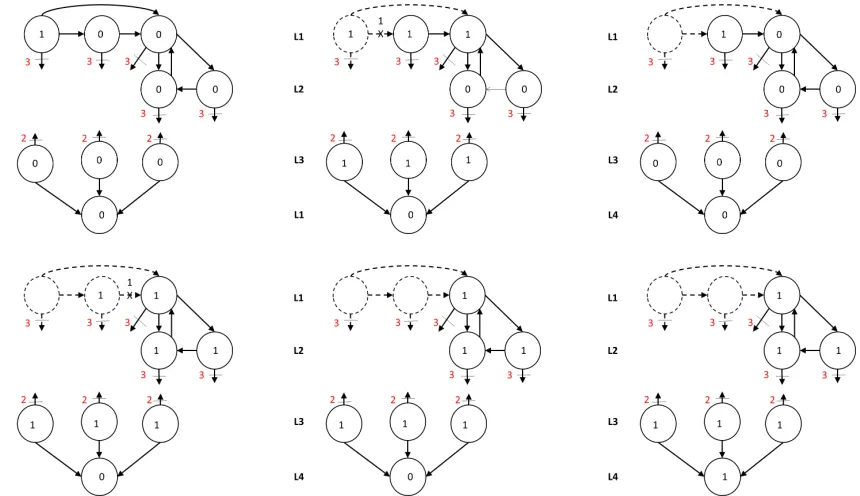
vf+1, vf+2 andvf+3 at the end of ΠMinMax. For a demonstration of the executionΠMinMax against AMinMaxfor odd value off, see Figure3.
On the other hand, iff is even, then the last crashed phasepf+1 will be a min phase. The reduced
graphGF will consist of nodesvf+1, vf+2 andvf+3, with values1,0and0 respectively. Hence no
Figure 3: Execution ofΠMinMaxinGagainstAMinMaxforf = 1. The first figure denotes the values of the nodes at the beginning ofp1. No crash occurs and the values of the nodes remain the same at the end ofp1.
The second figure denotes the reduced graph due to the crash ofv1 duringp2, with the values of the nodes
at the end ofp2.
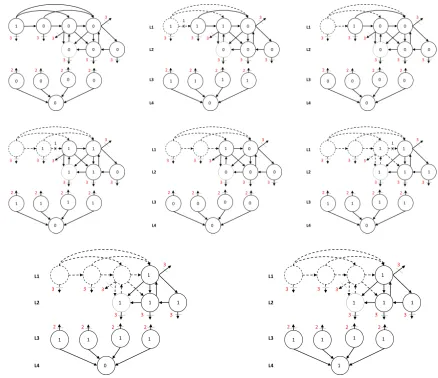
Figure 4: Execution ofΠMinMaxinGagainstAMinMaxforf = 2. The first figure denotes the values of the nodes at the beginning ofp1. No crash occurs and the values of the nodes remain the same at the end ofp1.
The second figure denotes the reduced graph due to the crash ofv1 duringp2, with the values of the nodes
at the end ofp2. The third figure denotes the reduced graph due to the crash ofv2duringp3, with the values
of the nodes at the end ofp3.
E
Impossibility of Consensus with
(
f
+ 2)(
d
+ 1)
−
3
Rounds in Total
Πis an arbitrary min-max based protocol withf+ 2phasesp1. . . , pf+2and(f+ 2)(d+ 1)−3rounds, with
each phase having at leastdrounds. We first derive few properties ofΠ, based on counting arguments. To begin with we claim that inΠ, there existat leastthree phases, each withexactlydrounds of communication.
Lemma E.1. In protocolΠthere exist at least three phases consisting of exactlydrounds each.
Proof. We prove the lemma by contradiction. Suppose there are at most two phases with exactlydrounds. Then, the remainingf phases must have at leastd+ 1rounds. This sums upto a total of2(d) + (f)(d+ 1) = 2d+f d+f, which is one more than the total number of rounds ofΠi.e(f+ 2)(d+ 1)−3 =f d+f+ 2d+ 2−3 = 2d+f d+f −1. Thus, we have arrived at a contradiction which proves thatΠmust have at leastthreephases with exactlydrounds each.
Based on LemmaE.1, we next show that inΠ, other than the first and the last phase, there exists at least one “intermediate phase”p` ∈ {p2, . . . , pf+1}consisting ofexactlydrounds; moreover ifp` 6=pf+1 then
it holds that the phasep`+2 inΠhasat mostd+ 1rounds6. More specifically, letr1, . . . , rf+2 denote the
number of rounds in phasep1, . . . , pf+2ofΠrespectively, where eachri≥dand wherer1+. . .+rf+2=
(f + 2)(d+ 1)−3. Then we have the following lemma.
6Note that ifp
Lemma E.2. In protocolΠ, one of the following holds:
• There exists a phasep` ∈ {p2, . . . , pf}, wherer`=dandr`+2 ≤d+ 1.
• rf+1=d.
Proof. We prove the lemma by contradiction. So assume that none of the two conditions hold in protocol Π. Hencerf+1 ≥ d+ 1. From LemmaE.1we know that are at least three phases consisting ofdrounds
each, which further implies that there exists at least one phasep` ∈ {p2, . . . , pf}, with r` = d. Note that
as per our assumption, we haver`+2 ≥ d+ 2 for every suchp`. Now we have the following two cases,
depending upon the total number of phases withdrounds inΠ:
• Π has exactly three phases of d rounds: consider r1 = rf+2 = d and r` = d for exactly one
p` ∈ {p2, . . . , pf}. Moreover, r`+2 ≥ d+ 2. Furthermoreri ≥ d+ 1, for alli ∈ {2, . . . f + 1}
andi6= `, `+ 2. This sums upto a total of at least3(d) +d+ 2 + (f −2)(d+ 1) = 2d+f d+f
rounds, which is at least one more than the available number of rounds inΠ and so we arrive at a contradiction.
• Π has more than three phases ofdrounds: Let there be m+ 2phases with drounds each, where
m >1. Considerr1 =rf+2 =d. Moreover, as per our assumption,rf+1 ≥d+ 1. Furthermore for
each of themphasesp`∈ {p2, . . . , pf}withdrounds, the correspondingp`+2phase has at leastd+ 2
rounds. This sums upto a total of at least(m+ 2)(d) +m(d+ 2) + (f−2m)(d+ 1) = 2d+f d+f
rounds, which is at least one more than the available number of rounds inΠ and so we arrive at a contradiction.
Figure 5: The family of graphs in which it is impossible to achieve consensus inf+ 2 phases with each round having at least d
rounds and with total (f + 2)(d+ 1)−3 rounds.
Now consider the directed graphG(see Figure5) withf crash-tolerant node connectivity and with crash-crash-tolerant diameterd. We next recall the adversary strategy AΠ consisting of
sub-strategiesA1
Π andA2Π against the protocol Π, executed over
G:
• From phasep1top`−1, the sub-strategyA1Πis followed,
which is exactly the same as the strategy AMinMax. Namelyp1is crash-free. Then in each of the subsequent
phasep2, . . . , p`−1, the source node crashes during the
first round of the phase after sending its value to all its outgoing neighbours, except the next source in the L1 layer.
• Betweenp` andp`+2, the sub-strategyA2Πis followed:
at the beginning of phase p`, the node v`−1 in the L1
layer will be the source node. During the first round ofp`, the sourcev`−1 crashes after sending its value to
the next sourcev`. The next phasep`+1 is a crash-free
phase. Duringp`+2, the source nodev` crashes in one
of the following two ways, depending upon whetherp`+2 hasdord+ 1rounds:
– p`+2 hasdrounds: herev` crashes after sending its value to all its neighbours (both in theL1
– p`+2 hasd+ 1rounds: herev` crashes after sending its value only to its neighbours in theL1
layer (and not to the neighbours inP(1)layer), exceptv`+1.
• For the remaining phases p`+3, . . . , pf+2, sub-strategy A1
Πis followed, where in each phase, the source node in
L1layer crashes after sending its value to all its neigh-bour (inL1layer andP(1)layer), except the next source in theL1layer.
Note that in the above description, we assumed that p` 6= pf+1, so that phase p`+2 exists in Π. In case
p` =pf+1, thenA1Πis followed fromp1 topf, whileA2Πis followed duringpf+1andpf+2. We now prove
the following theorem.
Theorem E.3. LetΠbe a min-max protocol wthf+ 2phases with total(f+ 2)(d+ 1)−3rounds, where each phase has at leastdrounds. Then consensus will not be achieved inG(Figure5) byΠagainstAΠ.
Proof of TheoremE.3: For simplicity, we first assume thatp` 6=pf+1, so that phasep`+2 exists inΠ. We
next analyse the outcome of the adversary strategyAΠagainstΠover the graphGin Fig5.
• Phasep1, . . . , p`−1: No change occurs in the graph duringp1 as it is a crash-free min phase. At the
end ofp1, the source nodev1has value1, while all the remaining nodes in the graph has value0. Due
to the adversary strategyA1
Π, the following invariant is maintained at the end of each phasepi for
i= 2, . . . , `−1: the source of the reduced graph will bevi. Ifpiis a min phase thenvihas value1,
while all the remaining nodes have value0. On the other hand ifpi is a max phase thenvi has value
0, while all the remaining nodes have value1. Hence consensus is not achieved in any of the phases
p1, . . . , p`−1.
• Phasep`, p`+1 andp`+2: Without loss of generality, letp` be a max phase, implying thatp`+1 and
p`+2are min and max phase respectively. We analyse each of these three phases separately.
– Phasep`: At the beginning ofp`, nodev`−1 will be the source node with value1, while all the
remaining nodes in the reduced graph will have value0. As per the adversary strategy, at the end of the first round ofp`, the new sourcev`will have value1, as it is a max phase. This value
further gets propagated to all other nodes in the graph, exceptvT, within the remainingd−1
rounds ofp`. At the end ofp`, all the nodes in the reduced graph have value1, except the node
vT, which retains the value0. This is because vT is at a distance dfrom the new source v`.
Hence consensus is not achieved in this phase.
– Phasep`+1: as per the adversary strategy this is a crash-free phase. However, due to the presence
of backward edges fromvT to the nodes inP(d−1)and to the nodev`+1, the value0ofvT
starts propagating backward. So even though there is no crash duringp`+1, by the end ofp`+1,
all the nodes in the graph except the sourcev`, reset their value to0. Note thatv`never sees the
value0and hence it retains the value1. Hence consensus is not achieved in this phase.
– Phasep`+2: here there are two cases, depending upon whetherp`+2hasdord+ 1rounds. ∗ p`+2hasdrounds: here the value1is passed to all the neighbours of the sourcev`, except
v`+1, at the end of the first round after whichv` crashes. As there are still d−1rounds
left inp`+2, the value1further propagates to all the remaining nodes in the reduced graph.
Hence at the end of this phase, except the nodev`+1, all the nodes have value 1 and so
∗ p`+2 hasd+ 1 rounds: here the value1is passed to all the neighbours of the sourcev`,
exceptv`+1and the nodes in layerP(1), at the end of the first round after whichv`crashes.
As there are stilldrounds left inp`+2, the value1further propagates to all the remaining
nodes in the reduced graph. Hence at the end of this phase, except the nodev`+1, all the
nodes have value1and so consensus is not achieved in this phase. Note that it is important that this phase has at mostd+ 1rounds, as other wise the nodev`+1 would also receive1
fromvT if there ared+ 2rounds in this phase. This is because oncev`crashes, nodevT
also becomes a source node, apart fromv`+1.
• Phasep`+3, . . . , pf+2: Note that the invariant condition that was maintained at the end ofp2, . . . , p`−1
is re-instated at the end ofp`+2. Namely, one of the source nodesv`+1 has a value0, while all the
remaining nodes have value1. The invariant is going to be retained for phasep`+3, . . . , pf+2. More
specifically, the following is ensured at the end of each phasepifori=`+ 3, . . . , f+ 2: the source
of the reduced graph will bevi−1 (and notvi). Ifpi is a min phase thenvi−1 has value1, while all
the remaining nodes have value 0. On the other hand ifpi is a max phase thenvi−1 has value 0,
while all the remaining nodes have value1. Hence consensus is not achieved in any of the phases
p`+3, . . . , pf+2.
Oncepf+2 is over the reduced graph consists of nodes vf+1, vf+2 andvf+3, along with all theP
nodes and vT. The source of the reduced graph will bevf+1 having a value different from all the
remaining nodes in the graph, all of which will have the same value.
We next consider the case whenp` = pf+1. In this case, phase p`+2 does not exist in Π. Here A1Π is
followed fromp1 topf, whileA2Πis followed duringpf+1 andpf+2. We analyse the different phases ofΠ
in this case.
• Phasep1, . . . , pf: Here no change occurs in the graph duringp1. The following invariant is
main-tained at the end of each phasepifori= 2, . . . , f: the source of the reduced graph will bevi. Ifpiis
a min phase thenvihas value1, while all the remaining nodes have value0. On the other hand ifpiis
a max phase thenvihas value0, while all the remaining nodes have value1. Hence consensus is not
achieved in any of the phasesp1, . . . , pf.
• Phasepf+1: Without loss of generality, letpf+1be max phase. At the beginning ofpf+1, nodevf
will be the source node with a value1, while all the remaining nodes in the reduced graph will have value0. As per the adversary strategy, at the end of the first round ofpf+1, the new sourcevf+1 will
have value1, as it is a max phase. This value further gets propagated to all other nodes in the graph, exceptvT, within the remainingd−1rounds ofpf+1. At the end ofpf+1, all the nodes in the reduced
graph have value1, except the nodevT, which retains the value0. This is becausevT is at a distance
dfrom the new sourcev`. Hence consensus is not achieved in this phase.
• Phasepf+2: As per the adversary strategy, this is a crash-free phase. Since it is a min phase, the value
0ofvT gets propagated back to all the nodes of the graph, except the source nodevf+1, which retains
its value1. Hence consensus is not achieved in this phase. 2
F
Impossibility of Consensus in
2
f
+1
Min-Max Phases with
d
Rounds Each
Here we show the impossibility of consensus in2f + 1alternate min-max phases for different values off
Lemma F.1. Letf = 1andd≥1. Then there exist directed graphs withf crash-tolerant node connectivity and crash-tolerant diameterd, and an adversary strategy forA, where consensus can be achieved only if there are2f+ 2alternate min and max phases, where each phase hasdrounds of communication.
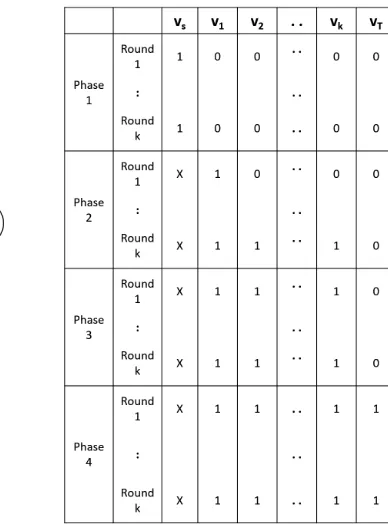
Proof: Consider the family of graph given in Fig.6, with the initial values of the nodes given in the figure. The graph has crash-tolerant diameterd=kwherek≥1and hasf crash-tolerant node connectivity. The graph containsk+ 2nodes where in the first phasevs is the initial source. It has a direct edge to all the
nodes. In this graphvihas a direct edge only tovj, fori∈ {1, . . . , k−1}andj =i+ 1, andvkhas a direct
edge to the sinkvT. It is easy to verify that the graph has crash-tolerant node connectivity of1: ifvscrashes
thenv1becomes the source, elsevsis the source. Ifv1becomes the source then it is at a distancekfrom the
nodevT and sod=kin the graph.
The adversarial strategy in the graph is as follows: the first phase is a crash-free min phase, due to which no change will occur to the value of the nodes in the graph. This is because the sourcevssees only value
1, while the remaining nodes will retain 0as their value, as this is a min phase. In the next phase which is a max phase, the sourcevscrashes during the first round after sending its inputonlyto the source of the
reduced graph, namely the nodev1. Moreover, this new sourcev1will getd−1 =k−1rounds to propagate
the value1to the nodesv2, . . . , vk. As a result, at the end of second phase, the nodesv1, . . . , vkwill set1as
their value as it is a max phase, However nodevT will still retain0as its value, since it never sees the value
1. During the third phase which is a crash-free min phase, no change happens in the graph. Specifically, the nodesv1, . . . , vkwill only see the value1; on the other hand even thoughvT sees the value1as well as0, it
retains0as its value since this is a min phase. Hence no consensus will be achieved betweenv1, . . . , vkand
vT at the end of the third phase. During the fourth phase there will be no crash (asf = 1) and consensus
is achieved, where all the nodes have value1. In Fig. 6, we present the transition table with the values of each node at the end of each round of each of the four phases. In the table, the symbol “X” denotes that the
corresponding node has crashed. 2
Lemma F.2. Letd= 1andf ≥1. Then there exist directed graphs withf crash-tolerant node connectivity and crash-tolerant diameterd, and an adversary strategy forA, where consensus can be achieved only if there are2f+ 2alternate min and max phases, where each phase hasdrounds of communication.
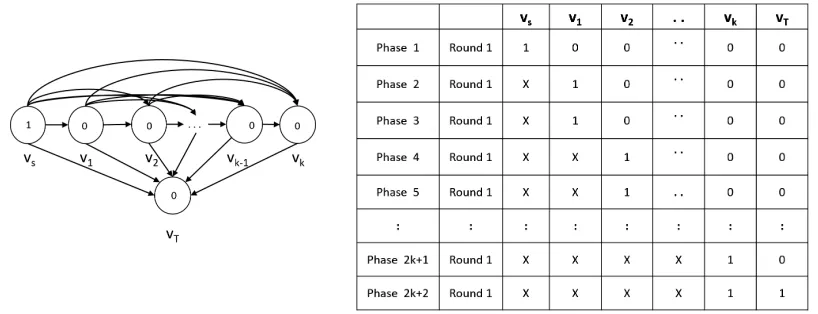
Proof: Consider the family of directed graphs given in Fig.7, with crash-tolerant diameterd= 1and which hasf crash-tolerant node connectivity, wheref = k. The initial value of the nodes are also given in the figure. The graph containsk+ 2nodes where in every phase there is always one source. The initial source
vsand the potential sourcesvi have a direct edge to all thejthnodes in the graph, fori∈ {1, . . . , k−1}
andj > i. There is one nodevT in the graph which is the sink of the graph and all the other nodes have
outgoing edges to this sink.
The adversarial strategy in this graph is as follows: the first phase is a crash-free min phase, due to which no changes occur in the value of the nodes. Then each subsequent min phase is also a crash-free min phase. During each max phase, the adversary crashes only node, namely the source of the current reduced graph, during the first round of the max phase. Moreover, before crashing, the source node sends its valueonlyto the source of the next reduced graph. For instance, during the first max phase (which is overall the second phase in the protocol), the sourcevscrashes after sending its value1only to the source of the next reduced
graph, namelyv1. Sinced = 1, it is ensured that the value of the crashed source node does not propagate
further in the graph during a crashed max phase. The manner in which the crashed source node propagates its value during a max phase , it is ensured that in the immediate next min phase (which is crash-free), no node in the reduced graph will change their value. This is because there will be only one source node in the reduced graph, and with value1, and throughout the min phase it sees only value1. On the other hand, the non-source nodes will see both0and1and will retain0as their input. As there will bef =kcrashed max phases, it follows that at the end of phase number2f, the reduced graph will be left with nodesvkandvT,
with values1and0respectively and with vk as the source. During the phase number2f + 1, no change
will occur in the graph and hence no consensus is achieved betweenvk andvT. The consensus is finally
achieved in phase number2f+ 2. The transition table with the values of each node at the end of each round
of each of the2f+ 2phases is given in Fig.7. 2
Figure 7: The graph for the casef =kandd= 1, with the corresponding transition table.