Open Access
Research
A statistical approach to estimating the strength of cell-cell
interactions under the differential adhesion hypothesis
Mathieu Emily*
1,2and Olivier François
1Address: 1TIMC-TIMB, Université Joseph Fourier, INP Grenoble, Faculty of Medicine, 38706 La Tronche cedex, France and 2Bioinformatics Research Center (BiRC), University of Aarhus, Hoegh-Guldbergs Gade 10, 8000 Aarhus C, Denmark
Email: Mathieu Emily* - [email protected]; Olivier François - [email protected] * Corresponding author
Abstract
Background: The Differential Adhesion Hypothesis (DAH) is a theory of the organization of cells within a tissue which has been validated by several biological experiments and tested against several alternative computational models.
Results: In this study, a statistical approach was developed for the estimation of the strength of adhesion, incorporating earlier discrete lattice models into a continuous marked point process framework. This framework allows to describe an ergodic Markov Chain Monte Carlo algorithm that can simulate the model and reproduce empirical biological patterns. The estimation procedure, based on a pseudo-likelihood approximation, is validated with simulations, and a brief application to medulloblastoma stained by beta-catenin markers is given.
Conclusion: Our model includes the strength of cell-cell adhesion as a statistical parameter. The estimation procedure for this parameter is consistent with experimental data and would be useful for high-throughput cancer studies.
Background
The development and the maintenance of multi-cellular organisms are driven by permanent rearrangements of cell shapes and positions. Such rearrangements are a key step for the reconstruction of functional organs [1]. In vitro experiments such as Holtfreter's experiments on the pronephros [2] and the famous example of an adult living organism Hydra [3] are illustrations of spectacular spon-taneous cell sorting. Steinberg [4-7] used the ability of cells to self-organize in coherent structures to conduct a series of pioneering experimental studies that character-ized cell adhesion as a major actor of cell sorting. Follow-ing his experiments, Steinberg suggested that the interaction between two cells involves an adhesion sur-face energy which varies according to the cell type. To
interpret cell sorting, Steinberg formulated the Differen-tial Adhesion Hypothesis (DAH), which states that cells can explore various configurations and finally reach the lowest-energy configuration. During the past decades, the DAH has been experimentally tested in various situations such as gastrulation [8], cell shaping [9], control of pat-tern formation [10] and the engulfment of a tissue by another one. Some of these experiments have been recently improved to support the DAH with more evi-dence [11].
In the 80's and the 90's, the DAH inspired the develop-ment of many mathematical models. These models, recently reviewed in [12], rely on computer simulations of physical processes. In summary, these models act by
min-Published: 18 September 2007
Theoretical Biology and Medical Modelling 2007, 4:37 doi:10.1186/1742-4682-4-37
Received: 23 April 2007 Accepted: 18 September 2007
This article is available from: http://www.tbiomed.com/content/4/1/37
© 2007 Emily and François; licensee BioMed Central Ltd.
imizing an energy functional called the Hamiltonian, and they can be classified into four main groups according to the geometry chosen to describe the tissues.
First, cell-lattice models consider that each cell is geometri-cally described by a common shape, generally a regular polygon (square, hexagon, etc ...) (see [13] for example). Although these models may not be realistic due to the simple representation of each cell, their computation is straightforward and fast. The second class of models has been called centric models. In comparison with the cell-lat-tice models, centric models are based on more realistic cell geometries by using tessellations to define cell bound-aries from a point pattern where points characterize cell centers [14]. While the main benefit of this class of mod-els is the use of a continuous geometry, tessellation algo-rithms are known to be computationally slow [12]. The third class of models are the vertex models. These models are dual to the centric models [15,16], and they have the same characteristics in terms of realism and computa-tional behavior. The fourth class of models, called sub-cel-lular lattice models, has been developed as a trade-off between the simulation speed of cell-lattice models and the geometrical flexibility of the centric models. The first sub-cellular lattice model was introduced by Graner and Glazier (GG model) [17].
Tuning the internal parameters of centric or lattice models is usually achieved by direct comparison of the model output and the real data that they are supposed to mimic. An important challenge is to provide automatic estima-tion procedures for these parameters based on statistically consistent models and algorithms. For example, it is now acknowledged that cell-cell interactions play a major role in tumorigenesis [18]. Better understanding and estimat-ing the nature of these interactions may play a key role for an early detection of cancer. In addition, the invasive nature of some tumors is directly linked to the modifica-tion of the strength of cell-cell interacmodifica-tions [19]. Estimat-ing this parameter could therefore be a step toward more accurate prognosis.
In this study, we present a statistical approach to the esti-mation of the strength of adhesion between cells under the DAH, based on a continuous stochastic model for cell sorting rather than a discrete one. Our model is inspired by the pioneering works of Sulsky et al. [20], Graner and Sawada (GS model) [21] and from the GG model [17]. In the new model, the geometry of cells is actually similar to the centric models: assuming that cell centers are known, the cells are approximated by Dirichlet cells. Using the theory of Gibbsian marked point processes [22], the con-tinuous model can still be described through a Hamilto-nian function (Section "A continuous model for DAH"). The Gibbsian marked point processes theory contains
standard procedures to estimate interaction parameters. In addition, it allows us to provide more rigorous simula-tion algorithms including better control of mixing proper-ties, and it also provides a tool for establish consistency of estimators (Section "Inference procedure and model sim-ulation"). In Section "Results and Discussion", results concerning the simulation of classical cell sorting patterns using this new model are reported, and the performances of the cell-cell adhesion strength estimator derived from this model are evaluated.
A continuous model for DAH
In this section, a new continuous model for differential adhesion is introduced. Like previous approaches, the model is based on a Hamiltonian function that describes cell-cell interactions. The Hamiltonian function incorpo-rates two terms: an interaction term and a shape con-straint term. The interaction term refers to the DAH through a differential expression of Cellular Adhesion Molecules (CAMs) weighted by the length of the mem-brane separating cells. This model is inspired by cell-cell interactions driven by cadherin-catenin complexes [23] which are known to be implicated in cancerous processes [24]. The main characteristic of interactions driven by cad-herin-catenin complexes is that the strength of adhesion is proportional to the length of the membrane shared by two contiguous cells. This particularity is due to a zipper-like crystalline structure of cadherin interactions [25]. The constraint term relates to the shape of biological cells and prevent non-realistic cell shapes.
The proposed model uses a Dirichlet tessellation as a rep-resentation of cell geometry. The Dirichlet tessellation is entirely specified from the locations of the cell centers. Formally, we denote by xi (i = 1, ..., n) the n cell centers,
where xi is assumed to belong to a non-empty compact
subset of ⺢2. The Dirichlet cell of x
i is denoted by
Dir(xi), and is defined as the set of points (within ) which are closer to xi than to any other cell centers. Let us
denote a (marked) cell configuration as
ϕ = {(x1, τ1), ..., (xn, τn)}, (1)
where the (xi) are the cell centers, and the (τi) are the cor-responding cell types (or marks). The marks belong to a finite discrete space M. In the section "Results and Discus-sion", we consider the case where cells may be of one of the three types: M = {τ1, τ2, τE}, in analogy with cell types used in [26].
The interaction term corresponds to pair potentials and it controls the adhesion forces between contiguous cells. This term is defined as follows
where |Dir(xi ∩ xj)| denotes the length of the contact zone between cell xi and cell xj. Function J is assumed to be sym-metric and nonnegative
J : M × M → [0, ∞)
The symbol i ~ϕj means that the cells xi and xj share a
com-mon edge in the Dirichlet tiling built from the configura-tion of points in ϕ.
The shape constraint term corresponds to singleton potentials. It controls the form of each cells and puts a penalty on abnormally large cells. It is defined as follows
where the function h is assumed to be nonnegative
h : × M → [0, ∞)
One specific form of the term h(Dir(xi), τi), used as an example in this paper, will be described in the section "Results and Discussion". The energy functional of our model is defined as a combination of the interaction term and the shape constraint as follows
H(ϕ) = θ Hinter (ϕ) + Hshape (ϕ) (2)
where θ is a positive parameter. This parameter can be interpreted as an adhesion strength intensity, as it deter-mines the relative contribution of cell-cell interactions in the energy. It may reflect the general state of a tissue, and its inference is relevant to applications of the model to experimental data.
Since one considers finite configurations ϕ on the com-pact set × , the energy functional H(ϕ) is finite (|H(ϕ)| < ∞). Indeed, one can notice that the area of the cell |Dir(xi)| is bounded by the area of the compact set . Coupling with the fact that h is a real-valued function, it comes that Hshape is bounded. Similarly, the length of a
common edge |Dir(xi ∩ xj)| is bounded by the diameter of
the compact set , and providing that J is a real-valued function, Hinter is also bounded. Moreover, since J and h
are positive functions and θ > 0, H(ϕ) is even positive.
Before giving an inference procedure for θ, we describe the connections of our continuous model to earlier models, for which no such procedure exists. The new continuous model improves on three previous approaches by Sulsky et al. [20], Graner and Sawada [21] and Graner and Gla-zier [17]. Sulsky et al. proposed a model of cell sorting [20] according to a parallel between cell movements and fluid dynamics. A Dirichlet tessellation was used for mod-eling cells, the following Hamiltonian was introduced
where ei, j is the interaction energy between cells xi and xj. As in our new continuous model, the length of the mem-brane also contributes to the energy. Graner and Sawada described another geometrical model for cell rearrange-ment [21]. Graner and Sawada introduced "free Dirichlet domains", which are an extension of Dirichlet domains, to overcome the excess of regular shapes in classical Dirichlet tilings. In addition to this geometrical represen-tation, Graner and Sawada proposed an extension to Sul-sky's Hamiltonian accounting for the interaction between cells and the external medium
where |Dir(xi ∩ M)| is the length of the membrane
between cell xi and the extracellular medium. This term is equal to 0 if the extracellular medium is not in the neigh-bourhood of xi. While the length of the membrane is explicitly included in the models, no statistical estimate for the interaction strength was proposed in these two approaches.
In the GG model [17], a cell is not defined as a simple unit, but instead consists of several pixels. The cells can belong to three types: high surface energy cells, low sur-face energy cells or medium cells, which were coded as 1, 2 and -1 in the original approach. According to the DAH, Hamiltonian HGG was defined as follows
where (i, j) are the pixel spatial coordinates, σij represents the cell to which the pixel (i, j) belongs, τ(σij) denotes the type of the cell σij, and the function J characterizes the interaction intensity between two cell types (δ denoted the Kronecker symbol). The neigbourhood relationship used by Graner and Glazier is of second order which means that diagonal pixels interact. The term
H xi xj J i j
i j
inter( ) Dir( ) ( , )
~
ϕ τ τ
ϕ
=
∑
∩H h xi i
i
shape( )ϕ =
∑
(Dir( ), )τ
HS =
∑
Dir( ∩ ) , ~xi xj ei j
i j (3)
H xi xj ei j x M e
i j
i i M
i
GS=
∑
Dir( ∩ ) , +∑
Dir( ∩ )~
,
H J ij i j a
i j i j ij i j
GG= ′ ′
(
−)
+ −′ ′
∑ ( ( ), ( )) ′ ′ ( ( )
( , )~( , )
,
τ σ τ σ 1 δσ σ λ σ AAτ σ Aτ σ
σ ( ) ( )
)2Γ( ),
indicates that the interaction between two
pixels within the same cell is zero. Shape constraints are modeled by the second term where λ corresponds to an elasticity coefficient, a(σ) is the cell area and Aτ(σ) is a prior area of a cell of type τ > 0. The function Γ denotes the Heaviside function and is included in the formula so that medium cells (coding -1) are not subject to the shape constraint. This model is simulated using the Boltzmann dynamics with various parameter settings and is able to reproduce many biologically relevant patterns [26]. The model introduced in this paper is a formal extension of the continuous version of the GG model [17] and also of the models introduced by Sulsky et al. [20] and Graner and Sawada [21]. Let us now explain in which sense this extension works. In the GG model, a cell σ is in the neigh-bourhood of a cell σ' as soon as a single pixel of σ is adja-cent to a pixel from σ'. With this in mind, the GG model's Hamiltonian can be rewritten as
where |σ∩σ'| is the number of connected pixels between
σ and σ'. The quantity |σ ∩σ'| can be identified as the Euclidean length of the interaction surface between the two cells σ and σ'. Identifying cells to their centers, |σ∩
σ'| can be approximated as |Dir(xi ∩ xj)|. In addition, a cell area in our model matches with the area of a Dirichlet cell, which means that a(σ) corresponds to |Dir(xi)|. Using
these notations, the GG energy function can be rewritten in a form similar to our Hamiltonian
The second term in Equation 5 is a particular case of the shape constraint term (see Equation 2) taking
To conclude this section, the new continuous model, introduced in this paper, unifies main features inspired from the three previous approaches. First, it borrows from Sulsky et al. the Dirichlet geometry for cells. Next it con-siders interactions between cells and surrounding medium as Graner and Sawada did. And finally it borrows from Graner and Glazier an additional constraint on the shape of cells. In addition, one strength of the new model
is the introduction of a new parameter which quantifies adhesion within a tissue.
Inference procedure and model simulation
An important benefit of the continuous approach is that it allows to develop consistent statistical estimation proce-dures for the adhesion strength parameter θ. To achieve this, we use the theory of Gibbsian marked point proc-esses which provides a natural framework for parameter estimation (see [22,27]). Gibbsian models, according to the statistical physics terminology, have been introduced and largely studied in [28] or [29]. The idea of modeling cell configurations with point processes has been intro-duced in the literature by [30] and [22].
Given the energy functional defined in equation 2, we introduce a new marked point processes that have a den-sity f, with respect to the homogeneous Poisson process of intensity 1 (as in [31], p360, l.12), of the following form
where Z(θ) is the partition function, and θ is the parame-ter of inparame-terest. The probability measure for the marks is assumed to be uniform on the space of marks M. As noted in the previous section, our energy functional H(ϕ) is pos-itive and bounded. Then H(ϕ) is stable in the sense of [28] (definition 3.2.1, p33). It follows that the proposed point process is well-defined as Z(θ) is bounded. A realization of such a process is called a configuration and is denoted as ϕ . When ϕ has exactly n points, we can write
ϕ = {(x1, ϕ1), ..., (xn, ϕn)},
as in Equation 1. A cell-mark couple (xi, τi) is then called a point. We can notice that the model proposed in this study belongs to the class of the nearest-neighbour markov point processes introduced by [32] (see Appendix 1).
In statistics, estimating θ is usually based on a maximum-likelihood approach. However, this approach cannot be used because the computation of the partition function is in general a very hard problem apart for very small n. Hence, as in [22], we resort to a classical approximation: the pseudo-likelihood method, first introduced by Besag in the context of the analysis of dirty pictures [33] (see also [34]). For any configuration ϕ, the pseudo-likelihood is defined as the product over all elements of ϕ of the fol-lowing conditional probabilities
1−
(
δσ σij, i j′ ′)
HGG= ∩ ′ J ′ + a −A A
′
∑
σ σ τ σ τ σ λ∑
σσ σ σ τ σ τ σ
( ( ), ( )) ( ( ) ) ( )
~
( ) 2Γ ( )
H xi xj J i j x A A
i j
i
i i i
( ) ( ) ( , ) ( ( ) ) ( ).
~
ϕ τ τ λ
ϕ
τ τ
=
∑
Dir ∩ +∑
Dir − 2Γ(5)
h xi i xi A A i n
i i
(Dir( ), )τ =λ(Dir( ) − τ )2Γ( τ ) =1… .
(6)
f H
Z ( , ) exp( ( ))
( )
ϕ θ ϕ
θ
= − (7)
PL( , ) Prob({ , }| \{ , }, )
{ , }
ϕ θ τ ϕ τ θ
τ ϕ =
∈
∏
xi i xIn this formula, the conditional probability of observing {xi, τi} at xi, given the configuration outside xi, can be described as
where M corresponds to the set of the possible cell types (or marks), and where Hϕ({xi, τi}) represents the
contri-bution of the marked cell {xi, τi} in the expression of the Hamiltonian H(ϕ), i.e.
Taking the logarithm of the pseudo-likelihood leads to
and maximizing LPL(θ) provides an estimate of θ, namely
(ϕ) = argmaxθLPL(ϕ, θ)
which can be computed using standard numerical tech-niques.
In order to evaluate both the statistical cell configurations according to the distribution of the Gibbsian marked point process and evaluate the statistical performances of
the estimator , an MCMC algorithm have been imple-mented. The algorithm differs from the GS and GG algo-rithms notably since these methods were time-dependent and account for the path from the initial to final state. We apply a Metropolis-Hastings algorithm for point processes as described in [31].
At each iteration, the algorithm randomly chooses between three operations: inserting a cell within the region , deleting a cell or displacing a cell within . One iteration is detailed in the appendix (Appendix 2). From Equation 7, one can remark that only the variation in the energy is needed to compute the acceptance proba-bility. Insertion, deletion and displacement of a cell in the configuration has been implemented using local changes as described in [35] and [36].
A second kind of benefit carried out by the use of marked point processes is to provide theoretical conditions that warrant the convergence of the simulation algorithm.
Proposition 1 Let be a compact subset of ⺢2 and M be a
finite discrete space. Let ϕ be a point configuration
ϕ = {(x1, τ1), ..., (xn, τn)}
Let us consider a Gibbsian marked point process as defined in Equation 2, and
where J charaterizes the interaction intensity and h the con-straint on the shape of cells.
Assuming that J and h are nonnegative real-valued functions, the Markov chain generated by the simulation algorithm of the continuous model (see Appendix 2) is ergodic.
The proof of proposition 1 can be derived along the same lines as [31] (Section 4, p. 364). It can be sketched as fol-lows. First, it is clear that the transition probabilities of the proposed algorithm satisfy Equations 3.5–3.9 in [31] (p. 361–362). Next, in order to ensure the irreducibility of the Markov chain, the density of the process has to be heredi-tary (Definition 3.1 in [31], p. 360). The nearest-neighbour markov property of our model ensures its hereditary. Then by adapting the proof of Corollary 2 in Tierney ([37], Sec-tion 3.1, p. 1713), it follows that the chain is ergodic.
Results and Discussion
Simulation of biological patterns
In this section, we report simulation results obtained with three marks M = {τ1, τ2, τE}. We provide evidence that our
model has the ability to reproduce at least three kinds of biologically observed patterns: checkerboard, cell sorting and engulfment. The constraint shape function h is bor-rowed from the GG model, and is is defined as in Equa-tion 6. The parameter λ controls the intensity of the shape constraint. It also acts on the density of points within the studied region . In the following of this paper we con-sider to be the unit disc and λ has been fixed to 10,000.
Biological tissue configurations are often interpreted in terms of surface tension parameters. For instance, checker-board patterns are usually associated with negative surface tensions, whereas cell sorting patterns are associated with positive surface tensions [17]. When two distinct cell types are considered, the surface tension between cells with the distinct types can be defined as
Prob({ , } | \ , ) exp( ({ , }, )) exp(
{ , }
\{ ,
x H x
H i i xi i i i
xi
τ ϕ τ θ ϕ τ θ
ϕ τ
= −
−
ii y m
m M∈ }∪{ , }({ , }, ))y m dy
∑
∫
θH xi i xi xj J i j h xi i
j i
ϕ τ θ θ τ τ τ
ϕ
({ , }, ) ( ) ( , ) ( ( ), ).
~
=
∑
Dir ∩ + DirLPL( , )ϕ θ = −Hϕ({ , }, )xiτ θi +log exp(−Hϕ\{ , } { , }xi iτ∪y m({ , }, ))y m θ ddy m M
xi i∈ ∈
∑ ∫ ∑ { , } , τ ϕ (8) ˆ θ ˆ θ
H xi xj J i j h x
i j i i i ( ) ( ) ( , ) ( ( ), ), ~ ϕ θ τ τ τ ϕ
=
∑
Dir ∩ +∑
Dir
γ12 τ τ1 2 τ τ1 1 τ τ2 2
2
The two marks τ1 and τ2 characterize "active cell types", as defined in [17], with distinct phenotypes responsible for the adhesion process. For example, phenotypes may rep-resent different levels of expression of cadherins. In addi-tion, active cells are surrounded by an extracellular medium modeled by cells of type τE. One hundred cells of
type τE were uniformly placed on the frontier of the unit disc .
These three types are similar to the ᐍ, d and M types of Gla-zier and Graner [26]. Simulations were generated from the Metropolis algorithm presented in the previous section. A unique configuration was used to initialize all the simula-tions. This configuration is displayed in Figure 1. It con-sisted of about 1,000 uniformly located active cells, and the marks were also uniformly distributed in the mark space M. The target areas for active cells were equal to Aτ1 = Aτ2 = 5 × 10⁻³. At equilibrium, configurations were expected to consist of about π/5.10-3 ≈ 628 cells in the unit disc. No area constraint affected the τE cells and we set Aϕ
E = -1. The interaction term affecting two contiguous
extra-cellular cells was set to the value J(τE, τE) = 0. The adhesion strength parameter θ was fixed to θ = 10.
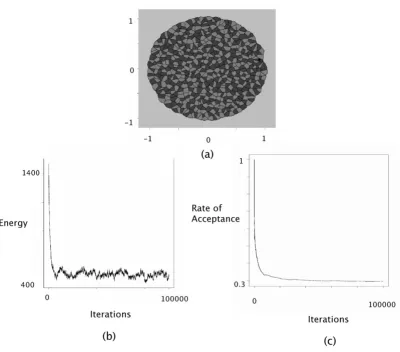
Checkerboard patterns can be interpreted as arising from negative surface tensions. In the GG model, checkerboard patterns were generated using parameter settings that cor-responded to a surface tension equal to γ12 = -3. Figure 2 displays the configuration obtained after 100,000 cycles of the Metropolis-Hastings algorithm, where the interac-tion intensities were fixed at J(τ1, τ2) = 0, J(τ1, τ1) = J(τ2,
τ2) = 1 and J(τE, τ1) = J(τE, τ2) = 0. These interaction inten-sities correspond to a surface tension equal to γ12 = -1 which was of the same order as the one used in the GG model. Moreover we have γ1E = -1/2 and γ2E = -1/2.
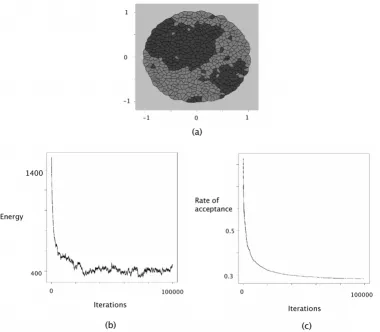
In contrast, cell sorting patterns arise from positive surface tensions between active cells. In the GG model, cell sort-ing patterns were generated ussort-ing parameter settsort-ings that corresponded to surface tensions around γ12 = +3. In our model, simulations were conducted using the following interaction intensities:
J(τ1, τ2) = 1, J(τ1, τ1) = J(τ2, τ2) = 0 and J(τE, τ1) = J(τE, τ2) = 0. These values correspond to γ12 = +1. Surface tension with extracellular medium is equal to γ1E = 0 and γ2E = 0. The configuration obtained after 100,000 steps cycles of Metropolis-Hastings is displayed in Figure 3.
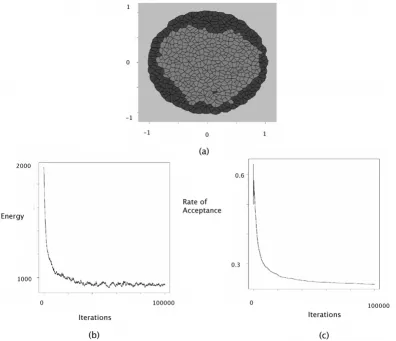
Simulations of engulfment were conducted using the fol-lowing parameters: J(τ1, τ2) = 1, J(τ1, τ1) = J(τ2, τ2) = 0, J(τE, τ1) = 0, J(τE, τ2) = 1. These interaction intensities pro-vide positive surface tensions between active cells, which contribute to the formation of clusters. The fact that J(τE,
τ2) is greater than J(τE, τ1) ensure that τ1 cells are more likely to be close to the extracellular medium and to sur-round the τ2 cells. It is reflected by the extracellular surface tensions: γ1E = 0 and γ2E = 1. The results are displayed in Figure 4.
At the bottom of Figures 2, 3, 4, the evolution of the energy as well as the rate of acceptance is plotted as a func-tion of the number cycles of Metropolis-Hastings algo-rithm. These curves exhibite a flat profile, which suggests that stationarity was indeed reached.
Statistical estimation of the adhesion strength parameter In this section, we study the sensitivity of simulation results to the adhesion strength parameter θ, and we report the performances of the maximum
pseudo-likeli-hood estimator .
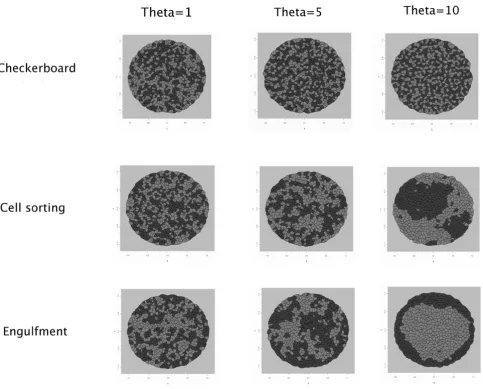
To assess the influence of θon simulations, three values were tested: θ = 1, θ = 5 and θ = 10. The results are pre-sented for simulations of checkerboard, cell sorting and
ˆ
θ
The initial configuration for simulating Checkerboard, Cell Sorting and Engulfment patterns
Figure 1
The initial configuration for simulating Checkerboard, Cell Sorting and Engulfment patterns. It consists of about 1,000 active cells surrounded by an extracellular medium. The active cells are randomly located in the unit sphere, and their types are randomly sampled from M. Cells of type τ1 are colored in black while cells of type τ2 are colored in grey.
One hundred cells of type τE were uniformely placed on the
engulfment patterns. In each case, the interaction intensi-ties were set as in the previous paragraph.
We ran the Metropolis algorithm for 100,000 cycles. This number is sufficient to provide a flat profile of energy and rate of acceptance. The final configurations, in checker-board, cell sorting and engulfment, are displayed in Figure 5. Either for checkerboard or for cell sorting simulations, we observe a gradual evolution when θ increases. For θ = 1, the marks seem to be randomly distributed, for θ = 5 a small inhibition is visible in the checkerboard simulation, small clusters appear in the cell sorting pattern and black cells start to surround white cells in the engulfment simu-lation. Finally, for θ = 10 the stronger inhibition between cells with the same types provides a more pronounced checkerboard pattern, larger clusters are obtained in cell sorting and black cells completely engulf white cells.
For each value of θ, 100 replicates of cell sorting, checker-board and engulfment were generated from which the
mean and the variance of were estimated. Each repli-cate consisted in 100,000 cycles started from independent initial configurations and sampled from uniform distribu-tions. The number of active cells was sampled from the interval [500,1500]. Cells were uniformly located within the unit disk and types were uniformly assigned to each cell. Table 1 summarizes the results obtained for θ in the range [1, 20]. For cell sorting, the bias is weak for all val-ues of θ, while for checkerboard the bias seems to be slightly higher. The results are similar regarding the vari-ance. It is higher for checkerboard than for cell sorting.
Under the engulfment model, the estimator seemed to systematically slightly overestimate θ. Variance under the engulfment model is of the same order as the variance in
ˆ
θ
ˆ
θ
Checkerboard simulation
Figure 2
Checkerboard simulation. The interaction intensities were chosen as follows: J(τ1, τ1) = 1, J(τ2, τ2) = 1, J(τ1, τ2) = 0, J(τ1, τE) = 0,
cell sorting. Finally, in the three model, the variance increased as θ increased. The estimates can be considered as accurate for moderate values of θ (≈ 10), as the pseudo-likelihood may provide significant bias in cases of strong interaction [38].
Experimental data
Estimation of the adhesion strength was also performed on a real data example. We used data from Pizem et al. ([39]), who measured survivin and beta-catenin markers in Human medulloblastoma. These markers are known to be involved in complexes that regulate adhesion between contiguous cells. An image analysis, analogous to the analysis performed in [40], was achieved to extract the locations of cell nuclei and the levels of expression of markers in cells. The expression levels were used to define cell types as displayed in Figure 6. The resulting image is relevant to a cell sorting pattern, and we used the set of J parameters that corresponded to this pattern.
The estimate of θ was computed as ≈ 5.27. This value provides evidence that the model is able to detect large clusters (black cell clusters here) and that white cells may
be surrounded by black cells. The estimated value was then tested as input to the simulation algorithm, and the resulting spatial pattern is displayed in Figure 7. Compar-ing the real tissue and the cell sortCompar-ing pattern simulated with the estimated interaction strength makes clear that the model provides a good fit to the data and that θ esti-mation is consistent.
Conclusion
In this study, we presented an approach to cell sorting based on marked point processes theory. It proposes a continuous geometry for tissues using a Dirichlet tessella-tion and an energy functessella-tional expressed as the sum of two terms: an interaction term between two contiguous cells weighted by the length of the membrane and a cell shape
ˆ
θ
ˆ
θ
Cell Sorting simulation
Figure 3
constraint term. Such models, where interactions are weighted by the length of the membrane, have already been considered in the literature, first by Sulsky et al. [20] and next by Graner and Sawada [21]. Based on Honda's studies that showed that the geometry of Dirichlet cells was in agreement with biological tissues [41,42], these earlier models also used a continuous geometry of cells. These authors were interested in formulating a dynamical model which determines not only the equilibrium state but the path from the initial state to final state. These two approaches introduced systems of differential equations to simulate cell patterns.
Although the previous approaches contained the main ingredients to model simulation, they were not well-adapted to perform statistical estimation of interaction parameters. Furthermore, Graner and Sawada reported two limitations of their approach. First, because the GS
model is not stochastic, it does not explore the set of pos-sible configurations ([21], p.497, l.10). Next Graner and Sawada stressed that their simulation algorithm suffers from instability because of its lack of theoretical control ([21], p.497, l.15). Graner and Glazier proposed Boltz-mann dynamics and were interested in the time needed to achieve desired configurations. However, there is no war-ranty that their Markov chain has correct mixing proper-ties, and the sensitivity of their method to the discretization scale remains to be studied. Because of dis-cretization, detailed balance condition and cell connexity did not seem to hold in the GG model. GG's approach cannot be easily adapted to define inference procedures.
Our study is not the first attempt to propose statistical procedures for estimating interaction strength parameters in tissues. In [13], two statistics have been introduced to measure the degree of spatial cell sorting in a tissue where
Engulfment simulation
Figure 4
cells are of types black and white. Cell sorting can be quantified by the fraction of black cells in the nearest neighborhood of single black cell and the number of iso-lated black cells. Although these two statistics have been recently used to study the role of cadherins in tissue segre-gation [43], their practical application requires cells to be pixels within a lattice ([13] and [43]). Their capacity to quantify cell sorting has been studied using a cell-lattice model where all cells have the same geometry, hypothesis which does not fit with the zipper-like structure of cadher-ins [25].
In contrast to these approaches, the mathematical back-ground of marked point processes allows the establish-ment of a statistical framework. In this study, we have shown that our model was able to reproduce biologically relevant cell patterns such as checkerboard, cell sorting
and engulfment. Checkerboard pattern formation was investigated in a simulation study of the sexual matura-tion of the avian oviduct epithelium [44]. Cell sorting is a standard pattern of mixed heterotypic aggregates. Experi-mental observations of this phenomena were reported by Takeuchi et al. [45] and Armstrong [1]. Engulfment of a tissue by another one was studied by Armstrong [1] and Foty et al. [46]. This phenomenon is a direct consequence of adhesion processes between the two cell types and the extracellular medium. These cell patterns were also simu-lated by pioneering studies ([17,20,21]).
Furthermore, the present model has been built so that it includes the strength of cell-cell adhesion as a statistical parameter. We proposed and validated an inference pro-cedure based on the pseudo-likelihood. The statistical errors remain small in cell sorting simulations. In
check-Influence of θ in simulations
Figure 5
erboard simulations, bias and variance are slightly higher than for cell sorting but still reasonable. The bias is also weak in engulfment simulations. Further improvements of this approach would require a longer study of the prop-erties of the point process model. In particular, the other interaction parameters can also be estimated in the same way that θ is. Although we did not assess the perform-ances of these estimators, we believe that they would be
useful for analyzing tissues arrays, as generated by high-throughput cancer studies [47].
Competing interests
The author(s) declare that they have no competing inter-ests.
Authors' contributions
OF and ME both provided the basic ideas of the project. ME was responsible for the development of the proposed method and carried out the simulation analysis. ME and OF equally contributed to the writing of the manuscript. All authors read and approved the final manuscript.
Appendix
Appendix 1
In this section we prove that the point process introduced in this paper is a nearest-neighbour markov point process which has been defined in [32] (p.107 Definition 4.9).
We use Theorem 4.13 (p.108) in [32] (analogue of the Hammersley-Clifford-Ripley-Kelly theorem [48] for near-est-neighbour markov point processes) which is as fol-lows
Simulated data
Figure 7
Simulated data. Using the interactions parameters for cell sorting patterns: J(τ1, τ1) = 1, J(τ2, τ2) = 1, J(τ1, τ2) = 0, J(τ1,
τE) = 0, J(τ2, τE) = 0 and J(τE, τE) = 0. The parameter θused for the simulation is the estimated value from experimental
data θ= 5.27 (see Figure 6). The estimated interaction
parameter θˆ ≈ 5.51. Table 1: Mean and Variance of , maximum of
Pseudo-likelihood, for checkerboard, cell sorting and engulf-mentsimulations. The evaluation was achieved using 100 simulations of each case.
Checkerboard Cell Sorting Engulfment
Mean Variance Mean Variance Mean Variance
θ = 1 0.99 0.39 1.12 0.34 1.27 0.32 θ = 3 3.34 0.48 3.03 0.43 3.08 0.41 θ = 5 5.15 0.92 5.37 0.45 5.23 0.48 θ = 8 8.42 1.03 8.11 0.92 8.21 0.67 θ = 10 10.58 1.36 10.26 0.67 10.22 1.02 θ = 12 12.12 1.55 12.14 0.92 12.18 0.94 θ = 15 15.51 1.72 14.94 1.64 15.48 1.12 θ = 20 19.52 2.15 20.08 1.51 20.28 1.82
ˆ
θ
Experimental data
Figure 6
Experimental data. The statistical procedure was conducted using the interactions parameters for cell sorting patterns:
J(τ1, τ1) = 1, J(τ2, τ2) = 1, J(τ1, τ2) = 0, J(τ1, τE) = 0, J(τ2, τE) = 0
Theorem 1 Let H be an hereditary subset of the set of finite configurations in × M. Let ~ϕbe a neighbour relation with
consistency conditions (C1)–(C2) (4.7 p.106 in [32]) hold, ϕ
∈ H. Then a function g : H → [0, ∞) is a Markov function if and only if
for all ϕ∈ H, where Ψ is an interaction function.
As proved in [32] (Appendix A1, p116), the set of Dirich-let configurations is hereditary and satisfies properties (C1) and (C2) (see paragraphs 2.5 p94 and 4.7 p106 in [32]).
Let ϕ be a finite configuration in and ~ϕits Dirichlet neighbourhood. Let Ψ be a function defined over all cliques φ∈ϕ as follows
Ψ (clique) = 1 for all cliques with three or more points
As mentioned in the section "A new model for DAH", one can remark that for each marked cell (xi, τi) in a configu-ration ϕ∈ ×
, and for each couple {(xi, τi), (xj, τj)}, such as xi ~ϕxj
This shows that Ψ is an interaction function in the sense of [32] (definition 4.11 p108). One can easily note that ∏c∈cliques(ϕ) Ψ(c) = f (ϕ, θ). Then Theorem 1 holds for the
interaction function proposed in this paper which leads to f is a Markov function.
Since the neighbourhood depends on the configuration, our point process is a nearest-neighbour markov point process as defined in [32] (Definition 4.9 p107).
Appendix 2
Here is the description of one iteration in the MCMC algo-rithm proposed in this paper. Let us denote ϕ the
config-uration just before the current iteration and ψ the proposed new configuration.
• With probability p(ϕ) – Displacement
- One point {xi, τi} is chosen with probability d(ϕ, {xi, τi})
- The proposal distribution for the moving point is b(ϕ, {x, τ})
- ψ = ϕ⊂ {xi, τi} ∪ {x, τ}
• Else with probability (1 - p(ϕ))q(ϕ) – Insertion
- The proposal distribution for the new point is b(ϕ, {x,
τ})
- ψ = ϕ∪ {x, τ}
• Else with probability (1 - p(ϕ))(1 - q(ϕ)) – Deletion
- The deleted point {xi, τi} is chosen with probability d(ϕ, {xi, τi})
- ψ = ϕ⊂ {xi, τi}
• The proposal configuration ψ is accepted with the acceptance probability A [31], as follows
A(ψ |ϕ) = min(1, f(ψ)/f(ϕ))
In the algorithm proposed in this paper, we used
p(ϕ) = 1/2 and q(ϕ) = 1/2 for all ϕ × M
d(ϕ, {xi, τi}) = 1/n for all {xi, τi} ∈ϕ and where n is the
number of points in ϕ where ρ ×
· is the intensity of the underlying marked Poisson proc-ess
Acknowledgements
The authors are grateful to anonymous referees for very useful comments. The authors would like to thank Jean-Michel Billiot and Remy Drouilhet for insightful discussions and to acknowledge Jose Pizem for providing experie-mental data. This work has been partly granted by the AlPB project sup-ported by the Institut d'Informatique et de Mathématiques Appliquées de Grenoble.
References
1. Armstrong PB: Cell sorting out: the self assembly of tissues in vitro. Critical Reviews in Biochemistry and Molecular Biology 1989,
24:119-149.
2. Holfreter J: Experimental studies on the development of the pronephros. Rev Can Biol 1944, 3:220-250.
g x( )= ( | ) ⊂
∏
Ψφ ϕφ ϕ
Ψ({ , }) ( ( ( ), ))
( ) ( ,
x exp h x
Z x
iτi = λ θ i τi iτ
− Dir >
for each point
0 ii)∈ϕ
Ψ( , ) ( | ( ) | ( , ))
( ) {
i j exp x x J Z
i j i j
= −θ ∩ τ τ > θ
Dir
for each couple
0 (( , ),( , )}xiτi xjτj such as xi~ϕxj
Ψ({ , }) ( ( ( ), )) ( )
x exp h x
Z
i τi λ i τi
θ
= − Dir >0
Ψ( , ) ( | ( ) | ( , )) ( )
i j exp x x J
Z
i j i j
= −θ ∩ τ τ >
θ
Dir
0
b( ,{ , })x
( )
ϕ τ
ρ
= 1
Publish with BioMed Central and every scientist can read your work free of charge
"BioMed Central will be the most significant development for disseminating the results of biomedical researc h in our lifetime."
Sir Paul Nurse, Cancer Research UK
Your research papers will be:
available free of charge to the entire biomedical community
peer reviewed and published immediately upon acceptance
cited in PubMed and archived on PubMed Central
yours — you keep the copyright
Submit your manuscript here:
http://www.biomedcentral.com/info/publishing_adv.asp
BioMedcentral 3. Gierer A, Berking S, Bode H, David CN, Flick K, Hansmann G,
Schaller H, Trenkner E: Regeneration of hydra from reaggre-gated cells. Nat New Biol 1972, 239:98-101.
4. Steinberg MS: On the mechanism of tissue reconstruction by dissociated cells, I. Population kinetics, differential adhesive-ness, and the absence of directed migration. Proceedings of the National Academy of Science 1962, 48:1577-1582.
5. Steinberg MS: Mechanism of tissue reconstruction by dissoci-ated cells, II. time-course of events. Science 1962, 137:762-763. 6. Steinberg MS: On the mechanism of tissue reconstruction by dissociated cells, III. Free energy relations and the reorgani-zation of fused, heteronomic tissue fragments. Proceedings of the National Academy of Science 1962, 48:1769-1776.
7. Steinberg MS: Reconstruction of tissues by dissociated cells.
Science 1963, 141:401-408.
8. McClay DR, Ettensohn CA: Cell adhesion in morphogenesis.
Annu Rev Cell Biol 1987, 3:319-345.
9. Nubler-Jung K, Mardini B: Insect epidermis: polarity patterns after grafting result from divergent cell adhesions between host and graft tissue. Development 1990, 110:1071-1079. 10. Newman SA, Comper WD: 'Generic' physical mechanisms of
morphogenesis and pattern formation. Development 1990,
110:1-18.
11. Foty RA, Steinberg MA: The differential adhesion hypothesis: a direct evaluation. Developmental Biology 2005, 278:255-263. 12. Brodland GW: Computational modeling of cell sorting, tissue
engulfment, and related phenomena: a review. Applied Mechanics Reviews 2004, 57:47-76.
13. Mochizuki A, Iwasa Y, Takeda Y: A stochastic model for cell sort-ing and measursort-ing cell-cell-adhesion. Journal of Theoretical Biol-ogy 1996, 179:129-146.
14. Honda H, Tanemura M, Imayama S: Spontaneous architectural organization of mammalian epiderms from random cell packing. The Journal of Invertigative Dermatology 1996,
106(2):312-315.
15. Nagai T, Honda H: A dynamic cell model for the formation of epithelial tissue. Philosophical Magazine B 2001, 81(7):699-719. 16. Honda H, Tanemura M, Nagai T: A three-dimensional vertex
dynamics cell model of space-filling polyhedra simulating cell behavior in a cell aggregate. Journal of Theoretical Biology 2004,
226:439-453.
17. Graner F, Glazier JA: Simulation of biological cell sorting using a two-dimensional extended Potts model. Physical Review Let-ters 1992, 69(13):2013-2016.
18. Barker N, Clevers H: Catenins, Wnt signaling and cancer. BioEs-says 2000, 22:961-965.
19. Lozano E, Betson M, Brage VMM: Tumor progression: Small GTPases and loss of cell-cell adhesion. BioEssays 2003,
25:452-463.
20. Sulsky D, Childress S, Percus JK: A model of cell sorting. Journal of Theoretical Biology 1984, 106(3):275-301.
21. Graner F, Sawada Y: Can surface adhesion drive cell-rearrang-ment? Part II: a geometrical model. Journal of Theoretical Biology
1993, 164(4):477-506.
22. Van-Lieshout MNM: Markov Point Processes and their Applications Impe-rial College Press; 2000.
23. Geiger B, Ayalon O: Cadherins. Annual Review of Cell Biology 1992,
8:307-332.
24. Foty RA, Steinberg MA: Cadherin-mediated cell-cell adhesion and tissue segregation in relation to malignancy. International Journal of Development Biology 2004, 48:397-409.
25. Shapiro L, Fannon AM, Kwong PD, Thompson A, Lehmann MS, Gru-bel G, Legrand JF, Als-Nielsen J, Colman DR, Hendrickson WA:
Structural basis of cell-cell adhesion by cadherins. Nature
1995, 374:327-337.
26. Glazier JA, Graner F: Simulation of differential adhesion driven rearrangement of biological cells. Physical Review E 1993,
47(3):2128-2154.
27. Møller J, Waagepetersen RP: Statistical Inference and Simulation for Spa-tial Point Processes Boca Raton: Chapman and Hall/CRC; 2003. 28. Ruelle D: Statistical Mechanics: rigorous results New-York: Benjamin;
1969.
29. Preston CJ: Random Fields. Lecture Notes in Mathematics 1976,
534:1-200.
30. Bertin E, Billiot JM, Drouilhet R: Spatial Delaunay Point Proc-esses. Stochastic Models 1999, 15:181-199.
31. Geyer CJ, Møller J: Simulation procedures and likelihood infer-ence for spatial point processes. Scandinavian Journal of Statistics
1994, 21:359-373.
32. Baddeley A, Møller J: Nearest-Neighbour Markov point proc-esses and random sets. International Statistical Review 1989,
2:89-121.
33. Besag J: Statistical analysis of non-lattice data. The Statistician
1975, 24:192-236.
34. Comets F: On consistency of a class of estimation for expo-nential families of Markov random fields on the lattice. The Annals of Statistics 1992, 20:455-468.
35. Watson DF: Computing the n-dimensional Delaunay tessela-tion with applicatessela-tion to Voronoi polytopes. The Computer J
1981, 24:167-172.
36. Bertin E: Diagrammes de Voronoi 2D et 3D, applications en analyse d'images. In PhD thesis Université Joseph Fourier – Greno-ble I; 1994.
37. Tierney L: Markov chains for exploring posterior distribu-tions. The Annals of Statistics 1994, 22:1701-1762.
38. Diggle PJ, Fiksel T, Grabarnik P, Ogata Y, Stoyan D, Tanemura M: On parameter estimation for pairwise interaction point proc-esses. International Statistical Review 1994, 62:99-117.
39. Pizem J, Cör A, Zadravec-Zaletel L, Popovic M: Survivin is negative prognostic marker in medulloblastoma. Neuropathol Appl Neu-robiol 2005, 31:422-428.
40. Emily M, Morel D, Marcelpoil R, Francois O: Spatial correlation of gene expression measures in tissue microarray core analysis.
Computational and Mathematical Methods in Medicine 2005, 6:33-39. 41. Honda H: Description of cellular patterns by Dirichlet
domains: The two-dimensional case. Journal of Theoretical Biology
1978, 72:523-543.
42. Honda H: Geometrical models for cells in tissues. International Review of Cytology 1983, 81:191-248.
43. Takano R, Mochizuki A, Iwasa Y: Possibility of tissue segregation caused by cell adhesion. Journal of Theoretical Biology 2003,
221:459-474.
44. Honda H, Yamanaka H, Eguchi G: Transformation of a polygonal cellular pattern during sexual maturation of the avian ovi-duct epithelium: Computer simulation. Journal of Embryology and Experimental Morphology 1986, 98:1-19.
45. Takeuchi I, Kakutani T, Tasaka M: Cell behavior during formation of prestalk/prespore pattern in submerged agglomerates of
Dictyosteltum . Developmental Genetics 1988, 9:607-614.
46. Foty RA, Pflerger CM, Forgacs G, Steinberg MS: Surface tensions of embryonic tissues predict their mutual envelopment behavior. Development 1996, 122:1611-1620.
47. Kononen J, Bubendorf L, Kallioniemi A, Barlund M, Schraml P, Leighton S, Torhorst J, Mihatsch MJ, Sauter G, Kallioniemi OP: Tissue microarray for high-throughput molecular profiling of tumor specimens. Nature Medicine 1998, 4:844-847.