
A Class of Estimators of Population Mean
in Case of Post Stratification
Hilal A. Lone
School of Studies in Statistics
Vikram University, Ujjain-456010, M.P. India [email protected]
Rajesh Tailor
School of Studies in Statistics,
Vikram University, Ujjain-456010, M.P. India [email protected]
Abstract
This paper proposes a class of ratio-cum-product type estimators in case of post-stratification. Particular members of the proposed class of ratio-cum-product type estimators have been identified and studied thoroughly from efficiency point of view. It has been shown that the identified particular estimators are more efficient than the usual unbiased estimator, Ige and Tripathi (1989) estimators, Chouhan (2012) estimators, Tailor et al. (2016) estimator and other considered estimators. An empirical study has been carried out to demonstrate the performance of the proposed estimators.
Keywords: Mean squared error, Bias, Ratio-cum-product estimator.
1. Introduction
Cochran (1940) and Robson (1957) envisaged classical ratio and product estimators which were studied in case of post stratification by Ige and Tripathi (1989). Recently, Lone and Tailor (2014) and Lone and Tailor (2015) proposed ratio and product type exponential estimators in case of post-stratification. Chouhan (2012) proposed class of ratio type estimators using various known parameters of auxiliary variates in case of post stratification. Tailor et al. (2015) proposed dual to Ige and Tripathi (1989) ratio and product estimators. Tailor et al. (2016) proposed a ratio-cum-product type estimator in case of post-stratification. Singh (1967) used information on population mean of two auxiliary variates and proposed ratio-cum-product type estimator for population mean in simple random sampling. Singh (1967) and Chouhan (2012) motivate authors to propose the class of ratio-cum-product type estimators in case of post-stratification. Many Researchers including Holt and Smith (1979), Jagers et al. (1985), Jagers (1986), Ige and Tripathi (1989), Agrawal and Panday (1993), Singh and Ruiz Espejo (2003) Tailor et al. (2011) and Tailor et al. (2015) contributed well in case of post-stratification.
Let us consider a finite population U
U1,U2,...,UN
of size N which is divided into L strata of size N1,N2,...,NL such that N NL
h h
1
variate, negatively correlated with the study variate y. Let yhi be the observation on
th
i
unit of
h
th stratum for study variate y and xhi and zhi be the observation oni
th unit of thh
stratum for auxiliary variates x andz
respectively, then
Nh
i hi h
h x
N X
1 1
: hth stratum mean for the auxiliary variate x,
Nh
i hi h
h y
N Y
1 1
:hth stratum mean for the study variate y,
Nh
i hi h
h x
N Z
1 1
: hth stratum mean for the auxiliary variate
z
,
L
h
h h L
h N
i
hi W X
x N
X
h
1 1 1
1
: Population mean of the auxiliary variate x,
L
h h h L
h N
i
hi W Y
y N
Y
h
1 1 1
1
: Population mean of the study variate y and
L
h
h hZ
W Z
1
: Population mean of the auxiliary variate
z
.A sample of size n is drawn from population U using simple random sampling without replacement. After selecting the sample, it is observed that which units belong to
h
thstratum. Let nh be the size of the sample falling in
h
th stratum such that n nL
h h
1
Here it is assumed that n is so large that possibility of nh being zero is very small.
In case of post-stratification, usual unbiased estimator of population mean Y is defined as
L
h h h
PS W y
y
1
, (1.1)
where N N
W h
h is the weight of the
th
h
stratum and
nh
i hi h
h y
n y
1 1
is sample mean of nh sample units that fall in the
h
th stratum.Using the results from Stephen (1945), the variance of yPS to the first degree of approximation is obtained as
L
h
L
h
yh h yh
h
PS W S
n S W N n y
Var
1 1
2 2
2
1 1 1
1
where
Nh
i
h hi h
yh y Y
N S
1
2 2
1 1
.
Ige and Tripathi (1989) defined a ratio and a product type estimator in case of post-stratification as
PS PS R PS
x X y
Yˆ (1.3)
and
Z z y
Y PS
PS P PS
ˆ . (1.4)
where
L
h h h
PS W x
x
1
and
L
h h h
PS W z
z 1
are the unbiased estimators of population means in case of post-stratification and xh and zh are the means of the samples of size nh that in case of post-stratification and xh and zh are the means of the samples of size fall in hth stratum.
Mean squared error of the Ige and Tripathi (1989) estimators R PS
Yˆ and P PS
Yˆ are
L
h
yxh xh
yh h R
PS W S R S RS
N n Y
MSE
1
1 2 2 1 2
2 1
1 ˆ
(1.5) and
L
h
yzh zh
yh h P
PS W S R S R S
N n Y
MSE
1
2 2 2 2 2
2 1
1
ˆ .
(1.6) where
X Y
R1 and
Z Y R2 .
Chouhan (2012) proposed the following ratio type estimators for population mean Y in case of post-stratification as
xh h L
h h
xh h L
h h ps
RSD PS
C x W
C X W y
Y
1 1
ˆ , (1.7)
) (
) ( ˆ
2 1
2 1
x x
W
x X
W y
Y
h h L
h h
h h L
h h ps
RSE PS
(1.8)
yxh h L h h yxh h L h h ps RST PS x W X W y Y 1 1ˆ , (1.9)
Mean squared errors of the estimators YˆPSRSD, YˆPSRSE and YˆPSRST upto the first degree of approximation are obtained as
L h yxh n xh n yh h RSDPS W S R S R S
N n Y MSE 1 1 2 2 1 2 2 1 1 ˆ , (1.10)
L h yxh n xh n yh h RSEPS W S R S R S
N n Y MSE 1 2 2 2 2 2 2 1 1
ˆ , (1.11)
L h yxh n xh n yh h RSTPS W S R S R S
N n Y MSE 1 3 2 2 3 2 2 1 1
ˆ , (1.12)
Where as the product version of RSD PS
Yˆ , RSE PS
Yˆ and RST PS
Yˆ can be written as
zh h L h h zh h L h h ps PSD PS C Z W C z W y Y 1 1ˆ , (1.13)
L h h h h L h h h h ps PSE PS z Z W z z W y Y 1 2 1 2 ) ( ) ( ˆ (1.14) and
yzh h L h h yzh h L h h ps PST PS Z W z W y Y 1 1ˆ (1.15)
Upto the first degree of approximation, mean squared error of the estimators PSD PS
Yˆ , PSE PS
Yˆ
and YˆPSPST are obtained as
L h yzh m zh m yh h PSDPS W S R S R S
N n Y MSE 1 1 2 2 1 2 2 1 1
ˆ , (1.16)
L h yzh m zh m yh h PSEPS W S R S R S
N n Y MSE 1 2 2 2 2 2 2 1 1
L h yzh m zh m yh h PSTPS W S R S R S
N n Y MSE 1 3 2 2 3 2 2 1 1
ˆ , (1.18)
where
. 3 / 2 ) ( / 1 / 3 / 2 ) ( / 1 / 1 2 1 1 1 2 1 1
i Z W Y i z Z W Y i C Z W Y R and i X W Y i x X W Y i C X W Y R yzh h L h h h h L h h xh h L h h mi yxh h L h h h h L h h xh h L h h ni Tailor et al. (2016) proposed a ratio-cum-product type estimator in case of post-stratification as
L h h h L h h h L h h h L h h h ps RP PS Z W z W x W X W y Y 1 1 1 1 ˆ (1.19)Up to the first degree of approximation, mean squared error of RP PS
Yˆ is obtained as
L h yzh xzh yxh zh xh yh h RPPS W S R S R S RS R R S R S
N n Y MSE 1 2 2 1 1 2 2 2 2 2 1 2 2 1 1 ˆ (1.20)
2. Proposed Class of Ratio-Cum- Product Type Estimators
In the line of Singh (1967), we suggest a class of ratio-cum-product type estimators for estimating population mean Y as
L h h h h h L h h h h h L h h h h h L h h h h h ps d Z c W d z c W b x a W b X a W y t 1 1 1 1 (2.1)where
ah,bh,chand dh
are the function of population parameters of the auxiliary variates.To obtain the bias and mean squared error of the proposed estimator t, we write
h
h
h Y e
y 1 0 , xh Xh
1e1h
and zh Zh
1e2h
such that 0 ) ( ) ( )(e0h E e1h E e2h
, 1 1 )
( 02 yh2
h h h C N nW e E 2 2 1 1 1 ) ( xh h h h C N nW e E , 2 2 2 1 1 ) ( zh h h h C N nW e E , xh yh yxh h h h
h C C
N nW e
e
E
1 1
)
( 0 1 ,
zh yh yzh h h h
h C C
N nW e
e
E
1 1
)
( 0 2 and
zh xh xzh h h h
h C C
N nW e
e
E
1 1
)
( 1 2 .
Expressing (2.1) in terms of e’s, we have
m h h h L h h n h h h L h h h h L h h X e Z c W X e X a W Y e Y W Y t 2 1 1 1 1 0 1 1 1 1 ) 1 ( ) 1 ( ) 1( e0 e1 1 e2 Y
t
1 2 0 1 0 2
2 1 2 1
0 e e e ee e e e e
e Y Y
t
(2.2) where Y e Y W e h h L h h 0 1 0
, n h h h L h h X e X a W e 1 1 1
and
m h h h L h h X e Z c W e 2 1 2
.Taking expectation on both sides of (2.2), we get the bias of the proposed estimator t upto the first degree of approximation as
L h yxh h h n h L h xh h n S a W R a S W X N n t B 1 2 1 2 1 1 1
L h xzh h h n h yzh h L h h m S c a R W S c WX 1 1
1
(2.3)
n h yxh Lh
zh h m xh h n yh
h S R a S R c S R a S
W N n t
MSE 1 1 2
1
2 2 2 2 2 2
2
yzh m h xzh h h m
n R a c S c R S
R 2
2
(2.4) where
n n
X Y R ,
m m
X Y
R ,
h h h
L
h h
n W a X b
X
1
and
h h h
L
h h
m W c Z d
X
1
.
Equation (2.4) can also be written as
t A R B R C R D R R E R FMSE n2 m2 2 n 2 n m 2 m (2.5)
where
L
h
yh hS
W N
n A
1 2
1 1
,
L
h
xh h ha S
W N n B
1
2 2
1 1
,
L
h
zh h hc S
W N n C
1
2 2
1 1
,
L
h
yxh h ha S
W N n D
1
1 1
,
L
h
xzh h h ha c S
W N n E
1
1 1
and
L
h
yzh h hc S
W N n F
1
1 1
.
The MSE of t is minimum when
) (
) ( * 2
* 2
say R E BC
BF DE R
say R E BC
EF DC R
m m
n n
(2.6)
Putting (2.6) in (2.5), we get the minimum mean squared error of the proposed estimator t as
1
min t A
MSE (2.7)
where
) (
) 2 (
2 2 2
E BC A
DEF BF
CD
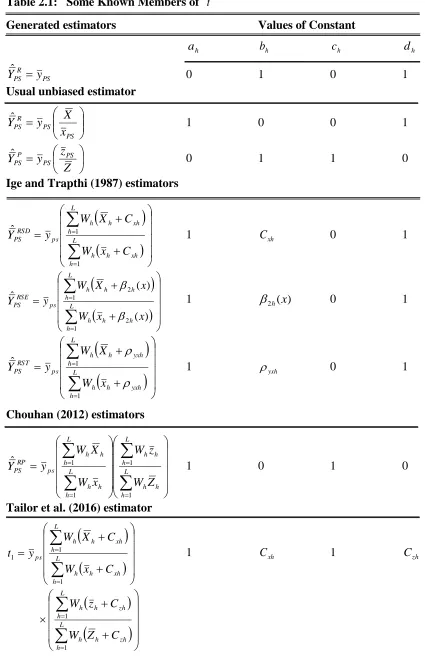
Table 2.1: Some Known Members of t
Generated estimators Values of Constant
h
a bh ch dh
PS R
PS y
Yˆ 0 1 0 1
Usual unbiased estimator
PS PS R PS
x X y
Yˆ 1 0 0 1
Z z y
Y PS
PS P PS
ˆ 0 1 1 0
Ige and Trapthi (1987) estimators
xh h L
h h
xh h L
h h ps
RSD PS
C x W
C X W y
Y
1 1
ˆ 1
xh
C 0 1
) (
) ( ˆ
2 1
2 1
x x
W
x X
W y
Y
h h L h
h
h h L
h h ps RSE PS
1 2h(x) 0 1
yxh h L
h h
yxh h L
h h ps
RST PS
x W
X W y
Y
1 1
ˆ 1
yxh
0 1
Chouhan (2012) estimators
L
h
h h L
h h h L
h h h L
h
h h ps
RP PS
Z W
z W
x W
X W y
Y
1 1 1
1
ˆ 1 0 1 0
Tailor et al. (2016) estimator
xh h L
h h
xh h L
h h ps
C x W
C X W y
t
1 1
1 1 Cxh 1 Czh
zh h L
h
zh h L
h h
C Z W
C z W
L
h
h h h L
h
h h h ps
x x
W
x X
W y
t
1
2 1
2 2
) (
) (
1 2h(x) 1 2h(z)
L
h
h h h L
h
h h h
z Z
W
z z
W
1
2 1
2
) (
) (
yxh h L
h h
yxh h L
h h ps
x W
X W y
t
1 1
3 1 yxh 1 yzh
yzh h L
h h
yzh h L
h h
Z W
z W
1 1
3. Efficiency Comparisons
From (1.2), (1.5), (1.6), (1.10), (1.11), (1.12), (1.16) (1.17), (1.18), (1.20) and (2.7), we conclude that the proposed class of ratio-cum- product type estimators t would be more efficient than
(i) yPS if
0
, (3.1)(ii) YˆPSR if
2
01
1 2 2 1 1
2
L
h
yxh xh
h L
h
yh
hS W R S RS
W
, (3.2)
(iii) P PS
Yˆ if
2
01
2 2 2 1 1
2
L
h
yzh zh
h L
h
yh
hS W R S R S
W
(iv) YˆPSRSD if
2
01
1 2
2 1 1
2
L
h
yxh n xh n h L
h
yh
hS W R S R S
W
, (3.4)
(v) YˆPSRSE if
2
01 1
2 2
2 2
2
L
h
L
h
yxh n xh n h yh
hS W R S R S
W
, (3.5)
(vi) YˆPSRST if
2
01
3 2
2 3 1
2
L
h
yxh n xh n h L
h
yh
hS W R S R S
W
, (3.6)
(vii) YPSPSD
ˆ if
2
01
1 2
2 1 1
2
L
h
yzh m zh m h L
h
yh
hS W R S R S
W
, (3.7)
(viii) PSE PS
Yˆ if
2
01
2 2
2 2 1
2
L
h
yzh m zh m h L
h
yh
hS W R S R S
W
, (3.8)
(ix) YˆPSPST if
2
01
3 2
2 3 1
2
L
h
yzh m zh m h L
h
yh
hS W R S R S
W
, (3.9)
(x) YˆPSRP if
2
01
2 2
1 1
2 2 2 2 2 1 1
2
L
h
yzh xzh
yxh zh
xh h L
h
yh
hS W R S R S RS R R S R S
W
, (3.10)
Expressions (3.1) and (3.10) are the conditions under which the proposed class of ratio-cum-product type estimator t is better than usual unbiased estimatoryPS, Ige and Tripathi (1989) estimators YPSR
ˆ and P PS
Yˆ , Chouhan (2012) estimators YPSRSD
ˆ , RSE PS
Yˆ and YPSRST
4. Study on the particular members of the proposed class of ratio-cum- product type estimators t
To illustrate the general result, we have considered the new members t1,t2 and t3 of the proposed class of ratio-cum- product type estimators t defined in table 6.2.1 as
zh h L h h zh h L h h xh h L h h xh h L h h ps C Z W C z W C x W C X W y t 1 1 1 11 , (4.1)
L h h h h L h h h h L h h h h L h h h h ps z Z W z z W x x W x X W y t 1 2 1 2 1 2 1 2 2 ) ( ) ( ) ( ) ( (4.2) and
yzh h L h h yzh h L h h yxh h L h h yxh h L h h ps Z W z W x W X W y t 1 1 1 1 3 (4.3)Upto the first degree of approximation, the mean squared errors of the estimators t1,t2
and t3 are obtained as
n yxh n m xzh m yzh
L h zh m xh n yh
h S R S R S R S R R S R S
W N n t
MSE 1 1 1 1
1 2 2 1 2 2 1 2
1 2 2 2
1 1
(4.4)
n yxh n m xzh m yzh
L h zh m xh n yh
h S R S R S R S R R S R S
W N n t
MSE 2 2 2 2
1 2 2 2 2 2 2 2
2 2 2 2
1
1
(4.5) and
n yxh n m xzh m yzh
L h zh m xh n yh
h S R S R S R S R R S R S
W N n t
MSE 3 3 3 3
1 2 2 3 2 2 3 2
3 2 2 2
1
1
(4.6)5. Empirical Study
To exhibit the performance of the proposed estimators, two population data sets are being considered. Descriptions of data sets are given by
Table 5.1: Population I- [Source: Chouhan (2012)]
z
: Area in ‘000 HectareConstant Stratum I Stratum II
h
N 10 10
h
n 4 4
h
Y 1.70 3.67
h
X 10.41 289.14
h
Z 6.32 80.67
yh
S 0.50 1.41
xh
S 3.53 111.61
zh
S 1.19 10.82
yxh
S 1.60 144.87
yzh
S -0.05 -7.04
xzh
S 1.38 -92.02
xh
2
1.97 2.90
zh
2
4.12 3.66
Table 5.2: Population II- [Source: Murthy (1967), p 228]
z
: Number of workers y: Output andx: Fixed capital
Constant Stratum I Stratum II
h
N 5 5
h
n 2 2
h
Y 1925.8 315.6
h
X 214.4 333.8
h
Z 51.80 60.60
yh
S 615.92 340.38
xh
S 74.87 66.35
zh
S 0.75 4.84
yxh
S 39360.68 22356.50
yzh
S 411.16 1536.24
xzh
S 38.08 287.92
xh
2
1.88 2.32
zh
2
Table 5.3: Percent Relative Efficiencies of the estimatorsyPS, R PS
Yˆ , YˆPSP, YˆPSRSD, YˆPSRSE,
RST PS
Yˆ , YPSPSD
ˆ , PSE PS
Yˆ , YPSPST
ˆ , RP PS
Yˆ , t1, t2 and t3 with respect to yPS.
Estimators Percent Relative Efficiencies
Population I Population II
PS
y 100.00 100.00
R PS
Yˆ 223.74 313.75
P PS
Yˆ 123.31 85.02
RSD PS
Yˆ 225.20 376.69
RSE PS
Yˆ 233.80 384.14
RST PS
Yˆ 227.49 378.73
PSD PS
Yˆ 123.36 85.03
PSE PS
Yˆ 123.38 85.43
PST PS
Yˆ 123.47 85.25
RP PS
Yˆ 288.16 258.07
1
t 291.07 404.85
2
t 312.91 409.54
3
t 294.31 405.42
6. Conclusion
A class of ratio-cum-product type estimators for population mean has been defined. The usual unbiased estimator, Ige and Tripathi (1989) estimators, Chouhan (2012) estimators and Tailor et al. (2016) estimator have been identified to be the member of the proposed class of ratio-cum-product type estimators t. Section 3 provides the conditions under which the proposed estimator t has less mean squared error as compared to the mean squared error of the other considered estimators. It is observed that particular members
2 1, t
t and t3 have higher percent relative efficiencies in comparison to usual unbiased estimator yPS, Ige and Tripathi (1989) estimators
R PS
Yˆ and YˆPSP, Chouhan (2012) estimators YPSRSD
ˆ , RSE PS
Yˆ and YPSRST
ˆ , Tailor et al. (2016) estimator RP PS
Yˆ and other estimators
PSD PS
Yˆ , YˆPSPSE and YˆPSPST. Hence, it can be concluded that the proposed members t1, t2 and 3
Acknowledgment
The authors are grateful to the reviewers for their constructive comments and valuable suggestions regarding improvement of the article.
References
1. Agrawal, M. C. and Pandey, K. B. (1993). An efficient estimator in post– stratification. Metron 51, 179-188.
2. Chouhan, S. (2012). Improved estimation of parameters using auxiliary information in sample surveys. Ph.D. Thesis, Vikram University, Ujjain, M.P., India.
3. Cochran, W. G. (1940). The estimation of the yields of the cereal experiments by sampling for the ratio of grain to total produce. J. Agril. Soc., 30, 262-275.
4. Holt, D. and Smith, T. M. F. (1979). Post-stratification. J. Roy. Statist. Soc., 142, A, 33-46.
5. Ige, A. F. and Tripathi, T. P. (1989). Estimation of population mean using post-stratification and auxiliary information. Abacus, 18, 2, 265-276
6. Jagers, P. (1968). Post stratification against bias in sampling. Int. Statist. Rev., 55, 159-167.
7. Jagers, P., Oden, A. and Trulsson, L. (1985). Post stratification and ratio estimation: Usages of auxiliary information in surveys sampling and opinion polls. Int. Statist. Rev., 53, 221-238
8. Johnston, J. (1972). Econometric Methods, 2nd ed., Tokyo: McGraw-Hill.
9. Lone H. A. and Tailor R. (2015). Dual to Separate Product Type Exponential Estimator in Sample Surveys. J. Statist. Appl. Prob. Lett. 2, 1, 89-96
10. Lone, H. A. and Tailor, R. (2014). Dual to Separate Ratio Type Exponential Estimator in Post-Stratification. J. Statist. Appl. Prob. 3, 3, 425-432
11. Murthy, M. N. (1967). Sampling Theory and Methods, Statistical Publishing Society. Calcutta, India.
12. Robson, D. S. (1957). Application of multivariate polykays to the theory of unbiased ratio-type estimation. J. Amer. Statist. Assoc., 52, 511-522.
13. Singh, H. P. and Ruiz Espejo, M. (2003). On Linear regression and ratio-product estimation of a finite population mean. The Statistician, 52, 1, 59-67.
14. Singh, M. P. (1967). Ratio-cum-product method of estimation. Metrika, 12, 1, 34-43.
15. Stephan, F. (1945). The expected value and variance of the reciprocal and other negative powers of a positive Bernoullian variate. Ann. Math. Statist. 16, 50-61. 16. Tailor, R., Jatwa, S. K. and Lone, H. A. (2015). Dual to ratio and product type
estimators in case of post-stratification. J. Mod. Appl. Statist. Meth. ( in press) 17. Tailor, R., Lone, H. A., Pandey, R., and Kumar, M. (2016). Ratio-cum-product
type estimator in case of post- stratification. Math. Sci. Lett. 5, 1, 103-106.
![Table 5.1: Population I- [Source: Chouhan (2012)]](https://thumb-us.123doks.com/thumbv2/123dok_us/239155.1517120/11.612.107.533.139.387/table-population-source-chouhan.webp)
![Table 5.2: Population II- [Source: Murthy (1967), p 228]](https://thumb-us.123doks.com/thumbv2/123dok_us/239155.1517120/12.612.74.488.429.704/table-population-ii-source-murthy-p.webp)

