Research Paper:
Cognitive Process in Patients With
Obsessive-Compulsive Disorder: A Cross-Sectional
Analytic Study
Saeid Yazdi-Ravandi1 , Farshid Shamsaei1 , Nasrin Matinnia2 , Jamal Shams3 , Abbas Moghimbeigi4 , Ali Ghaleiha1* , Mohammad Ahmadpanah1*
1. Behavioral Disorders and Substance Abuse Research Center, Hamadan University of Medical Sciences, Hamadan, Iran. 2. Department of Nursing, Faculty of Basic Sciences, Hamadan Branch, Islamic Azad University, Hamadan, Iran. 3. Behavioral Sciences Research Center, Shahid Beheshti University of Medical Sciences, Tehran, Iran.
4. Modeling of Noncommunicable Disease Research Center, Department of Biostatistics, School of Health, Hamadan University of Medical Sciences, Hamadan, Iran.
* Corresponding Authors: Mohammad Ahmadpanah, PhD.
Address: Behavioral Disorders and Substance Abuse Research Center, Hamadan University of Medical Sciences, Hamadan, Iran.
Tel: +98 (813) 8271066
E-mail: [email protected]
Introduction: In recent studies, deficit in cognitive process has been investigated as one of the etiological hypotheses in a wide range of Obsessive-Compulsive Disorder (OCD). This research aimed to compare cognitive process in patients with OCD and healthy groups.
Methods: In the current cross-sectional analytic study, 43 patients with OCD and 43 healthy individuals matched with gender, age, educational and marital status were selected by convenience sampling method and assessed by Wisconsin Cart Sorting Test (WCST), Paced Auditory Serial Addition Test (PASAT) and Yale-Brown Obsessive Compulsive Scale (Y-BOCS). The obtained data were analyzed with Chi-square, Independent t test, Mann-Whitney U test and Pearson correlation in SPSS version16.
Results: There was no difference between the patients with OCD and the healthy group in demographic characteristics (P>0.05). There was a significant differences between two group on the all subscale of WCST test and PASAT3, PASAT2 tests (P<0.01). These findings indicate that the OCD patient’s performance in cognitive process was significantly worse than the healthy controls.
Conclusion: The findings indicate that individuals with OCD suffer from a deficiency in various aspects of cognitive processes. Therefore, paying attention to these deficiencies can make an important contribution to the treatment of these patients.
Article info:
Received: 10 October 2017 First Revision: 20 November 2017
Accepted: 08 December 2017
Available Online: 01 November 2018
Keywords:
Obsessive Compulsive Disorder, Cognitive process, Information processing
Citation:Yazdi-Ravandi, S., Shamsaei, F., Matinnia, N., Shams, J., Moghimbeigi, A., Ghaleiha, A., et al. (2018). Cognitive Process in Patients With Obsessive-Compulsive Disorder: A Cross-Sectional Analytic Study. Basic and Clinical Neuroscience, 9(6), 448-457. http://dx.doi.org/10.32598/bcn.9.6.448
:
: http://dx.doi.org/10.32598/bcn.9.6.448 Use your device to scan
and read the article online
Funding:See Page 455
A B S T R A C T
Ali Ghaleiha, MD.
Address: Behavioral Disorders and Substance Abuse Research Center, Hamadan University of Medical Sciences, Hamadan, Iran.
1. Introduction
bsessive-Compulsive Disorder (OCD) is currently recognized as one of the disabling mental illnesses. “It is characterized by re-current, intrusive, and unwanted thoughts (obsession), impulses, and images, often associated with compulsive behaviors that are repetitive,
ritualized and often time consuming” (American
Psychi-atric Publication, 2013). The usual obsessions include contamination, doubting, ordering/symmetry, aggressive
thoughts, religion, and sexual imagery (Benzina, Mallet,
Burguière, N’diaye, & Pelissolo, 2016).
Several research studies have reported that patients with OCD have many deficits in cognitive flexibility,
set shifting, attention and memory (Tükel et al., 2012;
Aydın, Koybasi, Sert, Mete, & Oyekcin, 2014). Al-though dysfunctions in cognitive abilities are obvious in the daily behavior of OCD patients, fundamental research on neurocognitive dysfunction is still ongo-ing, and the dimensions of this type of dysfunction are
unknown (Chamberlain, Blackwell, Fineberg, Robbins,
& Sahakian, 2005). Among all cognitive impairments,
deficiencies in information processing and executive functions greatly restrain patient’s abilities to preserve, acquire and relearn the required skills for suitable
perfor-mances (Keefe, 1995).
Cognitive process dysfunction hypotheses have been used to explain many psychological disorders such as OCD (Penadés, Catalán, Andrés, Salamero, & Gastó, 2005), schizophrenia (Moritz et al., 2002), autism (Tan-guay, 2000), and bipolar disorders (Balanzá-Martínez et al., 2010).
Based on different studies, patients with OCD demon-strated specific cognitive deficits on attention, executive
and memory functions tasks (Rotge et al., 2008;
Bent-zina et al., 2016). Patients with OCD have an impaired performance pattern, which is qualitatively like the per-formance of patients with frontal lobe excisions and sub-cortical pathology. In addition, several research studies reported abnormalities in the cortico-basal ganglion
cir-cuits in OCD (Rotge et al., 2008; Benzina et al., 2016).
Converging findings from imaging research impli-cate abnormalities in frontal-subcortical circuitry in the
Highlights
●Considerable correlation was observed between Obsessive Compulsive Disorder (OCD) symptoms severity and
weak cognitive performances.
●OCD patients' function in cognitive process was significantly worse than the healthy subjects.
●OCD patients' performance on Wisconsin Cart Sorting and Paced Auditory Serial Addition tests was worse than
healthy subjects
Plain Language Summary
Obsessive-Compulsive Disorder (OCD) is currently recognized as one of the disabling mental illnesses. It is char-acterized by recurrent, intrusive, and unwanted thoughts (Obsession), impulses, and images, often associated with compulsive behaviors that are repetitive, ritualized and often time consuming (Compulsion). In recent studies, deficit in cognitive process has been investigated as one of the etiological hypotheses in a wide range of these patients. Out of all cognitive impairments, deficiencies in information processing and executive functions greatly restrain patient's abilities to preserve, acquire and relearn the required skills for suitable performances. This research aimed to com-pare cognitive process in patients with OCD and healthy subjects. Fourty-three patients with OCD and 43 healthy individuals matched with gender, age, educational and marital status were investigated by three cognitive processes assessment (Wisconsin Cart Sorting Test [WCST], Paced Auditory Serial Addition Test [PASAT] and Yale-Brown Obsessive Compulsive Scale [Y-BOCS]). The obtained data were showed that the OCD patients’ performance in cognitive process was significantly worse than the healthy controls. Also, there is a considerable correlation between OCD symptoms severity and poor cognitive performance. The findings indicate that individuals with OCD suffer from deficiencies in various aspects of cognitive processes. Therefore, paying attention to these deficiencies can make an important contribution to the treatment of these patients.
OCD pathogenesis (Saxena & Rauch, 2000; Lewin et al., 2014). Functional and structural imaging in OCD showed hyperactivity in the limbic, associative cortical
area, and related basal ganglia (Menzies et al., 2008).
Recent studies recommend that neurobiological abnor-malities play a main role in the cognitive dysfunction of
these patients (Abramovitch, Abramowitz, & Mittelman,
2013; Benzina et al., 2016).
Many neurocognitive studies suggest abnormalities in
the cognitive process of individuals with OCD
(Cham-berlain et al., 2007; Remijnse et al., 2006; Viswanath, Janardhan Reddy, Kumar, Kandavel, & Chandrashekar, 2009). However, not all studies have found abnormalities and when abnormalities are detected, the results are not
always consistent (Moritz, Kloss, & Jelinek, 2010).
Although cognitive processes have been investigated in OCD and promising results have been obtained, some-times these findings were controversial. Considering the mentioned issues, the identification of various aspects of the cognitive performances of these patients can contrib-ute in better understanding of the existing viewpoints on this disorder. The evaluation of cognitive processes (ex-ecutive functions and information processing) can be ap-plied in the treatment of these patients. This study aimed to compare the cognitive process in OCD patients and healthy control individuals. The authors hypothesized that OCD patients would perform weaker than healthy control individuals in the executive function and infor-mation processing areas.
2. Methods
This cross-sectional descriptive-analytical research was conducted in Farshchian-Sina Hospital of Hamadan City, Iran in 2017. This study included 43 patients who met the DSM-IV-TR criteria for OCD (50 patients were interviewed, seven of whom did not meet the study inclusion criteria). The control group consisted of 43 healthy participants who were selected from Farshchian Hospital and Hamadan University of Medical Sciences personnel and students, who matched the patients in terms of gender, age and education.
The participants of the two groups were selected by convenience sampling method. Patients in the current study were included as per the following criteria: 1. Hav-ing diagnosed with OCD by a psychiatrist accordHav-ing to the Structured Clinical Interview for DSM-IV Clinical Version (Persian edition); 2. Being 18 to 65 years old; 3. Having at least elementary level of education; 4. Taking a score of at least 16 on the Yale-Brown Obsessive
Compul-sive Scale (Y-BOCS); and 5. Lacking any current psychi-atric disorder except diagnosis of OCD.
Patients were not included in the study if they had 1. A his-tory of or current drug and/or alcohol abuse or dependen-cy (self-report); 2. Any neurologic disease or concomitant general medical condition; 3. Serious head injury history; 4. Intellectual disability or any clinical condition that could affect cognitive performance; 5. Significant medical illness; 6. Electroconvulsive therapy in the last year; 7. Physical dis-ability (e.g. blindness, deafness, speech problems, paralysis, amputation); and 8. Chosen to withdraw from the study.
2.1. Clinical measures
The sociodemographic profile included name, age, gender, address, marital status, and education.
2.1.1. Structured Clinical Interview for DSM-IV Dis-orders
Structured Clinical Interview for DSM-IV Disorders (SCID-I) is a structured interview method that provides in-formation to diagnose Axis-I psychiatric disorders included
in DSM (First, Spitzer, Gibbon, & Williams, 1997). In the
current study, the Persian version was used. Administration of this test usually takes about 45 to 90 minutes in a single
session (First, Spitzer, Gibbon, & Williams, 1996).
Reliabil-ity and validReliabil-ity of SCID have been reported acceptable in the
Iranian clinical population (Sharifi et al., 2009).
2.1.2. Yale-Brown Obsessive-Compulsive Scale
Yale-Brown Obsessive-Compulsive Scale (Y-BOCS) was developed by Goodman and some other researchers to
as-sess the severity of OCD symptoms (Goodman et al., 1989).
Y-BOCS includes 10 self-report items. The first 5 questions relate to obsession, and the other 5 questions relate to com-pulsion. All items have a score ranging from 0 (symptoms free) to 4 (extreme symptoms). The scores were classified as subclinical (0 to 7), mild (8 to 15), moderate (16 to 23),
severe (24 to 33), and extreme (34 to 40). Moreover, Rajezi
Esfahani, Motaghipour, Kamkari, Zahiredin and Janbozorgi (2012) studied the validity and reliability of the Persian ver-sion of Y-BOCS. They claimed that its test-retest reliability coefficients, split-half reliability, and internal consistency ranged between 0.89 and 0.99.
2.2. Cognitive process assessment
2.2.1. Wisconsin Cart Sorting Test
goal-ori-ented behavior, and organized searching. Assessing the shift depends on the concepts, and forming abstractions are the
main purposes of this test (Spreen & Strauss, 1998).
More-over, a computerized version of a 64-card WCST was used. WCST has 64 cards, containing figures in different shapes: Triangle, star, cross and circle (numbered from 1 to 4). The color of these shapes are red, green, yellow and blue. There-fore, each card has a figure (one of the four shapes), a number (1 to 4), and a color (red, green, yellow or blue).
The combination of these choices provides 64 different variations. For scoring, we considered the following: score of perseveration errors (this error arises when the subject, despite receiving feedback from the assessor, is trying to avert the incorrect response or continues sorting based on the former principle or incorrect guess), number of correct and incorrect responses, trials to first complete category, time of completion (second), and the number of completed cat-egories (which identifies correct sorting according to figures, colors, and numbers).
In this test, higher number of completed categories were considered as a better abstractive capability and lower perseverative error, and higher conceptual level response scores indicated less mental rigidity and better cognitive
flexibility (Tükel et al., 2012). Naderi (1994) by doing
test-retest reported the reliability of the test as 0.85 be-tween Iranian populations.
2.3. Information processing assessment
2.3.1. Paced Auditory Serial Addition Test
To assess the rate of attention and information processing, Paced Auditory Serial Addition Test (PASAT) is used as a serial addition task. In this test, 61 single-digit numbers be-tween 1 and 9 are read randomly to the patients in fixed-time intervals in two versions, i.e. in 3 and 2 seconds. In the cur-rent study, both versions were administered.
The patient has to sum each number to the one immediately prior to it. For example, if numbers 4 and 7 are presented, the correct answer would be 11. Higher number of correct an-swers indicate better performance. A maximum of 60 correct
responses can be achieved (Sherman, Strauss, & Spellacy,
1997). Some researchers have indicated that PASAT has a high internal consistency, typically ranged between 0.76 and
0.95 (Macleod & Prior, 1996; Sherman et al., 1997).
2.4. Statistical analysis
SPSS Version 22.00 was used for all statistical analy-ses. Kolmogorov-Smirnov was used to test data
normal-ity. The difference between the two groups in numeri-cal variables was evaluated by using the Independent samples t test. If the mentioned assumptions were not met, Mann–Whitney U test was used. For categorical
variables, χ2 test or Fisher exact test was utilized (Cohen,
1988). Statistics for effect size was calculated for each cognitive measure. Furthermore, to investigate the rela-tionship between the cognitive test and Y-BOCS scores in the OCD group, the Pearson correlation was used.
3. Results
The participants’ ages ranged between 19 and 62 years with the Mean±SD age of 35.12±11.00 years in the OCD
group, and 32.35±8.81 years in the healthy group. Table 1
presents demographic variables of the two groups and the scores of obsession, compulsion, and total score of Y-BOCS in the OCD group. There was no significant difference in gender, age, and educational and marital status between the two groups based on Chi-square and Fisher exact tests.
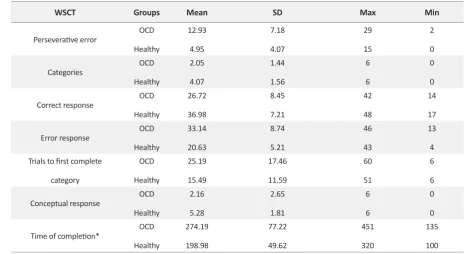
Table 2 presents all the descriptive indices of WSCT in two groups. As it can be seen, compared to healthy control individuals, patients with OCD performed worse in all WCST subtest scores. For example, the Mean±SD of the perseverative error and category were respec-tively 12.93±7.18 and 2.05±1.44 in the OCD group and 4.95±4.07 and 4.07±1.56 in the control group. In addition to these indicators, in this study, the time spent on the test
was also studied as an indicator. As shown in Table 2,
OCD patients spent more time to do the test tasks.
Independent t test results indicate that the performance of patients with OCD was significantly worse than the healthy control individuals with regard to the perseverative error (P<0.001, Cohen’s d=1.367), category (P<0.001, Cohen’s d=1.365), correct response (P<0.001, Cohen’s d=1.306), error response (P<0.001, Cohen’s d=1.738), trials to first complete category (P=0.003, Cohen’s d=0.654), and time of completion (P<0.001, Cohen’s d=0.115). In addition, in the subscale of the conceptual level responses, the Mann-Whitney U test results indicate a lower performance by OCD
individuals (P<0.001, Cohen’s d=1.374). According to Table
3, large effect sizes (1.115 to 1.738) were responsible for the
differences between the OCD and the healthy groups, expect trials to first complete category that had medium effect sizes.
In order to investigate information processing, PASAT3’’
and PASAT2’’ were conducted. According to Table 4,
this test. Table 4 presents a significant difference in infor-mation processing between the two groups for PASAT3’’ (P<0.001, Cohen’s d=0.784) and PASAT2’’ (P<0.003, Cohen’s d=0.662). Cohen’s d effect sizes between the two groups were medium.
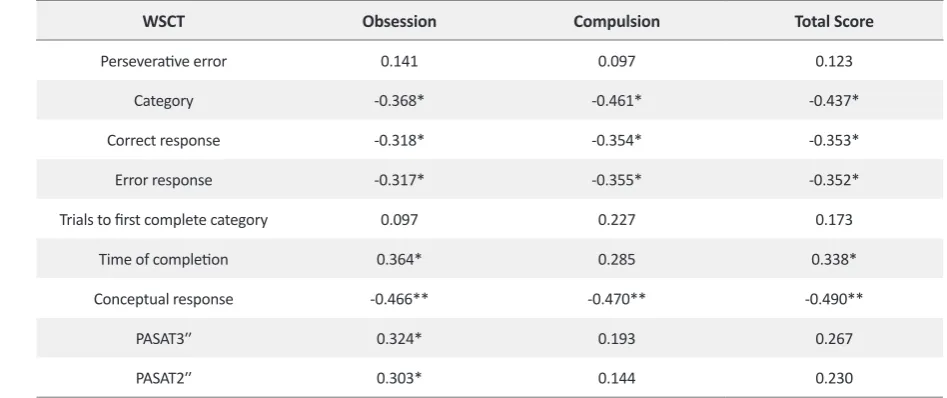
As observed in Table 5, there was a considerable
cor-relation between obsession, compulsion, and total score of Y-BOCS with the number of completed category (P<0.05), correct responses (P<0.05), error responses (P<0.05) and conceptual level responses (P<0.01) of
Table 2. WSCT test results
WSCT Groups Mean SD Max Min
Perseverative error OCD
Healthy 12.93 4.95 7.18 4.07 29 15 2 0 Categories OCD Healthy 2.05 4.07 1.44 1.56 6 6 0 0
Correct response OCD
Healthy 26.72 36.98 8.45 7.21 42 48 14 17
Error response OCD
Healthy 33.14 20.63 8.74 5.21 46 43 13 4
Trials to first complete category OCD Healthy 25.19 15.49 17.46 11.59 60 51 6 6
Conceptual response OCD
Healthy 2.16 5.28 2.65 1.81 6 6 0 0
Time of completion* OCD
Healthy 274.19 198.98 77.22 49.62 451 320 135 100 *Second
Table 1. Clinical and demographic characteristics of the study participants
Variables Groups
OCD (n=43) Healthy (n=43) Total (N=86) Sig.
Gender Male Female 14(32.6) 29(67.4) 20(46.5) 23(53.5) 34(39.5) 52(60.5)
X2=1.75
P=0.186
Marital status Single
Married 17(39.5) 26(60.5) 20(46.5) 23(53.5) 37(43) 49(57)
X2=0.427
P=0.514 Education degree* Under diploma Diploma College degree 10(23.2) 18(41.9) 15(34.9) 8(18.6) 18(41.9) 17(39.5) 18(20.9) 36(41.9) 32(37.2) P=0.237
Age, y 35.12±11.0 32.35±8.81 33.73±10.00 t=1.287
P=0.201 Y-BOCS Obsession Compulsion Total score 11.13±2.42 10.02±2.67 21.13±4.87
Table 3. Comparison of WSCT test results between patients with OCD and healthy control individuals
WSCT T df Effect Size P 95% CI
Lower Upper
Perseverative error 84 6.334 1.367 <0.001 5.472 10.481
Categories 84 -6.226 1.365 <0.001 -2.669 -1.377
Correct response 84 -6.049 1.306 <0.001 -13.627 -6.884
Error response 84 6.474 1.738 <0.001 8.668 16.355
Trials to first complete category 84 3.033 0.654 0.003 3.340 16.055
Time of completion 84 5.373 1.115 <0.001 47.372 103.046
Conceptual response* - z:-5.003 1.374 <0.001 -
-*Mann-Whitney U test
WCST. Our findings suggest that the correlation be-tween time of completion with obsession and total score was significant (P<0.05). Moreover, correlation between PASAT3’’ and PASAT2’’ with obsession subscale of Y-BOCS was significant.
4. Discussion
The main findings in our investigation revealed a signif-icant difference in information processing and executive function in OCD individuals compared to the healthy control individuals. In the present study, an impairment in cognitive processing was found with the WCST test in patients with OCD. Performance of OCD patients in the present study was weaker than healthy control indi-viduals. They showed more preservative error, error re-sponses, trial to first complete category, time of comple-tion; and fewer categories, correct response, conceptual level response.
This observation agrees with many studies that have reported deficits in the performances of OCD patients
in WCST (Penadés et al., 2005; De Geus, Denys,
Sits5-koorn, & Westenberg, 2007; Ghassemzadeh et al., 2012; Aydın et al., 2014). It suggests that OCD patients have a lower cognitive flexibility/set shifting, are more prone to
distraction, and inadequate in abstraction ability (Tükel
et al., 2012). Since the cognitive flexibility/set shifting is required to understand abstractive principles, it is dif-ficult for OCD patients to hypothesize and assess it, so it seems that they usually have doubt about everything
(Saremi, Shariat, Nazari, & Dolatshahi, 2017).
It is rational to clarify inflexible and persistent thoughts and behaviors of the executive function concept in OCD
patients (Saremi et al., 2017). Cognitive deficits were
found in patients with OCD, are associated with
pre-frontal-striatal dysfunction (Greisberg & McKay, 2003;
Lacerda et al., 2003). To be more specific, the brain structures that are mostly related to OCD disorders are
the basal ganglia structures and orbitofrontal cortex (De
Geus et al., 2007). Perseverative behavior is the most prominent feature of the executive/frontal dysfunction
Table 4. Comparison of PASAT test results between patients with OCD and healthy control individuals
Variable Groups Mean±SD Max Min T df Effect Size P 95% CI
Lower Upper
PASAT3′′ OCD
Healthy
16.88±11.14 9.05±8.66
42 42
3
0 3.642 84 0.784 <0.001 3.558 12.117
PASAT2′′ OCD
Healthy
19.26±12.66 11.91±9.28
45 43
2
(De Geus et al., 2007). The deficits detected in the pres-ent patipres-ents fit this profile.
The patients with OCD showed a lower number of completed category and conceptual level responses compared with healthy control individuals, and this il-lustrates a weaker concept formation. Previous
stud-ies have also concluded the same results (Rao, Reddy,
Kumar, Kandavel, & Chandrashekar, 2008). However, some research studies report that the WCST score of these patients and the healthy individuals do not differ
significantly (Deckersbach et al., 2000; Moritz et al.,
2002). This difference in previous research can be due to factors such as patient’s clinical situation, small sample size, intelligence quotient, and medication effects. An-other explanation for the present findings on the WCST can be attributed to the attention system dysfunction
(Greve, Williams, Haas, Littell, & Reinoso, 1996; Greve, Ingram, & Bianchini, 1998).
Regarding the PASAT, the authors found information processing deficits in patients with OCD in compari-son with the healthy control individuals. Patients with OCD often report sensory intolerances, which may lead to important functional impairments. There have been only a few OCD investigations on the stimulus
elements’ encoding process, such as attention (Foa &
McNally, 1986; Lavy, Van Oppen, & Van Den Hout, 1994). Cognitive theories suggest that OCD should similarly feature abnormal attentional processing
to-ward concern-related materials (Rachman, 1997;
Tata, Leibowitz, Prunty, Cameron, & Pickering, 1996; Morein-Zamir et al., 2013).
This deficiency could be related to anterior cingulate cortex dysfunction, a region involved in conflict moni-toring in attention functions and information processing
(Devinsky, Morrell, & Vogt, 1995; Van Veen & Carter, 2002). Furthermore, obtaining the effect size of Cohen’s d could lead to more reliable and deeper conception
about the cases. Based on Cohen’s (1988) definition of
effect size, the results of the current study demonstrated a large effect size in all subscales of WCST and medium effect in PASAT3′′ and PASAT2′′. Effect size values, in accordance with the significance level (P), were evaluat-ed for all cognitive variables, which indicate significant differences between OCD patients and healthy groups. These results showed that healthy control individuals performed better than patients with OCD. Prior meta-an-alytical research studies presented different effect sizes
of various cognitive process subdomains (Abramovitch
et al., 2013; Shin, Lee, Kim, & Kwon, 2014; Snyder, Kaiser, Warren, & Heller, 2015).
Our findings showed a considerable negative rela-tion between obsession, compulsion, and total Y-BOCS score with most subscales of the WCST test. PASAT3′′ and PASAT2′′ scores correlated significantly with obses-sion. Inconsistent with our result, several research find-ings have reported no significant correlation between the severity of OCD symptoms and performance in
cogni-tive tests (Saremi et al., 2017; Bédard, Joyal, Godbout, &
Chantal, 2009). Also, other studies reported a significant relation between the cognitive process and severity of
OCD symptoms (Nedeljkovic et al., 2009; Abramovitch,
Dar, Schweiger, & Hermesh, 2011). In fact, the severity
Table 5. Correlation of Y-BOCS scores with WCST and PASAT test variables in OCD group
Total Score Compulsion
Obsession WSCT
0.123 0.097
0.141
Perseverative error
-0.437* -0.461*
-0.368* Category
-0.353* -0.354*
-0.318* Correct response
-0.352* -0.355*
-0.317* Error response
0.173 0.227
0.097
Trials to first complete category
0.338*
0.285
0.364* Time of completion
-0.490** -0.470**
-0.466** Conceptual response
0.267 0.193
0.324* PASAT3′′
0.230 0.144
0.303* PASAT2′′
of OCD symptoms could probably reduce the ability of these patients in their cognitive processes.
In conclusion, this findings indicate that individuals with OCD suffer from a deficiency in various aspects of the cognitive process such as memory, shifting atten-tion, flexibility, perseveraatten-tion, and information process-ing, and they perform more poorly compared to normal individuals. In the current study, some aspects of the cognitive process were reviewed, too. These findings have significance because they suggest that OCD could be considered as a dysfunction of the cognitive ability. Therefore, paying attention to these deficiencies can seriously contribute to the treatment of these patients. Further studies are recommended to further explore the cognitive impairments in patients with OCD.
The current study had some limitations that should be considered. Our participants’ medications may have influenced test performance. The sample size was rela-tively small in both groups. We used a relarela-tively limited number of cognitive measures that may not have as-sessed all aspects of the cognitive process, and definitely missed some aspects of cognitive performance that may be impaired in these patients. Future studies should re-cruit larger samples and employ more comprehensive neuropsychological tests.
Ethical Considerations
Compliance with ethical guidelines
The research was approved by the Local Ethics Com-mittee of Hamadan University of Medical Sciences. Prior to participation in the study, an informed written consent was taken from all participants.
Funding
This article is part of a PhD. thesis of Saeid Yazdi-Ra-vandi and supported by Hamadan University of Medical Sciences (Grant No: 940125303).
Authors contributions
The authors contributions is as follows: Designed the study and supervised the project: Ali Ghaleiha and Mo-hammad Ahmadpanah; Designed the study, gathered the data, performed statistical analysis and interpreted the data and drafting the manuscript: Saeid Yazdi-Ravandi; Re-viewed and edited the manuscript: Farshid Shamsaei, Nas-rin Matinnia, Abbas Moghimbeigi and Jamal Shams; and all authors have seen and approved the final Manuscript.
Conflict of interest
The authors declared no conflict of interest.
Acknowledgements
The authors gratefully acknowledge the financial sup-port provided by Vice Chancellor of Research and Tech-nology of Hamadan University of Medical Sciences.
References
Abramovitch, A., Abramowitz, J. S., & Mittelman, A. (2013). The neuropsychology of adult obsessive–compulsive disorder: A meta-analysis. Clinical Psychology Review, 33(8), 1163-71.
[DOI:10.1016/j.cpr.2013.09.004]
Abramovitch, A., Dar, R., Schweiger, A., & Hermesh, H. (2011). Neuropsychological impairments and their association with obsessive-compulsive symptom severity in obsessive-com-pulsive disorder. Archives of Clinical Neuropsychology, 26(4),
364-76. [DOI:10.1093/arclin/acr022]
American Psychiatric Publication. (2013). Diagnostic and
statisti-cal manual of mental disorders. Washington: American Psychi-atric Publication. [DOI:10.1176/appi.books.9780890425596]
Aydın, P. C., Koybasi, G. P., Sert, E., Mete, L., & Oyekcin, D. G. (2014). Executive functions and memory in autogenous and reactive subtype of obsessive-compulsive disorder pa-tients. Comprehensive Psychiatry, 55(4), 904-11. [DOI:10.1016/j.
comppsych.2014.01.005]
Balanzá Martínez, V., Selva, G., Martínez Arán, A., Prickaerts, J., Salazar, J., González Pinto, A., et al. (2010). Neurocogni-tion in bipolar disorders-a closer look at comorbidities and medications. European Journal of Pharmacology, 626(1), 87-96.
[DOI:10.1016/j.ejphar.2009.10.018]
Bédard, M. J., Joyal, C. C., Godbout, L., & Chantal, S. (2009). Ex-ecutive functions and the obsessive-compulsive disorder: On the importance of subclinical symptoms and other concomi-tant factors. Archives of Clinical Neuropsychology, 24(6), 585-98.
[DOI:10.1093/arclin/acp052]
Benzina, N., Mallet, L., Burguière, E., N’diaye, K., & Pelissolo, A. (2016). Cognitive dysfunction in obsessive-compulsive dis-order. Current Psychiatry Reports, 18(9), 1-11. [DOI:10.1007/
s11920-016-0720-3]
Chamberlain, S. R., Blackwell, A. D., Fineberg, N. A., Robbins, T. W., & Sahakian, B. J. (2005). The neuropsychology of obses-sive compulobses-sive disorder: The importance of failures in cogni-tive and behavioural inhibition as candidate endophenotypic markers. Neuroscience & Biobehavioral Reviews, 29(3), 399-419.
[DOI:10.1016/j.neubiorev.2004.11.006]
Chamberlain, S. R., Fineberg, N. A., Blackwell, A. D., Clark, L., Robbins, T. W., & Sahakian, B. J. (2007). A neuropsychological comparison of obsessive-compulsive disorder and trichotillo-mania. Neuropsychologia, 45(4), 654-62. [DOI:10.1016/j.neuu
Cohen, J. (1988). Statistical power analysis for the behavioral sciences.
Mahwah, New Jersey: Lawrence Earlbaum Associates.
De Geus, F., Denys, D. A., Sitskoorn, M. M., & Westenberg, H. G. (2007). Attention and cognition in patients with obsessive– compulsive disorder. Psychiatry and Clinical Neurosciences,
61(1), 45-53. [DOI:10.1111/j.1440-1819.2007.01609.x]
Deckersbach, T., Savage, C. R., Henin, A., Mataix Cols, D., Otto, M. W., Wilhelm, S., et al. (2000). Reliability and valid-ity of a scoring system for measuring organizational
ap-proach in the complex figure test. Journal of Clinical and
Experimental Neuropsychology, 22(5), 640-8. [
DOI:10.1076/1380-3395(200010)22:5;1-9;FT640]
Devinsky, O., Morrell, M. J., & Vogt, B. A. (1995). Contributions of anterior cingulate cortex to behaviour. Brain, 118(1),
279-306. [DOI:10.1093/brain/118.1.279]
First, M. B., Spitzer, R. L., Gibbon, M., & Williams, J. B. (1997).
Structured clinical interview for DSM-IV clinical version (SCID-I/ CV). Washington: American Psychiatric Press.
First, M. B., Spitzer, R. L., Gibbon, M., & Williams, J. B. (1996).
User’s guide for the structured clinical interview for DSM-IV axis I Disorders: SCID-1 clinical version. Washington: American Psy-chiatric Association.
Foa, E. B., & McNally, R. J. (1986). Sensitivity to feared stimuli in obsessive-compulsives: A dichotic listening analysis.
Cognitive Therapy and Research, 10(4), 477-85. [DOI:10.1007/
BF01173299]
Goodman, W. K., Price, L. H., Rasmussen, S. A., Mazure, C., Fleischmann, R. L., Hill, C. L., et al. (1989). The Yale-Brown ob-sessive compulsive scale: I. development, use, and reliability.
Archives of General Psychiatry, 46(11), 1006-11. [DOI:10.1001/
archpsyc.1989.01810110048007]
Ghassemzadeh, H., Mojtabai, R., Karamghadiri, N., Noroozian, M., Sharifi, V., & Ebrahimkhani, N. (2012). Neuropsychologi-cal and neurologiNeuropsychologi-cal deficits in obsessive-compulsive disor-der: The role of comorbid depression. International Journal of Clinical Medicine, 3(3), 200-10. [DOI:10.4236/ijcm.2012.33040] Greisberg, S., & McKay, D. (2003). Neuropsychology of
obses-sive-compulsive disorder: A review and treatment implica-tions. Clinical Psychology Review, 23(1), 95-117. [DOI:10.1016/
S0272-7358(02)00232-5]
Greve, K. W., Ingram, F., & Bianchini, K. J. (1998). Latent structure of the Wisconsin Card Sorting Test in a clinical sample. Archives of Clinical Neuropsychology, 13(7), 597-609.
[DOI:10.1016/S0887-6177(97)00075-9]
Greve, K. W., Williams, M. C., Haas, W. G., Littell, R. R., & Rei-noso, C. (1996). The role of attention in Wisconsin Card Sort-ing Test performance. Archives of Clinical Neuropsychology,
11(3), 215-22. [DOI:10.1093/arclin/11.3.215]
Keefe, R. S. (1995). The contribution of neuropsychology to psychiatry. American Journal of Psychiatry, 152(1), 6-15.
[DOI:10.1176/ajp.152.1.6]
Lacerda, A. L., Dalgalarrondo, P., Caetano, D., Haas, G. L., Camargo, E. E., & Keshavan, M. S. (2003). Neuropsychologi-cal performance and regional cerebral blood flow in obses-sive–compulsive disorder. Progress in Neuro-Psychopharma-cology and Biological Psychiatry, 27(4), 657-65. [DOI:10.1016/
S0278-5846(03)00076-9]
Lavy, E., Van Oppen, P., & Van Den Hout, M. (1994). Selective processing of emotional information in obsessive compul-sive disorder. Behaviour Research and Therapy, 32(2), 243-6.
[DOI:10.1016/0005-7967(94)90118-X.]
Lewin, A. B., Larson, M. J., Park, J. M., McGuire, J. F., Murphy, T. K., & Storch, E. A. (2014). Neuropsychological functioning in youth with obsessive compulsive disorder: An examination of executive function and memory impairment. Psychiatry Research, 216(1), 108-15. [DOI:10.1016/j.psychres.2014.01.014] Macleod, D., & Prior, M. (1996). Attention deficits in adolescents
with ADHD and other clinical groups. Child Neuropsychology,
2(1), 1-10. [DOI:10.1080/09297049608401345]
Menzies, L., Chamberlain, S. R., Laird, A. R., Thelen, S. M., Sa-hakian, B. J., & Bullmore, E. T. (2008). Integrating evidence from neuroimaging and neuropsychological studies of ob-sessive-compulsive disorder: The orbitofronto-striatal model revisited. Neuroscience & Biobehavioral Reviews, 32(3), 525-49.
[DOI:10.1016/j.neubiorev.2007.09.005]
Morein Zamir, S., Papmeyer, M., Durieux, A., Fineberg, N. A., Sahakian, B. J., & Robbins, T. W. (2013). Investigation of at-tentional bias in obsessive compulsive disorder with and without depression in visual search. PloS One, 8(11), e80118.
[DOI:10.1371/journal.pone.0080118]
Moritz, S., Birkner, C., Kloss, M., Jahn, H., Hand, I., Haasen, C., et al. (2002). Executive functioning in obsessive–compulsive disorder, unipolar depression, and schizophrenia. Archives of Clinical Neuropsychology, 17(5), 477-483. [
DOI:10.1016/S0887-6177(01)00130-5]
Moritz, S., Kloss, M., & Jelinek, L. (2010). Negative priming (cog-nitive inhibition) in Obsessive-Compulsive Disorder (OCD).
Journal of Behavior Therapy and Experimental Psychiatry, 41(1), 1-5. [DOI:10.1016/j.jbtep.2009.08.004]
Naderi, N. (1994). [Study of information processing and sore of
neu-ropsychological function in obsessive compulsive patients (Persian)] [MSc. thesis]. Tehran: Iran University of Medical Sciences.
Nedeljkovic, M., Kyrios, M., Moulding, R., Doron, G., Wain-wright, K., et al. (2009). Differences in neuropsychological performance between subtypes of obsessive–compulsive disorder. Australian & New Zealand Journal of Psychiatry, 43(3),
216-26. [DOI:10.1080/00048670802653273]
Rao, N. P., Reddy, Y. J., Kumar, K. J., Kandavel, T., & Chan-drashekar, C. (2008). Are neuropsychological deficits trait
markers in OCD? Progress in Neuro-Psychopharmacology
and Biological Psychiatry, 32(6), 1574-9. [DOI:10.1016/j.pnn
-pbp.2008.05.026]
Penadés, R., Catalán, R., Andrés, S., Salamero, M., & Gastó, C. (2005). Executive function and nonverbal memory in obses-sive-compulsive disorder. Psychiatry Research, 133(1), 81-90.
[DOI:10.1016/j.psychres.2004.09.005]
Rachman, S. (1997). A cognitive theory of obsessions. Behaviour
Research and Therapy, 35(9), 793-802. [
DOI:10.1016/S0005-7967(97)00040-5]
Remijnse, P. L., Nielen, M. M., van Balkom, A. J., Cath, D. C., van Oppen, P., Uylings, H. B., et al. (2006). Reduced orbitofrontal-striatal activity on a reversal learning task in obsessive-com-pulsive disorder. Archives of General Psychiatry, 63(11),
1225-36. [DOI:10.1001/archpsyc.63.11.1225]
Rotge, J. Y., Guehl, D., Dilharreguy, B., Cuny, E., Tignol, J., Bi-oulac, B., et al. (2008). Provocation of obsessive-compulsive symptoms: A quantitative voxel-based meta-analysis of func-tional neuroimaging studies. Journal of Psychiatry & Neurosci-ence, 33(5), 405-12. [PMID] [PMCID]
Saxena, S., & Rauch, S. L. (2000). Functional neuroimaging and the neuroanatomy of obsessive-compulsive disorder. Psy-chiatric Clinics of North America, 23(3), 563-86. [DOI:10.1016/
S0193-953X(05)70181-7]
Saremi, A. A., Shariat, S. V., Nazari, M. A., & Dolatshahi, B. (2017). Neuropsychological functioning in obsessive-compulsive wash-ers: Drug-naive without depressive symptoms. Basic and Clinical Neuroscience, 8(3), 233-48. [DOI:10.18869/nirp.bcn.8.3.233] Sharifi, V., Assadi, S. M., Mohammadi, M. R., Amini, H.,
Ka-viani, H., Semnani, Y., et al. (2009). A Persian translation of the structured clinical interview for diagnostic and sta-tistical manual of mental disorders: Psychometric proper-ties. Comprehensive Psychiatry, 50(1), 86-91. [DOI:10.1016/j.
comppsych.2008.04.004]
Sherman, E. M., Strauss, E., & Spellacy, F. (1997). Valid-ity of the Paced Auditory Serial Addition Test (PASAT) in adults referred for neuropsychological assessment af-ter head injury. The Clinical Neuropsychologist, 11(1), 34-45.
[DOI:10.1080/13854049708407027]
Shin, N., Lee, T., Kim, E., & Kwon, J. (2014). Cognitive func-tioning in obsessive-compulsive disorder: A meta-anal-ysis. Psychological Medicine, 44(6), 1121-30. [DOI:10.1017/
S0033291713001803]
Spreen, O. , & Strauss, E. (1998). A compendium of neuropsychologi-al tests: Administration, norms, and commentary. Oxford: Oxford University Press.
Snyder, H. R., Kaiser, R. H., Warren, S. L., & Heller, W. (2015). Ob-sessive-compulsive disorder is associated with broad impair-ments in executive function: A meta-analysis. Clinical Psycho-logical Science, 3(2), 301-30. [DOI:10.1177/2167702614534210] Tanguay, P. E. (2000). Pervasive developmental disorders: A
10-year review. Journal of the American Academy of Child &
Adolescent Psychiatry, 39(9), 1079-95. [
DOI:10.1097/00004583-200009000-00007]
Tata, P. R., Leibowitz, J. A., Prunty, M. J., Cameron, M., & Pick-ering, A. D. (1996). Attentional bias in obsessional compul-sive disorder. Behaviour Research and Therapy, 34(1), 53-60.
[DOI:10.1016/0005-7967(95)00041-U]
Tükel, R., Gürvit, H., Ertekin, B. A., Oflaz, S., Ertekin, E., Baran, B., et al. (2012). Neuropsychological function in obsessive-compulsive disorder. Comprehensive Psychiatry, 53(2), 167-75.
[DOI:10.1016/j.comppsych.2011.03.007]
Van Veen, V., & Carter, C. S. (2002). The anterior cingulate as a
conflict monitor: fMRI and ERP studies. Physiology & Behavior,
77(4), 477-82. [DOI:10.1016/S0031-9384(02)00930-7]
Viswanath, B., Janardhan Reddy, Y. C., Kumar, K. J., Kandavel, T., & Chandrashekar, C. R. (2009). Cognitive endophenotypes in OCD: A study of unaffected siblings of probands with