R E S E A R C H
Open Access
Mining severe drug-drug interaction adverse
events using Semantic Web technologies:
a case study
Guoqian Jiang
*, Hongfang Liu, Harold R Solbrig and Christopher G Chute
* Correspondence:
Department of Health Sciences Research, Mayo Clinic, Rochester, MN, USA
Abstract
Background:Drug-drug interactions (DDIs) are a major contributing factor for unexpected adverse drug events (ADEs). However, few of knowledge resources cover the severity information of ADEs that is critical for prioritizing the medical need. The objective of the study is to develop and evaluate a Semantic Web-based approach for mining severe DDI-induced ADEs.
Methods:We utilized a normalized FDA Adverse Event Report System (AERS) dataset and performed a case study of three frequently prescribed cardiovascular drugs: Warfarin, Clopidogrel and Simvastatin. We extracted putative DDI-ADE pairs and their associated outcome codes. We developed a pipeline to filter the associations using ADE datasets from SIDER and PharmGKB. We also performed a signal enrichment using electronic medical records (EMR) data. We leveraged the Common Terminology Criteria for Adverse Event (CTCAE) grading system and classified the DDI-induced ADEs into the CTCAE in the Web Ontology Language (OWL).
Results:We identified 601 DDI-ADE pairs for the three drugs using the filtering pipeline, of which 61 pairs are in Grade 5, 56 pairs in Grade 4 and 484 pairs in Grade 3. Among 601 pairs, the signals of 59 DDI-ADE pairs were identified from the EMR data.
Conclusions:The approach developed could be generalized to detect the signals of putative severe ADEs induced by DDIs in other drug domains and would be useful for supporting translational and pharmacovigilance study of severe ADEs.
Keywords:Drug-drug Interaction, Adverse drug event, Data mining, Semantic web technology, Electronic medical records
Introduction
Drug-drug interactions (DDIs) are a major contributing factor for unexpected adverse drug events (ADEs) [1]. A semantically coded knowledge base of DDI-induced ADEs with severity information is critical for clinical decision support systems and transla-tional research applications. In particular, there is emerging interest in investigating genetic susceptibility of DDI-induced ADEs and developing genetic tests to identify all those at risk of ADEs prior to prescribing potentially dangerous medication [2,3], in which the severity information is essential for prioritizing the medical need to evaluate the potential impact of pharmacogenomics information in reducing ADEs [4]. How-ever, few of knowledge resources cover severity information of ADEs.
BioData Mining
© 2015 Jiang et al.; licensee BioMed Central. This is an Open Access article distributed under the terms of the Creative Commons Attribution License (http://creativecommons.org/licenses/by/4.0), which permits unrestricted use, distribution, and reproduction in any medium, provided the original work is properly credited. The Creative Commons Public Domain Dedication waiver (http:// creativecommons.org/publicdomain/zero/1.0/) applies to the data made available in this article, unless otherwise stated. Jianget al. BioData Mining (2015) 8:12
While recognizing, explaining and ultimately predicting DDIs constitute a huge challenge for medicine and public health, informatics-based approaches are increasingly used in dealing with the challenge [5]. Semantic Web technologies provide a scalable framework for data standardization and data integration from heterogeneous resources. For instance, Samwald et al. [6] developed a Semantic Web-based knowledge base for query answering and decision support in clinical pharmacogenetics, in which three dataset components are integrated. In our previous and ongoing study, we developed a standardized knowledge base of ADEs known as ADEpedia (http://adepedia.org) lever-aging Semantic Web technologies [7]. The ADEpedia is intended to integrate existing known ADE knowledge for drug safety surveillance from disparate resources such as Food and Drug Administration (FDA) Structured Product Labeling (SPL) [7], FDA Adverse Event Reporting System (AERS) [8], and the Unified Medical Language System (UMLS) [9].
The objective of the study is to develop and evaluate a Semantic Web-based ap-proach for mining severe DDI-induced ADEs. We utilized a normalized FDA AERS dataset and performed a case study of three frequently prescribed cardiovascular drugs: Warfarin, Clopidogrel and Simvastatin. We extracted putative DDI-ADE pairs and their associated outcome codes. We developed a pipeline to filter the associations using ADE datasets from SIDER and PharmGKB. We also performed a signal enrichment using electronic medical records (EMR) data. We leveraged the Common Terminology Criteria for Adverse Event (CTCAE) grading system and classified the DDI-induced ADEs into the CTCAE in the Web Ontology Language (OWL).
Background
FDA Adverse Event Reporting System (AERS)
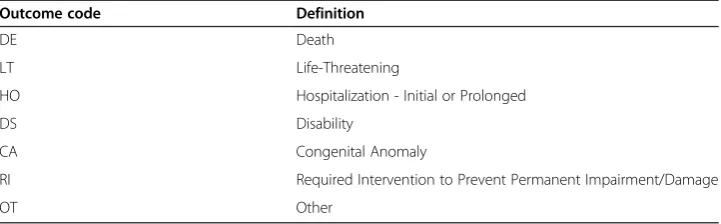
FDA AERS is a database that provides information on adverse event and medication error reports submitted to FDA [10]. By the definition of FDA, the“serious”means that one or more of the following outcomes were documented in the report: death (DE), hospitalization (HO), life threatening (LT), disability (DS), congenital anomaly (CA) and/ or other (OT) serious outcome. In our previous study, we produced a normalized AERS dataset known as AERS-DM [11]. The dataset contains 4,639,613 unique putative Drug-ADE pairs in which the drugs are represented by RxNorm [12] codes and the putative ADEs are represented by MedDRA [13] codes. The data set also contains the unique ID number (known as ISR) for each corresponding AERS report, which is a primary link field between the AERS data file. We used the ISR field to identify the outcome codes of each AERS report. Table 1 shows the outcome code definitions in AERS database.
Table 1 Outcome code definitions in AERS database
Outcome code Definition
DE Death
LT Life-Threatening
HO Hospitalization - Initial or Prolonged
DS Disability
CA Congenital Anomaly
RI Required Intervention to Prevent Permanent Impairment/Damage
OT Other
Common Terminology Criteria for Adverse Event (CTCAE)
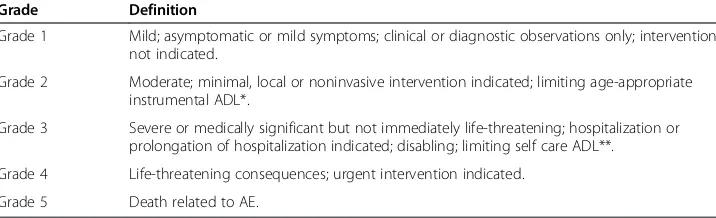
CTCAE is a widely accepted, standard grading scale for adverse events throughout the oncology research community [14]. The current released version is CTCAE 4.0. This version contains 764 AE terms and 26 “Other, specify”options for reporting text terms not listed in CTCAE. Each AE term is associated with a 5-point severity scale. The AE terms are grouped by MedDRA Primary SOC classes. In the CTCAE,“Grade”refers to the severity of the adverse event (AE). The CTCAE displays Grades 1 through 5 with unique clinical descriptions of severity for each AE based on a general guideline. Table 2 shows the grade definitions in the CTCAE grading system.
ADE datasets
SIDER (SIDeEffectResource) is a public, computer-readable side effect resource that contains information on marketed medicines and their recorded adverse drug reactions [15]. The information is extracted from public documents and package inserts, in par-ticular, from the US FDA Structured Product Labels (SPLs). The current version was released on October 17, 2012.
PharmGKB DDI-ADE Dataset is a database of DDI side effects based on FDA AERS reporting data [16], in which the confounding factors for prediction of the side effects are corrected through leveraging covariates in observational clinical data [17].
Semantic Web technologies
The World Wide Web consortium (W3C) is the main standards body for the World Wide Web [18]. The goal of the W3C is to develop interoperable technologies and tools as well as specifications and guidelines to lead the web to its full potential. The resource description framework (RDF), web ontology language (OWL), and SPARQL (a recursive acronym for SPARQL Protocol and RDF Query Language) specifications have all achieved the level of W3C recommendations, and are becoming generally accepted and widely used. RDF is a model of directed, labeled graphs that use a set of triples. Each triple is modeled in the form of subject, predicate and object. SPARQL is a standard query lan-guage for RDF graphs. OWL is a standard ontology lanlan-guage used for ontology modeling.
Methods
We utilized a normalized AERS dataset known as AERS-DM that was produced in a previous study [11]. The dataset contains 4,639,613 unique putative Drug-ADE pairs in
Table 2 Grade definitions in the CTCAE grading system
Grade Definition
Grade 1 Mild; asymptomatic or mild symptoms; clinical or diagnostic observations only; intervention not indicated.
Grade 2 Moderate; minimal, local or noninvasive intervention indicated; limiting age-appropriate instrumental ADL*.
Grade 3 Severe or medically significant but not immediately life-threatening; hospitalization or prolongation of hospitalization indicated; disabling; limiting self care ADL**.
Grade 4 Life-threatening consequences; urgent intervention indicated.
Grade 5 Death related to AE.
Note: Activities of Daily Living (ADL); *Instrumental ADL refer to preparing meals, shopping for groceries or clothes, using the telephone, managing money, etc.; **Self care ADL refer to bathing, dressing and undressing, feeding self, using the toilet, taking medications, and not bedridden.
which the drugs are represented by RxNorm codes and the putative ADEs are repre-sented by MedDRA codes. The AERS-DM dataset is organized in two database files in the Tab Separated Values (TSV) format and accessible at: http://informatics.mayo.edu/ adepedia/index.php/Download.
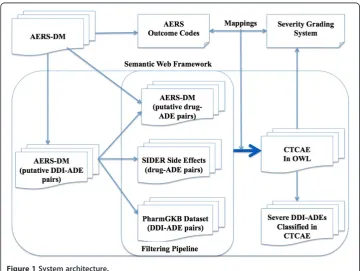
Figure 1 shows the system architecture of our approach. We first extracted a subset of putative DDI-ADE pairs (in which only two drugs are listed on a report) with their associated outcome codes from original AERS-DM dataset.
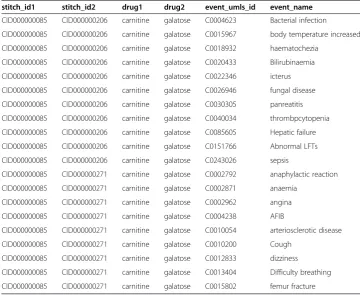
Second, we developed a filtering pipeline that comprises three datasets. The first dataset is a subset of original AERS-DM in which only one drug is listed on a report. This dataset was used to build a knowledge base of severe ADEs in a previous study. The second dataset is the SIDER 2 dataset. Table 3 shows a list of drug-ADE pair ex-amples from the dataset, in which drug names are coded in STICH ID (http://stitch. embl.de) and ADE names are coded in MedDRA. We excluded the putative DDI-ADE pairs based on the Drug-ADE pairs of the two datasets. The filtering would ensure that the reported ADEs could not be explained by a single drug effect. The third dataset is a PharmGKB dataset that is used as “silver” standard. Table 4 shows a list of DDI-ADE examples from the dataset, in which drug names are coded in STICH ID and ADE names are coded in UMLS Concept Unique Identifiers (CUIs).
Third, we converted all the datasets used in this study into the Semantic Web RDF format and loaded them into an open source RDF store known as 4store [19]. We established a SPARQL endpoint that provides standard query services against the RDF store. And then we developed the extraction and filtering algorithms using Java-based Jena ARQ APIs [20].
Third, to enrich the signals of the DDI-induced ADEs, we used the NLP-processed EMR data of a cohort of 138 k patients with health home care provided by Mayo Clinic
Figure 1System architecture.
Table 3 A list of Drug-ADE examples from SIDER dataset, in which drug names are coded in STICH ID and ADE names are coded in MedDRA
stitch_id1 stitch_id2 UMLS_con cept_id Drug_name side_effect_name MedDRA_conscept_type UMLS_concept_id MEDDRA_side_effect_name
−100003914 −39468 C0038454 Levobunolol cerebrovascular accident LLT C0038454 Cerebrovascular accident
−100003914 −39468 C0038454 Levobunolol cerebrovascular accident PT C0038454 Cerebrovascular accident
−100003914 −39468 C0015230 Levobunolol rash LLT C0038454 Rash
−100003914 −39468 C0015230 Levobunolol rash PT C0015230 Rash
−100003914 −39468 C0015230 Levobunolol rash PT C0015230 Dermatitis
−100003914 −39468 C0033377 Levobunolol ptosis LLT C0011603 Ptosis
−100003914 −39468 C0033377 Levobunolol ptosis PT C0033377 Eyelid ptosis
−100003914 −39468 C0033377 Levobunolol ptosis PT C0005745 Uterovaginal prolapse
−100003914 −39468 C0030554 Levobunolol paresthesia LLT C0156353 Paraesthesia
−100003914 −39468 C0030554 Levobunolol paresthesia PT C0030554 Paraesthesia
−100003914 −39468 C0006266 Levobunolol bronchospas LLT C0006266 Bronhospasm
−100003914 −39468 C0006266 Levobunolol bronchospas PT C0006266 Bronhospasm
−100003914 −39468 C1145670 Levobunolol respiratory failure LLT C1145670 Respiratory failure
−100003914 −39468 C1145670 Levobunolol respiratory failure PT C1145670 Respiratory failure
−100003914 −39468 C0027424 Levobunolol nasal congestion LLT C0027424 Nasal congestion
−100003914 −39468 C0027424 Levobunolol nasal congestion PT C0027424 Nasal congestion
−100003914 −39468 C0023380 Levobunolol lethargy LLT C0023380 Lethargy
−100003914 −39468 C0023380 Levobunolol lethargy PT C0023380 Lethargy
−100003914 −39468 C0947912 Levobunolol myasthenia LLT C0947912 Mysathenia
−100003914 −39468 C0947912 Levobunolol myasthenia PT C0151786 Muscular weakness
Jiang
et
al.
BioDa
ta
Mining
(2015) 8:12
Page
5
of
Rochester where medications and problems have been extracted and normalized to RxNorm codes and the UMLS concepts from the current medication and problem list sections of clinical notes using MedXN and MedTagger (http:// www.ohnlp.org/). For each DDI-induced ADE triples (D1, D2, P), we obtained the number of patients who are administrated with any of the two drugs or both (i.e., N(D1), N(D2), and N(D1,D2)) and the number of patients with puta-tive ADEs (i.e., N(D1,P), N(D2,P), and N(D1,D2,P) after taking the drugs. An occurrence of problem P is considered as putative ADE if it happens within 36 days of drug administration [17] and there is no occurrence of P in the EMR before the drug administration. We then developed the following metric to measure the signal enrichment of DDI-induced ADE:
Score Dð 1;D2;PÞ ¼log2 N DN Dð 1;D2;PÞ 1;D2
ð Þ
max N Dð 1;PÞ N Dð Þ1 ;
N Dð 2;PÞ
N Dð Þ2
:
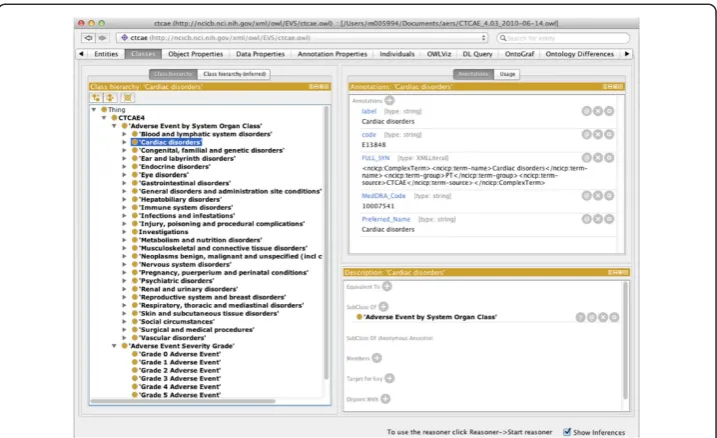
Finally, we developed the mappings between AERS outcome codes and CTCAE grades and classified the filtered DDI-ADEs into the CTCAE. We asserted that DE in AERS corresponds to Grade 5 in CTCAE; LT corresponds to Grade 4; the rest of out-come codes (HO, DS, CA, RI and OT) correspond to Grade 3. In this study, we utilized the CTCAE version 4.0 [14] rendered in OWL format. Figure 2 shows a screenshot of a Protégé4 environment displaying the categories and severity grades in CTCAE classification.
Table 4 A list of DDI-ADE examples from PharmGKB dataset, in which drug names are coded in STICH ID and ADE names are coded in UMLS CUI
stitch_id1 stitch_id2 drug1 drug2 event_umls_id event_name
CID000000085 CID000000206 carnitine galatose C0004623 Bacterial infection
CID000000085 CID000000206 carnitine galatose C0015967 body temperature increased
CID000000085 CID000000206 carnitine galatose C0018932 haematochezia
CID000000085 CID000000206 carnitine galatose C0020433 Bilirubinaemia
CID000000085 CID000000206 carnitine galatose C0022346 icterus
CID000000085 CID000000206 carnitine galatose C0026946 fungal disease
CID000000085 CID000000206 carnitine galatose C0030305 panreatitis
CID000000085 CID000000206 carnitine galatose C0040034 thrombpcytopenia
CID000000085 CID000000206 carnitine galatose C0085605 Hepatic failure
CID000000085 CID000000206 carnitine galatose C0151766 Abnormal LFTs
CID000000085 CID000000206 carnitine galatose C0243026 sepsis
CID000000085 CID000000271 carnitine galatose C0002792 anaphylactic reaction
CID000000085 CID000000271 carnitine galatose C0002871 anaemia
CID000000085 CID000000271 carnitine galatose C0002962 angina
CID000000085 CID000000271 carnitine galatose C0004238 AFIB
CID000000085 CID000000271 carnitine galatose C0010054 arteriosclerotic disease
CID000000085 CID000000271 carnitine galatose C0010200 Cough
CID000000085 CID000000271 carnitine galatose C0012833 dizziness
CID000000085 CID000000271 carnitine galatose C0013404 Difficulty breathing
CID000000085 CID000000271 carnitine galatose C0015802 femur fracture
Results
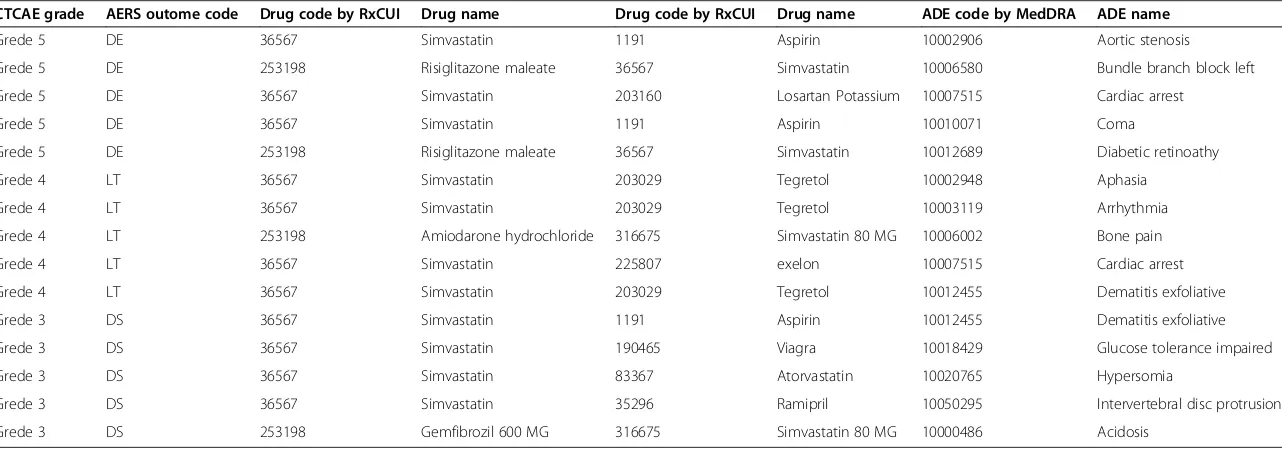
We were able to extract a set of putative DDI-ADE pairs and their associated out-come codes for the three target drugs: Warfarin, Clopidogrel and Simvastatin from normalized AERS-DM dataset. We then filtered the putative DDI-ADE pairs using the filtering pipeline based on three datasets. Table 5 shows the number of filtered DDI-ADE pairs for each target drug. In total, 601 pairs were filtered. Of them, 61 pairs are classified in Grade 5, 56 pairs in Grade 4 and 484 pairs in Grade 3. Table 6 shows a list of filtered DDI-ADE pair examples for the drug “Simvastatin”, in which, drugs are coded in RxNorm RxCUIs and ADEs are coded in MedDRA codes.
For the signal enrichment using the EMR data, we found that, there are 89 drug pairs prescribed concomitantly in 9.5 k patients, accounting for 6.9% of all patients in the EMR dataset we used. Out of 601 putative DDI-ADE pairs, the signals of 59 (D1, D2, P) pairs were identified. Table 7 shows the detailed statistics of those pairs occurred in no less than five patients.
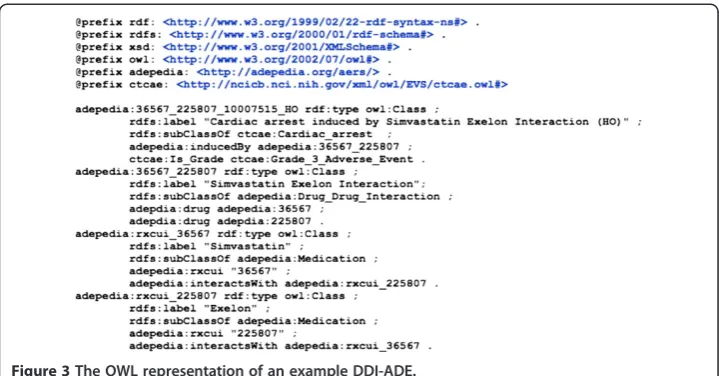
For integrating the filtered DDI-ADE pairs with the CTCAE, we produced an OWL rendering for each pair, asserting the filtered DDI-ADEs under AE terms in CTCAE (see Figure 3 for an example).
Figure 2The categories and severity grades of CTCAE classification in a Protégé 4 environment.
Table 5 The number of filtered DDI-ADE pairs for three drugs
Drug Number of DDI-ADE Pairs
Grade 5 Grade 4 Grade 3
Warfarin 32 11 157
Clopidogrel 17 29 166
Simvastatin 12 16 161
Total 61 56 484
Table 6 A list of filtered DDI-ADE pairs for the drug“Simvastatin”classified by CTCAE grades
CTCAE grade AERS outome code Drug code by RxCUI Drug name Drug code by RxCUI Drug name ADE code by MedDRA ADE name
Grede 5 DE 36567 Simvastatin 1191 Aspirin 10002906 Aortic stenosis
Grede 5 DE 253198 Risiglitazone maleate 36567 Simvastatin 10006580 Bundle branch block left
Grede 5 DE 36567 Simvastatin 203160 Losartan Potassium 10007515 Cardiac arrest
Grede 5 DE 36567 Simvastatin 1191 Aspirin 10010071 Coma
Grede 5 DE 253198 Risiglitazone maleate 36567 Simvastatin 10012689 Diabetic retinoathy
Grede 4 LT 36567 Simvastatin 203029 Tegretol 10002948 Aphasia
Grede 4 LT 36567 Simvastatin 203029 Tegretol 10003119 Arrhythmia
Grede 4 LT 253198 Amiodarone hydrochloride 316675 Simvastatin 80 MG 10006002 Bone pain
Grede 4 LT 36567 Simvastatin 225807 exelon 10007515 Cardiac arrest
Grede 4 LT 36567 Simvastatin 203029 Tegretol 10012455 Dematitis exfoliative
Grede 3 DS 36567 Simvastatin 1191 Aspirin 10012455 Dematitis exfoliative
Grede 3 DS 36567 Simvastatin 190465 Viagra 10018429 Glucose tolerance impaired
Grede 3 DS 36567 Simvastatin 83367 Atorvastatin 10020765 Hypersomia
Grede 3 DS 36567 Simvastatin 35296 Ramipril 10050295 Intervertebral disc protrusion
Grede 3 DS 253198 Gemfibrozil 600 MG 316675 Simvastatin 80 MG 10000486 Acidosis
Jiang
et
al.
BioDa
ta
Mining
(2015) 8:12
Page
8
of
Table 7 A list of putative DDI-ADE pairs signaled in the EMR data
D1 (RxCUI) D2(RxCUI) P (MedDRA) ADE Name N(D1) N(D2) N(D1,D2) N(D1,P) N(D2,P N(D1,D2,P) Score(DI,D2,P)
Aspirin (1191) Simvastatin (36567) 10002906 Aortic stenosis 38149 7494 2926 104 34 15 4.991
Zocor (196503) Simvastatin (36567) 10038428 Renal disorder 10894 7494 1472 40 56 7 4.550
Simvastatin (36567) atorvastatin (83367) 10028417 Myasthenia gravis 7494 2841 828 42 10 5 4.409
Warfarin (11289) Digoxin (3407) 10013887 Dysathria 6330 1927 641 43 7 6 4.36
Aspirin (1191) Simvastatin (36567) 10015090 Epistaxis 38149 7494 2926 126 28 9 4.257
gabapentin (25480) Simvastatin (36567) 10019245 Hearing impsored 4683 7494 280 35 70 5 3.935
Plavix (174742) Simvastatin (36567) 10017955 Gastrointestinal heamorrhage 4769 7494 642 54 42 9 3.88
Aspirin (1191) clopidogrel (32968) 10037423 Pulmunary oedema 38149 1436 1291 142 8 8 3.338
Aspirin (1191) clopidogrel (32968) 10005191 Blister Dyspnoea exertion 38149 1436 1291 135 9 7 3.048
Amlodipine (17767) Simvastatin (36567) 10013971 Dyspnoea exertional 2786 7494 561 62 89 11 2995
Aspirin (1191) Simvastatin (36567) 10047924 Wheezing 38149 7494 2926 354 73 27 2.969
Lantus (261551) Simvastatin (36567) 10012680 Diabetic neuropathy 1883 7494 329 39 20 5 2.63
Aspirin (1191) clopidogrel (32968) 10038428 Renal disorder 38149 1436 1291 175 9 6 2.452
Lantus (261551) clopidogrel (32968) 10040882 Skin lesion 38149 1436 1291 269 21 16 2.024
Aspirin (1191) clopidogrel (32968) 10046555 Urinary retention 38149 1436 1291 292 16 11 1.757
Aspirin (1191) clopidogrel (32968) 10061623 Adverse drug reaction 38149 1436 1291 368 20 15 1.549
Simvastatin (36567) Norvasc (58927) 10017076 fracture 7494 3416 318 139 59 6 1.219
D1 - drug1, D2 - drug 2, P - problem, N–number, and Score–enrichment score.
Jiang
et
al.
BioDa
ta
Mining
(2015) 8:12
Page
9
of
Discussion
In a previous study, we used a similar Semantic Web-based approach to build a know-ledge base of severe ADEs using the FDA AERS reporting data [8]. In this study, we fo-cused on mining the DDI-induced ADEs and their severity information, and configured the filtering pipeline differently using a collection of ADE datasets. The standardization of ADE datasets is essential for enabling interoperability and comparability among het-erogeneous data sources. We used a normalized AERS dataset, in which the drug names are normalized using standard drug ontologies RxNorm and NDF-RT and the ADEs are normalized using MedDRA, whereas the datasets from SIDER and PharmGKB used STITCH compound IDs to code drug names and used UMLS CUIs to code ADEs. Apparently, the solid mappings between RxNorm codes and STITCH IDs would be required in future, which will be part of our research efforts in constructing a standardized drug and pharmacological class network [21].
We also tested the signals of putative DDI-ADE pairs filtered by the pipeline using a large EMR data. We were able to detect some strong signals indicated by the enrich-ment score as illustrated in Table 7. This would potentially provide a very useful tool for the knowledge-driven detection of the DDI-induced ADEs from the EMR, though a rigorous patient chart review with a panel of clinicians would be needed in future to verify the signals to establish the causality of the drug-drug interaction.
For measuring the severity of ADEs, we used the CTCAE severity grading system. We found that the AERS outcome codes used to record serious patient outcomes in the AERS reporting data correspond well to the CTCAE Grades 3 to 5. Semantic Web OWL rendering of the DDI-ADE dataset provides seamless integration with the CTCAE itself, enabling a standard infrastructure for automatic classification of ADEs based on the severity conditions specified in the CTCAE.
There are several limitations in this study. First, we used the logic that a putative DDI-ADE combination is extracted if there exists an AERS report involving two drugs and the ADE. We understand that the AERS reports themselves do not make it easy to report concomitant drugs and these are known to be under-reported. This means the putative DDI-ADE pairs extracted in this study only reflect a portion of all DDI interac-tions and should not be considered as a comprehensive list. Second, the PharmGKB
Figure 3The OWL representation of an example DDI-ADE.
“silver standard” itself contains signals that have not been validated for causality. This is part of the reasons why we introduce the EMR-based signal enrichment metric in this study. Third, some signals identified from EMR data may not be valid and further rigorous validation approach will be needed in future to filter them out.
Conclusions
In summary, we developed a Semantic Web-based approach to mine severe DDI-induced ADEs. The dataset produced in this study will be publicly available from our ADEpedia website (http://adepedia.org). The approach developed could be generalized to detect the signals from EMR for putative severe ADEs induced by DDIs in other drug domains and would be useful for supporting translational and pharmacovigilance study of severe ADEs.
Consent
Informed consent of the use of EMRs for general research was provided by each subject with charts being included in the study. The study was approved by the Institutional Review Committee of the Mayo Clinic as Exempt (Mayo IRB Number: 12-009059).
Competing interests
The authors declare that they have no competing interests.
Authors’contributions
All co-authors are justifiably credited with authorship, according to the authorship criteria. Final approval is given by each co-author. In details: GJ–conception, design, development, analysis of data, interpretation of results, and drafting of the manuscript; HL–analysis of EMR data, interpretation of results and critical revision of the manuscript; HRS–conception and critical revision of the manuscript; CGC–institutional support and critical revision of the manuscript. All authors read and approved the final manuscript.
Acknowledgements
The study is supported in part by the SHARP Area 4: Secondary Use of EHR Data (90TR000201).
Received: 1 August 2014 Accepted: 26 February 2015
References
1. Becker ML, Kallewaard M, Caspers PW, Visser LE, Leufkens HG, Stricker BH. Hospitalisations and emergency department visits due to drug-drug interactions: a literature review. Pharmacoepidemiol Drug Saf. 2007;16(6):641– 51.
2. Daly AK. Pharmacogenomics of adverse drug reactions. Genome med. 2013;5(1):5.
3. Wang L, McLeod HL, Weinshilboum RM. Genomics and drug response. N Engl J Med. 2011;364(12):1144–53. 4. Phillips KA, Veenstra DL, Oren E, Lee JK, Sadee W. Potential role of pharmacogenomics in reducing adverse drug
reactions: a systematic review. JAMA. 2001;286(18):2270–9.
5. Percha B, Altman RB. Informatics confronts drug-drug interactions. Trends Pharmacol Sci. 2013;34(3):178–84. 6. Samwald M, Freimuth R, Luciano JS, Lin S, Powers RL, Marshall MS, et al. An RDF/OWL Knowledge Base for Query
Answering and Decision Support in Clinical Pharmacogenetics. Stud Health Technol Inform. 2013;192:539–42. 7. Jiang G, Solbrig HR, Chute CG, ADEpedia. A scalable and standardized knowledge base of adverse drug events
using Semantic Web technology. AMIA Annu Symp Proc. 2011;2011:607–16.
8. Jiang G, Wang L, Liu H, Solbrig HR, Chute CG. Building a knowledge base of severe adverse drug events based on AERS reporting data using Semantic Web technologies. Stud Health Technol Inform. 2013;192:496–500. 9. Jiang G, Liu HF, Solbrig HR, Chute CG. ADEpedia 2.0: Integration of Normalized Adverse Drug Events (ADEs)
Knowledge from the UMLS. AMIA Jt Summits Transl Sci Proc. 2013 Mar 18;2013:100-4. 10. The FDA AERS. [cited June 4, 2013]; Available from: http://www.fda.gov/Drugs/
GuidanceComplianceRegulatoryInformation/Surveillance/AdverseDrugEffects/default.htm.
11. Wang L, Jiang G, Li D, Liu H. Standardizing adverse drug event reporting data. J Biomed Semantics. 2014 Aug 12;5:36. doi: 10.1186/2041-1480-5-36.
12. Nelson SJ, Zeng K, Kilbourne J, Powell T, Moore R, Normalized names for clinical drugs. RxNorm at 6 years. JAMIA. 2011;18(4):441–8.
13. The MedDRA. [cited November 16, 2012]; Available from: http://www.meddramsso.com/. 14. The CTCAE v4.0. [cited June 1, 2013]; Available from: http://evs.nci.nih.gov/ftp1/CTCAE/About.html.
15. Kuhn M, Campillos M, Letunic I, Jensen LJ, Bork P. A side effect resource to capture phenotypic effects of drugs. Mol Syst Biol. 2010;6:343.
16. PharmGKB Dataset. [cited April 8, 2013]; Available from: http://www.pharmgkb.org/downloads.jsp.
17. Tatonetti NP, Fernald GH, Altman RB. A novel signal detection algorithm for identifying hidden drug-drug interactions in adverse event reports. JAMIA. 2012;19(1):79–85.
18. The World Wide Web Consortium (W3C). [cited May 25, 2013]; Available from: http://www.w3.org/. 19. Duke JD, Li X, Grannis SJ. Data visualization speeds review of potential adverse drug events in patients on
multiple medications. J Biomed Inform. 2010;43(2):326–31.
20. Ross CJ, Visscher H, Sistonen J, Brunham LR, Pussegoda K, Loo TT, et al. The Canadian Pharmacogenomics Network for Drug Safety: a model for safety pharmacology. Thyroid. 2010;20(7):681–7.
21. Zhu Q, Jiang G, Wang L, Chute CG. Standardized Drug and Pharmacological Class Network Construction. ICBO 2013 - Vaccine and Drug Ontology Studies (VDOS-2013) Workshop. Montreal, Qc. Canada; 2013.
Submit your next manuscript to BioMed Central and take full advantage of:
• Convenient online submission
• Thorough peer review
• No space constraints or color figure charges
• Immediate publication on acceptance
• Inclusion in PubMed, CAS, Scopus and Google Scholar
• Research which is freely available for redistribution
Submit your manuscript at www.biomedcentral.com/submit