ISSN (e): 2250-3021, ISSN (p): 2278-8719
Vol. 08, Issue 5 (May. 2018), ||VIII|| PP 72-79
Solving Economic Load Dispatch Problems: A Valuable
Evaluation
Naresh Kumar Yadav
Electrical Engineering DepartmentDeenbandhu Chhotu Ram University of Science & Technology Murthal (Sonepat)
Abstract—A rapid development has been noticed from the search-dependent optimization approaches for
distribution systems owing to spectacular distinction in FC’s and its influences in recent years. The major intention of ELD issue is to allocate the control parameters of power system for distributing the entire load to attain maximum profits while gratifying the entire inequality and equality measures. For attaining best possible result of practical ELD issue, the practical function of the ELD issue must regard VPE and so on. Accordingly, this survey intends to review various topics to solve ELD issues in distribution network. Accordingly, the algorithmic classification for the surveyed papers was analyzed and described. In addition, the performance measures and the maximum performance achievements are also analyzed and demonstrated in this survey. The renewable energy sources deployed in each reviewed papers are also portrayed. Finally, the research issues of the suggested model are also discussed briefly.Keywords— ELD; Distribution network; Algorithms; Performance measures. Nomenclature
Acronyms Description
ELD Emission Load Dispatch
FC Fuel Cost
EELD Economic Emission Load Dispatch GU Generating Unit
VPE Valve-Point Effects
PHOA Parallel Hurricane Optimization Algorithm GWO Grey Wolf Optimization
OKHA Krill Herd Algorithm OBL Opposition Based Learning IDE Improved Differential Evolution THS Tournament-based Harmony Search
HS Harmony Search
SAV Steam Admission Valves
IODPSO Improved Orthogonal Design Particle Swarm Optimization
MON Multi-objective Nonlinear
TLBO Teaching Learning Based Optimization ORCSA One Rank Cuckoo Search Algorithm RCCRO Real Coded Chemical Reaction Optimization MSFLA Modified Shuffled Frog Leaping Algorithm
GA Genetic Algorithm
NM Nelder–Mead
LI Lambda Iteration BF Bacterial Foraging
PSO Particle Swarm Optimization FA Firefly Algorithm
BBO Biogeography-Based Optimization DHS Differential Harmony Search
I.
INTRODUCTION
environment. The EELD issue [1] [2] [3] is regarded as an issue for analysts owing to its increased non-linear parameters. It intends to concern the load demand at reduced FC when gratifying inequality and equality factors. On the other hand, owing to the awareness of the pollution caused by fossil fuel plants, this guides the way to optimize the emission and cost concurrently [4] [5]. This is turning out to be advantageous for attaining the best possible scheduling of GU outputs. As a result, the EELD issue [6] [7] [8] was regarded as an arithmetical optimization problem with nonlinear parameters. These nonlinearities are raised in realistic applications owing to the initiating procedure of the SAV, which results in a rise in losses [9] [10] [11]. Usually, non-convexities occur from collective cycle units or VPE [12] [13]. The increase in features of nonlinearities also results in an unacceptable solution that includes a poor convergence. Minimization of the overall FC is considered as a major objective of distribution systems discarding the quantity of emission, which is generated. Anyhow, the intention of EELD issue [14] [15] is to concern on the significance of the ecological causes i.e. the quantity of the emission generated should be regarded along with the FC. In recent times, the remarkable rising of FC’s and the impacts of ecological problems of power GU’s provides alarms for the requirement of incessant development of optimization schemes for resolving EELD issues resourcefully [16] [17]. From operational viewpoint of power system, it is essential to reduce both generation costs and emission impacts at the same time. The EELD dilemma [18] can be manipulated as a MON issue. The optimization method required to resolve the EELD issue [19] [20] have to take into account along with the kinds of units, its features, costs of maintenance and operation, designs of accessible GU’s, the functioning parameters, potentials of transmission line and equipment limits, and the consistency of the accessible generations. Numerous optimization schemes have been implemented in recent times by several analysts to handle with the EELD issue [21] [22]. LI and gradient approaches are also exploited to resolve the ELD issues [24] [25] [26]. Anyhow, owing to the subsistence of nonlinearities in generators, preceding techniques do not succeed to provide precise decisions in power systems. Moreover, several optimization techniques together with dynamic programming and nonlinear were deployed to the similar issue. However, these approaches endure from non-convex and non-differential objective function, which causes the trapping of local optima. In the meantime, convex EELD issues [23] are solved efficiently through conventional local search schemes namely, LI ―which ignores network constraints and linear programming‖.
This survey has reviewed various works related to the ELD issues. Here, various algorithmic classifications, which are adopted in the surveyed papers, are demonstrated along with their performance measures. Along with it, the maximum performances achieved by the various works are also portrayed by this survey. In addition, the renewable resources adopted in each contribution are also described. The paper is organized as follows. Section II analyzes the various related works and reviews done under this topic. In addition, section III describes the various analyses on ELD issues, and section IV presents the research gaps and challenges. Finally, section V concludes the paper.
II.
LITERATURE REVIEW
A. Related works
In 2018, Rizk et al. [1] have introduced a PHOA for solving EELD issues in current power systems. Here, in PHOA, numerous populations move in the exploration space independently with the intention to optimize the objectives of the problem simultaneously by concerning the local behavior among them. In addition, executions were carried out, and evaluations with further optimization methods that were described in the literature were revealed. The attained outcomes determine the supremacy of the offered PHOA distinguished to other optimization methods.
In 2016, Moumita et al. [2] have established a novel evolutionary optimization methodology known as, GWO that was dependent on the grey wolves behavior, for the optimal functioning strategy of ELD. The established process was executed and analyzed on four test systems, and the outcomes authorize the efficiency and potential of the established algorithm when distinguished with numerous other approaches available in the literature. Moreover, the result was very promising, and it demonstrates that GWO was a very effective method for resolving numerous ELD issues.
In 2016, Ali et al. [3] have adopted a new heuristic process for resolving multifaceted ELD issue, by deploying a relatively novel technique known as OKHA. Here, KHA was merged with OBL to increase the accuracy and convergence speed of the fundamental KHA process. The adopted methodology was established to offer optimal outcomes while functioning with numerous operational parameters in ELD. The efficiency of the established technique was scrutinized and authenticated by performing statistical tests on five diverse standard systems. Distinguishing the statistical outcomes with other well-recognized approaches confirms the ability and robustness of suggested process over other prevailing systems.
optimal outcomes while gratifying the equality factors. Above all, IDE has attained much slighter alterations than traditional schemes on most of the test issues, demonstrating that it has better constancy on resolving ELD issues.
In 2016, Azmi et al. [5] have adopted a THS process for ELD issue. The THS was an improved model of the HS approach, in which the arbitrary assortment process was substituted by the THS procedure to stimulate the natural assortment of fittest value. This, in turn, enhances the convergence features of HS. Finally, the simulation outcomes demonstrate that the THS scheme was proficient of attaining improved quality solutions than numerous renowned optimization approaches.
In 2017, Qin et al.[6] have adopted an IODPSO technique for resolving the multi-area and single-area ELD issues with nonlinear characteristics, namely, VPE and so on. In the IODPSO process, an orthogonal modeled technique was exploited to set up a promising paradigm. Finally, investigational outcomes determine that IODPSO technique was a better model for resolving the non-smooth ELD issues.
In 2015, Sumit et al. [7] have offered a new TLBO method to resolve ELD of the thermal unit deprived of concerning transmission losses. TLBO was an evolutionary algorithm that was developed in recent times depending on two fundamental theories of education such as, learning and teaching phase. Initially, researchers develop their knowledge via the teaching practice of teacher, and lastly learners improve their skills by communications between themselves. Moreover, the efficiency of the implemented process has been confirmed on three diverse test systems with inequality and equality factors. Finally, the proposed scheme was compared with the other prevailing systems, and the supremacy of the suggested algorithm was demonstrated.
In 2015, Thang et al. [8] have adopted a ORCSA for resolving ELD issues. The major objective of the ELD issue was to reduce the thermal generator’s total cost while gratifying prohibited operating zones, VPE, etc. Furthermore, the GU’s deliberated in this work have diverse features namely, quadratic FC function. Finally, the outcomes acquired by ORCSA result was distinguished to other existing approaches, and the outcome specified that the ORCSA technique could attain improved outcomes than numerous other approaches.
In 2014, Kuntal et al. [9] have suggested a RCCRO model to resolve the EELD issue of power systems. EELD issue has been initiated as a MON issue by regarding both emission and economy instantaneously. A real-coded form of it, recognized as RCCRO was deployed here to resolve multi-objective EELD issues, so as to display the benefits of adopted scheme to resolve multifaceted continuous optimization issues. Finally, the solutions attained were quite promising and better to diverse prevailing optimization methods.
In 2013, Wang and Ling [10] had presented a DHS system by merging both HS and DE. Furthermore, a repair technique and three selection procedures were adopted for handling the constraints. Statistical executions were performed on the basis of diverse kinds of testing issues with numerous restraints comprising VPE and so on. Simulation outcomes and evaluations with the certain conventional algorithms establish the efficiency, effectiveness, and robustness of the suggested DHS process. At last, the consequence of constraint setting on DHS was also examined.
In 2013, Roy et al. [11] have introduced a novel approach for resolving EELD ISSUES with VPE, in which the cost function of GU’s displays non-convex features, as the VPE’s were designed and executed as rectified sinusoid elements. The adopted approach and its deviations were authenticated for four test systems, whose incremental fuel cost function considers the VPE’s. Finally, the outcomes were quite favorable and effective when distinguished with numerous benchmark approaches.
In 2012, Rahmat et al. [12] have adopted a novel method known as MSFLA with GA to resolve the ELD issue. Power production, emission costs, and spinning reserve were concurrently deliberated in the objective function of the presented ELD issue. A hybrid technique, which syndicates the BF process with the NM technique, together known as BF–NM system, was exploited to resolve the issue. Here, the simulations of the adopted BF–NM technique was distinguished with the outcomes of conventional approaches namely, PSO, GA, BF and DE schemes. Finally, the outcomes display the benefits of suggested technique for decreasing the entire cost of the scheme.
In 2012, Xin et al. [13] have established a technique for identifying the reasonable solution of the ED issues by means of the recently established FA. To establish the applicability and effectiveness of the offered technique, four ED test systems were analyzed and compared with certain ED solution methods that were published in recent times. At last, the outcomes of this analysis display that the adopted FA was capable to discover more economical loads than other approaches. Thus, this procedure was regarded to be a encouraging scheme for resolving the ED issues in practical systems.
In 2011, Aniruddha et al. [15] have established an amalgamation of DE and BBO schemes to resolve multifaceted EELD issues existing in the power systems. To demonstrate the advantages of the established method, it was deployed for resolving multi-objective EELD issues regarding both NOX and VPE emission.
From the analysis, the implemented scheme was recognized to be enhanced with respect to quality of the achieved promising and individual solutions.
III. REVIEW ON VARIOUS CONSTRAINTS
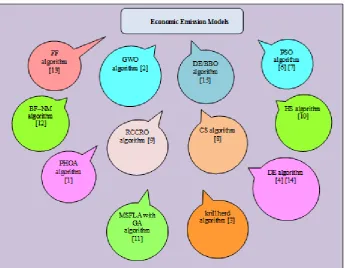
B. Algorithmic ClassificationThe papers that were reviewed have adopted various algorithmic techniques such as, FF algorithm, GWO algorithm, DE/BBO algorithm, PSO algorithm, BF-NM algorithm, RCCRO algorithm, CS algorithm, HS algorithm, DE algorithm, PHOA algorithm, MSFLA with GA algorithm and krill herd algorithm. Accordingly, FF algorithm was adopted in [13], and GWO algorithm was implemented in [2]. In addition, DE/BBO algorithm was adopted in [3], and PSO algorithm was implemented in [6] and [7]. Moreover, BF-NM algorithm and RCCRO algorithm were suggested in [12] and [9] respectively. CS algorithm was implemented in [8], and HS algorithm was adopted in [10] correspondingly. Furthermore, DE algorithm was deployed in [4] and [14], and PHOA algorithm was implemented in [1]. In addition, MSFLA with GA algorithm was exploited in [11], and krill herd algorithm was suggested in [3].
Fig. 1: Various schemes of the reviewed works
C. Renewable Sources
Fig. 2: Renewable sources of the reviewed works
D. Performance Measures
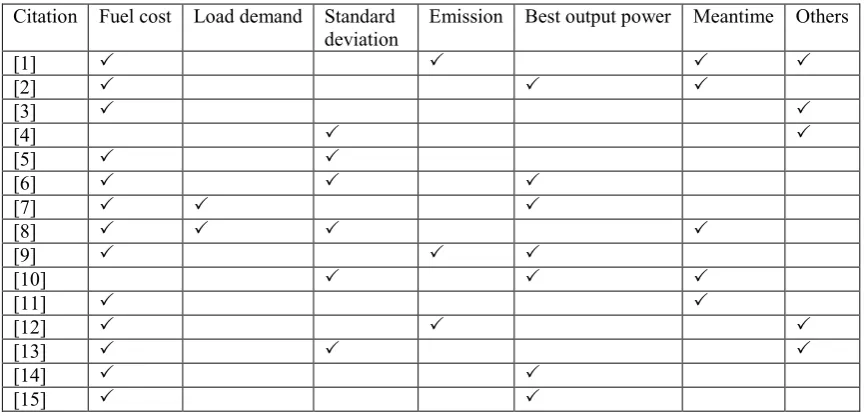
The performance measures include fuel cost, load demand, Standard deviation, Emission, Best output power, Meantime, Security indices, Best solution, Average objective function value, Minimum emission, Reserve and number of evaluation. Here, fuel cost has offered about 86.67% of the total contribution, load demand has offered about 13.33% of the entire contribution, and standard deviation has offered about 40% of the entire contribution, and emission has offered about 20% of the total contribution, best output power has offered about 46.67% of the total contribution. Accordingly, meantime has offered about 33.33% of the total contribution and Security indices time has offered about 6.67% of the total contribution. Also, best solution, average objective function value, minimum emission, reserve and number of evaluation have acquired about 6.67% of the entire contribution.
TABLE I. PERFORMANCE MEASURES OF THE REVIEWED WORKS
Citation Fuel cost Load demand Standard
deviation Emission Best output power Meantime Others
[1]
[2]
[3]
[4]
[5]
[6]
[7]
[8]
[9]
[10]
[11]
[12]
[13]
[14]
[15]
E. Maximum Performance Achieved
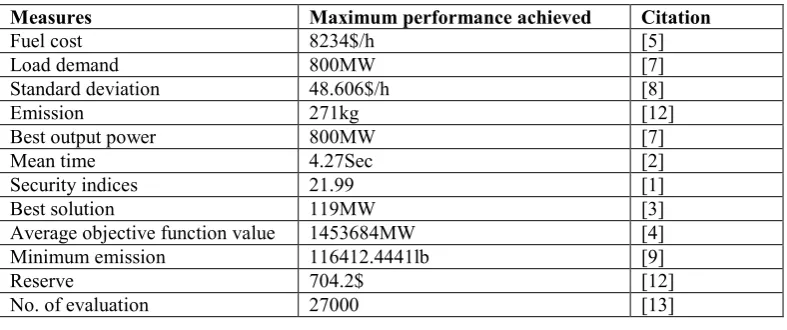
The maximum performance achieved by various performance measures is given by Table II. The enhanced fuel price attained from the reviewed papers was found to be 8234$/h, and it was adopted in [5]. In addition, Load demand was determined to be 800MW and it was deployed in [7]. Standard deviation was exploited in [8], and it attains a value
TABLE I. MAXIMUM PERFORMANCE ACHIEVED BY THE REVIEWED WORKS
Measures Maximum performance achieved Citation
Fuel cost 8234$/h [5]
Load demand 800MW [7]
Standard deviation 48.606$/h [8]
Emission 271kg [12]
Best output power 800MW [7]
Mean time 4.27Sec [2]
Security indices 21.99 [1]
Best solution 119MW [3]
Average objective function value 1453684MW [4]
Minimum emission 116412.4441lb [9]
Reserve 704.2$ [12]
No. of evaluation 27000 [13]
IV. RESEARCH GAPS AND CHALLENGES
ELD was regarded as a most important aspect in real power markets. The significant problems and challenges of ELD are portrayed in this section.
Frequency of the dispatch: Carrying out an ELD more frequently have an effect on the cost level.
Communication of information: Production operators, load serving units, and transmission possessors have to offer precise and up to date information to those carrying out the dispatch and planning operations. Those carrying out dispatch and planning have to offer precise and current dispatch instructions to production operators, load serving units, and transmission possessors. Insufficient or partial communications have an effect on the level of costs of the ELD.
Software tools for information and dispatch: Consistent and safe computer software is necessary for speedy system responses to sustain power system consistency when choosing the least cost generators for dispatching. Outdated software also has an effect on the level of prices attained by the ELD.
Coordination of dispatch over various areas: Where there are numerous, independently executed dispatches in an area, the efficiency of harmonization agreements and their performance have an effect on the cost level of ELD.
V. CONCLUSION
In recent days, the growing concerns of environmental issues and dramatic increment of FC’s of power GU’s had offered early alarms for the requirement of continuous development of optimization techniques for resolving EELD issues in an effective manner. From distribution viewpoint, it was essential to reduce both emission effects and costs concurrently. In this survey, various papers were analyzed, and the corresponding techniques adopted in each surveyed paper were described. In addition, the performance measures concerned in each paper were illustrated and along with it, the maximum performance measures attained were also illustrated. The renewable energy resources adopted in the surveyed papers were also described in this survey. Thus the- -survey provides the detailed analysis of the EELD problems from the reviewed papers.
REFERENCES
[1]. Rizk M. Rizk-Allah, Ragab A. El-Sehiemy, Gai-Ge Wang, ―A novel parallel hurricane optimization algorithm for secure emission/economic load dispatch solution‖, Applied Soft Computing, vol. 63, pp. 206-222, February 2018.
[2]. Moumita Pradhan, Provas Kumar Roy, Tandra Pal, ―Grey wolf optimization applied to economic load dispatch problems‖, International Journal of Electrical Power & Energy Systems, vol. 83, pp. 325-334, December 2016.
[3]. Sk Md Ali Bulbul, Moumita Pradhan, Provas Kumar Roy, Tandra Pal, ―Opposition-based krill herd algorithm applied to economic load dispatch problem‖, Ain Shams Engineering Journal, 26 April 2016. [4]. Dexuan Zou, Steven Li, Gai-Ge Wang, Zongyan Li, Haibin Ouyang, ―An improved differential
[5]. Mohammed Azmi Al-Betar, Mohammed A. Awadallah, Ahamad Tajudin Khader, Asaju La'aro Bolaji, ―Tournament-based harmony search algorithm for non-convex economic load dispatch problem‖, Applied Soft Computing, vol. 47, pp. 449-459, October 2016.
[6]. Quande Qin, Shi Cheng, Xianghua Chu, Xiujuan Lei, Yuhui Shi, ―Solving non-convex/non-smooth economic load dispatch problems via an enhanced particle swarm optimization‖, Applied Soft Computing, vol. 59, pp. 229-242, October 2017.
[7]. Sumit Banerjee, Deblina Maity, Chandan Kumar Chand, ―Teaching learning based optimization for economic load dispatch problem considering valve point loading effect‖, International Journal of Electrical Power & Energy Systems, vol. 73, pp. 456-464, December 2015.
[8]. Thang Trung Nguyen, Dieu Ngoc Vo, ―The application of one rank cuckoo search algorithm for solving economic load dispatch problems‖, Applied Soft Computing, vol. 37, pp. 763-773, December 2015. [9]. Kuntal Bhattacharjee, Aniruddha Bhattacharya, Sunita Halder nee Dey, ―Solution of Economic
Emission Load Dispatch problems of power systems by Real Coded Chemical Reaction algorithm‖, International Journal of Electrical Power & Energy Systems, vol. 59, pp. 176-187, July 2014.
[10]. Ling Wang, Ling-po Li, ―An effective differential harmony search algorithm for the solving non-convex economic load dispatch problems‖, International Journal of Electrical Power & Energy Systems, vol. 44, no. 1, pp. 832-843, January 2013.
[11]. Priyanka Roy, Pritam Roy, Abhijit Chakrabarti, ―Modified shuffled frog leaping algorithm with genetic algorithm crossover for solving economic load dispatch problem with valve-point effect‖, Applied Soft Computing, vol. 13, no. 11, pp. 4244-4252, November 2013.
[12]. Rahmat-Allah Hooshmand, Moein Parastegari, Mohammad Javad Morshed, ―Emission, reserve and economic load dispatch problem with non-smooth and non-convex cost functions using the hybrid bacterial foraging-Nelder–Mead algorithm‖, Applied Energy, vol. 89, no. 1, pp. 443-453, January 2012. [13]. Xin-She Yang, Seyyed Soheil Sadat Hosseini, Amir Hossein Gandomi, ―Firefly Algorithm for solving
non-convex economic dispatch problems with valve loading effect‖, Applied Soft Computing, vol. 12, no. 3, pp. 1180-1186, March 2012.
[14]. Aniruddha Bhattacharya, Pranab Kumar Chattopadhyay, ―Solving economic emission load dispatch problems using hybrid differential evolution‖, Applied Soft Computing, vol. 11, no. 2, pp. 2526-2537, March 2011.
[15]. Aniruddha Bhattacharya, P. K. Chattopadhyay, ―Hybrid differential evolution with biogeography-based optimization algorithm for solution of economic emission load dispatch problems‖, Expert Systems with Applications, vol. 38, no. 11, pp. 14001-14010, October 2011.
[16]. Sanjoy Roy, ―The maximum likelihood optima for an economic load dispatch in presence of demand and generation variability‖, Energy, vol. 147, pp. 915-923, 15 March 2018.
[17]. Yizi Shang, Shibao Lu, Jiaguo Gong, Ronghua Liu, Qixiang Fan, ―Improved genetic algorithm for economic load dispatch in hydropower plants and comprehensive performance comparison with dynamic programming method‖, Journal of Hydrology, vol. 554, pp. 306-316, November 2017.
[18]. Haiping Ma, Zhile Yang, Pengcheng You, Minrui Fei, ―Multi-objective biogeography-based optimization for dynamic economic emission load dispatch considering plug-in electric vehicles charging‖, Energy, vol. 135, pp. 101-111, 15 September 2017.
[19]. Sarat Kumar Mishra, Sudhansu Kumar Mishra, ―A Comparative Study of Solution of Economic Load Dispatch Problem in Power Systems in the Environmental Perspective‖, Procedia Computer Science, vol. 48, pp. 96-100, 2015.
[20]. Vahid Hosseinnezhad, Mansour Rafiee, Mohammad Ahmadian, Mohammad Taghi Ameli, ―Species-based Quantum Particle Swarm Optimization for economic load dispatch‖, International Journal of Electrical Power & Energy Systems, vol. 63, pp. 311-322, December 2014.
[21]. Juan Pablo Sáenz, Nurcin Celik, Hui Xi, Young-Jun Son, Shihab Asfour, ―Two-stage economic and environmental load dispatching framework using particle filtering‖, International Journal of Electrical Power & Energy Systems, vol. 48, pp. 93-110, June 2013.
[22]. Mojtaba Ghasemi, Mahdi Taghizadeh, Sahand Ghavidel, Abbas Abbasian, ―Colonial competitive differential evolution: An experimental study for optimal economic load dispatch‖, Applied Soft Computing, vol. 40, pp. 342-363, March 2016.
[23]. Tapas Kumar Panigrahi, Arun Ku. Sahoo, Aurobindo Behera, ―A review on application of various heuristic techniques to combined economic and emission dispatch in a modern power system scenario‖, Energy Procedia, vol. 138, pp. 458-463, October 2017.
[25]. Naresh Kumar Yadav, and Gunjan Bhargava, ―Hyperplane Variation on Distributed Acceleration Constants in Efficiency of Solving Economic Load Dispatch Problem‖, International Journal of Electronics Engineering Research, vol. 9, pp. 311-321, 2017.
[26]. Shivani Jindal, and NK Yadav, ―A Hybrid (FF-DE) Approach to Solve Economic Load Dispatch‖, International Journal of Advances in Electrical and Electronics Engineering, vol.3, no.3, pp. 144-155, 2012.