The Social Web of Things (SWoT) - Structuring
an Integrated Social Network for Human, Things
and Services
Cheng Cheng
a, Chunhong Zhang
a, Xiaofeng Qiu
a, Yang Ji
aa Key Laboratory of Ubiquitous Networks, Beijing University of Posts and Telecommunications, Beijing 100876,
China
Email: [email protected], {zhangch, qiuxiaofeng, jiyang}@bupt.edu.cn
Abstract— In recent years, the development of IOT (Internet of Things) technology has given people many ways to obtain information through various types of physical devices. In parallel with that trend, people rely more on context-aware service and devices in many aspects, such as health care and elderly home care. However, traditional sensors are typically locked into closed systems, which hinder the access to such sensors that can be available in other information systems. Establishing free communication between human and physical things will help build a network with hy-brid intelligence and amazing services. In order to share information and enable the communication between both physical devices and human, we proposed a SWoT (Social Web of Thing) framework in this paper that establishes social networking between embedded devices, services and human. Through the supernetwork approach, we discussed the service discovery in the SWoT system with heterogeneous social relations. At last, we introduced the MagicHome prototype of SWoT.
Index Terms— Internet of things, Social network, Semantic web, Service discovery
I. INTRODUCTION
In the current Internet of Things industry, things are still restricted on incompatible islands by dedicated soft-ware, and more importantly, by proprietary interface. There have been quite a number of independent researches that investigated the potentialities of integrating social network concepts into Internet of Things [12-14], which are named Social Internet of Things (SIoT). The barriers among different IoT systems still exist, the social interac-tion as well as informainterac-tion exchange still lack of universal protocols. This situation makes the sharing of data and collaboration between systems quite difficult.
Nowadays, Web protocols are mature enough to enable atomic device service and data identification, as well as provide standardized interface and low-barrier of develop-ment. Thus, WoT (Web of Things) [1,2,3] for smart things interaction on application layer through web technologies on top of the network connected by IoT is proposed. The smart things in WoT could be easily accessed or controlled by users through APIs (Application Program
Manuscript received June 17, 2013; revised January 2, 2012; accepted April 16, 2012. c2005 IEEE.
This work was supported by the State Key Program of Chi-na(GrantNo.2012ZX03005008).
Interface) as web servers, and be able to create new service processes.
In this paper, we proposed the framework of Social Web of Things (SWoT) based on supernetwork concept. In our framework, SWoT is an integrated social network and established among human, things and services so that the inhomogeneity of entities can be ignored. Moreover, the interactions across systems are allowed since the universal Web API. In such ecosystem, the issues like sharing, discovery, trustworthiness and interaction could be achieved on application layer by using social network techniques.
As shown in Figure 1, SWoT becomes an open platform for smart devices and services to publish and access data, and to communicate with human as well as others. Smart devices/services could connect directly to SWoT platform through uniform web API. For devices/services with limited capabilities, middleware acts as a broker to provide web API. Human and the third party platform could also communicate with physical world through applications with web API. To make a friendly interaction between human and things, communication middleware on the platform layer is needed. By this middleware, things can receive and transform human request in a machine-readable format. Also, things can publish their outputs in well-understood human language on the web, thus making them accessible and usable on a large scale under controlled access. From the discussed above, we
Figure 1. The Concept of Social Web of Things
(1) Provide a platform with open Web APIs, standard interaction protocols, and unified resource identification, which could integrate entities (human, devices and ser-vices) in different domains. On the SWoT platform, user could share their devices and/or services through social propagation mode. Meanwhile, the platform enables co-operation and resource discovery by social relationships. (2) Enable intelligent interaction between things and services without the participant of human. In the SWoT, things and services could establish social links, as well as the ability of reasoning and decision-making automatical-ly or semi-automaticalautomatical-ly by machine learning and other data mining methods.
(3) To make things and services understand each other and make machine-made raw data understandable by human (user-friendly), SWoT enables structural raw data to be translated into natural language. Also, SWoT could interpret the natural language to machine language by structuring ontology base.
(4) SWoT supports better and more convenient per-sonalized services/applications generation than IoT. On SWoT platform, not only professional developers but every common user could be able to generate their own services via visual and interactive user interfaces. From social information sharing, users could discover various trustworthy device data/ability and services they are in-terested in. Also, users could publish their own services to others in social way.
The introduction of social relationship in our work is no longer only for sharing devices or data. We aim to structure an integrated social network, which is not dependent on the recent human social networks but a brand new ecosystem. In this paper, we first propose a framework of Social Web of Things, which is based on WoT architecture and introduce the concept of social network. We use supernetwork theory to illustrate the integrated structure of SWoT and discuss the service discovery model in our framework. As last, we introduced a SWoT prototype named MagicHome.
II. RELATEDWORKS
Smart devices are widely deployed as the sensing elements to compose ubiquitous computing environments for the physical world. To meet the requirements of reuse and distribution of the resources and services of smart things, several systems have exposed the functionality of smart things upon which amount of applications could be built. SenseWeb [4] and Pachube [5] integrate the sensor systems with the Internet to form a centric platform where people share their sensory reading using web services.Furthermore, WoT (Web of Things) [1,2,3] for smart things interaction on application layer through web technologies on top of the network connected by IoT is proposed. The smart things in WoT can be easily accessed or controlled by users through open APIs as web services, and be composed to create new services.
The web enabled smart things to imply the possibil-ity to integrate physical objects into web information
ecosystems seamlessly. Some applications take the social network as the mediation of data sharing between things or peoples. Dominique [7] proposed an access control framework of smart things depending on the structure of social networks. The friends or relatives of the sensor owner would share smart things without the need to recre-ate another user database for trust purpose. SenseShare [8] exploited social networks and structures to provide authentication, privacy, and security while sharing sensor data with other people.
[12-14] have discussed the Social Internet of Things concept, and have proposed the general SIoT structure. However, these prior works often focus on the social relationships between devices. The role of human is not considered in the previous work.
In addition to leveraging social community structure for secure distribution of smart things, smart things could play more significant roles in the social networks, and even behave as almost the same as human user do. They would have identical social user IDs through which people and other devices could be linked together. They can keep up to date with which device is doing what where. Mats Alendal [16] described a vision of social web of things. The things will have friends, post messages, follow news feeds, and even chat with other things and/or friends.
However, there isn’t comprehensive understanding of the architecture for the social web of things as well as the technology challenges to implement the vision into reality. To facilitate the socialization of smart things in the web ecosystem, the design considerations of social web of things is proposed on which new capabilities could be easily envisioned.
III. THEFRAMEWORK OFSOCIALWEB OFTHINGS
The purpose of this paper is to present a framework for hybrid entities and complex relations in SWoT, and propose solutions to a number of issues that hinder implementation. The classical social network model has been adapted to handle the objects with minor changes [17], but it lacks a systematic and coherent theoretical basis, whereas an elegant unified theoretical basis already exists in the form of supernetwork modeling [18].
The supernetwork approach has been investigated and reported in [19] for a study area in The Netherlands (the Dordrecht-Rotterdam corridor) from a point of view of computational feasibility, the results of which were positive. Supernetwork, which consists of nodes, links (which may be physical virtual and, hence, are necessarily abstract), as well as the associated flows, were originally proposed in the context of transportation networks. The supernetwork models are usually adopted in the supply chain with electronic commerce, financial networks with intermediation, as well as telecommunication decision-making. [15]
Figure 2. The Supernetwork Framework for SWoT
include the owner of things, service developer and service user.
As mentioned above, the entities participating in S-WoT could be divided into three types: human(owner of things, service developer and service user), things(such as devices, sensors, actuators)and services. Things could supply abundant sensing data and/or capabilities. Human could composite these various data and capabilities to services. Considering the importance of service in SWoT, we abstract services as nodes in our SWoT.
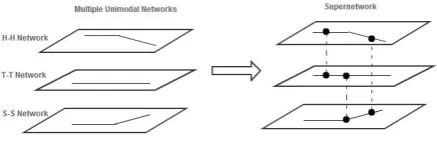
SWoT contains hybrid entities and complex relations between them. Therefore, in this paper we adopt supernet-work theory to describe the SWoT system. In the SWoT supernetwork (abbreviated for SWoTSN), the links corre-sponding to different relations, include, but not limited to: follower/friend links, co-owner links, co-work links and interface links, consolidation links, etc. Therefore , there exists three types of basic networks in SWoT
• Things-to-Things network (abbreviated as T-T net-work)is the social network between things in SWoT. The nodes are things and the links represent the relationship between things. Such as parental object relationship, co-location relationship, co-owner and co-work[12,13]. The T-T network could be modeled asGt= (T, ET−T), in whichT ={t1,t2,...tb}is the assembling of heterogeneous things in SWoT system, andET−T={(ti,tj)|ti,tj∈T}is the assembling of relations.
• Human-to-Human network (abbreviated as H-H net-work)is the social network between human in SWoT. The nodes are human and the links represent the relationship between them. Compared with recent human social network (facebook, twitter etc.), the relation types in the recent social network are often friends relationship, like the follower in Twitter. Although [14] has discussed the interests relationship model in human social network by supernetwork theory, the relations and nodes are far more com-plex in SWoT. We represent the H-H network as
Gh= (H, EH−H) , in which H = {h1,h2,...,hn} is the assembling of human in the network, and
EH−H={(hi,hj)|hi,hj ∈H}stands for the assem-bling of relations between human.
• Service-to-Service network (abbreviated as S-S net-work). From the discuss above, not only raw data and capabilities could be utilized as resourcesbut services could be published and utilized as resources as well. Meanwhile, different services could also access or
cooperate with each other. Therefore, we abstract ser-vice as nodes in the network. The network consists of services and could be represented asGs= (S, ES−S) , in which S = {s1,s2,...,sa}is the assembling of services and ES−S={(si,sj)|si,sj∈S}is the assembling of service cooperation relations.
To combine the three basic networks in our SWoT system, we introduce the mapping between each of them. Human-to-Things mapping relations, which we abbreviate as H-T. This kind of relation stands for the user who has things, and the thing belongs to whom. Things-to-Service mapping relations, which we abbreviate as T-S. This kind of relation stands for the service which has used data and capacity from which things, and the thing which has been accessed by which services. Human-to-Service mapping relations, which we abbreviate as H-S. This kind of relation stands for the user who has developed or used which services, and the service which has been accessed by whom.
Based on the mapping relations, we could integrate the networksGh,GtandGsinto a supernetwork by adding the mapping relations to the basic networks as links. In this paper, we call this network as SWoT supernetwork (SWoTSN). The processing as following:
Let each hi ∈ H , tj ∈ T and sl ∈ S represents a certain node in the basic network separately. We use Boolean variable φ(hi,tj), φ(hi,sl) and φ(tj,sl) to represent the mapping relations between different types of nodes. The value of Boolean variable equals to 1 when there exists a relation between the two nodes. Else the value is 0. Therefore the SWoT could be modeled by supernetwork as
SW oT SN=f(Gh, Gt, Gs)
=Gh+Gt+Gs+EH−T +ET−S+EH−S (1)
The links between different types of nodes are represented as:
EH−T={(hi,tj)|φ(hi,tj) =1} (2)
EH−S={(hi,sl)|φ(hi,sl) =1} (3)
ET−S={(tj,sl)|φ(tj,sl) =1} (4)
From the SWoTSN model above, we could conclude that SWoTSN is the integration of three types of basic networks, which consists of three types of nodes and six types of links.
IV. THESERVICEDISCOVERYMODEL INSWOT
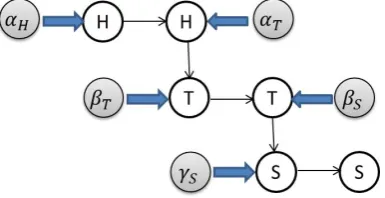
A main advantage of SWoT is the improvement of resource sharing and service discovery. In this section, we use service discovery in SWoT as an example to further describe the SWoT. We give two service discovery models of as following.
Figure 3. The Basic Service Discovery Model (BSDM)
Figure 4. The Social Relation Based Service Discovery Model (SR-SDM)
discovery model, in which only mapping relationships are considered.
For example, a developer wants to find a trusted temper-ature sensor. He can first choose the tempertemper-ature relevant services he developed before. Then he can discover a temperature sensor, which is most-used in the services. Figure 4 shows the social relation based service discovery model, which introduce social relationships in the basic networks we discussed in section 3. This model is also the core of SWoT service discovery.
For example, a developer can discover a trusted tem-perature sensor not only by his evaluation but his friend’s. Meanwhile, he could find more relevant sensors once he reached to the friend’s sensor by the T-T relationships. Similarly, the developer could find more relevant services have been developed by him or his friends. We use SR-SDM as an example to further describe the generation of service discovery in SWoT.
Let H = {h1,...,hn} and T = {t1,...tb} denotes the sets of human and things in the network and
X={x1,...,xm} denotes the set of directed links. Let
p denote a service discovery path, assumed to be a-cyclic, and consist of a sequence of links connecting an origin/destination (O/D) pair of nodes. A link in the SWoTSN framework needs not correspond to a physical link, but may be abstract and associated with a factor of production or activity required for interaction.
(1) Path Representation
A path pcould be divided into steps by the different character of nodes. LetpH hO, hk
∈p,(k∈n)denote the sub-path on H-H network, andpT tl,tD
∈p,(l∈b) denote the sub-path on T-T network, in whichhO andtD
stand for the origin node in H-H network and destination node in T-T network separately. Also, we let x(hk,tl)∈
p,(k∈n,l∈b)denote the link ofpon H-T. So the path
pcould be represented as:
p=
pH hO, hk, pT tl, tD,x(hk,tl)|k∈n,l∈b (5) (2) Individual Preference
In traditional SNS, users have different preference in interaction, such as relation establishment and service acquisition. Therefore, we should consider the individ-ual preference in SWoT. Similar to human’s preference, heterogeneous things and various services in SWoT have different functions, characters and requirements. For ex-ample, a real-time service would prefer to employ the sensors have high sensitivity and another data mining service would better adopt sensors with high accuracy. Therefore, we also take the individual preference of things into account.
Let αi={αHi,αT i,αSi},i ∈ n be the preference of useri to other users, things and services separately. Cor-respondingly, we adopt βj={βHj,βT j,βSj},j ∈ b and
γm={γHm,γT m,γSm},m∈ato represent the preference of thing and service.
(3) Decision-Making
There are multiple relations between nodes in SWoT-SN. This means that different nodes may play various roles in service discovery. So we need dynamic decision-making in generating service discovery path, which means when selecting a node in the path, we should consider the status of the previous node as well as the decision function.
Let s(hi) denote the status of hi and uH(.) denote the decision variable of the sub-path pH. Considering the individual preference in path choice, uH(.) could be reconstructed as uH={uH1,uH2,...uHn} and each
uHi ∝αi. Similarly, we have the decision function uT anduS.Thus, the policy in a service discovery path could be represented as U={uH,uT, uS}.
(4) A Specific Multi-Objective Optimization Problem We use the indicator function vi(s(hi),uHi) to rep-resent the quality of the growth path. And we adopt
f hO,tD as the optimal indicator function in the from the origin node, so we have
f hO, tD=optx(hk,tl)=1
fH hO, hk
+fT tl, tO (6)
fH hO, hk=opt
Yk
i=Ovi(s(hi), uHi)
(7)
fT tl, tO
=opt
YD
j=lvj(s(tj), uT j)
(8)
in which x(hk,tl) =1 means there is a link between hk andtl, andoptrepresents the optimal decision.
V. PROTOTYPE ANDCASESTUDY
Figure 5. MagicHome Overview
A. MagicHome Overview
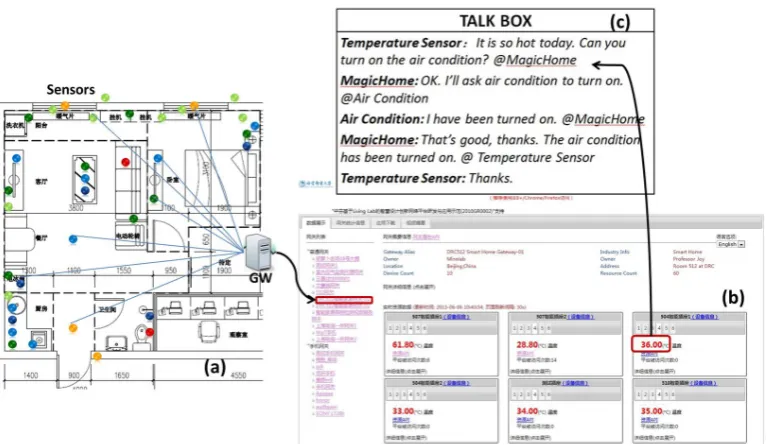
Figure 5(a) is the actual layout of MagicHome. It has a balcony, a living room, a bedroom, a dining room and a bathroom.
In MagicHome, there are lights, curtains, air condition-er, temperature and humidity sensor, luminance sensor, wind sensor, smoke sensor and other physical devices. Currently, these devices are connected wirelessly or wired to the smart gateway which acts as a broker to provide uniform web API for these devices.
The data are also collected and displayed on web pages (see figure 5(b)) http://www.cloudsensing.cn:8080/. MagicHome system provides the ability to customize rule configuration through web pages at http://www.cloudsensing.cn:8199/. Rule configuration XML file could be used by systems to handle different service discovery situations and the acquired data from APIs is used to trigger the rules. Based on the open APIs, human could upload their own devices and develop kinds of sensor based applications. Also, the system can achieve and save the social data, which we have discussed in section 2. Figure 5(c) is an example of the device chat scenario of MagicHome based on weibo.com, which is the biggest SNS website in China.
Till now, MagicHome only can support simple com-munication between human and things, which could be developed to test our SWoT framework and service dis-covery model in the future.
B. MagicHome System Description
As we introduced above, the main function of Magi-cHome system is to support a unified intelligent interac-tion between human and things. It means MagicHome system could collect data from heterogeneous devices, which we named WoT resource, and push the data to the social network as a human-friendly semantic format.
Figure 6. MagicHome System
Meanwhile, MagicHome system should also issue human commends to devices in machine language from social networks. Figure 6 demonstrates the main modules in MagicHome system, which includes Data Access Mod-ule, Context Reasoning ModMod-ule, Semantic Transformation Module and SNS Driver Pool. Corresponding to figure 1 in section 1, these modules should be on the SWoT platform layer.
(1) Data Access Module
The Data Access Module is primarily responsible to collect data from the WoT resources such as sensors and to issue the messages and commands originated from SNS to WoT resources.
As mentioned before, the data and operation of WoT Resource has been abstracted into URLs by Restful Web Service and thus can be accessed or controlled through HTTP API. With respect to the discovery of such URLs, the Device Management Module can manage and provide device profile including the URL of each WoT Resource.
In MagicHome system, the concept of Scenario is defined as a situation that some preset conditions are true. For example, we can define the scenario ’a room is hot’ when the value of temperature is higher than 30C. Moreover, the scenario itself can be one of the conditions of a more complex scenario.
Upon receiving the data forwarded by Data Access Module, the Context Reasoning Module starts to reason whether a certain scenario is triggered and generate the metadata that annotate such scenarios, which could be essential to mapping semantic description in the Semantic Transformation Module.
(3) Semantic Transformation Module
In order to make the annotation of scenario under-standable by human, the annotation of scenario has to be transformed into nature language. The process of transformation can be divided into two steps: 1) Build the semantic corpus. The corpus contains elementary nature language material that can be composed into nature language to describe the scenario in the next step. 2) Choose mapping algorithm to generate nature language with existing elementary materials. Here we just propose a framework to implement the semantic mapping. The algorithm can be chosen according to specific requirement case by case. Meanwhile, the algorithm can be also used to transform the messages and commands distributed from Social Network.
(4) SNS Driver Pool
The Social Network Service Driver Pool is the interface between the MagicHome server and social network web sites. By loading the SNS driver dynamically, the devices would have registered on any public or private social network and communicated with each other and human users in a social way. Also, devices could make friends with human users and receive commands from human.
C. The Design of MagicHome APIs
Each device or human could be regarded as a SWoT node. To enable the intelligent interaction between SWoT nodes, we need to design SWoT APIs. Although the existing SNS APIs provide a well foundation for SWOT platform, we still need to improve a part of SNS APIs in order to adapt to the SWoT environment.
The design of SWoT APIs in our MagicHome pro-totype is given below. There exists several APIs in our MagicHome prototype, such as user info APIs and control APIs. With these APIs, we can register sen-sors and services on the MagicHome platform, and search/recommend devices or services by their social relations or key-values.
(1) User Info APIs
User info APIs are consisted of user info write API, read API and search API. With these APIs, individuals and applications can write in or get user profile and social information which includes human users’ name, gender, age, etc. and device users’ name, type, function, location, output, units, etc.. The writable content includes key-value and social relation.
Example (user info write API):
API URL: https://api.SWOT.com/user_info /write
HTTP Request Method: POST Request Parameter: id or name, key-value, social relation Request:
POST https://api.SWOT/user_info/write? name=air condition& key-value= location -Beijing Room512 & key-value = type -household appliances& social relation= friend-temperature sensor
Result: 200
Returned 200 shows that we have successfully written in the air condition’s Info which including location, type, function and social relation.
User also can search based on the above user infoma-tion. With search API, we can search devices or services by their social relations or key-values instead of the only name and we will get more accurate search results. Also, we can acquire different user info based on the needs of various search requirements. The parameter ’count’ is to limit the number of results returned.
Example (user info search API) :
API URL: https://api.SWOT.com/user_info /search
HTTP Request Method: GET
Request Parameter: key-values, count, social relations
Request:
GET https://api.SWOT.com/user_info/ search?key-value= type-household appliances & key-value=location-BUPT& social relation= friend-temperature sensor & count=10
(2) Control APIs
Control APIs contain device status read API and device status write API. With this API, individuals can acquire real-time device status and permitted individuals can control the devices, such as turn on and turn up.
Example (device status read API): API URL: https://api.SWOT.com/control /read
HTTP Request Method: GET
Request Parameter: id or name, type Request:
GET https://api.SWOT.com/control/read ?name=air condition& type= switch
The parameter ’type’ represents a type of device status. For example, air condition has two statuses which are switch and amplitude.
Example (device status write API): API URL: https://api.SWOT.com/control /white
Figure 7. Real-time Performance of SWoT System
Request Parameter: id or name, type, operation
Request:
POST https://api.SWOT.com/control/ write?name=air condition& type= switch & operation= turn on
Result: 200
D. MagicHome API Evaluation
In this section, we will test the real-time performance of SWoT system by means of the MagicHome. Then we will compare it with real-time performance of a pure IoT system.
(1) The Project of Context Reasoning
The project is similar to figure 5(c), which is a device chat scenario of MagicHome based on weibo.com.
a) For temperature sensor
IF the value of temperature sensor is greater than 28 degrees,
THEN temperature sensor @air condition: so hot, tem-perature down.
b) For air condition
IF receive @message: temperature down, THEN turn on air condition and refrigeration. (2) MagicHome Real-time Performance
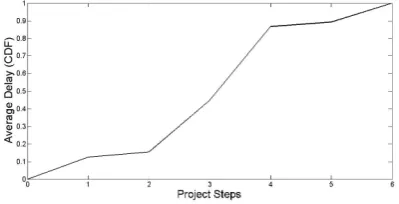
Since this project based on weibo.com, and the IoT API and weibo API does not use push mechanism, we use high frequency polling (100 times per second) to get real-time information. Figure 7 shows the result.
Step 1: from ’temperature sensor value = 28’ to ’Magi-cHome platform get temperature data’
The average delay of performing 10 times is 35 ms, mainly spent on the IoT APIs polling and IoT API perform. The number of API calls and polling interval time can be effectively reduced if we use push mechanism API instead of polling.
Step 2: to ’MagicHome platform output the result of context reasoning’
The average delay of performing 10 times is 7 ms, which mainly spent on database query of context reason-ing and platform internal execution.
Step 3: to ’weibo.com show @micro-blog’
The average delay of performing 10 times is 82 ms, mainly spent on SNS API perform.
Step 4: to ’MagicHome platform get @micro-blog’
The average delay of performing 10 times is 117 ms, mainly spent on the SNS APIs polling and SNS API perform.
Step 5: to ’MagicHome platform output the result of context reasoning’
The average delay of performing 10 times is 7 ms, mainly spent on database query of context reasoning and platform internal execution.
Step 6: to ’turn on air condition’
The average delay of performing 10 times is 30 ms, mainly spent on IoT API perform.
(3) IoT real-time performance
We evaluated the real-time performance of the termi-nals with an IoT system and two different IoT systems respectively.
a) When two terminals are in an IoT system
Terminal interaction is the information exchanged with-in the system. Delay is generated by the platform with-invokwith-ing terminal APIs and platform internal processing. After testing, the system delay like the step 1, 2, 6 of SWoT system.
b) When two terminals are in different IoT systems The system delay also includes information exchange between different platforms. In this case, the real-time performance is similar to the SWoT system that the system delay is mainly produced by the communication mechanisms and is occurred between the different plat-forms
VI. CONCLUSION
In this paper, we first introduced our perspective over SWoT and then proposed a SWoTSN model for struc-turing an integrated social network between human and things. This framework facilitates the socialization of smart things and services in the web ecosystem. We also discussed the service discovery model on the SWoTSN, which is a specific multi-objective optimization problem. At last, we gave the MagicHome prototype.
However, user experience of social interaction between human and physical devices in SWoT still needs further test. Meanwhile, the advanced APIs should be developed, such as the service discovery API. This will be part of our future work. In addition, research deeply on technologies of resource discovery, semantic interpreter, context mod-eling and privacy etc. in the new environment are still necessary.
REFERENCES
[1] D. Guinard, V. Trifa, F. Mattern, and E. Wilde, From the Internet of Things to the Web of Things: Resource Oriented Architecture and Best Practices, Architecting the Internet of Things, 2011, pp. 97-129
[2] Zhenyu Wu, Timo Itala, A Web-based Two-layered Integra-tion Framework for Smart Devices, EURASIP Journal on Wireless Communications and Networking, 2012
[4] Luo, L., Kansal, A., Nath, S., Sharing and exploring sensor streams over geocentric interfaces, in: Proc. the 16th ACM SIGSPATIAL international conference on advances in geo-graphic information systems, 2008, pp. 1-10
[5] Pachube, http://www.pachube.com, 2004
[6] IoT-A (Internet of Things - Architecture), http://www.iot-a.eu/public, 2011
[7] D. Guinard, M. Fischer, V. Trifa, Sharing using social networks in a composable web of things, in: Proc. IEEE Percom 2010, 2010, pp. 702-707
[8] Schmid Thomas Schmid, Young Cho, and Mani B. Srivas-tava, Exploiting Social Networks for Sensor Data Sharing with SenseShare, Center for Embedded Network Sensing, University of California, 2007
[9] SENSEI (Integrating the Physical with the Digital World of the Network of the Future),
http://www.sensei-project.eu/, 2010
[10] Dominique Guinard, Vlad Trifa, Erik Wilde, A Resource Oriented Architecture for the Web of Things, Internet of Things (IOT), 2010, pp. 1-8
[11] Fielding R T, Architectural Styles and the Design of Network-based Software Architecture,Deptof Computer ScienceUniversity of California, 2000
[12] Luigi Auzori, Antonio Iera, The Social Internet of Things (SIoT) - When social networks meets the Internet of Things: Concept, architecture and network characterization, Com-puter Networks: The International Journal of ComCom-puter and Telecommunications Networking, 2012, pp. 3594-3608 [13] J. Breslin, S. Decker, The future of social networks on
the Internet, in: Proc. IEEE Internet Computing , 2007, pp. 86-90
[14] L. Atzori, A. Iera, G. Morabito, SIoT: the social Internet of things, IEEE Communication Letters, 2011, pp.1193-1195 [15] A. Nagurney, J. Dong, Management of knowledge
inten-sive systems as Supernetwork, Mathematical and Computer Modelling, 2005, pp. 397-417
[16] Pintus Antonio, Carboni Davide, Piras Andrea, Paraimpu: A platform for a social Web of Things, in: Proc. the 21st Annual Conference on World Wide Web Companion, 2012, pp. 401-404
[17] L. Atzori, A. Iera, G. Morabito, Giving a social structure to the Internet of Things, IEEE Communications Letters, vol.15, no.11, 2011
[18] S. Catalano, C. Lindveld, K. Carlier, A Hypernetwork ap-proach towards multimodal transportation analysis, Report 1: literature survey, Delft University of Technology, report nr, VK 2001-011
[19] M. Benjamins, Ch.D. Lindveld, R. Van Nes, Multimodal travel choice modelling: a supernetwork approach, Proceed-ings of the 81st Annual Meeting of the Transportation Research Board, 2002
[20] Jung-Sing Jwo, Ting-Chia Chen, Mengru Tu, Object Search for the Internet of Things Using Tag-based Location Signatures, Journal of Software, vol.7, No.12, 2012 [21] Xianghua Fu, Chao Wang, Zhiqiang Wang, Zhong Ming,
Threshold Random Walkers for Community Structure De-tection in Complex Networks, Journal of Software, vol.8, No.2, 2013
[22] Chunhong Zhang, Yaxi He, Yang Ji, Temporal Pattern of User Behavior in Micro-blog, Journal of Software, vol.8, No.7, 2013
Cheng Cheng born in February, 1987, is a Ph.D. student majored in Information and Communication System of Bei-jing University of Posts and Telecommunications since 2009, China. She received the Bachelor Degree of Communication Engineering from Beijing Jiaotong University, China in 2009. Her paper ” Architecture design for social web of things” was published in the Proceedings of the ACM SIGKDD International Conference on Knowledge Discovery and Data Mining. Her
research interests include data mining and social network service (SNS).
Chunhong Zhangborn in February, 1971, received her master and bachelor degree majored in Information and Communication System of Beijing University of Posts and Telecommunications in China in 1996 and 1993. She is a lecturer in Beijing Universi-ty of Posts and Telecommunications, China, since 1996. She has published three books such as Social Network (Beijing: 2011), Internet of Things (Beijing: 2010), and more than ten academic papers, 5 patents. She has engaged in three national programs and several enterprise projects. Her research interests include social network, data mining, network science and distributed system, etc.